

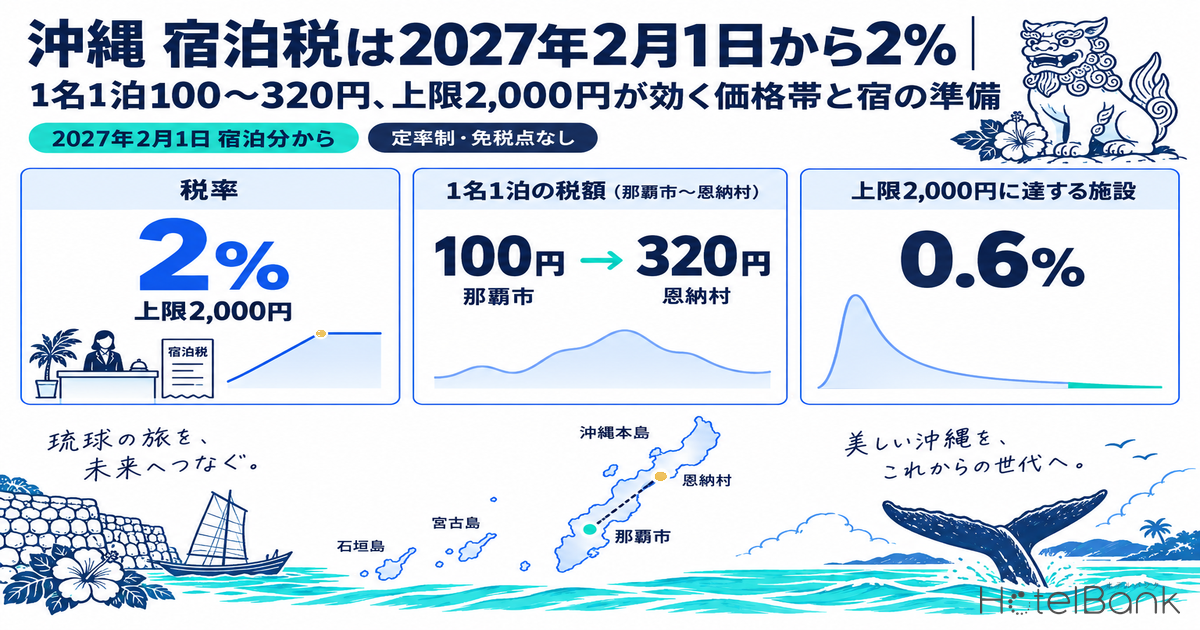
Okinawa Prefecture’s lodging tax takes effect for stays from Monday, February 1, 2027. The rate is a flat 2% of the room-only rate per person per night, capped at ¥2,000, with no tax-exempt threshold. In six municipalities — Motobu, Onna, Chatan, Miyakojima, Ishigaki and Nago — the levy is split between a 0.8% prefectural tax and a 1.2% municipal tax, but the total is the same 2%, so the amount a guest pays is identical anywhere in the prefecture. Using MetroEngines Research’s estimated settled ADR to calculate the tax per person per night by municipality, the result falls in a range from ¥100 in Naha to ¥320 in Onna (both at August 2026 levels), and the ¥2,000 cap is reached only at ¥100,000 per person — for two guests in one room, a room-only rate above ¥200,000 before tax. This article first sets out the framework of the system from the ordinance and the official handbook, then examines where the tax actually tops out and what properties should complete in the four months before it takes effect.
Metric Definitions Used in This Article
- ADR (average daily rate): An estimated settled rate (tax-exclusive equivalent) calculated by applying a segment-specific adjustment factor to the lowest-plan price level each property publishes on OTAs and similar channels (two guests per room, price per room, tax included). Checked against property-level results disclosed by listed hotel REITs (91 properties, most recent three months), the median error is about 7%. These are estimates and differ from each property’s actual settled prices and accounting figures. Area-level ADR is the median of the properties covered (the level of a typical property in the area).
- Room charge per person per night (this article’s estimate): The ADR above (two guests per room) divided equally by two. This follows the treatment in Okinawa Prefecture’s handbook, which “divides the room charge by the number of guests.” Because the lowest-plan price level is treated as equivalent to a room-only rate, at properties where the cheapest plan includes breakfast the figure approximates the upper bound of the tax base.
- Tax amount: The room charge per person per night, rounded down to the nearest ¥1,000, multiplied by 2% and capped at ¥2,000. Effective tax rate = tax amount ÷ room charge per person per night before rounding down.
- Listed price: The selling price published on OTAs and similar channels (two guests per room, per room, tax included, average of all plans). This is a separate metric from ADR.
- Data sources: MetroEngines Research (covering about 27,000 properties and about 1.26 million rooms nationwide confirmed as operating); ordinances and handbooks of Okinawa Prefecture and its municipalities
- — A flat 2% capped at ¥2,000 applies to stays from February 1, 2027, with no exempt threshold. In the six dual-levy municipalities the split is 0.8% prefectural + 1.2% municipal, so the guest’s burden is a uniform 2% across the prefecture
- — Calculated from estimated settled ADR (area median, two guests per room), the tax per person per night is ¥100 in Naha to ¥320 in Onna at August 2026 levels, and ¥80 in Ishigaki to ¥200 in Onna at February levels
- — The cap applies at ¥100,000 per person — above ¥200,000 room-only before tax for two guests in one room. On listed prices for February 1–7, 2027, 9 of 1,606 properties (0.6%) are at ¥220,000 or more, tax included, for two guests
- — Rounding down to the nearest ¥1,000 puts the effective tax rate at 1.66–1.99%. At ¥20,000 per person, Okinawa charges ¥400 versus ¥600 in Tokyo (3% from April 2027) and ¥1,000 in Kyoto City
- — Deadlines are November 30, 2026 for the subsidy application and January 27, 2027 for registration as a special collection agent. Align the PMS, OTA tax settings, terms and conditions, and notices to existing bookings under one policy
The Framework — The First Flat-Rate System at Prefectural Level, a Combined 2% Across the Prefecture and Six Municipalities
It is worth confirming the framework from primary sources first. The Okinawa Prefecture Lodging Tax Ordinance (submitted September 10, 2025 and passed by the prefectural assembly the same year) sets the rate at “2/100” in Article 6, and Supplementary Provision 4 provides that this is read as “0.8/100” in areas where a municipality levies its own lodging tax. The Minister for Internal Affairs and Communications gave consent on February 13, 2026 to the prefecture and five municipalities — Motobu, Onna, Chatan, Miyakojima and Ishigaki — and Nago obtained consent on June 30, 2026 after passing its ordinance on March 26, 2026. The prefecture’s official page currently lists these six as “municipalities introducing a lodging tax.”
From a property’s operational standpoint, the dual-levy mechanism is surprisingly simple. The 1.2% municipal tax (capped at ¥1,200) and the 0.8% prefectural tax (capped at ¥800) are an allocation made between the prefecture and the municipality, and the prefecture’s notice to the travel trade states explicitly that “regardless of location, lodging facilities in the prefecture collect a tax of 2% from guests.” In other words, a property in one of the six dual-levy municipalities bills guests the same amount as a property in a non-dual-levy area such as Naha; the only difference is that the filing and payment window is the municipality.
| Item | Okinawa Prefecture (non-dual-levy areas) | Six dual-levy municipalities (Motobu, Onna, Chatan, Miyakojima, Ishigaki, Nago) |
|---|---|---|
| Effective date | Stays from February 1, 2027 | Same date (all six municipalities) |
| Tax rate | Flat 2% | Prefecture 0.8% + municipality 1.2% = 2% total |
| Cap (per person per night) | ¥2,000 | Prefecture ¥800 + municipality ¥1,200 = ¥2,000 total |
| Exempt threshold | None (prefectural Q&A: “taxed regardless of the level of the room charge”) | None |
| Tax base | Room charge per person per night (room-only equivalent, excluding food and drink, consumption tax and similar taxes, and advances paid on the guest’s behalf). Rounded down to the nearest ¥1,000; where it exceeds ¥100,000, ¥100,000 | |
| Exemptions | Stays for educational activities of schools (excluding universities), stays to take part in competitions organized by junior high school athletic federations and similar bodies, and stays by foreign ambassadors and the like in the performance of their duties (in each case conditional on submitting a certificate) | |
| Ministerial consent | February 13, 2026 | Five municipalities on February 13, 2026; Nago on June 30, 2026 |
| Where to file and pay | Naha Prefectural Tax Office (eLTAX accepted) | Paid through the municipality where the property is located, together with the prefectural portion |
| Review | Ordinance Supplementary Provision 7: implementation to be reviewed with FY2029 as the target | |
Source: Compiled by the HotelBank Editorial Team from the Okinawa Prefecture Lodging Tax Ordinance, Okinawa Prefecture’s “Lodging Tax Special Collection Handbook” and “Lodging Tax Q&A (March 2026 edition),” Ministry of Internal Affairs and Communications press releases (February 13 and June 30, 2026), and the official websites of each municipality
The absence of an exempt threshold reflects a different design philosophy from a tiered fixed-amount system like Kyoto City’s, or Tokyo’s “no tax below ¥10,000.” The prefecture’s Q&A explains that “regardless of the level of the room charge, the degree of benefit guests receive from public services is the same,” so even low-priced properties are not excluded. On the other hand, rounding the tax base down to the nearest ¥1,000 works as a small buffer in practice, which is confirmed with numbers in the effective tax rate section below. The tax schedules of municipalities across Japan that have introduced a lodging tax, and the burden relative to prevailing rates, are set out in Japan Lodging Tax 2026: All 62 Municipalities, Rates and ADR Burden.
How the Tax Base Is Determined — Room-Only, Tax-Exclusive, Rounded Down to ¥1,000, with Per-Room Rates Divided by Headcount
What tends to confuse front-line staff is “what the 2% is applied to.” Article 5 of the ordinance defines the tax base as the room charge less consideration for food and drink, entertainment and use of facilities other than the guest room that accompany the stay, less consumption tax and similar taxes, and less advances paid on the guest’s behalf; where it exceeds ¥100,000, it is ¥100,000. The handbook paraphrases this as “the room-only rate excluding meals, consumption tax and the like,” and the prefecture’s notice to the travel trade gives an example of multiplying the amount rounded down to the nearest ¥1,000 by 2%: for a stay of ¥9,850 per person, ¥9,000 × 2% = ¥180.
For properties that set rates per room, Example 10 in the handbook treats “the total room charge per room per night divided by the number of guests” as the room charge per person. Two guests in a room priced at ¥15,000 before tax means ¥7,500 each, rounded down to ¥7,000 × 2% × 2 guests = ¥280. Extra-bed charges not attributable to a specific guest are added to the total, and a child sharing existing bedding free of charge, with no additional bedding, incurs no room charge and is therefore not taxed. This “divide by headcount” approach is the basis for the allocation in this article, where our ADR is divided by two to convert it to a per-person figure.
The timing boundary is also worth confirming. A stay from January 31 to February 1, 2027 is not taxed; taxation begins with stays checking in on February 1. However, the prefecture’s material for the travel trade states explicitly that “lodging tax is levied even where the booking was made before the taxation start date,” so collection is required for bookings already taken for February 2027 onward. For bookings made through travel agencies, the agency may collect the tax and settle it in advance, subject to agreement between the property and the agency. Note also that in arranged travel, where an OTA or similar channel deducts its sales commission from the receivable, the room charge before the deduction is the tax base. Amounts received as cancellation fees are not taxed because no stay takes place.
How Much per Person per Night — ¥100–¥320 Based on Estimated Settled ADR in Seven Municipalities
So what does the tax come to at prevailing price levels? Looking at MetroEngines Research’s estimated settled ADR (two guests per room, tax-exclusive equivalent, area median) for the finalized figures of the same month as the effective date (February 2026) and of the summer peak (August 2026), Onna is highest at about ¥20,100 in February and about ¥33,000 in August, while Naha reverses between months at about ¥14,200 in February and about ¥10,200 in August. The table below shows the tax per person per night obtained by dividing these by two, rounding down to the nearest ¥1,000 and multiplying by 2%.
| Municipality | ADR Feb 2026 (2 guests per room, tax-excl. equiv.) | Per person | Tax / person-night | ADR Aug 2026 | Per person | Tax / person-night | N (Aug) |
|---|---|---|---|---|---|---|---|
| Naha | ¥14,216 | ¥7,108 | ¥140 | ¥10,216 | ¥5,108 | ¥100 | 143 |
| Nago | ¥15,572 | ¥7,786 | ¥140 | ¥12,504 | ¥6,252 | ¥120 | 25 |
| Motobu | ¥15,366 | ¥7,683 | ¥140 | ¥18,848 | ¥9,424 | ¥180 | 22 |
| Onna | ¥20,052 | ¥10,026 | ¥200 | ¥32,961 | ¥16,480 | ¥320 | 43 |
| Chatan | ¥19,047 | ¥9,524 | ¥180 | ¥19,452 | ¥9,726 | ¥180 | 24 |
| Miyakojima | ¥11,473 | ¥5,736 | ¥100 | ¥18,802 | ¥9,401 | ¥180 | 76 |
| Ishigaki | ¥9,649 | ¥4,824 | ¥80 | ¥16,118 | ¥8,059 | ¥160 | 60 |
Source: Compiled by the HotelBank Editorial Team from MetroEngines Research (estimated settled ADR, area median; N = number of properties covered in each month. N for February 2026: Naha 139, Nago 22, Motobu 20, Onna 38, Chatan 24, Miyakojima 71, Ishigaki 58)
Source: Compiled by the HotelBank Editorial Team from MetroEngines Research (tax per person per night = ADR ÷ 2, rounded down to the nearest ¥1,000, × 2%)
What the difference between months shows is an obvious property of a flat-rate system that a fixed-amount system does not have: the tax moves with the season. The median property in Onna shows a 1.6-fold spread, ¥200 in February versus ¥320 in August, meaning the same property collects more in the busy season and less in the off-season. Naha is higher in February, but that is because February 2026 was a month of strong demand in the prefecture, and prices in business-oriented Naha do not jump much in summer. Ishigaki, by contrast, doubles from ¥80 in February to ¥160 in August, with the seasonal swing of a remote-island resort showing up directly in the tax.
The assumptions behind the estimate should be restated here. Our ADR is a tax-exclusive equivalent estimated from the lowest-plan price level, which is consistent with the tax base excluding consumption tax; but at resort properties where the cheapest plan includes breakfast, the meal portion is deducted, so the actual tax base is smaller than this estimate. It is also an equal split for two guests in one room: with single occupancy the per-person charge doubles, and with three guests it falls to two-thirds. The table above should therefore be read as “an upper-side guide for two guests staying at a typical property.” A municipality-by-municipality estimate covering more of the prefecture is also provided in Okinawa’s 2% Lodging Tax: ¥60–¥340 per Guest Night by Municipality.
Where the ¥2,000 Cap Starts to Apply — ¥100,000 per Person, or ¥200,000 Room-Only Before Tax for Two Guests
The most practical question under a flat-rate system is “where does the cap kick in?” Arithmetically there is one answer: a tax base of ¥100,000 × 2% = ¥2,000, and both the ¥800 cap on the 0.8% prefectural tax and the ¥1,200 cap on the 1.2% municipal tax are reached at the same ¥100,000. The point where the tax tops out therefore does not change with or without the dual levy. Converted to a per-room basis on the premise that the room rate is divided by headcount, the result is as shown below.
| Number of guests | Room-only rate per room per night at which the cap is reached (tax excl.) | Same, with 10% tax included | Maximum tax per room |
|---|---|---|---|
| 1 guest | ¥100,000 | ¥110,000 | ¥2,000 |
| 2 guests | ¥200,000 | ¥220,000 | ¥4,000 |
| 3 guests | ¥300,000 | ¥330,000 | ¥6,000 |
| 4 guests | ¥400,000 | ¥440,000 | ¥8,000 |
Source: HotelBank Editorial Team estimate based on Articles 5 and 6 of the Okinawa Prefecture Lodging Tax Ordinance and Example 10 of Okinawa Prefecture’s “Lodging Tax Special Collection Handbook”
Source: Compiled by the HotelBank Editorial Team from the Okinawa Prefecture Lodging Tax Ordinance. Points show the per-person level obtained by splitting each municipality’s August 2026 estimated settled ADR equally between two guests (MetroEngines Research)
As the line in the chart above shows, the tax rises linearly up to ¥100,000 per person and then sticks at ¥2,000. The median properties of all seven municipalities sit in a range of ¥5,000–¥16,500 per person, more than six times short of the cap. So how many properties does the cap actually concern? The next chart tallies price bands — two guests per room, tax included, average of all plans — for the 1,606 properties in Okinawa Prefecture for which MetroEngines Research could confirm listed prices for February 1–7, 2027.
Source: Compiled by the HotelBank Editorial Team from MetroEngines Research (N = 1,606 properties in Okinawa Prefecture; listed prices for check-ins February 1–7, 2027; two guests per room, tax included, average of all plans)
Properties at ¥220,000 or more, tax included, for two guests in one room — the level at which two guests reach the ¥4,000 maximum — number nine, just 0.6% of the total. The 66 properties (4.1%) at ¥110,000–¥220,000 are in a band that reaches the cap with single occupancy but not with two guests, and the remaining 95% live in a flat-2% world where the cap is irrelevant. Because listed prices are the average of all plans, including plans with meals, they overstate the tax base, and the number of properties where the cap actually applies can be assumed to be smaller still. The cap is a “ceiling” for a limited number of luxury properties; for the great majority of properties in the prefecture, the tax simply moves as rate × 2%.
The Structure of a Flat Rate — Effective Rate of 1.66–1.99%, Lighter at Low Prices Through Rounding, Declining Above the Cap
Looking at the effective tax rate — the tax divided by the per-person charge before rounding down — shows that a flat 2% is not actually uniform. The effect of rounding down to the nearest ¥1,000 is relatively larger the lower the charge: in Ishigaki in February 2026 (about ¥4,800 per person), ¥4,000 × 2% = ¥80, an effective 1.66%, while in Onna in the same month (about ¥10,000 per person) the charge is close to exactly ¥10,000, giving 1.99%. The gap is at most 0.33 points, and it works as a small buffer for the low-price band.
Source: Compiled by the HotelBank Editorial Team from MetroEngines Research (effective tax rate = tax ÷ room charge per person per night before rounding down; based on median estimated settled ADR for February and August 2026)
Beyond the cap, the opposite happens. At ¥120,000 per person, ¥2,000 ÷ ¥120,000 is 1.67%; at ¥150,000 it is 1.33%; at ¥200,000 it is 1.00% — the higher the rate, the lower the effective tax rate. Whereas fixed-amount lodging taxes are regressive, with a higher burden ratio at lower prices, Okinawa’s flat rate is proportional up to ¥100,000 and declining above it. Understanding this structure as two-staged — the tax rises as much as the price is raised, but that increment tops out at the cap — makes it easier to see ahead when revising rates.
Set alongside other major tourist destinations, the position of Okinawa’s design — flat rate, no exempt threshold, capped — becomes clear. Table 4 lines up, for each room-only rate per person per night (tax excl.), the tax in Okinawa Prefecture, in Tokyo, which moves to a flat 3% for stays from April 1, 2027 (no tax below ¥13,000 per person per night), and in Kyoto City, which switched to a five-tier fixed-amount system for stays from March 1, 2026. At ¥10,000 per person or below, Kyoto City’s fixed amount is twice Okinawa’s, and Tokyo remains untaxed. At ¥20,000 per person, Okinawa is ¥400 against ¥600 in Tokyo and ¥1,000 in Kyoto City; at ¥50,000 per person, Okinawa is ¥1,000 against ¥1,500 in Tokyo and ¥4,000 in Kyoto City. While capped Okinawa tops out at ¥2,000 from ¥100,000 per person, Kyoto City charges ¥10,000 from ¥100,000, and for Tokyo the outline of the amended ordinance shows no cap, so the tax rises in proportion to the charge. Okinawa’s burden is lighter than Kyoto City’s in the low-price band, and at ¥20,000 per person and above it is lighter than both Tokyo’s and Kyoto City’s in every price band.
| Room-only rate per person per night (tax excl.) | Okinawa Prefecture (flat 2%, ¥2,000 cap) | Tokyo (flat 3%, untaxed below ¥13,000) | Kyoto City (five-tier fixed amount) |
|---|---|---|---|
| ¥5,000 | ¥100 (2.00%) | Untaxed | ¥200 (4.00%) |
| ¥10,000 | ¥200 (2.00%) | Untaxed | ¥400 (4.00%) |
| ¥20,000 | ¥400 (2.00%) | ¥600 (3.00%) | ¥1,000 (5.00%) |
| ¥50,000 | ¥1,000 (2.00%) | ¥1,500 (3.00%) | ¥4,000 (8.00%) |
| ¥100,000 | ¥2,000 (2.00%) | ¥3,000 (3.00%) | ¥10,000 (10.00%) |
| ¥150,000 | ¥2,000 (1.33%) | ¥4,500 (3.00%) | ¥10,000 (6.67%) |
Source: HotelBank Editorial Team estimate based on the Okinawa Prefecture Lodging Tax Ordinance, the Tokyo Metropolitan Government Bureau of Taxation’s “Review of the Accommodation Tax,” and Kyoto City’s “Revision of the Accommodation Tax from March 1, 2026” (figures in parentheses are the effective tax rate on the charge. A simple comparison assuming each jurisdiction’s tax base equals the amount in the table; rounding is not taken into account for Tokyo)
To get a sense of scale, consider annual collections at a hypothetical property with 100 rooms, two guests per room and 80% occupancy. If Onna’s August level (¥320 per person) held year-round, ¥320 × 2 guests × 100 rooms × 0.8 × 365 days comes to about ¥18.7 million; at the February level (¥200), about ¥11.7 million would be held on behalf of guests and remitted. This is not the property’s revenue but money held in trust; even so, in monthly cash management it sits as cash until remittance at the end of the following month, and the prefecture pays an incentive on amounts remitted by the deadline — both of which matter in practice. The incentive is 2.5% in principle and 3.0% for the first five years of the system; in the example above, about ¥350,000–¥560,000 a year is paid around the end of August with no application required.
The amount held moves with both rate and occupancy. Table 5 takes two axes — the tax per person per night (the range of this article’s estimates for the seven municipalities) and an assumed room occupancy (60% to 90% year-round) — and shows the lodging tax a 100-room property with two guests per room would hold over a year. Even at ¥320, Onna’s August level, the range is 1.5-fold depending on the occupancy assumption, about ¥14.02 million to ¥21.02 million a year, while at ¥100, Naha’s August level, it stays at about ¥4.38 million to ¥6.57 million a year under the same conditions. The incentive is 3.0% of this remitted amount (for the first five years), so multiplying the values in the table by 0.03 gives a guide to the annual amount received.
| Tax per person per night \ Room occupancy (assumed, year-round) | 60% | 70% | 80% | 90% |
|---|---|---|---|---|
| ¥100 (Naha Aug, Miyakojima Feb) | ¥4.38M | ¥5.11M | ¥5.84M | ¥6.57M |
| ¥140 (Naha, Nago, Motobu Feb) | ¥6.13M | ¥7.15M | ¥8.18M | ¥9.20M |
| ¥180 (Chatan, Miyakojima, Motobu Aug) | ¥7.88M | ¥9.20M | ¥10.51M | ¥11.83M |
| ¥200 (Onna Feb) | ¥8.76M | ¥10.22M | ¥11.68M | ¥13.14M |
| ¥320 (Onna Aug) | ¥14.02M | ¥16.35M | ¥18.69M | ¥21.02M |
Source: HotelBank Editorial Team estimate (annual amount held = tax per person per night × 2 guests × 100 rooms × assumed occupancy × 365 days. Tax amounts are estimates based on the estimated settled ADR in Table 2; occupancy is an assumption)
Room for Pricing Design — Tax-Exclusive or Tax-Inclusive, Allocating Meal Plans, Handling OTA Commissions
The handbook gives receipt examples for both “pricing that does not include the lodging tax in the room rate” and “pricing that includes it,” and does not specify tax-inclusive or tax-exclusive display. Which to choose is a pricing design decision in itself. With tax-exclusive display, the lodging tax is collected on site without changing the price shown on OTAs and similar channels, so the apparent rate can be held steady in price comparisons with competitors, at the cost of having to notify guests of an additional charge at check-out. Tax-inclusive display builds the tax into the displayed price, which keeps the explanation to guests simple, but requires a decision on whether to add the 2% to the rate or absorb it. The prefecture’s material for travel agencies likewise asks them to confirm “whether or not to include the lodging tax when setting selling prices on booking sites,” so aligning each OTA’s tax-setting function with the property’s own policy is a key point before the tax takes effect.
For resorts and ryokan whose core products are plans with meals, how the room-only equivalent within a plan is defined determines the tax. Because the ordinance excludes consideration for food and drink from the tax base, if breakfast and dinner charges are clearly set out in internal rules, that portion can be deducted from the tax base. The prefectural Q&A has an item on the treatment where no meal charge has been set, and properties are required to keep documents from which the room-only rate can be confirmed in a tax audit. Put differently, the more a property manages its plan structure broken down into “room + meals,” the easier it is to show the basis of the tax base and to explain the tax.
Another point that is easy to overlook is the handbook’s caution that where the name and amount of the “lodging tax” are not clearly shown on the receipt, the lodging tax amount may itself become subject to consumption tax. The designation is “宿泊税” in Japanese and “Accommodation Tax” in English, and handwriting is acceptable. This only requires adding a tax line to the receipt template in the PMS or point-of-sale system, but if it is missed, consumption tax could end up being layered on top of the 2% held in trust. The subsidy the prefecture has prepared covers exactly this kind of modification.
Pre-Implementation Checklist — The November 30 Subsidy Deadline and the January 27 Registration Deadline
Finally, operators’ preparation items from the ordinance, the handbook and each municipality’s guidance are listed in order of deadline. Registration as a special collection agent with Okinawa Prefecture is made per property, and properties operating since before February 1, 2027 apply by post to the Tax Affairs Division, Department of General Affairs, Okinawa Prefecture by January 27, 2027. Article 9 of the ordinance requires the certificate issued after registration to be displayed in a clearly visible place such as the front desk. Properties located in the six dual-levy municipalities complete the procedure, including for the prefectural portion, in the manner set by their municipality. Miyakojima had announced its registration application period as May 1 to September 30, 2026, so properties that have not yet registered should check with the city’s tax division. Ishigaki sets the deadline for existing operators at January 27, 2027.
| Deadline / timing | Preparation item | Basis / notes |
|---|---|---|
| By November 30, 2026 | Apply for the system modification subsidy (adding tax calculation, monthly aggregation and receipt printing functions; new installations also eligible) | Subsidy rate 100%, standard ceiling ¥2 million per property. Having applied for registration as a special collection agent is a requirement. Completion of modification, payment and results reporting by January 31, 2027 |
| In parallel | Modify PMS and point-of-sale systems: tax base calculation per person per night (extracting the room-only equivalent, dividing per-room rates by headcount, rounding down to ¥1,000, ¥2,000 cap), exclusion of children sharing bedding and exempt guests, output of the monthly summary sheet | Handbook Examples 10 and 6; lodging tax monthly summary sheet (reference form) |
| In parallel | Tax settings on OTAs and the property’s own booking engine: include in the displayed price or collect on site, register the meal-charge breakdown for each plan, lodging tax notice text (Japanese “宿泊税” / English “Accommodation Tax”) | Prefecture’s material for travel agencies, “Requests 1 and 2” |
| Before implementation | Revise accommodation terms and conditions and terms of use: collection of lodging tax, application to bookings made before implementation, refunds on cancellation (prepaid tax is refunded; cancellation fees are not taxed), handling of refusal to pay | Prefectural Q&A and Chatan FAQ. Where the tax cannot be collected, the operator remits it and then seeks reimbursement from the guest |
| Before implementation | Notify existing bookings for February 1, 2027 onward: booking confirmation emails, statements on the official website and booking screens, clear indication of payment methods (card, cash, etc.) | Bookings made before the taxation start date are also taxed |
| By January 27, 2027 | Submit the special collection agent registration application (per property, by post). Properties in the six dual-levy municipalities follow each municipality’s method | Ordinance Article 9. New openings: by five days before the start of operation (Naha Prefectural Tax Office) |
| After the certificate arrives | Display the special collection agent certificate in a clearly visible place such as the front desk | Ordinance Article 9, Paragraph 4 |
| From February 1, 2027 | Collection begins. Show the name and amount of the “lodging tax” on receipts. Exemptions are determined by receiving and retaining certificates | Stays from January 31 to February 1 are not covered. Books are kept for five years |
| From end of March 2027 | File and pay for February (due at the end of the following month; eLTAX accepted). Properties meeting the requirements can, by application and designation, use a special arrangement of four filings a year covering three months each | Ordinance Article 10. A return must be filed even for months with no stays |
| Around end of August each year | Receive the special collection agent incentive payment (no application required) | 2.5% of amounts remitted by the deadline, 3.0% for the first five years; outside the scope of consumption tax |
Source: Compiled by the HotelBank Editorial Team from the Okinawa Prefecture Lodging Tax Ordinance, Okinawa Prefecture’s “Lodging Tax Special Collection Handbook” and “Lodging Tax Q&A,” the Okinawa Prefecture lodging tax system modification subsidy website, and the official websites of Ishigaki, Miyakojima, Motobu and Chatan
In terms of priority, the subsidy application with the nearest deadline (November 30) comes first, and since having applied for registration is a requirement, it makes sense to complete registration before that. Next, align the PMS and OTA settings under one policy (tax-exclusive or tax-inclusive), and if notices to existing bookings and the revision of terms and conditions are finished one to two months before implementation, the first day on February 1 can be met as an extension of normal check-in operations. The special filing arrangement is by application and its starting month is designated, so for small properties wanting to hold down monthly administrative work, applying early is effective.
Summary
Okinawa’s lodging tax adopts a design that is a first at prefectural level — a flat 2%, a ¥2,000 cap and no exempt threshold — and the dual levy by the prefecture and six municipalities also converges on a uniform 2% from the guest’s point of view. The tax per person per night estimated from estimated settled ADR ranges from ¥100 in Naha to ¥320 in Onna at August 2026 levels, and from ¥80 in Ishigaki to ¥200 in Onna at February levels; the cap applies only in the price band of ¥100,000 per person, or above ¥200,000 room-only before tax for two guests in one room, which is 0.6% of the prefecture. The effective tax rate is 1.66–1.99% because of rounding down and declines above the cap, so for most properties the tax can be regarded as moving in proportion to the rate. Preparation before implementation comes down to aligning four things — PMS, OTAs, terms and conditions, and existing bookings — under one policy, built around the subsidy closing November 30 and the registration due January 27. A review of the system is targeted for FY2029, and we intend to examine how prevailing rates move after implementation in a separate article.
⚠ Note on ADR for future dates: The tax estimates in this article are based on finalized figures (estimated settled ADR) for February and August 2026. The distribution of listed price bands for February 2027 is a snapshot of selling prices published on OTAs and similar channels at the time of the survey (October 2026), and will change as new plans are added and prices adjusted closer to the check-in date. The actual tax in the month of implementation will differ from this article’s estimates depending on settled prices at that time.
Frequently Asked Questions
Q. When does Okinawa’s lodging tax start, and how much is it?
It applies to stays from February 1, 2027, at 2% of the room-only rate per person per night (excluding consumption tax and meals, rounded down to the nearest ¥1,000), capped at ¥2,000. There is no exempt threshold: ¥5,000 per person means ¥100, and ¥10,000 per person means ¥200.
Q. Does the total come to 4% in areas with a municipal tax, such as Onna or Ishigaki?
No. Motobu, Onna, Chatan, Miyakojima, Ishigaki and Nago levy a 0.8% prefectural tax together with a 1.2% municipal tax, but the total is 2% (capped at ¥2,000), and the guest’s burden is the same wherever in the prefecture they stay.
Q. Are stays from February 2027 onward that were booked before implementation also taxed?
Yes. The prefecture states that “lodging tax is levied even where the booking was made before the taxation start date.” Only a stay from January 31 to February 1, 2027 is not covered.
Q. Are school trips subject to the lodging tax?
Stays for educational activities of schools (excluding universities) are exempt on submission to the lodging facility of a certificate issued by the principal or equivalent. The same applies to stays for taking part in competitions organized by junior high school athletic federations and similar bodies.
Related Articles
References and Sources
■ Data sources
The description of the system is based on the Okinawa Prefecture Lodging Tax Ordinance, the prefecture’s “Lodging Tax Special Collection Handbook” and “Lodging Tax Q&A (March 2026 edition),” its notice to the travel trade, the Ministry of Internal Affairs and Communications’ press releases on consent, and the official guidance of the six dual-levy municipalities. Price levels are MetroEngines Research’s estimated settled ADR (area median for seven municipalities in Okinawa Prefecture, finalized figures for February and August 2026, N = number of properties covered in each month) and listed prices for check-ins February 1–7, 2027 at 1,606 properties in Okinawa Prefecture (two guests per room, tax included, average of all plans, as of October 2026). The comparisons with Tokyo and Kyoto City are based on each jurisdiction’s official guidance.
■ Estimation assumptions
Room charge per person per night = estimated settled ADR (two guests per room, tax-exclusive equivalent) ÷ 2. Tax = room charge per person per night rounded down to the nearest ¥1,000 × 2% (capped at ¥2,000). Effective tax rate = tax ÷ per-person charge before rounding down. Annual amount held = tax per person per night × 2 guests × 100 rooms × assumed occupancy (60% to 90% year-round) × 365 days; property size and occupancy are illustrative assumptions. The incentive is 3.0% of amounts remitted by the deadline (for the first five years). Table 4 is a simple comparison assuming each jurisdiction’s tax base equals the amount in the table.
■ Limitations and caveats
Estimated settled ADR is an estimate from the lowest-plan price level, and at properties where the cheapest plan includes breakfast it exceeds the tax base (the tax is an upper-side guide). With single occupancy or three or more guests, the per-person charge changes. Because the distribution of listed price bands uses the average of all plans, including plans with meals, the number of properties reaching the cap comes out higher than in reality. Prices for February 2027 are listed values at the time of the survey and differ from settled prices in the month of implementation. For the details of the system (certification for exemptions, the special filing arrangement and so on), please check the latest guidance from the prefecture and each municipality.
■ References
- Okinawa Prefecture, “Okinawa Prefecture Lodging Tax” system overview (Tax Affairs Division, Department of General Affairs)
- Okinawa Prefecture Lodging Tax Ordinance (Bill Otsu No. 3, submitted September 10, 2025)
- Okinawa Prefecture, “Lodging Tax Procedures” — Lodging Tax Special Collection Handbook, Lodging Tax Q&A (March 2026 edition), registration application forms
- Okinawa Prefecture, “Notice to the Travel Trade on the Introduction of Lodging Tax in Okinawa Prefecture (Request)” (April 3, 2026, posted by the Japan Association of Travel Agents)
- Ministry of Internal Affairs and Communications, consent to the establishment of Okinawa Prefecture’s “Lodging Tax” (February 13, 2026)
- Ministry of Internal Affairs and Communications press release, “Establishment and Amendment of ‘Lodging Tax'” (June 30, 2026, Nago and others)
- Subsidy program for system modifications in response to the Okinawa Prefecture lodging tax
- Ishigaki City, “To Lodging Operators” (Ishigaki City lodging tax)
- Miyakojima City, “About the Miyakojima City Lodging Tax”
- Motobu Town, “Lodging Tax”
- Onna Village, “Overview of the Lodging Tax System”
- Chatan Town, “Chatan Town Lodging Tax” and FAQ on the Chatan Town lodging tax
- Okinawa Convention & Visitors Bureau, “Start of the Okinawa Prefecture Lodging Tax System and Exemption Procedures for School Trips”
- Okinawa Times, “Okinawa lodging tax: ministry consents to establishment; prefecture and five municipalities to introduce it in February 2027” (February 13, 2026)
- Tokyo Metropolitan Government Bureau of Taxation, “Review of the Accommodation Tax” (effective April 1, 2027; flat 3%, untaxed below ¥13,000 per person per night)
- Kyoto City, “Revision of the Accommodation Tax from March 1, 2026 Formally Decided”
- MetroEngines Research — estimated settled ADR (seven municipalities in Okinawa Prefecture, July 2025 to February 2027); tally of listed price bands for February 1–7, 2027 at 1,606 properties in Okinawa Prefecture