

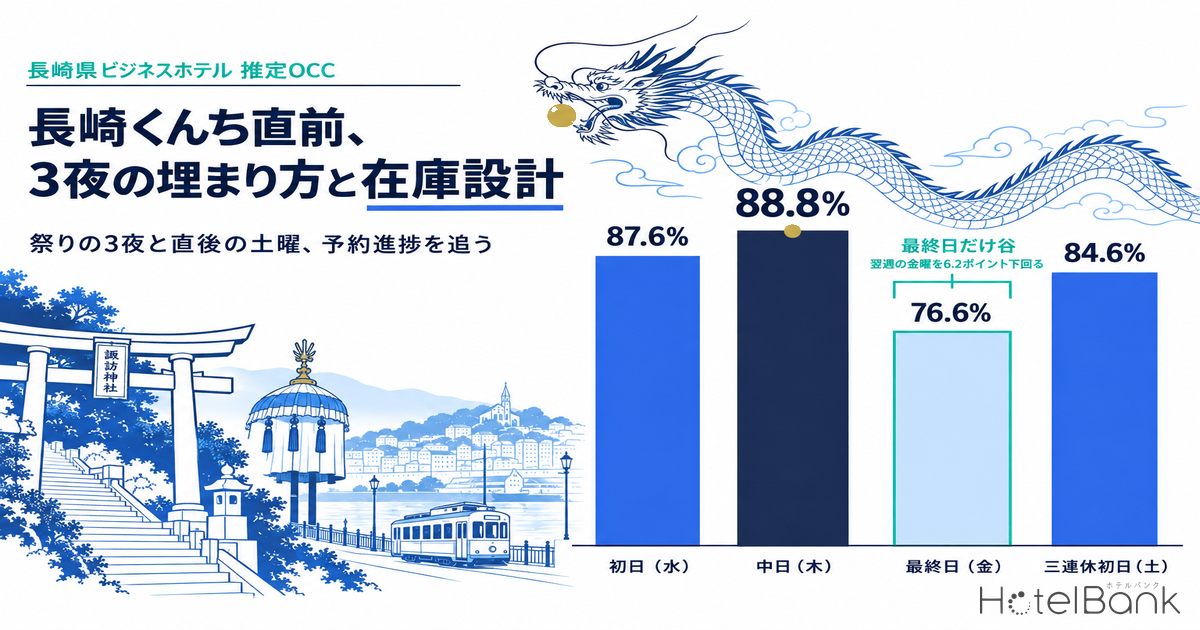
As of October 3 — four days before Nagasaki Kunchi (the autumn grand festival of Suwa Shrine, October 7–9, 2026) opens — estimated OCC (based on OTA-listed inventory) at Nagasaki Prefecture business hotels (N=57 properties, 4,426 rooms) had built to 88.8% for the middle night, Thursday, October 8, and 87.6% for the opening night, Wednesday, October 7. The final night, Friday, October 9, however, stood at only 76.6%, forming a trough before the 84.6% of Saturday, October 10, the first day of a three-day weekend. Measured at the same 14-days-out cross-section, the opening and middle nights ran 1.5–2.8 points ahead of the same weekday the following week, while the final night alone trailed the following Friday by 6.2 points. This article tracks booking progress for the three festival nights and the Saturday that follows from 45 days out to the latest observation, sorts out what happened in three phases — 30 days out, 14 days out and the final stretch — and works through an inventory design that links the final night to the nights on either side.
About the data in this article Scope: Nagasaki Prefecture business hotels, N=57 properties (4,426 rooms) / city hotels, N=15 properties (1,483 rooms); Nagasaki City, all property types, N=60 properties (3,683 rooms) — all based on listings on major booking sites. The price metric in this article is estimated settled ADR (the settled price level estimated from OTA and other sales data, tax-excluded equivalent), and occupancy is an estimate based on OTA-listed inventory. Both are defined at the end of the article. Data as of: October 4, 2026 (latest observation October 3).
- — Estimated OCC at Nagasaki Prefecture business hotels (N=57 properties) as of October 3, 2026: the middle night, Oct 8, at 88.8%; the opening night, Oct 7, at 87.6%. The final night, Oct 9, stood at 76.6%, forming a trough before the 84.6% of Oct 10, the first day of the three-day weekend.
- — Against the same weekday the following week at the 14-days-out cross-section, the opening night was ahead by +1.5 points and the middle night by +2.8 points, but the final night trailed the following Friday by 6.2 points.
- — In Nagasaki City (all property types, N=60 properties), the opening night had already reached 83.7% and the middle night 87.4% at 45 days out. Kunchi demand shows up less in late pickup than in a high starting point.
- — The largest gains came between 30 and 14 days out: +7.4 to +10.0 points. On September 15, the day booking opened for the Ouenwari travel subsidy, the one-day change was +3.0 for Saturday and +2.1 for the final night versus +0.7 for the middle night — the more inventory a night had left, the more it moved.
- — Even applying the late pace of September’s five Fridays (6 days out → day before, +3.7 to +6.4 points), the final night lands at 80.3–83.0%. That reaches neither the middle night nor Saturday, so a multi-night design linking it to the nights on either side is needed.
Nagasaki Kunchi 2026 runs Wednesday to Friday — a lineup that overlaps a three-day weekend and the Ouenwari subsidy
First, the schedule. According to the official site of the Nagasaki Traditional Performing Arts Promotion Association, Nagasaki Kunchi in 2026 (Reiwa 8) runs with October 7 as the Maebi (eve day), the 8th as the Nakabi (middle day) and the 9th as the Atobi (closing day), and six neighborhoods — Imakago-machi, Aburaya-machi, Motofune-machi, Kami-machi, Kajiya-machi and Chikugo-machi — serve as the dancing neighborhoods (odori-cho). The dedication dances are performed at four venues — Suwa Shrine, the Otabisho, Yasaka Shrine and the Kunchi viewing stands in Central Park — all clustered in central Nagasaki City. In this article, referring to the nights guests stay, we call the stay of October 7 the “opening night,” the 8th the “middle night” and the 9th the “final night.”
On this year’s calendar the three days fall on Wednesday through Friday, followed from Saturday, October 10 by a three-day weekend running to Sports Day (October 12). On top of that, Nagasaki Prefecture’s “Kyushu Fukko Ouenwari” Nagasaki campaign covers check-ins from October 1, with reservations opening on some OTAs at 10:00 on September 15. Direct bookings with properties were reported to open on September 28, and other OTAs and travel agencies on September 30 (Travel Watch, September 14, 2026). The three festival nights therefore sit in a lineup where three factors overlap: weekday festival demand, weekend holiday demand and a discount program. The curves below should be read with these conditions in mind.
Business hotels’ three nights — middle night 88.8%, final night alone in a 76.6% trough
At Nagasaki Prefecture business hotels, the ranking among the three festival nights — middle night highest, final night lowest — never changed once from 45 days out to the latest observation. As Table 1 shows, the middle night started at 73.5% at 45 days out and reached 88.8% at the latest observation (October 3, 5 days before the stay), and the opening night also built 20.3 points, from 67.3% to 87.6%. The final night, by contrast, started at 60.9% and was still only 76.6% at the latest observation (6 days before the stay). Its gap to the middle night was 12.6 points at 45 days out and 12.2 points at the latest observation — barely narrowed over six weeks.
| Stay date | 45 days out | 30 days out | 14 days out | 7 days out | Latest | Gain since 45 days out | Sold-out property rate (latest) | Listed inventory remaining (latest) |
|---|---|---|---|---|---|---|---|---|
| Oct 7 (Wed) opening night | 67.3% | 70.4% | 80.4% | 84.5% | 87.6% (4 days out) | +20.3pt | 19.3% (11 properties) | 550 rooms |
| Oct 8 (Thu) middle night | 73.5% | 76.8% | 84.2% | 87.6% | 88.8% (5 days out) | +15.3pt | 24.6% (14 properties) | 495 rooms |
| Oct 9 (Fri) final night | 60.9% | 65.6% | 73.8% | 76.1% | 76.6% (6 days out) | +15.7pt | 7.0% (4 properties) | 1,037 rooms |
| Oct 10 (Sat) first day of 3-day weekend | 67.8% | 72.8% | 82.4% | 84.6% | 84.6% (7 days out) | +16.8pt | 31.6% (18 properties) | 682 rooms |
Source: MetroEngines Research; compiled by the HotelBank Editorial Team
Overlaying the sold-out property rate (the estimated share of properties with no listed inventory visible on OTAs and similar channels) makes the night-by-night differences even sharper. At the latest observation, the middle night had risen to 24.6% (14 of 57 properties) and Saturday to 31.6% (18 properties), while the final night was at 7.0% (4 properties) — unchanged since 30 days out. Listed inventory remaining was 495 rooms for the middle night against 1,037 rooms for the final night, more than twice as much. The festival’s final night is a night that, though flanked by strong nights on both sides, has not filled on its own.
Figure 1: Booking curves at Nagasaki Prefecture business hotels (estimated OCC based on OTA-listed inventory, 45 days before the stay date to latest; N=57 properties / 4,426 rooms)
Source: MetroEngines Research; compiled by the HotelBank Editorial Team
Looking only at the prefecture-wide figures, however, we cannot tell whether the final night is “weak for a festival night” or whether “Fridays simply sit at this level.” So next we compare like weekday with like weekday.
Same-weekday comparison — the festival uplift applies only to the opening and middle nights; the final night trails the following Friday
The clearest yardstick for the festival effect is the same weekday in the weeks before and after. Table 2 lines up business hotels for the festival week, the previous week (September 30–October 2) and the following week (October 14–16) at the same 45-days-out and 14-days-out cross-sections. At 14 days out, the opening night’s 80.4% was 16.0 points above the previous Wednesday’s 64.4% and 1.5 points above the following Wednesday’s 78.9%. The middle night’s 84.2% was likewise 13.4 points above the previous Thursday and 2.8 points above the following Thursday. The final night’s 73.8%, by contrast, differed by only 1.3 points from the previous Friday’s 72.5% and fell 6.2 points short of the following Friday’s 80.0%.
| Weekday | Cross-section | Previous week (Sep 30–Oct 2) | Festival week (Oct 7–9) | Following week (Oct 14–16) | Festival week − following week |
|---|---|---|---|---|---|
| Wed (opening night) | 45 days out | 51.7% | 67.3% | 59.7% | +7.6pt |
| 14 days out | 64.4% | 80.4% | 78.9% | +1.5pt | |
| Thu (middle night) | 45 days out | 55.6% | 73.5% | 62.5% | +11.0pt |
| 14 days out | 70.8% | 84.2% | 81.4% | +2.8pt | |
| Fri (final night) | 45 days out | 62.2% | 60.9% | 66.9% | −6.0pt |
| 14 days out | 72.5% | 73.8% | 80.0% | −6.2pt |
Source: MetroEngines Research; compiled by the HotelBank Editorial Team
Going back to 45 days out reveals the character of the festival uplift. At 45 days out the opening and middle nights were 7.6 and 11.0 points above the same weekday the following week, but by 14 days out those gaps had narrowed to 1.5 and 2.8 points. Festival nights begin filling earlier than ordinary weekdays, but as the stay date approaches, the non-festival week catches up. The following week also falls within the Ouenwari eligibility period, so nights with spare inventory may have been more likely to move later. The final night was already 6.0 points below the following Friday at 45 days out, so no festival-driven early booking shows up in the prefecture-wide figures for it.
Figure 2: Estimated OCC at 14 days before the stay — festival week vs. the same weekdays in the weeks before and after (Nagasaki Prefecture business hotels; previous week N=62 properties / festival and following weeks N=57 properties)
Source: MetroEngines Research; compiled by the HotelBank Editorial Team
It is also worth checking the underlying strength of each weekday. In September 2026 actuals (as of the day before the stay, N=57–62 properties), estimated OCC at Nagasaki Prefecture business hotels averaged 79.6% across five Wednesdays (including the September 23 holiday), 79.8% across four Thursdays and 74.4% across four Fridays. Friday is the weakest of the weekdays. The final night’s 76.6% (6 days out) is closer to an ordinary Friday than to a festival night.
City hotels peak on Saturday — middle night 93.9%, Oct 10 at 95.1%, final night 84.6%
At city hotels (N=15 properties, 1,483 rooms), too, the final night forms a trough. The strongest night, however, is Saturday rather than the middle night: latest estimated OCC ranks October 10 at 95.1%, the middle night at 93.9%, the opening night at 92.0% and the final night at 84.6%. The final night is 9.3 points below the middle night and 10.5 points below Saturday, and its remaining listed inventory of 228 rooms is about 2.5 times the middle night’s (91 rooms).
| Stay date | 45 days out | 30 days out | 14 days out | 7 days out | Latest | Gain since 45 days out | Sold-out property rate (latest) | Listed inventory remaining (latest) |
|---|---|---|---|---|---|---|---|---|
| Oct 7 (Wed) opening night | 77.4% | 80.1% | 86.2% | 90.0% | 92.0% (4 days out) | +14.6pt | 13.3% (2 properties) | 119 rooms |
| Oct 8 (Thu) middle night | 82.3% | 83.7% | 90.0% | 93.9% | 93.9% (5 days out) | +11.6pt | 13.3% (2 properties) | 91 rooms |
| Oct 9 (Fri) final night | 70.6% | 75.2% | 81.2% | 84.5% | 84.6% (6 days out) | +14.0pt | 6.7% (1 property) | 228 rooms |
| Oct 10 (Sat) first day of 3-day weekend | 83.1% | 85.5% | 94.1% | 95.1% | 95.1% (7 days out) | +12.0pt | 26.7% (4 properties) | 73 rooms |
Source: MetroEngines Research; compiled by the HotelBank Editorial Team
The same-weekday comparison shows the same pattern as business hotels. Against the same weekday the following week at 14 days out, the opening night was ahead by 4.3 points (86.2% vs. 81.9%) and the middle night by 2.5 points (90.0% vs. 87.5%), while the final night trailed by 1.1 points (81.2% vs. 82.3%). Note that with N=15 city hotels, a single property moves the sold-out property rate by 6.7 points. These figures are better read for the gaps between dates and the direction of change than for their absolute level.
Narrowing to Nagasaki City — opening and middle nights in the 80s at 45 days out; festival demand shows up as “earliness”
At the prefecture level, business hotels built a full 20.3 points on the opening night from 45 days out, but it would be premature to read that as last-minute festival demand. Narrowing to Nagasaki City, where the dance venues are (all property types, N=60 properties, 3,683 rooms), the opening night was already at 83.7% and the middle night at 87.4% at 45 days out, and their gains through the latest observation were just 6.8 and 4.3 points. In other words, demand for the festival nights had largely taken shape before 45 days out.
| Stay date | Nagasaki City, 45 days out | Nagasaki City, latest | Gain | Nagasaki City sold-out property rate (latest) | Sasebo City, 45 days out | Sasebo City, latest | Gain |
|---|---|---|---|---|---|---|---|
| Oct 7 (Wed) opening night | 83.7% | 90.5% | +6.8pt | 36.7% (22 properties) | 72.0% | 82.5% | +10.5pt |
| Oct 8 (Thu) middle night | 87.4% | 91.7% | +4.3pt | 36.7% (22 properties) | 76.3% | 88.2% | +11.9pt |
| Oct 9 (Fri) final night | 70.1% | 80.5% | +10.4pt | 20.0% (12 properties) | 69.5% | 82.4% | +12.9pt |
| Oct 10 (Sat) first day of 3-day weekend | 77.5% | 88.1% | +10.6pt | 36.7% (22 properties) | 77.6% | 91.7% | +14.1pt |
Source: MetroEngines Research; compiled by the HotelBank Editorial Team
Even in Nagasaki City, though, the final night behaves differently. It started at 70.1% at 45 days out — 17.3 points below the middle night — and was still at 80.5% at the latest observation, with a sold-out property rate of 20.0% against 36.7% for the opening and middle nights. Compared with the same weekday the following week (October 14–16, N=60 properties), the gaps at 45 days out were +12.5 points for the opening night and +15.8 points for the middle night, but only +1.0 point for the final night. By 14 days out they were +5.0, +4.8 and −4.0 points respectively, so even in Nagasaki City the final night ended up below the following Friday.
Figure 3: Booking curves for Nagasaki City, all property types (estimated OCC based on OTA-listed inventory, 45 days before the stay date to latest; N=60 properties / 3,683 rooms)
Source: MetroEngines Research; compiled by the HotelBank Editorial Team
Sasebo City (all property types, N=34 properties, 2,887 rooms) is the contrast. Its starting points at 45 days out were 72.0% for the opening night and 76.3% for the middle night — more than 11 points below the same nights in Nagasaki City — and together with 69.5% for the final night and 77.6% for Saturday, the four nights were not far apart. From there, every night added 10.5–14.1 points through the latest observation. The large gains seen in the prefecture-wide figures therefore include ordinary build-up of this kind outside Nagasaki City. Putting it together, Kunchi demand appears not as a “late surge” but as a “high starting point at 45 days out,” and its benefit is limited to two nights: the opening and middle nights.
Gains by phase — the main battleground is 30 to 14 days out, and on the day Ouenwari opened, the nights with inventory left moved most
So when did the gains from 45 days out to the latest observation occur? Splitting the prefecture’s business hotels into three phases — “45 → 30 days out,” “30 → 14 days out” and “14 days out → latest” — the 30-to-14-days-out phase was the largest for every night: +10.0 points for the opening night, +7.4 for the middle night, +8.2 for the final night and +9.6 for Saturday. From 45 to 30 days out the gains were a modest +3.1 to +5.0 points, so even for the three festival nights, bookings only really start moving inside the final month.
| Stay date | 45 → 30 days out | 30 → 14 days out | Of which, Sep 15 alone | 14 days out → latest | Sold-out property rate (45 → 30 → 14 days out → latest) |
|---|---|---|---|---|---|
| Oct 7 (Wed) opening night | +3.1pt | +10.0pt | +1.7pt | +7.2pt (to 4 days out) | 5.3%→7.0%→15.8%→19.3% |
| Oct 8 (Thu) middle night | +3.3pt | +7.4pt | +0.7pt | +4.6pt (to 5 days out) | 10.5%→19.3%→17.5%→24.6% |
| Oct 9 (Fri) final night | +4.7pt | +8.2pt | +2.1pt | +2.8pt (to 6 days out) | 5.3%→7.0%→7.0%→7.0% |
| Oct 10 (Sat) first day of 3-day weekend | +5.0pt | +9.6pt | +3.0pt | +2.2pt (to 7 days out) | 15.8%→22.8%→29.8%→31.6% |
Source: MetroEngines Research; compiled by the HotelBank Editorial Team
This year, that phase included September 15, the day booking opened for the Ouenwari subsidy. Isolating the one-day move from the previous day’s observation, Saturday gained +3.0 points, the final night +2.1 points and the opening night +1.7 points, while the middle night moved only +0.7 points. The middle night, already nearly 80% full (79.6% as of September 14), had little room to move; the nights with inventory remaining reacted more to the program. In other words, the discount worked less to push strong nights higher than to fill nights that still had space.
From 14 days out onward, growth diverged by night. The opening night added +7.2 points through 4 days out and the middle night +4.6 points through 5 days out, while the final night managed only +2.8 points through 6 days out. That said, the final night still has observation days left. The previous Friday (October 2, N=62 properties) built 5.3 points in its last week, from 73.5% at 7 days out to 78.8% the day before. How far the final night climbs from here depends heavily on how the last few days are managed.
Landing range for the final night, Oct 9 — applying the late pace of September’s Fridays
Let us estimate, as a range, how much the final night can gain over its remaining six days by substituting the pace of ordinary Fridays for the same prefecture and property type. Across the five Fridays from September 4 to October 2, 2026, the gain from 6 days out to the day before was +3.7 to +6.4 points for business hotels (median +4.6 points) and +4.0 to +8.6 points for city hotels (median +5.8 points). Adding these directly to the final night’s October 3 level puts business hotels’ landing in a range of 80.3–83.0% and city hotels’ in 88.6–93.2%.
| Scenario | Business: gain | Business: landing | City: gain | City: landing |
|---|---|---|---|---|
| Starting point (Oct 3 observation, 6 days out) | — | 76.6% | — | 84.6% |
| Conservative (Sep Friday minimum) | +3.7pt | 80.3% | +4.0pt | 88.6% |
| Mid (Sep Friday median) | +4.6pt | 81.2% | +5.8pt | 90.4% |
| Strong (Sep Friday maximum) | +6.4pt | 83.0% | +8.6pt | 93.2% |
| Reference: middle night Oct 8, same day (5 days out) | — | 88.8% | — | 93.9% |
| Reference: Saturday Oct 10, same day (7 days out) | — | 84.6% | — | 95.1% |
Source: MetroEngines Research; compiled by the HotelBank Editorial Team
The September Fridays used (estimated OCC, 6 days out → day before) are listed below. Business hotels N=57–62 properties, city hotels N=16 properties; the property set is fixed for each stay date. *September 18 was the eve of a five-day holiday that began the next day.
| Stay date | Business: 6 days out | Business: day before | Gain | City: 6 days out | City: day before | Gain |
|---|---|---|---|---|---|---|
| Sep 4 (Fri) | 67.3% | 71.9% | +4.6pt | 72.7% | 78.7% | +6.0pt |
| Sep 11 (Fri) | 77.2% | 80.9% | +3.7pt | 85.7% | 89.7% | +4.0pt |
| Sep 18 (Fri)* | 66.9% | 73.3% | +6.4pt | 73.4% | 79.2% | +5.8pt |
| Sep 25 (Fri) | 66.5% | 71.6% | +5.1pt | 77.1% | 81.8% | +4.7pt |
| Oct 2 (Fri) | 74.2% | 78.8% | +4.6pt | 78.2% | 86.8% | +8.6pt |
Even at the pace of the fastest-growing Friday, business hotels’ final night reaches 83.0% — short of both the middle night, already at 88.8%, and Saturday’s 84.6% at 7 days out. City hotels, too, reach 93.2% in the strong case, below the middle night’s 93.9%. What the estimate shows is that capturing ordinary-Friday late demand alone will not fill the trough. Put the other way, bringing the final night close to the middle night and Saturday hinges on whether it can attract multi-night demand that links it to the nights on either side, rather than selling it as a standalone night. Note that this estimate assumes the growth pattern of an ordinary Friday and does not include any behavior specific to a festival’s closing day or the eve of a holiday weekend.
A price yardstick — check October estimated settled ADR against finalized months
This article focuses on how occupancy builds, but it is worth keeping one monthly price yardstick too. Comparing finalized estimated settled ADR (tax-excluded equivalent) year over year, Table 7 shows Nagasaki Prefecture business hotels at ¥6,604 in October 2025 (N=123 properties), 4.4% below ¥6,909 a year earlier, and city hotels at ¥13,216 (N=25 properties), 7.7% below ¥14,319. In August 2026, the latest finalized month, business hotels were at ¥7,097 (+0.4% YoY) and city hotels at ¥13,476 (−13.9% YoY).
| Property type | Month | Prior year (finalized) | Current year (finalized) | YoY |
|---|---|---|---|---|
| Business hotels | October (2024 → 2025) | ¥6,909 (N=120) | ¥6,604 (N=123) | −4.4% |
| August (2025 → 2026) | ¥7,070 (N=124) | ¥7,097 (N=128) | +0.4% | |
| City hotels | October (2024 → 2025) | ¥14,319 (N=25) | ¥13,216 (N=25) | −7.7% |
| August (2025 → 2026) | ¥15,648 (N=25) | ¥13,476 (N=24) | −13.9% |
Source: MetroEngines Research; compiled by the HotelBank Editorial Team
Even in an October that contains a festival and a holiday weekend, the monthly rate is not set by the strong nights alone. Occupancy on the opening and middle nights is settled early; how a property handles nights that fill later — the final night, or the nights after the holiday — is what moves the month’s outcome. The October 2026 level should be checked against the same finalized months once the month closes.
For revenue managers at Nagasaki Prefecture business and city hotels — implications and action plan
Let us reread the data from the standpoint of running your own property. The three Kunchi nights tend to be lumped together as “the festival period,” but each night booked in an entirely different way. From an operator’s perspective, there are four points to note.
1. Measure festival nights by “earliness” rather than “level.”In Nagasaki City, the opening night was at 83.7% and the middle night at 87.4% — already in the 80s at 45 days out. If your property was filling more slowly than the market at the same point, there is room to revisit selling conditions; if faster, there is good reason to set conditions before 45 days out. For the two festival nights, the effective approach is to finish preparations before the curve starts moving.
2. Treat the final night as “an ordinary Friday” and don’t try to sell it out on its own.At the prefecture’s business hotels, the final night’s 76.6% is a trough between the middle night’s 88.8% and Saturday’s 84.6%. Given that it trailed the following Friday by 6.2 points at 14 days out, the final night is best positioned not as a festival night but as a night to fill by linking it to the strong nights on either side.
3. Discount programs work on nights with space.On the day Ouenwari booking opened, the middle night moved +0.7 points, against +2.1 points for the final night and +3.0 points for Saturday. One reading is that directing program allocations to the trough night rather than to strong nights does more to lift overall occupancy.
4. There is still room to move in the final week.The previous Friday built 5.3 points, from 73.5% at 7 days out to 78.8% the day before. The final night still has 1,037 rooms of listed inventory at the prefecture’s business hotels and 228 rooms at city hotels, so late visibility and adjustments to selling conditions are likely to sway the outcome.
Behind this, most likely, is how festival visitors move. Kunchi events end on October 9, so the final night generates little demand from guests staying over for the next morning’s performances. It is likely a changeover night, when visitors heading home after the festival are replaced by guests arriving early for the three-day weekend. How you open inventory and set minimum lengths of stay should be designed around this changeover.
Action plan by phase — this year’s final stretch, and next year’s T-45, T-30 and T-14
Since this year’s T-30 and T-14 phases have already passed, the plan is split into moves for the final stretch and a design for the same three nights next year. In each case, compare your own booking pace against the market figures first, and use these as a starting point for discussion.
| Phase | Action | Decision trigger (figures in this article) | Aim |
|---|---|---|---|
| Final stretch (today–Oct 9) | Review side by side the single-night inventory for the final night (Oct 9) and the visibility of two-night plans for Oct 8–9 and Oct 9–10 | If your Oct 9 occupancy remains below the prefecture’s business hotels at 76.6% and city hotels at 84.6% | Fill the trough night by linking it to the strong nights on either side |
| Final stretch (today–Oct 9) | If inventory remains on the middle night (Oct 8) and Saturday (Oct 10), consider selling conditions (minimum length of stay) that prioritize two-night stays including the final night | If market sold-out property rates have reached 24.6% for the middle night and 31.6% for Saturday, yet your property still has inventory on both | Use what remains on the strong nights to bring guests into the final night |
| Final stretch (today–Oct 9) | Keep single-night stays on the final night open without restrictions, and relist returned inventory promptly | If the previous Friday built +5.3pt in its last week but your Oct 9 is not moving | Don’t miss the ordinary-Friday demand that moves late |
| Next year, before T-45 | Finalize selling conditions for the opening and middle nights (multi-night plans, priority for stay patterns that include the final night) before 45 days out | If your property fills earlier at the same point than this year’s pattern in Nagasaki City (opening night 83.7%, middle night 87.4% at 45 days out) | Build a multi-night path into demand that commits early, from the start |
| Next year, T-30 | Ahead of the 30-to-14-days-out build-up, open more inventory on the final night and Saturday, and revisit how the remainder is allocated across the opening and middle nights | Your gap to the prefecture’s business hotels at 30 days out (middle night 76.8%, final night 65.6%), and the +7.4 to +10.0pt gain from 30 to 14 days out | Align inventory for the nights you want to sell with the phase that moves most |
| Next year, T-14 | At 14 days out, compare the final night with the following Friday; if it trails, shift multi-night incentives and program allocations toward the final night | This year, at 14 days out the final night’s 73.8% trailed the following Friday’s 80.0% by 6.2pt. Whether the same pattern recurs | Identify the trough night two weeks out and act on it |
Setting a minimum length of stay becomes worth considering precisely at properties with ample inventory left on the strong nights. At properties where the middle night is already full, refining how two-night stays linking the final night and Saturday are presented is the more realistic option. Which to choose depends on where among the three nights your remaining inventory is concentrated.
Summary — three yardsticks for reading the three festival nights
Though part of the same festival, the three nights of Nagasaki Kunchi booked in completely different ways. Here are three yardsticks to take away for next year and beyond.
First, look at the starting point at 45 days out. In Nagasaki City, the opening night was at 83.7% and the middle night at 87.4% against 70.1% for the final night — at this point the nights the festival lifts and those it doesn’t were already clearly separated. Second, compare against the same weekday at 14 days out. At the prefecture’s business hotels, the opening and middle nights were 1.5–2.8 points ahead of the same weekday the following week while the final night trailed by 6.2 points — this cross-section identified the trough night. Third, track the gain in each phase. This year the largest gains, +7.4 to +10.0 points, came between 30 and 14 days out, and on the day the discount program opened, the nights with more inventory left moved the most.
The middle night is strongest, the final night forms a trough, and Saturday rises again on holiday-weekend demand. With that pattern as the premise, whether a property can design the final night to link with the nights on either side is likely to decide how Kunchi week ends up.
Frequently asked questions
Q. When is Nagasaki Kunchi held in 2026?
A. In 2026 (Reiwa 8) it runs for three days: Wednesday, October 7 is the Maebi (eve day), Thursday the 8th the Nakabi (middle day) and Friday the 9th the Atobi (closing day). The schedule and the six dancing neighborhoods are listed on the official site of the Nagasaki Traditional Performing Arts Promotion Association.
Q. Which of the three nights is most booked?
A. At Nagasaki Prefecture business hotels (N=57 properties), estimated OCC (based on OTA-listed inventory) as of October 3 was highest for the middle night, October 8, at 88.8%, followed by the opening night, October 7, at 87.6%, and the final night, October 9, at 76.6%. At city hotels (N=15 properties), the middle night was at 93.9% and October 10, the first day of the three-day weekend, at 95.1%.
Q. How different is the final night (October 9) from the other nights?
A. At the prefecture’s business hotels, the final night was 12.2 points below the middle night and, at 14 days out, 6.2 points below the following Friday (October 16). September’s Fridays averaged 74.4%, so the final night is close to an ordinary Friday.
Q. Is estimated OCC the same as actual room occupancy?
A. No. It is estimated from how inventory listed on OTAs and similar channels is being sold, and because rooms not listed are counted as sold, it runs higher than actual occupancy. Use it as a metric for reading differences between dates and trends over time.
Q. How much is the final night (October 9) likely to grow before the stay date?
A. Applying the gain that September 2026’s five Fridays built from 6 days out to the day before (+3.7 to +6.4 points for business hotels), the final night at the prefecture’s business hotels would land in a range of 80.3–83.0%. Even the strongest case falls short of the middle night’s 88.8% and Saturday’s 84.6%, so a multi-night design linking it to the nights on either side will shape the outcome. This is an estimate that assumes an ordinary Friday’s pace.
About the data
| Item | Description |
|---|---|
| Estimated OCC | Occupancy based on OTA-listed inventory = 100 − 100 × OTA-listed rooms remaining ÷ total rooms. Covers a fixed cohort of properties that list at least 30% of total rooms on OTAs (the same property set for each stay date; N is the number of properties). This is an estimate based on how inventory sold on OTAs is being absorbed, and it is defined differently from actual room occupancy (rooms not listed are counted on the sold side, so it runs higher). |
| Booking curve | Based on observations from 45 days before the stay date to the latest. “Latest” in this article is the October 3, 2026 observation, which is 4 days before the October 7 stay, 5 days before the 8th, 6 days before the 9th and 7 days before the 10th. |
| Sold-out property rate | The estimated share of properties with no listed inventory visible on OTAs and similar channels, as a ratio to the number of properties covered. Property counts in the tables are converted from the ratio. |
| Estimated settled ADR | Settled price level (tax-excluded equivalent) estimated from OTA and other sales data (lowest-plan level × property-type coefficient, ensembled across multiple channels). Past months are finalized values; current and future months are estimates based on current sales. Median error versus published operating results is 6.6%. This article uses finalized months only. |
| Properties covered | Estimated OCC (based on listings on major booking sites): Nagasaki Prefecture business hotels N=57 properties / 4,426 rooms (N=62 properties / 4,910 rooms for the previous week, September 30–October 2); Nagasaki Prefecture city hotels N=15 properties / 1,483 rooms; Nagasaki City, all property types, N=60 properties / 3,683 rooms; Sasebo City, all property types, N=34 properties / 2,887 rooms. September 2026 weekday averages are business-hotel values (N=57–62 properties) as of the day before the stay. Estimated settled ADR: business hotels N=120–128 properties, city hotels N=24–25 properties (varies by month). |
| Data as of | Data as of: October 4, 2026 (latest observation October 3). Sales and inventory change daily, so the figures in this article are a snapshot at the time of retrieval. |
Source: MetroEngines Research; compiled by the HotelBank Editorial Team
References and sources
■ Data sources
Data by property type for Nagasaki Prefecture, Nagasaki City and Sasebo City aggregated by MetroEngines Research (compiled by the HotelBank Editorial Team). We used booking curves by stay date (each stay date from September 4 to October 16, 2026, from 45 days before the stay through the October 3, 2026 observation) and finalized months of estimated settled ADR (August and October 2024, August and October 2025, August 2026). Schedules, programs and holidays are from the public sources in the table below. Data as of October 4, 2026.
■ Estimation assumptions
Estimated OCC follows the same property set (fixed cohort) for each stay date from 45 days out to the latest observation, and “gain” is the difference (in points) between two points in time for the same property set. The festival effect was measured as the difference from the same weekday in the previous and following weeks. The landing range for the final night, Oct 9 (Table 6), adds the minimum, median and maximum of the gains September 2026’s five Fridays built from 6 days out to the day before to the October 3 value (6 days out); it is not a forecast but an estimate that assumes an ordinary Friday’s pace. Estimated settled ADR is tax-excluded equivalent, and YoY figures were calculated only between finalized months.
■ Limitations and caveats
Estimated OCC is an estimate based on OTA-listed inventory; because rooms not listed are counted on the sold side, it runs higher than actual room occupancy. City hotels are a small sample (N=15 properties), and a single property moves the sold-out property rate by 6.7 points. The latest observation is 4–7 days before the stay date, and final outcomes will change with future sales and inventory adjustments. Statements about the one-day change on the Ouenwari opening day and about visitor movements are interpretations of booking patterns and have not been confirmed against results by guest segment or rate plan.
| Source | Content referenced |
|---|---|
| Nagasaki Traditional Performing Arts Promotion Association, “Nagasaki Kunchi” official site (in Japanese) | 2026 (Reiwa 8) schedule (Oct 7 Maebi, Oct 8 Nakabi, Oct 9 Atobi), dancing neighborhoods, dance venues |
| Travel Watch, article on the booking schedule for the “Kyushu Fukko Ouenwari” Nagasaki campaign (September 14, 2026; in Japanese) | Eligible stay period, booking opening dates |
| Kumamoto Nichinichi Shimbun, “Kyushu Fukko Ouenwari bookings open — Kumamoto and Nagasaki trips eligible first” (September 15, 2026; in Japanese) | September 15 booking opening, eligible prefectures |
| Cabinet Office, “About National Holidays” (in Japanese) | Sports Day 2026 (October 12) |