

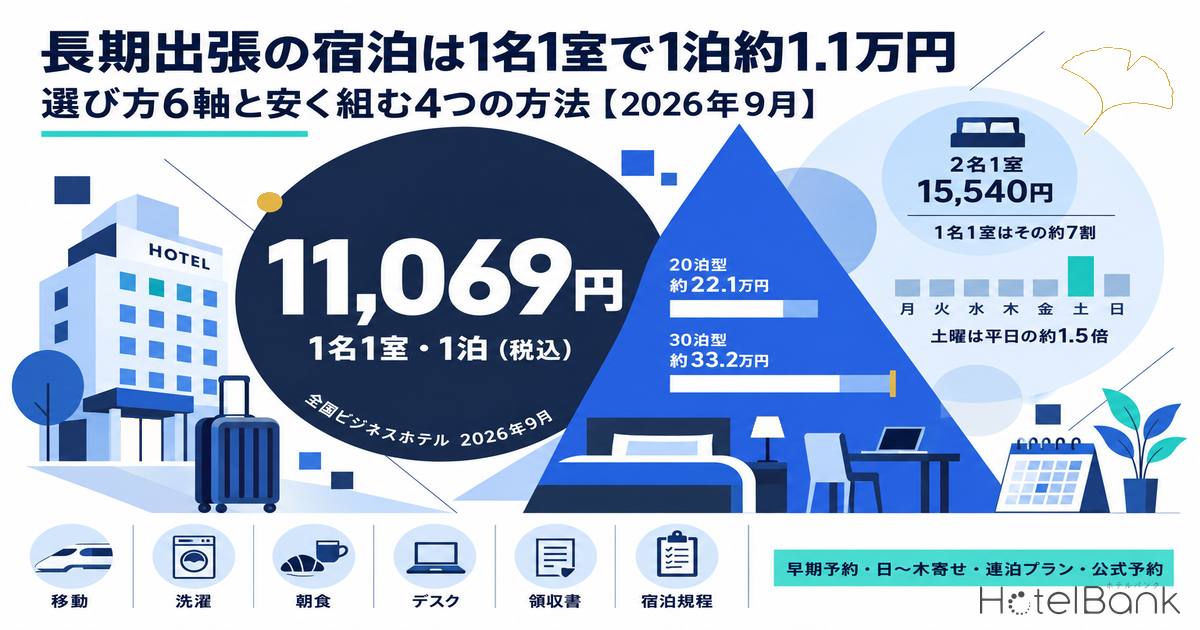
For a long business trip in Japan, the baseline is to book a business hotel within walking distance of your workplace, single occupancy, for consecutive nights. The listed price for business hotels nationwide is about ¥11,100 per night for one guest in one room (September 2026, N=8,141 hotels, tax included). A 20-night pattern — staying weekdays only and going home on weekends — comes to roughly ¥220,000, and a continuous 30-night stay to roughly ¥330,000 at the national average. If the trip runs beyond three nights and you want to handle laundry and simple cooking where you stay, an apartment-style hotel with an in-room washer-dryer becomes another option. This article sets out six criteria for choosing accommodation, actual price levels on both a single-occupancy and a double-occupancy basis, and four ways to keep the bill down, so that travelers can make the call themselves.
- — The baseline for a long business trip is consecutive nights, single occupancy, at a business hotel within walking distance of the workplace. The nationwide listed price is ¥11,069 per night (September 2026, N=8,141 hotels, tax included)
- — Indicative totals are approx. ¥221,000 for a weekdays-only 20-night pattern and approx. ¥332,000 for a continuous 30-night stay (national average, rate × nights)
- — Widely quoted market rates are on a double-occupancy basis (¥15,540). The single-occupancy rate used for business travel is about 70% of that
- — By city, single-occupancy rates range from ¥12,915 in Kita Ward, Osaka to ¥20,859 in Nakamura Ward, Nagoya — a spread of more than ¥6,000 per night
- — At business hotels in Tokyo, Saturday runs at about 1.5 times the weekday average (September 2026, double occupancy). Four moves keep the bill down: booking early, concentrating nights on Sunday–Thursday, consecutive-night plans, and direct-booking perks
Six Criteria for Choosing Accommodation on a Long Business Trip
Over a stay of several weeks to several months, items that go unnoticed on a one- or two-night stay start to matter. Checking the following six points in order before booking saves the trouble of switching hotels midway.
| Criterion | What to check | Why it matters on a long stay |
|---|---|---|
| 1. Commute to the workplace | Within a 15-minute walk, or a single train line with no transfers | The daily round trip adds up to 40 journeys over 20 working days. A 10-minute difference becomes about 7 hours a month |
| 2. Laundry | Number of machines and opening hours of the on-site coin laundry, or an in-room washer-dryer | Assume laundry twice a week. With machines on site, you can run a load at night and collect it in the morning |
| 3. Breakfast | Price difference for a breakfast-included plan, and serving hours | Breakfast that is free or costs a few hundred yen replaces the time and cost of 20 meals out in one go |
| 4. Desk and Wi-Fi | Desk width, chair back support, availability of wired LAN | Determines whether evening document work and online meetings can be done entirely in the room |
| 5. Receipts and qualified invoices | Whether receipts can be issued in the guest’s name or the company’s name, whether the invoice registration number is shown, and whether a single monthly receipt is possible | If expenses can be settled on one document, the accounting side processes them once a month |
| 6. Company travel policy | Per-night cap, whether breakfast is included or separate, whether prepayment or a corporate contract is allowed | Pinning down the cap first narrows the candidates and avoids out-of-pocket costs |
Travelers who want to do both laundry and cooking in the room can also consider apartment-style hotels with a kitchen and washer-dryer, in addition to consecutive nights at a business hotel. For concrete examples in major cities, When a Business Trip Runs Past Three Nights, Skip the “Hotel” — Top 5 Apartment-Style Stays With a Kitchen and Washer-Dryer (HotelPicks, in Japanese) compares five properties including Tokyu Stay Hakata (東急ステイ博多) and MIMARU Tokyo Ueno East (MIMARU東京 上野EAST). For typical charges and the routine when relying on a business hotel’s on-site laundry, see Hotel Laundry in Japan: Free–¥600 a Wash, 5 Room-Drying Steps.
Cost Levels — Single and Double Occupancy Use Different Bases
Most of the widely quoted figures for hotel market rates are “two guests per room, price per room.” Business travel is mainly single occupancy, so re-reading the same month and the same set of properties at the single-occupancy listed price gives the following for business hotels nationwide (OTA listed prices, tax included, as of September 2026, retrieved October 2, 2026).
| Business hotels nationwide | September 2026 | October 2026 |
|---|---|---|
| Single occupancy (per room, tax included) | ¥11,069 (N=8,141 hotels) | ¥11,412 (N=7,812 hotels) |
| Double occupancy (per room, tax included) | ¥15,540 (N=7,966 hotels) | ¥16,067 (N=7,666 hotels) |
Source: HotelBank Editorial Team research (monthly aggregation of public OTA data; average listed price for each month). N is the number of business hotels for which a listed price was observed in that month. The single-occupancy rate is about 70% of the double-occupancy rate.
By city, even the same single-occupancy rate varies by more than ¥6,000 per night depending on the ward. Travelers whose destination is already fixed will budget more accurately by using the level for the ward where the workplace is located.
| Area (business hotels) | Single occupancy | Double occupancy | N (hotels) |
|---|---|---|---|
| Chiyoda Ward, Tokyo | ¥19,124 | ¥22,470 | 66 |
| Shinjuku Ward, Tokyo | ¥18,907 | ¥21,630 | 85–87 |
| Taito Ward, Tokyo | ¥17,857 | ¥20,675 | 183–184 |
| Chuo Ward, Osaka | ¥13,809 | ¥15,768 | 164–166 |
| Kita Ward, Osaka | ¥12,915 | ¥15,284 | 58 |
| Nakamura Ward, Nagoya | ¥20,859 | ¥26,522 | 63–64 |
| Hakata Ward, Fukuoka | ¥18,051 | ¥21,351 | 139 |
Source: HotelBank Editorial Team research (OTA listed prices, tax included, as of September 2026, retrieved October 2, 2026). Because the number of hotels observed differs slightly between single and double occupancy, N is shown as a range.
What 20 and 30 Nights Add Up To
Multiplying this single-occupancy rate by the number of nights shows the total accommodation cost. We estimated two patterns: a “20-night pattern,” staying weekdays only and returning home on weekends, and a “30-night pattern,” staying continuously at the destination.
| Single occupancy, based on September 2026 listed prices | 1 night | 20-night pattern | 30-night pattern |
|---|---|---|---|
| National average | ¥11,069 | approx. ¥221,000 | approx. ¥332,000 |
| Kita Ward, Osaka | ¥12,915 | approx. ¥258,000 | approx. ¥387,000 |
| Taito Ward, Tokyo | ¥17,857 | approx. ¥357,000 | approx. ¥536,000 |
| Hakata Ward, Fukuoka | ¥18,051 | approx. ¥361,000 | approx. ¥542,000 |
The totals are a simple rate × nights calculation, and there is room to come in below them by using consecutive-night plans or advance-purchase pricing. If your company’s travel policy sets a per-night cap, compare it with the city-level rates above and decide on candidate areas first. How to proceed when the cap and actual market levels are far apart is covered in Business Trip Budgets Fall Short: ¥15,959 Hotels and 5 Fixes (prices in that article are on a double-occupancy basis, as of August 2026).
Four Ways to Keep the Bill Down
On a long business trip, accommodation cost moves more with “how you book the same hotel” than with switching hotels. Here are four approaches, in descending order of impact.
1. Choose advance-purchase or prepaid plans. Booking as soon as the trip dates are fixed opens up advance-purchase plans (14 days ahead, 28 days ahead, and so on) and prepaid card-payment plans. Long business trips often involve work whose schedule is set well ahead, which suits this type of plan.
2. Avoid Saturdays and concentrate nights on Sunday–Thursday. Listed prices at business hotels move sharply by day of the week. Across 538–561 business hotels in Tokyo, the average by stay date for September 2026 (double occupancy, as of the day before the stay) was about ¥17,600–¥19,300 on Monday through Friday, against about ¥26,900 on Saturday — roughly 1.5 times the weekday average. The 20-night pattern, with weekends at home, naturally skips that Saturday. Even on a continuous stay, splitting Saturday out into a separate booking evens out the overall rate.
| Business hotels in Tokyo — average by day of the week (double occupancy, as of the day before the stay) | Mon | Tue | Wed | Thu | Fri | Sat | Sun |
|---|---|---|---|---|---|---|---|
| September 2026 (N=538–561 hotels) | ¥17,636 | ¥18,086 | ¥19,288 | ¥19,076 | ¥17,570 | ¥26,879 | ¥19,789 |
Source: HotelBank Editorial Team research (based on OTA listed inventory; average listed price as of the day before each stay date; double occupancy; tax included). The number of hotels covered ranges from 538 to 561 depending on the stay date. The September Sundays include the day before a holiday run (September 20).
3. Use consecutive-night and monthly plans. Properties with long-stay plans — seven nights or more, or 30 nights — often hold the rate down in exchange for less frequent housekeeping. On OTAs you can filter by keywords such as 連泊 (consecutive nights), ウィークリー (weekly) and マンスリー (monthly), and some properties provide a contact point on their official site for long stays or corporate contracts. Where pricing is by quotation, bringing the city-level rate × nights above gives you a starting point for negotiation.
4. Take the perks of booking through the official site or app. Major chains are set up so that booking through their official site or app gives the best deal, with membership points and consecutive-night perks. Toyoko Inn (東横イン) is known as a long-business-trip staple for its membership program and breakfast-included operation; APA Hotel (アパホテル) awards points on app bookings; Dormy Inn (ドーミーイン) has large communal baths that make it easier to recover during a stay. Comfort Hotel (コンフォートホテル) also includes breakfast, which makes weekday rates easy to plan around. Each chain has different strengths, so choose by whichever of the six criteria weighs most for you.
When the Stay Runs to Months — Shifting to a Living-Oriented Choice
Once a trip exceeds a month and you start thinking about your resident registration, mail and luggage storage, choosing accommodation moves from “business trip” toward “hotel living.” At that point the questions change: how to book in one-month units and how that differs from renting an apartment, what hotel living offers and what it costs overall, and — in Tokyo — how to find rooms with a washing machine and kitchen. The longer the stay, the more it pays to weigh those living-related points alongside the nightly rate.
For a Closer Look
For concrete property comparisons, the following articles (in Japanese) go into detail.
Five apartment-style properties with an in-room kitchen and washer-dryer, selected from Tokyo, Osaka, Fukuoka and Sapporo. The article compares Tokyu Stay Hakata (東急ステイ博多), with a washer-dryer in every room and a mini kitchen in some rooms; Tokyu Stay Sapporo Odori (東急ステイ札幌大通), three minutes from Odori Station; Tokyu Stay Shinjuku Eastside (東急ステイ新宿イーストサイド); MIMARU Osaka Namba Station (MIMARU大阪 難波STATION), with rooms of around 40㎡; and MIMARU Tokyo Ueno East (MIMARU東京 上野EAST), with a kitchen and dining area — on consecutive-night rates and everyday-living facilities.
Compares five properties that officially offer booking in one-month units, on booking conditions, laundry facilities, housekeeping frequency and parking. It covers Tokyu Stay Sapporo Odori (東急ステイ札幌大通) and Tokyu Stay Sapporo (東急ステイ札幌), with washer-dryers in every room; Dormy Inn PREMIUM Sapporo (ドーミーインPREMIUM札幌) and Dormy Inn Sapporo ANNEX (ドーミーイン札幌ANNEX), where the “Monthly 30” plan can be booked on the official website; and Richmond Hotel Sapporo Ekimae (リッチモンドホテル札幌駅前), which offers a flat-rate monthly plan for 30 nights or more. Standard rates are shown on a single-occupancy basis.
Frequently Asked Questions
Q. How much per night should I expect to pay for a hotel on a long business trip in Japan?
The single-occupancy listed price at business hotels nationwide was ¥11,069 per night as of September 2026 (tax included, N=8,141 hotels). As a national-average guide, a weekdays-only 20-night pattern comes to approx. ¥221,000 and a continuous 30-night stay to approx. ¥332,000. Levels differ by area: in the same month, the single-occupancy rate was ¥12,915 in Kita Ward, Osaka and ¥17,857 in Taito Ward, Tokyo.
Q. Why do these amounts differ from the hotel market rates I usually see?
Because most figures quoted as market rates are “two guests per room, price per room.” For business hotels nationwide in September 2026, the double-occupancy rate was ¥15,540 and the single-occupancy rate ¥11,069, so single occupancy is about 70% of double occupancy. Budgeting a business trip on the single-occupancy basis keeps the gap small.
Q. How can I keep accommodation costs down on a long business trip?
Even at the same hotel, what you pay changes with how you book. The four basics are: choose advance-purchase or prepaid plans, avoid Saturdays and concentrate nights on Sunday–Thursday, use consecutive-night or monthly plans, and take the perks of booking through the official site or app.
Q. Which day of the week is most expensive at business hotels?
At business hotels in Tokyo, Saturday is the most expensive. In the September 2026 averages by stay date (double occupancy, as of the day before the stay, N=538–561 hotels), Saturday was ¥26,879 and Monday through Friday ¥17,570–¥19,288. Saturday is about 1.5 times the weekday average. The 20-night pattern, with weekends at home, naturally skips that Saturday.
Q. How should I handle laundry during a long business trip?
You can either choose a business hotel with an on-site coin laundry or choose an apartment-style hotel with an in-room washer-dryer. Assuming laundry twice a week, it is reassuring to check the number of machines and the opening hours of the on-site laundry before booking.
Methodology and Sources
■ Data sources
HotelBank Editorial Team research (monthly aggregation of public OTA data). Listed prices for business hotels nationwide: September 2026, single occupancy N=8,141 hotels and double occupancy N=7,966 hotels; October 2026, single occupancy N=7,812 hotels and double occupancy N=7,666 hotels (all tax included, retrieved October 2, 2026). Prices by day of the week are averages of the listed price as of the day before each stay date (double occupancy, tax included) for 538–561 business hotels in Tokyo.
■ Estimation assumptions
Totals for the 20-night and 30-night patterns are a simple calculation of “monthly average single-occupancy listed price × nights.” The 20-night pattern assumes staying weekdays only and returning home on weekends; the 30-night pattern assumes staying continuously at the destination. Discounts from advance-purchase plans, consecutive-night and monthly plans, and membership perks are not reflected.
■ Limitations and caveats
Listed prices are averages of the selling prices observed in each month and do not represent actual amounts paid or the rates of individual properties. The number of hotels observed (N) varies by month and by occupancy condition. October 2026 figures are listed prices as of the retrieval date and may change with future sales conditions. Area figures are aggregated at ward level and include wards with around 60 hotels.
Related Articles