

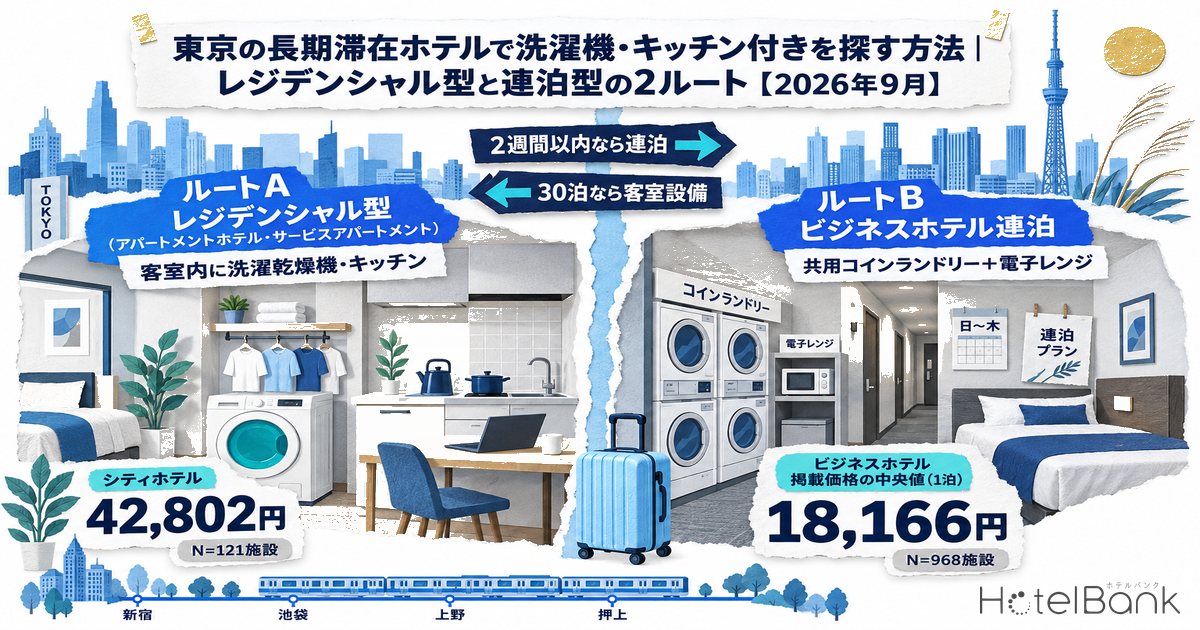
There are essentially two ways to stay long-term in a Tokyo hotel while still using a washing machine and a kitchen. One is to choose a residential-type property (an apartment hotel or serviced apartment) with a washer-dryer and a compact kitchen in the room. The other is to string together nights at a business hotel and make do with the shared coin laundry and microwave on site. Which you pick depends on whether you value freedom of facilities or a lower nightly rate. This article sets out how to search for each and what they cost, using HotelBank’s aggregation of public OTA data (as of September 2026, two guests per room, tax included).
- — There are two routes. Either a residential-type property (apartment hotel or serviced apartment) with a washer-dryer and compact kitchen in the room, or a run of nights at a business hotel using the shared coin laundry and microwave instead.
- — Business hotels list at ¥18,166 a night. That is the Tokyo listed rate (as of September 2026, N=968 properties, per room for two, tax included); a simple 30-night multiple comes to about ¥540,000. City hotels list at ¥42,802 (N=121 properties).
- — Narrow residential-type properties by facilities. Search on “washing machine”, “kitchen” and “in-room microwave”, then check three things: whether the washer-dryer is in the room or shared, how the kitchen is equipped, and what kind of long-stay plan is offered.
- — Bring business-hotel costs down with day of week and plan names. Stay mainly Sunday to Thursday, look first at plans labelled “consecutive nights” or “long stay”, and for more than two weeks ask the hotel directly about weekly or monthly plans.
- — Two weeks or less and mostly eating out: Route B. More than two weeks and cooking a lot: Route A. If unsure, spend the first week in a business hotel and get quotes from residential-type properties in the meantime.
Two Routes to a Stay With a Washer and a Kitchen
“Long-stay hotels” tend to be lumped together, but in Tokyo there are really only two ways to make laundry and light cooking work. Which suits you is decided almost entirely by how long you stay and how often you cook.
| Route | How the facilities are provided | Best suited to |
|---|---|---|
| A. Residential type (apartment hotels, serviced apartments) | Mostly properties with an in-room washer-dryer and compact kitchen (IH hob, sink, cookware) | Two weeks to several months. People who want to cook as part of daily life, work from the room, or travel as a family or group |
| B. Consecutive nights at a business hotel | Shared coin laundry plus shared microwave instead. The room is treated as a place to sleep | Around 3 nights to two weeks. People who mostly eat out on weekdays and just need to run a wash |
Route A puts the “living” facilities inside the room, which pushes listed prices up; Route B keeps the nightly rate down by sharing the facilities. Let’s start with prices.
What It Costs — Tokyo Business Hotels Run About ¥18,200 a Night
Listed rates by category in Tokyo, aggregated by the HotelBank Editorial Team from public OTA data (as of September 2026, two guests per room, tax included), are as follows.
| Category | Listed rate per night | Properties covered |
|---|---|---|
| Business hotels | ¥18,166 | N=968 properties |
| City hotels | ¥42,802 | N=121 properties |
Source: HotelBank Editorial Team research (aggregation of public OTA data, as of September 2026, tax-included listed rate per room for two guests). Actual booking prices vary by plan and date.
The listed rate for business hotels, the benchmark for Route B, is about ¥18,200 a night (as of September 2026, N=968 properties). A simple 30-night multiple comes to about ¥540,000, but that is a stack of standard-plan rates; in practice consecutive-night plans, early-booking plans and the days of the week you choose all change what you pay. Listed rates tend to be lower from Sunday to Thursday, and the longer the stay, the more it pays to plan which days of the week it spans.
Residential-type properties (Route A) are not counted as a separate facility category on OTAs, so no single price level can be given. But central Tokyo properties with an in-room washer-dryer and kitchen are often listed above business-hotel rates, in a band closer to city hotels. In exchange, eating out and coin-laundry costs drop out of the stay budget, so for stays longer than two weeks the total-cost comparison can flip.
Route A: Finding Residential-Type Properties With an In-Room Washer-Dryer and Kitchen
The trick to finding residential-type properties is to filter by facilities rather than by property name. In an OTA search, tick “washing machine”, “kitchen”, “kitchenette” and “microwave (in room)” in the preference or in-room amenity filters, and apartment hotels and serviced apartments surface together. In Tokyo, these properties tend to cluster just outside major terminal stations such as Shinjuku, Ikebukuro, Ueno and Oshiage.
Three things are worth checking:
- Is the washer-dryer “in the room” or “shared in the building”? Compare the listing photos with the wording in the amenities section. “Laundry available” can mean either.
- How the kitchen is equipped. Some properties have an IH hob, sink, cookware and tableware; others stop at a microwave and kettle. Choose according to how often you will cook.
- What kind of long-stay plan is offered. On OTAs, properties split into those that permanently list “7 nights or more” and “30 nights or more” plans, and those that switch to an individual quote for a month or longer. Stays beyond 30 nights often assume you will contact the property directly.
For a concrete picture of which properties are where in the city, this comparison of five long-stay hotels in Shinjuku, Shibuya and Ikebukuro by kitchen, laundry and monthly-plan terms (innippon, in Japanese) is specific. If you are planning a long stay as a family, pay particular attention to the in-room facilities and the number of guests allowed per unit, since serviced apartments differ widely on both.
Route B: Building a Stay Around Consecutive Nights at a Business Hotel and Shared Laundry
If all you need is to do your laundry, consecutive nights at a business hotel work perfectly well. Many urban business hotels have a coin laundry on site and put a shared microwave on the lobby floor or by the elevators. Add “coin laundry” or “laundry” as an OTA filter and the candidates line up. Typical on-site laundry prices and how to dry clothes in your room are set out in detail in Hotel Laundry in Japan: Free–¥600 a Wash, 5 Room-Drying Steps.
As bases for a string of nights, each major chain has its own long-stay strengths. Many Dormy Inn properties have a large public bath and sauna, which helps with the fatigue of a long run of nights. Comfort Hotel’s free breakfast brings down food costs over consecutive nights. APA Hotel and Toyoko Inn give member benefits and points for bookings through their official websites and apps, and the returns grow with the number of nights. For all of them, you can confirm which properties have on-site laundry through the property search on the chain’s official website.
There are three keys to keeping costs down on Route B: (1) stay mainly Sunday to Thursday (listed rates tend to rise on Fridays and Saturdays); (2) look first at plans labelled “consecutive nights” or “long stay” (many lower the rate in return for less frequent cleaning); and (3) for more than two weeks, ask the hotel directly whether it has weekly or monthly plans. Combine the three and the total you pay at the same hotel changes noticeably.
Which to Choose — Decide by Number of Nights and How Often You Cook
The rule is simple. If your stay is two weeks or less and you will barely cook, choose Route B. The nightly rate is lower and there are far more candidates. If your stay is longer than two weeks, or you want to eat in your room more than half the week, choose Route A. An in-room washer-dryer and kitchen become worth more per day the longer you stay. If you are unsure, a two-step approach is realistic: spend the first week in a business hotel and get quotes from residential-type properties in the meantime.
For what else to weigh when choosing a business hotel for a long stay, see Business Hotels for Long Stays: 6 Checks and ¥16,722 a Night in Tokyo.
Find Out More
For side-by-side comparisons of specific properties, these articles go into detail.
Shinjuku, Shibuya and Ikebukuro: 5 long-stay hotels with monthly plans — kitchen, laundry and Wi-Fi speed compared (innippon, in Japanese)
Compares five properties on the west side of central Tokyo by kitchen, laundry facilities and how they handle monthly plans — including MIMARU Tokyo Ikebukuro (MIMARU東京 池袋), where every room has an IH hob and cookware, and Citadines Shinjuku Tokyo (シタディーン新宿東京), where every room has a fitted kitchen. Indicative price ranges for two guests per night are included.
Once a business trip goes past 3 nights, stop staying in a “hotel” — Top 5 apartment-type stays with a kitchen and washer-dryer, where you live like a local (HotelPicks, in Japanese)
Picks five apartment-type properties in Tokyo, Osaka, Fukuoka and Sapporo with an in-room washer-dryer and kitchen — including MIMARU Tokyo Ueno EAST (MIMARU東京 上野EAST), which sleeps four to eight with a kitchen and dining area, and Tokyu Stay Shinjuku Eastside (東急ステイ新宿イーストサイド) in the Shinjuku Station area.
Frequently Asked Questions
Q. How do I find a hotel in Tokyo with a washing machine and a kitchen?
A. Filter by facilities rather than by hotel name. In an OTA’s preference or in-room amenity filters, tick “washing machine”, “kitchen”, “kitchenette” and “microwave (in room)”, and apartment hotels and serviced apartments come up together. Then check three things: whether the washer-dryer is in the room or shared in the building, whether the kitchen runs to an IH hob, sink and cookware, and whether long-stay plans are listed permanently or quoted individually.
Q. How much does a 30-night stay at a Tokyo business hotel cost?
A. The listed rate for business hotels in Tokyo (as of September 2026, N=968 properties, per room for two guests, tax included) is ¥18,166 a night, which multiplies out to roughly ¥540,000 for 30 nights. That is a stack of standard-plan rates, so consecutive-night plans, staying mainly Sunday to Thursday, and weekly or monthly plans all push the amount you actually pay downward.
Q. Which works out cheaper: a residential-type property or a run of nights at a business hotel?
A. Business hotels have the lower nightly rate, while residential-type properties are often listed at prices closer to city hotels. But a residential-type property cuts what you spend on eating out and coin laundry, so for stays longer than two weeks the total-cost comparison can flip. As a rule of thumb: two weeks or less and eating out mostly, choose a business hotel; more than two weeks and cooking often, choose a residential-type property.
Q. Can I do laundry and simple cooking at a business hotel?
A. Many urban business hotels have a shared coin laundry on site and put a shared microwave on the lobby floor or by the elevators. Filtering an OTA search by “coin laundry” or “laundry” brings up the candidates, and each chain’s property search on its official website also shows whether a hotel has on-site laundry.
Q. Can I book a stay of more than 30 nights through an OTA?
A. On OTAs, properties split into those that permanently list “7 nights or more” and “30 nights or more” plans, and those that switch to an individual quote for a month or longer. Stays beyond 30 nights often assume you will contact the property directly, so once you have narrowed down your candidates, confirming with the property is the reliable route.
Methodology and Sources
■ Data source
Accommodation prices are aggregated by the HotelBank Editorial Team from public OTA data, using the per-night listed rates for the “business hotel” (N=968 properties) and “city hotel” (N=121 properties) categories in Tokyo, collected as of September 2026. The price basis is “two guests per room, per-room rate (tax included)”. How to search by facilities and the types of plans described are a general summary of what can be checked through OTA search filters and each chain’s official property search.
■ Calculation assumptions
The 30-night figure is a simple multiple of the business-hotel per-night listed rate by 30, rounded to the nearest ¥10,000. Consecutive-night discounts, weekly/monthly plans, member rates and accommodation tax, as well as living costs such as food and coin laundry, are not included.
■ Limitations
Listed rates are not actual transaction prices, and consecutive-night plans and the choice of days tend to push what you pay downward, so the amounts in this article are upper-end guides. Because the price basis is two guests per room, it will not match what a single guest pays. Residential-type properties (apartment hotels and serviced apartments) are not counted as a separate facility category on OTAs, so their price band is described only qualitatively.
Related Articles