

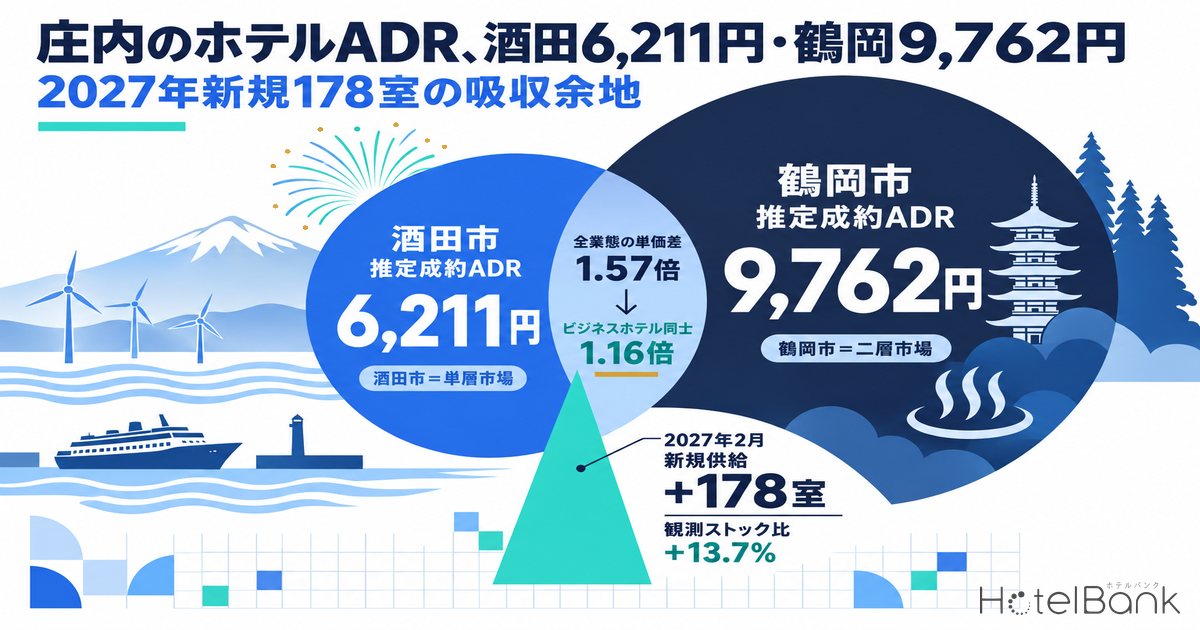
Sakata and Tsuruoka are the two core cities of the Shonai region in Yamagata Prefecture. According to MetroEngines Research & Consulting, their estimated settled ADR over the latest 12 months (September 2025–August 2026) was ¥6,211 in Sakata and ¥9,762 in Tsuruoka, a 1.57x gap. In February 2027, a 178-room hotel is scheduled to open in central Sakata. Reading this as “more supply entering a low-rate market” leads to a wrong call: once the comparison is limited to the same hotel type, the gap between the two cities narrows to 1.16x. This article breaks down the room-stock mix, booking pace and demand drivers of the two Shonai cities and quantifies the real base into which the 178 new rooms will enter.
Metric Definitions Used in This Article
- ADR (average daily rate) = estimated settled rate (tax-excluded equivalent), calculated by applying segment-specific adjustment factors to the lowest-plan rate each property publishes on OTAs and other channels (per room, 2 guests per room, tax included). Checked against property-level results disclosed by listed hotel REITs (91 properties, latest 3 months), the median error is about 7%. These are estimates and differ from each property’s actual settled prices and accounting figures. Area-level ADR is the median of the covered properties (the level of a typical property in the area).
- Listed price = the average of all plans listed on OTAs and other channels (per room, 2 guests per room, tax included). Its basis differs from estimated settled ADR, so the two should not be compared directly.
- OCC (occupancy) = share of rooms sold relative to total rooms in the area (an estimate based on OTA-listed inventory). It reflects how inventory sold on OTAs is being absorbed and differs from a property’s actual overall occupancy.
- LT (lead time) = days before check-in. LT0 = same day. The booking-pace curves in this article use LT45 and below only.
- Data source: MetroEngines Research & Consulting
Source: MetroEngines Research & Consulting (Sakata N=14–15 properties, Tsuruoka N=43–48 properties)
- — The 1.57x rate gap is not a gap in pricing power. Comparing like-for-like hotel types, the spread between Sakata’s ¥6,211 and Tsuruoka’s ¥9,762 shrinks to 1.16x; most of it is explained by the room-stock mix.
- — Sakata is a single-layer market in which hotel-type properties hold 87.7% of room stock. In Tsuruoka the share is only 51.0%; onsen ryokan, temple lodgings (shukubo) and resorts make up the rest, forming a two-layer market.
- — The 178 new rooms opening in February 2027 equal +13.7% of Sakata’s 1,297 observed rooms. The hotel-type share rises to 89.2%, temporarily reinforcing Sakata’s single-layer structure.
- — Absorption capacity is proven on days with demand. On the night of the Sakata Fireworks (September 12, 2026), estimated occupancy was already 98.6% at LT45, and the listed price of the remaining rooms was about 1.9x a normal Saturday and did not move from 45 days out.
- — Absorption room comes from three layers: construction-phase stays for a 450 MW offshore wind project (scheduled to start operation in June 2030), 22 cruise calls, and event demand. At 65% annual occupancy the new hotel needs 42,231 room nights.
The Two Shonai Cities Are Not “One Lodging Market” — Their Room Mix Is Opposite
First, pin down the denominator. Defining “stock confirmed as operating” as properties for which a 2-guest, 1-room selling price was observed in the latest three months (June 20 – September 20, 2026), Sakata has 21 properties with 1,297 rooms and Tsuruoka 59 properties with 2,459 rooms. Counting properties registered as in operation instead gives 16 properties / 1,145 rooms in Sakata and 61 properties / 2,407 rooms in Tsuruoka. When discussing supply pressure, inventory that is actually being sold is the more realistic denominator, so this article mainly uses the sales-observed basis.
What matters is not the total but the mix. In Sakata, business and city hotels (collectively “hotel-type” below) account for 9 properties and 1,137 rooms, or 87.7% of room stock. Ryokan, minshuku, cottages and similar total just 160 rooms. In Tsuruoka, hotel-type properties number 11 with 1,255 rooms, only 51.0%; the remaining 1,204 rooms are carried by ryokan in the onsen towns of Yunohama, Yutagawa and Atsumi, the shukubo temple lodgings of Mt. Haguro, and resort hotels.
Source: MetroEngines Research & Consulting (properties with sales observed in the latest 3 months; Sakata N=21 properties, Tsuruoka N=59 properties)
| Type | Sakata properties | Sakata rooms | Tsuruoka properties | Tsuruoka rooms |
|---|---|---|---|---|
| Business hotels | 7 | 867 | 10 | 1,132 |
| City hotels | 2 | 270 | 1 | 123 |
| Ryokan / minshuku | 6 | 125 | 42 | 966 |
| Resort / other | 6 | 35 | 6 | 238 |
| Total (sales-observed basis) | 21 | 1,297 | 59 | 2,459 |
| Hotel-type share | 87.7% | 51.0% | ||
Source: MetroEngines Research & Consulting (sales observed in latest 3 months, as of September 20, 2026)
This difference in mix translates directly into a difference in market character. Sakata is effectively a single-layer market built around business demand, while Tsuruoka is a two-layer market in which business demand and onsen/leisure demand stand side by side in roughly equal measure. The moment the two cities are compared on rate alone, the difference in mix shows up as a “rate gap.”
The 1.57x Rate Gap Reflects Mix, Not Pricing Power
Re-cut the estimated settled ADR by hotel type. Comparing business hotels only, the latest 12-month averages are ¥5,994 in Sakata (N=6 properties) and ¥6,971 in Tsuruoka (N=9–10 properties), a 1.16x gap. Most of the 1.57x city-wide gap is explained by Tsuruoka’s thick ryokan segment at ¥13,235 (N=30–34 properties). In other words, Sakata’s properties are not selling 40% cheaper than Tsuruoka’s. The issue is structural: Sakata has only a thin segment carrying the high-rate tier.
Source: MetroEngines Research & Consulting (estimated settled ADR, 12 monthly values from September 2025 to August 2026. Bars show the monthly minimum–maximum; diamonds show the 12-month average)
| Segment | 12-month average | Lowest month | Highest month | Range | Properties |
|---|---|---|---|---|---|
| Sakata business hotels | ¥5,994 | ¥5,424 | ¥6,927 | 1.28x | 6 |
| Sakata all types | ¥6,211 | ¥5,742 | ¥7,277 | 1.27x | 14–15 |
| Tsuruoka business hotels | ¥6,971 | ¥6,066 | ¥8,662 | 1.43x | 9–10 |
| Tsuruoka all types | ¥9,762 | ¥7,986 | ¥12,060 | 1.51x | 43–48 |
| Tsuruoka ryokan | ¥13,235 | ¥10,659 | ¥15,878 | 1.49x | 30–34 |
| (Reference) Yamagata City all types | ¥12,236 | ¥9,669 | ¥18,469 | 1.91x | 56–62 |
Source: MetroEngines Research & Consulting (estimated settled ADR, September 2025 – August 2026)
The other thing to read here is the range. Sakata’s business hotels moved between ¥5,424 and ¥6,927 across the 12 months, with the highest month only 1.28x the lowest. Tsuruoka’s ryokan show 1.49x and Yamagata City as a whole 1.91x. Sakata’s rates have been extremely flat, meaning the market as a whole has not yet used its room to move prices by season or day of week. That is not a weakness but untapped headroom. How ADR moves in opposite directions by hotel type across Yamagata Prefecture is laid out with confirmed monthly figures in Yamagata ADR Splits by Segment.
That headroom is already starting to be used. Sakata’s estimated settled ADR rose +8.8% year on year on a 12-month average basis, with July 2026 up 16.8% and August up 15.9% versus the same months a year earlier — the summer gains are clearly larger. Tsuruoka rose 2.9% (August: −5.0% YoY) and has shifted to a plateau from an already high level. In terms of upward momentum, it is Sakata that is moving now.
Sakata. Source: MetroEngines Research & Consulting (N=12–15 properties)
Tsuruoka. Source: MetroEngines Research & Consulting (N=43–49 properties)
Booking Pace Differs Too — Sakata Builds Late, Tsuruoka Is Settled 45 Days Out
When the shape of rates differs, so does the way inventory depletes. We compared the remaining-inventory trajectory within 45 days of check-in (LT) for observed cohorts in both cities. Sakata’s cohort is 10 properties with 279 rooms and Tsuruoka’s is 30 properties with 1,190 rooms; note that both are limited to properties that could be continuously observed on OTAs. How business hotels across the prefecture absorb their inventory is broken into property-level types in Yamagata Business Hotels: 3 Absorption Types.
Source: MetroEngines Research & Consulting (Sakata cohort N=10 properties / 279 rooms, Tsuruoka cohort N=30 properties / 1,190 rooms. Estimates based on OTA-listed inventory)
For a Saturday in Tsuruoka, estimated occupancy for September 19, 2026 had already reached 67.6% at LT45 (estimate based on OTA-listed inventory, Tsuruoka cohort N=30 properties / 1,190 rooms). From there it filled in a straight line, reaching 96.5% by LT21. The listed price of the remaining rooms also stepped up from the ¥34,100 range to the ¥54,200 range — a textbook onsen-destination pattern in which the faster rooms fill, the more expensive the late inventory becomes.
Sakata’s weekday (Wednesday, August 19) stood at 49.1% at LT45, then 76.7% at LT14, 90.3% at LT3 and 94.6% the day before — a business-demand curve that builds sharply in the final two weeks. The Saturday (August 22) started higher, at 76.3% at LT45, but added only 18.3 points over the following 45 days, and the listed price of remaining rooms fell from the ¥21,200 range to the ¥14,600 range. Weekend demand is largely fixed 45 days out, and after that point the priority shifts to selling through rather than building occupancy.
On Days With Demand, Sakata Also Sells Out 45 Days Ahead
This does not mean Sakata lacks the ability to capture high-rate demand. Overlaying the curve for Saturday, September 12, 2026 — the night of the “Sakata Fireworks 2026” — shows estimated occupancy for September 12, 2026 of 98.6% already at LT45 (estimate based on OTA-listed inventory; 4 of 279 rooms remaining), with the remaining rooms listed at ¥40,500. That is about 1.9x a normal Saturday (the ¥21,200 range), and it did not move from 45 days out. On a day with a clear reason to visit — a fireworks display of about 10,000 shells — Sakata’s stock sells out 45 days ahead at a high price level. The market has the capacity to absorb higher prices; what it lacks is “enough of those days.”
| Stay date | LT45 est. occupancy | LT14 | LT1 | Listed price of remaining rooms, LT45 | Listed price of remaining rooms, LT1 |
|---|---|---|---|---|---|
| Sakata 2026-08-19 (Wed) | 49.1% | 76.7% | 94.6% | ¥15,200 | ¥13,900 |
| Sakata 2026-08-22 (Sat) | 76.3% | 90.0% | 94.6% | ¥21,200 | ¥14,600 |
| Sakata 2026-09-12 (Sat, fireworks) | 98.6% | 98.9% | 100.0% | ¥40,500 | ¥26,100 |
| Tsuruoka 2026-09-16 (Wed) | 47.1% | 73.3% | 87.8% | ¥20,900 | ¥25,700 |
| Tsuruoka 2026-09-19 (Sat) | 67.6% | 98.5% | 99.5% | ¥34,100 | ¥54,200 |
Source: MetroEngines Research & Consulting (listed price of remaining rooms = average listed price of inventory on sale at each point; 2 guests per room, tax included)
Yamagata’s Business Hotels Run in the 90% Range in Summer — Spare Capacity Is Already Thin
To gauge how much new supply can be absorbed, you need to know how full existing inventory already is. Looking at monthly estimated occupancy by category for Yamagata Prefecture as a whole (based on OTA-listed inventory), business hotels were at 84.4% in May 2026, 88.8% in June, 87.2% in July, 91.7% in August and 92.9% in September — consistently above ryokan and resorts, reaching 92.9% in September.
Source: MetroEngines Research & Consulting (estimates based on OTA-listed inventory. Business N=21–22 properties / 1,765–1,961 rooms; ryokan N=88–103 properties; resort N=13–15 properties)
OTA-listed inventory is not a property’s full inventory, so these figures cannot be read directly as actual occupancy. Still, the direction is clear: business-oriented inventory in the prefecture is absorbed to around 90% in peak months. The two Shonai cities together have 17 business hotels with 1,999 rooms, or 20 properties with 2,392 rooms including city hotels. The 178 new rooms will be added to that.
February 2027: 178 Rooms in Central Sakata — +13.7% on the Base
Of the 13 new openings in our nationwide 2027 pipeline (based on confirmed OTA listings), one is in Yamagata Prefecture: a 178-room hotel scheduled to open on February 25, 2027 in Nakamachi, Sakata — the central district, about five minutes by car from JR Sakata Station. It will be operated by Sunfrontier Hotel Management and is an 11-storey steel-frame building. The top floor will feature an observation open-air bath fed by natural hot spring water with views of Mt. Chokai, a sauna and a lounge. More than 60% of the rooms are doubles; there will also be twins and deluxe twins, plus rooms with a kitchen and washing machine for mid- to long-term stays (source: Sunfrontier Hotel Management official site).
| Base | Existing rooms | After +178 | Increase | Definition |
|---|---|---|---|---|
| Sales-observed basis (main metric in this article) | 1,297 rooms | 1,475 rooms | +13.7% | 21 properties with a 2-guest, 1-room selling price observed in the latest 3 months |
| Hotel-type only | 1,137 rooms | 1,315 rooms | +15.7% | 9 business and city hotels |
| Registered-in-operation basis | 1,145 rooms | 1,323 rooms | +15.5% | 16 properties across ryokan, business and city categories |
| (Reference) Tsuruoka, sales-observed basis | 2,459 rooms | — | — | 59 properties |
Source: MetroEngines Research & Consulting (sales-observed basis, as of September 20, 2026) / new openings based on confirmed OTA listings
Whichever base is used, the increase falls in the 13–16% range. That is not a small amount to enter a single regional-city market at once, and given that confirmed operating stock is around 1,300 rooms, it is a size at which a single building can change the character of the market. The hotel-type share rises further from 87.7% to 89.2%, temporarily reinforcing Sakata’s single-layer structure.
How to read the supply data: New openings are counted from properties whose OTA listings have been confirmed. Because listings appear only a few months before opening, the count for the second half of 2027 and beyond is expected to grow as further listings appear. Please read the figures as a lower bound of the confirmed pipeline. Planning data derived from the MLIT “Statistics on Building Construction Starts” contained no relevant Yamagata project at the time of writing.
Where Will the Absorption Come From? Three Layers: Offshore Wind, Cruises and Fireworks
Running 178 rooms at 55–75% annual occupancy requires 35,700–48,700 room nights a year, or 98–134 room nights a day. Building that without cannibalizing existing properties’ demand requires new stay demand. Shonai and Sakata have three candidate layers, each peaking at different times. How a regional core city absorbs new supply of similar scale is examined with the same framework in Matsumoto ADR ¥13,400 vs ¥18,300 Ceiling: Absorbing 222 New Rooms.
| Demand driver | Timing | Nature of stay | Indicative scale |
|---|---|---|---|
| Offshore wind off Yuza Town, Yamagata | Construction phase through start of operation in June 2030 | Business, mid- to long-term (mainly weekdays) | 450 MW / 30 turbines of 15 MW. Promotion zone approx. 4,100 ha. Sakata Port used as the base port |
| Cruise calls at Sakata Port | Mainly April–October | Pre/post-call stays, crew | 22 calls scheduled for FY2026 (2 cancelled as of September 2026). “Asuka II” returns for the first time in 9 years; 4 maiden calls |
| Sakata Fireworks and other events | Specific dates (September and others) | Leisure, high rate | About 10,000 shells. Held on September 12, 2026; the observed cohort was 98.6% absorbed at LT45 |
| Shonai Airport – Tokyo route | Year-round (extra flights in some periods) | Wide-area inflow for business and leisure | Increased to 5 flights a day (seasonal additional flights) |
Source: Ministry of Economy, Trade and Industry / Ministry of Land, Infrastructure, Transport and Tourism, approval of public tender occupancy plan (December 2025); Yamagata Prefecture; Sakata City; Sakata Tourism Association; MetroEngines Research & Consulting
Of these, the offshore wind construction phase is the most likely to translate directly into room-night volume. The Yuza offshore project, by Yamagata Yuza Offshore Wind LLC (jointly owned by Marubeni, Kansai Electric Power, BP, Tokyo Gas and Marutaka), received approval of its public tender occupancy plan in December 2025 and aims to start operation in June 2030. Sakata Port was designated a base port in April 2024, and quay and other works are under way. The opening of the 178 new rooms (February 2027) almost coincides with the ramp-up of this construction phase.
Because the number of construction workers has not been published by the developer or local governments, we estimate the scale by working backward. If an average of 100 people a day stayed in single occupancy, that would be 36,500 room nights a year — almost exactly the 35,700 room nights needed to run 178 rooms at 55% occupancy. Of course, not everyone would stay at the new hotel; demand would be shared with existing properties. The following is a simple estimate with its assumptions stated.
| Annual occupancy assumption for the 178 rooms | Room nights / year | Room nights / day | Annual room revenue at est. settled ADR ¥6,500 | At est. settled ADR ¥8,000 |
|---|---|---|---|---|
| 55% (conservative) | 35,734 | 98 | ¥232 million | ¥286 million |
| 65% (mid) | 42,231 | 116 | ¥274 million | ¥338 million |
| 75% (bullish) | 48,728 | 134 | ¥317 million | ¥390 million |
Simple estimate. ADR assumptions are placeholders informed by the 12-month average of ¥5,994 for Sakata business hotels and ¥6,971 for Tsuruoka business hotels. Actual investment decisions require a detailed feasibility study. Source: MetroEngines Research & Consulting
Fixing the assumptions at a single point invites errors, so we vary annual room revenue (¥ million) along two axes: occupancy and estimated settled ADR. Against the mid case (65% occupancy, ADR ¥6,500) of ¥274 million, the conservative floor (55%, ¥5,500) is ¥197 million and the bullish ceiling (75%, ¥8,500) is ¥414 million. Even for the same 178 rooms, the assumptions produce a 2.1x spread.
| Annual occupancy | Room nights / year | ADR ¥5,500 | ADR ¥6,500 | ADR ¥7,500 | ADR ¥8,500 |
|---|---|---|---|---|---|
| 55% (conservative) | 35,734 | 197 | 232 | 268 | 304 |
| 60% | 38,982 | 214 | 253 | 292 | 331 |
| 65% (mid) | 42,231 | 232 | 274 | 317 | 359 |
| 70% | 45,479 | 250 | 296 | 341 | 387 |
| 75% (bullish) | 48,728 | 268 | 317 | 365 | 414 |
Simple estimate (178 rooms × 365 days × occupancy × estimated settled ADR). ADR assumptions are placeholders informed by the 12-month average of ¥5,994 for Sakata business hotels and ¥6,971 for Tsuruoka business hotels. Actual investment decisions require a detailed feasibility study. Source: MetroEngines Research & Consulting
The product design of these 178 rooms leans toward two of the three layers: “business / mid- to long-term” and “leisure.” Rooms with a kitchen and washing machine suit long stays during the construction phase, while the top-floor hot-spring observation bath, sauna and lounge add a leisure appeal that Sakata’s hotel-type inventory has so far lacked. It is a design that adds one more “reason to stay” to a single-layer market, and if the city’s overall rate level is lifted, existing properties can also build their pricing on top of it more easily.
Location Fundamentals in Numbers — Land Prices, Employment and Population
As a premise for investment decisions, we lay out land costs and catchment for the two cities. In the 2026 official land prices, the average for commercial land was ¥40,266/㎡ in Sakata (−0.13% YoY) and ¥30,000/㎡ in Tsuruoka (−0.16%). Sakata’s commercial land price is 1.34x Tsuruoka’s, so Sakata — where hotel-type ADR is lower than in Tsuruoka — has the more expensive land. Across all land uses, the averages are nearly level: ¥25,015/㎡ in Sakata (+0.20%) and ¥24,586/㎡ in Tsuruoka (−0.02%).
For employment concentration, the source of weekday demand, the area within a 1.5 km radius of Sakata Station has 1,952 establishments and 13,245 employees (9.5% office-type), and the same radius around Tsuruoka Station has 1,807 establishments and 11,852 employees (13.8% office-type). Sakata has more establishments and employees, but Tsuruoka has a higher office-type share. Within 1 km of the new hotel site (Nakamachi, Sakata) there are 1,068 establishments and 6,471 employees (11.3% office-type), showing a compact structure in which the commercial and business functions of the city center fit within a 1 km radius.
| Indicator | Sakata | Tsuruoka | Source |
|---|---|---|---|
| Estimated settled ADR (12-month average, all types) | ¥6,211 | ¥9,762 | MetroEngines Research & Consulting |
| Estimated settled ADR (business hotels) | ¥5,994 | ¥6,971 | Same as above |
| Listed price (all-plan average, tax included) | ¥16,155 | ¥26,542 | Same as above |
| Rooms, sales-observed basis | 1,297 rooms | 2,459 rooms | Same as above |
| Hotel-type share | 87.7% | 51.0% | Same as above |
| Official land price, commercial (2026) | ¥40,266/㎡ | ¥30,000/㎡ | MLIT “Land Price Publication,” aggregated |
| Establishments within 1.5 km of station | 1,952 | 1,807 | Economic Census |
| Employees within 1.5 km of station | 13,245 | 11,852 | Same as above |
| City population (April 2025) | 93,102 | 115,669 | Population and households by municipality |
Source: MetroEngines Research & Consulting / MIC and METI “Economic Census for Business Activity” / MLIT “Land Price Publication” / Japan Geographic Data Center
Distribution of Lodging Facilities in the Two Shonai Cities
The map plots the 73 properties with 5 or more rooms among those with sales observed in the latest three months. Circle size shows room count and color shows property type. At a glance, Sakata’s large hotel-type properties are concentrated around the station and the city center, while Tsuruoka has hotel-type properties in the city center plus ryokan clusters spread along the Sea of Japan coast (Yunohama, Atsumi) and toward Mt. Haguro.
Source: MetroEngines Research & Consulting (N=73 properties with 5+ rooms and sales observed in the latest 3 months)
The Breakfast Premium Is the Entry Point to Rate Headroom
One of the quickest ways to capture rate headroom is food and beverage. In a paired analysis measuring the price difference between room-only and breakfast-included plans within the same hotel, the breakfast premium for Yamagata hotels averaged +10.4% (+¥1,800, N=46 properties) in August 2026. By type, business hotels showed +8.4% (+¥1,300, N=34 properties), while city hotels showed +20.9% (+¥4,200, N=8 properties) — more than double.
The 178 rooms coming to Sakata fall into the city-hotel category, and in-prefecture results show there is room to add around ¥4,000 per night depending on how breakfast is designed. For existing business hotels as well, building a breakfast around local ingredients is a realistic way to raise per-night revenue without touching room rates. Shonai’s ingredients — rice, seafood and dadacha-mame edamame — have strong appeal, so the conditions are in place.
Summary — Sakata Is Not a “Cheap Market” but a “Single-Layer Market”
The key points of this article are summarized below.
| Issue | Data | Implication |
|---|---|---|
| Rate gap between the two cities | 1.57x across all types → 1.16x between business hotels | Most of the gap is room-stock mix. Sakata’s pricing power is not inferior |
| Market structure | Hotel-type share: Sakata 87.7% / Tsuruoka 51.0% | Sakata is a single-layer business-demand market; Tsuruoka is a two-layer business + onsen market |
| Rate range | Sakata business 1.28x / Tsuruoka ryokan 1.49x / Yamagata City 1.91x | There is still room to move rates by season and day of week |
| Booking pace | Sakata weekdays surge after LT14; fireworks night at 98.6% by LT45 | On days with a reason to visit, rooms sell out 45 days ahead at high rates |
| New supply | +178 rooms = +13.7% of sales-observed stock | A size at which a single building can change the market’s character |
| Absorption room | Offshore wind 450 MW, 30 turbines (operation scheduled June 2030) / 22 cruise calls (FY2026) | Mid- to long-term stays during the construction phase are the main candidate for room-night volume |
Source: MetroEngines Research & Consulting; METI and MLIT; Sakata City
From the perspective of regional banks and local developers, Sakata is not a “low-rate market” but “a market that still has only one layer capable of moving rates.” The materials for building a second layer are in place on two fronts: the time-limited but high-certainty business demand of the offshore wind construction phase, and leisure resources such as Mt. Chokai, the Sankyo Soko rice warehouses and the fireworks. The 178 rooms opening in February 2027 are designed on the premise of that second layer and may work to lift the rate level of the market as a whole. For existing operators, this is not a phase for defending rates but for rethinking how to build pricing on top of a rising base.
⚠ Note on estimates: ADR in this article is an estimated settled rate calculated from selling prices published on OTAs and other channels, and differs from each property’s actual settled prices and accounting figures. Estimated occupancy is likewise based on the absorption of OTA-listed inventory and differs from a property’s actual overall occupancy. Room counts and opening dates for new openings are based on operators’ published figures and are subject to change. The investment simulation is a simple estimate with stated assumptions; actual investment decisions require a detailed feasibility study.
Related Articles
References and Sources
■ Data sources
Selling prices and inventory data published on OTAs and other channels are collected daily; the area median of property daily averages is aggregated into monthly averages. Estimated settled ADR is an estimate (tax-excluded equivalent) obtained by applying segment-specific adjustment factors to the lowest-plan rate (2 guests per room, per room, tax included); checked against property-level results disclosed by listed hotel REITs (91 properties, latest 3 months), the median error is about 7%. Periods covered: estimated settled ADR, the 12 months from September 2025 to August 2026 (Sakata N=14–15 properties, Tsuruoka N=43–48 properties); room stock and booking pace, sales observed from June 20 to September 20, 2026; estimated occupancy, monthly figures by category for Yamagata Prefecture (business N=21–22 properties / 1,765–1,961 rooms, ryokan N=88–103 properties, resort N=13–15 properties).
■ Estimate assumptions
The revenue estimate for the 178 new rooms is a simple estimate assuming annual occupancy of 55% (conservative), 65% (mid) and 75% (bullish) and estimated settled ADR of ¥5,500–¥8,500. Required room nights = 178 rooms × 365 days × annual occupancy; annual room revenue = required room nights × estimated settled ADR. Sensitivity is checked on the two axes of occupancy and ADR. The ADR assumptions are placeholders informed by the 12-month averages of ¥5,994 for Sakata business hotels and ¥6,971 for Tsuruoka business hotels. Because the number of offshore wind construction workers has not been published by the developer or local governments, scale is indicated only through a back-calculation assuming an average of 100 people a day staying in single occupancy (36,500 room nights a year). Non-room revenue, operating costs, pre-opening costs and financing terms are not included.
■ Limitations
ADR and occupancy are both estimates based on OTA-listed inventory and differ from each property’s actual settled prices, accounting figures and actual occupancy. The new-opening pipeline counts properties whose OTA listings have been confirmed; because listings appear only a few months before opening, counts for future months should be read as a lower bound. Booking-pace curves are limited to cohorts of continuously observed properties (Sakata 10 properties / 279 rooms, Tsuruoka 30 properties / 1,190 rooms) and do not represent the market as a whole. Land price, employment and population figures come from public statistics with differing reference dates. The revenue estimate is a simple estimate with stated assumptions; actual investment decisions require a detailed feasibility study.
■ Market data
- MetroEngines Research & Consulting — estimated settled ADR (Sakata N=14–15 properties, Tsuruoka N=43–48 properties, September 2025 – August 2026), listed prices, estimated occupancy based on OTA-listed inventory, booking-pace curves (LT45 and below), sales observation (June 20 – September 20, 2026), new-opening pipeline (based on confirmed OTA listings), paired analysis of the breakfast premium (Yamagata Prefecture, N=46 properties)
■ Government statistics and public data
- METI and MLIT, “Approval of public tender occupancy plans for offshore wind projects in ‘Sea of Japan off Aomori (South)’ and ‘Off Yuza Town, Yamagata'” (December 16, 2025, Japanese)
- METI and MLIT, “Results of operator selection for offshore wind projects in ‘Sea of Japan off Aomori (South)’ and ‘Off Yuza Town, Yamagata'” (December 24, 2024, Japanese)
- MLIT Ports and Harbours Bureau, “Public tender for the offshore wind project off Yuza Town, Yamagata” (Japanese)
- Yamagata Prefecture, “Progress of offshore wind projects off the prefecture” (Japanese)
- Sakata City, “Sakata Port cruise ship call schedule and record” (Japanese)
- Sakata City, “Oishii Shonai Airport (SHONAI AIRPORT)” (Japanese)
- MIC and METI, “Economic Census for Business Activity (2021)” (boundaries = 2020 Population Census small areas, e-Stat statistical GIS)
- MLIT “Land Price Publication” 2026, Sakata aggregate (Tochidai Data) / same, Tsuruoka
- Japan Geographic Data Center, “Population and households by municipality” (April 2025 survey, Japanese)
■ Company releases and media reports
- Sunfrontier Hotel Management, “Tabi no Hotel lit Sakata (たびのホテルlit酒田), scheduled to open February 25, 2027” (Japanese)
- Sunfrontier Fudosan press release (PR TIMES, Japanese)
- Sakata Fireworks 2026 official website (Japanese)
- Sakata Sanpo, “Cruise ship calls in FY2026” (Japanese)
- Wind Journal, “[Offshore Wind Round 3] Layout plan for 30 turbines off Yuza Town, Yamagata” (Japanese)