

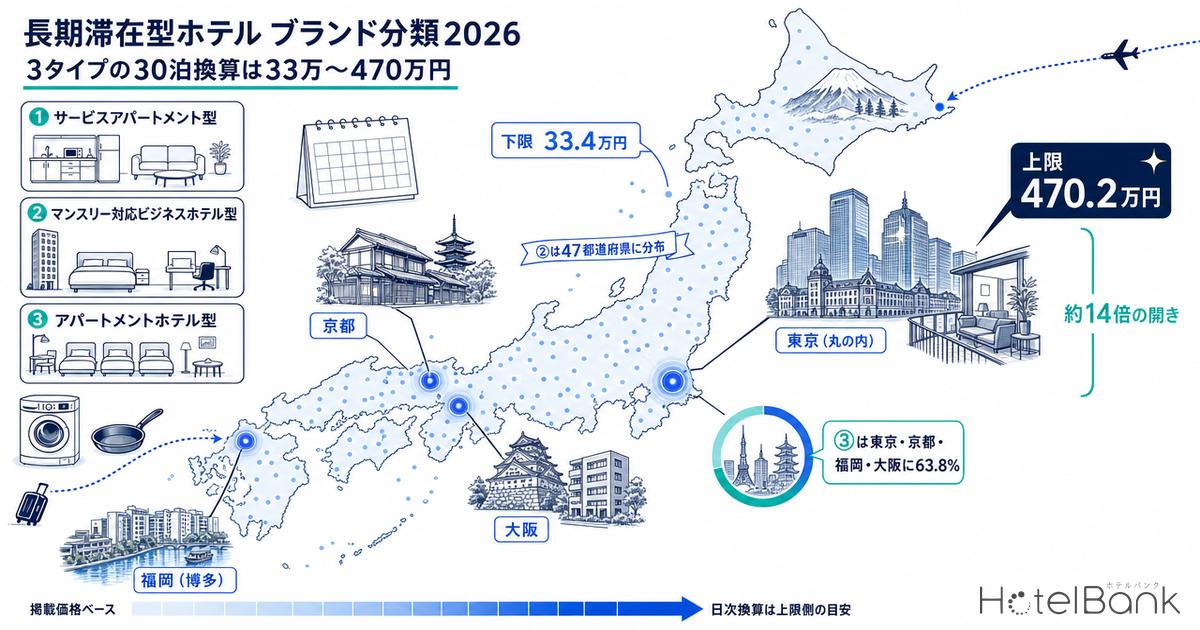
The label “long-stay hotel” actually lumps together three business formats whose charging structures, room specifications and target demand are entirely different. For corporate travel managers looking for somewhere to house project staff on long assignments, operators weighing how to capture mid- to long-term stays, and investors deciding whether an apartment hotel development stacks up, comparisons do not hold unless that distinction is made clear. This article sorts the long-stay hotel brands operating in Japan into three types — (1) serviced apartments, (2) business hotels with monthly plans, and (3) apartment hotels — and sets out each type’s characteristics, footprint, and 30-night-equivalent price band aggregated at the property level.
Metric Definitions Used in This Article
- Listed price (all-plan average, tax-inclusive): the average price of all plans each property publishes on OTAs and other channels, per room for 2 guests (tax-inclusive). This listed price is the main basis for price comparison in this article.
- ADR (estimated settled rate): an estimated settled rate (tax-exclusive equivalent) calculated by applying a segment-specific adjustment factor to the lowest-plan price level each property publishes on OTAs. Checked against property-level results disclosed by listed hotel REITs (91 properties, most recent 3 months), the median error is about 7%. It is an estimate and differs from each property’s actual transaction prices and accounting figures.
- 30-night equivalent: a reference value obtained by simply multiplying the per-night price above by 30. It differs from the contract rates of the long-stay and monthly plans each company publishes; read it as an upper-bound guide (the gap is tested later in the article).
- Period and population: settled months from September 2025 to August 2026. For each property we took the median of its monthly prices over the period; at brand level we show the interquartile range (P25–P75) and median of those per-property medians. For brands with more than 60 properties, up to 60 properties were randomly sampled nationwide.
- Data source: MetroEngines Research
- — 30-night equivalents range from ¥334k to ¥4.702M, a spread of about 14x. The gap reflects differences in in-room living functions, occupancy capacity and location, not brand quality (listed-price basis, September 2025 to August 2026).
- — Type (2), business hotels with monthly plans, spans 7 brands and 1,104 properties across all 47 prefectures, with brand medians differing by at most about 1.7x. It is the baseline for long-stay assignments in regional and suburban areas.
- — 63.8% of the 210 Type (3) apartment hotels are concentrated in Tokyo, Kyoto, Fukuoka and Osaka. The per-room rate is high, but capacity is large, so on a per-person monthly basis they can compete with Type (2).
Breaking long-stay hotels down into three types
Two axes separate the three types: how much of the living function is built into the room, and the unit in which the price is set. Cut along these two axes, it becomes clear that procurement works completely differently even when the stay is “long” in every case.
| Type | In-room living functions | Main charging unit | Core demand |
|---|---|---|---|
| (1) Serviced apartment | Full kitchen, washer-dryer and a full set of residential furniture. Weekly housekeeping | Mainly monthly contract rates; daily sales are supplementary | Expatriate and executive assignments; substitute for company housing |
| (2) Business hotel with monthly plans | Rooms built purely for sleeping; living functions supplemented by on-site large public baths, breakfast and laundry | Daily rate plus multi-night discounts, tiered at 7, 14 and 30 nights | Business trips, construction work, training, temporary housing |
| (3) Apartment hotel | Kitchen, washing machine, sleeping for larger groups. Operated as a hotel licensed under the Hotel Business Act | Daily rate per room; large capacity makes per-person splitting effective | Inbound families and groups; stays by project teams |
Source: Compiled by HotelBank Editorial Team
The difference that matters most in practice is that Type (2) prices are built up from daily rates, whereas Type (1) is in principle a monthly contract. Type (2) prices can be read straight from public information on OTAs and elsewhere, but multiplying Type (1)’s daily prices by 30 does not get you to actual contract terms. Type (3) sits in between: daily sales dominate, but because capacity is large, comparing on a per-room rather than per-person basis leads to the wrong decision.
30-night equivalents range from ¥330k to ¥4.7M
First, for Type (2) business hotels with monthly plans and Type (3) apartment hotels, we aggregated listed prices per property for each brand and lined up the 30-night-equivalent ranges. The left end of each bar is P25, the right end P75, and the white marker the median. Brands are grouped by type and are not sorted by price.
Source: Compiled by HotelBank Editorial Team from MetroEngines Research
The seven Type (2) brands fall broadly within a 30-night-equivalent range of ¥330k–¥670k. Even the largest gap between brand medians is only about 1.7x, so as a price band they form a continuum. Type (3), by contrast, spans a wide ¥740k–¥3.82M, showing how different the product is even under the same “apartment hotel” label. Across both types, the floor of the 30-night equivalent (Toyoko Inn’s P25 at ¥334k) and the ceiling of Type (1), discussed below (Ascott Marunouchi Tokyo at ¥4.702M), are about 14x apart.
Type (2) business hotels with monthly plans (by brand)
| Brand | Main footprint | Properties priced (N) | 30-night equivalent P25–P75 | Est. settled ADR per night (median) |
|---|---|---|---|---|
| APA Hotel (アパホテル) | Tokyo, Osaka, Hokkaido, Fukuoka, Aichi and nationwide | 58 | ¥469k–¥669k | ¥11,100 |
| Kuretake Inn (くれたけイン) | Shizuoka, Osaka, Aichi, Hokkaido and others | 18 | ¥357k–¥446k | ¥7,300 |
| Comfort Hotel (コンフォートホテル) | Hokkaido, Aichi, Osaka, Fukuoka, Mie and nationwide | 54 | ¥382k–¥536k | ¥8,800 |
| Super Hotel (スーパーホテル) | Tokyo, Osaka, Hokkaido, Ehime, Shizuoka and nationwide | 59 | ¥457k–¥614k | ¥8,800 |
| Toyoko Inn (東横INN) | Tokyo, Osaka, Kanagawa, Saitama, Aichi and nationwide | 59 | ¥334k–¥393k | ¥7,700 |
| Hotel MyStays (ホテルマイステイズ) | Tokyo, Hokkaido, Osaka, Kanagawa, Chiba and others | 57 | ¥463k–¥656k | ¥11,700 |
| Hotel Livemax (ホテルリブマックス) | Tokyo, Osaka, Kanagawa, Aichi, Hyogo and others | 58 | ¥419k–¥626k | ¥10,000 |
Source: Compiled by HotelBank Editorial Team from MetroEngines Research (based on per-property medians for settled months September 2025 to August 2026. Footprint lists the prefectures with the most listed properties and is not a ranking by property count)
This type’s strengths are that prices are easy to read and that stays of the same quality can be procured anywhere in the country. Rooms are pared down to sleeping, but shared facilities — large public baths, breakfast, coin laundries — deliver a living experience close to Types (1) and (3), and the fact that cleaning and linen changes continue at hotel standard keeps management costs low for whoever is hosting the long-stay guest. APA Hotel and Super Hotel cover major cities nationwide, making it easy to align conditions across sites on assignments that place staff at several locations. Toyoko Inn and Kuretake Inn sit in the range that keeps a 30-night budget lowest, and Comfort Hotel offers the deepest choice in regional hub cities. Hotel MyStays (operated by Iconia Hospitality, renamed from MyStays Hotel Management Co., Ltd. in July 2025) and Hotel Livemax are positioned as brands that put long-stay plans front and centre as a product.
Type (3) apartment hotels (by brand)
| Brand | Main footprint | Properties priced (N) | Median rooms per property | 30-night equivalent P25–P75 |
|---|---|---|---|---|
| hotel MONday / MONday Apart | Tokyo, Kyoto, Osaka | 24 | 45 | ¥934k–¥1.969M |
| MIMARU / MIMARU SUITES | Tokyo, Kyoto, Osaka | 26 | 40 | ¥2.305M–¥3.816M |
| Minn | Tokyo, Kyoto, Osaka, Hokkaido | 29 | 26 | ¥745k–¥1.258M |
| Rakuten STAY | Kanagawa, Kyoto, Yamanashi, Okinawa, Fukuoka and others | 51 | 10 | ¥887k–¥1.783M |
| GRAND BASE (グランドベース) | Fukuoka, Nagasaki, Oita, Aichi, Kagoshima and others | 42 | 7 | ¥888k–¥1.206M |
| Lando Hotel (ランドーホテル) | Fukuoka, Hiroshima, Hokkaido, Osaka | 4 | 32 | ¥775k–¥1.142M |
Source: Compiled by HotelBank Editorial Team from MetroEngines Research (listed prices are per room for 2 guests, tax-inclusive. Rooms of this type mostly sleep 4–6, so per-room levels come out high)
Type (3)’s price differences directly reflect differences in room capacity and floor area. MIMARU is designed for families and groups with large per-room capacity, and its 30-night-equivalent range sits a step above the other brands. Its operator, Cosmos Hotel Management (part of Cosmos Initia, a Daiwa House Group company), runs 28 buildings with about 1,500 rooms as of September 2026 and has set a target of 3,000 rooms by 2030 (source: Daiwa House Industry news release, August 26, 2026). GRAND BASE, on the other hand, rolls out small properties of around 7 rooms each across core cities in western Japan and is operated by REQREA. Minn, operated by SQUEEZE, is anchored in Tokyo, Kyoto and Osaka and is expanding to Hokkaido and Hokuriku, and has also announced a move into Hakata, Fukuoka in 2026. Rakuten STAY ranges from station-front urban properties to villa-type properties in Yamanashi, Kanagawa and Okinawa, and the breadth of its range reflects that mix.
Serviced apartments are best viewed property by property — daily sales are only a small slice
The number of Type (1) serviced apartments in Japan is limited to begin with, and there is not enough of a population to talk about price bands at brand level, so we list them property by property. In this format, monthly fixed-term leases and monthly contracts are the mainstream, and the daily prices on OTAs and elsewhere are a supplementary channel for filling vacancies. The figures below are therefore “the level if bought by the night” and should be kept separate from the terms offered on monthly contracts. For families weighing a serviced apartment against a monthly apartment (a furnished short-term rental let under a lease rather than a hotel licence), the practical difference is that the serviced apartment adds hotel-style services such as housekeeping and a front desk.
Source: Compiled by HotelBank Editorial Team from MetroEngines Research
| Property | Location | Rooms | Months observed | 30-night equivalent (listed price) | 30-night equivalent (est. settled ADR) |
|---|---|---|---|---|---|
| Ascott Marunouchi Tokyo (アスコット丸の内東京) | Chiyoda-ku, Tokyo | 130 | 12 | ¥4.702M | ¥2.849M |
| Oakwood Premier Tokyo (オークウッドプレミア東京) | Chiyoda-ku, Tokyo | 123 | 12 | ¥3.669M | ¥2.711M |
| Fraser Suites Akasaka Tokyo (フレイザースイート赤坂東京) | Minato-ku, Tokyo | 224 | 3 | ¥2.046M | ¥1.719M |
| Citadines Central Shinjuku Tokyo (シタディーンセントラル新宿東京) | Shinjuku-ku, Tokyo | 206 | 11 | ¥1.407M | ¥1.047M |
| Fraser Residence Nankai Osaka (フレイザーレジデンス南海大阪) | Osaka City, Osaka | 114 | 12 | ¥1.304M | ¥931k |
| Citadines Shinjuku Tokyo (シタディーン新宿東京) | Shinjuku-ku, Tokyo | 160 | 12 | ¥1.268M | ¥1.112M |
| Oakwood Hotel Kyoto Oike (オークウッドホテル京都御池) | Kyoto City, Kyoto | 120 | 12 | ¥619k | ¥504k |
Source: Compiled by HotelBank Editorial Team from MetroEngines Research (settled months September 2025 to August 2026. Fraser Suites Akasaka Tokyo was observed for only 3 months; treat as a reference value)
Note that properties under the same brand can differ in character. Oakwood runs residence-flavoured lines such as “Premier” and “Residence” alongside a line that puts hotel operation first; Kyoto Oike is run more like a hotel, so its 30-night equivalent lands at ¥619k, close to the top of Type (2). Conversely, properties in the central business districts such as Marunouchi and Akasaka sit in a range that directly serves demand for expatriate company-housing substitutes. As a published example of a monthly contract, a three-bedroom at Oakwood Apartments Shirokane is advertised from ¥1.3M per month (source: Tokyo Serviced Apartments listing, checked September 18, 2026). The figures confirm that, in this format, reading daily sales × 30 skews toward the upper bound.
Closing the gap between “daily rate × 30” and published monthly rates
This is the crux of procurement practice. The 30-night equivalent in this article is only a reference value obtained by multiplying the daily listed price by 30, and the long-stay plans each company publishes are distributed below it. Hotel Livemax, for example, has announced its long-stay product “Hotel Biz Monthly” from ¥100,000 per month (30 nights) (announced February 26, 2021; varies by area). The median 30-night equivalent calculated from the same brand’s daily listed prices is ¥480k, showing that daily sales and monthly plans rest on entirely different premises. Tokyu Stay, a stay-oriented hotel brand with washer-dryer-equipped rooms, also officially offers mid- to long-stay plans covering stays of up to 31 nights. Kyoritsu Maintenance likewise offers weekly and monthly plans under its Dormy Inn brand, capturing demand from business trips, workations and temporary housing.
In our own separate measurements, multi-night discounts typically run at about 15% at 7 nights and about 20% at 30 nights (how the discount builds by length of stay is tested in Japan Hotel Long-Stay Discounts: 15% at 7 Nights, 20% at 30 Nights). In other words, “daily listed price × 30 × 0.8” is a realistic upper-bound guide for what can be bought through plans. How much lower you can go is decided by three things: (1) whether a dedicated long-stay plan exists, (2) whether direct or corporate contracts are available, and (3) timing within the season. The effect of (3) is large — even at the same property, prices can differ by 1.5x or more from week to week. The fact that simply shifting the start week of a long-stay assignment by one week changes the total is the most reproducible cost-saving lever in corporate procurement that places multiple people on long stays.
Source: Compiled by HotelBank Editorial Team from MetroEngines Research
Plotting room count against price as a scatter chart makes it clear that the three types occupy separate zones. Type (2) is clustered at 70–200 rooms per property and a 30-night equivalent of ¥350k–¥600k, while Type (3) is small at 7–45 rooms per property with a price band that spreads upward. Type (1) sits at the top and at large scale. The key point is that Type (3)’s high per-room rate comes from its large capacity, so for a stay by four people it can compete with Type (2) once converted to a per-person basis. When sending people in as a project team, an apartment hotel used by four per room can come in below Type (2) on a per-person monthly basis.
Footprint — regional assignments depend on Type (2), while Type (3) is concentrated in four cities
Aggregating the locations of listed properties by type makes the regional differences in availability clear. Of the 210 properties across the six Type (3) apartment hotel brands covered in this article, 63.8% are in four prefectures: Tokyo, Kyoto, Fukuoka and Osaka. The 1,104 properties across the seven Type (2) brands, by contrast, are spread across all 47 prefectures, and the top four prefectures account for only 40.9%.
Source: Compiled by HotelBank Editorial Team from MetroEngines Research
This difference can also be read from an investment and development perspective. Type (3) is a format that selectively targets cities with deep demand from inbound families and groups, and Kyoto’s share — 13.3% for Type (3) versus 1.9% for Type (2) — captures that character well. Fukuoka, meanwhile, is high at 12.9% for Type (3), reflecting operators based in western Japan that build up small properties across the area. Listings for Type (1) serviced apartments are limited to Tokyo, Osaka, Kyoto and Kanagawa, and only 6 properties had prices observed in 11 or more of the 12 months.
So when arranging stays of 30 nights or more for projects in regional or suburban areas, the practical options converge almost entirely on Type (2). Conversely, if a kitchen and sleeping space for several people are requirements in central Tokyo, Kyoto or Fukuoka, Type (3) is the realistic answer. As an order for defining requirements, narrowing down by “area → required living functions → per-person budget” makes it easier to settle on a single type to compare.
Supply side — major brands keep entering
Major players continue to enter the long-stay space. Mitsubishi Estate Hotels & Resorts opened the first property of its new brand “WAYPOINT” in Tsukiji, Tokyo on April 1, 2026, and plans 10 properties by 2030. Hilton also added “Apartment Collection” as a new collection brand in its lodging category in 2026; the company’s materials describe it as a brand handling furnished apartments, with 3 properties in 1 country (the same materials do not state the number of properties in Japan). Together with MIMARU’s 3,000-room plan mentioned above, mid- to long-stay inventory in cities is set to deepen over the next few years. Whether these two brands work as development projects comes down to net operating income per unit of floor area, the yardstick investors will need to test them against.
From an operator’s or investor’s viewpoint, the task is to judge which type this supply expansion will affect. Type (3) apartment hotels have large per-room capacity, so the same number of rooms houses 2–3 times as many people as Type (2). Supply indicators based on room counts alone therefore struggle to capture the real supply-demand picture. When assessing an area’s mid- to long-stay capacity, you need both to rebuild the count on a capacity basis rather than a room basis and to factor in Type (2)’s multi-night inventory — a “hidden supply”. Type (2) normally serves daily business-trip demand but can handle long-stay assignments with the same inventory when they come in, making it the most elastic source of supply.
Summary — decide the basis of comparison first
Here is what this article established. First, the 30-night-equivalent cost of long-stay hotels spans about 14x on a listed-price basis, from ¥334k to ¥4.702M. That spread reflects differences in in-room living functions and capacity, plus location, not brand quality. Second, Type (2) business hotels with monthly plans keep the gap between brand medians within about 1.7x at most, and because they can be procured in all 47 prefectures, they are the baseline for long-stay assignments. Third, daily listed prices × 30 are an upper-bound guide; going through long-stay plans produces a gap of roughly 20% in our measurements, and more for some brands.
To turn this into procurement and investment decisions, the checks boil down to five points: (1) which types exist in the target area; (2) whether the required living functions extend to kitchen and laundry, or whether sleeping plus shared facilities is enough; (3) whether you are comparing on a per-person monthly basis rather than a per-room rate; (4) whether you have obtained terms for long-stay plans and corporate contracts; and (5) whether there is room to shift the start week. Settle these five points before lining up prices, and the 14x spread converges into a comparable range of about 3–4x.
Related Articles
- Long-Stay Hotels Take Off in Tokyo: Mitsubishi Estate WAYPOINT and Hilton Enter the Market
- Japan Hotel Long-Stay Discounts: 15% at 7 Nights, 20% at 30 Nights
- Monthly Hotels in Japan: No Lease, 20% Off at 30 Nights (Aug 2026)
- Business Hotels for Long Stays: 6 Checks and ¥16,722 a Night in Tokyo
References and Sources
■ Market data
- MetroEngines Research — public price data for accommodation facilities in Japan (settled months September 2025 to August 2026; listed prices and estimated settled ADR)
■ Company and brand publications
- Daiwa House Group, “Apartment hotel MIMARU restarts new openings toward 3,000 rooms in 2030” (August 26, 2026, in Japanese)
- Cosmos Initia, “Apartment hotel MIMARU accelerates expansion in the Osaka area” (in Japanese)
- Live Max Co., Ltd., “Launch of Hotel Biz Monthly, long stays at business hotels” (February 26, 2021, in Japanese)
- Tokyu Stay, “About mid- to long-stay plans (up to 31 nights)” (in Japanese)
- Dormy Inn, “Weekly and monthly plans” (in Japanese)
- SQUEEZE, “Planning and operation of apartment hotel Minn” (in Japanese)
- GRAND BASE official website (operated by REQREA)
- Iconia Hospitality Co., Ltd. corporate website (renamed from MyStays Hotel Management on July 1, 2025)
- Oakwood brand site (hotels and serviced apartments)
- Tokyo Serviced Apartments, “Oakwood” property list (monthly rents, checked September 18, 2026, in Japanese)
- Hilton, “Company Overview” (updated August 25, 2026)
■ Industry reports and press
- Travel Voice, “Why the world’s major hotel groups are focusing on long stays” (July 28, 2026, in Japanese)
- Housing Industry Newspaper, “Cosmos Initia targets 3,000 apartment hotel rooms by 2030” (in Japanese)
Source: Hilton, “Company Overview” (updated August 25, 2026)