

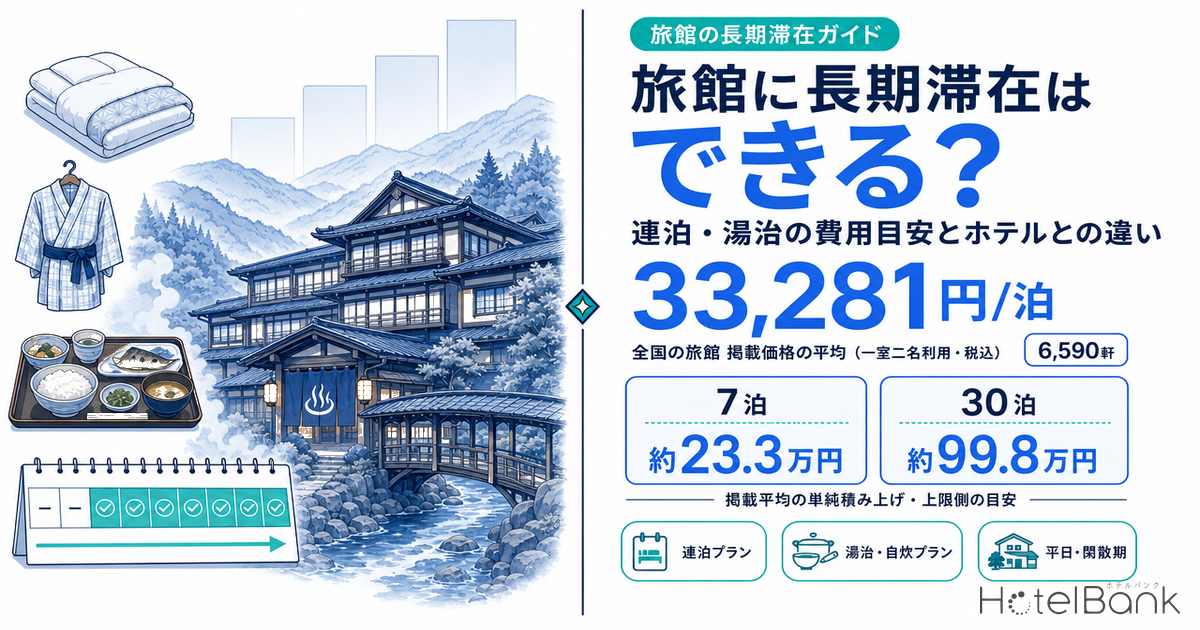
Yes, you can stay long-term at a ryokan. Ryokan with multi-night plans exist all over Japan, and the ryokan as a form of lodging has been hosting extended stays longer than anything else in the country, through the tradition of toji (湯治, therapeutic hot spring stays). As a cost benchmark, start from the average OTA listed price across 6,590 ryokan in Japan, ¥33,281 per night (per room for 2 guests, tax included, as of September 2026): that comes to about ¥233,000 for 7 nights and about ¥998,000 for 30 nights. This is an upper-end estimate, because listed prices include many plans with two meals. Switching to toji plans, room-only stays or a weekday-centered schedule brings it down considerably. This article walks through the price evidence, cost estimates by number of nights, how to find ryokan with multi-night plans, and how a ryokan long stay differs from a hotel one.
- — Long ryokan stays are possible. Three kinds of plans make them work: multi-night plans, toji and self-catering plans, and workation or long-stay plans.
- — The average listed price is ¥33,281 per night (6,590 ryokan nationwide, per room for 2 guests, tax included, September 2026). That is about 2.1 times the ¥15,625 for business hotels, and it includes two meals and hot spring baths.
- — About ¥233,000 for 7 nights and about ¥998,000 for 30 nights (total per room for 2). Per person that is about ¥116,000 and about ¥499,000, an upper-end estimate from simply multiplying the average.
- — Three ways to cut the cost: toji or self-catering plans, switching to room-only or breakfast-only, and scheduling around weekdays and the off-season.
- — Choose between a ryokan and a hotel by purpose. A ryokan suits a stay centered on rest and hot springs with meals taken care of; a hotel suits keeping your work going and living at your own pace.
Can You Stay Long-Term at a Ryokan? Multi-Night Plans and the Culture of Toji
In short, a long stay at a ryokan is nothing unusual. The standard ryokan stay with dinner and breakfast is designed to be complete in a single night, but alongside it there has long been a way of operating built around consecutive nights.
The prime example is toji: the custom of staying at a hot spring town for a week to several weeks and bathing in the waters day after day. In the hot spring towns of Tohoku and the mountains, ryokan with communal kitchens and dedicated toji wings (湯治部) still take guests for extended stays. Meals at toji inns are not the one-night-complete style of a kaiseki course; they rotate a menu you can eat every day without tiring of it. The system from an era when long stays were the norm is still alive.
Today, ryokan offer three main options for long stays.
- Multi-night (renpaku) plans — The dinner menu changes from the second night, or special rates apply for consecutive nights. The plan name on booking sites says 連泊 (renpaku, consecutive nights)
- Toji and self-catering plans — Room-only stays or simple meals keep the nightly rate down, designed for stays measured in weeks
- Workation and long-stay plans — Offered on weekdays or in the off-season by ryokan that normally serve short-stay guests
In other words, the idea that a ryokan means one or two nights is just a modern booking habit. On the ryokan side, both the culture and the systems for hosting long stays are there. The real questions are the cost and how to find such ryokan.
Measured Costs: Ryokan in Japan Average ¥33,281 per Night in Listed Prices
Across the OTA listed prices of 6,590 ryokan nationwide compiled by the HotelBank Editorial Team (as of September 2026), the average is ¥33,281 per night. The key point is the price unit: this is the rate per room when two guests share (tax included). Per person, it works out to about ¥16,600 per night. Note also that a large share of ryokan plans include two meals, so the basis differs from hotel listed prices, which are mostly room-only.
| Category | Average listed price (per night, room for 2, tax incl.) | Properties (N) |
|---|---|---|
| Resort hotel | ¥46,032 | 1,845 |
| Ryokan | ¥33,281 | 6,590 |
| City hotel | ¥26,434 | 1,383 |
| Pension | ¥24,991 | 1,501 |
| Minshuku (family-run guesthouse) | ¥21,232 | 1,409 |
| Business hotel | ¥15,625 | 7,900 |
Source: HotelBank Editorial Team research. Average listed prices from public OTA data (daily listed prices by municipality, averaged across municipality × day; as of September 2026; rate per room for 2 guests, tax included). These are listed prices and differ from actual booked prices and plan-specific prices.
The ryokan average is about 2.1 times that of business hotels, largely because it is a price for the whole stay: dinner and breakfast, hot spring or large communal baths, and the room’s furnishings. When comparing long-stay costs, the fair measure is the total daily spend, adding what you would pay for meals elsewhere. In the same data as of August 2026, ryokan were ¥35,252 and business hotels ¥15,959 (2.2 times), so the level moves from month to month. Before booking a long stay, it is worth checking the ryokan’s toji rates and whether the local bathing tax (入湯税, nyutozei) is included in the quoted price.
What Do 7 or 30 Nights Cost? Estimates from the Listed Average
Multiplying the listed average of ¥33,281 per night by the number of nights gives these benchmarks.
| Nights | Total per room for 2 (tax incl.) | Per person |
|---|---|---|
| 1 night | ¥33,281 | about ¥16,600 |
| 7 nights | ¥232,967 | about ¥116,500 |
| 14 nights | ¥465,934 | about ¥233,000 |
| 30 nights | ¥998,430 | about ¥499,200 |
To be clear about the assumptions: these figures are a simple multiple of the national average, an upper-end estimate based on listed prices that include many two-meal plans. In an actual long stay, three things bring the cost down significantly.
- At inns with toji or self-catering plans, the nightly rate can be less than half that of a two-meal plan
- Switching to room-only or breakfast-only puts meals under your own control
- A schedule built around weekdays and the off-season changes listed price levels even at the same inn
To compare a month’s accommodation costs with hotels, see our measured breakdowns of a month of hotel living in Japan and two weeks of hotel living.
How to Find Ryokan with Multi-Night or Long-Stay Plans
These steps narrow down ryokan that accept long stays efficiently.
1. Search plan names on booking sites
Entering 連泊 (renpaku, consecutive nights), 湯治 (toji), 長期滞在 (long stay) or ワーケーション (workation) in the keyword search brings up inns with dedicated plans. Japanese booking sites sometimes list plans with a minimum-night condition such as 【7泊以上】 (7 nights or more), or plans that state a multi-night discount.
2. Search availability for your actual number of nights
If you want 7 nights, search with a 7-night date range. Inns that don’t accept consecutive stays drop out at this point, leaving only those that can host you.
3. Confirm how multi-night stays work on the official website
Meals matter most. If you stay several nights on a two-meal plan, how the menu changes from the second night shapes how satisfying the stay is. An inn that states something like “the menu changes daily for consecutive stays” on its dining page or FAQ is showing that it hosts multi-night guests routinely. For concrete examples of inns that officially state they change the menu, see this analysis of ryokan that publish their consecutive-night menus (in Japanese).
4. Consider a toji inn
For stays measured in weeks, a toji inn designed from the start for long stays makes sense in terms of both cost and comfort. Check the official website for a communal kitchen and for the toji wing’s rate structure.
How It Differs from a Hotel Long Stay: Not Which Is Better, but Which Fits
Ryokan and hotels each have clear strengths for long stays. Rather than ranking them, the right approach is to choose by the purpose of your stay.
| Ryokan long stay | Hotel long stay | |
|---|---|---|
| Meals | Two meals are standard, so you don’t have to think about food. Toji inns also allow self-catering | Freedom to arrange eating out and cooking at your own discretion |
| Hot springs and bathing | Many inns let you use hot springs or large baths every day | Available if you choose a property with a large communal bath |
| Housekeeping and service | Hands-on service, including daily cleaning and futon laid out and put away | Some properties let you choose cleaning frequency, making it easier to keep your own routine |
| Work environment | An out-of-the-ordinary setting suited to focus or rest | Strong on work continuity: desk, Wi-Fi and location |
| Best for | Stays centered on rest, recuperation or hot springs; people who want meals and daily life taken care of | Business trips or an extension of city life; people who want to live at their own rhythm |
If you are planning a hotel long stay, our data on how long-stay discounts scale at 7, 14 and 30 nights and three ways to handle meals during a hotel long stay help with budgeting. Put both ryokan and hotels on your list, and decide by how you rank meals, bathing and work environment.
Where to Look Further
For side-by-side comparisons of specific inns, these articles (in Japanese) go into detail.
How to change the second night’s meal: three inns that redesign the menu for consecutive stays (wabistay)
A reading of three inns that state on their official websites that they change the menu for consecutive stays: Sekizenkan Honkan (積善館 本館) in Shima Onsen, whose toji building dates to 1694 and which says “the menu changes daily for consecutive stays”; Meigetsuso (名月荘) in Yamagata, which prepares a menu different from the first night; and Echizen Onsen Heisei (越前温泉 平成), which says it changes every dish even within the same course. The comparison is based on each inn’s official wording.
Drinking as a cure: why sipping the waters has counted as part of the healing in toji villages (yadolist)
Traces the culture of insen (飲泉, drinking hot spring water) handed down in toji villages through three inns: Sengakukan (泉岳舘) at Yuya Onsen, which has a drinking fountain on the premises; Keiunkan (慶雲館) at Nishiyama Onsen, where all six baths of different character are fed directly from the source; and Izumiya Ryokan (泉屋旅館) at Tawarayama Onsen, whose public bathhouse has a drinking spot. It sharpens your picture of how to spend a toji stay.
Frequently Asked Questions
Can you stay long-term at a ryokan?
Yes. The options are multi-night plans that adjust the menu and rates from the second night, toji and self-catering plans that keep the nightly rate down with room-only stays or simple meals, and workation or long-stay plans offered on weekdays and in the off-season. In the hot spring towns of Tohoku and the mountains, ryokan with communal kitchens and toji wings still take guests for extended stays.
How much does it cost to stay at a ryokan for a week or a month?
Multiplying the average listed price across 6,590 ryokan in Japan, ¥33,281 per night (per room for 2 guests, tax included, September 2026), gives ¥232,967 (about ¥233,000) for 7 nights and ¥998,430 (about ¥998,000) for 30 nights. Per person, that is about ¥116,000 for 7 nights and about ¥499,000 for 30 nights. Because listed prices include many plans with two meals, treat this as an upper-end estimate.
How can I reduce the cost of a long ryokan stay?
Three things work: choose a ryokan with toji or self-catering plans, switch to room-only or breakfast-only and source your own meals, and build your schedule around weekdays and the off-season. With toji or self-catering plans, the nightly rate can fall to less than half that of a two-meal plan.
How do I find ryokan with multi-night plans?
Enter 連泊 (renpaku, consecutive nights), 湯治 (toji), 長期滞在 (long stay) or ワーケーション (workation) in a booking site’s keyword search, then search availability for your actual number of nights to narrow the list to places that accept long stays. Then check the official website’s dining page or FAQ for how meals are handled from the second night.
Is a ryokan or a hotel better for a long stay?
Choose by purpose, not by which is better. A ryokan suits rest and recuperation with two meals a day, daily hot spring baths and housekeeping including futon service; a hotel suits people who want to arrange their own meals and keep work going with a proper desk and Wi-Fi.
Methodology and Sources
■ Data Source
Prices are OTA listed prices from public data compiled by the HotelBank Editorial Team (as of September 2026). They are category averages, starting with 6,590 ryokan nationwide, calculated by averaging daily listed prices by municipality across municipality × day. The number of properties (N) per category is shown in the table.
■ Estimate Assumptions
All prices are on a per-room basis for 2 guests sharing (tax included). Costs by number of nights are a simple multiple of the ryokan listed average of ¥33,281 per night and do not reflect multi-night discounts, seasonal variation or day-of-week differences. Per-person figures are the room price divided by 2 and rounded to the nearest ¥100.
■ Limitations
These are listed prices and differ from actual booked prices and plan-specific prices. Ryokan listed prices include many two-meal plans, so their basis differs from mostly room-only hotels. Actual spend varies by season, day of week and plan mix, and choosing toji, self-catering or room-only plans brings it below the estimates.
Related Articles