

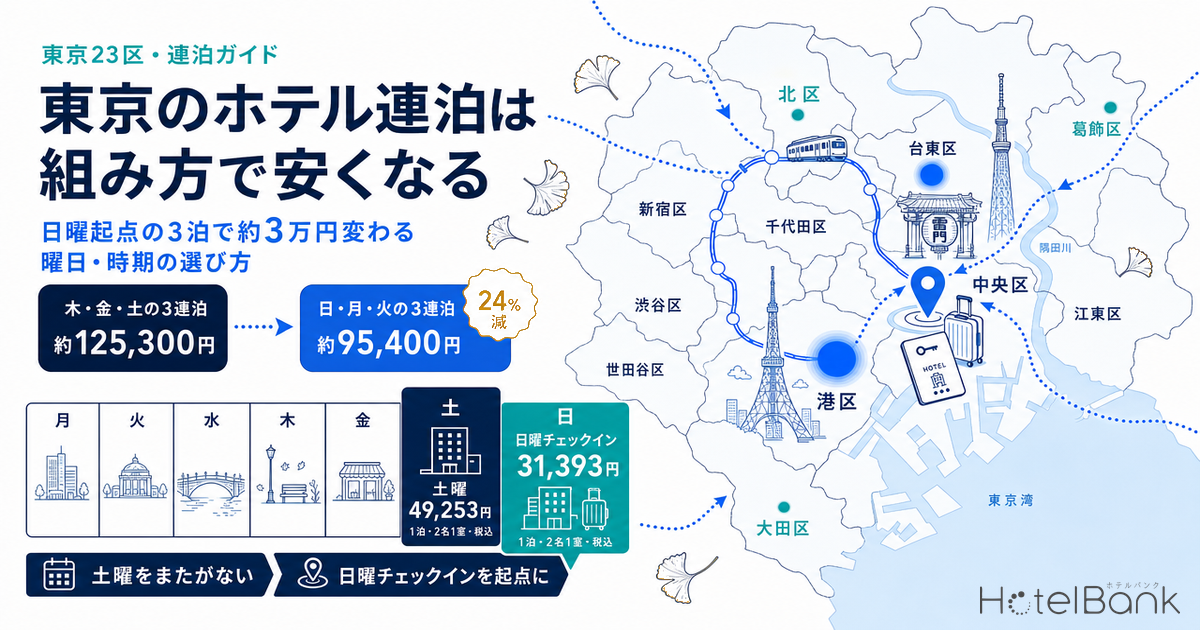
When you stay three or five nights in a row at the same hotel in Tokyo, what you pay depends heavily on which nights you include. The HotelBank Editorial Team measured OTA listed prices across Tokyo’s 23 wards (the tax-inclusive total shown on booking sites — the price readers see when they search, not the amount actually paid). A Sunday check-in cost about ¥31,400 per night versus about ¥49,300 on Saturday, a gap of roughly ¥18,000 from the day of the week alone (as of September 16, 2026; 733 properties in 14 wards). For the same three nights, Thursday–Saturday came to about ¥125,300, while Sunday–Tuesday came to about ¥95,400 — roughly ¥30,000 cheaper just by how the stay is arranged. Based on these measurements, this article lays out how to put together a cheaper multi-night stay using four levers: day of week, plan type, timing and area.
- — In Tokyo’s 23 wards, one night is cheapest on Sunday at about ¥31,400 and most expensive on Saturday at about ¥49,300 — a gap of about ¥18,000 from the day of the week alone (as of September 16, 2026; 733 properties in 14 wards).
- — Three nights cost about ¥95,400 starting on Sunday versus about ¥125,300 starting on Thursday — a difference of about ¥30,000, or 24%, from the arrangement alone.
- — For 2, 3 and 5 nights, a Sunday start is always the cheapest. Seven nights, however, cost the same whichever day you start (about ¥255,200), so the start day does not matter for a full week.
- — Saturday is not only the priciest night: it has the highest share of sold-out properties (21.1%) and the lowest share of rooms still available (24.7%), so there are fewer rooms to choose from.
- — Timing and area also bring prices down. Taito Ward was ¥37,092 in April versus ¥27,794 in June, and moving between wards — Chuo at ¥52,759 versus Kita at ¥19,165 — makes a difference of around ¥30,000 per night.
A Multi-Night Total Is the Sum of Each Night’s Price — Which Is Why the Arrangement Matters
OTA listed prices are set night by night, and the total for a multi-night stay is basically the sum of each night’s price. What drives the total, then, is not the number of nights itself but whether your stay includes the expensive nights or avoids them. Because per-night prices in Tokyo’s 23 wards swing widely by day of week and season, shifting your check-in by just a few days can change the total by tens of thousands of yen for the same room and the same number of nights.
On top of that, OTA search results list plans aimed at multi-night guests, labeled 【連泊】 (consecutive nights) or 【2泊以上】 (2 nights or more), along with early-booking and prepaid plans that sit in a lower price band than standard rates. Properties that offer multi-night plans tend to be well suited to longer stays, and combining these plans with a smart choice of days widens the savings further. The most efficient order is: decide the days of the week → choose the plan → fine-tune with timing and area.
Measured: The Choice of Days Alone Changes a 3-Night Stay by About ¥30,000
The chart below shows OTA listed prices across Tokyo’s 23 wards, compiled by day of week by the HotelBank Editorial Team. Sunday, Monday and Tuesday are the lowest at roughly ¥31,000–¥32,000 per night, Thursday and Friday sit around ¥38,000, and Saturday climbs to the ¥49,000 range.
OTA listed price by day of week, Tokyo 23 wards (1 night, 2 guests per room, tax included)
¥31,701
¥32,265
¥34,600
¥37,834
¥38,172
¥49,253
¥31,393
Source: HotelBank Editorial Team research. OTA listed prices as of September 16, 2026, compiled for 14 check-in dates from October 13 to 26, 2026 (the 14 of Tokyo’s 23 wards for which listing data was available; N=733 properties; weighted average of listed rooms; each day of week is the average of two dates).
Build a multi-night stay from these per-night prices, and the gap grows with every night you add.
| Same 3 nights | Total listed price (2 guests per room, tax included) |
|---|---|
| Stay Thursday, Friday, Saturday | approx. ¥125,300 |
| Stay Sunday, Monday, Tuesday | approx. ¥95,400 (about ¥30,000 / 24% less) |
The same pattern holds for five nights. Five nights from Sunday to Thursday total about ¥167,800 (about ¥33,600 per night on average), while five nights from Wednesday to Sunday come to about ¥191,300 — a difference of about ¥23,000 just from shifting the window toward weekdays. The period measured here covers ordinary weeks with no public holidays, but the first and middle days of a three-day holiday weekend tend to be priced like Saturdays, so if your dates are flexible the same logic applies: choose a window that does not straddle a holiday weekend.
How Much the Total Moves by Start Day and Number of Nights
Adding up the per-night prices above gives the total for every combination of check-in day and length of stay. For 2, 3 and 5 nights, a Sunday start is always the cheapest, and for 3 nights it is about ¥30,000 (23.9%) cheaper than the most expensive start, Thursday. By contrast, 7 nights cost the same — about ¥255,200 — whichever day you start. A one-week stay always includes each day of the week exactly once, so if you want to move the total, the lever works for stays shorter than a week in which you can avoid Saturday.
| Start | 2 nights | 3 nights | 5 nights | 7 nights |
|---|---|---|---|---|
| Sunday check-in | ¥63,094 | ¥95,359 | ¥167,793 | ¥255,218 |
| Monday check-in | ¥63,966 | ¥98,566 | ¥174,572 | ¥255,218 |
| Tuesday check-in | ¥66,865 | ¥104,699 | ¥192,124 | ¥255,218 |
| Wednesday check-in | ¥72,434 | ¥110,606 | ¥191,252 | ¥255,218 |
| Thursday check-in | ¥76,006 | ¥125,259 | ¥188,353 | ¥255,218 |
| Friday check-in | ¥87,425 | ¥118,818 | ¥182,784 | ¥255,218 |
| Saturday check-in | ¥80,646 | ¥112,347 | ¥179,212 | ¥255,218 |
Source: HotelBank Editorial Team research. Estimates calculated by adding up the per-night prices by day of week (chart above) for the number of nights; multi-night plan discounts are not included. The highlighted row is the cheapest start day for each length of stay.
Saturday Is Not Just “Expensive” — It Also Has the Fewest Rooms Left
The same data also shows the inventory side. On Saturday, the share of listed rooms still available is 24.7%, the lowest of the week, and the share of fully booked properties reaches 21.1%, two to four times the weekday level. The nights with high prices are also the nights with the fewest rooms to choose from. The more you want to stay in the same room throughout a multi-night trip, the harder it is to secure dates that span a Saturday.
| Day | Share of listed rooms still available | Share of fully booked properties |
|---|---|---|
| Mon | 30.2% | 5.4% |
| Tue | 28.7% | 5.8% |
| Wed | 27.0% | 7.5% |
| Thu | 25.5% | 11.8% |
| Fri | 26.8% | 10.2% |
| Sat | 24.7% | 21.1% |
| Sun | 28.8% | 6.3% |
Source: HotelBank Editorial Team research. Same dataset as the per-night prices by day of week (as of September 16, 2026; check-in dates October 13–26, 2026; 14 of Tokyo’s 23 wards; N=733 properties). The share of rooms still available is vacant rooms as a share of listed rooms; the share of fully booked properties is the proportion of properties with no vacancy found for that date.
The takeaway is simple: avoid spanning a Saturday, and if possible start with a Sunday check-in. Dropping a single Saturday night changes the total by about ¥18,000. Whether you are sightseeing or arriving the night before a business trip, if you have one day of flexibility, start by reconsidering your check-in day. Note that if you narrow the search to business hotels and pick the lowest listed price for each date, most prices fall in the ¥10,000s per night — lower than the levels here — but the conclusion is the same: avoid Saturday and shift your stay toward Sunday–Thursday.
When to Use Multi-Night, Early-Booking and Prepaid Plans
Once you have fixed the days, the next step is to lower the price through the type of plan. OTA search results often show several prices for the same room, and accepting certain conditions lets you choose a lower price band.
- Multi-night plans (labeled 【連泊】 or 【2泊以上】): Mostly plans that keep prices down in exchange for conditions such as eco-friendly cleaning every other day. Properties that offer them tend to be well suited to long stays, and these plans appear when you search for two nights or more.
- Early-booking plans (e.g. 早割14 / 28 / 60 — 14, 28 or 60 days in advance): The earlier you book once your check-in date is fixed, the wider the range of prices available. Because a multi-night stay holds one room for a long stretch, booking early also makes it easier to secure the same room for the whole stay.
- Prepaid plans: Often priced below pay-at-the-property rates. Cancellation terms tend to be stricter, which suits multi-night stays whose dates are already fixed.
- Member rates and multi-night perks on official websites: Some business hotel chains offer member rates or points for bookings through their official website or app, which can be the best deal. Once you have narrowed down your options, compare official prices as well.
Shifting the Season and Area Widens the Savings Further
Even with the same mix of days, the overall price level moves from month to month. For example, monthly listed prices in Taito Ward (2 guests per room, tax included, N=152–184 properties per month) were ¥37,092 in April 2026 versus ¥27,794 in June — a range of about ¥9,300 per night. For a multi-night stay with flexible dates, avoiding a single peak month multiplies that difference by every night you stay. The monthly figures for Taito Ward are from HotelBank Editorial Team research (monthly listed prices from September 2025 to September 2026, 2 guests per room, tax included). Across Tokyo as a whole, over the 12 months from August 2025 to July 2026, June was the cheapest month, and November, the most expensive, was 1.33 times higher.
Your choice of area matters too. The ward-level figures below are all from HotelBank Editorial Team research (monthly listed prices for September 2026). The listed price for Tokyo’s 23 wards as a whole was ¥35,133 per night (average weighted by number of properties, 2 guests per room, tax included, N=957 properties, as of September 2026), but price levels vary widely by ward within that average. In September 2026, Chuo Ward was ¥52,759 and Minato Ward ¥48,144, while Kita Ward was ¥19,165, Katsushika Ward ¥19,770 and Ota Ward ¥19,953 — shifting wards makes a difference of around ¥30,000 per night. Basing yourself outside the Yamanote Line loop or in the eastern and northern parts of the city and commuting into central Tokyo by train pays off more the longer you stay. Taito Ward has the largest number of listed properties among the 23 wards (183 properties, averaging ¥32,978), offering a wide range of price points and making it an easy base for a multi-night stay. For how to choose accommodation in the Kuramae and Asakusabashi area, for example, see “Leather, paper and the smell of coffee: two adults walking Kuramae and Asakusabashi from artisan shop to artisan shop — 7 hotels within walking distance on the east bank of the Sumida River, with map” (HotelPicks, in Japanese).
For a full cost simulation of a 7-night stay including food and laundry, see our separate article, “One Week of Hotel Living in Tokyo: ¥88,200 for 7 Nights, Any Start Day,” if you want to estimate your overall budget.
To Search in More Detail
For side-by-side comparisons of specific hotels, the following articles (in Japanese) go into detail.
Set in Taito Ward, which has the most listed properties of the 23 wards, this article compares seven hotels — including Nest Hotel Orto Kuramae Ekimae (ネストホテルオルト蔵前駅前), a one-minute walk from Kuramae Station, and Tosei Hotel Cocone Asakusa Kuramae (トーセイホテル ココネ浅草蔵前), with a large public bath for guests — with guide prices (from ¥16,000 per night for 2 guests per room) and a map of walking routes.
An overview of five hotels near stations in Bunkyo Ward that work as a base for multi-night business trips. It compares weekday guide prices and routes from the station for properties such as Kasuga no Yu Dormy Inn Korakuen (春日の湯 ドーミーイン後楽園), a one-minute walk from Kasuga Station with a large bath and sauna, and Richmond Hotel Tokyo Suidobashi (リッチモンドホテル東京水道橋), whose 196 rooms are designed as well-equipped workspaces.
Frequently Asked Questions
Do Tokyo hotels automatically get cheaper if I stay several nights?
Listed prices are set night by night, and the total for a multi-night stay is basically the sum of each night’s price. So the total moves not because you add nights but because of which days of the week you include. In Tokyo’s 23 wards, three nights starting on Sunday cost about ¥95,400 and three nights starting on Thursday about ¥125,300 — a gap of about ¥30,000, or 24%, for the same three nights (as of September 16, 2026; 733 properties in 14 wards).
Which check-in day is the cheapest?
In Tokyo’s 23 wards, a Sunday check-in is the cheapest and gave the lowest total for 2, 3 and 5 nights alike. Per night, Sunday is about ¥31,400, Monday about ¥31,700 and Tuesday about ¥32,300 — the start of the week is lowest — while Saturday stands out at about ¥49,300.
Does the day of the week matter for a 7-night stay?
Seven nights always include each day of the week exactly once, so the total listed price stays at about ¥255,200 whichever day you start. For a one-week stay, your choice of month and ward matters more than the start day.
Besides price, is there any other difference if I avoid Saturday?
Yes. On Saturday, the share of listed rooms still available is 24.7%, the lowest of the week, and 21.1% of properties are fully booked — two to four times the weekday level. Nights with high prices also have fewer rooms to choose from, so the more you want to stay in the same room throughout a multi-night trip, the easier it is to secure dates that do not span a Saturday.
Where should I look for multi-night plans?
The three main types are plans labeled 【連泊】 (consecutive nights) or 【2泊以上】 (2 nights or more) in search results, early-booking plans such as 早割14 / 28 / 60 (14, 28 or 60 days in advance), and prepaid plans. They let you choose a lower price band in exchange for conditions such as less frequent cleaning or stricter cancellation terms. After narrowing down your options, comparing member rates on the property’s official website or app widens your choices further.
How much difference does changing the area make?
In Tokyo’s 23 wards in September 2026, Chuo Ward was ¥52,759 and Minato Ward ¥48,144, versus ¥19,165 in Kita Ward, ¥19,770 in Katsushika Ward and ¥19,953 in Ota Ward — shifting wards alone made a difference of around ¥30,000 per night. Taito Ward has the most listed properties at 183, offering a wide range of price points and making it an easy base for a multi-night stay.
Methodology and Sources
■ Data Sources
Per-night prices by day of week, the share of rooms still available and the share of fully booked properties are HotelBank Editorial Team’s own aggregation of publicly listed prices and public inventory on hotel booking sites. The data covers 14 check-in dates from October 13 to 26, 2026, observed as of September 16, 2026, and averages a cumulative 733 properties in the 14 of Tokyo’s 23 wards for which observation data was available, weighted by the number of listed rooms. All prices are per room, for 2 guests per room, tax included. Ward-level and monthly listed prices use the monthly series from the same aggregation (ward-level: September 2026; Taito Ward monthly: September 2025 to September 2026).
■ Calculation Assumptions
The multi-night totals in Tables 1 and 2 are estimates obtained by adding up the per-night prices by day of week for the number of nights from the check-in date. They do not include discounts from multi-night plans, early-booking plans, prepaid plans or member rates. The 14-day period covers ordinary weeks with no public holidays and does not reflect price levels during holiday weekends or major events. The 23-ward average in the ward-level figures is the average of each ward’s listed price weighted by the number of listed properties.
■ Limitations
Listed prices are the prices displayed on booking sites, not the amounts actually paid. Coverage is limited to properties for which listing data was available, and 9 of the 23 wards were not included in the observation for this period. Because the mix of hotel grades differs by ward, price gaps between wards reflect differences in property mix as well as location. Figures are as of the observation date and change with booking timing and room availability even for the same dates. They cannot be used to compare or rank the price levels of specific properties or chains.
■ References
This article draws on HotelBank’s own earlier analyses (in Japanese) of stays by number of nights (“Multi-night stays in Tokyo are cheaper when shifted toward Sunday–Thursday”), monthly price levels (“Tokyo listed prices peak in November and bottom out in June, a 1.33x gap”), and the total cost of a 7-night stay (“One week of hotel living: 7 nights in Tokyo for about ¥88,000”).
Related Articles