

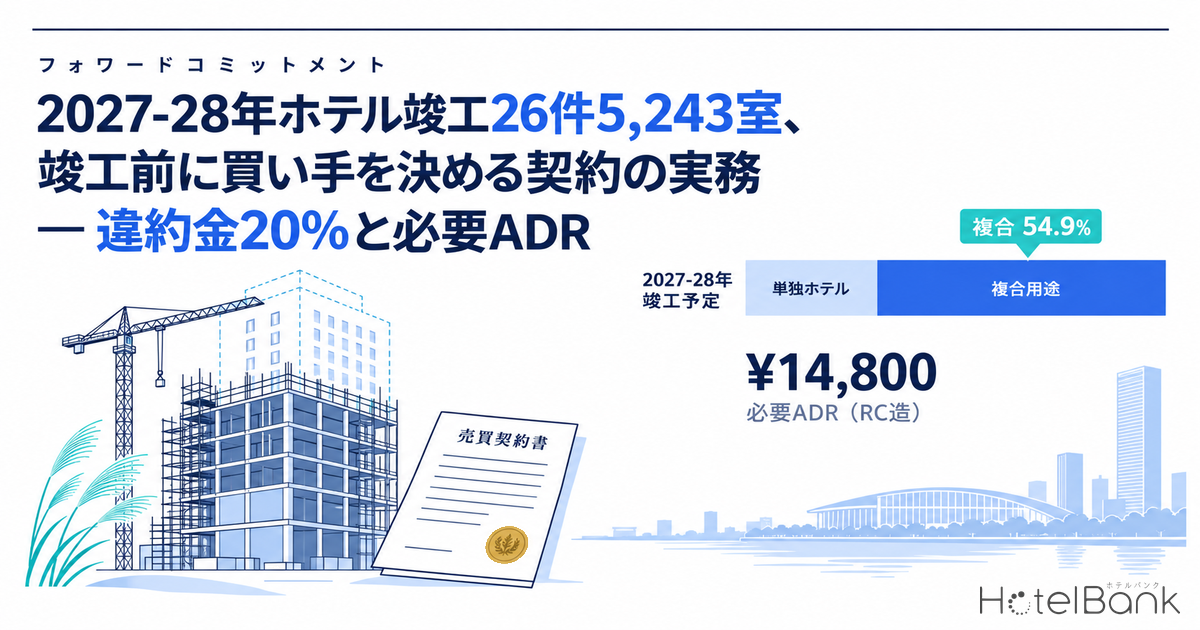
Whether a hotel development succeeds is often decided before construction even starts. The reason is that a contract fixing the future sale price and handover terms at a stage when not a single building has gone up — a forward commitment — determines whether the project finance can be put together at all. This article focuses squarely on that contract, the one that locks in a buyer before completion. We lay out the structure of the contract, the penalty levels that can be confirmed in actual disclosure documents, and set them against a pipeline of 26 projects and 5,243 rooms scheduled for completion in 2027–2028, compiled from the Ministry of Land, Infrastructure, Transport and Tourism’s (MLIT) building plan data. Finally, for four major projects, we back-calculate the ADR level needed for the hotel floor space to justify today’s construction costs.
Metric Definitions Used in This Article
- Forward commitment: A contract that fixes, at the present time, the future sale of a property that has not yet been completed. Under the Financial Services Agency’s (FSA) “Comprehensive Guidelines for Supervision of Financial Instruments Business Operators, etc.,” a “forward commitment, etc.” is defined more broadly as “a forward-dated sale and purchase agreement under which settlement and delivery of the property take place one month or more after the contract is signed, or any other similar agreement.” This is a different concept from the “forward ADR” (prices posted in advance for future stay dates) that our articles have used until now, and it is never used in that sense in this article.
- ADR (Average Daily Rate): An estimated settled rate (tax-excluded equivalent), calculated by applying segment-specific adjustment factors to the lowest-plan price level each property publishes on OTAs and elsewhere (two guests per room, per-room rate, tax included). Checked against property-level results disclosed by listed hotel REITs (91 properties, latest three months), the median error is approximately 7%. These are estimates and differ from each property’s actual transaction prices and accounting figures. Area-level ADR is based on the median of the target properties and represents the level of a typical property in the area.
- RevPAR, GOP and cap rate: RevPAR is room revenue per available room (ADR × occupancy). GOP (gross operating profit) is revenue minus operating expenses, i.e., profit before rent and depreciation. The cap rate is annual net income (in this article, the rent equivalent) divided by price; we use supportable price = annual rent ÷ cap rate.
- Pipeline: Building plan summaries (based on building confirmation applications) drawn from MLIT’s “Building Starts and Completions Statistics” and related sources. They do not indicate opening dates, operators or brands.
- Data sources: MetroEngines Research & Consulting / MLIT “Building Starts and Completions Statistics”
Source: MetroEngines Research & Consulting / MLIT “Building Starts and Completions Statistics” / timely disclosures of each investment corporation
- — 26 projects, 5,243 rooms: Hotel plans with 50 or more rooms scheduled for completion in 2027-28 (based on building confirmation applications). The 2028 figure of 8 projects and 1,428 rooms is a floor that will rise as further applications are filed.
- — Penalty of 20% of the sale price: From a July 2025 disclosure by Nippon Hotel & Residential Investment Corporation. Where a clause makes financing a condition precedent, the buyer can walk away from the contract without a penalty.
- — Mixed-use reaches 54.9% of rooms: Up 23.5 points from 31.4% for 2025-26 completions. Selling before completion requires carving out the hotel floor space through strata title or a trust.
- — Required ADR of around ¥14,800: Estimated for RC structure, 40㎡ gross floor area per room, a 5.3% yield and 80% occupancy (assumed). Chiba Mihama Ward needs +11% on current levels, while Okayama Kita Ward and Utsunomiya need roughly double; depending on assumptions, the figure moves from ¥12,700 to ¥17,600.
- — Preferred equity plus right of first negotiation: For a listed REIT three years before completion, the realistic landing point is a structure that carries no acquisition obligation and defers price-setting until after completion (United Urban Investment Corporation, Hakone Gora).
Drawing the Line with Our Earlier Coverage — This Article Is About the Contract Alone
We have previously examined the timeline and financing of hotel development from separate angles. Our earlier article, Hotel Build Times: 2.80-Year Median, 1.96 Solo vs 4.00 Mixed-Use, dealt with the construction period itself from groundbreaking to completion; other pieces have covered vintage gaps and supply-demand balance in regional designated cities facing 300-room-class projects around 2028, and acquisition-stage debt capacity (LTV of 57–63% for a 100-room, ¥3 billion hotel).
This article overlaps with none of them. It deals only with contract structures that lock in the sale itself before completion — in many cases, before construction even begins. The length of construction and the supply-demand balance are referred to in a line or two, only as variables that determine whether such a contract can be concluded.
One terminology note up front. In our articles, the word “forward” has almost without exception meant forward ADR — prices posted in advance on OTAs for future stay dates. The “forward commitment” in this article is an entirely different concept: a contract that fixes, today, the future sale of a property that has not yet been completed. It is not about posting prices in advance, but about locking in a sale in advance.
Anatomy of the Contract — More Than One Month Triggers a Disclosure Obligation
The legal entry point is terse. The FSA’s “Comprehensive Guidelines for Supervision of Financial Instruments Business Operators, etc.” define forward commitments, etc. as “a forward-dated sale and purchase agreement under which settlement and delivery of the property take place one month or more after the contract is signed, or any other similar agreement.” In other words, targeting a property under development is not a requirement: if more than one month separates contract and settlement, even the sale of a completed, existing property can qualify. In J-REIT timely disclosures, it has become established practice to set up a separate section titled “Matters concerning forward commitments, etc.” for transactions meeting this definition, explaining the financial impact if the contract cannot be performed.
Reading the actual disclosures, the structure of this section is remarkably standardized. In the “Notice Concerning Acquisition and Leasing of Asset (Okinawa Marriott Resort & Spa)” released by Japan Hotel REIT Investment Corporation (ジャパン・ホテル・リート投資法人) on June 4, 2015, the sale agreement was signed on June 4, 2015 and the settlement and delivery date was July 10 of the same year — a 36-day gap. The disclosure states that “the trust beneficiary interest transfer agreement may be terminated on the grounds of a breach of obligations under the agreement, in which case the party in breach shall pay the counterparty a certain percentage of the purchase price.” The planned acquisition price was ¥14,950 million.
What is easily overlooked is the next sentence in the same disclosure: “The trust beneficiary interest transfer agreement for the asset to be acquired includes a special provision making the Investment Corporation’s borrowing of funds … or other financing a condition precedent to payment of the purchase price. Accordingly, if borrowing or other financing for payment of the purchase price is not obtained, the agreement will terminate without payment of any penalty or the like.” If a financing contingency (a clause making financing a condition precedent) is attached, the buyer can walk away from the contract without a penalty. When assessing the risk of a forward commitment, the presence or absence of this clause should be checked before the penalty rate.
Penalties Are Said to Be 10–20% of the Price — and 20% Appears in an Actual Filing
On penalty levels, real estate practice guides commonly state that “in many cases, a penalty equivalent to 10–20% of the sale price arises.” As a matter of editorial policy, however, we cannot state such market norms as anything more than “generally said to be.” The only thing we can assert definitively is the figure written into a contract that has actually been disclosed.
A clear example is the “Notice Concerning Transfer of Domestic Real Estate (Oedo Onsen Monogatari Kimitsu-no-Mori, Oedo Onsen Monogatari Kounkaku)” released by Nippon Hotel & Residential Investment Corporation (日本ホテル&レジデンシャル投資法人) on July 4, 2025. The sale agreement was signed on July 4, 2025, the scheduled transfer date was August 29, 2025, and the planned transfer price was ¥1,897 million for the two properties combined. After stating explicitly that the agreement constitutes a forward commitment, etc., the disclosure reads: “If either party intentionally or negligently breaches a material obligation stipulated in the sale agreement, the other party may, after issuing a demand with a reasonable cure period, terminate the agreement and claim from the counterparty, as liquidated damages, an amount equivalent to 20% of the transfer price as a penalty.”
Fifty-six days from contract to settlement and a penalty of 20% of the price: this is what a forward commitment actually concluded by a listed investment corporation looks like. On a ¥1,897 million transaction, the penalty comes to about ¥379 million. The disclosure itself assesses that “the possibility of a material impact on the Investment Corporation’s finances and distributions is low,” but that can be said precisely because the counterparty is a listed investment corporation and the settlement period is under two months. Take on a penalty at the same rate for a development project completing three years out, and the burden grows heavier in proportion to the length of the settlement period.
Four Structures Confirmed in Disclosures — Firm Sales, Rights of First Negotiation and Development Funds
There is more than one way to secure a buyer’s involvement before completion. Lining up the cases whose original text we could confirm in IR materials reveals two designs with different risk allocations running side by side: one that “fixes the sale” and one that “stops at a right of first negotiation.” The list below is limited to cases where the contract date, handover timing and contract form could be confirmed in a disclosure or official release.
| Announced | Project / party | Contract form | Contract → settlement / completion | Price / investment |
|---|---|---|---|---|
| June 4, 2015 | Okinawa Marriott Resort & Spa Japan Hotel REIT Investment Corporation | Trust beneficiary interest transfer agreement qualifying as a forward commitment, etc. Includes a clause making financing a condition precedent to payment (terminates without penalty if financing fails) | 2015/6/4 → 2015/7/10 (36 days) | ¥14,950 million |
| July 4, 2025 | Oedo Onsen Monogatari Kimitsu-no-Mori / Kounkaku Nippon Hotel & Residential Investment Corporation (seller) | Sale agreement qualifying as a forward commitment, etc. On a material breach, 20% of the transfer price can be claimed as a penalty | 2025/7/4 → 2025/8/29 (56 days) | ¥1,897 million (2 properties) |
| August 25, 2025 | (Tentative) Ginza Tsukiji Hotel Project (18 rooms) CREAL / Showa Leasing / Pluga Capital (プルーガ・キャピタル) | Forward-commitment-type fund fixing price and terms for a property before completion on the premise of future handover. Senior loan from The Chugoku Bank; Showa Leasing as financial advisor | Announced 2025/8/25 → completion scheduled Oct 2026 | Undisclosed |
| September 4, 2026 | Planned Rihga-branded hotel in Hakone Gora (tentative name: ノワ・バイ・リーガ 箱根強羅, 90 rooms) United Urban Investment Corporation | Preferred equity in a development-stage TMK (about 14.3% of the total) + right of first negotiation. No acquisition obligation. Tenant risk mitigated by a reservation agreement for a fixed-term building lease | Subscription agreement 2026/9/7 → completion scheduled Sep 2028 Negotiation right expires end of Sep 2031 | ¥166,500,000 + ¥77,300,000 |
Source: Compiled by MetroEngines Research & Consulting from the original text of each investment corporation’s and company’s timely disclosures and official releases
Of these four, the most recent — Hakone Gora — is closest to the current standard for development deals. United Urban Investment Corporation acquired preferred equity securities in a special purpose company (TMK) before the building has been built, and in return obtained a right of first negotiation to conclude a sale agreement for the property between completion (around September 2028) and the end of September 2031. The disclosure states plainly: “The right of first negotiation is held by the Investment Corporation as a right, and it does not bear any obligation to acquire the property in the future.” The sale price, too, is to be “determined as agreed upon through good-faith consultation … taking into account the hotel’s actual sales performance, financial and economic trends, and financing conditions,” and is not fixed at present.
In other words, this is not a forward commitment (fixed price, acquisition obligation) but an option (price not fixed, no acquisition obligation). Development risk is borne up to the amount invested (about ¥240 million), while price risk is left to post-completion negotiation. It shows how deep a listed investment corporation can realistically go on a three-years-to-completion timeline.
The other design is the Ginza Tsukiji case. Here, an unlisted fund fixes price and terms before completion, a regional bank provides the senior loan, and a leasing company handles financial advisory and part of the equity. The division of roles is clear: at a stage when listed REITs find it hard to take on an acquisition obligation, an unlisted fund steps in as the pre-completion buyer, and its presence is what makes the bank’s senior loan decision possible. At 18 rooms, the project falls short of a listed REIT’s acquisition size, but because a buyer was secured before completion, the development financing came together.
The 2027-28 Pipeline Is 26 Projects and 5,243 Rooms — but That Is a Floor
From MLIT’s building plan data, we extracted plans that include hotels with 50 or more rooms, removed duplicates by location, room count, scheduled completion, main use and type of work, and tallied them by completion year. As of the survey date, we identified 70 projects with 15,517 rooms. The breakdown by completion year is as follows.
Source: Compiled by MetroEngines Research & Consulting from MLIT “Building Starts and Completions Statistics” (50+ rooms, N=70 projects)
| Scheduled completion | Projects | Rooms | Average per project | Notes |
|---|---|---|---|---|
| 2025 | 22 | 5,304 | 241 | Mostly completed / at opening stage |
| 2026 | 20 | 4,770 | 239 | Completion to pre-opening |
| 2027 | 18 | 3,815 | 212 | Main focus of this article. Under construction to about to break ground |
| 2028 | 8 | 1,428 | 179 | Main focus of this article. Confirmation applications still being added |
| 2029 | 1 | 100 | 100 | Part of a large mixed-use project |
| 2031 | 1 | 100 | 100 | Part of a large mixed-use project |
Source: Compiled by MetroEngines Research & Consulting from MLIT “Building Starts and Completions Statistics”
Major 2027-28 Projects — From a 1,000-Room Mixed-Use Complex to 300-Room Standalone Hotels
Among projects scheduled for completion in 2027–2028, we extracted those with 190 or more rooms, using the location, room count and main use exactly as stated in the building plans. Brand names and operators are not included, as they do not appear in the building plans. What is recorded is the building owner (the party filing the building plan), which does not indicate the future hotel operator or owner.
| Scheduled completion | Location | Rooms | Main use (as stated) | Floors | Building owner (as stated) |
|---|---|---|---|---|---|
| Feb 2027 | Dojimahama 2-chome, Kita Ward, Osaka City, Osaka | 220 | Condominiums for sale (514 units), hotel, offices | 40 | Mitsubishi Jisho Residence |
| Apr 2027 | Ekimae-cho 1-chome, Kita Ward, Okayama City, Okayama | 190 | Hotel, apartments, retail | 16 | Nomura Real Estate |
| May 2027 | Kitanaka-dori 6-chome, Naka Ward, Yokohama City, Kanagawa | 272 | Apartments, hotel, parking | 40 | Daiwa Jisho / Sumitomo Realty & Development |
| Jul 2027 | Onoedori 5-chome, Chuo Ward, Kobe City, Hyogo | 223 | Hotel | 12 | Daiwa House Realty Management |
| Aug 2027 | Uchikanda 1-chome, Chiyoda City, Tokyo | 261 | Hotel | 13 | APA Home / APA Mansion |
| Oct 2027 | Nihonbashi 1-chome 30–32, Chuo City, Tokyo | 197 | Retail, offices, hotel, apartments, etc. | 39 | Nihonbashi 1-chome Central District Urban Redevelopment Association |
| Dec 2027 | Hibino 1-chome, Mihama Ward, Chiba City, Chiba | 1,000 | Hotel, cinema, restaurants, bathing facility | 23 | Royal Lease |
| Dec 2027 | Shimogoryo, Furano City, Hokkaido | 200 | Hotel | 10 | Route Inn Japan |
| May 2028 | Minami 7-jo Nishi 5-chome, Chuo Ward, Sapporo City, Hokkaido | 200 | Hotel, parking | 11 | Marubeni Urban Development / Haseko Corporation / Sogo Jutaku |
| May 2028 | Maebara-nishi 2-chome, Funabashi City, Chiba | 238 | Hotel | 14 | Toyoko Inn |
| Oct 2028 | Ikegami-cho, Utsunomiya City, Tochigi | 300 | Hotel (300 rooms), restaurant, machine room (B1F) | 14 | Ikegami-cho District Quality Building Development Association |
| Dec 2028 | Nodaya-cho 1-chome, Kita Ward, Okayama City, Okayama | 300 | Residential, hotel, retail | 12 | Nodaya-cho District Urban Redevelopment Preparatory Association |
Source: Compiled by MetroEngines Research & Consulting from MLIT “Building Starts and Completions Statistics” (scheduled for completion 2027-28, 190+ rooms, N=12 projects). Uses and building owners as stated. Opening dates, operators and brands are not included
The first thing that stands out among these 12 projects is the 1,000 rooms at Hibino 1-chome, Mihama Ward, Chiba City. Its uses are “hotel, cinema, restaurants, bathing facility,” with 23 floors above ground and completion scheduled for December 2027. As a single plan it is in a league of its own, accounting for 26.2% of the 18 projects and 3,815 rooms due in 2027 on its own. That said, a composition that folds in a cinema and a bathing facility sits awkwardly with the framework of a pure sale of lodging floor space. Either a design that carves out only the hotel floors as strata title or trust beneficiary interests is a prerequisite, or the plan is quite likely premised on the developer holding it — that is as far as the stated uses allow us to read. We examine the scale of this plan and how far Chiba City’s existing stock can absorb it separately in Kaihin-Makuhari 1,000-Room ¥30bn Mixed-Use: Breakeven ADR ¥13,200.
Distribution of 190+ room projects scheduled for completion in 2027-28 (approximate locations based on the addresses in the building plans). Circle size indicates room count. Source: Compiled by MetroEngines Research & Consulting from MLIT “Building Starts and Completions Statistics”
Mixed-Use Share Rises from 31% to 55% of Rooms — Carve-Out Designs Become a Prerequisite
One structural variable that determines whether a pre-completion sale can be concluded is whether the plan is a standalone hotel or combined with residential, office or retail uses. A standalone hotel can simply be sold as a whole building, but mixed-use requires a design that carves out only the hotel floors through strata title or a trust beneficiary interest, and issues such as management bylaws, allocation of common-area costs and securing the operator’s circulation routes must be settled before the sale agreement. A contract that fixes the price three years before completion cannot even be signed unless this groundwork is finished.
We tested this hypothesis against the distribution of stated uses. Classifying plans whose main use includes residential, office, shops, commercial, food and beverage, entertainment and the like as “mixed-use,” and hotels (including those listing only parking or machine rooms alongside) as “standalone,” gives the following result.
Source: Compiled by MetroEngines Research & Consulting from MLIT “Building Starts and Completions Statistics” (N=68 projects, excluding 2 projects due in 2029 or later)
| Completion period | Standalone hotel | Mixed-use | Mixed-use share (rooms) | Mixed-use share (projects) |
|---|---|---|---|---|
| 2025-26 (completed to near-term) | 31 projects · 6,909 rooms | 11 projects · 3,165 rooms | 31.4% | 26.2% |
| 2027-28 | 15 projects · 2,364 rooms | 11 projects · 2,879 rooms | 54.9% | 42.3% |
Source: Compiled by MetroEngines Research & Consulting from MLIT “Building Starts and Completions Statistics”
The hypothesis holds. The mixed-use share by rooms rose 23.5 points from 31.4% to 54.9%, meaning that the majority of the pipeline completing in 2027-28 will be mixed-use. By project count, too, the share rose from 26.2% to 42.3%. The difference in scale is also clear: across all 70 projects surveyed, the median height of mixed-use projects is 29 floors versus 11 for standalone projects, and the median room count is 208 for mixed-use versus 179.5 for standalone. Limiting the view to the 26 projects completing in 2027-28, the gap widens further, with median heights of 32 floors for mixed-use and 10 for standalone.
The practical implication is simple. More than half of the hotel floor space completing in 2027-28 will need to be carved out through strata title or a trust if it is to be sold before completion. Moreover, mixed-use projects are high-rise and large, and urban redevelopment associations frequently appear as the building owner. For redevelopment-association projects, finalization of the rights conversion plan overlaps as a condition precedent, so a contract fixing the sale price three years before completion faces a hurdle one notch higher than for standalone hotels. Put the other way, the 15 standalone hotels with 2,364 rooms are the effective population in which a pre-completion whole-building sale works as is.
What Can Hotel Floor Space Sell For? — Back-Calculating from Municipal ADR
A contract that fixes the price before completion means the buyer accepts “income at the time of completion” based only on information available today. So what is the hotel floor space of the major projects worth at current area income levels? Starting from MetroEngines Research & Consulting’s estimated settled ADR (settled months, latest 12 months = September 2025 to August 2026), we estimated a supportable price per room.
(1) Occupancy (assumed) 80% (2) Room revenue only (F&B, banquets, etc. excluded) (3) Rent (NOI equivalent) = annual room revenue × 30% (conservatively assuming GOP-linked variable rent) (4) Two cap rate cases, 4.5% and 5.3%. The 5.3% figure is the level for Sendai — the highest of the eight cities in the Japan Real Estate Institute’s 54th “Japanese Real Estate Investor Survey” (as of April 2026) for expected yields on limited-service hotels — used as a proxy for regional cities outside the survey. The survey’s expected yields for limited-service hotels are Tokyo 4.1%, Osaka 4.5%, Kyoto 4.5%, Fukuoka 4.7%, Nagoya 4.9%, Sapporo 5.0%, Naha 5.0% and Sendai 5.3% (5) ADR is an estimate and differs from actual transaction prices and accounting figures
* This is a simplified estimate; an actual investment decision requires a detailed feasibility study.
| Project municipality | Estimated settled ADR latest 12-month avg. | Properties covered | RevPAR (80% assumed) | Supportable price per room @4.5% | Supportable price per room @5.3% |
|---|---|---|---|---|---|
| Chiba City, Mihama Ward (1,000 rooms, completion scheduled Dec 2027) | ¥13,400 | 12 | ¥10,700 | ¥26.1M | ¥22.1M |
| Yokohama City, Naka Ward (272 rooms, completion scheduled May 2027) | ¥11,600 | 51 | ¥9,300 | ¥22.6M | ¥19.2M |
| Okayama City, Kita Ward (300 rooms, completion scheduled Dec 2028) | ¥7,900 | 47 | ¥6,400 | ¥15.5M | ¥13.1M |
| Utsunomiya City (300 rooms, completion scheduled Oct 2028) | ¥7,300 | 50 | ¥5,800 | ¥14.2M | ¥12.1M |
Source: MetroEngines Research & Consulting (estimated settled ADR, average of settled months September 2025 to August 2026) / Japan Real Estate Institute, 54th “Japanese Real Estate Investor Survey” (as of April 2026) / MLIT “Building Starts and Completions Statistics”
Setting these supportable prices against construction costs brings the issue into focus. Hotel construction costs for 2025 based on MLIT’s Building Starts Statistics were ¥1.952 million per tsubo on average across all structures, ¥2.026 million per tsubo for reinforced concrete (RC) and ¥2.405 million per tsubo for steel (S), remaining well above the 2022 all-structure average of ¥1.38 million. Assuming 40㎡ (12.1 tsubo) of gross floor area per room including common areas, construction cost alone comes to about ¥24.5 million per room for RC and about ¥29.1 million for S, excluding land. Per-room construction costs vary widely by hotel type — from roughly ¥8.7 million to ¥71.4 million per room when split into three tiers — and the ADR needed to make each tier work differs accordingly.
Source: MetroEngines Research & Consulting (estimated settled ADR, average of settled months September 2025 to August 2026, N=12–51 properties) / MLIT “Building Starts Statistics” / Japan Real Estate Institute, 54th “Japanese Real Estate Investor Survey”
Under the assumptions of a 5.3% cap rate and RC construction, making a per-room price that matches construction cost work requires an ADR of around ¥14,800 (around ¥12,600 at 4.5%). Comparing this required level with each area’s current estimated settled ADR gives the following.
| Project municipality | Current estimated settled ADR | Required ADR (RC, 5.3%) | Required increase | Reading |
|---|---|---|---|---|
| Chiba City, Mihama Ward | ¥13,400 | ¥14,800 | +11% | Already within range. Capturing large-event demand could close the gap to construction cost |
| Yokohama City, Naka Ward | ¥11,600 | ¥14,800 | +28% | Depends on common-area cost allocation in the mixed-use scheme. Co-development with housing is effectively a condition |
| Okayama City, Kita Ward | ¥7,900 | ¥14,800 | +87% | Hotel floor space alone structurally cannot reach construction-cost levels |
| Utsunomiya City | ¥7,300 | ¥14,800 | +103% | Same as above. Land cost advantages or subsidy schemes become a prerequisite |
Source: MetroEngines Research & Consulting (estimated settled ADR, N=12–51 properties) / MLIT “Building Starts Statistics” (2025 RC ¥2.026 million per tsubo)
The result is clear. Areas where current ADR can support fixing the price before completion are limited to a small part of the Tokyo metropolitan area. Chiba Mihama Ward is 11% short of the required level, Yokohama Naka Ward 28%. In Okayama Kita Ward and Utsunomiya — regional designated-city and prefectural-capital class markets — the calculation calls for roughly double the current ADR.
This ties back to the finding in the previous section. The rise of mixed-use to 55% of rooms in the 2027-28 pipeline is consistent with the reading that more areas can no longer recover construction costs from a hotel alone, and designs that make the whole project pencil out by combining it with housing and retail are being chosen. Indeed, the 300 rooms at Nodaya-cho, Okayama Kita Ward are “residential, hotel, retail” and the 272 rooms at Kitanaka-dori, Yokohama Naka Ward are “apartments, hotel, parking” — both co-developed with housing. The 300 rooms at Ikegami-cho, Utsunomiya are a hotel-led plan of “hotel (300 rooms), restaurant,” not co-developed with housing (in our classification it counts as mixed-use because a restaurant is listed), and the type of work is recorded as “reconstruction,” so new-build construction cost assumptions may not apply directly.
For those seeking to lock in as buyers before completion, the decision criteria boil down to three. First, whether the hotel floor space is designed so that it can be carved out through strata title or a trust (in mixed-use projects, sorting out the property rights is a condition precedent to the sale agreement). Second, how far the ADR required at completion is from current area levels; the required increases in the table above become the underwriting assumptions as they stand. Third, whether a clause making financing a condition precedent is attached. If it is, the buyer can walk away without a penalty; if not, a penalty equivalent to 20% of the transfer price becomes a real burden.
Sensitivity of Required ADR — Assumptions on Occupancy, Rent Ratio, Yield and Floor Area Move It from ¥12,700 to ¥17,600
The required ADR of ¥14,800 in the previous section is a point estimate resting on a single set of assumptions: 80% occupancy (assumed), a 30% rent ratio, a 5.3% cap rate and 40㎡ of gross floor area per room. In a contract that fixes the price three years before completion, these assumptions themselves become the risk the buyer takes on. We therefore recalculated the same formula (required ADR = construction cost per room × cap rate ÷ (occupancy × 365 days × rent ratio)) while varying the assumptions. Construction cost is held at the 2025 RC figure of ¥2.026 million per tsubo, excluding land.
| Scenario | Occupancy | Rent ratio | Required ADR @4.5% | Required ADR @5.3% | Chiba Mihama | Yokohama Naka | Okayama Kita | Utsunomiya |
|---|---|---|---|---|---|---|---|---|
| Pessimistic | 75% | 27% | ¥14,900 | ¥17,600 | +31% | +51% | +121% | +141% |
| Base (used in text) | 80% | 30% | ¥12,600 | ¥14,800 | +11% | +28% | +87% | +103% |
| Optimistic | 85% | 33% | ¥10,800 | ¥12,700 | -5% | +9% | +60% | +74% |
Required increases compare the required ADR @5.3% with each area’s estimated settled ADR (average of settled months September 2025 to August 2026, N=12–51 properties). Occupancy and rent ratio are assumptions set for this article. Source: MetroEngines Research & Consulting / MLIT “Building Starts Statistics” / Japan Real Estate Institute, 54th “Japanese Real Estate Investor Survey”
In the optimistic scenario (occupancy (assumed) 85%, rent ratio 33%), Chiba Mihama Ward’s current ADR already exceeds the required level, and Yokohama Naka Ward gets there with a single-digit increase. In the pessimistic scenario (occupancy (assumed) 75%, rent ratio 27%), however, the required ADR rises to ¥17,600, meaning a 30% increase even for Chiba Mihama Ward and more than double current levels for Okayama Kita Ward and Utsunomiya. The two regional projects need a 60–70% increase even in the optimistic scenario, so the conditions for a pre-completion sale differ in kind from the two Tokyo-area projects, which can reach the required level depending on assumptions.
| Floor area per room (construction cost / room) | 4.1% Tokyo | 4.5% Osaka, Kyoto | 4.7% Fukuoka | 5.0% Sapporo, Naha | 5.3% Sendai |
|---|---|---|---|---|---|
| 32㎡ (¥19.6M) | ¥9,200 | ¥10,100 | ¥10,500 | ¥11,200 | ¥11,900 |
| 36㎡ (¥22.1M) | ¥10,300 | ¥11,300 | ¥11,800 | ¥12,600 | ¥13,300 |
| 40㎡ (¥24.5M) | ¥11,500 | ¥12,600 | ¥13,200 | ¥14,000 | ¥14,800 |
| 44㎡ (¥27.0M) | ¥12,600 | ¥13,900 | ¥14,500 | ¥15,400 | ¥16,300 |
| 48㎡ (¥29.4M) | ¥13,800 | ¥15,100 | ¥15,800 | ¥16,800 | ¥17,800 |
Column yields are expected yields for limited-service hotels in the Japan Real Estate Institute’s 54th “Japanese Real Estate Investor Survey” (as of April 2026); city names are the corresponding survey cities. Bold figures are the 40㎡ × 4.5% / 5.3% cases used in the text. Construction cost is the 2025 RC figure of ¥2.026 million per tsubo from MLIT’s “Building Starts Statistics”; simplified estimate excluding land
Trimming floor area by 8㎡ per room (40㎡ → 32㎡) lowers the required ADR by about 20%, exceeding the effect of cutting the cap rate by 0.8 points from 5.3% to 4.5% (about 15%). In negotiations to fix the price before completion, the gross floor area per room including common areas — that is, the design — determines price with the same weight as the yield level. Even so, the lowest combination in Table 8 (32㎡, 4.1%) still requires an ADR of ¥9,200, which does not reach the levels of Okayama Kita Ward (currently ¥7,900) or Utsunomiya (¥7,300). And 4.1% is Tokyo’s expected yield, not a level that can be applied to regional cities.
Conclusion — A Contract Three Years Out Is a Purchase of Three Years of ADR Outlook
Legally, a forward commitment is defined by the terse line of “more than one month from contract to settlement.” But when one is struck for a development project three years before completion, what the contract is really trading is not the property but the outlook for ADR and GOP three years from now. The penalty of “20% of the transfer price” shown in Nippon Hotel & Residential Investment Corporation’s disclosure is a light figure for a transaction settling in 56 days, but attach the same rate to a contract that binds for three years and its weight is of a different order of magnitude.
That is precisely why designs such as United Urban Investment Corporation’s Hakone Gora case are adopted: stopping at preferred equity and a right of first negotiation during development, and leaving price-setting to post-completion negotiation. No acquisition obligation is taken on, development risk is capped at the amount invested, and tenant risk is neutralized up front through a reservation agreement for a fixed-term building lease. For a listed investment corporation on a three-years-to-completion timeline, this is an eminently rational landing point.
And construction cost levels are what divide the success of these contracts by area. With 2025 RC construction costs of ¥2.026 million per tsubo, the ADR needed to support about ¥24.5 million of construction cost per room is around ¥14,800. Few areas have current ADR at that level, and in areas that fall short, mixed-use — securing project viability through co-development with housing and retail — is being chosen. The fact that the mixed-use share of the 2027-28 pipeline has reached 55% of rooms can be read as the consequence.
The 2028 figure of 8 projects and 1,428 rooms is a floor and will certainly grow as further confirmation applications are filed. For those considering pre-completion acquisitions, 2027 is “a year to choose from a population that is already fully visible,” while 2028 is “a year in which the population is still forming.” For the latter, the practical entry point is to invest after the certificate of building confirmation has been issued, narrowing the risk — the sequence made explicit in the Hakone Gora case.
Related Reading
- Hotel Acquisition Costs 7.1%: A 6.5% Gross Yield Becomes 4.65% Net
- Kaihin-Makuhari 1,000-Room ¥30bn Mixed-Use: Breakeven ADR ¥13,200
- Utsunomiya 300-Room Hotel Plan: LRT, Business Demand & +5% Supply
- Hotel Build Times: 2.80-Year Median, 1.96 Solo vs 4.00 Mixed-Use
- Construction +41% & Labor Crunch Erase Japan’s 2027-2029 Hotel Supply
References and Sources
■ Data sources
The pipeline is based on building plan summaries drawn from MLIT’s “Building Starts and Completions Statistics” and related sources (building confirmation applications, 50+ rooms, duplicates removed by location, room count, scheduled completion, main use and type of work; N=70 projects, 15,517 rooms). ADR is MetroEngines Research & Consulting’s estimated settled ADR (municipality level, average of settled months September 2025 to August 2026, N=12–51 properties). Contract practice is based on the original text of each investment corporation’s and company’s timely disclosures and official releases.
■ Estimation assumptions
Occupancy (assumed) 80%; room revenue only; rent (NOI equivalent) = annual room revenue × 30%; cap rates of 4.5% / 5.3% (expected yields for limited-service hotels from the Japan Real Estate Institute’s 54th “Japanese Real Estate Investor Survey”); construction cost at the 2025 RC figure of ¥2.026 million per tsubo with 40㎡ (12.1 tsubo) of gross floor area per room, excluding land. Table 7 varies occupancy (assumed) from 75% to 85% and the rent ratio from 27% to 33%, and Table 8 varies the yield from 4.1% to 5.3% and floor area from 32㎡ to 48㎡, recalculating with the same formula.
■ Limitations
Building plans do not indicate opening dates, operators, brands or future owners, and counts for 2028 onward are floors. The mixed-use / standalone split is a mechanical classification based on stated main uses. ADR is an estimate; checked against property-level results of listed hotel REITs, the median error is approximately 7%. These are simplified estimates excluding ancillary revenue, land cost, development profit and taxes and fees, and do not indicate the price of any individual project or an investment decision.
■ Market data
- MetroEngines Research & Consulting — Estimated settled ADR by municipality (settled months September 2025 to August 2026, N=12–51 properties)
■ Government statistics and public data
- MLIT “Building Starts and Completions Statistics” (building plan summaries, confirmation-application basis, N=70 projects)
- MLIT “Building Starts Statistics” (建築着工統計調査) — 2025 hotel construction cost: all-structure average ¥1.952 million per tsubo, RC ¥2.026 million per tsubo, S ¥2.405 million per tsubo
- Financial Services Agency “Comprehensive Guidelines for Supervision of Financial Instruments Business Operators, etc.” (金融商品取引業者等向けの総合的な監督指針) — Definition of forward commitments, etc.
■ Timely disclosures and official releases of investment corporations and companies (original text confirmed; in Japanese)
- Japan Hotel REIT Investment Corporation, “Notice Concerning Acquisition and Leasing of Asset (Okinawa Marriott Resort & Spa)” (June 4, 2015)
- Nippon Hotel & Residential Investment Corporation, “Notice Concerning Transfer of Domestic Real Estate (Oedo Onsen Monogatari Kimitsu-no-Mori, Oedo Onsen Monogatari Kounkaku)” (July 4, 2025)
- United Urban Investment Corporation, “Notice Concerning Acquisition of Asset (Preferred Equity Securities in the Hakone Kami-Gora Project (Hotel Development) TMK)” (September 4, 2026)
- CREAL Inc., “Accelerating Development of Lodging Facilities to Meet Inbound Demand” (August 25, 2025)
- SBI Shinsei Bank, “Accelerating Development of Lodging Facilities to Meet Inbound Demand [Showa Leasing]” (August 25, 2025)
■ Industry reports
- Japan Real Estate Institute, 54th “Japanese Real Estate Investor Survey” (as of April 2026) — Expected yields for limited-service hotels
- JAPAN-REIT.COM Glossary: “Forward Commitment” (in Japanese)