

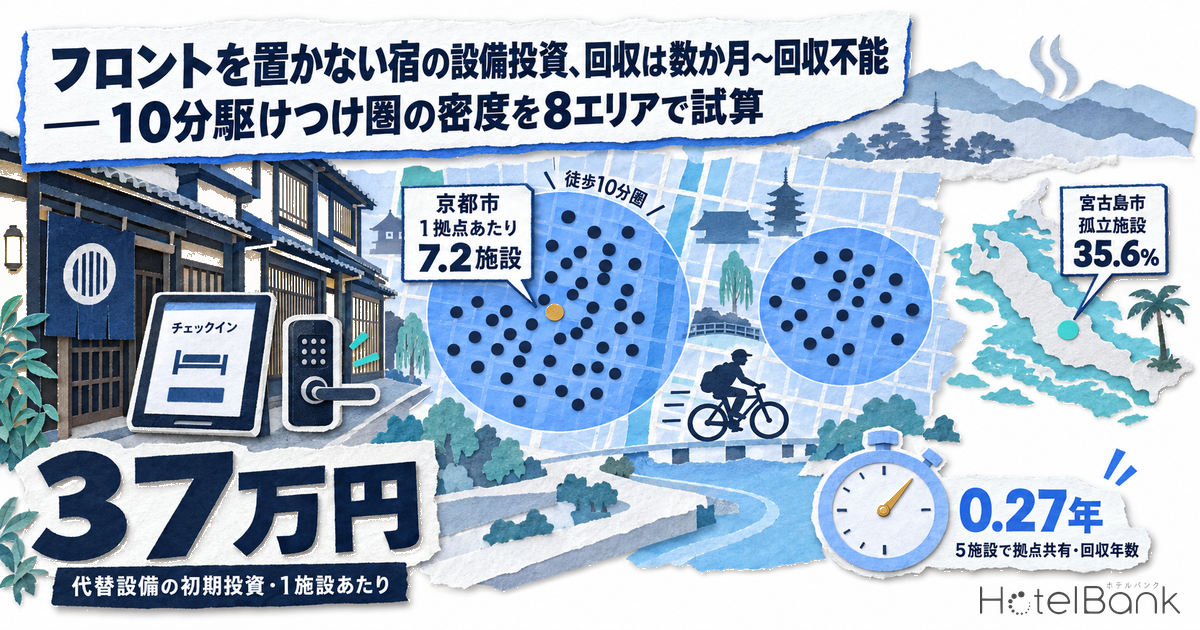
Running a lodging facility without a staffed front desk (genkan-choba) requires capital equipment that, under this article’s assumptions, comes to only about ¥370,000 per property. What the operator must keep in place, for every night a guest is on site, is a response capability under which “staff can normally reach the property in roughly 10 minutes.” Payback is therefore governed not by the price of the hardware but by a question of location: how many properties can share that one response capability. This article first sets out the legal framework from primary sources, then uses the locations of 1,047 small lodging properties (4,326 rooms) across eight areas tracked by MetroEngines Research to count how many properties a single response base can cover, and estimates the resulting payback period.
Scope of this article: Our earlier coverage of the 2026 revisions to the Hotels and Inns Business Act explained the statutory changes and touched on front-desk substitutes, but did not address investment payback; subsidy-led labor-saving investment cases are handled separately. This article narrows to a single question — operating without a front desk — and covers only the payback period derived from the capex of substitute equipment net of the labor cost it saves. Relief from subsidies or tax measures is not factored in.
Metric Definitions Used in This Article
- Small lodging property: a property with 10 rooms or fewer for which a selling price was observed on online booking channels for stay dates 17–23 August 2026. Limited to properties tracked by MetroEngines Research whose operation could be confirmed (properties not listed on booking channels are excluded).
- 10-minute radius (on foot): the “roughly 800m or less by road” standard Kyoto City applies to small lodging properties, converted to a 600m straight-line radius on the assumption that street routing adds about 1.3x.
- 10-minute radius (by vehicle, reference): a 2km straight-line radius set by the editorial team as a simple proxy for a response operation using a vehicle. The national guidelines do not specify a mode of travel; in practice each municipality judges by “the time normally required.”
- Response base: a base placed so as to cover every property with the fewest possible 10-minute radii, computed from straight-line distances between properties (greedy-algorithm approximation). The more properties per base, the more widely the response capability can be shared.
- Room occupancy rate: the prefecture-level room occupancy rate for simple lodgings (kan’i shukusho) in the Japan Tourism Agency’s Overnight Travel Statistics Survey, 2025 final figures.
- Data sources: MetroEngines Research (property locations and room counts), the Japan Tourism Agency, the Ministry of Health, Labour and Welfare, the Ministry of Land, Infrastructure, Transport and Tourism and others (full list at the end).
- — ¥370,000 per property plus ¥6,000 a month — this article’s assumption for substitute equipment (ID-check terminal, smart lock, recording camera, in-house phone). Small next to labor cost
- — The 10-minute response requirement survived the April 2025 revision of the guidelines. Requirements met by equipment and those that remain as nightly labor cost are separate things
- — Kyoto City: 7.2 properties per base (10-min walk radius, N=473). Miyakojima manages 1.7, and 35.6% of its properties are isolated on foot (N=59)
- — A base shared by 5 properties at 30% annual occupancy pays back in 0.27 years. At 15% annual occupancy shared by 2 properties it takes 7.56 years; isolated properties never pay back
- — In low-occupancy areas, a site that lets 3 or more properties share a base is the rough threshold for payback inside three years. At ¥500,000 of capex, even 3 properties take 3.17 years
The Framework: “Substitute Equipment” and the “10-Minute Capability” Are Separate Requirements
The legal basis for operating without a front desk sits across five layers: the act itself, the cabinet order, the ministerial ordinance, administrative notices, and municipal by-laws. What matters for an investment decision is that requirements met by equipment (identity verification, monitoring who comes and goes, key handover) and requirements met by people (emergency response) are laid down separately. The former is settled by a one-time capital outlay; the latter stays on the books as an operating cost for every night a guest is present.
For hotel and inn operations, Article 1(1)(ii) of the Enforcement Order of the Hotels and Inns Business Act requires “a front desk suitable for meeting prospective guests in person, or other equipment for appropriately verifying such persons that conforms to the standards prescribed by Ministry of Health, Labour and Welfare ordinance.” Those standards, set out in Article 4-3 of the Enforcement Regulations, specify two things: first, equipment enabling a prompt response to accidents and other emergencies; and second, equipment enabling accurate entry of the guest register, appropriate handover of room keys, and confirmation of the movements of non-guests in and out of the property.
Operational detail comes from the MHLW’s Hygiene Management Guidelines for the Lodging Industry. The facility and equipment standards for hotel and inn operations (Part II, Section 1, item 8) treat a front desk as the default, but allow it to be omitted where all three of the following are satisfied: (1) a capability for prompt emergency response, understood as one under which “staff can normally reach the property in roughly 10 minutes” at a guest’s request; (2) identity verification and confirmation of movements in and out; and (3) appropriate key handover.
The permitted methods for (2) were widened by the revision applied on 1 April 2025 (Notice Kensei-hatsu 0311 No. 1 of 11 March 2025). Alongside the existing approach of continuous monitoring by video camera, operators may now match identity information shared in advance against a QR code or PIN at an automated check-in device, and record the process from an angle at which faces can be distinguished. In that case the building must be structured so that guest-only areas cannot be entered without the key issued to the verified person, and entry and exit must be recorded. In other words, a design that does not require a video call with a staff member on every arrival is now explicitly recognized in the guidelines. The 10-minute capability under (1), by contrast, survived the revision unchanged.
Simple lodging operations are structured differently. Article 1(2) of the Enforcement Order contains no front-desk provision, deferring instead, in item (vii), to “structural and equipment standards prescribed by prefectural by-law.” The guidelines say a front desk or equivalent “is desirable,” and may be omitted where substitute equipment and an emergency response capability are in place. For that capability too, the wording is that a capability under which “staff can normally reach the property in roughly 10 minutes” is desirable. What is actually required of a simple lodging therefore depends on the local by-law.
On sharing a base across multiple properties, the MHLW notice of 15 December 2017, “On the Installation of Front Desks and Equivalents in Simple Lodging Operations,” told municipalities whose by-laws require a front desk that there is no objection to a single operator sharing one front desk across several simple lodgings, nor to several operators jointly establishing one front desk, provided an adequate emergency response capability exists. The same notice states that the existence of that capability “should be judged by the time normally required for staff to reach the property,” and that a mechanical test based on distance from the front desk is not what is envisaged.
Kyoto City, by contrast, sets an explicit distance guide in its by-law and rules. Where the front desk is inside the property, staff must be stationed inside it. Where a small lodging property — one that offers a single room or the whole building to one party of no more than nine people at a time — places its front desk off site, staff must be stationed somewhere from which the off-site front desk or the lodging property “can be reached within 10 minutes (roughly 800m or less by road).” That is the standard behind the 10-minute walk radius used here. Note that the guideline revision applied on 20 January 2026 (Kensei-hatsu 0120 No. 48) clarified that by-laws may impose certain restrictions to prevent adverse effects on the surrounding living environment, so municipal add-ons may keep changing.
| Requirement | Legal basis | How it is met | Nature of the cost |
|---|---|---|---|
| Identity verification and accurate guest register | Enforcement Regulations Art. 4-3(ii) / Guidelines II-1-8(5)2), VI-4 | Verification by video call or tablet, or matching at an automated check-in device plus recording from an angle at which faces can be distinguished | Capex + monthly fee |
| Confirming movements of non-guests | Enforcement Regulations Art. 4-3(ii) / Guidelines II-1-8(5)2) | Continuous monitoring by video camera, or a structure only key holders can enter plus recording at the entrance | Capex + monthly fee |
| Appropriate key handover | Enforcement Regulations Art. 4-3(ii) / Guidelines II-1-8(5)3) | Issuing PINs or electronic keys and changing them for each stay | Capex + monthly fee |
| Emergency response capability | Enforcement Regulations Art. 4-3(i) / Guidelines II-1-8(5)1) (for simple lodgings, “desirable” under II-2-2) | A capability under which staff can normally reach the property in roughly 10 minutes | Labor cost for every night a guest is present |
| Municipal add-ons (e.g. Kyoto City) | Enforcement Order Art. 1(2)(vii) and by-laws | Stationing staff within roughly 800m by road, among others | Constraint on where the base can sit |
Capex for Substitute Equipment: ¥370,000 per Property, ¥6,000 a Month
Substitute equipment comes in four parts: identity verification via an automated check-in device or similar, keys, entrance recording, and a means of emergency contact. The MHLW’s published casebook on efficiency measures describes the same combination — photographing the face on a tablet at the entrance and matching it against pre-registered information, issuing electronic key passcodes, security cameras and sensor lights on possible intrusion routes, and a landline phone in the room.
Prices vary widely by product and installation conditions, so this article assumes a whole-building rental with a single entrance, uses published price levels where they can be confirmed, and applies editorial assumptions where they cannot. One published example of a PIN-type smart lock (hard-installed) puts the unit at ¥66,000 (tax included), standard installation at about ¥45,000 per unit, and the monthly cloud management fee at ¥1,650–2,750 per unit. Adding a tablet or similar terminal, a camera with recording, and voice equipment gives capex of ¥370,000 per property and a monthly fee of ¥6,000 (¥72,000 a year). A configuration with a lock on every guest room raises both capex and the monthly fee in proportion to the number of locks.
| Item | Capex | Monthly | Nature of the figure |
|---|---|---|---|
| PIN-type smart lock (hard-installed, one entrance) | ¥111,000 | ¥1,650–2,750 | Published price example (unit ¥66,000 + standard installation about ¥45,000) |
| Identity-check / check-in terminal (tablet + mounting) | ¥80,000 | Balance booked as system fees and similar | Editorial assumption |
| Entrance camera (face-distinguishable angle, recording, installation included) | ¥150,000 | Editorial assumption | |
| In-house phone and similar for emergency contact | ¥30,000 | Editorial assumption | |
| Total (this article’s assumption) | ¥370,000 | ¥6,000 | Sensitivity case also runs ¥500,000 of capex |
The labor cost it is compared against needs its own assumptions stated. Guest presence is taken as the 19 hours from 15:00 to 10:00 the next morning. The hourly wage is ¥1,234 — the 2025 Basic Survey on Wage Structure figure for part-time workers in “accommodation and food services” — plus a 25% late-night premium for the seven hours from 22:00 to 05:00 and a further 15% for employer social insurance contributions and similar. On that basis, staffing one night of on-site cover costs about ¥29,400, and covering all 365 days comes to roughly ¥10.75 million a year. Because the FY2026 regional minimum wages rise to a national weighted average of ¥1,177, taking effect in stages from 1 October, a ¥1,500 hourly case is also run.
The Geography of the 10-Minute Radius: 7.2 Properties per Base in Kyoto, 1.7 in Miyakojima
How many properties can share a response capability is decided by the distances between them. Since the notice also permits a front desk operated jointly by several operators, we measured the density of all small lodging properties in each area, regardless of operator, as the scope for base sharing. The eight areas covered are Kyoto City, Kanazawa, Takayama, Yufu, Ito, Hakuba, Miyakojima, and Motobu and Nakijin.
The spread is wide. On the 10-minute walk radius, Kyoto City’s 473 properties can be covered by 66 bases, which works out to 7.2 properties and 19.5 rooms per base. The median distance from a property to the nearest other small property is just 94m, and only 4.9% of properties have no other property within walking range. Kanazawa (5.0 properties per base), Yufu (4.6) and Hakuba (4.2) follow.
Miyakojima, by contrast, needs 34 bases for 59 properties — 1.7 properties per base. There, 35.6% of properties have no other property within walking range: slightly more than one in three has no one nearby to share a base with. Takayama (20.3%) and Motobu and Nakijin (20.7%) also leave one property in five isolated on foot. Widening to the 2km straight-line radius that assumes a vehicle response drops Miyakojima’s isolated share to 8.5% and Motobu and Nakijin’s to 0.0%. On islands and in resort areas, the municipality’s judgment about which mode of travel the 10 minutes is measured by moves the economics directly.
Splitting properties by base size makes the character of each area clearer still. In Kyoto City, 77.8% of properties fall under bases covering 10 or more properties, so a small team can cover a wide area. In Miyakojima, 52.5% sit under bases of two to four properties and 37.3% under single-property bases, with no base of 10 or more at all. In the onsen town of Yufu, 70.7% fall under bases of 10 or more, whereas Ito is spread across bases of two to four (28.6%) and five to nine (23.6%) — two onsen destinations whose properties cluster quite differently.
| Area | Small properties | Rooms | Avg rooms per property | Bases, walk radius | Properties per base, walk radius | Isolated, walk radius | Properties per base, 2km vehicle radius | Isolated, 2km vehicle radius | Simple-lodging room occupancy (prefecture, 2025) |
|---|---|---|---|---|---|---|---|---|---|
| Kyoto City | 473 | 1,287 | 2.7 | 66 | 7.2 | 4.9% | 22.5 | 1.7% | 52.0% |
| Kanazawa | 60 | 228 | 3.8 | 12 | 5.0 | 5.0% | 20.0 | 0.0% | 15.7% |
| Takayama | 69 | 451 | 6.5 | 28 | 2.5 | 20.3% | 4.6 | 10.1% | 26.1% |
| Yufu | 92 | 602 | 6.5 | 20 | 4.6 | 7.6% | 11.5 | 2.2% | 17.2% |
| Ito | 140 | 874 | 6.2 | 40 | 3.5 | 10.7% | 11.7 | 1.4% | 24.6% |
| Hakuba | 67 | 401 | 6.0 | 16 | 4.2 | 3.0% | 13.4 | 0.0% | 13.6% |
| Miyakojima | 59 | 246 | 4.2 | 34 | 1.7 | 35.6% | 3.9 | 8.5% | 34.7% |
| Motobu & Nakijin | 87 | 237 | 2.7 | 38 | 2.3 | 20.7% | 7.2 | 0.0% | 34.7% |
Labor Cost per Occupied Room-Night: Base Sharing Cuts Kyoto to Under a Third
Next we converted the nightly labor cost into a figure per occupied room-night — one room actually sold for one night. Two models are compared: on-site cover, where each property staffs the hours guests are present, and base cover, where no front desk is staffed and one base within the 10-minute radius covers several properties. Each property is assumed to operate as a whole-building rental for one party, occupancy at each property is assumed independent of the others, and one person is assumed to cover at most 10 properties at a time. Under base cover, staff are posted on any night when at least one of the covered properties has guests.
Under on-site cover, the cost per occupied room-night is set by the average room count per property. In Kyoto City and Motobu and Nakijin, where the average is 2.7 rooms, it runs to about ¥10,800; in Takayama, Yufu, Ito and Hakuba, averaging six-plus rooms, it is ¥4,500–4,900. The fewer the rooms in a whole-building rental or machiya, the heavier the per-room burden of staffing each property separately. Switching to base cover brings Kyoto City down to about ¥3,300, less than a third, and to about ¥2,400 on the 2km vehicle radius. Miyakojima runs about ¥5,500 on foot and about ¥3,600 by vehicle — a wide gap driven purely by the assumed mode of travel.
| Area | On-site cover (per occupied room-night) | Base cover, walk radius | Base cover, 2km vehicle radius | Annual labor saving per property (walk radius) | Payback (area average, walk radius) | Isolated properties with no saving |
|---|---|---|---|---|---|---|
| Kyoto City | ¥10,822 | ¥3,337 | ¥2,405 | ¥3.87 mn | 0.10 yr | 4.9% |
| Kanazawa | ¥7,749 | ¥5,231 | ¥4,371 | ¥0.55 mn | 0.78 yr | 5.0% |
| Takayama | ¥4,505 | ¥3,028 | ¥2,497 | ¥0.92 mn | 0.44 yr | 20.3% |
| Yufu | ¥4,500 | ¥2,939 | ¥2,534 | ¥0.64 mn | 0.65 yr | 7.6% |
| Ito | ¥4,717 | ¥2,976 | ¥2,124 | ¥0.98 mn | 0.41 yr | 10.7% |
| Hakuba | ¥4,920 | ¥3,572 | ¥3,061 | ¥0.40 mn | 1.13 yr | 3.0% |
| Miyakojima | ¥7,062 | ¥5,534 | ¥3,594 | ¥0.81 mn | 0.50 yr | 35.6% |
| Motobu & Nakijin | ¥10,809 | ¥6,887 | ¥4,358 | ¥1.35 mn | 0.29 yr | 20.7% |
Every area average comes in at a little over a year or less. But that average blends the large savings of properties that have someone to share a base with and the zero saving of isolated ones. At an isolated property, removing the front desk does not change the need to keep someone within the 10-minute radius, so labor cost is identical to on-site cover and the capex cannot be recovered from labor savings at all. That describes 35.6% of properties in Miyakojima, 20.3% in Takayama and 20.7% in Motobu and Nakijin.
Payback Sensitivity: Properties Sharing the Base and Occupancy Decide It
An individual property’s payback is set almost entirely by two variables: how many properties share the base, and occupancy. On assumptions of ¥370,000 capex, a ¥72,000 annual fee and a ¥1,234 hourly wage, a base shared by five properties at 30% occupancy (assumed as an annual average) saves ¥1.44 million of labor cost per property a year and pays back in 0.27 years, about three months. Even sharing between two properties pays back in 0.90 years at 30% occupancy.
Payback stretches out where low occupancy meets few sharing properties. At 15% occupancy (again an assumed annual average) shared between two properties, the saving is only ¥120,000 a year and payback takes 7.56 years. When occupancy is low, on-site cover already requires staffing on few nights, so consolidating into a base removes few nights too. At that same 15%, sharing across three properties shortens payback to 2.35 years and across five to 1.07 years. For an area with low occupancy, aiming at payback inside three years means choosing a site where at least three properties can share a base.
| Properties sharing the base | 15% occupancy (annual) | 30% occupancy | 50% occupancy |
|---|---|---|---|
| 1 property (isolated) | Never (saving ¥0) | Never (saving ¥0) | Never (saving ¥0) |
| 2 properties | 7.56 yr (saving ¥0.12 mn) | 0.90 yr (saving ¥0.48 mn) | 0.29 yr (saving ¥1.34 mn) |
| 3 properties | 2.35 yr (saving ¥0.23 mn) | 0.46 yr (saving ¥0.87 mn) | 0.17 yr (saving ¥2.24 mn) |
| 5 properties | 1.07 yr (saving ¥0.42 mn) | 0.27 yr (saving ¥1.44 mn) | 0.11 yr (saving ¥3.29 mn) |
| 7 properties | 0.74 yr (saving ¥0.57 mn) | 0.21 yr (saving ¥1.82 mn) | 0.10 yr (saving ¥3.85 mn) |
| 10 properties | 0.55 yr (saving ¥0.75 mn) | 0.18 yr (saving ¥2.18 mn) | 0.09 yr (saving ¥4.30 mn) |
| Sensitivity case (payback) | 2 properties, 15% occupancy (annual) | 3 properties, 15% occupancy | 2 properties, 30% occupancy | 5 properties, 30% occupancy (annual) |
|---|---|---|---|---|
| Base case (¥370,000 capex, ¥1,234 hourly wage) | 7.56 yr | 2.35 yr | 0.90 yr | 0.27 yr |
| ¥500,000 capex | 10.22 yr | 3.17 yr | 1.21 yr | 0.37 yr |
| ¥1,500 hourly wage | 4.93 yr | 1.79 yr | 0.72 yr | 0.22 yr |
The higher wages go, the larger the saving from base sharing and the faster the payback. In a period of continuing minimum-wage increases, the investment case for a front-deskless design gets stronger, not weaker. Set capex at ¥500,000, however, and payback at 15% occupancy (assumed annual average) with three properties sharing becomes 3.17 years, just past the three-year mark. In low-occupancy areas, trimming the equipment configuration is the most direct lever on payback.
Options for Isolated Properties: Own Base, Joint Base, Local Staff, Outsourcing
Properties that cannot share a base on foot still have ways to make the numbers work. The MHLW casebook sets out three patterns matched to location. An operator in Fukuoka City keeps its city-centre properties within a 10-minute response as a rule and outsources remote locations where it cannot staff a capability itself. A whole-building rental in Aji, Takamatsu, rings every property’s landline through to all staff simultaneously, contracts part of the cleaning work to residents of the local hamlet, and calls on those cleaners when a response is needed. Operators in Tokyo, Osaka and elsewhere use remote check-in by tablet video call.
Own base
Urban areas where one base can cover five or more properties
Where properties cluster tightly, as in Kyoto City and Kanazawa, a single in-house base covers a wide area and payback runs in months.
Joint base
Onsen towns and resorts where the operator has few buildings
The notice permits a front desk operated jointly by several operators. Where another company’s properties sit nearby, as in Yufu and Hakuba, sharing raises the number of properties per base.
Local staff doing double duty
Islands and outlying areas with many isolated properties
Local residents handle cleaning and response together. Because no dedicated response payroll is needed, this is the realistic option where base sharing is not available.
Where third-party outsourcing is used, response-time terms are worth checking before signing. Some nationwide response services publish a target arrival window of 30–90 minutes and guarantee no specific time. Whether the 10-minute standard can be met depends on whether personnel are actually stationed in that area. How standby time at the base or at home is treated also matters: whether it counts as working hours turns on how tightly the worker is constrained, so checking with a labor and social security attorney while the capability is still being designed narrows the gap between the estimate and the actual payroll.
Where to Put the Base: Zoning and Land Price Constraints
Adding a new property inside a cell where small properties already cluster raises the count per base, but zoning constrains where that is possible. Under Appended Table 2 of the Building Standards Act, hotels and inns cannot be built in Category I or II exclusively low-rise residential zones, agricultural residential zones, Category I or II exclusively mid/high-rise residential zones, industrial zones, or exclusively industrial zones; in Category I residential zones, floor area devoted to the use is capped at 3,000 m². For a plan that widens a cell by buying up properties scattered through residential neighborhoods, the zoning of each individual property decides whether base sharing works.
The fixed cost of the base itself also varies by area. In the 2026 Official Land Price survey, commercial land rose 10.1% in Kyoto City and 7.3% in Okinawa Prefecture, and the third-largest commercial-land increase nationwide was a site in Hakuba (+35.2%). Rather than renting a dedicated office for the base, using a room in the operator’s own property inside a dense cell, or doubling up with a cleaning and linen base, is less exposed to those rising fixed costs.
Five Checks for Lending and Investment Decisions
| Check | What to look at | Relation to this article’s estimates |
|---|---|---|
| 1. Licence type and by-law | Hotel and inn operation or simple lodging. Whether the local by-law sets a distance standard or a staffing-location rule | Determines whether the walk radius or the vehicle radius applies |
| 2. Properties within the 10-minute radius | How many properties, own or third-party, are inside the radius and could share a base | A single property generates no labor saving. Around 15% annual occupancy, three or more is the rough threshold |
| 3. Identity verification method | Guidelines VI-4 method 1) (video call and similar) or 2) (automated check-in matching plus recording) | Method 2) allows a design with no staff posted for a call on every arrival |
| 4. Who provides the response | Own base, joint base, local staff doing double duty, or outsourcing. If outsourced, the arrival-time terms | Whether the provider’s target arrival fits the 10-minute standard |
| 5. Occupancy assumption | The gap between the Japan Tourism Agency’s prefecture-level simple-lodging occupancy and the business plan | The lower the occupancy, the smaller the gain from consolidating into a base |
Conclusion
Capital equipment for a front-deskless property runs at roughly ¥300,000–500,000 apiece — not a large sum next to labor cost. What decides payback is not the price of the hardware but how many properties cluster inside the range a responder can reach in 10 minutes. Kyoto City’s 7.2 properties per base on the 10-minute walk radius puts payback for properties that share a base in the order of months. In Miyakojima, 35.6% of properties are isolated on foot, and for those the capex cannot be recovered from labor savings at all.
For an operator running several buildings, where the next property is acquired changes capital efficiency substantially. A property that falls inside the 10-minute radius of an existing base shortens payback and raises the number of properties that base covers. On islands and in resort areas, where isolation is common, combining a joint base with local staff doing double duty widens the room to make the same capital outlay pay.
Method and Assumptions
- Coverage: properties with 10 rooms or fewer tracked by MetroEngines Research for which a selling price was observed for stay dates 17–23 August 2026 (1,047 properties / 4,326 rooms across eight areas). Properties not listed on booking channels are excluded, and no distinction is drawn between owner-resident and other operations.
- Base placement: straight-line distances were computed from property coordinates, and all properties were covered by a greedy algorithm that repeatedly places a base at the point covering the most as-yet-uncovered properties. Differences in travel time caused by the road network, terrain or rivers are not reflected.
- Labor cost: 19 hours of guest presence (15:00 to 10:00 the next day), an hourly wage of ¥1,234 (2025 Basic Survey on Wage Structure, part-time workers in “accommodation and food services”), a 25% premium on the seven late-night hours, and a further 15% for employer social insurance contributions and similar. About ¥29,400 a night.
- Occupancy: whole-building operation for one party per property, with each property’s occupancy assumed independent. Room occupancy uses the prefecture-level simple-lodging figures from the Japan Tourism Agency’s Overnight Travel Statistics Survey, 2025 final values. Base cover assumes one person per 10 properties at most.
- Equipment: ¥370,000 of capex (a mix of published price examples and editorial assumptions) and a ¥72,000 annual fee. Subsidies, tax incentives, depreciation, equipment replacement and rent for the base space are excluded.
- These estimates are a simplified model for like-for-like comparison. They do not indicate whether any individual property satisfies licensing requirements, nor its actual financial results. Licensing requirements must be confirmed with the competent public health centre or municipality.
Related Articles
- Lodging Supply Denominator: 44,901 Simple Lodgings Move Kyoto 21st→5th
- Face Recognition Check-In: Survival Strategy for Mid-Size Business Hotels
References and Sources
■ Data sources
Locations and room counts of properties with 10 rooms or fewer tracked by MetroEngines Research & Consulting (N=1,047 properties / 4,326 rooms across eight areas; selling prices observed for stay dates 17–23 August 2026). The legal framework draws on the Enforcement Order and Enforcement Regulations of the Hotels and Inns Business Act, the MHLW Hygiene Management Guidelines for the Lodging Industry and related notices, and Kyoto City materials. Occupancy is from the Japan Tourism Agency’s Overnight Travel Statistics Survey, 2025 final figures; wages from the 2025 Basic Survey on Wage Structure.
■ Estimation assumptions
¥370,000 capex and a ¥72,000 annual fee (published price examples plus editorial assumptions). 19 hours of guest presence; an hourly wage of ¥1,234 with a 25% late-night premium and 15% for employer contributions, giving about ¥29,400 a night. The 10-minute walk radius is 600m straight-line; the vehicle radius is 2km straight-line. Whole-building operation for one party, with occupancy independent across properties, and base cover at one person per 10 properties. Payback = capex / (annual labor saving − annual fee). Sensitivity runs ¥500,000 capex and a ¥1,500 hourly wage.
■ Limitations and caveats
Base placement is a greedy-algorithm approximation using straight-line distances and does not reflect travel-time differences from the road network, terrain or rivers. Properties not listed on booking channels are excluded. Subsidies and tax measures, depreciation, equipment replacement, rent for the base, and whether standby time counts as working hours are all outside the model. Whether an individual property satisfies licensing requirements is for the competent public health centre or municipality to judge.
■ Laws and notices
- Enforcement Order of the Hotels and Inns Business Act (Cabinet Order No. 152 of 1957), Article 1 (e-Gov Law Search)
- Enforcement Regulations of the Hotels and Inns Business Act (Ministry of Health and Welfare Ordinance No. 28 of 1948), Article 4-3 (MHLW law database)
- MHLW, “Partial Revision of the Hygiene Management Guidelines for the Lodging Industry” (Kensei-hatsu 1115 No. 5, 15 November 2023)
- MHLW, “Partial Revision of the Hygiene Management Guidelines for the Lodging Industry” (Kensei-hatsu 0311 No. 1, 11 March 2025; applied 1 April 2025)
- MHLW, “Front Desk Requirements Change From 1 April 2025” (leaflet)
- MHLW, “Partial Revision of the Hygiene Management Guidelines for the Lodging Industry” (Kensei-hatsu 0120 No. 48, 20 January 2026)
- MHLW, “Casebook on Efficiency Measures for Front Desks and Equivalents in Simple Lodging Operations”
- MHLW, “On Front Desk Regulation for Simple Lodging Operations Under the Hotels and Inns Business Act” (Regulatory Reform Promotion Council, Regional Industry Revitalization WG, Document 1-2, 19 April 2024; includes an extract of the notice of 15 December 2017)
- Kyoto City, “New Rules on Stationing Staff at Lodging Facilities”
- Kyoto City, “Procedures for Establishing an Off-Site Front Desk and Related Cases”
- Building Standards Act, Appended Table 2 (e-Gov Law Search)
■ Government statistics and public data
- Japan Tourism Agency, “Overnight Travel Statistics Survey (2025 annual, final figures)” (published 6 July 2026)
- MHLW, “Summary of the 2025 Basic Survey on Wage Structure” (hourly wages of part-time workers by industry)
- MLIT, “Summary of the 2026 Official Land Price Survey” (March 2026)
- MHLW, FY2026 regional minimum wages (national weighted average ¥1,177, taking effect in stages from 1 October 2026)
■ Market data and pricing
- MetroEngines Research — locations and room counts of small properties (N=1,047 properties / 4,326 rooms across eight areas)
- Published prices and fees for PIN-type smart locks (confirmed September 2026)
- Published terms of a nationwide response service (target arrival time) (confirmed September 2026)