

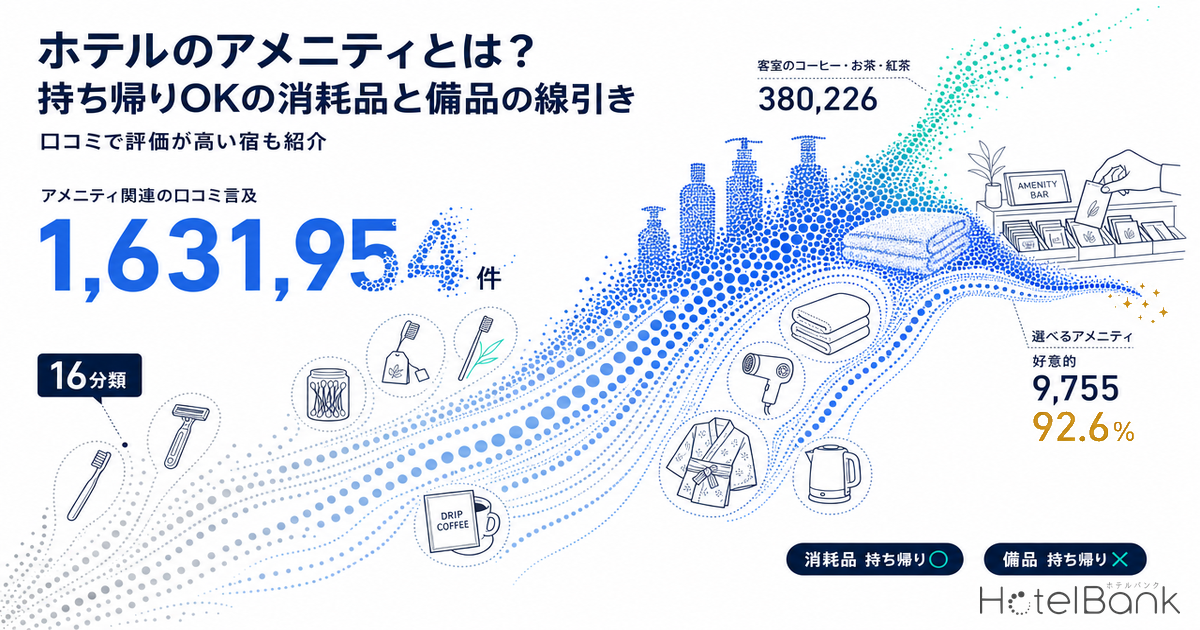
Amenities are the collective term for the fittings and consumable items a hotel or ryokan provides in its guest rooms and public areas. They divide broadly into single-use “consumables” such as toothbrushes and razors, and “fixtures” such as towels and hair dryers, and the general rule is that consumables may be taken home while fixtures may not. This article sets that dividing line out in a table, then reads what guests actually praise from 1.63 million amenity-related mentions across 16 amenity categories (September 2024 to September 2026, HotelBank Editorial Team analysis), and introduces the hotels whose self-select amenities draw the strongest reviews.
- — Consumables can generally be taken home; fixtures cannot. Single-use items such as toothbrushes and razors are treated differently from installed items such as towels and hair dryers.
- — The most-mentioned amenity in guest reviews is in-room coffee and tea, at 380,000 mentions, ahead of the basic toothbrush-and-razor set at 195,000 and towels at 162,000.
- — Self-select amenities draw a 92.6% positive share, the highest of the 16 categories. At 9,755 mentions the volume is small, but it converts into satisfaction.
- — Japan’s plastics recycling act, in force since April 2022, covers five items in the lodging industry for reduced use. Properties are shifting from stocking rooms to an amenity-bar model.
The dividing line: consumables go home, fixtures stay
What you may take home, and what you may not
Hotel amenities in Japan split into items prepared one per guest on the assumption they will be used up, and items installed in the room on the assumption the next guest will use them too. The first group are consumables, the second are fixtures. The table below sets out the usual classification.
| Category | Typical items | Take home |
|---|---|---|
| Consumables | Toothbrush, razor, hairbrush or comb, cotton swabs, cotton pads, shower cap, single-use skincare, tea bags and drip coffee, bottled water | Generally yes (intended to be used up) |
| Fixtures | Bath towel, face towel, bathrobe, loungewear such as yukata and pyjamas, hair dryer, bottled shampoo and body wash, electric kettle, humidifier, umbrella | No (part of the room’s fittings) |
When in doubt, check the in-room notice and the front desk
This line is only a general guide, and practice differs from property to property. Slippers are a good example: some properties tell guests they may take disposable pairs home, while washable reusable pairs are treated as fixtures. Bottled water is a free service at some properties and a paid minibar item at others. The treatment is usually written on the in-room notice or on the card placed beside the amenities, so when in doubt the front desk is the reliable answer. Loungewear — yukata, pyjamas and the like — is the best-known item on the fixtures side, and how often guests mention it in reviews varies widely by property type.
Which amenities do guests actually praise? Mentions across 16 categories
The HotelBank Editorial Team classifies guest reviews by theme, and amenities break down into 16 categories. Amenity-related mentions in reviews between September 2024 and September 2026 total 1,631,954 (N=1,631,954, HotelBank Editorial Team analysis). Mentions by category are as follows.
| Amenity category | Mentions | Relative scale (bar) |
|---|---|---|
| In-room coffee, green tea and black tea | 380,226 | |
| Overall range of amenities | 301,212 | |
| Basic set: toothbrush, razor and the like | 195,344 | |
| Towel quality and quantity | 161,902 | |
| In-fridge drinks and welcome drinks | 104,895 | |
| Yukata, pyjamas and loungewear | 89,260 | |
| Hair dryer | 83,148 | |
| In-room shampoo and body wash | 66,015 | |
| Slippers and indoor footwear | 54,342 | |
| Skincare such as toner and lotion | 53,728 | |
| Air purifier and humidifier | 48,066 | |
| Welcome sweets and tea snacks | 40,248 | |
| Free water and mineral water | 23,116 | |
| Chargers and USB charging | 11,027 | |
| Self-select amenities (amenity buffet) | 9,755 | |
| Children’s and baby amenities | 9,670 |
Source: HotelBank Editorial Team analysis (guest reviews classified by theme, period September 2024 to September 2026, total mentions N=1,631,954).
The most-mentioned category is, perhaps unexpectedly, in-room coffee and tea, ahead of the basic toothbrush-and-razor set and ahead of towels. Satisfaction with the moment of sitting down in the room sits at the centre of how guests judge amenities. How guests praise coffee served in the lobby and public areas is analysed in detail in In-House Coffee in Guest Reviews — 122 Japan Hotels, 17,385 Mentions. The category worth noting, though, is self-select amenities (the amenity buffet). At 9,755 mentions it is not among the larger categories, but 92.6% of those mentions (9,029) are positive, the highest share of the 16 categories. The experience of choosing what you want in the lobby is, in other words, the amenity guests are most likely to praise. For women travelling alone on business or for leisure, the range of skincare and loungewear is often what decides the booking. A HotelPicks article (in Japanese) comparing station-adjacent hotels in Sendai, Hiroshima and Sapporo on women-only floors and amenity provision is a useful companion piece.
10 hotels most mentioned for self-select amenities
How an amenity bar works
Self-select amenities means picking skincare, bath salts, tea and the like from an amenity bar in the lobby or beside the front desk, taking only as much as you need up to the room. We counted the properties with the most guest-review mentions of “self-select amenities” and “amenity buffet” (period September 2024 to September 2026, top 10 among properties with 30 or more such mentions, HotelBank Editorial Team analysis).
| Rank | Property | Location | Mentions | Of which positive | Relative scale (bar) |
|---|---|---|---|---|---|
| 1 | Oriental Hotel Tokyo Bay (オリエンタルホテル東京ベイ) | Urayasu, Chiba | 89 | 79 | |
| 2 | Hotel Silk Tree Nagoya (ホテル シルク・トゥリー名古屋) | Nagoya, Aichi | 73 | 69 | |
| 3 | Matsue New Urban Hotel (松江ニューアーバンホテル) | Matsue, Shimane | 67 | 65 | |
| 4 | Richmond Hotel Premier Kyoto Ekimae (リッチモンドホテルプレミア京都駅前) | Kyoto | 65 | 64 | |
| 5 | Hotel Actel Nagoya Nishiki (ホテルアクテル名古屋錦) | Nagoya, Aichi | 64 | 64 | |
| 6 | Richmond Hotel Sendai (リッチモンドホテル仙台) | Sendai, Miyagi | 60 | 59 | |
| 7 | Hotel Season (ホテル シーズン) | Mito, Ibaraki | 52 | 51 | |
| 8 | Anda no Mori Osaka Tennoji Tower (アンダの森 大阪天王寺タワー) | Osaka | 47 | 46 | |
| 9 | Hotel Fujita Fukui (ホテルフジタ福井) | Fukui | 44 | 43 | |
| 9 | Mont Blanc Hotel Raffine Nagoya Ekimae (モンブランホテルラフィネ名古屋駅前) | Nagoya, Aichi | 44 | 44 |
Source: HotelBank Editorial Team analysis (guest-review mentions of self-select amenities and the amenity buffet, period September 2024 to September 2026, properties with 30 or more such mentions. Two properties tie at ninth place on equal mentions).
The top of the table mixes leisure and business properties: Oriental Hotel Tokyo Bay, with its thick family demand from the Tokyo Disney Resort area, alongside Hotel Silk Tree Nagoya and Hotel Actel Nagoya Nishiki in Nagoya’s Nishiki entertainment district. Every one of them shows a positive share of around 90%, which suggests the pleasure of choosing feeds straight through into how guests rate the stay. Checking the amenity page on a property’s official site, or the wording of the room plan, before booking will show what the amenity bar stocks and which plans it covers. How far the buffet model has spread across Japan is covered in Self-Select Amenities: 39 Japan Hotels, 96% Positive Mentions.
Environmental rules are moving amenities to a take-what-you-need model
Under the Act on Promotion of Resource Circulation for Plastics, in force since April 2022, five plastic items the lodging industry provides free of charge — toothbrush, hairbrush, comb, razor and shower cap — are designated for reduced use, and many hotels have rethought how they hand out amenities. Properties are increasingly dropping the stocked-room model in favour of an amenity bar beside the front desk where guests take only what they need, and switching to toothbrushes made of bamboo, wood or biomass plastic. The spread of self-select amenities described in the previous section is part of the same shift.
What this changed about what guests pack
From the guest’s side, the current standard is to take only what you will use and bring the things you are particular about. If you have preferences about toothbrush firmness or skincare brands, bringing your own is the certain route; if you want to travel light, choosing a property with a well-stocked amenity bar gets you close to arriving empty-handed. Environmental care and a comfortable stay can both be settled at the point where you choose the property.
Where to look next
For choosing a property around its amenities, these articles go deeper (both in Japanese).
Station-adjacent business hotels in Sendai, Hiroshima and Sapporo where a woman travelling alone can stay with confidence, Top 5 — strong on women-only floors and late check-in (HotelPicks, in Japanese)
Compares five properties on their women’s amenities and loungewear, including the women-only area at JR Tower Hotel Nikko Sapporo (JRタワーホテル日航札幌), the amenity set on the women’s plan at Richmond Hotel Premier Sendai Ekimae (リッチモンドホテルプレミア仙台駅前), and the ladies’ amenities at Mitsui Garden Hotel Hiroshima (三井ガーデンホテル広島).
The summer yukata as an institution — linen and cotton, indigo and white, and the change of clothes a ryokan assembles as the rainy season lifts (wabistay, in Japanese)
On the ryokan yukata, arguably the highest form of loungewear, reading how three properties — Tawaraya (俵屋旅館), Tobira Onsen Myojinkan (扉温泉 明神館) and Ryori Ryokan Kanazawa Chaya (料理旅館 金沢茶屋) — switch fabric and the indigo-and-white palette with the season.
Frequently asked questions
Can I take hotel amenities home?
Single-use consumables prepared one per guest — toothbrush, razor, hairbrush, cotton swabs, shower cap, single-use skincare and so on — can generally be taken home. Fixtures such as towels, bathrobes, loungewear, hair dryers and bottled shampoo are part of the room’s fittings and cannot. Practice differs by property, though, so the in-room notice or the front desk is the reliable answer.
What happens if I take a towel or bathrobe home?
Towels, bathrobes and loungewear such as yukata are fixtures provided on the assumption the next guest will use them, and taking them home is not envisaged. Some properties sell the same items or offer them for a fee, so if you like one it is worth asking at the front desk.
Can I take the slippers?
Slippers are the classic case where practice splits by property. Some properties tell guests they may take the disposable type home, while the washable reusable type is treated as a fixture. This is usually written on the card beside the amenities or in the in-room notice, so check there.
Why are there no toothbrushes in Japanese hotel rooms any more?
Because the Act on Promotion of Resource Circulation for Plastics, in force since April 2022, designated five plastic items the lodging industry provides free of charge — toothbrush, hairbrush, comb, razor and shower cap — for reduced use. A growing number of properties have stopped stocking them in the room and switched to an amenity bar beside the front desk where guests take only what they need.
How do I find a property with good amenities?
In guest reviews, self-select amenities (the amenity buffet) carry a 92.6% positive share, the highest of the 16 categories, which makes them a reliable route to satisfaction. Looking at the amenity page on a property’s official site, or the wording of the room plan, before booking will show what the amenity bar stocks and which plans it covers.
Methodology and sources
■ Data source
Our own classification of guest reviews by theme (16 amenity categories). The period is September 2024 to September 2026, and total amenity-related mentions are N=1,631,954. The per-property counts cover the same period and are limited to properties with 30 or more such mentions. HotelBank Editorial Team analysis.
■ Basis of the counts
A mention is a review whose text contains a reference to that theme; it is not a count of guests or of properties. The positive share is calculated within the same period and the same category. Table 3 is ranked by mentions in descending order, with equal counts sharing a rank.
■ Limitations
The split between consumables and fixtures is a general guide, not a legal definition, and actual practice differs by property. Table 3 also shows how often something was mentioned in reviews, not a ranking of amenity quality or range. Larger properties, which accumulate more reviews, tend to accumulate more mentions as well.
■ References
- Ministry of the Environment, “Rationalisation of the Use of Designated Plastic Products” (plastic-circulation.env.go.jp) — the five items designated for the lodging industry
- Ministry of the Environment, “About the Plastic Resource Circulation Act” (plastic-circulation.env.go.jp) — in force April 2022
Related reading