

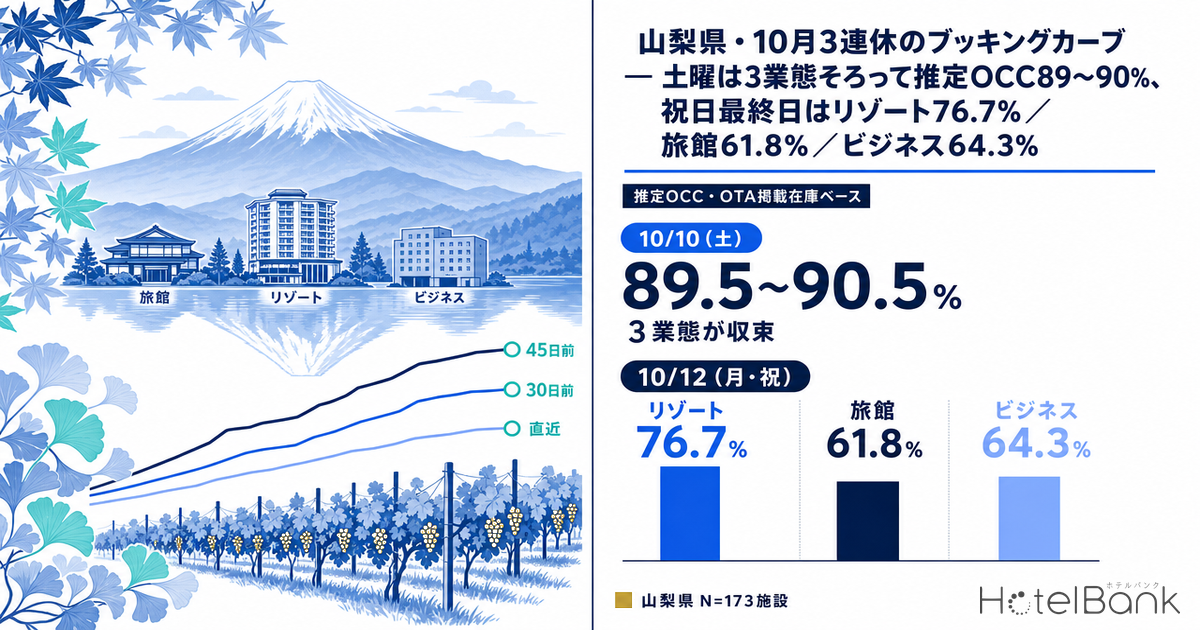
For the three-day weekend of Saturday 10 October to Monday 12 October 2026 (a public holiday), we tracked estimated OCC (based on OTA-listed inventory) within a 45-day lead time across 95 ryokan, 32 resort hotels and 46 business hotels in Yamanashi (173 properties, 8,584 rooms in total). On the opening Saturday all three categories converge at 89.5-90.5% at the latest observation, while on the closing public holiday resort hotels sit at 76.7% against ryokan at 61.8% and business hotels at 64.3% – a gap of 12-15 points between categories. Saturday is “the day every category fills”; the closing holiday is “the day the categories fill in completely different ways”. This article compares the three days at three fixed checkpoints – 45 days out, 30 days out and the latest observation – and sets out the practical questions around how to fill the final day.
Scope: ryokan, resort hotels and business hotels in Yamanashi, N=173 properties (8,584 rooms). Occupancy figures in this article are estimates based on OTA-listed inventory; the sold-out property rate is the share of properties whose listed inventory can no longer be confirmed on OTAs and similar channels (estimate). Both definitions appear at the end of the article. Data retrieved: 17 September 2026 (latest observation as of 16 September 2026).
• OCC (occupancy rate) = the share of sold rooms against total rooms in the area (an estimate based on OTA sales inventory). This article uses a fixed cohort of properties that list at least 30% of their total rooms on OTAs.
• Sold-out property rate = the share of properties whose listed inventory can no longer be confirmed on OTAs and similar channels (estimate).
• This article does not address price levels; it covers only estimated OCC and the sold-out property rate.
• Source: MetroEngines Research
- — Sat 10 Oct puts all three categories at 89.5-90.5%, converging to a category spread of just 1.0 point (latest observation, as of 16 September 2026, N=173 properties).
- — Mon 12 Oct (holiday) reads resort 76.7% / ryokan 61.8% / business 64.3%. Ryokan fall 27.9 points from Saturday, resorts only 13.8 points.
- — At 45 days out on the final day, resorts are already at a normal-Saturday level (73.8%), while ryokan and business hotels start 13-15 points lower. The final day should be designed as an extension of a multi-night stay.
Saturday erases the category gap; the closing holiday opens it up
Start with the outline of the three days. At the latest observation (as of 16 September 2026, 24-26 days before the stay date), estimated OCC for Saturday 10 October is ryokan 89.7%, resort 90.5%, business 89.5%. The spread across the three categories is just 1.0 point – a level at which category differences carry almost no meaning. On Sunday 11 October the figures are ryokan 78.3%, resort 80.0%, business 74.7%, widening the spread to 5.3 points. And on Monday 12 October (holiday) they become ryokan 61.8%, resort 76.7%, business 64.3%: the resort-ryokan gap opens to 14.9 points and the resort-business gap to 12.4 points.
That this is not simply a case of “the holiday is weak across the board” becomes clear when set against ordinary Saturdays in the same month. Comparing at 45 days out, Saturday 3 October reads ryokan 72.7%, resort 74.5%, business 68.3%, and Saturday 17 October reads ryokan 71.9%, resort 75.9%, business 67.7%. Against those, the closing day of the long weekend – 12 October – stood at ryokan 57.7%, resort 73.8%, business 54.5% at 45 days out. In other words, resort hotels secure essentially the same level on the closing holiday as on an ordinary Saturday (-0.7 points against 3 October), while ryokan start 15.0 points and business hotels 13.8 points below an ordinary Saturday. The weakness of the final day does not fall evenly on every category – it is concentrated in ryokan and business hotels. The same shape, where only the closing public holiday fills slowly, has also been observed in Hokkaido’s October three-day weekend.
Conversely, on the opening Saturday the largest uplift over an ordinary Saturday belongs to business hotels. At 45 days out, 10 October reads 80.7% against 68.3% on 3 October – a difference of 12.4 points. Ryokan show 79.6% against 72.7%, an uplift of 6.9 points, and resorts 81.8% against 74.5%, an uplift of 7.3 points. On the opening day of a long weekend, demand flows even into categories that are not normally strong on Saturdays, and the category gap disappears as a result.
What the booking curves reveal about where the gains actually land
Next, look at how bookings accumulate from 45 days out to the latest observation. On the opening day (Saturday 10 October) the curve shows all three categories starting high, running in parallel and arriving at around 90%. The gain from 45 days out to the latest observation is +10.1 points for ryokan, +8.7 points for resorts and +8.8 points for business hotels. Both the starting position and the landing point are close together, and the shape of the curve itself is similar.
Source: MetroEngines Research; compiled by the HotelBank Editorial Team
The curve for the closing day (Monday 12 October, a public holiday) looks entirely different. Resort hotels are already at 73.8% at 45 days out and add only +2.9 points from there to land at 76.7%. Ryokan move from 57.7% to 61.8%, a gain of +4.1 points, and business hotels from 54.5% to 64.3%, a gain of +9.8 points. Although business hotels add the most of the three categories, their starting position is low enough that even at the latest observation they remain 12.4 points short of resorts. Ryokan, for their part, show a gain of just +4.1 points – the smallest of any category on any of the three days.
Source: MetroEngines Research; compiled by the HotelBank Editorial Team
What this reveals is that each category captures the final day’s demand at a different stage. Resort hotels have essentially taken the closing holiday’s demand by 45 days out, and move little thereafter. Business hotels are open at 45 days out but accumulate comparatively fast from 30 days out onwards (54.5% at 45 days out to 64.4% at 30 days out, +9.9 points, then -0.1 points through to the latest observation). Ryokan are consistently gradual from 45 days out to the latest observation, with no large gain in any interval. How to build an operating routine that reads the curve at three fixed checkpoints – 45 days out, 30 days out and the latest observation – is set out in detail in Okayama Booking Curves: 3 Checkpoints, Aug 8 Late-Surges +11.8pt.
| Stay date | Category (N) | 45 days out | 30 days out | Latest obs. | Gain | Sold-out property rate (latest) |
|---|---|---|---|---|---|---|
| Sat 10 Oct | Ryokan (95 properties) | 79.6% | 87.0% | 89.7% | +10.1pt | 50.5% |
| Sat 10 Oct | Resort (32 properties) | 81.8% | 88.9% | 90.5% | +8.7pt | 46.9% |
| Sat 10 Oct | Business (46 properties) | 80.7% | 86.9% | 89.5% | +8.8pt | 60.9% |
| Sun 11 Oct | Ryokan (95 properties) | 72.8% | 76.5% | 78.3% | +5.5pt | 28.4% |
| Sun 11 Oct | Resort (32 properties) | 75.2% | 79.4% | 80.0% | +4.8pt | 25.0% |
| Sun 11 Oct | Business (46 properties) | 63.0% | 71.4% | 74.7% | +11.7pt | 23.9% |
| Mon 12 Oct (holiday) | Ryokan (95 properties) | 57.7% | 59.4% | 61.8% | +4.1pt | 10.5% |
| Mon 12 Oct (holiday) | Resort (32 properties) | 73.8% | 76.1% | 76.7% | +2.9pt | 15.6% |
| Mon 12 Oct (holiday) | Business (46 properties) | 54.5% | 64.4% | 64.3% | +9.8pt | 8.7% |
Estimated OCC is based on OTA-listed inventory. The latest observation is as of 16 September 2026 (24 days to the stay date for 10 Oct, 25 days for 11 Oct, 26 days for 12 Oct). Gain is the change from 45 days out to the latest observation. Source: MetroEngines Research; compiled by the HotelBank Editorial Team
Sizing the inventory left on the final day in rooms, not ratios
Beyond ratios, the absolute volume of listed inventory still available is worth holding on to. At the latest observation, rooms still listed across the 173 properties in scope total 877 on Saturday 10 October – ryokan 299, resort 181, business 397. Sunday 11 October totals 1,968 rooms. Against those, Monday 12 October (holiday) totals 2,898 rooms – ryokan 1,103, resort 444, business 1,351 – roughly 3.3 times the opening Saturday. In combined estimated OCC across the three categories, the three days line up at 89.8% on the 10th, 77.1% on the 11th and 66.2% on the 12th.
Source: MetroEngines Research; compiled by the HotelBank Editorial Team
Comparing the opening and closing days within the same category, estimated OCC at the latest observation falls 27.9 points for ryokan (89.7% to 61.8%) and 25.2 points for business hotels (89.5% to 64.3%), while resort hotels drop only 13.8 points (90.5% to 76.7%). The final-day decline is roughly half as steep for resorts alone.
The sold-out property rate (the share of properties whose listed inventory can no longer be confirmed on OTAs and similar channels, estimated) points the same way. On Saturday 10 October it reads ryokan 50.5%, resort 46.9%, business 60.9% – around half of properties in each category have exhausted their listed inventory. By Monday 12 October (holiday) it falls to ryokan 10.5%, resort 15.6%, business 8.7%. Business hotels swing 52.2 points, from 60.9% on Saturday to 8.7% on the holiday – the widest range of any category. Put the other way round, the closing day of the long weekend is a day on which most properties in every category still hold open allocation, and therefore a day on which demand is fought over.
Summing up the structure across Yamanashi’s three categories: on the closing day resort hotels have broadly taken their demand by 45 days out and then hold high with little room left to grow; ryokan barely move from a low starting position; and business hotels accumulate intensively towards 30 days out but cannot close the gap because their initial level is so low. Three categories, three distinct shapes.
For revenue managers running ryokan, resort hotels and business hotels in Yamanashi – implications and an action plan
(1) Design the long weekend as “two days plus one”, not as three days. The opening Saturday has all three categories converging at 89.5-90.5% at the latest observation, so a property that looks only at Saturday and concludes “the long weekend is strong” may miss what is actually happening on the final day. When assessing your own pace over the long weekend, always lay out Saturday, Sunday and the holiday separately by day, and check whether the shape matches the market’s own sequence (89.7% / 78.3% / 61.8% in the case of ryokan).
(2) Treat final-day weakness as a category-specific problem. Resort hotels hold 76.7% even on 12 October, on a par with an ordinary Saturday (74.5% for 3 October at 45 days out). Ryokan, by contrast, started 15.0 points and business hotels 13.8 points below an ordinary Saturday. There is room to design inventory and products on the premise that the closing public holiday is not “a day that fills because it is a long weekend” but, for ryokan and business hotels, a harder day than an ordinary weekend.
(3) The interval in which gains occur differs by category. For 12 October, business hotels built from 54.5% at 45 days out to 64.4% at 30 days out, a gain of +9.9 points, and were then flat through to the latest observation. Ryokan were consistently gradual, +4.1 points from 45 days out to the latest observation. Knowing which interval your own property tends to move in – checked against the day-by-day pace of past long-weekend final days – gives you something concrete to base the timing of your interventions on.
(4) Sell the final day as “the second or third night of a multi-night stay”, not as “a single night on the last day”. While the sold-out property rate on Saturday climbs to 50.5% for ryokan and 60.9% for business hotels, the final day stays around 10%. Picking up demand missed on Saturday through the final day alone is difficult; a design that extends guests already holding Saturday and Sunday through to the final day fits the nature of the inventory still available (2,898 rooms across the three categories).
| Time horizon | Action | Trigger for acting | Objective |
|---|---|---|---|
| Today to this week | Break the three days apart and check your own day-by-day pace against the market’s sequence | When your own pace on 12 Oct is further behind 10 Oct than the market’s own drop (ryokan -27.9pt / business -25.2pt) | Make visible the hole on the final day that a long-weekend average conceals |
| Today to this week | Put multi-night plans that add the final day to a Saturday-Sunday stay front and centre | When your own 10 Oct and 11 Oct sit close to market level (ryokan 89.7% / 78.3%) but only 12 Oct lags badly | Go after extension demand, which converts more reliably than fresh acquisition for the final day alone |
| Within two weeks | Revisit product design around the final day’s check-out time and journey home (late check-out, earlier dinner, luggage storage and so on) | When the allocation left on the final day is large relative to your total inventory and has moved slowly over the past one to two weeks | Absorb the “no day off tomorrow” constraint on the product side |
| Within two weeks | Audit how inventory is released for the final day (room types held back, minimum-stay settings blocking a single night on the last day) | When the market’s sold-out property rate on the final day sits around 10% (ryokan 10.5%, business 8.7%) yet your own sellable room types are unusually restricted | Confirm you are not losing the opportunity through your own settings before demand ever becomes the constraint |
| Close in (one week out to day of) | Decide the release rules for same-day and last-minute allocation on the final day in advance | When your own final day flattens out over the closing interval (the market’s 12 Oct moves resort +0.6pt / ryokan +2.4pt / business -0.1pt from 30 days out to the latest observation – barely at all) | Take what is there by pre-set rule rather than leaving the call to last-minute instinct |
| Looking to next month | For the next long weekend, register the final day in the sales calendar as “a day to prepare 45 days out” | When you cannot reproduce the structure the market’s resorts showed, already holding 73.8% at 45 days out | Raise the initial level of the final day itself |
Source: MetroEngines Research; compiled by the HotelBank Editorial Team
In summary: three yardsticks for measuring a long weekend
First, assess the long weekend day by day. On the opening Saturday all three categories converge at 89.5-90.5% at the latest observation and the category gap all but disappears. Take that day’s number as representative of the whole long weekend and the reality of the final day goes unseen. The premise has to be managing a long weekend as three separate curves – Saturday, Sunday and the holiday.
Second, compare the final day against an ordinary weekend. At 45 days out, the closing day (12 October) had resorts at 73.8%, essentially level with an ordinary Saturday (74.5% on 3 October, 75.9% on 17 October), while ryokan at 57.7% and business hotels at 54.5% sat 13-15 points below one. Rather than lumping everything under “it is a long weekend”, benchmarking against an ordinary weekend makes it easier to judge where your own final day stands.
Third, know the interval in which gains occur. For the final day, business hotels concentrated their gain in the 45-to-30-days-out interval at +9.9 points; resorts had broadly taken their demand before 45 days out and added only +2.9 points through to the latest observation; and ryokan were gradual throughout at +4.1 points. Once you know which pattern your property is closest to, the choice between pulling interventions forward and building a thicker last-minute catch becomes concrete.
About the Data
- Definition of estimated OCC (based on OTA-listed inventory): OTA-listed-inventory occupancy = 100 − 100 × rooms still listed on OTAs ÷ total rooms. Scope is a fixed cohort of properties that list at least 30% of their total rooms on OTAs (the same set of properties for every stay date; the N= figures in this article are that property count). It is an estimate based on how listed inventory is being taken up on OTAs, and its definition differs from actual room occupancy (it reads high because rooms never listed are counted as taken).
- Booking curve: based on observations from 45 days before the stay date to the latest observation.
- Sold-out property rate: the share of properties whose listed inventory can no longer be confirmed on OTAs and similar channels (estimate). It may not match actual full-occupancy status.
- Breakdown of scope: Yamanashi / ryokan N=95 properties, 2,889 rooms; resort hotels N=32 properties, 1,906 rooms; business hotels N=46 properties, 3,789 rooms (all on a major-booking-site listing basis). Total N=173 properties, 8,584 rooms. Stay dates in scope are Saturday 10, Sunday 11 and Monday 12 (holiday) October 2026; the reference comparison dates are Saturday 3 and Saturday 17 October.
- This article does not address price levels; it covers occupancy and the sold-out property rate only.
- Data retrieved: 17 September 2026 (latest observation as of 16 September 2026). Sales status and inventory change daily, so the figures in this article are a snapshot as of the retrieval date.