

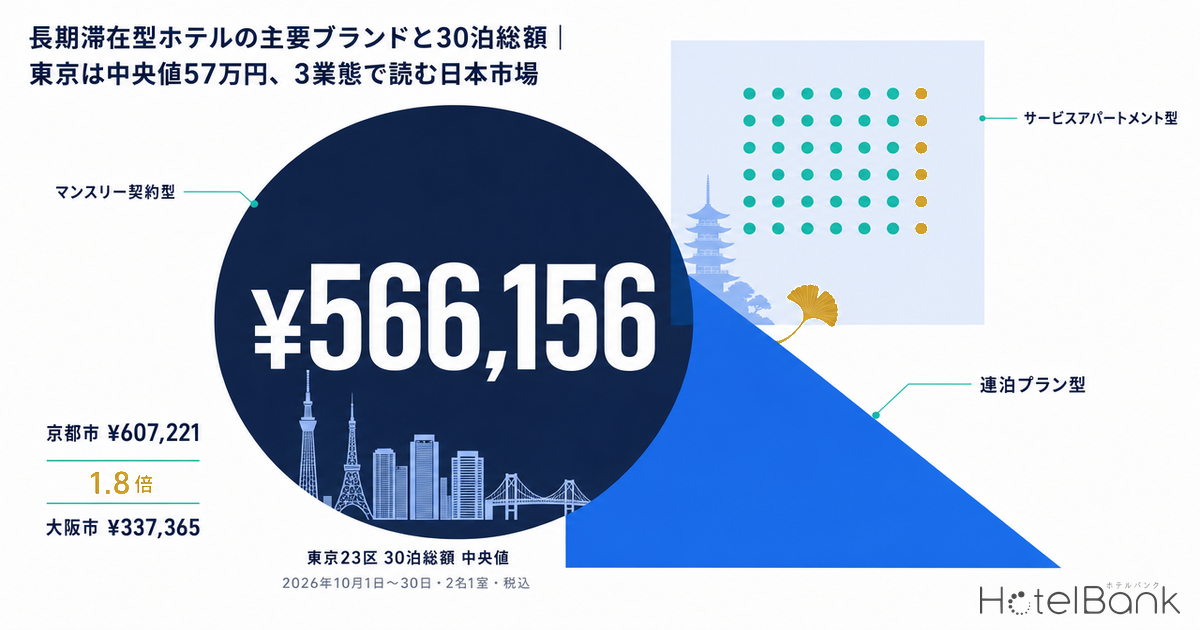
“Long-stay hotel” has not settled into a single, agreed product category in Japan. Properties sold on something close to a monthly contract, ordinary hotels that simply list a consecutive-night plan, and serviced apartments that sit close to rental housing all appear side by side in the same search results. This article is written for investors, operators and corporate travel bookers. It separates the field into three business models, sets out the publicly disclosed terms of the major brands operating in Japan with sources attached, and then measures the 30-consecutive-night total for six major cities from MetroEngines Research listed-price data.
Metric Definitions Used in This Article
- Listed price: the selling price each property publishes on OTAs and similar channels. Per room for two guests in one room, tax included. Some analyses also use the per-room price for four guests in one room, and say so explicitly where they do.
- 30-night total: the sum of each property’s cheapest listed price for every night across 30 consecutive nights from Thursday 1 October to Friday 30 October 2026. Per room, tax included. This is the level you reach by stacking 30 ordinary one-night bookings, and it differs from the dedicated monthly rates the operators sell on their own websites. Only properties with 28 or more nights observed are included; missing nights are scaled to 30 using the mean of the observed nights.
- This article does not use ADR (estimated settled rate). Because the question at hand is the total paid across a consecutive stay, the aggregation is built on the listed prices actually shown on screen.
- Data source: MetroEngines Research
- — Median ¥337,000–¥607,000: the 30-consecutive-night total for business and city hotels in six major cities (October 2026, two guests per room, tax included, N=2,184 properties). Kyoto is the highest and Osaka the lowest, a 1.8x spread.
- — Tokyo’s 23 wards sit at a median of about ¥566,000. The range runs 1.66x, from about ¥461,000 at the 25th percentile to about ¥765,000 at the 75th — so the price band you choose moves the total by more than ¥300,000.
- — Three tiers by business model: hotels with consecutive-night plans about ¥415,000, extended-stay hotels about ¥731,000, and apartment-hotel formats about ¥1.20M (median, per room, N=172 properties).
- — The gap narrows per person: in Tokyo, an apartment-hotel room for four is 2.66x a business or city hotel room for two on a per-room basis, but only 1.33x per person.
- — Saturdays run +33.1% against the median (long-stay brands in Tokyo, N=96 properties). Even so, changing the day of the week you start on moves the 30-night total by only about ±1%.
The long-stay hotel category splits into three business models
Start with the definitions. The properties grouped under the long-stay label fall into three models that differ in how revenue is built, how the contract is written, and how the room is designed. Without that distinction, lumping everything together as “long stay” makes neither a rate comparison nor a read on supply possible.
| Business model | Contract / unit of sale | Room design | Revenue characteristics |
|---|---|---|---|
| Monthly-contract type | A block such as 30 nights is sold as a single product. The rate is fixed for the period, with no lease agreement, deposit, key money or guarantor required | Ordinary hotel rooms, unchanged. Housekeeping is typically thinned out to once every few days | The per-room rate is lower, but occupancy and collection are locked in ahead of time. Housekeeping and front-desk costs are compressed as well |
| Consecutive-night plan type | Plans with a consecutive-night condition — 7 nights or more, 14 nights or more — are layered on top of ordinary per-night selling | Existing rooms are used as they are. Shared facilities such as a coin laundry cover the needs of a longer stay | Long-stay demand can be captured with existing inventory, with the flexibility to revert to ordinary selling on days when short-stay demand is strong |
| Serviced apartment type | Built around stays of 30 days or more, often contracted with corporate clients on a monthly quotation | Units come with a kitchen, washer-dryer, furniture and appliances, and floor areas close to residential | Rates are high and stays are long. Demand is led by corporate accounts — expatriates, secondees and construction and plant workers |
Source: compiled by the HotelBank Editorial Team from company disclosures
Between these three types sits the “apartment-hotel format,” where the rooms themselves are designed for a long stay but are still sold from a single night. These properties have a kitchen and a washer-dryer, sleep four to six, and are sold by the room; new openings in this tier have continued in Japan in recent years. In the price measurement later in this article, this tier is treated as its own category.
Why are operators looking at this field now? The reason is revenue smoothing. Securing one 30-night stay and winning 30 one-night bookings produce the same top line, but the operational load and the cancellation risk are very different. Overseas, the room count at long-stay hotels in the United States is reported to have grown by more than 50% between 2012 and 2022, expanding at 7.1% a year against 3.2% for the hotel market as a whole (Travel Voice, in Japanese). Japan has a deep supply of rental housing, so the American style of “living in a hotel” will not transplant directly. But in areas where three demand sources overlap — inbound long stays, construction and plant workers, and foreign expatriates — the model has room to work.
Major brands operating in Japan, listed side by side
Below are the major brands that officially market a long-stay product, presented side by side. No ranking by property count or room count is applied. Operators do not count “number of locations” the same way — some include only directly managed properties, others franchisees and partners — so there is no meaning in a third party recounting them and assigning positions. Everything listed comes from each company’s own disclosures.
| Brand (operator) | Main cities | Contract / booking unit | Room and stay facilities | Source |
|---|---|---|---|---|
| Ascott / Citadines / Somerset (The Ascott Japan) | Tokyo, Yokohama, Kyoto, Osaka | Serviced residences covering everything from a single short night to a long stay | Residence-specification units. Citadines entered Japan in 2009 | The Ascott Japan |
| APA Hotel (APA Hotel Network) | Nationwide | A monthly plan for 30 consecutive nights at the same hotel. Published from ¥105,000 for 30 nights | Standard housekeeping including a change of sheets and pillowcases every three nights. Desk power outlet, free Wi-Fi and wired LAN, suitable for remote work | APA Hotel official |
| Oakwood (part of The Ascott since 2022) | Tokyo, Osaka | Serviced apartments. Built around long stays, but short stays are accepted | Units with furniture, appliances and a kitchen. The Japan roll-out began in Akasaka, Tokyo in 2000 | SA navi |
| Tokyu Stay (Tokyu Stay Service) | Tokyo and nationwide | Weekly and monthly plans of 7 to 31 nights. A flat-rate long-stay plan is available at 30 locations nationwide, with no contract or screening required. Stays of 32 nights or more are handled by Tokyu Stay Residence | A washer-dryer in every room. A mini kitchen, microwave and cookware in some rooms. About 20 sqm on average, with utilities and Wi-Fi included in the room rate and no set-up costs | Tokyu Stay official |
| Dormy Inn (Kyoritsu Maintenance) | Nationwide | Weekly and monthly long-stay plans marketed as “urban workation” | The distinguishing feature is being able to stay long term at a property with a large communal bath | Dormy Inn official |
| Fraser Residence (Frasers Hospitality) | Osaka | Covers everything from a single night to a long stay | A kitchen, cookware and a washer-dryer in every unit | Osaka Convention & Tourism Bureau |
| Hotel MONday / MONday Apart | Tokyo, Kyoto, Osaka | Weekly and monthly plans from 7, 14 and 30 nights. Beyond 30 nights, stays can be extended one day at a time | Induction kitchen, fully automatic washer-dryer, large refrigerator, microwave, rice cooker and cookware. No deposit, no key money and no utility charges, Wi-Fi included. Weekly housekeeping is built into the room rate | Hotel MONday official |
| MYSTAYS (Iconia Hospitality) | Major cities nationwide | Long-stay plans from 7 nights, plus monthly plans from 30 nights | Housekeeping and linen-change terms vary by property and plan | MYSTAYS official |
| MIMARU (Cosmos Hotel Management / Daiwa House Group) | Tokyo, Kyoto, Osaka | Sold by the night as standard. The room design itself is built for long stays and larger parties | Spacious rooms sleeping up to 10, with a dining table, kitchen and cookware. A 24-hour coin laundry or an in-room washing machine | MIMARU official (in Japanese) |
| Minn (SQUEEZE) | Tokyo, Osaka, Kyoto, Hokkaido and others | An apartment hotel sold by the night that also accommodates long-stay use | Mostly rooms of 25 sqm or more with a kitchen. Mobile and self check-in run on an in-house system | SQUEEZE official |
Source: compiled by the HotelBank Editorial Team from company disclosures (this table is in Japanese alphabetical order and applies no ranking by scale or merit)
Read the table across and it becomes clear that each operator is competing on a different axis. One brand puts a flat-rate 30-night product on a nationwide network; another absorbs the “living” part of a stay by fitting a washer-dryer in every room; a third goes after multi-guest long stays with kitchens and large rooms; a fourth offers residence-specification units on the assumption of a corporate contract. The axis a reader should choose on is not “which is biggest” but “which fits what my company or my department actually needs.”
Measured across six major cities, the 30-night total has a median of ¥330,000 to ¥610,000
Now to the measurement. For the 30 consecutive nights from Thursday 1 October to Friday 30 October 2026, the cheapest listed price for each night (two guests per room, tax included) was summed for each property. The scope is business and city hotels in six major cities, limited to properties with 20 rooms or more where listings were observed on at least 28 of the 30 nights.
Source: MetroEngines Research, compiled by the HotelBank Editorial Team
| City | Properties | 25th percentile | Median | 75th percentile | Per night (median) |
|---|---|---|---|---|---|
| Kyoto City | 299 | ¥482,904 | ¥607,221 | ¥797,501 | ¥20,241 |
| Tokyo 23 wards | 891 | ¥460,859 | ¥566,156 | ¥764,532 | ¥18,872 |
| Fukuoka City | 218 | ¥415,747 | ¥490,964 | ¥613,216 | ¥16,365 |
| Nagoya City | 148 | ¥376,279 | ¥449,993 | ¥517,736 | ¥15,000 |
| Sapporo City | 161 | ¥347,614 | ¥390,345 | ¥454,540 | ¥13,012 |
| Osaka City | 467 | ¥281,200 | ¥337,365 | ¥429,643 | ¥11,246 |
Source: MetroEngines Research, compiled by the HotelBank Editorial Team (30 nights from 1 to 30 October 2026, two guests per room, tax included, sum of the cheapest listed price each night)
At the median, the gap between the most expensive city, Kyoto (about ¥607,000), and the cheapest, Osaka (about ¥337,000), is 1.8x. Per night that is about ¥20,200 against about ¥11,200 — and the fact that this is the spread across the same 30 days of the same October is exactly where the difference in each city’s supply and demand shows. Kyoto in autumn stacks sightseeing demand on top of international conferences and school trips, while Tokyo has a thick floor of business demand all year. Osaka, by contrast, has heavy room supply, and its 25th percentile falls into the ¥280,000s.
What matters in practice to a corporate booker is not the median but the distance between the 25th and 75th percentiles. In Tokyo’s 23 wards that runs from about ¥461,000 to about ¥765,000, a spread of 1.66x. Even for the same “30 nights in Tokyo,” the choice of location and property grade alone moves the total by more than ¥300,000. Put the other way round, arranging a long stay is mostly decided before any rate negotiation, in the design of which price band of inventory you go looking at. How the total builds up when a stay stretches to two months is measured on the same listed-price basis in Hotel Long Stay for 2 Months: What 60 Nights Costs, ¥790,000 in Tokyo and ¥490,000 in Osaka.
By business model, the 30-night total splits into three tiers
Next, taking only the brands that carry a long-stay product, the 30-night total was aggregated on the same terms as above. The scope is 192 properties located in major cities, of which the 172 that could be clearly classified are organised into four categories.
Source: MetroEngines Research, compiled by the HotelBank Editorial Team
| Business model | Properties | 25th percentile | Median | 75th percentile |
|---|---|---|---|---|
| Hotels with consecutive-night plans | 47 | ¥322,288 | ¥415,041 | ¥519,749 |
| Extended-stay hotels (washer-dryer in the room) | 28 | ¥555,099 | ¥730,770 | ¥1,015,989 |
| Serviced apartment type | 8 | ¥690,477 | ¥1,165,356 | ¥2,771,662 |
| Apartment-hotel format | 89 | ¥880,068 | ¥1,200,505 | ¥1,559,464 |
Source: MetroEngines Research, compiled by the HotelBank Editorial Team (N=172 properties, per-room total for two guests per room, tax included)
These categories organise price bands that follow from differences in product design; they do not rank brands. The extended-stay level has in-room washer-dryers and mini kitchens priced into it, and the serviced apartment level has residential floor areas, furniture and appliances priced into it. And the per-room figures must not be read straight across as “which is more expensive.” Rooms at hotels with consecutive-night plans are mostly designed for one or two guests, whereas apartment-hotel and serviced apartment rooms are designed for four to six — up to ten at some brands. Comparing per-room amounts alone puts things with different floor areas and different capacities on the same scale.
Booked for four, the per-person gap narrows from 2.7x to 1.3x
So the same 30-night aggregation was run for apartment-hotel properties using the listed price for four guests in one room, then converted to a per-person figure. The scope is the 86 properties with four-guest listings observed on at least 28 nights.
| Area | Properties | 30-night total (four per room, median) | Per person, 30 nights | Per person, per night |
|---|---|---|---|---|
| Tokyo | 54 | ¥1,504,074 | ¥376,018 | ¥12,534 |
| Kyoto | 18 | ¥1,259,030 | ¥314,758 | ¥10,492 |
| Osaka | 10 | ¥1,149,758 | ¥287,439 | ¥9,581 |
| All | 86 | ¥1,320,914 | ¥330,229 | ¥11,008 |
Source: MetroEngines Research, compiled by the HotelBank Editorial Team (four guests per room, tax included, sum of the cheapest listed price each night)
Compared within Tokyo, an apartment-hotel room for four comes to about ¥1.50M per room, 2.66x the median for a business or city hotel room for two (about ¥566,000). Converted to a per-person figure, though, it is about ¥376,000 against about ¥283,000 — the gap narrows to 1.33x. On top of that, apartment-hotel rooms have a kitchen and laundry facilities inside the room, so food and cleaning costs during the stay come down structurally. For placing a team of three or four in one city for a month, judging on the per-room total alone leads to the wrong decision. How the presence of an in-room kitchen moves food costs during a stay is worked through in Meals on a Long Hotel Stay in Japan: Three Patterns and the Switch to a Kitchen Room.
For a solo 30-night stay, conversely, the band for hotels with consecutive-night plans (median about ¥415,000, about ¥322,000 at the 25th percentile) is the realistic option. As the brand table above shows, this tier has an established format for selling 30 nights as a single flat-rate product, and APA Hotel publishes a monthly plan from ¥105,000 for 30 nights. Whether the use case is a solo business stay, a medium-term project run by a team, or preparation for a posting with family in tow changes which business model to choose.
What drives the 30-night total up is how many Saturdays fall inside the period
When 30 nights are stacked up from ordinary one-night bookings, the swing in nightly rate by day of the week is a large part of the total. For 96 long-stay brand properties in Tokyo and 518 business hotels across the eight central wards, a day-of-week price index was calculated with each property’s 30-night median set at 100.
Source: MetroEngines Research, compiled by the HotelBank Editorial Team
At long-stay brands, Saturday runs 133.1 and Monday 92.4, a gap of 40.7 points. Business hotels trace almost the same shape at 131.3 on Saturday and 88.9 on Monday, which shows the two are operating on the same demand curve. The period aggregated here, 1 to 30 October 2026, contains four Saturdays (the 3rd, 10th, 17th and 24th), and those four nights are what tell on the total.
Two practical implications follow. One is that shifting the start date by a single day can leave the period holding either four Saturdays or five. Even so, as the table below shows, the effect on the 30-night total is limited, so for a budget going through approval it pays more to settle the price band first than to adjust the start date. The other is the operator’s view. Because Saturdays stand out when bookings are stacked up in the ordinary way, a flat-rate monthly product that smooths them away carries a clear value for the customer: the price is easy to read. That several brands in the table above lead with “flat rate,” “no set-up costs” and “utilities included” can be read as making that legibility itself the product.
| Starting day | Saturdays in the period | Long-stay brands (Tokyo, N=96 properties) | Business hotels (Tokyo 8 central wards, N=518 properties) |
|---|---|---|---|
| Thursday start (1 October, as in this article) | 4 | Baseline | Baseline |
| Friday start | 5 | +1.1% | +1.0% |
| Saturday start | 5 | +0.8% | +0.7% |
| Sunday start | 4 | −0.5% | −0.7% |
| Monday start | 4 | −0.7% | −0.6% |
| Tuesday start | 4 | −0.5% | −0.3% |
| Wednesday start | 4 | −0.3% | −0.1% |
Source: MetroEngines Research, compiled by the HotelBank Editorial Team (an approximation applying the day-of-week price index in the chart above to 30 nights = 4 weeks + 2 nights. It does not reflect the actual price movements of individual properties)
Even a Friday start, which puts five Saturdays inside the period, lifts the total by only about 1% on this approximation. Applied to the median for business and city hotels in Tokyo’s 23 wards (about ¥566,000), that is a difference of about ¥5,700. Night by night, Saturday stands out at more than 30% above the median, but averaged across 30 nights it thins out. What moves the 30-night total substantially is not the start date but the choice of price band seen earlier — more than ¥300,000 between the 25th and 75th percentiles in Tokyo’s 23 wards.
Three points for investors and operators
Finally, the points to weigh when looking at this field as a business.
First, how much revenue smoothing to count on. A 30-night stay fixes occupancy and collection in advance, but the rate over that period sits below what peak days could have sold for. In this measurement, Saturdays at long-stay brands in Tokyo ran +33.1% against the median. Selling 30 nights at a flat rate is precisely the decision to give up that upside in exchange for certainty. The deeper the occupancy trough at a location, the better the terms of that trade; the thicker the floor of business demand in a city centre, the more careful the design has to be.
Second, room design determines the demand segment. Whether a kitchen and a washer-dryer go inside the room changes which demand you can go after. A solo business stay for which a shared coin laundry is enough and a family or team stay built around cooking and laundry are different markets. In this price measurement too, a gap of 2.66x per room came down to 1.33x per person. In other words, the per-room rate of an apartment format only shows its real economics once the capacity is filled. So “is there demand at this location that fills the capacity” becomes the precondition for choosing this design.
Third, the regulatory position. Long-stay hotels are lodging facilities operated within the framework of the Hotel Business Act, not under a lease agreement. The convenience of needing no deposit, key money or guarantor, with utilities and Wi-Fi included in the rate, follows from that. At the same time, it has been pointed out that where the line falls between a long stay and a residence is an area where the regulatory framework has not caught up (Travel Voice, in Japanese). For development and investment work, confirming the fire, building and lodging-business requirements at an early stage is a precondition.
Summary
Japan’s long-stay hotels divide into three models — monthly-contract, consecutive-night plan and serviced apartment — with the apartment-hotel format sitting between them. The major brands each design their product on a different axis, and ranking them by scale serves no practical purpose.
Measured on a listed-price basis, the 30-consecutive-night total for business and city hotels in six major cities had a median between about ¥337,000 in Osaka and about ¥607,000 in Kyoto (N=2,184 properties). Narrowing to long-stay brands, the figures split into three tiers — a median of about ¥415,000 for hotels with consecutive-night plans, about ¥731,000 for extended-stay hotels and about ¥1.20M for apartment-hotel formats — but booked for four guests, the per-person figure falls to about ¥330,000. Solo or team; 7 nights or 30; whether cooking and laundry need to happen inside the room. Those are the three axes for the decision, not the size of the brand.
⚠ A note on listed prices for future dates: the 30-night totals in this article are estimates based on selling prices published on OTAs and similar channels for October 2026 as at the time of the survey, and they move as the check-in date approaches. Please note that prices set high at present may fall through last-minute adjustment, and that lower price bands may appear as new plans are added. Note also that the amounts in this article are the level reached by stacking 30 ordinary one-night bookings, and differ from the dedicated weekly and monthly rates the operators sell on their own websites.
Related reading
- Six Checks for a Long-Stay Business Hotel: Tokyo Listed Prices at ¥16,722 a Night and Three Ways to Cut the Cost
- Hotel Long Stay for 2 Months: What 60 Nights Costs, ¥790,000 in Tokyo and ¥490,000 in Osaka
- What 30 Nights of Hotel Living Costs a Salaried Worker: ¥490,000 Tokyo, ¥240,000 Osaka, ¥230,000 Nagoya at Station-Front Business Hotels
- How Many Nights Before a Long-Stay Discount Bites? 15% at 7 Nights and 20% at 30 Is the Measured Going Rate
- Meals on a Long Hotel Stay in Japan: Three Patterns and the Switch to a Kitchen Room
References and Sources
■ Market data
- MetroEngines Research — OTA listed-price data (1–30 October 2026, two guests per room and four guests per room, tax included)
■ Company disclosures
- Tokyu Stay, “Flat-Rate Long-Stay Plan” / “Medium- and Long-Stay Plan (up to 31 nights)”
- Hotel MONday, “Guide to Weekly and Monthly Plans”
- APA Hotel, “Why Choose the Monthly Plan”
- Dormy Inn, “Urban Workation (Weekly and Monthly)”
- MYSTAYS, “Better Value from 7 Nights: Long-Stay Plans”
- MIMARU official site (Cosmos Hotel Management)
- SQUEEZE, “Minn: Apartment Hotel Planning and Operation”
- The Ascott Japan press release (Citadines Harbourfront Yokohama)
- SA navi, “Serviced Apartments and Extended-Stay Hotels” (Oakwood)
- Osaka Convention & Tourism Bureau, “Fraser Residence Nankai Osaka”
■ Industry reports and press coverage