

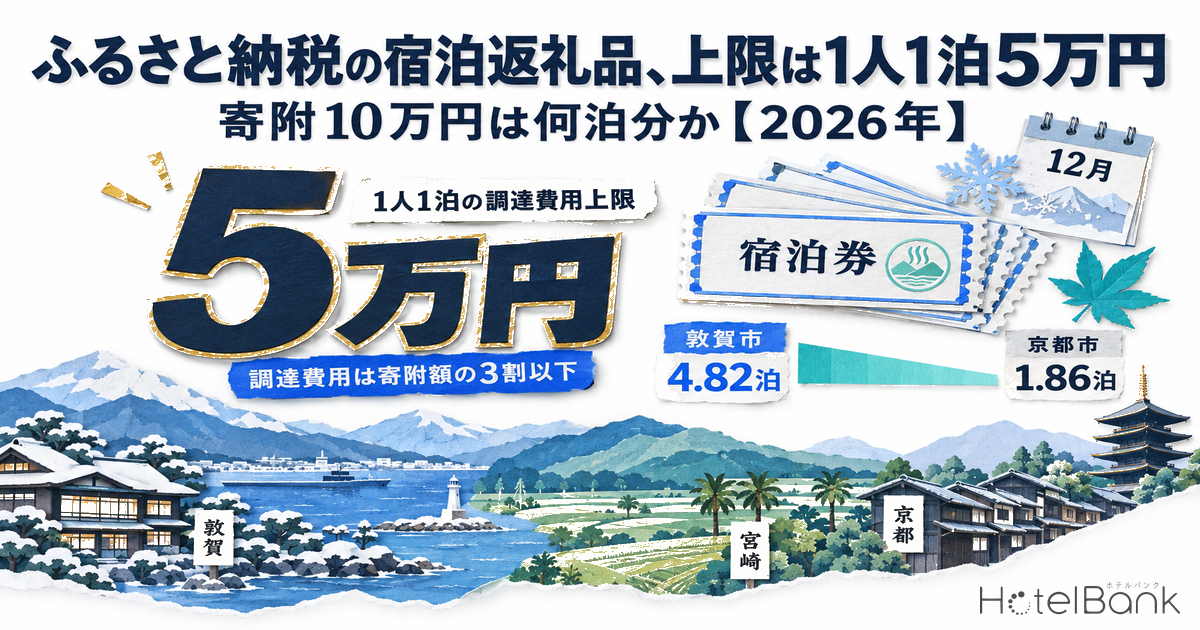
When a municipality offers a lodging voucher as a furusato tax (hometown tax donation) reward, two rules constrain how the amount may be designed. One applies to every reward: procurement cost must be no more than 30% of the donation (Local Tax Act, Article 37-2, Paragraph 2, Item 2). The other applies to lodging alone — the cost must “not exceed ¥50,000 per person per night” (MIC Notification, Article 5, Item 7-3(a)). These are two separate ceilings, and only in combination do they determine how many nights a given donation can fund. This article first establishes the rules as they now stand, using the survey the Ministry of Internal Affairs and Communications (MIC) published on 31 July 2026 as primary source, then overlays the room stock and estimated settled ADR of the municipalities receiving the largest donation totals to convert donation amounts into actual nights.
Metric Definitions Used in This Article
- ADR (Average Daily Rate): An estimated settled rate (net-of-tax equivalent) calculated by applying category-specific adjustment coefficients to the lowest publicly listed plan level each property posts on OTAs (double occupancy, per-room rate, tax included). The median error against property-level actuals disclosed by listed hotel REITs is approximately 7% (91 properties, most recent three months). These are estimates and differ from each property’s actual transaction prices and accounting figures. Municipality-level ADR is the median of the properties covered (the level of a typical property in that area); this article uses the median of the 12 finalised months from September 2025 to August 2026.
- Procurement cost: The amount a local government spends to provide a reward. For a lodging voucher this corresponds to the amount the property receives. It is not the donation itself.
- Average donation per transaction: The donation total in the MIC survey divided by the number of donations — the mean amount per individual donation.
- Property and room counts: Counts covering only properties confirmed as listed on major booking sites; unlisted ryokan, minshuku and simple lodgings are excluded. Nationally there are 98,338 Ryokan Business Act permits against 27,248 properties confirmed as listed, so the figures here cover the listed subset.
- Data sources: Institutional rules and amounts from MIC, “Survey Results on the Current State of Furusato Tax Donations (conducted FY2026)” and other published materials. ADR and room stock from MetroEngines Research.
- — The ceiling has two storeys: on top of the 30%-of-donation limit on procurement cost (Local Tax Act, Article 37-2), lodging carries a monetary standard of no more than ¥50,000 per person per night (Notification, Article 5, Item 7-3(a)). Properties operated only within the prefecture (Item 7-2) are outside that monetary standard.
- — A ¥100,000 donation = ¥30,000 of procurement cost: converted at the estimated settled ADR of the top 14 donation-receiving municipalities (median of the 12 months from September 2025 to August 2026), that buys between 1.86 nights (Kyoto City) and 4.82 nights (Tsuruga City).
- — ¥1.3314 trillion received, ¥22,300 average per donation: FY2025 was up 4.6% year on year. Donations earmarked for “tourism, exchange and settlement promotion”, however, came to ¥33.79 billion, down 1.4% (MIC, published 31 July 2026).
- — In 2025, September at 41.1% outran December at 29.1%: donations were pulled forward ahead of the ban on point awards that took effect in October 2025 (RIETI survey). For 2026, assume the year-end concentration returns and settle blackout dates, inventory and donation tiers during September to November.
The Lodging Reward Ceiling Has Two Storeys — the 30% Rule and ¥50,000 Per Person-Night
Start by pinning the current rules to primary sources. According to “Survey Results on the Current State of Furusato Tax Donations (conducted FY2026)”, published by MIC on 31 July 2026, FY2025 (1 April 2025 to 31 March 2026) saw ¥1.3314 trillion received across 59.630 million donations. Against the prior year’s ¥1.27275 trillion and 58.787 million donations, that is up 4.6% in value and 1.4% in count. The average donation per transaction was ¥22,300, up 3.1% from ¥21,700 the year before.
Of that, reward procurement cost came to ¥352.8 billion, or 26.5% of donations received (25.2% the prior year). The Local Tax Act sets the 30% procurement limit per individual donation, so on average there is 3.5 points of headroom left to the ceiling. What matters here is that the statute applies the test to each and every donation. It is not enough for the aggregate average to come in under 30% — every single donation must. For a high-value reward such as a lodging voucher, that per-donation test is where the design starts.
Lodging then carries a standard of its own. A reward must satisfy the “local-product standard”, and for services consisting of the provision of lodging, Article 5 of the Notification lays out two routes. Item 7-2 covers accommodation facilities located within the municipality that are “operated by a party that operates accommodation facilities only within the prefecture to which the local government belongs.” That applies where an operator holding a business permit under Article 3, Paragraph 1 of the Ryokan Business Act conducts its ryokan business only inside that prefecture. Where the name on the business permit carries the brand name of an accommodation facility outside the prefecture, however, the judgment is made objectively on the name regardless of operating structure, and the property falls outside this route.
Properties that do not qualify under Item 7-2 are caught instead by Item 7-3(a), which is the monetary standard: “the cost required to procure the service does not exceed ¥50,000 per person per night.” The test is applied per person per night. The MIC Q&A (Question 24-3) gives worked examples: a paired lodging voucher costing ¥80,000 to procure is divided by 2 (two people × one night) for ¥40,000 and meets the standard, whereas ¥120,000 becomes ¥60,000 and does not. For travel vouchers that do not specify a property, Question 24-4 states that steps such as restricting the lodging portion to ¥50,000 or less per person per night are required. Item 7-3(b) then places outside this monetary standard any reward offered by a local government within a prefecture containing a municipality to which the Disaster Relief Act was applied for a designated extraordinary disaster (as of the notification: Niigata, Toyama, Ishikawa and Fukui prefectures and all municipalities within them). These amendments apply from designation periods beginning on or after 1 October 2024.
One further institutional change took effect in October 2025. An amendment to Article 2, Item 1(b)(2) of the Notification banned solicitation through any party that awards points or similar to donors in connection with their donation. Awards equivalent to those granted with settlement in ordinary commercial transactions are excluded, but awards made via a third party are covered. Set out by MIC in its notification of 28 June 2024 (So-Zei-Shi No. 67), the amendment applies from designation periods beginning on or after 1 October 2025. Because it changes the front door of solicitation, it also bears on how properties plan their demand generation.
The two ceilings pull in opposite directions. The 30% rule pushes toward raising the donation relative to the procurement cost, while the ¥50,000 rule caps the procurement cost itself. The combinations that satisfy both work out as follows.
| Voucher contents | Person-nights | Procurement cost ceiling (¥50,000 × person-nights) |
Donation required for that cost (cost ÷ 30%) |
|---|---|---|---|
| 1 guest, 1 night | 1 | ¥50,000 | ¥166,700 |
| 2 guests, 1 night (paired voucher) | 2 | ¥100,000 | ¥333,300 |
| 2 guests, 2 nights / 4 guests, 1 night | 4 | ¥200,000 | ¥666,700 |
| (Reference) procurement cost of ¥30,000 | — | Within standard | ¥100,000 |
Source: Compiled by the HotelBank Editorial Team from Local Tax Act Article 37-2, Paragraph 2, Item 2; MIC Notification Article 5, Item 7-3(a); and Q&A Question 24-3. Amounts rounded to the nearest ¥100
Read from the property’s side, it comes out like this. To build a voucher that pays the property ¥30,000 per night, the donation has to be set at ¥100,000. Conversely, a ¥50,000 donation tier supports procurement cost of at most ¥15,000, and that is the ceiling on the property’s actual receipts. And as long as the Item 7-3 route is used, the amount receivable per person per night tops out at ¥50,000. Under an operating structure that qualifies under Item 7-2, by contrast, that ¥50,000 ceiling does not apply and only the 30% rule bites. Which route a property uses to satisfy the local-product standard therefore changes the very range of donation amounts it can design around.
Where the ¥1.3314 Trillion Lands — Distribution by Prefecture
The geographic skew in donations received is large. By prefecture (prefectural and municipal totals combined), Hokkaido stands out at ¥188.8 billion, followed by Miyazaki at ¥62.5 billion, Fukuoka at ¥60.2 billion, Shizuoka at ¥58.4 billion and Yamanashi at ¥51.4 billion. The top of the table is held by primary-produce regions, and it does not necessarily line up with the scale of lodging demand.
Source: Compiled by the HotelBank Editorial Team from MIC, “Survey Results on the Current State of Furusato Tax Donations (conducted FY2026)”
Among the top 20 municipalities, Izumisano City in Osaka leads at ¥23.04 billion, followed by Shiranuka Town in Hokkaido at ¥22.33 billion, Miyakonojo City in Miyazaki at ¥21.65 billion and Bekkai Town in Hokkaido at ¥21.16 billion. For thinking about lodging, though, what carries meaning is not the total received but the average donation per transaction — the total divided by the number of donations. The national average is ¥22,300, yet the top 20 include municipalities running at 1.7 to 2.5 times that level: Kofu City in Yamanashi at ¥56,300, Minamiuonuma City in Niigata at ¥54,600, Nagoya City in Aichi at ¥49,600 and Kyoto City at ¥39,000. It is an indicator of handling higher-priced rewards across a narrower count of donations.
A high average donation cannot, however, be taken as proof that lodging vouchers are behind it. Jewellery, crafts and premium foodstuffs are among several other high-value categories, and the published materials do not allow a breakdown by item to be identified.
Where Lodging Sits in the Whole — What Can Be Established
No comprehensive statistic exists in the published materials showing how much of the national total lodging-related rewards account for. The MIC survey does not tabulate rewards by item, and the composition of the ¥352.8 billion in procurement cost is not disclosed. What follows is therefore limited to three pieces of circumstantial evidence within what can be established. It is not a complete census.
First, there are donation totals by the purpose the donor selected. In FY2025, donations earmarked for “tourism, exchange and settlement promotion” came to ¥33.79 billion across 1.344 million donations at 716 local governments — 2.5% of all donations received. The caveat is that this classifies what the money will be spent on, not what the reward is. A donation whose reward is a lodging voucher may be booked under a different purpose, and vice versa.
On that basis, and compared with the prior year, this category fell 1.4%, from ¥34,250 million to ¥33,786 million. The count dropped 5.7% as well, from 1.426 million to 1.344 million. While total donations grew 4.6%, only two of the ten purpose categories declined: “tourism, exchange and settlement promotion” and “disaster support and reconstruction.” The fastest growth was “safety, security and disaster preparedness” at +20.2%, followed by “regional and industrial promotion” at +18.7%.
Source: Compiled by the HotelBank Editorial Team from MIC, “Survey Results on the Current State of Furusato Tax Donations (conducted FY2026)”
Second, there is survey work on what donors actually choose. A column published on 11 March 2026 by the Research Institute of Economy, Trade and Industry (RIETI) reports, from a web survey of employed people aged 20 to 64 with personal income of ¥3 million or more (N=10,850, fielded 28–30 January 2026, covering donations made January to December 2025), that the most-chosen rewards were seafood at 39.7%, meat at 36.8%, rice at 28.7% and fruit at 23.6%. Food dominates the top categories, and travel or lodging vouchers do not appear among them.
Third, there is the fact that the rules themselves treat lodging as a distinct category. Article 5 of the Notification deliberately carves lodging out of the general provision for service provision (Item 7) and gives it dedicated provisions in Items 7-2 and 7-3. Setting a monetary standard and operator requirements specifically for it means there is a real body of cases requiring that judgment.
Taken together, the three suggest that lodging vouchers are a minority category, nowhere near the food categories in monetary scale, yet one given a frame of its own in the rules. Being a minority is also, read the other way, a reflection of a structurally high value per transaction. The next section converts that value into actual figures.
How Many Nights Does ¥100,000 Buy? — Converted Using Room Stock and ADR in the Top 14 Municipalities
Of the top 20 municipalities by donations received, 14 have at least 10 properties covered by the estimated settled ADR calculation, and for those we matched room stock against rate levels. Since procurement cost is capped at 30% of the donation, a ¥100,000 donation supports ¥30,000 of procurement cost. Dividing that by the municipality’s estimated settled ADR (double occupancy, per room) gives the number of nights it buys at a typical property.
| Municipality | Donations (¥100M) |
Avg. donation per transaction |
Listed properties |
Rooms | Estimated settled ADR |
Nights per ¥100,000 |
Donation needed for one night |
|---|---|---|---|---|---|---|---|
| Izumisano City, Osaka | 230.4 | 17,045 | 34 | 4,413 | 7,830 | 3.83 nights | 26,100 |
| Miyakonojo City, Miyazaki | 216.5 | 20,452 | 22 | 1,572 | 6,268 | 4.79 nights | 20,900 |
| Nagoya City, Aichi | 174.5 | 49,601 | 200 | 32,770 | 9,695 | 3.09 nights | 32,300 |
| Miyazaki City, Miyazaki | 143.1 | 19,773 | 80 | 7,316 | 7,592 | 3.95 nights | 25,300 |
| Kesennuma City, Miyagi | 134.8 | 15,522 | 25 | 769 | 9,372 | 3.20 nights | 31,200 |
| Kyoto City, Kyoto | 132.6 | 39,048 | 905 | 48,896 | 16,111 | 1.86 nights | 53,700 |
| Yaizu City, Shizuoka | 114.2 | 14,857 | 18 | 985 | 7,038 | 4.26 nights | 23,500 |
| Kofu City, Yamanashi | 102.0 | 56,289 | 41 | 2,872 | 7,782 | 3.86 nights | 25,900 |
| Fujiyoshida City, Yamanashi | 101.0 | 17,255 | 31 | 1,122 | 12,006 | 2.50 nights | 40,000 |
| Fuji City, Shizuoka | 101.0 | 14,860 | 24 | 1,962 | 6,870 | 4.37 nights | 22,900 |
| Tsuruga City, Fukui | 83.8 | 19,118 | 25 | 1,592 | 6,230 | 4.82 nights | 20,800 |
| Choshi City, Chiba | 70.1 | 12,695 | 18 | 639 | 8,688 | 3.45 nights | 29,000 |
| Hanamaki City, Iwate | 69.8 | 15,618 | 32 | 1,614 | 13,630 | 2.20 nights | 45,400 |
| Minamiuonuma City, Niigata | 69.0 | 54,566 | 49 | 1,640 | 11,584 | 2.59 nights | 38,600 |
Donations received and average donation per transaction: MIC, “Survey Results on the Current State of Furusato Tax Donations (conducted FY2026)”, FY2025 actuals. Property counts, room counts and estimated settled ADR: MetroEngines Research (based on major booking-site listings; property and room counts as of September 2026; ADR is the median of the 12 finalised months from September 2025 to August 2026; properties covered N = Izumisano 26 / Miyakonojo 20 / Nagoya 189 / Miyazaki 58 / Kesennuma 16 / Kyoto 412 / Yaizu 14 / Kofu 38 / Fujiyoshida 19 / Fuji 27 / Tsuruga 23 / Choshi 16 / Hanamaki 32 / Minamiuonuma 28). Kyoto City and Nagoya City aggregate ward-level tabulations. Amounts in yen; nights to two decimal places
The number of nights a ¥100,000 donation buys spans a 2.6-fold range. The most is Tsuruga City at 4.82 nights, followed by Miyakonojo at 4.79, Fuji City at 4.37 and Yaizu at 4.26. The fewest is Kyoto City at 1.86 nights, then Hanamaki at 2.20, Fujiyoshida at 2.50 and Minamiuonuma at 2.59. Inverted into “the donation needed for one night at a typical property”, the range runs from ¥20,800 in Tsuruga City to ¥53,700 in Kyoto City. For the same ¥100,000 donation, how many nights the ¥30,000 the property receives is worth differs sharply by location.
The municipality-level figures read more easily once decomposed into two axes: the donation and the ADR. The table below combines donation tiers (procurement cost being 30% of each) with estimated settled ADR levels to show the nights the procurement cost covers. Estimated settled ADR across the 14 municipalities runs from ¥6,230 to ¥16,111, and the table’s columns span that range.
| Donation | Procurement cost (× 30%) | ADR ¥6,000 | ADR ¥8,000 | ADR ¥10,000 | ADR ¥12,000 | ADR ¥16,000 |
|---|---|---|---|---|---|---|
| ¥50,000 | ¥15,000 | 2.50 nights | 1.88 nights | 1.50 nights | 1.25 nights | 0.94 nights |
| ¥100,000 | ¥30,000 | 5.00 nights | 3.75 nights | 3.00 nights | 2.50 nights | 1.88 nights |
| ¥200,000 | ¥60,000 | 10.00 nights | 7.50 nights | 6.00 nights | 5.00 nights | 3.75 nights |
| ¥300,000 | ¥90,000 | 15.00 nights | 11.25 nights | 9.00 nights | 7.50 nights | 5.63 nights |
Source: HotelBank Editorial Team calculation assuming the 30% ceiling in Local Tax Act Article 37-2, Paragraph 2, Item 2. Nights = procurement cost ÷ estimated settled ADR (rounded to two decimal places). Excludes meals, lodging tax, shipping and other solicitation costs. Every combination shown sits within the ¥50,000 per person-night standard
A ¥50,000 donation tier does not reach a full night in a market with ¥16,000 ADR (0.94 nights). The same donation buys 2.50 nights in a ¥6,000 ADR market. Estimated settled ADR is an estimate, and applying the roughly 7% median error either way puts the ¥100,000 figure in a band of 1.74 to 2.00 nights for Kyoto City and 4.50 to 5.18 for Tsuruga City. That is not wide enough to reorder the municipalities, but when designing an individual voucher a property should substitute its own actual selling rates.
Overlaying the average donation per transaction reveals where a lodging voucher sits as a product. The chart below plots estimated settled ADR on the horizontal axis against each municipality’s average donation on the vertical, with a diagonal reference line at “ADR ÷ 30%” — the donation needed to fund one night. Municipalities above the line are those where the average single donation already exceeds the level of one night.
Source: Compiled by the HotelBank Editorial Team from MIC, “Survey Results on the Current State of Furusato Tax Donations (conducted FY2026)”, and MetroEngines Research (N=14 municipalities)
Only three cities sit above the reference line: Kofu, Nagoya and Minamiuonuma. Kofu’s average donation of ¥56,300 against ¥25,900 needed for one night is 2.17 times; Minamiuonuma’s ¥54,600 against ¥38,600 is 1.41 times; Nagoya’s ¥49,600 against ¥32,300 is 1.54 times. In the remaining 11 municipalities the average single donation does not reach the level of one night. The widest gap is Hanamaki City, where an average donation of ¥15,600 stands against the ¥45,400 needed for one night, a ratio of 0.34. For the municipality-level rate structure and seasonal swing across Iwate Prefecture, including Hanamaki, see Iwate Hotel Market 2026: 2.2x ADR Gap, Morioka ¥200 Lodging Tax in more detail.
What this configuration means is that for many municipalities a lodging voucher is a product standing on a different tier from their mainstay donation size. Among the 11 municipalities below the line, the 10 excluding Kyoto City (¥39,000) have average donations between ¥12,700 and ¥20,500, while the donation needed to fund one night at a typical property (double occupancy) is ¥27,600 at the median of the 14 and ¥53,700 in Kyoto City at the top. A voucher including two meals, or covering multiple nights, pushes the required donation higher still. Against the national average donation of ¥22,300, a lodging voucher is therefore designed as a product priced above the average single donation. It is a reward that contributes through high value rather than high volume, and the response after listing should not be measured on the same yardstick as high-volume rewards.
One more practical implication worth registering is where the ¥50,000 per person-night standard actually bites. Estimated settled ADR across these 14 municipalities peaks at ¥16,100 per room in Kyoto City (double occupancy, net-of-tax equivalent), or around ¥8,100 per person. Even on tax-inclusive listed prices (double occupancy, per room, area median), the higher readings as of August 2026 are ¥52,300 for Yamanashi City in Yamanashi Prefecture and ¥40,700 for Hanamaki City — neither in the table above — which come to roughly ¥20,000–¥26,000 per person. At median market levels, in other words, the ¥50,000 ceiling is not reached. Where the standard genuinely constrains is the upper end of the price distribution: high-end ryokan exceeding ¥50,000 per person with two meals, and premium room types including suites. Properties in that bracket should first check whether they qualify via the Item 7-2 route — that is the practical order of operations. Whether a lodging tax applies, and at what rate, differs by municipality; rates and effective dates by municipality are tabulated in Japan Lodging Tax 2026: All 62 Municipalities, Rates and ADR Burden.
Will the December Concentration Return? — The 2025 Pull-Forward and How to Read 2026
Donations cluster at year-end because of how the scheme is built. Resident tax deductions apply to donations made between 1 January and 31 December of the preceding year, so a rush develops toward year-end once annual income is foreseeable. The MIC survey states explicitly that FY2026 deduction amounts relate to donations made between 1 January and 31 December 2025.
In 2025, though, that seasonality broke. On the timing question in the RIETI column cited above, December accounted for 50.6% in 2024 (2024 sample N=10,882), whereas in 2025 September came to 41.1%, ahead of December’s 29.1% (2025 sample N=10,850). The respondents in each year are separate samples. Donations were pulled forward into September ahead of the ban on solicitation involving point awards that took effect on 1 October 2025.
Source: Compiled by the HotelBank Editorial Team from the Research Institute of Economy, Trade and Industry (RIETI) column “Preliminary report: Furusato tax donations in 2025 — reward selection structure, the impact of the rule changes, and intent to continue” (11 March 2026; 2024 sample N=10,882, 2025 sample N=10,850; separate samples by year)
The point that matters for 2026 is that the September concentration was a one-off tied to the rule transition. The point-award ban has applied since October 2025, so no deadline remains to motivate pulling donations forward. Because 2026 is the first full year without a rule-change rush, the calendar-year basis of the deduction is likely to assert itself plainly and donations to return to clustering in December. For a property’s own planning, it is reasonable to build on the pre-2024 year-end pattern rather than treating the September level as the baseline.
Four Things to Settle During Autumn — Releasing Inventory and Handling Peak Season
If donations cluster in December, a property’s preparation has to be finished between September and November. Registering the reward, agreeing the procurement cost and fixing the terms of use all go through discussion with the municipality, so autumn is the effective deadline for being ready in time for year-end applications. Four operational questions are worth settling in advance.
First, assume the donation date and the stay date will diverge. A donation received in December produces a voucher that will be used on some day inside its validity period. With a one-year validity, the actual stays can spread across the following year’s Golden Week and summer holidays, or even into the new-year period a year after that. Donations concentrate in December, but room consumption scatters across the year. How to absorb that lag is where the design starts.
Second, decide before listing whether to set blackout dates. Whether peak season is excluded from the usable dates is part of the terms presented to the donor, and changing terms after listing is difficult in practice. Across the 14 municipalities above, the gap between the highest and lowest month of estimated settled ADR varies by municipality. In markets where the rate swing across the year is small, the need for blackout dates is relatively low; in markets where rates spike in specific periods, the decision to exclude those periods feeds straight through to revenue. Look at the property’s own annual rate curve first, then decide whether to exclude, or to leave dates open and aim to steer usage into the low season.
Third, think about releasing inventory together with the booking path. A lodging voucher does not normally reserve room inventory up front; the standard form is that a booking completes if space is available when the voucher is used. Issuing the voucher and holding inventory open for it are therefore two separate decisions. If the design does not exclude peak season, how much peak inventory is allocated to voucher usage has to be positioned within the ordinary sales plan. If it does exclude peak season, plan for usage to gather in the low season and square that with the selling rates for that period.
Fourth, design the donation-to-procurement-cost mapping one tier at a time. Because the 30% rule is tested per individual donation, every tier offered must keep its procurement cost at or under 30%. The more donation tiers in the lineup, the more procurement-cost steps have to match them. As the conversion table above shows, ¥15,000 of procurement cost corresponds to a ¥50,000 donation and ¥30,000 to ¥100,000. Where the Item 7-3 route is used, also confirm for each combination of guest count and nights that procurement cost stays at or under ¥50,000 per person per night.
The direction of the rules is also worth reading for what it means to properties. The FY2026 tax reform set the share of donations usable by the local government as its own resources at 60% or more, applied in stages from the FY2026 designation onward: 52.5% at the FY2026 designation, 55% in FY2027, 57.5% in FY2028 and 60% from FY2029. Since the FY2025 actual was 52.1%, the solicitation-cost side will be squeezed from today’s 47.9% down to 40%.
Source: Compiled by the HotelBank Editorial Team from MIC, “Survey Results on the Current State of Furusato Tax Donations (conducted FY2026)”
What deserves attention here is that the 30% ceiling on rewards is left unchanged. FY2025 reward procurement cost was 26.5%, and what faces the squeeze is the other 21.4% — shipping at 5.7%, promotion at 0.7%, settlement at 1.5% and administration and other at 13.6%. The funding actually paid to properties as rewards is on course to be preserved under the rules, so the room to design a lodging voucher is not narrowing. Alongside that, 97.2% of FY2025 donations came through portal sites, up from 94.5% the prior year. Rising portal share at a time of mounting pressure to compress intermediation costs is a shift worth holding in mind when thinking about future solicitation channels.
Conclusion
Furusato tax lodging rewards carry a two-storey ceiling. On top of the rule common to all rewards — procurement cost no more than 30% of the donation — lodging adds a monetary standard of “not exceeding ¥50,000 per person per night.” The latter does not apply, however, where the separate route’s requirement is met: a property located within the municipality and operated only within that prefecture. The first step in any design is to establish which route the property uses to satisfy the local-product standard.
For a feel for the amounts: a ¥100,000 donation supports ¥30,000 of procurement cost, which across the estimated settled ADR of the top 14 municipalities spans 1.86 to 4.82 nights. The donation needed for one night at a typical property runs from ¥20,800 to ¥53,700, exceeding the national average donation of ¥22,300 in 12 of the 14. A lodging voucher is a product priced above the average single donation. In only three of the 14 municipalities does the average donation itself exceed the level of one night.
On seasonality: since the September 2025 concentration was a one-off pull-forward tied to the point-award ban, the natural reading is that 2026 returns to clustering in December along the calendar-year basis of the deduction. If so, the preparation deadline is autumn. Assume the donation date and the stay date will diverge, then decide whether to set blackout dates, how much peak inventory to allocate to vouchers, and how to step the donation tiers and procurement costs. Settle those during autumn and December’s applications can be absorbed as planned occupancy for the following year.
Related Reading
References and Sources
■ Data sources
Rules and donation actuals from MIC, “Survey Results on the Current State of Furusato Tax Donations (conducted FY2026)” (FY2025 actuals, settlement estimates for all local governments), and MIC notifications (So-Zei-Shi No. 65 and No. 67). Donation timing and reward categories from the RIETI web survey (2025 sample N=10,850; 2024 sample N=10,882). Estimated settled ADR, listed property counts and room counts from MetroEngines Research (based on major booking-site listings).
■ Calculation assumptions
Procurement cost is set at the 30% ceiling of the donation and divided by each municipality’s estimated settled ADR (double occupancy, per room-night; median of 12 monthly values from September 2025 to August 2026) to derive nights. For Kyoto City and Nagoya City, ward-level values are aggregated weighted by property count. Meals, lodging tax, shipping, administration and other solicitation costs are excluded.
■ Limitations and caveats
Estimated settled ADR is an estimate; the median error against actuals disclosed by listed hotel REITs is approximately 7%. It indicates the level of a typical property in a municipality and differs from the procurement cost of any individual voucher. No published statistic gives the national value or count of lodging rewards, so the positioning of lodging vouchers rests on circumstantial evidence within what can be established. The composition of donation timing comes from surveys of different respondents in each year.
■ Rules and statistics (primary sources)
- MIC, Local Tax Bureau, Municipal Tax Division, “Survey Results on the Current State of Furusato Tax Donations (conducted FY2026)” (31 July 2026) — FY2025 donations of ¥1.3314 trillion across 59.630 million transactions; actuals by prefecture and for the top 20 local governments; breakdown of solicitation costs; donations by purpose category; staged application of the FY2026 tax reform
- MIC, “Operation of the Designation System for Furusato Tax Donations” (So-Zei-Shi No. 67, 28 June 2024) — Notification Article 5, Items 7-2 and 7-3 (local-product standard for lodging; ¥50,000 per person per night); Notification Article 2, Item 1(b)(2) (ban on solicitation through parties awarding points or similar, applying from 1 October 2025); Local Tax Act Article 37-2, Paragraph 2, Item 2 (30% ceiling on procurement cost)
- MIC, “Q&A on the Operation of the Designation System for Furusato Tax Donations (Notification)” (So-Zei-Shi No. 65, 28 June 2024) — Question 24-2 (determining an operator that operates only within the same prefecture); Question 24-3 (worked example of the per-person-per-night conversion for a paired lodging voucher); Question 24-4 (treatment of travel vouchers that do not specify a property)
- MIC Furusato Tax Donation Portal — related materials
■ Surveys and research
- Research Institute of Economy, Trade and Industry (RIETI), Yoko Konishi, Naoya Igei and Chiemi Ito, “Preliminary report: Furusato tax donations in 2025 — reward selection structure, the impact of the rule changes, and intent to continue” (11 March 2026) — Web survey N=10,850 (2025 sample; employed people aged 20–64 with personal income of ¥3 million or more; fielded 28–30 January 2026). Donation timing by month (the 2024 sample is a separate N=10,882) and selection rates by reward category
■ Room stock and rate data
- MetroEngines Research — Estimated settled ADR (median of the 12 finalised months from September 2025 to August 2026, by municipality; properties covered across the 14 municipalities range from 14 to 412), and listed property and room counts (based on major booking-site listings). We track roughly 168,000 properties nationwide, of which approximately 27,000 properties and 1.26 million rooms are confirmed as listed and form the analysis base