

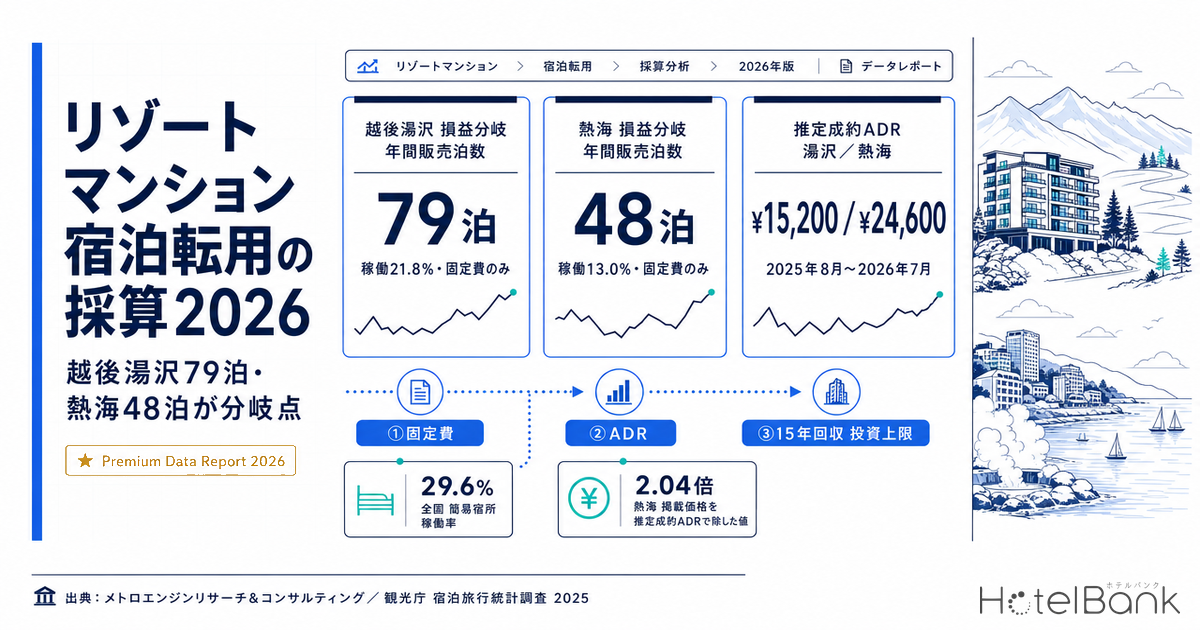
Resort condominium units sold in bulk during Japan’s bubble era now change hands for as little as ¥100,000-something. The entry barrier is low, but from the moment you own a unit, management fees, repair reserve contributions, and fixed asset tax start going out every month. Viewed from the standpoint of operating the unit as lodging, the investment decision boils down not to the purchase price but to a single question: how many nights per year must be sold to cover fixed costs and recover the investment? This article breaks the model down into four stages for Echigo-Yuzawa (Yuzawa Town, Niigata) and Atami (Atami City, Shizuoka): (1) acquisition price bands, (2) annual fixed costs, (3) licensing and unstaffed-operation costs, and (4) the annual nights sold required for viability.
Metric Definitions Used in This Article
- ADR (Average Daily Rate): An estimated transacted rate (tax-excluded equivalent), calculated by applying property-type-specific adjustment factors to the lowest published plan level of each property (per room, 2 guests per room, tax included). Cross-checked against property-level results disclosed by listed hotel REITs (91 properties, most recent 3 months), the median error is about 7%. These are estimates and differ from each property’s actual transacted prices and accounting figures. Area-level ADR is the median of the properties covered (i.e., the level of a typical property in the area).
- Listed price (all-plan average, tax included): The published price averaged across all plans, from room-only to meal-inclusive. This is a separate metric from estimated transacted ADR, and the two are explicitly distinguished in this article.
- Annual nights sold: Total nights sold per year, treating one condo unit as one sales unit. The value divided by 365 is shown alongside as the occupancy rate.
- Data source: MetroEngines Research & Consulting
- — Break-even on fixed costs alone is 79 nights/year (21.8% occupancy) in Echigo-Yuzawa and 48 nights/year (13.0% occupancy) in Atami. The decision axis is annual nights sold, not purchase price.
- — At the national average occupancy for simple lodging facilities (29.6% in 2025 = 108 nights/year), the maximum total investment recoverable over 15 years is about ¥3 million in Echigo-Yuzawa and about ¥12.7 million in Atami.
- — Estimated transacted ADR is ¥15,200 in Yuzawa and ¥24,600 in Atami (August 2025–July 2026). In Atami, the listed price is 2.04x the estimated transacted ADR; using it in a business plan would overstate revenue by roughly 2x.
- — The biggest sensitivity is whether an operating agent is used. Outsourcing at 15% of revenue raises Yuzawa’s required nights from 108 to 162, out of reach at national average occupancy.
- — The biggest constraint is not price but the building’s management bylaws. In Yuzawa, the first building whose owners’ association approved lodging operations did so only in March 2018, so the pool of eligible buildings is limited. The screening order should be “bylaws → fixed costs → price.”
Conclusion: The Maximum Viable Investment on a 15-Year Payback Is About ¥3 Million in Yuzawa and About ¥12.7 Million in Atami
Let us start with the conclusion. The line for covering only fixed costs that are incurred even at zero occupancy—management fees, repair reserves, and fixed asset tax—came to 79 nights/year (21.8% occupancy) in Echigo-Yuzawa and 48 nights/year (13.0% occupancy) in Atami. Up to this point, both areas are comfortably within reach.
The picture changes once recovery of the acquisition cost is added as a condition. According to the Japan Tourism Agency’s Overnight Travel Statistics Survey, the national room occupancy rate for simple lodging facilities (kani shukusho) in 2025 was 29.6%, equivalent to 108 nights per year. Working backward from the maximum total investment that could be fully recovered by sustaining those 108 nights for 15 years yields about ¥3 million in Echigo-Yuzawa and about ¥12.7 million in Atami. Given that initial outlays for furniture, appliances, fire safety equipment, and licensing come to around ¥2 million on top of the purchase price, the upper limit that “works at average occupancy” is a property price of around ¥1 million in Yuzawa and around ¥10 million in Atami.
Put the other way, making a lodging conversion work for a property above this level requires either far more nights sold than the national average or a rate above average. In Echigo-Yuzawa, that means pursuing it through a design that concentrates sales in the winter season rather than year-round. The sections below build up the numbers in stages.
1. Acquisition Price Bands — Yuzawa Averages ¥5.85 Million but Starts at ¥100,000-Something; Atami Splits into Four Tiers by Building Age
About 10,000 resort condominium units were sold in Echigo-Yuzawa over the six years from 1985 to 1991, and the current total stock is said to be roughly 57–58 buildings and about 14,000 units (Niigata Nippo / LIFULL HOME’S PRESS). Resale prices vary enormously. As of September 2025, the average sale price was ¥5.85 million (average building age 35 years, average 50㎡), up 34.5% year over year in a rising phase, yet units priced from ¥100,000 to around ¥1 million are also on the market. Renovated units at the top end reach ¥18.8–19.8 million.
Atami splits clearly into four tiers by building age: 1970s buildings at ¥5–15 million, 1980s–90s buildings at ¥10–25 million, 2000s buildings at ¥20–45 million, and newer buildings from the 2010s onward at ¥40 million and up. Backed by year-round demand for the sea and hot springs, Atami trades a notch higher than Yuzawa.
| Area | Price band | Acquisition price range | Notes |
|---|---|---|---|
| Echigo-Yuzawa (Yuzawa Town, Niigata) | Low band | ¥100k–¥1M | Older, smaller units with heavy shared-facility burdens |
| Middle band | ¥5.85M (average) | As of Sep 2025 · avg. 35 years old · avg. 50㎡ / +34.5% YoY | |
| High band | ¥18.8M–¥19.8M | Renovated units | |
| Atami (Atami City, Shizuoka) | ~50 years old | ¥5M–¥15M | Completed in the 1970s |
| 30–40 years old | ¥10M–¥25M | Completed in the 1980s–90s | |
| ~20 years old | ¥20M–¥45M | Completed in the 2000s | |
| Newer | ¥40M+ | Completed in the 2010s or later |
The key point here is that a low purchase price does not mean an easy investment. A unit you can buy for ¥100,000 is also a unit you can only sell for ¥100,000. In the sense that the exit is thin, a low price goes hand in hand with low liquidity, and the center of gravity of the investment decision shifts to stage 2.
2. Annual Fixed Costs — Even at Zero Occupancy, ¥300k–¥500k/Year in Yuzawa and Around ¥420k/Year in Atami
A defining feature of strata-titled resort condominiums is that their common areas often include hot spring baths, pools, tennis courts, and the like, which makes management fees higher than in typical residential condominiums. Reported levels are about ¥586/㎡ for management fees and about ¥213/㎡ for repair reserves.
| Cost item | Echigo-Yuzawa (monthly) | Atami (monthly) | Description |
|---|---|---|---|
| Management fee | ¥22,000–¥29,000 | ¥15,000–¥25,000 | Common-area management; upkeep of hot spring baths, pools, etc. |
| Repair reserve | ¥3,000–¥11,000 | ¥10,000–¥15,000 | Funding for major repairs |
| Hot spring operating fee | Often included in management fee | ¥0–¥5,000 | Some properties charge it separately |
| Subtotal | ¥25,000–¥40,000 | ~¥30,000 | — |
| Fixed asset tax & city planning tax | ¥30,000–¥50,000/year | ~¥80,000/year (assumed) | Yuzawa Town applies the standard fixed asset tax rate |
| Vacation home ownership tax | — | ¥650/㎡/year | Atami City’s own tax. ¥32,500/year for 50㎡ of taxable area; ¥74,750/year for 115㎡ |
| Annual total | ~¥330k–¥530k | ~¥420k–¥520k | Incurred even at zero occupancy |
These fixed costs diverge further by property. For large properties with extensive shared facilities, a case has been reported where management fees and repair reserves combined came to ¥53,200 per month (¥638,000 per year). Annual fixed costs above ¥600,000 mean that a burden equivalent to the gross profit of 40 nights a year is already loaded on before anything else. In the investment decision for a lodging conversion, reading the owners’ association meeting materials and long-term repair plan carries more weight than estimating the purchase price.
About Atami City’s vacation home ownership tax: The taxable object is “a building or portion thereof used mainly for recreation,” and the rate is ¥650 per year per 1㎡ of floor area. The taxation period has been renewed for fiscal 2026 through fiscal 2030. According to the city’s Q&A, common areas are also taxed on a pro-rata basis, so the taxable area is larger than the registered area (the more extensive a resort condominium’s shared facilities, the larger the pro-rata area). The income model in this article assumes a taxable area equivalent to 115㎡, or ¥74,750 per year. Because the treatment of units used for lodging operations year-round is determined case by case, an inquiry to the Atami City Tax Division before acquisition is a prerequisite.
3. Licensing and Management Bylaws — In Yuzawa, “Buildings That Allow Lodging Conversion” Are Limited to Begin With
This is the stage most easily overlooked in this theme. There are two routes for operating a single unit in a strata-titled condominium as lodging.
| Item | Hotel Business Act: simple lodging business | Private Lodging Business Act: private lodging (minpaku) |
|---|---|---|
| Procedure | License from the prefectural governor, etc. | Notification to the prefectural governor, etc. |
| Operating days | No cap (year-round operation allowed) | Up to 180 days per year |
| Front desk (reception) | Relaxed to “desirable” in the March 2016 amendment. Not required if there is equipment with equivalent functions and an emergency response system | Not required (entrusting to a management company, etc. is a requirement) |
| Identity verification | Substitution via ICT equipment (facial recognition, etc.) is permitted | Same as left |
| Fire safety equipment | Automatic fire alarm systems, exit lights, flame-retardant materials, etc. Prior consultation with the local fire department and submission of a “notice of commencement of use of a fire-protected building” and an “application for a certificate of fire code compliance” are required (per Atami City guidance) | |
| Management bylaws | The management bylaws may be requested at the time of application. If the bylaws prohibit it, the business cannot be operated | |
On the regulatory side, the approval of unstaffed front desks and ICT-based identity verification has made operating a single unit quite realistic. In fact, of the 1,412 lodging facilities that opened in 2026 (confirmed via OTA listings; the 2026 count will rise as more listings appear), 680 (48.2%) were vacation rental homes; adding 64 cottages, 23 minshuku (family-run inns), and 14 pensions, small-scale and whole-unit rental formats account for the bulk of supply. Hotel Business Act licensing for single-room operations is already well established as a system.
The constraint lies not in regulation but in the management bylaws. In Echigo-Yuzawa, the first resort condominium owners’ association to pass a resolution introducing private lodging operations was Angel Resort Yuzawa, at an extraordinary general meeting on March 14, 2018; the association designated Angel Co., Ltd. as its private lodging management company (per the company’s press release). Market information indicates that, out of about 58 buildings, only a very small number currently clearly permit lodging operations under their bylaws. Changing the bylaws requires a resolution at a general meeting of unit owners, generally with at least three-quarters in favor.
Accordingly, when selecting a property in Echigo-Yuzawa, the pool is narrowed first by “whether the building permits lodging operations”, before price, floor area, or views. Reversing this order leaves you holding a unit you cannot operate after acquisition. For Atami as well, while the city’s guidance presents both the Private Lodging Business Act and Hotel Business Act routes, it notes that restrictions may apply under management bylaws.
4. Supply-Side Context — In Both Areas, Small Properties Make Up Half the Market
In assessing the economics of a lodging conversion, it is worth grasping the actual competitive environment. Within the scope tracked by MetroEngines Research & Consulting, we tallied the composition by room count for Echigo-Yuzawa (6km radius from central Yuzawa Town, N=365 properties, 5,787 rooms) and Atami (4km radius around Atami Station, N=269 properties, 6,240 rooms).
In Echigo-Yuzawa, properties with 10 rooms or fewer number 133 (36.4%) and those with 11–30 rooms number 156 (42.7%), so small and mid-sized properties dominate overwhelmingly. Atami is even more extreme: properties with 5 rooms or fewer alone account for 105 (39.0%). When a single condo unit is converted to lodging, it is positioned not as “a new room next to a hotel” but as a member competing within an already thick layer of small-scale inventory.
Openings in Atami have held steady at 20 properties in 2023, 15 in 2024, 14 in 2025, and 16 in 2026, and this small-scale inventory is still building up. For the supply-side trend of small properties accumulating in Izu and Atami, our analysis of the breakdown of Shizuoka’s 67 hotels opening in 2026 covers a broader area. Both rates and inventory need to be viewed with this structure as a given.
Opening counts in this article are based on confirmed OTA listings. Only about 19% of properties are listed on OTAs before opening, and more than half are listed after opening, so counts for the most recent months and years (2026 in this article) may increase as more listings appear. When looking at future supply volume, we recommend also referring to the building-plan pipeline based on building confirmation applications (Ministry of Land, Infrastructure, Transport and Tourism, “Statistics on Building Construction Starts”).
Distribution of lodging facilities within 6km of Echigo-Yuzawa (circle = room-count scale)
Distribution of lodging facilities within 4km of Atami (circle = room-count scale)
5. ADR Anchors — Seasonal Swing of 2.38x in Yuzawa vs. 1.56x in Atami
Next, we set the anchor on the revenue side. Monthly trends in estimated transacted ADR for both areas are shown below.
Yuzawa Town: estimated transacted ADR by month (2025 vs. 2026)
Atami City: estimated transacted ADR by month (2025 vs. 2026)
| Metric (August 2025–July 2026) | Echigo-Yuzawa (Yuzawa Town) | Atami (Atami City) |
|---|---|---|
| Estimated transacted ADR, 12-month average | ¥15,200 | ¥24,600 |
| Peak month | ¥23,200 (January 2026) | ¥30,300 (December 2025) |
| Lowest month | ¥9,700 (June 2026) | ¥19,400 (June 2026) |
| Seasonal swing (peak ÷ lowest) | 2.38x | 1.56x |
| Winter 4-month average (Dec–Mar) | ¥20,500 | ¥26,900 |
| Summer 3-month average (Jun–Aug) | ¥13,300 | ¥23,600 |
| Listed price (all-plan average, tax included) | ¥25,300 | ¥50,400 |
| Listed price ÷ estimated transacted ADR | 1.67x | 2.04x |
| Reference: median est. transacted ADR, 11–30 rooms | ¥16,100 (N=19 properties) | ¥24,700 (N=29 properties) |
| Reference: median est. transacted ADR, 10 rooms or fewer | ¥12,500 (N=4 properties) | ¥21,400 (N=14 properties) |
What deserves attention is the gap between listed prices and estimated transacted ADR. Atami’s listed price (all-plan average, tax included) is ¥50,400, but this is a simple average of published prices that includes meal-inclusive plans and unsold high-priced plans, and it is 2.04x the estimated transacted ADR. Using listed prices as the ADR assumption in a business plan would overstate revenue by about 2x. This article uses estimated transacted ADR (tax-excluded equivalent) throughout.
The difference in seasonality also bears directly on design. Echigo-Yuzawa shows a 2.38x gap between January and June, with rates concentrated in the four winter months. Atami holds ¥19,400 even in its lowest month and is leveled out year-round. These are markets that demand fundamentally different business designs: in Yuzawa, “sell intensively in winter”; in Atami, “sell thinly and broadly year-round”.
6. Annual Nights Sold Required for Viability — 79/48 Nights for Fixed Costs Alone, 108–193 Nights Including Payback
We now translate the figures so far into a per-unit P&L. Variable costs consist of cleaning and linen (¥10,000 per stay in Yuzawa and ¥12,000 in Atami, allocated over an average stay of 1.8 nights), a 10% sales channel commission, and utilities and consumables.
| Item | Echigo-Yuzawa | Atami |
|---|---|---|
| Estimated transacted ADR (per night) | ¥15,200 | ¥24,600 |
| Cleaning & linen (allocated per night) | −¥5,600 | −¥6,700 |
| Sales channel commission (10%) | −¥1,500 | −¥2,500 |
| Utilities & consumables | −¥1,200 | −¥1,500 |
| Contribution margin (per night) | ¥6,900 | ¥14,000 |
| Annual fixed costs (management fee, repair reserve, taxes) | ¥400,000 | ¥515,000 |
| Insurance, telecom, unstaffed check-in operation | ¥150,000 | ¥150,000 |
| Total annual fixed costs | ¥550,000 | ¥665,000 |
| Break-even annual nights sold | 79 nights (21.8% occupancy) | 48 nights (13.0% occupancy) |
Looking only at covering fixed costs, Atami needs 48 nights a year and Yuzawa 79. Next, we add recovery of the purchase price and initial investment (furniture, appliances, fire safety equipment, and licensing, assumed at ¥2 million) as a condition.
| Scenario | Total investment | Payback period | Required annual nights sold | Required occupancy |
|---|---|---|---|---|
| Yuzawa: fixed costs only | — | — | 79 nights | 21.8% |
| Yuzawa: low-band acquisition (¥1M) + ¥2M initial | ¥3M | 15 years | 108 nights | 29.7% |
| Yuzawa: low-band acquisition (¥1M) + ¥2M initial | ¥3M | 10 years | 123 nights | 33.6% |
| Yuzawa: average-price acquisition (¥5.85M) + ¥2M initial | ¥7.85M | 15 years | 155 nights | 42.5% |
| Yuzawa: average-price acquisition (¥5.85M) + ¥2M initial | ¥7.85M | 10 years | 193 nights | 52.8% |
| Atami: fixed costs only | — | — | 48 nights | 13.0% |
| Atami: older-band acquisition (¥8M) + ¥2M initial | ¥10M | 15 years | 95 nights | 26.1% |
| Atami: older-band acquisition (¥8M) + ¥2M initial | ¥10M | 10 years | 119 nights | 32.6% |
| Atami: middle-band acquisition (¥15M) + ¥2M initial | ¥17M | 15 years | 128 nights | 35.2% |
| Atami: middle-band acquisition (¥15M) + ¥2M initial | ¥17M | 10 years | 169 nights | 46.3% |
| Benchmark: national simple-lodging room occupancy (2025) | ~108 nights | 29.6% | ||
Reading this table is simple. Only scenarios whose required occupancy in the right-hand column is below 29.6% work under average operations. Yuzawa at ¥3 million over 15 years sits right on the line at 29.7%, while Atami at ¥10 million over 15 years has headroom at 26.1%. On the other hand, acquiring an average-priced unit (¥5.85 million) in Yuzawa requires 42.5% occupancy even on a 15-year payback, presupposing operating capability 13 points above the national average.
The chart above plots required nights against total investment on the horizontal axis. The point where each line crosses the national average of 108 nights is “the maximum total investment that works at average occupancy” for each area: about ¥3 million in Echigo-Yuzawa and about ¥12.7 million in Atami. Most of this gap comes from the contribution margin per night, which differs by 2x at ¥6,900 versus ¥14,000. It is a very straightforward structure: double the unit margin supports double the investment at the same number of nights.
7. Design Choices That Widen Viability in Echigo-Yuzawa — The Upside of Winter-Focused Operation
The year-round model so far is also a conservative view for Echigo-Yuzawa. The area’s estimated transacted ADR averages ¥20,500 over the four winter months (December–March), 35% above the annual average. If sales are concentrated in this period, the contribution margin per night rises to ¥11,700.
Year-round, leveled operation
ADR ¥15,200 / contribution margin ¥6,900
79 nights to cover ¥550,000 in fixed costs. A design that secures 108 nights, spread across the year, including 15-year payback on a ¥3 million investment.
Winter-focused operation
Winter ADR ¥20,500 / contribution margin ¥11,700
47 nights for fixed costs only, and about 64 nights including 15-year payback on a ¥3 million investment. Reached by selling about 53% of the 121 winter days.
Combined operation
With 60 winter nights plus 30 off-season nights, annual contribution margin is about ¥860,000. This covers ¥550,000 in fixed costs and ¥200,000 in 15-year amortization of a ¥3 million investment (¥750,000 total) with room to spare. The more sales capacity is shifted toward high-rate periods, the wider the viable range becomes.
Echigo-Yuzawa is a market with a clear seasonal peak driven by ski demand, and supply concentration is also evident from the perspective of room stock around ski resorts. Travel time of about 80 minutes from Tokyo on the Joetsu Shinkansen suits an operation built around two-night weekend stays. A design that stacks up winter occupancy and does not force low-margin sales in the off-season offers more realistic upside than aiming for year-round leveling.
Atami is the opposite: a year-round market that holds ¥19,400 even in its lowest month. Because it can sell steadily throughout the year, it works even with a lower occupancy target, and operation is less demanding than in Yuzawa. The trade-off is a higher acquisition price.
8. Sensitivity Analysis — Required Nights When ADR and Cleaning Costs Move
The table below shows required annual nights sold when assumptions are changed. The base case is a total investment of ¥3 million (Yuzawa) / ¥10 million (Atami) with a 15-year payback.
| Change in assumption | Yuzawa required nights | Yuzawa occupancy | Atami required nights | Atami occupancy |
|---|---|---|---|---|
| Base case | 108 nights | 29.7% | 95 nights | 26.1% |
| ADR −10% | 135 nights | 37.0% | 113 nights | 31.0% |
| ADR +10% | 90 nights | 24.8% | 82 nights | 22.5% |
| Cleaning cost +20% | 129 nights | 35.3% | 105 nights | 28.8% |
| Average stay 1.8 → 2.5 nights | 88 nights | 24.2% | 84 nights | 23.0% |
| Use of an operating agent (15% of revenue) | 162 nights | 44.2% | 129 nights | 35.4% |
The largest sensitivity is whether an operating agent is used. With an outsourcing fee of 15% of revenue, Yuzawa’s required nights rise from 108 to 162, beyond reach at national average occupancy. Conversely, simply extending the average stay from 1.8 to 2.5 nights lowers the requirement to 88 nights. Because cleaning costs are a fixed amount per stay, the more multi-night stays there are, the thinner the variable cost per night becomes.
Two-Axis Grid of ADR × Annual Nights Sold — Where the Investment Ceiling Flips
In addition to the one-dimensional sensitivity above, we lay out on two axes how the maximum total investment recoverable over 15 years changes when rate and nights sold move simultaneously. Darker shading means a larger supportable investment. “Not viable” marks the zone where annual contribution margin does not reach fixed costs, so the investment cannot be recovered even at zero. The intersection of the base row (108 nights/year) and base column (base ADR) is ¥2.9 million for Yuzawa and ¥12.7 million for Atami; the “about ¥3 million” and “about ¥12.7 million” cited in the text are these values rounded.
| Annual nights sold | ADR −20% | ADR −10% | Base ADR | ADR +10% | ADR +20% |
|---|---|---|---|---|---|
| 60 nights (16.4% occupancy) | Not viable | Not viable | Not viable | Not viable | 40 |
| 80 nights (21.9% occupancy) | Not viable | Not viable | <10 | 170 | 330 |
| 108 nights (29.6% occupancy = national average) | Not viable | 70 | 290 | 510 | 740 |
| 130 nights (35.6% occupancy) | Not viable | 250 | 520 | 790 | 1,050 |
| 160 nights (43.8% occupancy) | 170 | 500 | 830 | 1,160 | 1,490 |
| Annual nights sold | ADR −20% | ADR −10% | Base ADR | ADR +10% | ADR +20% |
|---|---|---|---|---|---|
| 60 nights (16.4% occupancy) | Not viable | 60 | 260 | 460 | 660 |
| 80 nights (21.9% occupancy) | 150 | 420 | 680 | 950 | 1,210 |
| 108 nights (29.6% occupancy = national average) | 550 | 910 | 1,270 | 1,630 | 1,990 |
| 130 nights (35.6% occupancy) | 870 | 1,300 | 1,730 | 2,160 | 2,600 |
| 160 nights (43.8% occupancy) | 1,300 | 1,830 | 2,360 | 2,890 | 3,430 |
Two points can be read from these grids. First, in Echigo-Yuzawa, a −20% swing in ADR makes the model unviable even at 108 nights a year. When the rate falls to ¥12,160, contribution margin per night drops to ¥4,164, and 133 nights are needed just to cover ¥550,000 in annual fixed costs. The Yuzawa investment case has very little tolerance for rate downside. Second, Atami can still support an investment of about ¥5.53 million at 108 nights a year even with the same −20%. Because its absolute contribution margin is larger, it has more room to absorb the same percentage change. Structurally, a design that protects rate works best in Yuzawa, and a design that stacks up nights works best in Atami.
These two points indicate the priorities for operating design. For a single strata-titled unit, two things determine profitability: (1) whether you can set up an unstaffed check-in system premised on self-operation, and (2) whether you can design products that capture multi-night demand. These two levers are more sensitive than raising rates.
9. Investment Decision Checklist
Three things to confirm before acquisition
(1) Whether the management bylaws permit lodging operations (go back as far as the general meeting minutes); (2) the recent revision history of management fees and repair reserves, plus the long-term repair plan; (3) the actual annual fixed costs including fixed asset tax and vacation home ownership tax. These three items pin down annual fixed costs and determine break-even nights.
Licensing prerequisites
Prior consultation with the local fire department is the starting point. Whether automatic fire alarm systems and similar equipment can be installed depends on the equipment configuration of the whole building, so coordination with the owners’ association is needed. Under the Hotel Business Act’s simple lodging category there is no cap on operating days; under the private lodging business, the cap is 180 days per year.
Rule of thumb for viability
Assuming a 15-year payback at national average occupancy (108 nights/year), the maximum total investment is about ¥3 million in Yuzawa and about ¥12.7 million in Atami. Anything above that presupposes above-average operations, such as winter-focused sales or multi-night product design.
Summary
Converting strata-titled resort condominiums to lodging is not the simple story of “cheap to buy, so high yield.” Even as the purchase price approaches zero, ¥300,000–¥600,000 a year in fixed costs—management fees, repair reserves, and taxes—comes first. Covering these fixed costs alone requires 79 nights a year in Echigo-Yuzawa and 48 in Atami.
Adding recovery of acquisition cost as a condition, the maximum total investment recoverable over 15 years at the national average occupancy for simple lodging facilities (29.6% in 2025 = 108 nights/year) settles at about ¥3 million in Echigo-Yuzawa and about ¥12.7 million in Atami. This gap is roughly proportional to the difference in contribution margin (¥6,900 vs. ¥14,000 per night).
And the most important precondition is not money but the management bylaws. In Echigo-Yuzawa, the first building whose owners’ association approved lodging operations appeared only in 2018, and the pool remains limited. The order for searching for a property is not “price → location → bylaws” but “bylaws → fixed costs → price,” and sticking to this order is the most effective decision in this investment model. The greatest upside lies in two areas: a design that captures the winter rate peak, and a product design that dilutes cleaning costs through multi-night stays.
⚠ Note on the estimates: The income model in this article is a simplified estimate combining publicly available resale price ranges and maintenance cost levels with MetroEngines Research & Consulting’s estimated transacted ADR. Actual investment decisions require detailed review, including on-site confirmation of each unit’s management bylaws, long-term repair plan, licensing requirements, and fire safety equipment. Estimated transacted ADR is an estimate and differs from each property’s actual transacted prices and accounting figures.
Related Reading
- Niigata Hotel Investment Map: Niigata City, Yuzawa & Sado in 3 Layers
- Shizuoka’s 67 New 2026 Hotels: 1,089 Rooms, 64% One-Room Villas
- Aging Trade Areas Constrain Hotel Exits: Atami 49.1% vs Takayama 38.8%
- Corporate Retreat Conversions: 8.27% GOP Yield Across 5 Onsen Areas
- Simple Lodging × Vacant Home Reuse 2026: Kyoto, Osaka & Naha Whole-House IRR
- Japan 2026: 1,242 Openings, 33,749 Rooms — 47% Villas, 42% Business
References and Sources
■ Data sources
Estimated transacted ADR, distribution of properties by room count, and the breakdown by property type of facilities opened in 2026 are tabulated by MetroEngines Research & Consulting (Yuzawa Town N=34–53 properties/month, Atami City N=99–106 properties/month, period August 2025–July 2026). The occupancy benchmark is the Japan Tourism Agency’s Overnight Travel Statistics Survey, 2025 annual figures (preliminary). Resale price and maintenance cost levels use the ranges stated in the published materials listed below.
■ Model assumptions
One condo unit is treated as one sales unit. Variable costs consist of cleaning and linen (¥10,000 per stay in Yuzawa and ¥12,000 in Atami, allocated over an average stay of 1.8 nights), a 10% sales channel commission, and utilities and consumables. Annual fixed costs are management fees, repair reserves, fixed asset tax, and vacation home ownership tax, plus ¥150,000 for insurance, telecom, and unstaffed check-in operation. The payback period is 15 years, calculated as a simple cumulative sum with no discount rate, and recovery through sale is not included.
■ Limitations and caveats
Estimated transacted ADR is an estimate derived by applying property-type-specific adjustment factors to each property’s lowest published plan level, and it differs from actual transacted prices and accounting figures (median error of about 7% when cross-checked against property-level results disclosed by listed hotel REITs). Area-level values are medians of the properties covered and do not indicate the earning power of any individual unit. Management fees, repair reserves, licensing requirements, and the feasibility of installing fire safety equipment vary by unit and building. This model is not a substitute for an investment decision; it is a framework for preliminary review that presupposes on-site confirmation for each unit.
■ Market data
- MetroEngines Research & Consulting — Estimated transacted ADR (Yuzawa Town sample N=34–53 properties/month, Atami City sample N=99–106 properties/month), distribution of lodging facilities by room count (Echigo-Yuzawa N=365 properties, Atami N=269 properties), breakdown by property type of facilities opened in 2026 (based on confirmed OTA listings, N=1,412)
■ Government statistics and municipal materials
- Japan Tourism Agency, Overnight Travel Statistics Survey (2025 annual figures, preliminary) — Room occupancy by facility type (Japanese)
- Atami City, “What Is the Vacation Home Ownership Tax?” / Vacation Home Ownership Tax Q&A (Japanese)
- Atami City, “Private Lodging and Simple Lodging” — Fire safety equipment and notification requirements (Japanese)
- Yuzawa Town, “Fixed Asset Tax” (Japanese)
- Ministry of Health, Labour and Welfare, “Regulations on Front Desks for Simple Lodging Businesses under the Hotel Business Act” (materials submitted to the Regulatory Reform Promotion Council) (Japanese)
■ Published information on resale prices and maintenance costs
- Yuzawa Resort Condominiums: Price Trends and Buying Guide 2025 — Average sale price ¥5.85 million; management fee and repair reserve levels (Japanese)
- The Appeal of Hot-Spring Condominiums in Atami and How to Choose: Price Trends and Maintenance Costs — Price bands by building age; monthly maintenance costs (Japanese)
- LIFULL HOME’S PRESS, “Considering the Potential of Resort Condominiums in Yuzawa Town, with Net In-Migration for Eight Consecutive Years” — Units supplied; management fee examples (Japanese)
- Niigata Nippo, “57 Resort Condominium Buildings That Sprang Up in Yuzawa Town During the Bubble” — Building and unit counts; position of fixed asset tax (Japanese)
- Angel Co., Ltd., “A First for Yuzawa Town (Echigo-Yuzawa), Niigata: Private Lodging Approved at a Resort Condominium” (March 2018) (Japanese)