

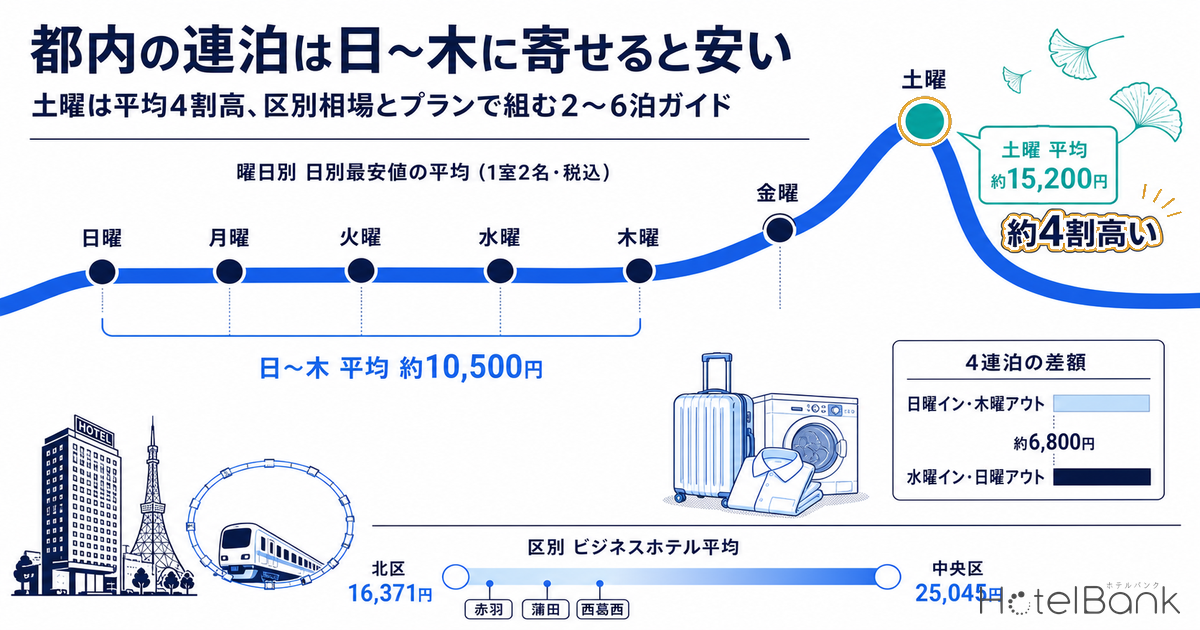
The key to a cheap 2–6 night stay in Tokyo comes down to three things, in this order: the day of the week, the area, and how you choose your plan. When the HotelBank Editorial Team aggregated 654 daily lowest listed prices at Tokyo business hotels (September 7 – October 4, 2026; 1 room, 2 guests, tax included), the Sunday–Thursday average came to about ¥10,500, while Saturday averaged about ¥15,200 — roughly 40% higher. In other words, even for the same four-night stay, whether or not it includes a Saturday makes a big difference to what you pay. This article walks through how to put together a cheaper 2–6 night stay, using actual Tokyo market prices from public OTA data (2 guests per room, per-room price, tax included).
- — Sunday–Thursday averages about ¥10,500; Saturday alone is about ¥15,200 (28 Tokyo business hotels, 654 observations, 2 guests per room, tax included). Leaving out Saturday night is the top priority for a multi-night stay.
- — The same four nights can differ by about ¥6,800. Sunday check-in / Thursday check-out comes to about ¥41,400; Wednesday check-in / Sunday check-out comes to about ¥48,200.
- — Choosing the right days pays off most for 2–4 nights. At six nights, a Saturday falls within the stay whichever day you start, so the gap narrows to about ¥5,100.
- — Kita, Edogawa and Arakawa wards run ¥16,000–18,000 a night, over ¥5,000 cheaper than Chuo or Minato wards. Over four nights, that is a difference of more than ¥20,000.
- — The “40% higher” Saturday figure may be overstated. Because sold-out days are excluded, Saturday’s observation coverage is only 52.7% (versus 80–95% on other days).
What does a night cost for a multi-night stay in Tokyo?
Let’s start with the baseline. According to OTA listed prices as of September 2026 (2 guests per room, per-room price, tax included; HotelBank Editorial Team research), average prices by accommodation category in Tokyo are as follows.
| Category | Average listed price (1 room, 2 guests, tax incl.) | Properties covered |
|---|---|---|
| Capsule hotels | ¥14,187 | 32 |
| Business hotels | ¥18,496 | 949 |
| Ryokan | ¥35,173 | 63 |
| City hotels | ¥41,740 | 115 |
Source: HotelBank Editorial Team research (aggregated from public OTA data, as of September 2026). These are averages across listed plans; actual prices on booking screens vary by date and plan.
For a 2–6 night stay, the realistic option is business hotels, which offer by far the widest choice at 949 properties. The average of about ¥18,500 is just an overall figure. As shown below, depending on how you combine day of week and area, it is entirely possible to keep a twin-occupancy room in the low ¥10,000s per night. For solo travelers, single-room rates are generally lower still.
Choosing your days: skipping Saturday saves about ¥6,800 over four nights
The day of the week has the biggest impact on what a multi-night stay costs. The HotelBank Editorial Team took 654 daily lowest listed prices for 28 Tokyo business hotels over the 28 days from September 7 to October 4, 2026 (1 room, 2 guests, tax included; days with no price because the hotel was sold out are excluded) and averaged them by day of week. Here are the results.
| Check-in day | Average daily lowest price | Observations |
|---|---|---|
| Monday | ¥10,042 | 99 |
| Tuesday | ¥10,553 | 104 |
| Wednesday | ¥10,280 | 99 |
| Thursday | ¥11,113 | 97 |
| Friday | ¥11,598 | 106 |
| Saturday | ¥15,177 | 59 |
| Sunday | ¥10,528 | 90 |
Source: HotelBank Editorial Team research (654 daily lowest listed prices at 28 Tokyo business hotels, September 7 – October 4, 2026, 1 room, 2 guests, tax included).
How to read this (a note on the Saturday figure): This is an average of rooms for which a price could be obtained on that day; days with no price shown because the hotel was sold out are excluded. The share of possible observations actually captured was 80–95% for Monday–Friday and Sunday (90–106 out of 112 possible, i.e. 4 days × 28 hotels), but only 52.7% for Saturday (59 out of 112). Because cheaper rooms generally sell out first, the rooms still available and observed on Saturdays skew toward the higher end. So the “about 40% higher on Saturday” figure is a fair reflection of the price gap for rooms you can actually book, but may overstate the average increase across all rooms. It is useful as a reason to avoid Saturdays, but should not be read as an exact multiplier.
Sunday through Thursday all average about ¥10,500, while Saturday alone is about ¥15,200 — roughly 40% higher. Friday is about ¥11,600, without Saturday’s jump. Applying these day-of-week averages directly, the same four-night stay comes to about ¥41,400 in total for “Sunday check-in, Thursday check-out” versus about ¥48,200 for “Wednesday check-in, Sunday check-out” — a difference of about ¥6,800 (about 14%).
The basic rule for a 2–6 night stay, then, is to check in on Sunday where possible and keep Saturday night out of your itinerary. If you must stay over a weekend, one option is a “split stay,” spending just the Saturday night in an area where prices are calmer (see the next section). Note that this day-of-week effect only holds up to six nights. For a one-week stay that includes each of the seven days exactly once, changing the start day barely moves the total (we measured this in One Week of Hotel Living in Tokyo: ¥88,200 for 7 Nights, Any Start Day).
| Check-in day | 2 nights | 3 nights | 4 nights | 5 nights | 6 nights |
|---|---|---|---|---|---|
| Sunday check-in | ¥20,570 | ¥31,123 | ¥41,403 | ¥52,516 | ¥64,114 |
| Monday check-in | ¥20,595 | ¥30,875 | ¥41,988 | ¥53,586 | ¥68,763 |
| Tuesday check-in | ¥20,833 | ¥31,946 | ¥43,544 | ¥58,721 | ¥69,249 |
| Wednesday check-in | ¥21,393 | ¥32,991 | ¥48,168 | ¥58,696 | ¥68,738 |
| Thursday check-in | ¥22,711 | ¥37,888 | ¥48,416 | ¥58,458 | ¥69,011 |
| Friday check-in | ¥26,775 | ¥37,303 | ¥47,345 | ¥57,898 | ¥68,178 |
| Saturday check-in | ¥25,705 | ¥35,747 | ¥46,300 | ¥56,580 | ¥67,693 |
Source: Estimate by the HotelBank Editorial Team using the day-of-week averages in Table 2. Actual booking prices vary by property, plan and date.
The table is simple to read: Sunday check-in is the cheapest for almost every length of stay, and the further you move from it, the more likely you are to pull in a Saturday night and pay more. The one exception is three nights, where Monday check-in (¥30,875) edges out Sunday check-in (¥31,123) by ¥248, since both avoid Saturday. For two nights, Sunday check-in costs ¥20,570 versus ¥26,775 for Friday check-in — a ¥6,205 gap over just two nights. At six nights, by contrast, a Saturday falls within the stay whatever day you start, so the gap by check-in day narrows (lowest ¥64,114, highest ¥69,249, a difference of ¥5,135). Choosing your days matters most for 2–4 nights; beyond six nights the effect fades.
Why does Saturday jump so much on its own? Because there is little spare supply. According to the Japan Tourism Agency’s Overnight Travel Statistics Survey, the national room occupancy rate for business hotels was 75.3% (2025 annual figure, final) and 74.1% for city hotels (same basis). That means that even on an average day, only about one room in four is empty (Japan Tourism Agency, released July 6, 2026 (Japanese)). On Saturdays, when demand concentrates, rooms fill up even further from that starting point. Because cheaper rooms sell out first, it is closer to the truth to think of Saturday not as “prices going up” but as “the cheap rooms disappearing”. Flip that around, and Sunday through Thursday is when choices remain — an advantage not only on price but also in how easily you can get the room type you want.
Choosing your area: outside the Yamanote Line, prices drop by around ¥5,000 a night
Even among business hotels, average listed prices vary widely by ward. Averages by ward as of September 2026 (2 guests per room, tax included; HotelBank Editorial Team research; wards with 10 or more properties) are as follows.
| Ward | Business hotel average | Properties covered |
|---|---|---|
| Kita | ¥16,371 | 20 |
| Edogawa | ¥17,767 | 17 |
| Arakawa | ¥18,148 | 11 |
| Ota | ¥18,408 | 51 |
| Toshima | ¥18,657 | 56 |
| Bunkyo | ¥19,733 | 14 |
| Shinagawa | ¥20,339 | 29 |
| Taito | ¥21,610 | 178 |
| Shinjuku | ¥22,086 | 82 |
| Sumida | ¥23,339 | 24 |
| Meguro | ¥23,358 | 10 |
| Chiyoda | ¥23,417 | 66 |
| Koto | ¥23,510 | 29 |
| Minato | ¥24,894 | 99 |
| Chuo | ¥25,045 | 133 |
| Shibuya | ¥38,361 | 25 |
Source: HotelBank Editorial Team research (aggregated from public OTA data, as of September 2026, 2 guests per room, per room, tax included). All wards with 10 or more properties are listed, sorted from lowest to highest average listed price. Wards with fewer than 10 properties are excluded because their figures are prone to swings.
Kita, Edogawa, Arakawa and Ota wards run ¥16,000–18,000 a night, more than ¥5,000 a night below Chuo and Minato wards. Over four nights, that is a difference of more than ¥20,000. Akabane (Kita), Nishi-Nippori and Machiya (Arakawa), Kamata (Ota) and Nishi-Kasai (Edogawa) are all within 15–25 minutes by train of central Tokyo’s major stations, which makes them convenient bases for a multi-night stay. The more your stay revolves around “going to the same place every day,” the less need there is to stay in the center, and the more likely you are to save overall by basing yourself in an outer ward with fewer transfers. As for why Taito Ward (Ueno and Asakusa) — home to more accommodation than any other of the 23 wards — does not stand out on price, Why Taito Ward Has Tokyo’s Most Hotels digs into it from the angle of property size and business mix.
Choosing plans and facilities: filters that matter for multi-night stays
Once you have settled on days and area, the final step is choosing the right plan. Four things tend to make the biggest difference on a multi-night stay.
- Early-booking and prepaid plans: OTAs carry many discount plans such as “Early Bird 28” or “Prepaid by credit card only,” which suit multi-night stays with fixed dates. The same room is often priced 10–20% lower than a last-minute booking.
- Consecutive-night and eco-cleaning plans: Plans such as “2 nights or more only” or “No housekeeping” are priced lower because the hotel saves on cleaning. If the main purpose of your 2–6 nights is sightseeing or business, skipping daily housekeeping is a realistic choice.
- Official membership benefits: Most major chains offer member rates or points on bookings through their official website or app, and these pay off more the more nights you stay with the same chain. Check the market rate on an OTA first, then compare it with the official price so nothing slips through.
- Washing machines, kitchens and other extended-stay facilities: Beyond three nights, changes of clothes and access to a coin laundry start to matter. With an in-house laundry, two days’ worth of clothes is enough. Tokyo is also seeing more extended-stay hotels such as KOKO HOTEL Residence Tokyo Oshiage (KOKO HOTEL Residence 東京押上) (in Japanese), with a kitchen and washing machine in every room — a strong option for multi-night stays where you want to keep dining-out costs down.
Note that for long stays of more than seven nights, pricing works differently and monthly-style contracts also come into play, so if you are considering a month-long stay it is worth looking at monthly hotels and serviced apartments as well. If you are looking at around seven nights, the rule of thumb of “hotels for six nights or fewer, weekly apartments for seven or more” is another useful reference point.
At this price range, you generally don’t need to worry about accommodation tax. Tokyo’s accommodation tax is not charged when the room rate is under ¥10,000 per person per night; it is ¥100 for ¥10,000 to under ¥15,000, and ¥200 for ¥15,000 or more (all per person per night, based on the room-only rate excluding meals). Because the prices in this article are for 2 guests per room, a ¥10,500 room works out to ¥5,250 per person, below the tax-free threshold. From April 1, 2027, the rate will change to 3% of the room rate and the tax-free threshold to under ¥13,000 per person per night, but unless a twin-occupancy room exceeds ¥26,000 a night, it will remain untaxed after the change (Tokyo Metropolitan Government Bureau of Taxation, “Review of the Accommodation Tax” (Japanese)).
For a closer look
For specific hotel comparisons, these articles go into more detail (both in Japanese).
A detailed report on an apartment hotel that opened in July 2026, five minutes’ walk from Oshiage Station, with every room at least 42.3 m² and equipped with a kitchen and washing machine. It covers everything from the floor area and bed configuration of its five room types to an extended-stay operating model with no restaurant and room cleaning every three days — a design well suited to multi-night stays.
Compares five properties, including Kyukamura Minami-Izu (休暇村 南伊豆), with seven washing machines and seven dryers and detergent included in the price, and Kita Kobushi Shiretoko Hotel & Resort (北こぶし知床ホテル&リゾート), with a 24-hour laundry — checking the number of machines, fees and floor locations against official information. The approach to cutting luggage on a multi-night stay applies just as well to choosing a hotel in Tokyo.
Frequently Asked Questions
Q. How much per night should I budget for a multi-night stay in Tokyo?
A. Based on OTA listed prices as of September 2026 (2 guests per room, per room, tax included), the average for Tokyo business hotels is about ¥18,500. However, that is an average across all plans at all properties; by choosing your days and area you can keep it in the low ¥10,000s per night. On a daily-lowest-price basis, Sunday through Thursday averages about ¥10,500.
Q. Which day should I check in to pay the least?
A. Sunday check-in is the cheapest in most cases: ¥20,570 for two nights and ¥41,403 for four nights, the lowest for every length of stay except three nights, where Monday check-in is ¥248 cheaper. Checking in on Friday or Wednesday, by contrast, costs more because the stay includes a Saturday night.
Q. Why are Saturdays so expensive?
A. Because demand concentrates and supply runs out of slack. The national room occupancy rate for business hotels was 75.3% for the year (2025 final figure, Japan Tourism Agency), meaning only about one room in four is empty even on an average day. On Saturdays the cheaper rooms sell out first, so it is closer to reality to think of it not as “prices going up” but as “the cheap rooms disappearing.”
Q. Which Tokyo wards are cheapest to stay in?
A. Kita Ward (average ¥16,371, 20 properties), Edogawa Ward (¥17,767, 17 properties), Arakawa Ward (¥18,148, 11 properties) and Ota Ward (¥18,408, 51 properties) are on the cheaper side. They are more than ¥5,000 a night below Chuo Ward (¥25,045) and Minato Ward (¥24,894), a difference of over ¥20,000 across four nights. Akabane, Nishi-Nippori, Kamata and Nishi-Kasai are all within 15–25 minutes of central Tokyo’s major stations.
Q. Are there plans that make multi-night stays cheaper?
A. Typical examples are early-booking and prepaid plans, “2 nights or more only” plans, and eco-cleaning plans that skip housekeeping; the latter are cheaper because the hotel saves on cleaning. In addition, major chains offer member rates and points for bookings through their official website or app, which pay off more the more nights you stay with the same chain.
Q. Will I have to pay Tokyo’s accommodation tax?
A. Not at the price range covered in this article. Tokyo’s accommodation tax is not charged on room rates under ¥10,000 per person per night, and with 2 guests per room even a ¥10,500 room works out to ¥5,250 per person, below the threshold. From April 1, 2027, the rate changes to 3% with a tax-free threshold of under ¥13,000 per person per night, but as long as a twin-occupancy room does not exceed ¥26,000 a night, it will remain untaxed after the change.
Methodology and Sources
■ Data sources
Publicly listed OTA prices for Tokyo accommodation, collected and aggregated by the HotelBank Editorial Team. Averages by category and by ward are as of September 2026 (2 guests per room, per room, tax included). The day-of-week analysis uses 654 daily lowest listed prices for 28 Tokyo business hotels over the 28 days from September 7 to October 4, 2026. For demand-side context we referred to the Japan Tourism Agency’s Overnight Travel Statistics Survey, and for taxation to materials published by the Tokyo Metropolitan Government Bureau of Taxation.
■ Assumptions
All prices are the total per room for 2 guests (tax included); single-occupancy rates are lower. The totals by number of nights in Table 4 are estimates simply built up from the day-of-week averages in Table 2, not consecutive-night plan prices at any specific property. Accommodation tax liability was assessed on the room-only rate per person per night (excluding meals).
■ Limitations
Listed prices are the prices shown on booking screens, not actual transaction prices. Days on which no price could be obtained because the hotel was sold out are excluded, so Saturdays — when sell-outs are most common — have fewer observations (59 of 112 possible, 52.7% coverage) and their average skews high. The day-of-week figures reflect one specific four-week window (September 7 – October 4, 2026); both price levels and day-of-week gaps shift with holidays, major events and season. Ward averages are simple averages that include differences in property mix (size and type), not price differences between properties of the same grade.
■ References
- Japan Tourism Agency, “Overnight Travel Statistics Survey (April 2026 second preliminary, May 2026 first preliminary, and 2025 annual final figures),” released July 6, 2026 (Japanese)
- Japan Tourism Agency, Overnight Travel Statistics Survey — statistics top page (Japanese)
- Tokyo Metropolitan Government Bureau of Taxation, “Review of the Accommodation Tax” (Japanese)
Related Articles