

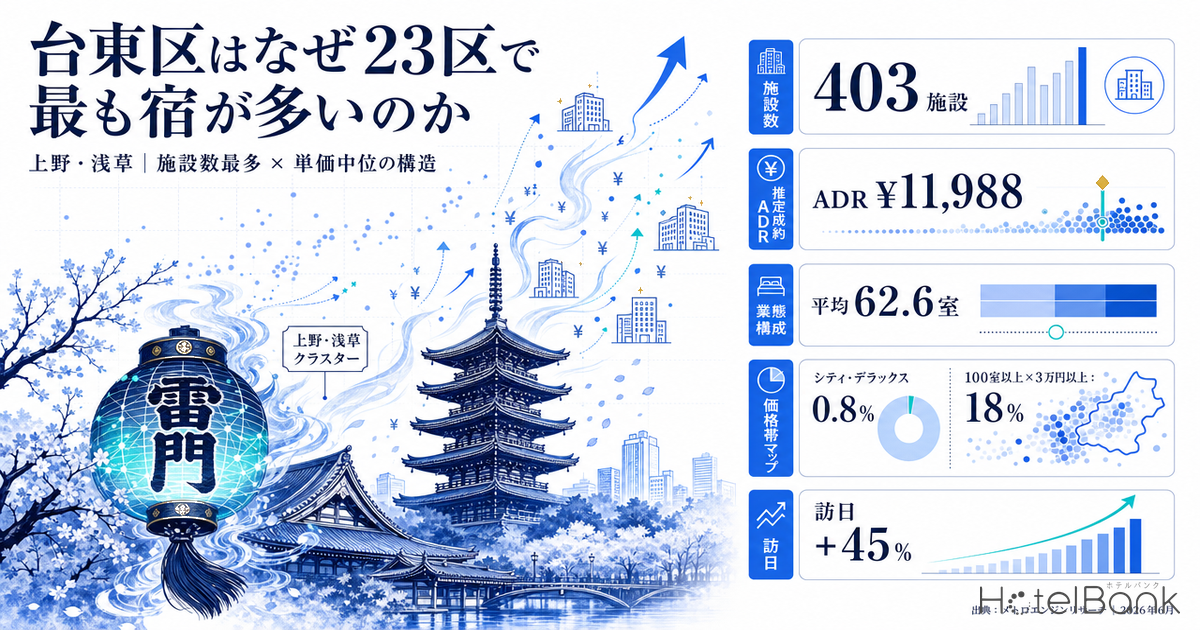
Which of Tokyo’s 23 wards has the most lodging facilities? The answer is neither Minato nor Shinjuku — it is Taito Ward. Of the 2,399 lodging facilities in Tokyo for which MetroEngines Research was able to observe prices in June 2026, 403 were in Taito Ward. That is nearly 70% more than second-place Shinjuku Ward’s 238 facilities — an exceptional concentration. Yet the estimated settled ADR for the same month was ¥12,000, marginally below the ¥12,100 average for Tokyo as a whole. “Among the largest facility counts in Japan, but only average pricing” — where does this asymmetry come from, and where is the room to grow? We read it through property-type composition, facility scale, and the recent opening and construction pipeline.
- — 403 facilities, the most of any of Tokyo’s 23 wards, 70% above second-place Shinjuku Ward’s 238. But at an average of 62.6 rooms per facility, the total of 24,240 rooms still falls short of Chuo and Minato Wards.
- — Estimated settled ADR is ¥12,000 (June 2026, N=176 facilities), on par with the Tokyo average. Looking at business hotels alone, however, the ward records ¥12,400 and ranks 9th among the 23 wards — it has not been swept along by price competition.
- — City and deluxe hotels account for just 3 of 400 facilities (0.8%). The gap against Chuo Ward’s 13.9% and Minato Ward’s 21.5% explains roughly 40% of the ¥11,400 difference in average pricing.
- — The largest white space is “100+ rooms × listed price of ¥30,000 or more,” where only 16 of 87 facilities (18%) qualify. Against Chuo Ward’s 49% and Minato Ward’s 41%, the mid-to-large upper-midscale band is thin.
- — In the construction pipeline, only 4 projects have room counts on record (one of which appears to have already opened). Projects without registered room counts number 58 for scheduled completion in 2027–2029 alone, so on a project-count basis supply is not thin.
Metric Definitions Used in This Article
- ADR (average daily rate): An estimated settled rate (tax-exclusive equivalent) calculated by applying property-type-specific adjustment coefficients to the lowest published plan level each facility lists on OTAs and similar channels (double occupancy, per-room rate, tax-inclusive). Cross-checked against property-level actuals disclosed by a listed hotel REIT (Invincible Investment Corporation) across 184 property-months (April–May 2026), the median error is 7.5%, and 6.0% for the business and city hotel segments that are central to this article. These are estimates and differ from each facility’s actual transacted prices or accounting figures. Area-level ADR is the median of the target facilities (the level of a typical facility in the area).
- Listed price: The average price across all plans published on OTAs and similar channels (double occupancy, per-room rate, tax-inclusive). It includes everything from room-only to meal-inclusive plans. This article uses this figure for property-type composition analysis and facility-level price-band mapping, and labels it explicitly as “listed price.”
- Facility count: The number of facilities for which a price could be observed on OTAs in the given month. Lodging facilities not listed on OTAs are excluded.
- Data source: MetroEngines Research
403 Facilities — A 70% Lead Over Second Place
Start with the facts. Ranking the 23 wards by the number of facilities with observable prices in June 2026, Taito Ward leads with 403, followed by Shinjuku Ward with 238, Chuo Ward with 208, and Minato Ward with 204. From fifth place the numbers fall away sharply — Toshima Ward with 137 and Sumida Ward with 132. The top four wards account for roughly 40% of all observed facilities in Tokyo, and within that Taito Ward alone carries close to 17%.
This concentration is not a one-off. Taito Ward’s observed facility count was 270 in July 2024 and 263 in June 2025, then rose in stages to 328 in April 2026 and 403 in June 2026. Part of the recent increase reflects expanded observation coverage, but the opening record discussed below confirms that the growth is substantively real.
Source: Compiled by the HotelBank Editorial Team from MetroEngines Research (June 2026, observed facility count and estimated settled ADR)
Overlay estimated settled ADR on the same chart, however, and Taito Ward comes in at ¥12,000 (N=176 facilities) — clearly below the three central wards: Chuo Ward at ¥15,700 (N=152), Minato Ward at ¥15,000 (N=131), and Shibuya Ward at ¥21,300 (N=33). Overwhelming in facility count, mid-tier or lower in rate: the structure is visible right here.
Many Facilities, Not Many Rooms — A Scale Structure Averaging 62.6 Rooms
“Most facilities” and “most rooms” are, however, two different things. The 387 Taito Ward facilities with observable prices in June 2026 that also have room counts on record hold 24,240 rooms in total — an average of just 62.6 rooms per facility. On the same basis, Chuo Ward has 202 facilities and 27,696 rooms (average 137.1), and Minato Ward has 199 facilities and 32,559 rooms (average 163.6). In other words, Taito Ward leads all 23 wards in facility count yet falls short of Chuo and Minato Wards in room count.
The reason lies in property-type composition. Breaking down Taito Ward’s observed facilities by type, business hotels are the largest group at 187, followed by hostels at 103, then vacation rentals at 28, guesthouses at 24, and dormitories at 13. Summed together, the small-scale lodging types from hostels down reach 168 facilities — a little over 40% of the total. On a room-count basis the picture inverts entirely. Of the 24,240 rooms across the 387 facilities with registered room counts, business hotels account for 18,649 rooms, or 76.9% of the total, followed by hostels at 2,049 rooms (8.5%) and capsule hotels at 1,490 rooms (6.1%). Hostels make up a quarter of facilities but less than a tenth of rooms. One concrete expression of this small-scale segment is the experimental apartment hotel “Sumu Ueno East,” which opened in Higashi-Ueno in February 2026.
| Property type | Facilities | Share | Listed price (all-plan average) |
|---|---|---|---|
| Business hotel | 187 | 46.8% | ¥20,300 |
| Hostel | 103 | 25.8% | ¥26,700 |
| Vacation rental | 28 | 7.0% | ¥43,900 |
| Guesthouse | 24 | 6.0% | ¥16,000 |
| Adults-only | 18 | 4.5% | ¥15,000 |
| Ryokan | 15 | 3.8% | ¥25,100 |
| Dormitory | 13 | 3.3% | ¥9,400 |
| Capsule hotel | 9 | 2.3% | ¥7,800 |
| City hotel | 2 | 0.5% | ¥72,000 |
| Deluxe hotel | 1 | 0.3% | ¥61,000 |
Source: Compiled by the HotelBank Editorial Team from MetroEngines Research (June 2026, Taito Ward, based on the 400 facilities whose property type could be identified. Listed price is the all-plan average, double occupancy, tax-inclusive)
City and Deluxe Hotels Are 0.8% of the Total — The Decisive Difference From Central Tokyo
This is the heart of the matter. Of Taito Ward’s 400 observed facilities, two are city hotels and one is a deluxe hotel — three in total, a share of just 0.8%. Run the same tally for other central wards and Chuo Ward has 28 facilities at 13.9%, Minato Ward 43 at 21.5%, Shinjuku Ward 18 at 7.7%, and Shibuya Ward 10 at 9.7%. Given the scale of its concentration, Taito Ward’s 0.8% stands out as strikingly low.
Source: Compiled by the HotelBank Editorial Team from MetroEngines Research (June 2026, property-type composition, facility-count basis)
This gap feeds directly into average rates. Weighting listed prices by property type, Taito Ward comes to ¥23,000 and Chuo Ward to ¥34,400 — a difference of ¥11,400. If Taito Ward hypothetically had Chuo Ward’s property-type composition (holding each type’s price at Taito Ward’s actual level), the average would rise to ¥27,800. Conversely, keeping Taito Ward’s composition but applying Chuo Ward’s price level for each type gives ¥28,900. In other words, of the gap in average rate between the two wards, roughly 40% is explained by differences in property-type composition and roughly 50% by price-level differences within the same property type. Composition is not the only reason — that is the important point.
| Assumption | Average listed price | Gap vs. Taito actual | Interpretation |
|---|---|---|---|
| Taito Ward actual (both composition and by-type prices from Taito) | ¥23,000 | — | Baseline |
| Composition only replaced with Chuo’s (prices stay Taito’s actual) | ¥27,800 | +4,800 | Composition effect = approx. 42% of the gap |
| By-type prices only replaced with Chuo’s (composition stays Taito’s) | ¥28,900 | +5,900 | Price effect = approx. 52% of the gap |
| Chuo Ward actual (both composition and prices from Chuo) | ¥34,400 | +11,400 | Total gap |
Source: Compiled by the HotelBank Editorial Team from MetroEngines Research (June 2026. Listed price is the all-plan average at double occupancy, tax-inclusive, weighted by facility count per property type. The composition effect and price effect do not sum to 100% because of the cross term)
Business Hotels Alone Put Taito 9th of 23 Wards — This Is Not a “Cheap Ward”
Compare like with like and Taito Ward looks different. Isolating business hotels, the estimated settled ADR for June 2026 in Taito Ward is ¥12,400 (N=160 facilities). Ranked across the 23 wards that places it 9th, on the upper side of the Tokyo-wide business hotel level. Ahead of it sit Shibuya Ward at ¥20,300 (N=27), Meguro Ward at ¥15,800 (N=9), Chuo Ward at ¥14,600 (N=129), and Minato Ward at ¥14,400 (N=96). Taito Ward falls in roughly the same range as Chiyoda Ward at ¥12,900 (N=63), Shinjuku Ward at ¥12,600 (N=78), and Sumida Ward at ¥12,500 (N=24), and is clearly separated from price bands such as Toshima Ward at ¥10,300 (N=55), Ota Ward at ¥10,400 (N=50), and Kita Ward at ¥9,300 (N=19).
Source: Compiled by the HotelBank Editorial Team from MetroEngines Research (June 2026, business hotels only, wards with 3 or more facilities)
Moreover, Taito Ward’s 187 observed business hotels far exceed second-place Chuo Ward’s 137. “Home to the largest cluster of business hotels in the 23 wards, yet holding a mid-tier rate” — this means the ward has not been swept along by price competition, and can be read as an indicator of underlying demand depth. Taito Ward’s own tourism statistics for fiscal 2024 put annual visitors to the ward at 41.21 million (34.81 million Japanese, 6.40 million foreign), up 6.7% year on year, with foreign visitors surging 45% (an increase of 1.98 million). That depth of demand is likely what supports rates even as supply expands rapidly.
Price-Band Map — The 18% White Space at “100+ Rooms × ¥30,000 and Above”
So which price band, specifically, is thin? The scatter plot below maps the 381 Taito Ward facilities with 10 or more days of price observations in June 2026 by room count (horizontal axis) and listed price (vertical axis).
Source: Compiled by the HotelBank Editorial Team from MetroEngines Research (June 2026, Taito Ward N=381 facilities. Listed price at double occupancy, tax-inclusive)
The upper right of the chart — 100 or more rooms and a listed price of ¥30,000 or above — is plainly sparse. In numbers: Taito Ward has 87 facilities with 100 or more rooms, of which 16 (18%) are listed at ¥30,000 or above. The same tally gives 60 of 122 facilities (49%) in Chuo Ward and 46 of 112 (41%) in Minato Ward. Narrow the threshold to listed prices of ¥50,000 or above and the gap widens further: 5 facilities in Taito Ward against 29 in Chuo Ward and 31 in Minato Ward.
| Ward | Observed facilities | Total rooms | Average rooms | 100+ rooms | of which listed ¥30,000+ | of which listed ¥50,000+ |
|---|---|---|---|---|---|---|
| Taito Ward | 387 | 24,240 | 62.6 | 87 | 16 (18%) | 5 |
| Chuo Ward | 202 | 27,696 | 137.1 | 122 | 60 (49%) | 29 |
| Minato Ward | 199 | 32,559 | 163.6 | 112 | 46 (41%) | 31 |
Source: Compiled by the HotelBank Editorial Team from MetroEngines Research (June 2026, facilities with 10 or more observation days)
| Rooms \ Listed price | Up to ¥20,000 | ¥20,000–30,000 | ¥30,000–50,000 | ¥50,000+ | Total |
|---|---|---|---|---|---|
| 1–29 rooms | 71(18.6%) | 39(10.2%) | 52(13.6%) | 19(5.0%) | 181 |
| 30–99 rooms | 64(16.8%) | 22(5.8%) | 10(2.6%) | 17(4.5%) | 113 |
| 100–199 rooms | 28(7.3%) | 26(6.8%) | 7(1.8%) | 4(1.0%) | 65 |
| 200+ rooms | 14(3.7%) | 3(0.8%) | 4(1.0%) | 1(0.3%) | 22 |
| Total | 177 | 90 | 73 | 41 | 381 |
Source: Compiled by the HotelBank Editorial Team from MetroEngines Research (the same 381 facilities as the scatter plot above, tallied in a 4×4 grid. Listed price is the all-plan average at double occupancy, tax-inclusive. The shaded cells are the “100+ rooms × ¥30,000 and above” zone)
The grid makes the location of the white space clearer still. The four cells covering 100+ rooms × ¥30,000 and above hold 16 facilities in total, just 4.2% of the 381. By contrast, 1–29 rooms × ¥30,000 and above reaches 71 facilities (18.6%), confirming numerically that the high-rate band is concentrated in small-scale properties. The 100–199 room band holds 65 facilities, but the large majority of them (54 facilities, 83%) sit below ¥30,000.
That said, the upper price bands are not entirely absent. Taito Ward does have 76 facilities listed in the ¥30,000–50,000 band, 30 in the ¥50,000–80,000 band, and 11 at ¥80,000 and above. But their average room counts are small — 37.2, 45.3, and 42.3 rooms respectively — so the high-rate band skews toward the “small boutique” format. The accurate description is that Ueno and Asakusa have relatively few mid-to-large-scale vessels capable of absorbing high-rate demand.
Distribution Map — Two Poles Around Ueno Station and Asakusa/Tawaramachi
Geographically, Taito Ward’s lodging facilities cluster into two groups: around Ueno and Okachimachi Stations, and across the Asakusa, Tawaramachi, and Kuramae area. Circle size indicates room scale and color indicates listed-price band.
Source: Compiled by the HotelBank Editorial Team from MetroEngines Research (June 2026, Taito Ward N=387 facilities)
Openings Since 2025 — 19 Facilities, 1,879 Rooms, Widening the Price-Band Catchment
Turn to the supply side. Within the scope of OTA listings confirmed by MetroEngines Research, 19 facilities totaling 1,879 rooms have opened in Taito Ward since January 2025 — 10 facilities and 1,194 rooms in 2025, plus 9 facilities and 685 rooms in 2026.
| Opening | Facility | Rooms | Property type |
|---|---|---|---|
| 2026-09 | HUBEX AKIHABARA | 20 | Hostel |
| 2026-08 | APA Hotel Keisei Ueno-Ekimae Minami (アパホテル〈京成上野駅前南〉) | 342 | Business hotel |
| 2026-07 | Cross Suites Tokyo Asakusa (クロススイーツ東京浅草) | 78 | Hostel |
| 2026-06 | EN The HOUSE Asakusa Nitenmon | 31 | City hotel |
| 2026-05 | GRAND MONday Ueno Okachimachi (GRAND MONday 上野御徒町) | 57 | Business hotel |
| 2026-01 | KOKO HOTEL Asakusa Komagata (KOKO HOTEL 浅草駒形) | 69 | Hotel |
| 2025-12 | Hotel Amanek Asakusa Sakurabashi (ホテルアマネク浅草桜橋) | 96 | Business hotel |
| 2025-11 | Toyoko Inn Minowa-eki (東横INN三ノ輪駅) | 168 | Business hotel |
| 2025-10 | Four Points Flex by Sheraton Tokyo Ueno (フォーポイント フレックス by シェラトン 東京上野) | 199 | Hotel |
| 2025-08 | HOTEL WINDS ASAKUSA Capsule Inn | 119 | Capsule hotel |
| 2025-07 | Henn na Hotel Premier Tokyo Asakusa Tawaramachi (変なホテルプレミア東京 浅草田原町) | 421 | Business hotel |
Source: MetroEngines Research & Consulting (based on confirmed OTA listings, a selection centered on properties of 50+ rooms, N=11 of 19 facilities). Note: OTA listings typically begin several months before opening, so facility and room counts for the most recent months onward may increase as further listings appear.
Two developments stand out. The first is the continued addition of large business hotels. A 421-room property arrived in July 2025, and in August 2026 the 342-room APA Hotel Keisei Ueno-Ekimae Minami joins the Ueno Hirokoji area. That property features a large public bath and open-air bath and sits a one-minute walk from Ueno-hirokoji Station on the Tokyo Metro Ginza Line. The catchment in the price band that serves both inbound demand and domestic business travel is steadily thickening around Ueno Station.
The second is the entry of an international brand in the upper-midscale band. The 199-room Four Points Flex by Sheraton Tokyo Ueno, which opened in October 2025, sits precisely in the 100+ rooms × upper-mid price zone identified as thin in the previous section. That an international brand chose Ueno is itself a market signal that demand exists in this zone.
How to Read the Construction Pipeline — Many Projects, Unreadable Scale
Supply beyond this point, however, should not be overstated. Within the building-permit-based pipeline drawn from MLIT’s Construction Statistics Survey (建築動態統計調査), only four projects in Taito Ward have room counts on record. Hotel-use projects without registered room counts, though, number 58 for scheduled completion in 2027–2029 alone.
| Location | Rooms | Construction start | Scheduled completion | Use |
|---|---|---|---|---|
| 2-18-5 Ryusen, Taito Ward | 168 | 2023-10 | 2025-11 | Hotel (appears already open) |
| 2-1-4 Negishi, Taito Ward | 34 | 2025-05 | 2026-05 | Hotel / retail |
| 6-3-10 Asakusa, Taito Ward | 29 | 2025-04 | 2026-10 | Hotel |
| 3-33-7 Asakusa, Taito Ward | 40 | 2025-08 | 2026-10 | Hotel |
Source: Compiled by MetroEngines Research & Consulting from MLIT’s Construction Statistics Survey. Note: building-permit basis as of the survey date. Project and room counts are expected to rise as further permits are filed, so read these as a floor for the currently confirmed pipeline.
The 168-room Ryusen project matches a facility that opened in November 2025 on scheduled completion date, room count, and operator, and appears already to be in operation. The remaining three total 103 rooms, all in the 30–40 room range. But only a small fraction of projects carry registered room counts, and including hotel-use projects without room counts, Taito Ward building permits number 58 for scheduled completion in 2027–2029 alone. On a project-count basis the supply pipeline is in fact substantial; the reality is that total room count cannot be read because scale is unknown. Since permits are typically filed one to two years before opening, openings in autumn 2026 may be limited, but meaningful supply is likely waiting from 2027 onward.
Listed REIT Holdings Also Skew Small-to-Mid — About ¥20.9 Million per Room
The same tendency appears in how investment capital enters. Across the property master of seven listed hotel REITs, eight properties totaling 1,068 rooms can be identified as located in Taito Ward. Their combined acquisition price is approximately ¥22.3 billion, or about ¥20.9 million per room. The breakdown is five properties and 549 rooms held by Invincible Investment Corporation and three properties and 519 rooms by Japan Hotel REIT Investment Corporation — all in the 69–268 room mid-to-economy band, with four of the eight under 100 rooms.
Looking at the monthly operating results both corporations publish: Invincible Investment Corporation reported June 2026 occupancy of 82.7% (101 domestic hotels, ADR ¥12,412, RevPAR ¥10,264, with ADR down 3.9% year on year). Japan Hotel REIT Investment Corporation reported June 2026 occupancy of 81.2% (29 hotels under variable-rent and similar schemes, ADR ¥18,509, RevPAR ¥15,023, with ADR up 1.6% year on year). Both pursue investment policies centered on limited-service and mid-band properties, and their Taito Ward holdings reflect that. Conversely, no case can currently be confirmed in which Taito Ward appears among the holdings of a corporation that incorporates high-price-band central Tokyo properties. Here too the structure shows through: the ward’s lodging stock is heavily accumulated in the mid price band.
Rates Are Rising Steadily — The Two-Year Trend
Finally, the time series. Taito Ward’s estimated settled ADR was ¥12,000 in July 2024 and ¥12,000 in June 2026 — flat when single months are compared head to head. Align for seasonality and overlay year on year, however, and the upward trend is clear. Comparing Octobers: ¥13,900 in 2024 → ¥15,800 in 2025 → ¥18,700 in 2026 (estimated). For Novembers: ¥14,900 in 2024 → ¥16,800 in 2025 → ¥18,800 in 2026 (estimated) — double-digit year-on-year growth sustained in both.
Source: Compiled by the HotelBank Editorial Team from MetroEngines Research (Taito Ward, estimated settled ADR. Figures from August 2026 onward are estimates based on listed levels as of the survey date)
The macro environment is a tailwind as well. According to the Japan Tourism Agency’s Accommodation Travel Statistics Survey, Tokyo’s room occupancy rate in January 2026 was 70.7%, far above the national average of 52.7% and maintaining a top-tier position among prefectures. Occupancy holding up even as Japanese guest numbers decelerate indicates that inbound demand is providing the floor. Ueno and Asakusa are among the areas where that inbound demand concentrates most heavily, consistent with the 45% growth in foreign visitors shown in Taito Ward’s tourism statistics.
⚠ Note on ADR for future dates: Figures in this article for August 2026 onward are estimates calculated from selling prices published on OTAs and similar channels as of the survey date, and will move as the check-in date approaches. Please note that levels may rise or fall from the current figures as new plans are added or last-minute price adjustments are made.
Conclusion — From the “Taito of Quantity” to the “Taito of Depth”
To summarize. Taito Ward has the most lodging facilities of any of Tokyo’s 23 wards, counting 403 as of June 2026. But its internal composition — built around 187 business hotels, with small-scale types such as hostels, guesthouses, and vacation rentals making up a little over 40% — averages just 62.6 rooms per facility. As a result, its room count falls short of Chuo and Minato Wards.
Its average rate looks lower than the three central wards because city and deluxe hotels account for only 0.8% of the total: roughly 40% of the gap can be attributed to property-type composition and roughly 50% to price-level differences within the same type. Yet on business hotels alone, Taito Ward holds a mid-tier position at ¥12,400 and 9th of 23 wards, and sustaining that price level amid such supply density is itself evidence of demand depth.
The visible room to grow lies in the zone of 100 or more rooms and a listed price of ¥30,000 or above. In Taito Ward only 16 of 87 facilities (18%) meet those conditions, leaving a large margin relative to Chuo Ward’s 49% and Minato Ward’s 41%. High-rate facilities do exist, but they skew toward small boutique formats averaging 37–45 rooms, so there are relatively few mid-to-large-scale vessels to absorb the upper-midscale segment of the inbound demand converging on Ueno and Asakusa. The opening of an international brand’s 199-room property in Ueno in October 2025 can be positioned as the first substantive answer to that gap.
That much of the construction pipeline has undetermined scale should not be overlooked in this context either. On project count alone the 58 permits scheduled for completion in 2027–2029 make for a thick pipeline, which may mean existing facilities have limited time to build up their rates. The next theme for “the ward with the densest concentration of lodging in Japan” is not adding more facilities, but creating depth across price bands.
Related Reading
- JTA Jan 2026 Deep Dive: Tokyo’s Foreign Guest Ratio Locks in 50%+ as Domestic Demand Fades
- JTA 2025 Annual Stats Deep Dive: Japanese -3.8%, Foreign +8.2% Structural Shift
- Construction +41% & Labor Crunch Erase Japan’s 2027-2029 Hotel Supply
- All Market Trends articles
References and Sources
■ Data sources
MetroEngines Research OTA listed-price observation data (July 2024 – December 2026, Tokyo’s 23 wards). Facility count is the number of facilities with an observable price on OTAs in the given month; estimated settled ADR is an estimate produced by applying property-type-specific adjustment coefficients, with area-level values taken as the median of the target facilities. Listed price is the all-plan average at double occupancy, tax-inclusive. These are used alongside MLIT’s Construction Statistics Survey (building-permit basis), the Japan Tourism Agency’s Accommodation Travel Statistics Survey, Taito Ward’s “FY2024 Taito Ward Tourism Statistics,” and the monthly operating results and portfolio disclosures of listed hotel REITs.
■ Calculation assumptions
The composition-contribution decomposition (Table 5) takes as its baseline each ward’s by-type listed prices weighted by facility count per type, then compares two counterfactuals: (a) applying Chuo Ward’s property-type composition to Taito Ward’s by-type prices, and (b) applying Chuo Ward’s by-type prices to Taito Ward’s property-type composition. The composition effect and price effect do not sum to 100% because a cross term remains. The two-axis grid (Table 6) tallies the same 381 facilities as the scatter plot (facilities with 10 or more days of price observation in June 2026) across four room-count bands × four listed-price bands. The REIT per-room acquisition price is a simple average obtained by dividing the combined acquisition price of the eight properties identified as located in Taito Ward by their combined room count.
■ Limitations and caveats
Lodging facilities not listed on OTAs are excluded from the population, and expanded observation coverage can appear as an increase in facility count (part of the rise in Taito Ward’s observed facility count from 328 in April 2026 to 403 in June 2026 falls into this category). Cross-checked against property-level actuals disclosed by Invincible Investment Corporation across 184 property-months (April–May 2026), estimated settled ADR carries a median error of 7.5% (6.0% for the business and city hotel segments) and differs from any individual facility’s actual transacted prices or accounting figures. ADR from August 2026 onward is an estimate based on listed levels as of the survey date, not a confirmed figure. Because the construction pipeline is on a building-permit basis, it should be read as a floor that will rise in project and room count as further permits are filed.
■ Market data
- MetroEngines Research — observed facility counts, estimated settled ADR, and listed prices for Tokyo’s 23 wards (July 2024 – December 2026), property-type composition, facility-level price-band distribution
- MetroEngines Research & Consulting (based on confirmed OTA listings) — new openings in Taito Ward (since January 2025, N=19 facilities)
- Listed hotel REIT ownership master — 8 properties located in Taito Ward (5 held by Invincible Investment Corporation, 3 by Japan Hotel REIT Investment Corporation)
■ Government statistics and municipal materials
- MLIT “Construction Statistics Survey” (building plans for lodging use, building-permit basis)
- Japan Tourism Agency “Accommodation Travel Statistics Survey”
- Japan Tourism Agency “Accommodation Travel Statistics Survey (November 2025 second preliminary report, December 2025 first preliminary report)”
- Taito Ward “FY2024 Taito Ward Tourism Statistics”
■ Corporate disclosures