

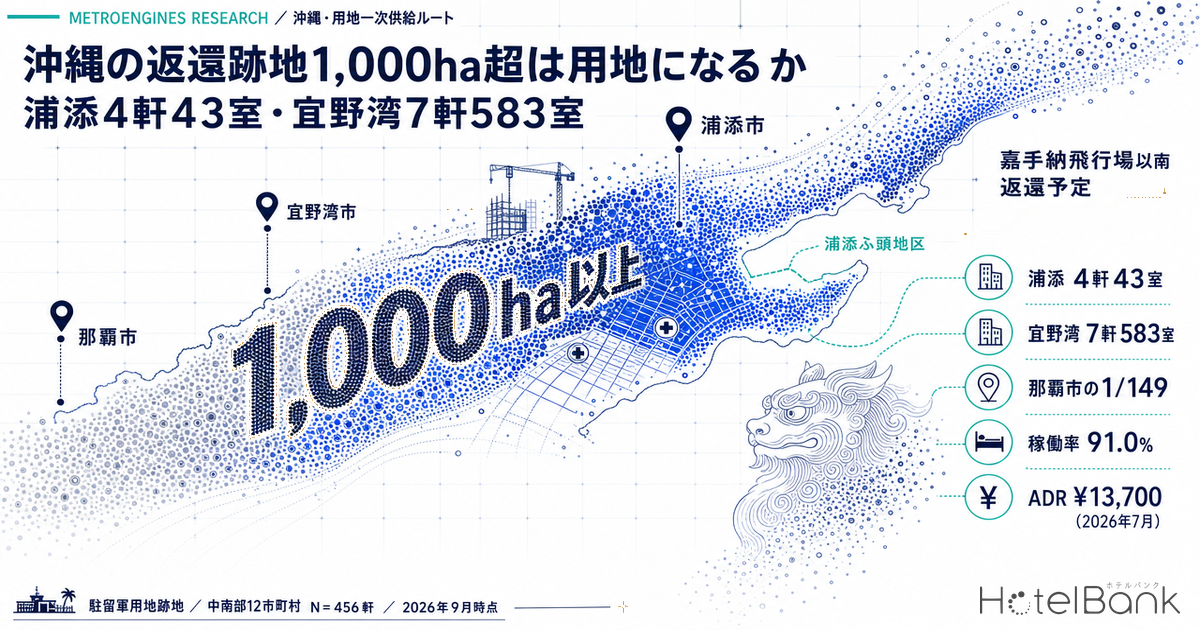
In central and southern Okinawa Island, where hotel sites have become increasingly hard to acquire, there is essentially only one route through which large, contiguous parcels will newly come onto the market: land returned from US military bases. Under the 2013 “Consolidation Plan for Facilities and Areas in Okinawa,” more than 1,000 hectares south of Kadena Air Base are scheduled to be returned (Cabinet Office). This article reads that returned land not as a question of “Okinawa’s supply and demand” but as a primary supply route — “where will development land come from?” — and uses actual data to quantify how thin the current room stock is in Urasoe and Ginowan, the two cities that host these sites.
Metric Definitions Used in This Article
- ADR (Average Daily Rate): An estimated settled rate (tax-exclusive equivalent) calculated by applying format-specific adjustment factors to the lowest-plan price level each property publishes on OTAs and other channels (per room, 2 guests per room, tax-inclusive). Checked against property-level results disclosed by listed hotel REITs (91 properties, most recent 3 months), the median error is approximately 7%. These are estimates and differ from each property’s actual settled prices and accounting figures. Area-level ADR is the median of the properties covered (the level of a typical property in the area).
- OCC (Occupancy Rate): The share of rooms sold relative to total rooms in the area (an estimate based on OTA sales inventory; consistency checks against monthly REIT disclosures confirm accuracy within a few percentage points). In this article it is used only at the prefecture (macro) level; OCC is not calculated for individual municipalities or properties.
- Listed price: Where referenced, the per-room rate for 2 guests (tax-inclusive), averaged across all plans.
- Room stock: The total registered room count of operating properties within the scope tracked by MetroEngines Research (as of September 2026). Includes small inns not listed on OTAs, but is not a complete census.
- — More than 1,000ha south of Kadena Air Base is scheduled for return. In the densely built-up central and southern region, this is effectively the single route through which large new development sites will emerge.
- — The two host cities have tiny hotel stocks: Urasoe has 4 hotels with 43 rooms, and Ginowan 7 hotels with 583 rooms. That is 1/149 and 1/23 of Naha’s 16,614 rooms — extremely thin for cities of roughly 100,000 residents.
- — The cause is land, not demand. About 14% of Urasoe’s city area is the Makiminato Service Area, and about 25% of Ginowan is MCAS Futenma; the most valuable locations — the waterfront and arterial-road frontage — have been occupied by base and port land.
- — Demand is in place. Estimated prefecture-wide occupancy reached 91.0% in July 2026 (1,083 properties, 51,693 rooms), and the summer peak of the estimated settled ADR has risen from about ¥11,700 to about ¥13,700 in two years.
- — Land becomes acquirable well after the return date. The measured case of the West Futenma Housing Area shows about 10 years from return to the opening of the anchor facility. Land prices are already moving ahead — Urasoe commercial land +7.14%, Ginowan +8.89% — so the longer one waits, the higher acquisition costs climb.
How This Article Differs from Our Previous Coverage — Not Volume, Not Downtown, Not the Outer Islands
HotelBank has covered the Okinawa hotel market from several angles. To avoid confusion, we first clarify where this article sits.
| Previous article | Layer covered |
|---|---|
| Okinawa 2026: 2,842 new rooms broken down by format | Allocation of supply “volume” by format |
| From transit point to destination: new hotel openings in Naha | Redevelopment and openings in central Naha |
| Resort condominium investment in Miyakojima and Yaeyama | Resort investment on the outer islands |
| Central Okinawa US military site hotels: the full picture | Revenue models of the development projects themselves on central Okinawa’s returned sites |
| This article | Returned base land in central and southern Okinawa Island = the primary supply route for development land |
For developers searching for land, operating companies participating in redevelopment of the returned sites, and regional banks and funds underwriting Okinawa projects, the question is not “does Okinawa have enough rooms?” It is “when, where, and on what terms will large parcels of land come out?” The urban areas of central and southern Okinawa are already dense, and vacant lots of several hectares rarely trade. That is precisely why returned base land matters as a primary supply route.
Returned Base Land as Primary Supply — Four Sites Confirmed in Public Data
Among the returned (or to-be-returned) sites in central and southern Okinawa, we summarize the major ones whose area, timing, and redevelopment direction can be confirmed in public documents. All figures below are taken directly from published national, prefectural, and municipal materials; no estimates are included.
| Facility / district | Location | Area | Status / outlook |
|---|---|---|---|
| South of Kadena Air Base (Consolidation Plan, total) | Central and southern Okinawa | 1,000ha+ | Scheduled for return under the Consolidation Plan published in 2013 (Cabinet Office) |
| Camp Zukeran (Camp Foster) — West Futenma Housing Area | Ginowan | approx. 51ha | Returned March 2015, handed over to landowners March 2018. Redeveloped as the Okinawa Health and Medical Hub / commercial zone / general park. University of the Ryukyus Hospital opened January 2025 and the Faculty of Medicine opened April 2025 (Ginowan City) |
| Makiminato Service Area (Camp Kinser) | Urasoe | approx. 14% of city area | “Makiminato Service Area Site Utilization Plan” adopted in 2024. Part of the land along National Route 58 has already been returned (Urasoe City) |
| Naha Port Facility (Naha Military Port) | Naha | 56.8ha | To be returned after functions are relocated to an approx. 49ha replacement facility in the Urasoe Pier district (Okinawa Prefecture) |
| MCAS Futenma | Ginowan | 480.6ha | Occupies about 25% of the city’s area. Return is conditional on relocation to a replacement facility (Ginowan City) |
Source: Compiled by MetroEngines Research & Consulting from Cabinet Office “Promotion of Utilization of Former US Military Land” and published materials of Ginowan City, Urasoe City, and Okinawa Prefecture
Three points stand out. First, a precedent model that has already been “implemented” exists. The West Futenma Housing Area was returned in 2015 and handed over in 2018; in 2025 the University of the Ryukyus Hospital opened and its Faculty of Medicine began classes. This gives a measured figure of about 10 years from return to use. Second, Urasoe alone hosts a returned site equivalent to about 14% of its city area. Its site utilization plan was adopted in 2024, so the administrative preparation is already well advanced. Third, the return of the Naha Port Facility is tied to its relocation to the Urasoe Pier district, meaning the western coastlines of Naha and Urasoe move as a single project. How to monetize the returned sites themselves as development projects is covered separately in our analysis of central Okinawa, Central Okinawa US Military Site Hotels: The Final Mega-Development & 3-in-1 Revenue Model.
From a land-acquisition standpoint, the most important point is that much of this land is privately owned. The Makiminato Service Area, covered by Urasoe’s site utilization plan, will change hands only after coordination with landowners and land readjustment following its return. In other words, the return date is not the date the land becomes acquirable. West Futenma’s timeline — “returned 2015 → handed over 2018 → facility opened 2025” — is the only measured sample showing that realistic lead time. For the option of structuring a project on leased land rather than ownership, our analysis back-calculating the maximum supportable ground rent across 9 markets provides useful reference points.
Room Stock in the Two Host Cities Is 1/23 and 1/149 of Naha’s
So how many rooms sit on top of — or next to — this land today? Within the scope tracked by MetroEngines Research, we tallied the room stock of operating properties by municipality across central and southern Okinawa Island (as of September 2026).
Source: MetroEngines Research & Consulting (12 municipalities in central and southern Okinawa Island, operating properties N=456, as of September 2026). Chart shows total rooms (all formats) on a logarithmic scale; labels are in Japanese — see Table 3 for English names.
| Municipality | All formats: properties | All formats: rooms | Hotels only: properties / rooms | Returned base land |
|---|---|---|---|---|
| Naha | 227 | 16,614 | 110 / 14,059 rooms | Naha Port Facility |
| Chatan | 54 | 2,051 | 21 / 1,850 rooms | Part of Camp Zukeran |
| Okinawa City | 40 | 819 | 14 / 682 rooms | — |
| Ginowan | 22 | 715 | 7 / 583 rooms | West Futenma Housing Area / MCAS Futenma |
| Itoman | 20 | 611 | 5 / 532 rooms | — |
| Uruma | 48 | 445 | 8 / 316 rooms | — |
| Kitanakagusuku | 5 | 365 | 4 / 365 rooms | Part of Camp Zukeran |
| Nanjo | 21 | 211 | 2 / 145 rooms | — |
| Tomigusuku | 3 | 169 | 1 / 168 rooms | — |
| Urasoe | 14 | 111 | 4 / 43 rooms | Makiminato Service Area / Urasoe Pier |
| Nakagusuku | 1 | 24 | 0 / 0 rooms | Part of the Army POL Depots |
| Nishihara | 1 | 9 | 0 / 0 rooms | — |
Source: MetroEngines Research & Consulting (master tally of operating properties, as of September 2026). “Hotels only” is the total of business hotels, city hotels, and resort hotels. The returned-base-land column is based on published materials of the Cabinet Office, Okinawa Prefecture, and each city.
The numbers are clear. Urasoe’s room stock is 111 rooms across 14 properties of all formats, or just 43 rooms across 4 properties when limited to hotels. That is 1/149 of Naha’s 16,614 rooms, and only about one-sixth of neighboring Ginowan’s 715 rooms. Ginowan, too, has only 715 rooms across 22 properties of all formats and 583 rooms across 7 hotels — 1/23 of Naha. For cities with populations around 100,000, both are extremely thin.
A note on the figures behind this theme: the “7 properties in Urasoe, 12 in Ginowan” that prompted this article were re-tallied independently, and we confirmed that the values change depending on how the population is defined. Limited to properties whose prices are continuously observed on OTAs, there were 7 in Urasoe and 16 in Ginowan as of July 2026; among operating properties in the property master, 14 in Urasoe and 22 in Ginowan; and restricted to the hotel formats, 4 in Urasoe and 7 in Ginowan. This article presents two series side by side: “hotels only,” the most conservative and clearly defined in use, and “all formats,” which is the most comparable. Whichever basis is used, the conclusion does not change: these two cities are the thinnest areas for rooms in central and southern Okinawa.
There is a reason for this thinness. About 14% of Urasoe’s city area is occupied by the Makiminato Service Area, and its western coast is the Urasoe Pier district — the relocation destination for the Naha Port Facility. In other words, the waterfront and arterial-road frontage that would be most valuable as hotel locations have been base and port land. In Ginowan, too, MCAS Futenma occupies about 25% of the city area. Rooms are scarce not because demand is absent but because there has structurally been no land on which to supply them. Conversely, as returns progress, this is exactly where room for new supply will emerge.
Prefecture-Wide Occupancy Hit 91.0% in July — Demand Is Waiting for Redevelopment
Before turning to land, let us confirm the level of demand. Overlaying Okinawa Prefecture’s estimated settled ADR year by year shows the summer peak rising each year: about ¥11,700 in July 2024, about ¥12,800 in July 2025, and about ¥13,700 in July 2026.
Source: MetroEngines Research & Consulting (Okinawa Prefecture, estimated settled ADR, N=481–508 properties per month, finalized months from July 2024 to August 2026). Chart lines: 2024 (grey), 2025 (light blue), 2026 (blue), by month (Jan–Dec).
Occupancy is also high. Okinawa Prefecture’s occupancy rate in July 2026 (estimated, based on OTA-listed inventory) was 91.0% across all properties (1,083 properties, 51,693 rooms), versus 87.3% in June and 87.8% in August. By format, city hotels were at 93.4%, resort hotels 91.7%, and business hotels 91.6% — all above 90%.
| Format | Properties | Rooms | Estimated occupancy |
|---|---|---|---|
| All properties | 1,083 | 51,693 | 91.0% |
| City hotels | 13 | 2,895 | 93.4% |
| Resort hotels | 231 | 24,985 | 91.7% |
| Business hotels | 177 | 16,596 | 91.6% |
| Deluxe | 7 | 869 | 83.4% |
Source: MetroEngines Research & Consulting (Okinawa Prefecture, July 2026, estimated occupancy based on OTA-listed inventory). These are estimates based on how inventory sold on OTAs is absorbed, and differ from each property’s actual overall occupancy.
Price-Band Map — Ginowan Sits Between Chatan and Naha; Urasoe Lacks Even a Measurable Sample
Next, we look at which price band the host areas currently occupy. The average estimated settled ADR over the most recent 12 months (September 2025 to August 2026) is as follows.
Source: MetroEngines Research & Consulting (estimated settled ADR, average of the most recent 12 months = September 2025 to August 2026; number of properties shown under each bar). Bars from left: Onna, Chatan, Ginowan, Urasoe, Naha, Kitanakagusuku, Okinawa City.
Ginowan stands at about ¥13,700 (N=5 properties), between Chatan at about ¥15,700 (N=23–25) and Naha at about ¥10,100 (N=136–141). Onna Village, the flagship of the west-coast resort area, is at about ¥20,500 (N=38–42), 1.5 times Ginowan.
A caveat is needed here: Urasoe’s estimated settled ADR is based on only 1–2 properties and is not stable as an indicator. As a reference value, its 12-month average is about ¥12,200, but at this sample size a single property’s price change moves the area figure directly, and it is not precise enough to support investment decisions. This in itself supports the argument of this article. Urasoe is “a market without even enough properties to build a price index.” The market is not thin — it has not yet been established.
On the Map — Returned Sites vs. Existing Rooms
We overlaid existing lodging properties in Urasoe and Ginowan with the locations of the returned sites. Circle size represents room count. The map shows visually that Ginowan’s rooms are concentrated in the Ginowan Convention area on the west coast, while Urasoe has only small properties scattered along National Route 58.
Source: MetroEngines Research & Consulting (property locations and room counts); Cabinet Office, Okinawa Prefecture, and municipal materials (site locations). Blue dots = existing lodging properties (circle = room count); dashed circles = returned sites / relocation destination (approximate locations).
Of Ginowan’s 583 hotel rooms, the top two properties alone account for 480. The West Futenma Housing Area lies inland on the city’s east side, where a new demand generator — the University of the Ryukyus Hospital — began operating in January 2025. Medical institutions generate lodging demand from patients’ families, healthcare workers, and academic conference attendees, yet Ginowan’s current room stock is skewed toward the west coast. West Futenma is an area where the conditions for an “urban clinic-adjacent” medical-stay hotel are increasingly coming together.
In Urasoe, the land between National Route 58 and the west coast is the Makiminato Service Area, and existing properties are squeezed onto the east side of Route 58. If the Urasoe Pier district moves forward, a large block of development land will emerge on the waterfront within a 20-minute drive of Naha Airport.
Land Prices Are Moving First — Urasoe Commercial +7.14%, Ginowan +8.89%
Land prices in these two cities are rising even before the primary supply of land comes into view. In the 2026 official land price publication, Urasoe’s average commercial land price was ¥274,000/㎡, up 7.14% year on year, and its average residential land price was ¥164,416/㎡, up 5.07%. Ginowan’s municipal rate of change was +8.89%, among the highest in the prefecture, and the top residential gainer was Nodake 3-chome in Ginowan at +18.6%. Residential land across Okinawa Prefecture rose 6.4%, ranking 8th nationwide.
Source: Ministry of Land, Infrastructure, Transport and Tourism (MLIT) “Official Land Prices” (2026); Okinawa Times “[Okinawa Official Land Prices 2026] Land price growth ranking”; Tochidai Data (aggregation based on MLIT official land prices)
That land prices are rising ahead of time is a headwind in terms of acquisition cost, but it is also a signal that the market has begun to price in the future potential of the returned sites. We have back-calculated the land-price ceiling at which hotel use remains feasible in a separate analysis, and competition for land with condominium use is also a realistic issue in central and southern Okinawa. The standout rise in Ginowan’s residential land can be read as a reflection of the returned land being valued first for residential and medical uses. When pursuing land for hotel use, the business case must be built on the assumption of competing with residential and commercial uses.
One 200-Room Project Planned in Urasoe — 1.8x the Current Stock
Checking the current construction pipeline using MLIT’s “Building Construction Dynamics Statistics,” among projects registered for hotel use in Okinawa Prefecture, the only one in central and southern Okinawa is a single project in Nishihara 6-chome, Urasoe (200 rooms, 17 stories above ground, total floor area 20,700㎡; construction started April 2023, scheduled completion July 2026).
This single project carries significant weight. Urasoe’s current room stock is 111 rooms across all formats, so just one 200-room property coming online would increase the city’s room count by about 2.8 times. Limited to hotels, 43 rooms would become 243 — 5.7 times. In other words, Urasoe is so thin that a single building decision rewrites the structure of the market itself. For first movers, it is an environment where a pioneer premium can be captured; on the other hand, it should be factored in that if a second or third building enters at the same time, the supply-demand balance will shift abruptly.
*Based on building confirmation applications as of the time of research. Confirmation applications are typically filed 1–2 years before opening, so the number of projects and rooms is expected to increase as further applications are added. Please treat this as the lower bound of the confirmed pipeline at this point.
Note that the issue of whether a site lies inside or outside an urbanization promotion area — and which zoning designation applies — affecting opening schedules is not unique to Okinawa. Nationwide, 61% of 2026 hotel openings sit outside urbanization promotion areas, where development permits and farmland conversion lengthen the time to opening; this is a useful reference point when estimating the lead time for redeveloping returned base land.
Source: Compiled by MetroEngines Research & Consulting from MLIT “Building Construction Dynamics Statistics”
Feasibility Sensitivity — Three Lead-Time Scenarios and ADR × OCC
All figures so far are “facts observable today.” What those pursuing land actually need to judge are the two questions beyond that: when can the land be acquired and at what level will the hotel perform. The following is a sensitivity framework based solely on the published and measured values confirmed in this article; it is not a financial forecast for any specific project.
1. Lead Time — Three Scenarios from Return to Room Supply
For redevelopment of returned base land in Okinawa, only one sample — the West Futenma Housing Area — can be observed end to end from return to actual facility operation. Placing its measured timeline (returned March 2015, handed over March 2018, anchor facility — the University of the Ryukyus Hospital — operating in 2025) as the base case and flexing up and down gives the following.
| Scenario | Assumption | Land acquirable | Indicative opening |
|---|---|---|---|
| Optimistic | A site utilization plan is already in place, land readjustment proceeds ahead of schedule, and land moves in stages from partially returned parcels. The Route 58 frontage of the Makiminato Service Area, part of which has already been returned, fits this pattern. | 3–4 years after return | 6–7 years after return |
| Base | Proceeds as measured at the West Futenma Housing Area: 3 years from return to handover, then infrastructure development and use allocation, for a total of about 10 years until the anchor facility operates. | 5–6 years after return | 9–11 years after return |
| Pessimistic | Return itself is conditional on completion of relocation to a replacement facility. MCAS Futenma and the Naha Port Facility fall into this category; since relocation completion dates are not fixed, the return date itself can shift. | Return date not fixed | 15+ years / cannot be determined |
Assumptions: Compiled by MetroEngines Research & Consulting from the return, handover, and operation record of the West Futenma Housing Area (Ginowan City), the Makiminato Service Area Site Utilization Plan (Urasoe City, 2024), and the history of the Naha Port Facility relocation (Okinawa Prefecture). There is only one measured sample, so these are estimated ranges.
The practical implication is clear. Even in the base case, one should expect roughly 10 years from getting involved at the acquisition stage of a site with a published return schedule to opening. Conversely, building MCAS Futenma or the Naha Port Facility — whose return depends on relocation — into a business-plan timeline is not viable at present. What can realistically be pursued is effectively limited to the Makiminato Service Area, where a site utilization plan is in place and partial returns have begun, and the remaining use allocations at the already-handed-over West Futenma Housing Area.
2. ADR × OCC — RevPAR Sensitivity by Room Rate and Annual Occupancy
Next, we set out on two axes the performance level of a hotel operated on such land. The rate axis follows the market levels confirmed in this article: within the range from Naha’s approximately ¥10,100 to Onna’s approximately ¥20,500, we step through ¥10,000 to ¥18,000, the band realistically targeted by sites on returned land in central and southern Okinawa. The occupancy axis is on an annual basis. The prefecture-wide 91.0% is a value for July 2026, a peak month, and must not be substituted as an annual assumption (June’s 87.3% and August’s 87.8% of the same year are both summer months). On an annual basis including winter, read the table on the assumption that occupancy will fall below this band.
| Estimated settled ADR | Annual OCC (assumed) | ||||
|---|---|---|---|---|---|
| 70% | 75% | 80% | 85% | 90% | |
| ¥10,000 | ¥7,000 ¥2.56M | ¥7,500 ¥2.74M | ¥8,000 ¥2.92M | ¥8,500 ¥3.10M | ¥9,000 ¥3.28M |
| ¥12,000 | ¥8,400 ¥3.07M | ¥9,000 ¥3.28M | ¥9,600 ¥3.50M | ¥10,200 ¥3.72M | ¥10,800 ¥3.94M |
| ¥14,000 | ¥9,800 ¥3.58M | ¥10,500 ¥3.83M | ¥11,200 ¥4.09M | ¥11,900 ¥4.34M | ¥12,600 ¥4.60M |
| ¥16,000 | ¥11,200 ¥4.09M | ¥12,000 ¥4.38M | ¥12,800 ¥4.67M | ¥13,600 ¥4.96M | ¥14,400 ¥5.26M |
| ¥18,000 | ¥12,600 ¥4.60M | ¥13,500 ¥4.93M | ¥14,400 ¥5.26M | ¥15,300 ¥5.58M | ¥16,200 ¥5.91M |
Top line = RevPAR (per room per night); bottom line = annualized room revenue (RevPAR × 365 days, per room). The shaded cell is the midpoint (ADR ¥14,000 × annual OCC 80% (estimate, as of 2026, annual assumption)). The rate range is based on market levels of the estimated settled ADR by MetroEngines Research & Consulting (most recent 12 months = September 2025 to August 2026).
*This table covers room revenue only. It excludes ancillary revenue (F&B, banquets, parking, etc.), operating expenses, land acquisition costs, construction costs, and financing terms entirely. NOI, yield, or IRR therefore cannot be read directly from it. It is not a financial forecast for any specific project, but a calculation showing how much the choice of rate and occupancy moves room revenue.
At the midpoint (ADR ¥14,000 × annual OCC 80% (estimate, as of 2026, annual assumption)), RevPAR is ¥11,200 and annual room revenue per room is about ¥4.09 million. Using Ginowan’s market rate of about ¥13,700, a 5-point swing in annual OCC moves annual revenue by about ¥250,000 per room. For a 200-room property, that is a difference of roughly ¥50 million per year; the feasibility of a site on returned land is more sensitive to how much annual occupancy can be built up than to the rate level. Building an annual plan from the summer peak alone means taking this swing head-on.
Urasoe requires a further caveat. Its estimated settled ADR is based on only 1–2 properties, so the rate axis of this table cannot be read as Urasoe’s market level. Neighboring Ginowan’s approximately ¥13,700 and Naha’s approximately ¥10,100 serve as the realistic upper and lower bounds.
Practical Issues for Land Seekers — Five Checkpoints
Translating the data so far into land-acquisition practice boils down to the following five points.
| Issue | Confirmed facts and implications |
|---|---|
| 1. Lead time | West Futenma Housing Area: returned March 2015 → handed over March 2018 → anchor facility operating in 2025. Only one measured sample exists, showing about 10 years from return to use. Do not treat the scheduled return date as the acquirable date. |
| 2. Landowner coordination | Much of the returned land is privately owned and changes hands after land readjustment. Land is allocated within use quotas under the municipality’s site utilization plan, not through bilateral deals with single landowners. Urasoe adopted its site utilization plan in 2024. |
| 3. Underlying demand | Okinawa Prefecture’s estimated occupancy was 91.0% in July 2026 (1,083 properties, 51,693 rooms). The summer peak of the prefecture-wide estimated settled ADR has risen from about ¥11,700 in 2024 to about ¥13,700 in 2026. Demand is in a position to wait for redevelopment. |
| 4. Room for entry | Urasoe has 4 hotels with 43 rooms; Ginowan 7 hotels with 583 rooms. In Urasoe, a single 200-room-class building would increase the city’s stock by about 2.8 times. First-mover advantages are large, but if multiple buildings enter at the same time, the supply-demand impact works at the same multiple. |
| 5. Competing uses | 2026 official land prices: Urasoe commercial land +7.14%, Ginowan +8.89%, and residential land in Nodake 3-chome, Ginowan +18.6%. Residential, medical, and commercial uses are gaining value first, and hotel use needs to build its business case amid that competition. |
Summary
When searching for hotel land in central and southern Okinawa Island, chasing the urban areas’ circulating inventory has its limits. The route through which large new parcels emerge is effectively concentrated in the more than 1,000 hectares of returned base land under the Consolidation Plan. And the room stock of Urasoe and Ginowan, the cities hosting that land, is just 111 and 715 rooms respectively across all formats, or 43 and 583 rooms in hotels — 1/149 and 1/23 of Naha.
The thinness is not due to weak demand. Prefecture-wide estimated occupancy reached 91.0% in July 2026, and the summer peak of the estimated settled ADR has risen by about ¥2,000 in two years. Supply simply has not structurally occurred because the most valuable locations — the waterfront and arterial-road frontage — were base and port land. Return is the only primary supply route that lifts that constraint, and the West Futenma Housing Area, a measured sample of “about 10 years from return to use,” provides a benchmark for that lead time.
The practical conclusion for land seekers is clear. Waiting to act until tradable land comes onto the market is too late. Get involved from the stage when use quotas under the site utilization plan are decided, and align the business plan with the land readjustment schedule. Land prices are already moving ahead, and that timeline will not wait.
Related Reading
- Okinawa 2026: 2,842 New Rooms, 0.6% Business vs 22.1% City Inventory
- Okinawa’s 2% Lodging Tax: ¥60–¥340 per Guest Night by Municipality
- Central Okinawa US Military Site Hotels: The Final Mega-Development & 3-in-1 Revenue Model
- Leasehold Hotel Development: 1.38x Land Price Reach Across 9 Markets
- Hotel vs Condo Land Rivalry: ADR-Implied Feasible Land Price Map
- Autumn on Japan’s Islands: 2.37x ADR Gap Across 10 Municipalities
References and Sources
■ Data Sources
Room stock and property counts are a master tally of operating properties (12 municipalities in central and southern Okinawa Island, N=456 properties, as of September 2026). Estimated settled ADR is an estimate obtained by applying format-specific adjustments to each property’s OTA public prices; municipal figures are averages over the most recent 12 months (September 2025 to August 2026), and prefecture-level figures are monthly from July 2024 to August 2026 (N=481–508 properties per month). Estimated occupancy is a prefecture-level estimate based on the absorption of OTA-listed inventory (July 2026, 1,083 properties, 51,693 rooms). The area, timing, and redevelopment direction of returned sites are from published materials of the Cabinet Office, Okinawa Prefecture, Ginowan City, and Urasoe City; construction plans from MLIT’s “Building Construction Dynamics Statistics”; and land prices from MLIT’s “Official Land Prices” (2026).
■ Calculation Assumptions
The three lead-time scenarios place the West Futenma Housing Area — the only sample observable end to end (returned March 2015, handed over March 2018, anchor facility operating 2025) — as the base case, treat sites where partial returns have begun as optimistic, and sites whose return is conditional on completion of relocation to a replacement facility as pessimistic. The ADR × OCC sensitivity table is a grid of estimated settled ADR ¥10,000–¥18,000 × annual OCC 70–90%, calculated as RevPAR = ADR × OCC and annualized = RevPAR × 365 days (per room). Annual OCC values are assumptions; the prefecture’s 91.0% for July 2026 is an actual summer-peak value and is therefore not used as an annual figure.
■ Limitations and Caveats
(1) Urasoe’s estimated settled ADR covers only 1–2 properties and is an unstable reference value; it cannot be read as the city’s market level. (2) Room stock is a tally within the scope tracked by our company and is not a complete census. The fact that values change with how the population is defined (continuous OTA observation / property master / hotels only) is noted alongside in the text. (3) There is only one measured lead-time sample, so the ranges are not statistical. (4) The ADR × OCC sensitivity table covers room revenue only and excludes ancillary revenue, operating expenses, land acquisition costs, construction costs, and financing terms, so NOI, yield, or IRR cannot be read from it. It is not a financial forecast for any specific project. (5) Construction plans are lower-bound values based on building confirmation applications and will increase as further applications are added.
■ Market Data
- MetroEngines Research & Consulting — Estimated settled ADR, estimated occupancy (based on OTA-listed inventory), property and room stock tally (12 municipalities in central and southern Okinawa Island, operating properties N=456, as of September 2026)
■ Government and Municipal Publications
- Cabinet Office, “Promotion of Utilization of Former US Military Land” (駐留軍用地跡地利用の推進)
- Cabinet Office, “Policy on Promoting and Facilitating the Utilization of Former US Military Land” (駐留軍用地跡地利用の促進及び円滑化等に関する方針)
- Cabinet Office, “Designation of Specified Military Land, Specified Former Military Land, and Hub Returned Land” (特定駐留軍用地・特定駐留軍用地跡地・拠点返還地の指定)
- Cabinet Office, Okinawa General Bureau, “Guide to Returned Sites and Facilities Agreed for Return” (返還跡地・返還合意施設ガイド)
- Okinawa Prefecture, “Promotion of Utilization of Former US Military Land” (駐留軍用地跡地利用の推進)
- Okinawa Prefecture, “History of the Naha Port Facility Relocation” (那覇港湾施設の移設の経緯) (Naha Port Facility 56.8ha / replacement facility approx. 49ha)
- Ginowan City, “West Futenma Housing Area” (西普天間住宅地区) (approx. 51ha, returned March 2015, handed over March 2018)
- Ginowan City, “Overview of MCAS Futenma” (普天間飛行場の概要)
- Ginowan City, Base Policy Department, “MCAS Futenma in the Middle of the City” (まちのど真ん中にある普天間飛行場) (480.6ha, about 25% of the city area)
- Urasoe City, “Makiminato Service Area Site Utilization Plan” (牧港補給地区跡地利用計画) (2024)
- Urasoe City, “Information on Urasoe West Coast Development and the Naha Military Port” (浦添市西海岸開発と那覇軍港に関する情報一覧)
- MLIT, “Building Construction Dynamics Statistics” (建築物動態統計調査) (construction plans for lodging facilities)
■ Land Prices and News Coverage
- Okinawa Times, “[Okinawa Official Land Prices 2026] Land price growth ranking: No. 1 residential is Nodake 3-chome, Ginowan” (Japanese)
- Tochidai Data, “Urasoe land price levels and official land prices (2026)” (aggregation based on MLIT official land prices; Japanese)
- Okinawa Times, “University of the Ryukyus Hospital, relocating to the West Futenma campus, to open January 6, 2025” (Japanese)