

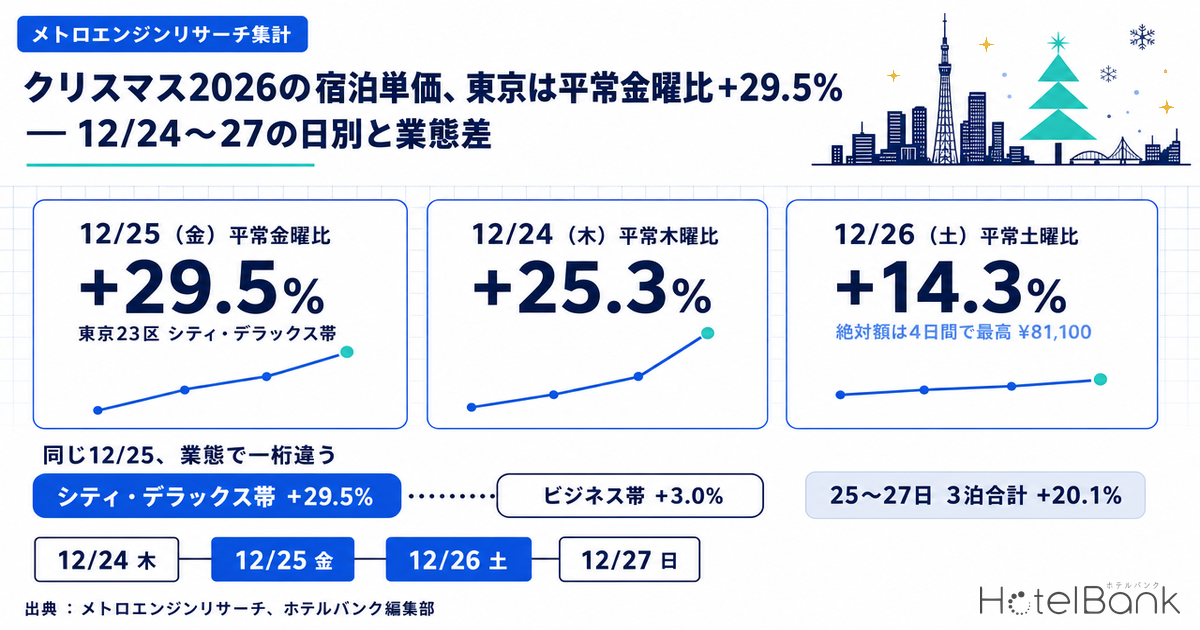
Christmas 2026 falls with December 24 on a Thursday, the 25th on a Friday, the 26th on a Saturday and the 27th on a Sunday. This pattern, in which Christmas Eve runs straight into three consecutive days leading into the weekend, did not occur in any of the past three years. Daily December listed prices compiled by MetroEngines Research across 1,359 properties in six major cities show that this calendar plays out as completely different price movements by city and by segment. In the city/deluxe segment of Tokyo’s 23 wards, December 25 (Fri) is priced +29.5% above an ordinary Friday in the same December, while the business hotel segment in Tokyo’s 23 wards on the same day is only +3.0%. This article focuses on the four days from December 24 to 27, examining the structure of forward prices by day, city and segment, and outlines the design options available to operators.
Metric Definitions Used in This Article
- Listed price: The average across all plans of the selling prices each property publishes (from room-only to meal-inclusive plans). Per-room rate for two guests sharing one room (tax included). All daily analysis in this article (the daily series from December 1 to 31) is based on this listed price; for each city, we calculate each property’s daily average and use the median.
- ADR (Average Daily Rate) = Estimated settled rate (tax-excluded equivalent), calculated by applying segment-specific adjustment factors to the lowest-plan level published by each property (two guests per room, per-room rate, tax included). Reconciliation against property-level results disclosed by listed hotel REITs (91 properties, most recent 3 months) shows a median error of approximately 7%. This is an estimate and differs from each property’s actual settled prices and accounting figures. Area-level ADR is the median of the target properties (the level of a typical property in the area). In this article it is used only to show monthly levels, not in the daily analysis.
- OCC (Occupancy) = Ratio of rooms sold to total rooms in the area (estimated from OTA sales inventory; consistency checks against REIT monthly disclosures confirm accuracy within roughly a few percentage points).
- Ratio to same-weekday baseline: The median listed price on the target date compared with the median for the same weekday in the same December, excluding Christmas week and the year-end/New Year period (i.e., the matching weekdays between December 1 and 23).
- Data source: MetroEngines Research
- — Dec 25 (Fri) is +29.5% vs. a normal Friday — city/deluxe segment in Tokyo’s 23 wards (N=94 properties). Christmas Eve on the 24th is also +25.3% vs. a normal Thursday, lifting Thursday and Friday to near-Saturday levels.
- — The uplift on Saturday the 26th is only +14.3% — its absolute price is the highest of the four days (¥81,100), but the Saturday premium is already built into normal Saturday levels. 2026 is not a year to chase a new Saturday premium.
- — Business hotels in Tokyo’s 23 wards are +3.0% on the same Dec 25 — the decline in corporate demand toward year-end and the rise in leisure demand nearly cancel out, producing a move an order of magnitude smaller than in the city hotel segment.
- — Sapporo is up more than 30% across segments; Kyoto is −10.6% — Sapporo reflects a December-specific demand structure in which illuminations overlap with the ski season. Kyoto falls in the trough between autumn foliage and year-end.
- — The 3-night total for Dec 25–27 is +20.1% in Tokyo’s 23 wards — Sunday the 27th lifts the total. The 27th is the entry point to the year-end range, so an inventory strategy that avoids selling out is consistent with the price staircase.
Christmas 2026 Falls Thu–Fri–Sat–Sun — The Most Weekend-Aligned Calendar in Three Years
First, let’s check the weekday arrangement. Christmas lodging demand takes an entirely different shape depending on which days of the week the 24th and 25th fall on. In 2024, the 24th was a Tuesday and the 25th a Wednesday; in 2025, the 24th was a Wednesday and the 25th a Thursday — both landing mid-week. In 2026, Christmas Eve is a Thursday, Christmas Day a Friday, the 26th a Saturday and the 27th a Sunday, so demand builds for four consecutive days from the 24th through the 27th.
| Year | 12/23 | 12/24 (Eve) | 12/25 | 12/26 | 12/27 | 12/28 | Shape of demand |
|---|---|---|---|---|---|---|---|
| 2024 | Mon | Tue | Wed | Thu | Fri | Sat | Isolated weekdays; the weekend is separated, from the 28th onward |
| 2025 | Tue | Wed | Thu | Fri | Sat | Sun | Christmas Day on Thursday; the weekend shifts to the 26th–27th |
| 2026 | Wed | Thu | Fri | Sat | Sun | Mon | Eve → Christmas Day → weekend in a row; the four days merge into one block |
Source: HotelBank Editorial Team
This difference translates directly into the size of the price uplift. Comparing the median listed price on December 25 with the median for “the same weekday in the same December, excluding Christmas week and the year-end/New Year period” for the past two years and for 2026, the city/deluxe segment in Tokyo’s 23 wards was +9.3% in 2024 (Wednesday) and +7.6% in 2025 (Thursday), while in 2026 (Friday) the gap widens to +29.5%. With the date moving to a Friday, Christmas demand and regular weekend demand now fall on the same day.
Source: Compiled by HotelBank Editorial Team from MetroEngines Research data
That said, the level of the uplift itself varies widely by city. Sapporo has been consistently high, at +40% to +68% in all three years. This reflects not so much Christmas itself as a December-specific demand structure in which the Sapporo White Illumination and the Munich Christmas Market in Sapporo (scheduled for November 20 – December 25 in 2026) overlap with the start of the ski season. Kyoto, by contrast, hovered around zero in the previous two years and falls to −10.6% in 2026, showing little response to Christmas. In Kyoto, early December — the tail end of the autumn foliage season — is the most expensive part of the month, so the baseline for ordinary days itself sits high.
Daily December Listed Prices in Six Cities — A Plateau Begins on Dec 25 and Runs Straight into Year-End
Next, we look at the median daily listed price by city from December 1 to 31. Coverage, within the scope tracked by MetroEngines Research, is 251 city/deluxe hotels and 1,108 business hotels located in Tokyo’s 23 wards, Osaka City, Nagoya City, Fukuoka City, Sapporo City and Kyoto City (number of properties aggregated as of December 24).
Source: Compiled by HotelBank Editorial Team from MetroEngines Research data (N=251 properties, city/deluxe segment)
The city/deluxe segment in Tokyo’s 23 wards traces a typical weekly pattern between December 1 and 23, ranging from ¥54,100 to ¥73,000 with only Saturdays spiking. After rising to ¥68,700 on December 23 (Wed), however, it moves onto a plateau above the upper bound of ordinary days for all four days: ¥74,400 on the 24th, ¥77,200 on the 25th, ¥81,100 on the 26th and ¥76,200 on the 27th. From the 28th onward, it connects without a break into the year-end/New Year range (¥83,100 on the 29th, ¥87,800 on the 31st). In Tokyo in December 2026, “ordinary” and “peak” switch places at the 25th, and prices do not come back down before the end of the month.
Sapporo follows the same shape but rises earlier. By December 18 (Fri) it is already at ¥41,100, above the early-month ordinary level (¥32,600 on December 8), and it climbs almost steadily from there: ¥48,300 on the 24th, ¥51,200 on the 25th and ¥56,100 on the 26th. This shows that the second half of December, when the illumination period overlaps with the ski season, is inherently Sapporo’s peak season.
Kyoto, on the other hand, shows the opposite shape. December 1–5 is the most expensive stretch at ¥59,000–¥63,000, falling into the ¥39,000 range by mid-month, and Christmas Eve on the 24th sits at the low end of the month at ¥37,200. The reversal begins at ¥51,700 on the 26th (Sat), with prices rising again toward year-end to reach ¥70,800 on December 31. For Kyoto, Christmas falls in the trough between two peaks: autumn foliage and the year-end/New Year holidays.
The Uplift Concentrates on Friday — Dec 25 Is +29.5% vs. a Normal Friday, Dec 26 +14.3% vs. a Normal Saturday
This is the core question. To separate whether the change is simply due to the weekday arrangement or whether Christmas itself carries an uplift, we compare each day with ordinary days of the same weekday.
| City (city/deluxe segment) | 12/24 (Thu) | vs. normal Thu | 12/25 (Fri) | vs. normal Fri | 12/26 (Sat) | vs. normal Sat | N |
|---|---|---|---|---|---|---|---|
| Tokyo 23 wards | ¥74,351 | +25.3% | ¥77,246 | +29.5% | ¥81,145 | +14.3% | 94 |
| Osaka City | ¥27,225 | +1.0% | ¥27,657 | ±0.0% | ¥40,150 | +9.0% | 67 |
| Nagoya City | ¥35,660 | +14.7% | ¥36,544 | +17.9% | ¥49,162 | −2.2% | 14 |
| Fukuoka City | ¥36,664 | +3.0% | ¥42,781 | +10.3% | ¥56,989 | +6.9% | 21 |
| Sapporo City | ¥48,258 | +46.3% | ¥51,155 | +39.5% | ¥56,062 | +17.2% | 25 |
| Kyoto City | ¥37,168 | −15.1% | ¥39,844 | −10.6% | ¥51,693 | +3.6% | 28 |
City medians of listed prices (all-plan average, 2 guests per room, tax included). N is the number of properties aggregated as of 12/25. Nagoya City has only N=14 and is shown for reference. Source: Compiled by HotelBank Editorial Team from MetroEngines Research data
Source: Compiled by HotelBank Editorial Team from MetroEngines Research data
Three points stand out. First, the largest uplift falls on December 25 (Fri), followed by the 24th (Thu). Tokyo’s 23 wards are +29.5% on the 25th and +25.3% on the 24th, and Nagoya follows the same order at +17.9% / +14.7%. Rather than an Eve-heavy pattern, what is at work is the effect of Christmas Day falling on a Friday.
Second, the uplift on December 26 (Sat) is relatively small: +14.3% in Tokyo’s 23 wards, +9.0% in Osaka and even −2.2% in Nagoya. In absolute terms the 26th is the highest day (¥81,100 in Tokyo), but that is because the “it’s Saturday, so it’s expensive” portion is already built into normal Saturday levels; the additional amount attributable to Christmas is limited. In other words, 2026 is not a year to newly capture a Saturday premium, but a year in which Thursday and Friday — days that normally carry lower rates — can be raised to Saturday-like levels.
Third, the uplift on December 27 (Sun) (Tokyo +31.2%, Osaka +52.0%, Nagoya +40.9%) should not be read as a Christmas-only effect. The 27th is the Sunday when year-end travel begins, overlapping with the start of homecoming and year-end trips from the 28th (Mon) onward. Indeed, December 28 in Tokyo’s 23 wards is even higher at ¥78,100. Whether the 27th is treated as “day four of Christmas” or “day one of year-end” changes the playbook, so this day should be planned separately. The pricing structure of the year-end/New Year period itself (December 29 – January 3) is covered separately in Year-End 2026-27 Room Rates Are Already Visible: December Forward ADR vs Prior-Year Actuals.
Business Hotels Move the Opposite Way on the Same Days — How to Account for Falling Corporate Demand
Looking at the same four days in a different segment reverses the picture. In the business hotel segment (N=1,108 properties), December 25 (Fri) in Tokyo’s 23 wards is only +3.0% vs. a normal Friday, and the 24th (Thu) +1.7% — an order of magnitude below the city/deluxe segment’s +29.5% / +25.3%.
| City (business hotel segment) | 12/24 (Thu) | vs. normal Thu | 12/25 (Fri) | vs. normal Fri | 12/26 (Sat) | vs. normal Sat | N |
|---|---|---|---|---|---|---|---|
| Tokyo 23 wards | ¥24,568 | +1.7% | ¥25,671 | +3.0% | ¥32,147 | −2.9% | 485 |
| Osaka City | ¥14,134 | −0.1% | ¥15,802 | +7.7% | ¥21,340 | −0.1% | 212 |
| Nagoya City | ¥13,757 | −5.1% | ¥15,576 | −0.3% | ¥31,240 | +2.2% | 83 |
| Fukuoka City | ¥17,991 | −8.2% | ¥21,968 | −0.3% | ¥33,882 | −2.4% | 149 |
| Sapporo City | ¥23,552 | +41.7% | ¥26,486 | +30.9% | ¥27,152 | +4.9% | 77 |
| Kyoto City | ¥17,194 | −16.5% | ¥18,844 | −8.4% | ¥27,372 | +2.9% | 98 |
City medians of listed prices (all-plan average, 2 guests per room, tax included). N is the number of properties aggregated as of 12/25. Source: Compiled by HotelBank Editorial Team from MetroEngines Research data
Source: Compiled by HotelBank Editorial Team from MetroEngines Research data
Why does the gap widen? For business hotels, ordinary Thursday and Friday rates in December are kept high to begin with by business travel and corporate use. In Tokyo’s 23 wards, a normal Thursday is ¥24,200 and a normal Friday ¥24,900 — more than 20% higher than Sunday (¥19,300). Christmas Day is a regular business day for many companies, but it also falls in the period when business travel starts to thin out toward year-end, so the decline in corporate demand and the increase in leisure demand offset each other. As a result, on the same days that city hotels raise rates sharply, business hotels pass through almost flat. December 24 in Fukuoka (−8.2%) and Kyoto (−16.5%), both below a normal Thursday, shows that this substitution does not fully take place.
Sapporo is again the exception, with business hotels also rising sharply: +41.7% on the 24th and +30.9% on the 25th. It is a market where the city’s leisure demand lifts every segment regardless of hotel type, which means even limited-service hotels have wide latitude to set leisure-oriented pricing during the Christmas period.
It is also worth noting the overall market direction. On a monthly estimated settled ADR basis at the prefectural level, December 2026 comes in at ¥17,500 for Tokyo (+10.5% YoY, N=1,004 properties), ¥12,700 for Hokkaido (+34.6% YoY, N=756), ¥11,500 for Aichi (+27.4% YoY, N=422) and ¥14,200 for Fukuoka (+10.7% YoY, N=423), while Osaka is at ¥11,100 (−0.2% YoY, N=591) and Kyoto at ¥17,200 (−3.8% YoY, N=512) — a split picture. Christmas-period planning should be considered alongside the direction of this monthly baseline.
For Operators (1): Four Consecutive Days Create Room to Design Multi-Night Stays
The most practical implication of the 2026 calendar is that December 25 (Fri), 26 (Sat) and 27 (Sun) are consecutive. Viewed by total stay value rather than per-night rate, the role of these three days changes.
Source: Compiled by HotelBank Editorial Team from MetroEngines Research data
In the city/deluxe segment, comparing the three-night total for December 25–27 with the three-night total for a normal weekend (December 18–20), Tokyo’s 23 wards come to ¥234,600 vs. ¥195,400 (+20.1%), Sapporo ¥161,700 vs. ¥131,100 (+23.3%) and Osaka ¥106,800 vs. ¥88,900 (+20.2%). By contrast, on a two-night total for the 25th and 26th, the differences are small: Osaka +6.7%, Nagoya +3.7% and Kyoto +3.7%. It is the third night, the 27th (Sun), that lifts the total.
This is where the design opportunity lies. Sunday is normally a low-rate day, but because December 27, 2026 overlaps with the start of year-end travel, it is easier to package the stay as a “Christmas-to-year-end three-night stay” rather than a regular “two-night weekend.” In the business hotel segment too, three-night totals grow clearly — Kyoto +24.1% and Sapporo +18.4% — compared with the two-night comparison (+11.1% and +9.8%, respectively). Even in segments with limited room to raise per-night rates, upside remains in extending length of stay.
Conversely, a two-night stay starting on December 24 (Thu) — the 24th and 25th — is worth designing as a weekday-start multi-night stay. In the city/deluxe segment of Tokyo’s 23 wards, both the 24th and the 25th are more than 25% above their same-weekday baselines, with Thursday and Friday lifted to the same level. In a year when Thursday and Friday — two days that normally carry different rates — line up at the same height, multi-night discounts can be kept thin and still work.
For Operators (2): Bundling with In-House Dining Carries a Large Rate Difference
The Christmas period is also one of the few times of year when stay value can be designed through combinations with in-house restaurants and dinners. In a paired comparison (as of September 2026) limited to properties that sell both a “breakfast-included plan” and a “half-board plan (breakfast and dinner)” at the same property, the uplift from adding dinner is as follows.
Paired comparison limited to properties selling both breakfast-included and half-board plans at the same property. Source: Compiled by HotelBank Editorial Team from MetroEngines Research data
Kyoto Prefecture shows the largest uplift at +¥16,200 (+36.5%, N=50 properties), followed by Tokyo at +¥11,500 (+23.9%, N=85) and Hokkaido at +¥8,500 (+26.6%, N=163). The gap between half-board and room-only (the “full-board premium”) reaches +54.2% in Kyoto, +52.8% in Osaka and +44.4% in Tokyo. Given that the breakfast-only uplift in Tokyo is just +13.3% (N=466 properties), designs that include dinner represent a significant lever separate from the room rate.
Because December 24 (Thu) and 25 (Fri) rise to the same level in 2026, spreading dinner seatings across both days is less likely to erode room pricing. Compared with years when demand concentrates on Christmas Eve (the 2024 and 2025 pattern), there is room to capture guests previously lost to restaurant capacity constraints by shifting them to the following day. Even limited-service hotels without in-house dining can apply the same idea through partner vouchers with nearby restaurants or breakfast upgrade sales.
For Operators (3): Don’t Treat December 27 as “the Last Day of Christmas”
The third point concerns how to hold inventory. At the time of this analysis, December 25 is still more than 100 days away — too early to read the progress of inventory absorption. We therefore limit the discussion here not to inventory volumes but to design implications that can be derived from the daily price structure.
In the daily series for the city/deluxe segment in Tokyo’s 23 wards, the day after December 27 (Sun) at ¥76,200, the 28th (Mon) rises further to ¥78,100, continuing to ¥83,100 on the 29th (Tue) and ¥87,800 on the 31st (Thu). In other words, the 27th is not partway down a slope but at the start of the next climb. In Osaka too, prices dip from ¥39,000 on the 27th to ¥34,300 on the 28th before climbing again to ¥37,300 on the 29th and ¥43,900 on the 31st. Kyoto is even more extreme, rising steadily from ¥47,000 on the 27th to ¥70,800 on the 31st.
Given this shape, treating the 27th onward as a transition into the year-end range and holding back a certain amount of inventory until close to arrival is more consistent with the price staircase than a design that sells out all inventory on the 27th as “the last night of a Christmas stay.” In markets like Kyoto, where rates keep rising toward year-end, not rushing to sell out during Christmas translates directly into upside.
What holding inventory means also differs by segment. For business hotels, corporate demand drops out entirely from December 28 (Mon) onward, so even in Tokyo’s 23 wards the rise from the 27th (¥26,700) to the 28th (¥27,600) is modest. For business hotels, rather than forcing high prices during Christmas, a more natural design is to reliably fill the 24th–27th and prepare for the shift to leisure demand from the 28th onward. City/deluxe hotels, on the other hand, see prices keep rising through year-end, so there is no need to sell out all Christmas-period inventory.
Summary
Christmas 2026 has the most weekend-aligned calendar of the past three years, with demand building for four consecutive days: the 24th (Thu), 25th (Fri), 26th (Sat) and 27th (Sun). According to MetroEngines Research’s aggregation, in the city/deluxe segment of Tokyo’s 23 wards (N=94 properties), December 25 is +29.5% vs. a normal Friday and the 24th +25.3% vs. a normal Thursday — both Christmas Day and Eve are lifted to Saturday-like levels. Meanwhile, the uplift on the 26th (Sat) is relatively small at +14.3%. 2026 is not “a year to capture the Saturday premium” but “a year when Thursday and Friday can be raised to Saturday levels.”
By segment, business hotels in Tokyo’s 23 wards are +3.0% on December 25 and +1.7% on the 24th, as the drop in corporate demand nearly offsets the rise in leisure demand. By city, Sapporo is up more than 30% across segments thanks to the overlap of illuminations and the ski season, while Kyoto falls below ordinary days because it sits in the trough between the tail end of autumn foliage and year-end. Even under the same “Christmas,” the design assumptions differ by market.
For operators, three levers form the core: (1) two types of multi-night design — a three-night package for the 25th–27th (Tokyo +20.1%, Sapporo +23.3%) and a weekday-start two-night stay for the 24th–25th; (2) combinations with in-house dining that spread dinner seatings across Eve and Christmas Day (the half-board uplift is +¥11,500 in Tokyo and +¥16,200 in Kyoto); and (3) inventory holding that recognizes the 27th onward as the entrance to the year-end range.
⚠ Note on prices for future dates: The December 2026 figures in this article are aggregated from selling prices published at the time of the survey and will change as check-in dates approach, as new plans are added and prices are adjusted. Current levels will not necessarily materialize, and listed prices differ from settled prices. Please treat these figures not as a definitive forecast but as the shape of prices the market is pricing in at present.
Related Articles
- Year-End 2026-27 Room Rates Are Already Visible: December Forward ADR vs Prior-Year Actuals
- Tokyo Business Hotel ADR 12-Month Trend: 30% Central vs Outer Ward Gap
References and Sources
■ Market data
- MetroEngines Research — daily listed prices (2 guests per room, tax included, all-plan average) for December 2024, December 2025 and December 2026 across 1,359 properties in six cities; monthly ADR by prefecture; paired comparison by meal type
■ Government statistics and public data
- Japan Tourism Agency, “Overnight Travel Statistics Survey (December 2025 second preliminary report, January 2026 first preliminary report) and 2025 annual figures (preliminary)”
- Japan Tourism Agency, “Overnight Travel Statistics Survey (November 2025 second preliminary report, December 2025 first preliminary report)”
■ Events and regional information