

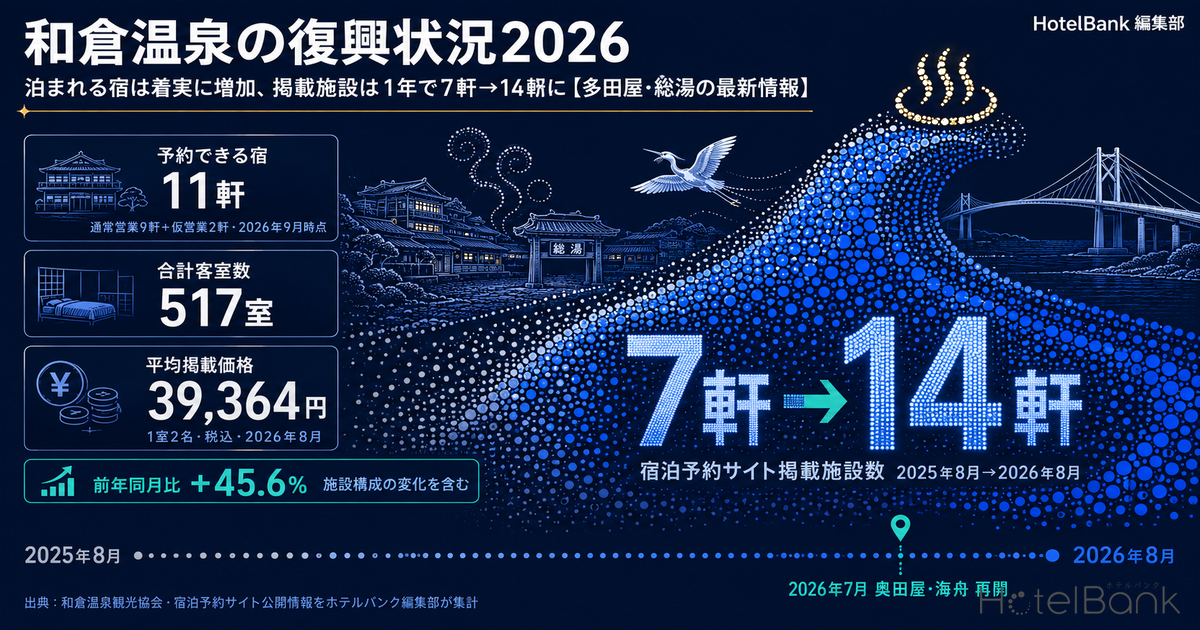
“Can I actually go to Wakura Onsen yet?” In short: yes. The Noto Peninsula Earthquake of January 1, 2024 forced most of the inns in this hot-spring town to close, but the number of inns reopening has been rising steadily since then. According to the accommodation list of the Wakura Onsen Tourism Association (as of September 2026, checked by the HotelBank Editorial Team), 11 inns, counting both regular and provisional operation, are taking bookings from general travelers, and two more reopened in July 2026. The Soyu public bath for day visitors is also back to regular hours.
This article sets out, based on official announcements, which inns you can book right now and the level of listed prices, the status of inns still closed such as Tadaya and Kagaya, and practical information including access and the Soyu public bath.
- — You can stay at Wakura Onsen now. The Wakura Onsen Tourism Association’s accommodation list shows 11 inns (9 in regular operation + 2 in provisional operation) taking bookings from general travelers (as of September 2026), with a combined 517 rooms.
- The number of properties listed on booking sites doubled from 7 in August 2025 to 14 in August 2026. Two more inns reopened in July 2026: Okudaya (奥田屋, July 9) and Shirasagi no Yu Noto Kaishu (白鷺の湯 能登 海舟, July 16).
- The average listed price in August 2026 was ¥39,364 per room for 2 guests, tax included (N=14 properties). That is +45.6% YoY, but much of the rise reflects a change in property mix as ryokan serving dinner and breakfast returned to the listings — it is not the price increase at any single inn.
- For the much-searched Tadaya (多田屋), the reopening date is “currently undecided” (official website, as of September 2026). Kagaya (加賀屋) plans a new building of 7 stories and 33 rooms, with investment of about ¥7.7 billion, targeting opening by the end of FY2028, while its sister inn Ae no Kaze (あえの風) is scheduled to reopen in the second half of FY2028 with about 80 rooms.
- The Wakura Onsen Soyu day-use bath is in regular operation (7:00–21:00, last entry 20:30; adults ¥500). The one thing to note is that from January 2026 it closes on the 25th of every month (the following Monday if the 25th falls on a weekend).
How Far Has Recovery Come? — The Number of Open Inns Keeps Rising
Here are the key facts in chronological order. The Noto Peninsula Earthquake of January 1, 2024 forced most accommodation facilities in Wakura Onsen to close. Since then, the Soyu day-use bath has reopened and inns have been returning to operation in stages. Most recently, according to the Wakura Onsen Tourism Association, Okudaya (奥田屋) reopened on July 9, 2026 after being rebuilt, and Shirasagi no Yu Noto Kaishu (白鷺の湯 能登 海舟) reopened on July 16.
The recovery also shows up in the numbers. The HotelBank Editorial Team’s aggregation of public OTA data shows that the number of listed accommodation properties in Nanao City, which includes Wakura Onsen, rose from 7 in August 2025 to 14 in August 2026 (OTA listing basis, N=14 properties). Two caveats apply, however. Being listed on an OTA is not proof that a property is operating, and conversely an increase in listings does not in itself mean a “full recovery.” Always check the operating and reopening status of individual inns on each property’s official website or the Wakura Onsen Tourism Association’s official information before booking. For a look at how Wakura Onsen and Wajima have progressed through the recovery phases, see our analysis Noto Earthquake +16 Months: Wakura Onsen Recovery & Summer 2026 ADR.
Inns You Can Book Now — 11 in Regular or Provisional Operation
The table below lists the inns currently operating, based on the Wakura Onsen Tourism Association’s accommodation list (as of September 2026, checked by the HotelBank Editorial Team). Inns in provisional operation may offer different services from normal (meals, large public baths, room types, etc.), so check the latest information when booking.
| Inn | Operating status (Tourism Association information, as of Sep 2026) | Rooms |
|---|---|---|
| Nihon no Yado Notoraku (日本の宿 のと楽) | Open | 165 rooms |
| TAOYA Wakura (TAOYA和倉) | Open | 101 rooms |
| Noshu Iroha (能州いろは) | Open | 23 rooms |
| Ajina Yado Hosenkaku (味な宿 宝仙閣) | Open | 22 rooms |
| Hanagoyomi (花ごよみ) | Open | 10 rooms |
| Yunohana (湯の華) | Open | 10 rooms |
| Hamazuru (はまづる) | Open | 26 rooms |
| Okudaya (奥田屋) | Rebuilt and reopened on July 9, 2026 | 4 rooms |
| Shirasagi no Yu Noto Kaishu (白鷺の湯 能登 海舟) | Reopened on July 16, 2026 | 100 rooms |
| Yukemuri no Yado Biwanso (ゆけむりの宿 美湾荘) | Provisional operation | 34 rooms |
| Hotel Kaibo (ホテル海望) | Provisional operation | 22 rooms |
Source: Wakura Onsen Tourism Association accommodation list (as of September 2026, checked by the HotelBank Editorial Team). In addition, three inns are listed as accepting only disaster-relief workers and reconstruction workers. Check each property’s official website for the latest operating status.
Listed Price Levels — The Average Looks Higher, but the Return of Upscale Ryokan Plays a Part
According to the HotelBank Editorial Team’s aggregation of public OTA data, the average listed price (per room for 2 guests, tax included) among listed properties in Nanao City was about ¥39,400 per night as of August 2026 (N=14 properties, August 2026). That is +45.6% versus the same month a year earlier, but it is too early to read this figure simply as “prices went up.” Over the past year, one ryokan after another serving dinner and breakfast has returned to the listings, so the average was most likely pushed up by a change in property mix. It does not mean the same plan at the same inn rose by nearly 50%.
Actual price ranges differ widely by property type. What you pay at an inn focused on room-only or breakfast-included stays is on a different scale from a ryokan with two meals per night, so treat “just under ¥40,000 on average” only as an overall guide that includes hot-spring ryokan, and compare actual listed prices for your specific dates when booking. As at other hot-spring resorts, weekends and holiday periods tend to run higher, while weekdays are often the better bet.
Figure 1: Monthly average listed price in Nanao City (line; per room for 2 guests, tax included / left axis) and number of listed properties (bars / right axis). The average price stepped up as listed properties grew from 7 to 14, indicating that a substantial part of the price increase comes from the change in property mix. Source: Compiled by the HotelBank Editorial Team from public information on accommodation booking sites.
Charted, the rise in the average price and the increase in listed properties move almost in parallel. From August to October 2025, when only 7–8 properties were listed, the average ranged from ¥22,000 to the ¥27,000s. Since March 2026, when returning ryokan pushed the count above 11, it has hovered around ¥35,000. In other words, rather than “Wakura got more expensive,” it is closer to reality to say that high-priced hot-spring ryokan that had temporarily disappeared from the market have come back. If you choose an inn focused on room-only stays, you can still stay on a budget not very different from before the earthquake.
When Will Closed Inns Such as Tadaya and Kagaya Reopen?
The answer to the frequently searched question “When will Tadaya reopen?” is, according to Tadaya’s official website (as of September 2026, checked by the editorial team), “currently undecided.” The site states that the inn is closed and that the reopening date is currently undecided, adding that updates will be posted on its official website and social media. Meanwhile, an annex to the Japan Tourism Agency’s “Regional Tourism Revitalization Support Plan for Wakura Onsen Integrated with Seawall Restoration” and reporting by the Hokkoku Shimbun indicate that Tadaya aims to finish demolition in summer 2027 and reopen in April 2028 (at roughly half its current scale). A target reopening date is not the same as the day bookings actually become available, so base any booking decision on official announcements.
Kagaya (加賀屋), Ae no Kaze (あえの風), Niji to Umi (虹と海) and Taisho Roman no Yado Togetsuan (大正浪漫の宿 渡月庵) are also listed as closed on the Wakura Onsen Tourism Association’s list (as of September 2026). However, the outlook for reopening differs by inn. On August 25, 2026, Kagaya announced its construction plan for a new building (7 stories above ground, 33 rooms, investment of about ¥7.7 billion), held a groundbreaking ceremony, and set a target opening of the end of FY2028. Its sister inn Ae no Kaze is planned to reopen in the second half of FY2028 (about 80 rooms), while no timeline has yet been given for Niji to Umi or Taisho Roman no Yado Togetsuan. All of these are plans several years out and may change, so it is safest to confirm announcements on official websites before building them into your travel plans. For reference, Kagaya had 233 rooms before the earthquake, so the new 33-room building marks a major shift in the supply side of Wakura’s recovery.
Access and the Soyu Public Bath / Day-Use Bathing
Access is the same as before the earthquake. By rail, the standard route is a limited express from Kanazawa Station toward the JR Nanao Line, about 1 hour, getting off at Wakuraonsen Station. The hot-spring town is about 2 km from the station, roughly 5 minutes by car. By car, head north from the Kanazawa area on the Noto Satoyama Kaido expressway. Road conditions can change due to reconstruction work, so it is worth checking the latest road information before you set out.
Wakura Onsen Soyu, the hub for day-use bathing, is back in regular operation. According to its official information, hours are 7:00–21:00 (last entry 20:30), and admission is ¥500 for adults, ¥150 for elementary school children and ¥50 for preschool children (revised May 21, 2025). From January 2026 it closes on the 25th of every month (the following Monday if the 25th falls on a weekend). It is convenient both as a stop before or after your stay and as a day trip from central Nanao. The Tourism Association has also announced a new footbath, the “Wakura Pokémon Footbath,” from May 2026, adding to the places to stop by while strolling the hot-spring town.
Alternatives: Central Nanao and Notojima Island
If you cannot get a Wakura ryokan on your preferred date, or want to keep costs down, widening your search to neighboring areas gives you more options. Business-type hotels are operating around Nanao Station; for inns bookable within walking or driving distance of Wakuraonsen Station and Nanao Station, this article covering five hotels within a 15-minute walk of Wakuraonsen and Nanao stations, with their reopening status (Japanese) is a useful reference. Staying in Nanao and making day trips to the Soyu bath and the hot-spring town can cut what you pay considerably.
Another option is Notojima Island, just across the Notojima Ohashi Bridge from Wakura Onsen. It has attractions such as the Notojima Aquarium, and small minshuku and island inns welcome travelers. Spending one night each, pairing Wakura’s hot springs with an island dinner table, is a very Noto way to travel in the third year of recovery. If you think of Wakura, Nanao and Notojima as a single area since the earthquake, there is no shortage of inns in operation.
Where to Look for More Detail
For detailed comparisons of specific inns, these articles (in Japanese) are helpful.
5 hotels with 70+ rooms within a 15-minute walk of Wakuraonsen and Nanao stations serving Noto Peninsula Earthquake reconstruction crews — reopening status and worker plans on a map (innippon.news, Japanese)
Maps five properties — Hotel Route-Inn Nanao Ekihigashi, Hotel Alivio, TAOYA Wakura, Nihon no Yado Notoraku and Hotel Kaibo — with distance from the station, room counts and indicative prices, so you can compare Nanao Station business hotels and Wakura hot-spring inns at a glance.
From Hegurajima to Notojima — crossing two islands of the outer and inner seas on the Noto Peninsula in its third year of recovery, 4 days / 3 nights (tabilog.world, Japanese)
A 4-day, 3-night itinerary moving from Oyado Tanaka (お宿たなか) in Wajima to Noshu Iroha (能州いろは) in Wakura and Shima no Yado Enomeso (島の宿 えのめ荘) on Notojima. It proposes an island-hopping way to enjoy Noto with Wakura’s hot springs as the midpoint of the trip.
Frequently Asked Questions
Can I stay at Wakura Onsen now?
Yes. The Wakura Onsen Tourism Association’s accommodation list (as of September 2026) shows 11 inns — 9 in regular operation and 2 in provisional operation — taking bookings from general travelers, with a combined 517 rooms. Two more inns reopened in July 2026: Okudaya (July 9) and Shirasagi no Yu Noto Kaishu (July 16). In addition, three inns accept only disaster-relief and reconstruction workers. Inns in provisional operation may offer different services from normal, such as meals and large public baths, so check each property’s latest information when booking.
When will Tadaya reopen?
Tadaya’s official website (as of September 2026) states that “the reopening date is currently undecided.” Meanwhile, the “Regional Tourism Revitalization Support Plan for Wakura Onsen Integrated with Seawall Restoration” by the Japan Tourism Agency and the MLIT Ports and Harbours Bureau indicates a target of finishing demolition in summer 2027 and reopening in April 2028, and reports say the inn will be about half its current scale. However, a target date is not the same as the day you can actually book. Base your booking decisions on announcements on the official website.
When will Kagaya reopen?
Kagaya held a groundbreaking ceremony at the site of its new building on August 25, 2026, and is targeting opening by the end of FY2028 with a 7-story, 33-room building and investment of about ¥7.7 billion. The reopening was originally planned for the end of FY2027 but was pushed back a year due to factors such as rising construction material costs. Its sister inn Ae no Kaze is planned to reopen in the second half of FY2028 with about 80 rooms after demolition of the former Nishi no Kaze wing and an extension, while no timeline has been given for Niji to Umi. Kagaya had 233 rooms before the earthquake, so the new building represents a shift to a high-value-added format with far fewer rooms.
How much does it cost to stay at Wakura Onsen?
According to the HotelBank Editorial Team’s aggregation of public information from accommodation booking sites, the average listed price in Nanao City, which includes Wakura Onsen, was ¥39,364 per room for 2 guests, tax included (as of August 2026, N=14 properties). That is +45.6% YoY, but this largely reflects a change in property mix as ryokan serving dinner and breakfast returned to the listings one after another; it does not mean the same plan at the same inn rose by nearly 50%. Prices at room-only or breakfast-focused inns and at ryokan with two meals are on different scales, so compare actual listed prices for your dates when booking.
Can I use Wakura Onsen Soyu as a day visitor?
Yes. Wakura Onsen Soyu is back in regular operation, open 7:00–21:00 (last entry 20:30), with admission of ¥500 for adults, ¥150 for elementary school children and ¥50 for preschool children (revised May 21, 2025). Its closing day had been the fourth Thursday from April 1, 2025, but from January 2026 it changes to the 25th of every month (the following Monday if that falls on a weekend). It works both as a stop before or after your stay and as a day trip from central Nanao.
What are the alternatives if I can’t get a room in Wakura?
There are some. Business-type hotels are operating around Nanao Station, and staying in Nanao while making day trips to the Soyu bath and the hot-spring town can cut costs considerably. Another option is Notojima Island, just across the Notojima Ohashi Bridge from Wakura Onsen, which has attractions such as the Notojima Aquarium and small minshuku and island inns in operation. If you think of Wakura, Nanao and Notojima as one area, there is no shortage of inns in operation.
Methodology and Sources
■ Data Sources
Operating status, room counts and closure status are based on the accommodation lists of the Wakura Onsen Tourism Association and Wakura Onsen Ryokan Cooperative (as of September 2026, checked by the HotelBank Editorial Team). The number of listed properties and average listed prices were aggregated by the HotelBank Editorial Team at the municipality level from listed prices published on accommodation booking sites; for each month from August 2025 to August 2026, we calculated the average per-room rate (tax included) for 2 guests. The aggregation covers Nanao City, with 7–14 properties per month. Planned rebuilding and reopening dates are based on the Japan Tourism Agency’s “Regional Tourism Revitalization Support Plan for Wakura Onsen Integrated with Seawall Restoration,” reporting by the Hokkoku Shimbun, Ryoko Shimbun and Kanko Keizai Shimbun, and what each property’s official website displayed (as of September 2026).
■ Calculation Assumptions
All average listed prices are per room, tax included, for 2 guests, not per person. Year-on-year comparisons are for the same municipality under the same conditions. The aggregation unit is all of Nanao City, not Wakura Onsen alone, and includes business-type properties around Nanao Station in addition to Wakura Onsen’s hot-spring ryokan. Operating status categories (regular operation, provisional operation, closed, disaster-relief workers only) use the Tourism Association’s own labels as published and were not determined independently by HotelBank.
■ Limitations and Caveats
Listed prices are the prices displayed on booking sites, not actual transaction prices. Being listed on a booking site is not proof of operation, and conversely an increase in listings does not in itself mean a full recovery. Nanao City has a small sample of 7–14 properties per month, so a change in a single property’s listing can move the average significantly. In particular, the +45.6% YoY figure discussed in this article largely reflects the change in property mix from ryokan serving dinner and breakfast returning to the listings, and differs from the price increase at any individual property. Differences due to meals, plan conditions, cancellation policies and bathing tax are not reflected. Planned rebuilding and reopening dates are all plans several years out and may change. Operating status, prices and opening hours are subject to change, so always check each property’s official information before booking.
■ Property and Public Information Sources (Japanese)
- Wakura Onsen Tourism Association / Wakura Onsen Ryokan Cooperative: “Ryokan” list (operating status, room counts)
- Wakura Onsen Tourism Association: “[Regular Operation] Wakura Onsen Soyu (day-use hot spring)” (hours, admission, closing days)
- Wakura Onsen Tourism Association: Access information
- Tadaya official website: “Notice of Temporary Closure”
- Wakura Onsen Kagaya official website
- Japan Tourism Agency / MLIT Ports and Harbours Bureau: “Regional Tourism Revitalization Support Plan for Wakura Onsen Integrated with Seawall Restoration” (formulated March 2025)
- Same plan: main text and annex (PDF)
- Hokkoku Shimbun: “Kagaya to reopen at end of FY2028 — 7 stories, 33 rooms”
- Ryoko Shimbun: “Kagaya ‘to open by end of FY2028’ — groundbreaking ceremony at new building site”
*Operating status in this article is based on information from the Wakura Onsen Tourism Association and each property’s official website (as of September 2026); planned rebuilding and reopening dates are based on the annex to the Japan Tourism Agency’s “Regional Tourism Revitalization Support Plan for Wakura Onsen Integrated with Seawall Restoration” and reporting by the Hokkoku Shimbun, Kanko Keizai Shimbun and others; listed prices are based on the HotelBank Editorial Team’s aggregation of public OTA data (as of August 2026, N=14 properties, 2 guests per room, tax included). Operating status and prices are subject to change, so always check official information before booking.
Related Articles