

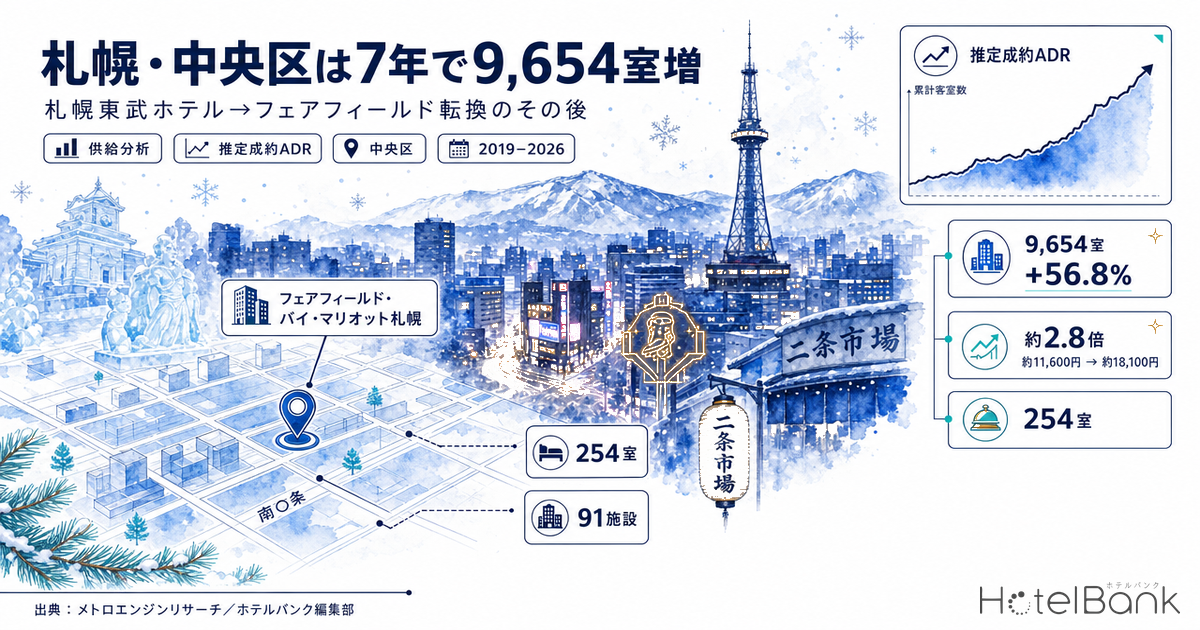
For readers who arrived here searching for the “Sapporo Tobu Hotel,” the answer first: the property reopened on 26 April 2020 as Fairfield by Marriott Sapporo, and the name Sapporo Tobu Hotel no longer exists. The building is still owned by Tobu Railway, and Tobu Ryokuchi still runs it. This article is not a booking guide. It is a supply analysis for operators and investors, using measured data to examine how room supply and room rates in Sapporo’s Chuo Ward moved over the seven years from 2019 — the year that conversion was announced — to the present.
Metric Definitions Used in This Article
- ADR (average daily rate) = the estimated transacted rate (tax-exclusive equivalent), calculated by applying a property-type correction coefficient to the lowest published plan level each property lists on OTAs (double occupancy, per-room rate, tax-included). Cross-checked against property-level actuals disclosed by listed hotel REITs (91 properties, most recent three months), the median error is approximately 7%. These are estimates and differ from each property’s actual transacted prices and accounting figures. Area-level ADR is the median of the properties covered (the level of a typical property in the area).
- Listed price = the average across all plans published on OTAs (double occupancy, per-room rate, tax-included). Because it spans room-only through meal-inclusive plans, it prints higher than the estimated settled ADR.
- Basis for counting new openings = the establishment date of properties whose OTA listing could be confirmed. Because OTA listings appear several months before opening, counts of properties and rooms for the most recent years will rise as further listings are reflected.
- Data source = MetroEngines Research (prices and supply).
- — The rebrand to Fairfield by Marriott Sapporo took place on 26 April 2020. Tobu Railway continued to own the building and Tobu Ryokuchi continued to operate it — a conversion that swapped the brand without letting go of the asset.
- — Against the 24 properties and 3,411 rooms flagged as forthcoming as of May 2019, the actual outcome was 91 properties and 9,654 rooms — roughly 2.8 times as many. This trade area demonstrated on its own that supply outlooks built on building-permit filings should be read as a floor, not a ceiling.
- — Even though the room count grew by roughly 28%, the estimated settled ADR in Chuo Ward rose +56.8%, from about ¥11,600 in July 2019 to about ¥18,100 in July 2026. Rising supply and rising rates can coexist.
- — New supply is concentrated on the north-south axis running through Susukino and Odori (46 properties and 8,641 rooms of 100 rooms or more). Foreign-affiliated brands only arrived in force from 2024 onward, which makes the 2020 Fairfield conversion the leading edge of that wave.
- — The confirmed forward pipeline stands at 3 projects and 542 rooms (building-permit basis). Given how the 2019 forecast turned out, this too should be read as the floor for rooms that will be added by 2028.
What became of the Sapporo Tobu Hotel — the name changed, the owner did not
The Sapporo Tobu Hotel opened on 26 April 1994 at Minami 4-jo Higashi 1-chome in Sapporo’s Chuo Ward. Sitting between the Susukino crossing and the Nijo Market, it was known for generously sized guest rooms of about 30 square metres. Tobu Railway announced its tie-up with Marriott International in May 2019, and this site reported the details on the day of the announcement. The hotel closed entirely from October of that year for a full renovation and resumed trading on 26 April 2020 as the first Fairfield by Marriott in Japan — the same calendar date as the original opening.
The point to note is that the conversion involved no transfer of ownership. Tobu Railway continues to own the building, and operations are handled by Tobu Ryokuchi, a company within the same group. What Marriott supplied was the brand and its reservation and loyalty base: a structure for capturing an international brand’s demand channel without parting with the asset. In domestic conversions to foreign-affiliated brands, the question is usually how ownership, operation and brand are split among three parties; here, the owner kept both ownership and operation and simply changed the brand on top.
| Item | Before the rebrand | Now |
|---|---|---|
| Name | Sapporo Tobu Hotel | Fairfield by Marriott Sapporo |
| Opening | 26 April 1994 | 26 April 2020 (rebrand opening) |
| Rooms | — | 254 |
| Ownership | Tobu Railway | Tobu Railway (retained) |
| Operator | Tobu Ryokuchi | Tobu Ryokuchi |
| Closure period | October 2019 to April 2020 (full renovation) | |
| Location | Minami 4-jo Higashi 1-chome, Chuo Ward, Sapporo (close to Susukino and the Nijo Market) | |
Source: announcements by Tobu Railway, Tobu Ryokuchi and Marriott International, and materials published by Tobu Hotel Management; compiled by the HotelBank Editorial Team
Where this property now sits within the Susukino price range, and how guests rate it, is covered property by property in our separate review of six years of results since the rebrand. This article shifts the lens away from the single building and asks how much thicker the Chuo Ward trade area itself became over those same seven years.
The Tobu group still has four Marriott hotels — quality substitution, not expansion
At the time of the 2019 announcement, the tie-up between the Tobu group and Marriott International was described as bringing the group “to four hotels including Sapporo.” Seven years on, the hotel list published by Tobu Hotel Management still shows four properties carrying a Marriott brand. The breakdown is shown below: a single group covering the range from midscale through luxury.
| Property | Location | Positioning |
|---|---|---|
| Courtyard by Marriott Tokyo Ginza Tobu Hotel | 6-14-10 Ginza, Chuo City, Tokyo | The upscale city hotel where the partnership began |
| AC Hotel by Marriott Tokyo Ginza | 6-14-7 Ginza, Chuo City, Tokyo | The first AC-brand hotel in Japan |
| Fairfield by Marriott Sapporo | Minami 4-jo Higashi 1-chome, Chuo Ward, Sapporo | The first in Japan, via conversion of an existing hotel |
| The Ritz-Carlton, Nikko | Chugushi, Nikko, Tochigi | Luxury property opened in July 2020 |
Source: Tobu Hotel Management, “Hotels and Restaurants” listing; compiled by the HotelBank Editorial Team (as of September 2026)
That the count has been flat for seven years does not mean the partnership stalled. The group holds historic assets such as the Nikko Kanaya Hotel and the Chuzenji Kanaya Hotel within its own portfolio, and it can be read as having put its weight into repositioning those existing assets rather than adding more foreign-affiliated brands. Using a brand partnership to lift the rate range per property, rather than to raise the property count, is a realistic option for an asset-holding railway operator.
What happened to the “24 properties, 3,411 rooms” forecast of 2019 — the outcome was 91 properties and 9,654 rooms
This is the heart of the article. Our May 2019 piece reported that Sapporo’s Chuo Ward held 177 properties and 24,034 rooms, with 24 properties and 3,411 rooms scheduled to open. Seven years later, we can mark that forecast against the outcome.
Within the scope tracked by MetroEngines Research, 91 properties and 9,654 rooms opened in Sapporo’s Chuo Ward from June 2019 onward. Of those, 46 properties and 8,641 rooms are mid-to-large hotels of 100 rooms or more, and 19 properties and 4,825 rooms have 200 rooms or more. Against the 3,411 rooms that had been flagged, the rooms actually delivered came to roughly 2.8 times that figure. The pipeline that was visible at the time turned out to represent only about a third of the supply that would come on stream over the following seven years.
| Item | Flagged as of May 2019 | Actual, June 2019 onward |
|---|---|---|
| Properties | 24 | 91 |
| Rooms | 3,411 | 9,654 |
| Of which 100 rooms or more | — | 46 properties, 8,641 rooms |
| Of which 200 rooms or more | — | 19 properties, 4,825 rooms |
| Average per property | 142 rooms | 106 rooms |
Source: MetroEngines Research (based on confirmed OTA listings, N=91 properties); the May 2019 forecast is drawn from an earlier article on this site; compiled by the HotelBank Editorial Team
One point calls for care in reading the property count. The actual average of 106 rooms per property is below the 142 rooms implied by the forecast. That is not because fewer mid-to-large hotels were built; it is because a large number of small properties, which are hard to capture at the forecasting stage, were in fact launched. Measured in rooms, properties of 200 rooms or more account for half the total, so the centre of gravity of supply has if anything shifted towards larger hotels.
Source: MetroEngines Research (based on confirmed OTA listings, N=91 properties); compiled by the HotelBank Editorial Team. Note: 2019 covers June onward. Because OTA listings appear several months before opening, the 2026 figure will rise as further listings are reflected.
Year by year, the peak of supply falls in 2020 (28 properties, 1,965 rooms). The largest number of rooms opened in the year demand disappeared under COVID-19, but that is because the development decisions had been taken in 2017 and 2018: projects already under construction do not stop when the demand environment changes. Supply then fell to 893 rooms in 2023 before settling back at around 1,000 rooms a year from 2024. The 9,654 rooms opened since June 2019 amount to roughly 28% on a room basis of the 298 properties and 33,894 rooms currently tracked in Chuo Ward. Slightly more than one room in four in this trade area is inventory created in the past seven years.
Supply up 30%, rates up 57% over seven years — the estimated settled ADR in Chuo Ward
If supply grows this much, do rates fall? The answer is the opposite. The estimated settled ADR in Sapporo’s Chuo Ward rose +56.8%, from about ¥11,600 in July 2019 to about ¥18,100 in July 2026. The listed price for the same month (average of all plans, tax-included) was about ¥27,900. Even on the most recent year-on-year comparison, July 2026 was up +3.9% — still climbing in a year that followed a heavy build-out of supply.
Source: MetroEngines Research; compiled by the HotelBank Editorial Team (127-137 properties covered in each month)
Overlaid year by year, the seasonal shape is almost identical in every year: a peak in February for the Sapporo Snow Festival, a summer peak in July and August, and troughs in April and November. What changed is not the shape but the level — each successive year’s line sits parallel and higher. July 2026’s ¥18,100 compares with about ¥13,400 in July 2023, a gain of +35% in three years. The February peak also doubled, from about ¥10,300 in 2023 to about ¥20,600 in 2026. This can be read as a phase in which demand growth outran supply growth.
Within that upswing, Fairfield by Marriott Sapporo averaged an estimated settled ADR of about ¥22,900 over the most recent twelve months (August 2025 to July 2026). That is well above the Chuo Ward area median for the same period (about ¥14,600), meaning the property holds an upper price band while carrying 254 rooms. It is a figure that shows the conversion — layering an international brand’s loyalty base onto the building — working on the rate side.
By property type, incidentally, Hokkaido as a whole saw city and business hotels diverge in their pricing direction in the first half of 2026. The property-type differences behind the area average are set out in our analysis of that divergence using confirmed monthly data.
Where the new supply landed — 46 properties clustered in Susukino and Odori
Plotted on a map, seven years of new supply is clearly skewed. The 46 properties of 100 rooms or more are concentrated along the north-south axis running from the Susukino crossing through Odori to the south exit of Sapporo Station, with only limited spread towards Maruyama or south of Nakajima Park. Large-scale development away from the established entertainment-district footfall lines has barely happened in this period.
Source: MetroEngines Research (based on confirmed OTA listings, N=46 properties of 100 rooms or more)
| Opening | Property | Rooms |
|---|---|---|
| June 2019 | Vessel Hotel Campana Susukino | 296 |
| September 2019 | Red Planet Sapporo Susukino Central | 212 |
| September 2019 | Hotel JAL City Sapporo Nakajima Park | 211 |
| August 2020 | Hotel Forza Sapporo Ekimae | 304 |
| October 2020 | KOKO HOTEL Sapporo Ekimae | 224 |
| October 2020 | JR Inn Sapporo Kita 2 Jo | 205 |
| February 2021 | Solaria Nishitetsu Hotel Sapporo | 318 |
| April 2021 | Sapporo Granbell Hotel Tanukikoji | 218 |
| September 2021 | Susukino Granbell Hotel | 300 |
| January 2022 | OMO3 Sapporo Susukino | 226 |
| April 2022 | 2ND by hotel androoms Sapporo | 212 |
| June 2022 | Daiwa Roynet Hotel Sapporo Nakajima Park | 210 |
| September 2022 | Sotetsu Fresa Inn Sapporo Susukino | 200 |
| February 2023 | Travelodge Sapporo Susukino | 211 |
| September 2023 | Via Inn Prime Sapporo Odori | 255 |
| January 2024 | SAPPORO STREAM HOTEL | 436 |
| April 2024 | The Centurion Sauna Sapporo | 254 |
| July 2024 | Courtyard by Marriott Sapporo | 321 |
| July 2026 | KOKO HOTEL Sapporo Susukino 2nd | 212 |
Source: MetroEngines Research (based on confirmed OTA listings, 200 rooms or more, N=19 properties); compiled by the HotelBank Editorial Team
Looking at the roster of brands, 2019 to 2022 was dominated by domestic limited-service chains, and foreign-affiliated brands only entered in earnest from 2024. That year brought both SAPPORO STREAM HOTEL (436 rooms) and Courtyard by Marriott Sapporo (321 rooms), and InterContinental Sapporo (149 rooms) followed in October 2025. The 2020 Fairfield conversion sits at the head of this inflow of foreign-affiliated brands. Conversion of an existing hotel is the fastest route to execution, and this was a case of putting a brand into the market without waiting for new construction.
The rooms still to be added in Chuo Ward — 542 on a building-permit basis
The forward view can be checked within the same framework. On a building-permit basis, drawn from the Ministry of Land, Infrastructure, Transport and Tourism’s Statistical Survey on Building Construction Starts, accommodation projects filed to date in Sapporo’s Chuo Ward number three, totalling 542 rooms.
| Location | Rooms | Scheduled completion | Construction start |
|---|---|---|---|
| Kita 1-jo Nishi 5-chome, Chuo Ward | 216 | December 2026 | October 2021 |
| Minami 7-jo Nishi 5-chome, Chuo Ward | 200 | May 2028 | May 2026 |
| Minami 7-jo Nishi 4-chome, Chuo Ward | 126 | February 2027 | June 2025 |
Source: Ministry of Land, Infrastructure, Transport and Tourism, “Statistical Survey on Building Construction Starts”; compiled by MetroEngines Research & Consulting. Note: building-permit basis as of the survey date. Counts of projects and rooms are expected to rise as further permits are filed, so this should be treated as the floor for the confirmed pipeline at this point in time.
This is where marking the 2019 forecast pays off. The pipeline visible at the time — “24 properties, 3,411 rooms” — in the event swelled to 9,654 rooms. This trade area has demonstrated for itself the rule of thumb that building-permit figures are always a floor. The current 542 rooms should therefore be read as the minimum, not the maximum, that will be added in Chuo Ward by 2028. The pipeline from autumn 2026 onward is tracked project by project in our review of Sapporo room supply for 2026-2029.
Conclusion — three readings from seven years in Chuo Ward
First, a brand conversion can be executed without giving up ownership. The move from the Sapporo Tobu Hotel to Fairfield by Marriott Sapporo was completed with Tobu Railway retaining the asset and operations remaining inside the group. Because no new build was involved, execution was quick, and it served as the first point of entry for a foreign-affiliated brand into this market.
Second, supply forecasts can only be used as a floor. Against the 3,411 rooms visible in 2019, the outcome was 9,654. Development is not decided once demand is visible; and once decided, it completes regardless of how the demand environment changes. The fact that the largest volume of supply landed in 2020 states that asymmetry plainly.
Third, rising supply and rising rates can coexist. Chuo Ward added roughly 28% to its inventory on a room basis over seven years while lifting the estimated settled ADR by +56.8%. That said, much of the increase came from the seasonal peaks rising higher, while the April and November troughs grew comparatively slowly. How much of the peak a property can capture is what determines where the room to grow rates lies in this trade area.
Related reading
- Sapporo Hotel Supply 2026-2029: Hyatt Opens a New High-ADR Tier
- Hokkaido ADR H1 2026: City −5.7%, Business +4.1%, April the Turn
- A 4.1 Review Score Is Average, Not a Strength: Sapporo Price Position
References and Sources
■ Data sources
The estimated settled ADR and listed price for Chuo Ward, Sapporo are monthly aggregations of the area median of estimated values derived by applying property-type coefficients to OTA published prices (July 2019 to July 2026, on a confirmed-month basis). The number of properties covered is 127 to 137 in each month across the charted window (January 2023 to July 2026); the minimum in the retrospective window is 110 properties in July 2019. Property and room counts for new openings are on the basis of the establishment date of properties whose OTA listing could be confirmed (June 2019 onward, N=91 properties); existing stock is the 298 properties and 33,894 rooms currently tracked in Chuo Ward. Forward projects are on the building-permit basis of the Ministry of Land, Infrastructure, Transport and Tourism’s “Statistical Survey on Building Construction Starts.”
■ Calculation assumptions
The estimated settled ADR is on a double-occupancy, per-room, tax-exclusive-equivalent basis. Year-on-year and percentage changes are calculated only between months on the same basis (confirmed-month basis) and are not mixed with months on a listing-snapshot basis. “Roughly 2.8 times” is the ratio of the actual 9,654 rooms to the 3,411 rooms flagged as of May 2019; “roughly 28% on a room basis” is 9,654 divided by 33,894. The average per property is the simple average of rooms divided by properties.
■ Limitations and caveats
(1) ADR is an estimate and differs from each property’s actual transacted prices and accounting figures (cross-checked against property-level disclosure by listed hotel REITs, the median error is approximately 7%). (2) Because the estimated settled ADR is known to overstate actual conditions during the COVID-19 period (March 2020 to April 2022), this article does not quote levels for that period as figures, and confines rate comparisons to 2023 onward plus the confirmed 2019 values. (3) Because the tally of new openings starts from confirmation of an OTA listing, properties not yet listed and properties with no listing are excluded; counts for the most recent years will rise as further listings are reflected. (4) Building-permit projects are as of the survey date and represent a floor that will increase as further permits are filed. (5) The total property count and the number of properties used to calculate ADR have different denominators and cannot be compared directly.
■ Market data
- MetroEngines Research — estimated settled ADR and listed price for Chuo Ward, Sapporo (July 2019 to July 2026); new openings (based on confirmed OTA listings, N=91 properties)
■ Government statistics and public data
- Ministry of Land, Infrastructure, Transport and Tourism, “Statistical Survey on Building Construction Starts” (accommodation building plans, building-permit basis)
■ Company announcements and press coverage
- Tobu Hotel Management, “Hotels and Restaurants” listing
- Gekkan Hoteres, “Tobu Railway / Tobu Ryokuchi / Marriott International: Fairfield by Marriott Sapporo, the first property in Japan for the brand, opens 26 April”
- Real Economy, “Sapporo Tobu Hotel to be rebranded as Fairfield by Marriott Sapporo in spring 2020”
- TRAICY, “The Ritz-Carlton, Nikko confirmed to open on 15 July”
- HotelBank (21 May 2019) — property and forthcoming-opening counts for Chuo Ward as of 2019