

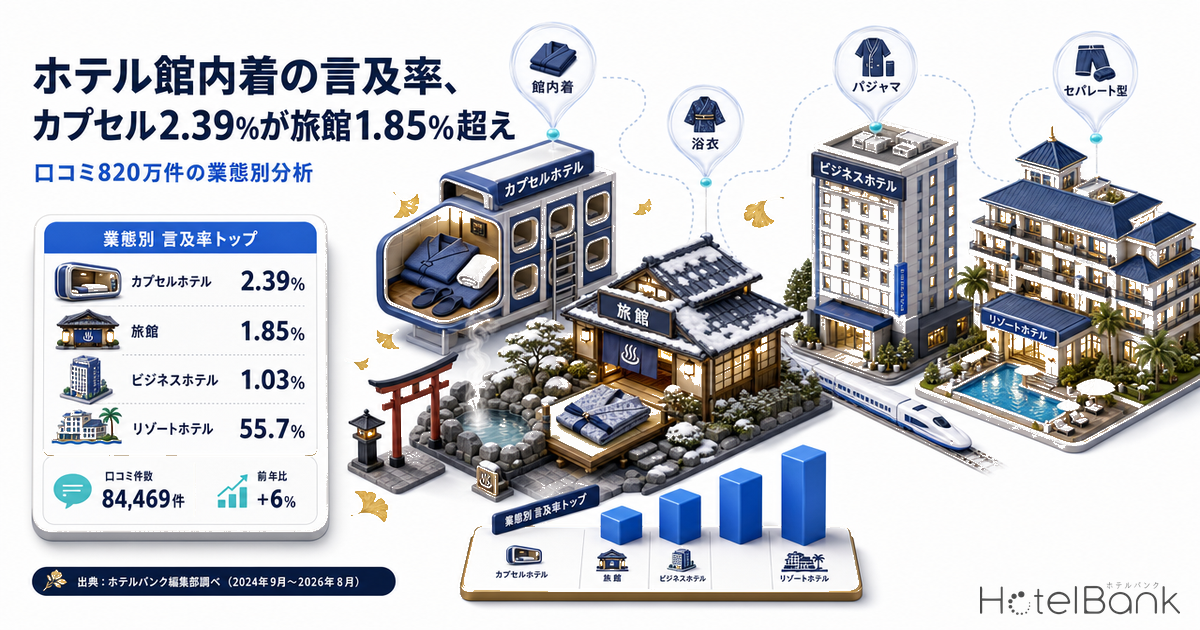
Hotel loungewear is a relatively low-cost, low-capex fixture, yet it is also the item guests wear for the longest stretch of their stay. An analysis by the HotelBank Editorial Team of 8,207,735 guest reviews (41,187 properties, the 24 months from September 2024 to August 2026) found 84,469 reviews that mentioned loungewear — yukata, pajamas, samue and room wear — or 1.03% of the total. Broken out by property segment, the highest mention rate belonged not to ryokan but to capsule hotels, at 2.39%.
Metric Definitions Used in This Article
- Loungewear mention rate: The share of guest reviews posted during the study period that contain a reference to loungewear (yukata, pajamas, samue, in-house wear, room wear and similar terms). A review is counted once even if it refers to loungewear several times. Because classification is done by natural-language analysis, results include variation from spelling differences and contextual judgment.
- ADR (Average Daily Rate): An estimated transacted rate (tax-exclusive equivalent) derived by applying a segment-specific adjustment factor to each property’s lowest advertised plan level on OTAs and similar channels (2 guests per room, per-room rate, tax included). Cross-checked against property-level results disclosed by listed hotel REITs (91 properties, trailing three months), the median error is roughly 7%. These are estimates and differ from each property’s actual transacted prices and accounting figures.
- Data sources: Review metrics from HotelBank Editorial Team research; price metrics from MetroEngines Research
- — 1.03% — Of 8,207,735 guest reviews (41,187 properties, September 2024 to August 2026), 84,469 mentioned loungewear. Seasonality is almost absent: 1.08% in winter against 1.09% in summer, with a steady volume of mentions year-round.
- — Capsule 2.39% > Ryokan 1.85% — The top mention rate by segment belongs to capsule hotels, not ryokan. Loungewear is not a theme confined to ryokan and their yukata tradition.
- — Volume centres on cities — In absolute counts, business hotels lead with 28,334 mentions, ahead of ryokan at 26,537. One third of everything guests say about loungewear originates at business hotels.
- — Vocabulary mirrors the segment — “Yukata” accounts for 84.1% at ryokan, “pajamas” for 59.5% at business hotels, and “in-house wear / room wear” for 57.5% at capsule hotels. Mentions of two-piece sets exceed 10% in urban segments but reach only 1.1% at ryokan.
- — The rate effect is limited — 55.7% of reviews mentioning loungewear also mention a bathing element, 1.86x the 30.0% overall average. Yet the gap in estimated transacted ADR is about +6% in the larger strata, and the difference in overall rating stays around +0.1 points.
Loungewear Is Not a Seasonal Item — 24 Months of Mentions Hold Near 1%
Autumn and winter bring shorter daylight hours and longer stretches spent indoors, so it would be natural to expect interest in loungewear to concentrate in the colder months. The measured figures contradict that intuition. Across the trailing 12 months (September 2025 to August 2026), the monthly mention rate averaged 1.08% in winter (November to February) and 1.09% in summer (June to August) — effectively no difference. Loungewear is not a seasonal item but a theme that generates a steady stream of mentions all year.
What the data does show clearly is a year-on-year climb. The level rose gradually from 0.92% in September 2024 to 1.09% in August 2026. Comparing each month against the same month a year earlier, 2026 exceeded 2025 in seven months out of eight. One reading is that guests are beginning to treat loungewear not as a fixture that goes without saying, but as an element of the stay worth talking about.
Source: HotelBank Editorial Team research (analysis of 8,207,735 guest reviews, September 2024 to August 2026)
Capsule 2.39% Tops Ryokan 1.85% — The Mention-Rate Map by Segment
This is the central finding of the analysis. Aggregating loungewear mention rates by segment puts capsule hotels on top at 2.39% (2,914 mentions across 122,007 reviews at 256 properties), more than half a point clear of ryokan at 1.85% (26,537 out of 1,435,040 reviews at 8,729 properties). Lodging attached to bathing facilities scores higher still (2.48%, 136 properties), but the base is small enough that this specialised category is best treated as a reference figure.
In other words, loungewear is not a theme reserved for ryokan and their yukata tradition. If anything, the smaller the guest room and the greater the weight of shared space, the closer loungewear moves to the centre of the stay experience.
Source: HotelBank Editorial Team research (N=8,207,735 reviews, 41,187 properties)
Rate and volume, however, are separate questions. In absolute counts the leader is business hotels with 28,334 mentions, ahead of ryokan at 26,537. Business hotels have a low mention rate of 0.76%, but their review base of 3.71 million is an order of magnitude larger. One third of everything guests across Japan say about loungewear is spoken from a business hotel.
| Segment | Reviews | Loungewear mentions | Mention rate | Properties | Positive share |
|---|---|---|---|---|---|
| Capsule hotel | 122,007 | 2,914 | 2.39% | 256 | 70.9% |
| Ryokan | 1,435,040 | 26,537 | 1.85% | 8,729 | 72.8% |
| Resort hotel | 770,778 | 10,292 | 1.34% | 1,906 | 57.6% |
| Minshuku (guesthouse) | 70,213 | 895 | 1.27% | 2,480 | 65.9% |
| Deluxe hotel | 178,297 | 1,635 | 0.92% | 211 | 66.4% |
| Business hotel | 3,715,311 | 28,334 | 0.76% | 8,478 | 63.9% |
| City hotel | 1,036,768 | 7,460 | 0.72% | 1,217 | 63.5% |
| Hostel | 260,684 | 1,478 | 0.57% | 2,110 | 38.8% |
| All segments | 8,207,735 | 84,469 | 1.03% | 41,187 | — |
Source: HotelBank Editorial Team research (guest reviews, September 2024 to August 2026)
“Yukata” or “Pajamas” — Vocabulary Mirrors the Segment
The pattern of mention rates splitting by segment is not unique to loungewear: mention rates for breakfast and staff also differ several-fold between segments. But a mention rate alone does not reveal what guests actually value about loungewear. To get at that, we tallied which words appear across the 72,905 Japanese-language passages that referred to loungewear. Overall, “yukata” accounts for 44.8%, “pajamas” for 36.2%, “in-house wear / room wear” for 18.1% and “samue” for 6.7%.
That composition differs completely from segment to segment. At ryokan, “yukata” takes 84.1% and “samue” holds a visible 11.1%. At business hotels the lead passes to “pajamas” at 59.5%, while “yukata” falls to 18.5%. City hotels show almost the same mix (pajamas 60.6%). At capsule hotels, the functional terms “in-house wear / room wear” take a majority at 57.5% and “yukata” is a mere 3.3%. Resort hotels sit between the ryokan and urban patterns, with “yukata” at 53.0% coexisting with “in-house wear” at 25.1%.
Source: HotelBank Editorial Team research (Japanese-language passages mentioning loungewear, N=72,905. Passages containing several terms are counted more than once)
Worth noting is the treatment of the “separate” (two-piece top-and-bottom) style. It reaches 10.8% at business hotels and 10.6% at city hotels, against just 1.1% at ryokan. Urban guests judge loungewear not as a piece of Japanese atmosphere but as sleepwear for sleeping well. Read the passages themselves and the appreciation of a separated top and bottom recurs again and again: “I was glad the pajamas doubled as two-piece in-house wear,” “the separate type was easy to put on.” This matches what the industry is doing — since the start of 2026 several urban hotels have publicly announced a switch from gown-style to two-piece loungewear.
A second axis is “size range” (6.3% overall, 8.6% at ryokan, 8.7% at resorts) and “children’s sizes” (5.9% overall, 11.3% at resorts, 7.5% at city hotels). At resort and city hotels, where family demand is large, the depth of children’s size inventory feeds straight into ratings. A comment such as “there were many sizes of children’s pajamas too, and each of my children got a perfect fit” shows plainly how size range connects to satisfaction.
Two Structures Shared by Urban Properties With High Mention Rates
The table below takes the three urban segments — business, city and capsule — narrows them to properties with at least 400 reviews, and ranks them by positive loungewear mention rate. Capsule hotels occupy 10 of the top 18 places, and their locations cluster in the centres of Tokyo, Osaka, Hiroshima, Kanazawa and Fukuoka.
| # | Property | Segment | Location | Rooms | Positive mention rate | Bath mention rate |
|---|---|---|---|---|---|---|
| 1 | Hotel Hikari (ホテル ヒカリ) | Business hotel | Taito, Tokyo | 126 | 7.96% | 24.7% |
| 2 | Grand Vrio Hotel Tamba Sasayama Wakura (グランヴィリオホテル丹波篠山 和蔵) | Business hotel | Sasayama, Hyogo | 100 | 7.00% | 22.3% |
| 3 | Hotel Patio Dogo (ホテル パティオ・ドウゴ) | Business hotel | Matsuyama, Ehime | 101 | 6.83% | 20.1% |
| 4 | MyCUBE by MYSTAYS Asakusa Kuramae (MyCUBE by MYSTAYS浅草蔵前) | Capsule hotel | Taito, Tokyo | 161 | 6.25% | 0.2% |
| 5 | Akihabara BAY HOTEL (秋葉原BAY HOTEL) | Capsule hotel | Chiyoda, Tokyo | 130 | 5.55% | 0.4% |
| 6 | Kyoto Umekoji Kadensho (京都梅小路 花伝抄) | City hotel | Shimogyo, Kyoto | 180 | 5.44% | 30.3% |
| 7 | Capsule Inn Otsuka (カプセルイン大塚) | Capsule hotel | Toshima, Tokyo | 244 | 4.98% | 27.1% |
| 8 | Capsule Hotel CUBE Hiroshima (カプセルホテルCUBE広島) | Capsule hotel | Naka, Hiroshima | 141 | 4.24% | 0.9% |
| 9 | Dossy Gotanda (ドシー五反田) | Capsule hotel | Shinagawa, Tokyo | 168 | 4.20% | 21.0% |
| 10 | Hotel Aurain (ホテルオーレイン) | Business hotel | Aoi, Shizuoka | 305 | 4.19% | 40.2% |
| 11 | Tokyo Ariake BAY HOTEL (東京有明BAY HOTEL) | Capsule hotel | Koto, Tokyo | 146 | 4.18% | 0.7% |
| 12 | Kanazawa Capsule Hotel Musashimachi (金沢カプセルホテル武蔵町) | Capsule hotel | Kanazawa, Ishikawa | 120 | 4.15% | 0.5% |
| 13 | Gran Rectore Yugawara (グランレクトーレ湯河原) | City hotel | Yugawara, Kanagawa | 55 | 4.01% | 47.9% |
| 14 | NINJA&GEISHA | Capsule hotel | Higashiyodogawa, Osaka | 96 | 3.88% | 0.4% |
| 15 | Nine Hours Woman Shinjuku (ナインアワーズウーマン新宿) | Capsule hotel | Shinjuku, Tokyo | 126 | 3.83% | 0.2% |
| 16 | Hotel Ole (ホテルオーレ) | City hotel | Fujieda, Shizuoka | 144 | 3.65% | 33.5% |
| 17 | Super Hotel Premier JR Nara Station (スーパーホテル PremierJR奈良駅) | Business hotel | Nara, Nara | 230 | 3.64% | 35.6% |
| 18 | Nine Hours Nakasu-Kawabata Station (ナインアワーズ中洲川端駅) | Capsule hotel | Hakata, Fukuoka | 127 | 3.63% | 0.7% |
Source: HotelBank Editorial Team research (urban properties with at least 400 reviews during the study period. Bath mention rate = share of reviews referring to a large communal bath, hot spring, sauna or open-air bath)
Looking across the table, high-mention urban properties fall clearly into two types. The first is the bath-equipped type. Bath mention rates run from 20% to 48%, and the large communal bath or hot spring is a destination on the in-house circulation route. Loungewear works as the garment guests travel in between room and bath, and its comfort ends up recorded in the reviews. The second is the full-kit type, where bath mention rates sit below 1% and yet loungewear mention rates are high. These properties are designed around a circulation route to a shared lounge or shower booths, with loungewear, towels and amenities supplied as a single set.
Read the words of guests at the latter type and the axis of evaluation is plain. “What I liked most was that everything you need for a stay — pajamas, towels, slippers — was provided,” “all the items I needed, such as room wear, were there, so I could travel light,” “the pajamas and towels were exchanged free of charge every day.” For business travellers and inbound guests trying to reduce what they carry, loungewear reads as proof that you can stay empty-handed. Mentions of daily exchange during multi-night stays reached 5.6% at capsule hotels, above the 1.5% at ryokan. The picture of a property that supplies loungewear and amenities as one complete set is drawn in the same outline in our study identifying “all-inclusive” amenity hotels — breakfast buffet, loungewear and skincare.
Across whole segments, the structure holds up numerically as well. Splitting loungewear mention rates between properties with heavy bath mentions and those without, business hotels show 0.98% against 0.63% and city hotels 1.10% against 0.55% — in both cases the side with a large communal bath is clearly ahead. Capsule hotels alone invert the pattern, at 2.11% against 2.95%. At capsule hotels, in other words, loungewear stands as part of the circulation design whether or not there is a large communal bath.
| Segment | Group with heavy bath mentions | Properties | Group with light bath mentions | Properties |
|---|---|---|---|---|
| Ryokan | 1.91% | 3,711 | 1.16% | 81 |
| Resort hotel | 1.46% | 1,006 | 0.91% | 111 |
| City hotel | 1.10% | 360 | 0.55% | 453 |
| Business hotel | 0.98% | 2,010 | 0.63% | 3,373 |
| Capsule hotel | 2.11% | 125 | 2.95% | 61 |
Source: HotelBank Editorial Team research (properties with at least 80 reviews during the study period. “Heavy” = bath mention rate of 5% or more; “light” = under 1%)
Loungewear × Bathing — More Than Half Are Discussed in the Same Review
Of the 84,469 reviews mentioning loungewear, 47,045 — or 55.7% — also refer within the same review to a bathing element such as a large communal bath, hot spring, sauna or open-air bath. Since bathing elements appear in 30.0% of all reviews, loungewear reviews discuss bathing at 1.86 times that density.
Breaking the co-occurrence down, the large communal bath leads with 11,815 mentions, followed by open-air baths at 7,317, hot springs at 7,165, the size of the bath at 4,177, saunas at 3,945 and private baths at 3,675. In guests’ minds, loungewear and hot water are not separate amenities but a single scene of the stay. A comment such as “everyone walking around in yukata, it really made you feel you had arrived in an onsen town,” recorded in onsen districts where a circuit of public bathhouses is part of the experience, is the archetype. Loungewear is not a fixture confined to the guest room; it works as a device that supports movement around the property, or around the district.
Seen this way, the order in which loungewear investment should be considered changes as well. Rather than renewing loungewear on its own, designing it together with the “destinations outside the guest room” — bathing facilities, shared lounges, in-house restaurants — leaves a stronger impression on guests. The penetration and rate effect of bathing facilities, the principal investment here, are set out in detail in our analysis of the 23.5% bath-attachment rate at urban hotels and its relationship to estimated ADR. Put the other way round, for properties that already have in-house laundry and shared facilities, loungewear amounts to a complementary good that raises the return on investments already made.
Distribution by Prefecture — Gunma 1.77%, Shimane 1.62%, Ehime 1.55%
Ranking mention rates by prefecture (limited to prefectures with at least 20,000 reviews) puts Gunma first at 1.77%, followed by Shimane at 1.62%, Ehime at 1.55%, Hyogo at 1.53% and Tochigi at 1.52%. These are prefectures holding onsen destinations — Kusatsu, Tamatsukuri, Dogo, Kinosaki, Kinugawa — where the surrounding streets are part of the circuit. Kanagawa (1.43%) and Shizuoka (1.36%) also rank highly, home to Hakone and Atami respectively.
At the other end sit Okinawa at 0.60%, Fukuoka at 0.68% and Miyazaki at 0.72%. That a resort destination such as Okinawa ranks low likely reflects a prevailing style of stay that does not assume a bathing culture. Read the other way, it suggests a market where the mechanisms that get guests talking about loungewear remain comparatively untouched.
Source: HotelBank Editorial Team research (prefectures with at least 20,000 reviews during the study period)
How Much Does It Add to Rate? Estimated Transacted ADR Differs About 6% in the Larger Strata
Here is the point that matters for operating decisions: do properties where loungewear gets talked about actually command higher rates? From business and city hotels across 13 urban prefectures, we extracted the 3,891 properties with at least 150 reviews during the study period, split them into a “mentioned” group with loungewear mention rates of 2.0% or higher (228 properties) and a “not mentioned” group below 0.5% (1,709 properties), and compared estimated transacted ADR for April to July 2026.
Stratifying by prefecture × grade and comparing across the 28 strata where both groups had enough properties, the median ADR of the mentioned group exceeded the not-mentioned group in 21 strata. The median difference is +8.0%, and the property-count-weighted average is +11.7%. These figures need a caveat, however: the fewer the properties in a stratum, the wider the swing. Restricting to the 8 strata with at least 8 properties on each side, the differences scatter roughly between -13% and +11%, and the median settles at +6.0%.
Source: Compiled from MetroEngines Research and HotelBank Editorial Team research (estimated transacted ADR is the average for April to July 2026. Mentioned group N=228 properties, not-mentioned group N=1,709 properties)
Stated plainly, loungewear on its own does not do much to lift rate. In the largest sample — the upper grade band in Tokyo (23 properties with mentions, 109 without) — the difference is -1.5%, essentially flat. The data does not support a simple causal claim that enriching loungewear adds thousands of yen to the rate.
Satisfaction shows the same pattern: the effect is small but the direction is consistent. In the urban segments (business, city, capsule), the median overall rating is 4.02 for the mentioned group (411 properties) against 3.93 for the not-mentioned group (2,903 properties), a gap of +0.09 points. For ryokan and resorts it is 4.36 (1,083 properties) against 4.24 (536 properties), or +0.12 points. On a five-point scale, roughly 0.1 points is a modest result for any single initiative.
Loungewear is therefore best positioned not as the lead act in revenue but as an amplifier. Where a principal investment such as a large communal bath or a shared lounge already exists, loungewear smooths the movement toward it, the vocabulary in reviews expands and ratings accumulate a few points. If you are looking for measures that translate directly into rate, other moves rank higher; conversely, for properties that already have in-house facilities but have yet to see guests’ words gather around them, there is upside here that is easy to reach relative to the money involved.
TOP 20 Properties in Japan Where Loungewear Is Most Discussed
Finally, here are the 20 properties nationwide that collected the most positive mentions of loungewear during the study period. The ranking is by count of positive mentions, and every property is in operation with recent sales activity on record. That capsule hotels, station-front business hotels and large city hotels appear alongside ryokan and resorts captures the breadth of this field well.
| # | Property | Segment | Location | Rooms | Positive mentions | Mention rate |
|---|---|---|---|---|---|---|
| 1 | Grand Nikko Tokyo Bay Maihama (グランドニッコー東京ベイ 舞浜) | Resort hotel | Urayasu, Chiba | 707 | 112 | 1.58% |
| 2 | Morizuya (森津屋) | Ryokan | Toyooka, Hyogo | 12 | 101 | 18.41% |
| 3 | Oyado Koto no Yume (おやど 古都の夢) | Ryokan | Takayama, Gifu | 23 | 98 | 9.43% |
| 4 | Hakone Ashinoko Hanaori (箱根・芦ノ湖 はなをり) | Resort hotel | Hakone, Kanagawa | 154 | 96 | 3.85% |
| 5 | Akihabara BAY HOTEL (秋葉原BAY HOTEL) | Capsule hotel | Chiyoda, Tokyo | 130 | 92 | 6.51% |
| 6 | Kyoto Umekoji Kadensho (京都梅小路 花伝抄) | City hotel | Shimogyo, Kyoto | 180 | 88 | 6.86% |
| 7 | Tenseien (天成園) | Ryokan | Hakone, Kanagawa | 198 | 86 | 4.79% |
| 8 | Toki no Yu Setsugetsuka (季の湯 雪月花) | Ryokan | Hakone, Kanagawa | 158 | 86 | 6.16% |
| 9 | Villa Fontaine Grand Haneda Airport (ヴィラフォンテーヌグランド羽田空港) | City hotel | Ota, Tokyo | 1,557 | 83 | 0.78% |
| 10 | Amanek Inn Beppu (アマネクイン別府) | Business hotel | Beppu, Oita | 64 | 80 | 4.56% |
| 11 | Grand Vrio Hotel Miyajima Wakura (グランヴィリオホテル宮島 和蔵) | Resort hotel | Hatsukaichi, Hiroshima | 210 | 80 | 5.38% |
| 12 | Kyoto Arashiyama Onsen Kadensho (京都 嵐山温泉 花伝抄) | Ryokan | Nishikyo, Kyoto | 101 | 79 | 7.30% |
| 13 | Shiraishiya (白石家) | Ryokan | Matsue, Shimane | 73 | 78 | 4.84% |
| 14 | Asagiriso (あさぎり荘) | Ryokan | Toyooka, Hyogo | 35 | 78 | 13.00% |
| 15 | Kissho Yamanaka (吉祥 やまなか) | Ryokan | Kaga, Ishikawa | 44 | 77 | 8.92% |
| 16 | Dogo Yaya (道後やや) | Ryokan | Matsuyama, Ehime | 65 | 75 | 11.76% |
| 17 | Hotel Patio Dogo (ホテル パティオ・ドウゴ) | Business hotel | Matsuyama, Ehime | 101 | 75 | 7.56% |
| 18 | Super Hotel Premier JR Nara Station (スーパーホテル PremierJR奈良駅) | Business hotel | Nara, Nara | 230 | 73 | 3.98% |
| 19 | Capsule Hotel CUBE Hiroshima (カプセルホテルCUBE広島) | Capsule hotel | Naka, Hiroshima | 141 | 73 | 4.36% |
| 20 | Hotel Kowakuen Haruka (ホテル古湧園 遥) | Ryokan | Matsuyama, Ehime | 84 | 71 | 6.36% |
Source: HotelBank Editorial Team research (guest reviews, September 2024 to August 2026. Mention rate is the share of each property’s total reviews)
Implications for Operators — How to Read the Cost-Benefit
The data above translates into four points for operating decisions.
First, it pays to question segment conventions. Loungewear is not the exclusive property of ryokan; by mention rate, capsule hotels lead at 2.39%. The more a property adopts an urban design that trims guest rooms and thickens shared space, the closer loungewear moves to the centre of the stay. For the capsule segment, which is expanding as a home for multi-night and extended stays, an operation that runs as far as daily loungewear exchange can become a point of differentiation.
Second, match the vocabulary to the segment. Urban guests speak of “pajamas” and “in-house wear” rather than “yukata,” and mentions of the two-piece style exceed 10% at business and city hotels. Simply moving plan names, in-room guidance and photography toward the words guests actually use changes the pitch. At ryokan and resorts, conversely, the vocabulary of “yukata” at 84.1% and “samue” at 11.1% is alive and well, and the Japanese styling itself still carries value.
Third, size range and children’s inventory feed straight into satisfaction. Mentions of size run to 8.6% at ryokan and 8.7% at resorts; mentions of children’s sizes to 11.3% at resorts and 7.5% at city hotels. At properties with a high share of families, inventory design — adding more length increments, splitting children’s sizes by age band — is the additional investment that pays back most readily.
Fourth, set expectations realistically. The gap in estimated transacted ADR is around +6% in the larger strata and the gap in overall rating around +0.1 points. Loungewear is not a measure that moves rate on its own. But at properties where the principal investment in bathing facilities and shared space is already in place, loungewear connects that experience and increases the volume of vocabulary in reviews. When weighing occupancy and rate together as the two wheels of performance, loungewear is an area where — precisely because the outlay is small — priority is not high but the barrier to starting is low.
Conclusion
Of 8,207,735 guest reviews, 84,469 — or 1.03% — mentioned loungewear. That ratio barely moves with the season and keeps occurring all year. On an annual basis it rose from 0.92% in September 2024 to 1.09% in August 2026, exceeding the prior-year month in seven months out of eight.
By segment, capsule hotels at 2.39% outrank ryokan at 1.85%, confirming numerically that loungewear is not a theme specific to ryokan. In absolute counts, however, business hotels lead with 28,334 mentions, so the centre of gravity for volume sits in the cities. Vocabulary mirrors the segment: ryokan speak of “yukata,” urban properties of “pajamas” and “separate,” and capsule hotels in the functional term “in-house wear.”
55.7% of reviews mentioning loungewear also touch on a bathing element — 1.86 times the 30.0% overall average. Loungewear is recognised not as a guest-room fixture but as a device supporting movement toward the bath and shared spaces. The gap in estimated transacted ADR is about +6% in the larger strata and the gap in overall rating around +0.1 points, both modest; but given how small the outlay is, this remains an area of easily reachable upside for properties that already have in-house facilities in place.
Related Reading
- Capsule Hotel ¥40,000 a Month? Today It’s ¥66,000 for 30 Nights
- Hotel Laundry in Japan: Free–¥600 a Wash, 5 Room-Drying Steps
- 200K Hotel Reviews: Breakfast Mentions 3.5x by Segment, Staff 2.2x
- Identifying “All-Inclusive” Amenity Hotels — Buffet × Loungewear × Skincare Triple Crown
- 23.5% of Japan’s Urban Hotels Have a Bath — Onsen-Named Earn +54% ADR
- In-House Coffee in Guest Reviews — 122 Japan Hotels, 17,385 Mentions
- Self-Select Amenities: 39 Japan Hotels, 96% Positive Mentions
- In-Room Dining Ryokan TOP 30: 58.3% Still Offer It, ADR +91%
References and Sources
■ Review and price data
- HotelBank Editorial Team research — classification and aggregation by natural-language analysis of 8,207,735 guest reviews (41,187 properties, September 2024 to August 2026)
- MetroEngines Research — estimated transacted ADR (April to July 2026, 1,937 properties)
■ Public statistics
- Japan Tourism Agency, “Overnight Travel Statistics Survey”
- Japan National Tourism Organization (JNTO), “Statistics of Visitors to Japan”
■ Industry loungewear renewal cases (official announcements)