

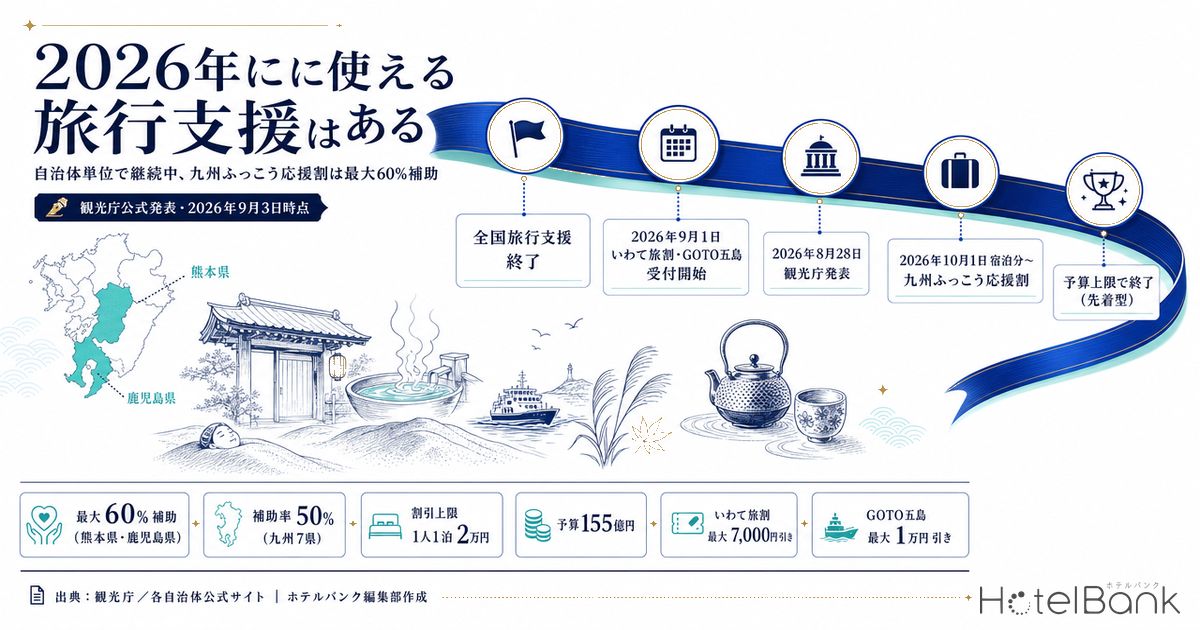
“Is there any travel subsidy you can actually use in 2026?” The short answer is yes. But it is no longer the single, uniform nationwide discount of a few years ago — support has shifted to programs run at the local-government level. Japan’s national travel discount scheme has already ended, and what is available in autumn 2026 falls into two groups: region-limited programs funded by the national government and delivered by prefectures, and prefectures’ and municipalities’ own campaigns. The largest of these is the Kyushu Fukko Ouenwari (九州ふっこう応援割) recovery travel subsidy, announced by the Japan Tourism Agency on August 28, 2026, which covers up to 60% of accommodation charges — an unusually large subsidy by recent standards — and applies to stays from October 1. This article covers only the programs whose existence and booking status we were able to confirm in official announcements, and sets out how much travelers actually save and how to apply.
- — The national travel discount program has ended. What is usable in 2026 is local-government support, split into two types: region-limited programs funded by the national government, and prefectures’ and municipalities’ own campaigns.
- — Kyushu Fukko Ouenwari applies to stays from October 1, 2026. The subsidy rate is 50% across the seven Kyushu prefectures, and 60% in Kumamoto and Kagoshima. The discount cap is ¥20,000 per person per trip (¥30,000 for transport-inclusive trips of two nights or more; ¥35,000 for multi-prefecture itineraries covering two or more prefectures).
- — At a ¥40,000 room rate for two people for one night, 60% takes ¥24,000 off, leaving ¥16,000 to pay. The cap starts to bite at roughly ¥67,000 (60%) and ¥80,000 (50%), so the higher the room rate, the larger the discount.
- — Programs are running outside Kyushu too. Iwate Tabiwari, Phase 2 takes up to ¥5,000 off per person per night (¥7,000 in the northern and coastal areas), and GOTO Goto takes up to ¥10,000 off on stays of ¥20,000 or more. Both have been accepting bookings since September 1, 2026.
- — Oita is the only prefecture to have published its booking-open date (as of September 3, 2026; the remaining six have not). Every program is first-come, first-served and closes once its budget or coupon allocation runs out, and “the period you can book in” and “the period you can stay in” are set separately.
The National Travel Discount Has Ended — 2026 Is the Year to Look for Local-Government Support
The uniform nationwide travel discount run after the pandemic has ended, and there is no national program on the same footing in 2026. What is running instead falls into two types.
- Region-limited programs funded by the national government and delivered by prefectures — aimed at rebuilding tourism demand after a disaster. The leading example in autumn 2026 is Kyushu Fukko Ouenwari.
- Prefectures’ and municipalities’ own campaigns — usually structured as discount coupons distributed through accommodation booking sites. Iwate Prefecture and Goto City in Nagasaki are among those accepting bookings as of September 2026.
What both have in common is that they are first-come, first-served and close as soon as the budget runs out. Acting when you first hear about a program can be worth anywhere from a few thousand to several tens of thousands of yen.
Kyushu Fukko Ouenwari — From October 1 Stays, with 60% in Kumamoto and Kagoshima
On August 28, 2026, the Japan Tourism Agency formally announced Kyushu Fukko Ouenwari as a response to the accommodation cancellations that spread across Kyushu following the 2026 Kumamoto earthquake (Japan Tourism Agency, “Kyushu Fukko Ouenwari” page, confirmed September 3, 2026). The outline is as follows.
| Item | Details |
|---|---|
| Eligible areas | The seven Kyushu prefectures — Fukuoka, Saga, Nagasaki, Kumamoto, Oita, Miyazaki and Kagoshima (eligibility covers “travel and accommodation products of one night or more within the Kyushu region”) |
| Subsidy rate | 50% of the travel or accommodation charge (60% in Kumamoto and Kagoshima) / applied per person per night |
| Discount cap (per person per trip) | Accommodation only, or transport-inclusive one night: ¥20,000 / transport-inclusive two nights or more: ¥30,000 / multi-prefecture itinerary staying in two or more prefectures: ¥35,000 |
| Eligible period | Stays from Thursday, October 1, 2026 onward (each prefecture sets its own end date) |
| Booking-open date | Set and announced by each prefecture in turn. Oita has already published “sales open late September, eligible period October 1 to December 25” (as of September 3, 2026) |
Source: compiled by the HotelBank Editorial Team from the Japan Tourism Agency’s official announcement (August 28, 2026). As of September 3, 2026.
A concrete example shows the scale. For a one-night stay for two people at an inn in Kumamoto with a room rate of ¥40,000 (¥20,000 per person), the 60% rate means ¥12,000 off per person, or ¥24,000 for the pair. The bill drops to ¥16,000. Kagoshima is also at 60%. In the other five prefectures — Fukuoka, Saga, Nagasaki, Oita and Miyazaki — the rate is half. Because the cap is set high, at ¥20,000 per person per trip, the discount grows largest at exactly the ryokan and onsen inns that are usually out of reach. For a fuller calculation of which price bands benefit most at each subsidy rate, and how to choose your dates, see Kyushu Fukko Ouenwari: 60% Off in Kumamoto, Kagoshima, ¥20,000 Cap. In Kagoshima, for instance, an itinerary running from the hot sand baths of Ibusuki up into the hills of Kirishima — the kind of trip built around inns in the ¥50,000-a-night band — is where the program pays off most.
One important caveat: as of September 3, Oita is the only prefecture to have published its booking-open date. The remaining six prefectures’ booking-open dates, eligible booking sites and travel agents, and coupon-collection methods are expected to be announced in turn on each prefecture’s official tourism site. The ¥15.5 billion budget, how many person-nights it covers, and how much October availability is left in each prefecture all remain moving targets, with several conditions still unannounced. Because weekend and holiday bookings move the moment an announcement lands, the sensible preparation is to check the official announcements for the prefecture you want to visit frequently, and shortlist candidate inns in advance. On the supply side, how accommodation operators are preparing to receive these guests is covered in Kyushu Travel Subsidy Due Aug 28: ¥3,200-¥6,300 ADR, Rate Beats Cap.
Quick Reference by Price Band — How Much Comes Off, and How Much You Pay
Applying the subsidy rate and cap to a range of room rates gives the following picture. Every row is based on the room rate for two people in one room for one night, showing the discount per person alongside the final amount the pair pays. Because these are one-night trips, the ¥20,000 per-person cap is the one that applies.
| Room rate (2 people, 1 room, 1 night) | 60% rate (Kumamoto, Kagoshima) | 50% rate (other 5 prefectures) | ||
|---|---|---|---|---|
| Discount per person | Amount paid by 2 people | Discount per person | Amount paid by 2 people | |
| ¥20,000 | ¥6,000 | ¥8,000 | ¥5,000 | ¥10,000 |
| ¥30,000 | ¥9,000 | ¥12,000 | ¥7,500 | ¥15,000 |
| ¥40,000 | ¥12,000 | ¥16,000 | ¥10,000 | ¥20,000 |
| ¥60,000 | ¥18,000 | ¥24,000 | ¥15,000 | ¥30,000 |
| ¥80,000 | ¥20,000(cap applied) | ¥40,000 | ¥20,000 | ¥40,000 |
| ¥100,000 | ¥20,000(cap applied) | ¥60,000 | ¥20,000(cap applied) | ¥60,000 |
Calculated by the HotelBank Editorial Team from the subsidy rates published by the Japan Tourism Agency (50% of the travel or accommodation charge; 60% in Kumamoto and Kagoshima) and the discount cap (¥20,000 per person per trip). Figures assume a one-night stay on an accommodation-only or transport-inclusive one-night product; “cap applied” marks the price bands where the amount calculated at the stated rate exceeds the cap and levels off. Actual discounts vary with each prefecture’s implementation rules and the products on sale.
The discount keeps growing in line with the stated rate up to a room rate of about ¥67,000 at 60%, and about ¥80,000 at 50%. Beyond that it levels off at the ¥20,000 per-person-per-trip cap.
Two things stand out. First, the higher the room rate, the larger the discount in absolute terms. At a ¥20,000 inn, even 60% is only ¥6,000 per person; at a ¥60,000 inn it is ¥18,000 per person. Second, that growth stops at ¥20,000 per person. In Kumamoto and Kagoshima at 60%, the discount pins to the cap once the room rate passes about ¥67,000; in the five prefectures at 50%, once it passes about ¥80,000. To get the most out of the high subsidy rate, the ¥60,000-¥80,000 room-rate band (two people, one room) is the most efficient — right up against the cap without wasting it. Many of the ryokan and onsen inns that are usually out of reach sit in exactly that band.
The cap itself changes with the product type. Accommodation-only and transport-inclusive one-night products are capped at ¥20,000 per person per trip, but transport-inclusive stays of two nights or more go up to ¥30,000, and multi-prefecture itineraries covering two or more prefectures up to ¥35,000. The design means the more nights you stay, and the more prefectures you cross, the higher the ceiling you can use.
Discount cap by product type (per person per trip). Source: Japan Tourism Agency, “Kyushu Fukko Ouenwari”.
Set against other local-government programs, the difference in scale is clear. Iwate Tabiwari Phase 2 caps out at ¥5,000 per person per night (¥7,000 in the northern and coastal areas), and GOTO Goto takes ¥10,000 off stays of ¥20,000 or more. Kyushu Fukko Ouenwari is an order of magnitude larger. That said, programs count their caps differently — per trip, per night, or per booking — so lining the figures up side by side is not a like-for-like comparison. A high cap and actually receiving that amount are also two different things: as the table above shows, using the full cap requires a correspondingly high room rate.
Local Programs You Can Already Book from September — Iwate and Goto City
Outside Kyushu, too, there are local-government programs confirmed on their official sites as accepting bookings. The two leading examples that could be booked and used as of September 3, 2026 are below.
| Program | Run by | Discount | Period |
|---|---|---|---|
| Odense! Iwate Tabiwari Campaign (Phase 2) | Iwate Prefecture | Up to half the accommodation charge, capped at ¥5,000 off per person per night (up to ¥7,000 off in the northern and coastal areas) | Bookings opened September 1, 2026 (coupons distributed until December 25). Stays eligible for check-in October 1 through check-out December 26 |
| GOTO Goto Accommodation Discount Campaign | Goto City, Nagasaki | ¥3,000 off stays of ¥6,000 or more, ¥5,000 off ¥10,000 or more, and up to ¥10,000 off ¥20,000 or more | September 1, 2026 to February 28, 2027. Coupons are limited in number (about 4,000 for September-October, about 4,000 for November-December, about 2,000 for January-February 2027) |
Source: compiled by the HotelBank Editorial Team from each program’s official site (confirmed September 3, 2026).
Using Iwate Tabiwari simply means collecting the discount coupon distributed on accommodation booking sites and booking an eligible property. Note, though, that transport-inclusive travel products are not eligible — accommodation only. It also cannot be combined with other travel discount programs run by Iwate Prefecture (combining it with coupons issued independently by inns or booking sites is allowed). Room rates vary widely across Iwate’s municipalities, so how easily you can use up the discount cap varies by area as well (for detail, see Iwate Hotel Market 2026: 2.2x ADR Gap, Morioka ¥200 Lodging Tax). GOTO Goto is tiered, so the discount grows as the accommodation charge rises (officially described as “up to 50%”). It also works by collecting an electronic coupon on an accommodation booking site, and applies to participating properties within Goto City. Goto City also sits in Nagasaki, one of the prefectures covered by Kyushu Fukko Ouenwari, so from October onward there may be better options depending on what that program’s details turn out to be.
How to Apply, and How to Avoid Losing Out
The fine print differs from program to program, but using them comes down to roughly three steps.
- Check on the program’s official site whether it is currently accepting bookings — the prefecture’s or city’s official tourism site, or the campaign’s dedicated site, is the primary source. Information about programs not yet open or already closed mixes easily into search results, so always check the date.
- Book through the specified route — collecting a coupon on an accommodation booking site, an eligible travel agency product, or an eligible plan on the inn’s own site. Each program specifies which routes work. Book outside the specified route and the discount does not apply, so confirm the eligible routes before booking.
- Prepare the documents needed at check-in — some programs require identification. It may be required for every member of the party, so check the conditions when you book.
Three things to watch. First, every program stops accepting bookings once its budget cap is reached, even if the stated period has not ended. High-rate programs like Kyushu Fukko Ouenwari in particular tend to fill on weekend dates right after bookings open. Second, “the period you can book in” and “the period you can stay in” are different. Iwate Tabiwari Phase 2 can be booked in September, but only stays from October 1 onward qualify. Third, a discount applies only when the eligible period, the eligible property and the eligible booking route all line up. Always confirm the discounted amount on the booking confirmation screen before finalizing.
Summary — For an Autumn Trip, Fit Your Dates to the Eligible Period
Travel subsidies you can use in 2026 do exist, at the local-government level. Kyushu Fukko Ouenwari, which starts with stays from October 1, is a large program at up to 60% and up to ¥20,000 per person per night, and each prefecture is expected to announce its booking-open date during September. Outside Kyushu, programs you can book right now are running too, such as Iwate Tabiwari Phase 2 and GOTO Goto. If you are planning an autumn trip, start by checking the official site of the local government at your destination to see whether a program exists, then fit your dates to the eligible period — that alone can change what you pay substantially.
Frequently Asked Questions
Q. Is there a travel subsidy I can use in 2026?
A. Yes. But Japan’s national travel discount program has already ended, and in 2026 support is centered on local government. It splits into two types: region-limited programs funded by the national government and delivered by prefectures (Kyushu Fukko Ouenwari), and prefectures’ and municipalities’ own campaigns (Odense! Iwate Tabiwari Campaign, GOTO Goto Accommodation Discount Campaign, and others).
Q. When can Kyushu Fukko Ouenwari be used?
A. It applies to stays from October 1, 2026. The booking (sales) open date, however, is set by each prefecture and announced in turn, and as of September 3, 2026 only Oita has published one. Oita has set sales to open in late September, covering stays from October 1 to December 25. The remaining six prefectures have not announced, so check the official site of the prefecture you want to visit.
Q. How much cheaper does Kyushu Fukko Ouenwari make a stay?
A. The subsidy rate is 50% of the travel or accommodation charge, and 60% in Kumamoto and Kagoshima. The discount cap is ¥20,000 per person per trip (¥30,000 for transport-inclusive stays of two nights or more, ¥35,000 for multi-prefecture itineraries covering two or more prefectures). For example, a one-night stay for two people at a ¥40,000 room rate in Kumamoto gets ¥24,000 off at 60%, leaving ¥16,000 to pay.
Q. Is the discount cap “per night” or “per trip”?
A. In the Japan Tourism Agency’s announcement, the discount cap is stated per person per trip. The subsidy rate (50% or 60%), on the other hand, is applied to the charge per person per night. So the total subsidy grows the more nights you stay, but the discount you can receive on any one trip is capped.
Q. Are there programs outside Kyushu?
A. Yes. Iwate Prefecture’s “Odense! Iwate Tabiwari Campaign” Phase 2 opened for booking on September 1, 2026, covering half the accommodation charge per person per night up to ¥5,000 off (¥7,000 in the northern and coastal areas). Eligible stays run from check-in on October 1 to check-out on December 26, and transport-inclusive travel products are not eligible. Goto City in Nagasaki runs the “GOTO Goto Accommodation Discount Campaign” from September 1, 2026 to February 28, 2027, tiered at ¥3,000 off stays of ¥6,000 or more, ¥5,000 off ¥10,000 or more, and ¥10,000 off ¥20,000 or more.
Q. Where should I book?
A. Each program specifies which booking routes qualify. Collecting a coupon distributed on an accommodation booking site, an eligible travel agency product, an eligible plan on the inn’s own site — book outside the specified route and the discount does not apply. Confirm the eligible routes and properties on the program’s official site before booking, and check the discounted amount on the booking confirmation screen before finalizing.
Q. Can programs be combined?
A. It depends on the program. For Iwate Tabiwari, it cannot be combined with other travel discount schemes run by Iwate Prefecture, but the guidance states it can be combined with coupons issued independently by accommodation booking sites or by the inn. Always check whether combining is allowed on each program’s official site.
Q. What should I watch out for?
A. Three things. First, every program has a cap on its budget or the number of coupons distributed, and is first-come, first-served — it closes once the cap is reached, even inside the stated period. GOTO Goto has published its coupon allocations by period as roughly 4,000, 4,000 and 2,000. Second, “the period you can book in” and “the period you can stay in” are different. Third, a discount applies only when the eligible period, the eligible property and the eligible booking route all line up.
Related Reading
- Kyushu Fukko Ouenwari: 60% Off in Kumamoto, Kagoshima, ¥20,000 Cap
- Kyushu Subsidy: Kumamoto & Kagoshima Hold 34.9% of Oct Unsold Rooms
- Kyushu Subsidy: 10pt Border Step Cuts Kurokawa-Yufuin Gap to ¥665
- Aso & Kurokawa Onsen Are Open: Autumn ADR Flat, Sept Holiday 1.5% Left
- Iwate Hotel Market 2026: 2.2x ADR Gap, Morioka ¥200 Lodging Tax
References and Sources
The subsidy rates, discount caps, eligible periods and booking status of every program covered in this article were confirmed against the primary sources below — the official sites of the responsible national agency and of each local government — on September 3, 2026. Anything that could not be confirmed is not stated in the article.
- Japan Tourism Agency, “Kyushu Fukko Ouenwari” — subsidy rate 50% (60% in Kumamoto and Kagoshima), discount caps (per person per trip) of ¥20,000 / ¥30,000 / ¥35,000, eligibility from stays on October 1, 2026 onward, and the list of booking-open dates by prefecture
- Japan Tourism Agency, “Kyushu Fukko Ouenwari” program outline (PDF) — the unit the subsidy rate applies to (per night, per person) and the discount caps by product type
- Oita Prefecture, “About Kyushu Fukko Ouenwari” — sales scheduled to open late September 2026, eligible period covering stays from October 1 to December 25, 2026, discount limits, and the possibility of an early close depending on budget execution
- Iwate Prefecture, “Odense! Iwate Tabiwari Campaign” — Phase 2 discount caps (¥7,000 in the northern and coastal areas, ¥5,000 in other areas), bookings open September 1, 2026, coupon distribution period, eligible stay period (check-in October 1 to check-out December 26), transport-inclusive travel products not eligible, and no combining with other prefectural programs
- Goto City, “GOTO Goto Accommodation Discount Campaign” (Goto no Shimatabi) — discount tiers (¥3,000 for ¥6,000 or more, ¥5,000 for ¥10,000 or more, ¥10,000 for ¥20,000 or more), period September 1, 2026 to February 28, 2027, and coupon allocations
■ Basis of the calculations
The amounts in Table 1 and the charts are reference figures calculated by the HotelBank Editorial Team from the subsidy rates and discount caps published by the Japan Tourism Agency. They assume a room rate for two people in one room for one night, on an accommodation-only or transport-inclusive one-night product, with the ¥20,000 per-person-per-trip cap applied. Taxes, bathing tax and assorted fees are not included.
■ Points to note
Because each prefecture sets its own implementation rules, eligible products and booking-open date for Kyushu Fukko Ouenwari, actual discounts and conditions may differ from the calculations in this article. As of September 3, 2026, Oita is the only prefecture to have published a booking-open date; the remaining six have not. Every program may stop accepting bookings the moment its budget or coupon allocation is exhausted, even within the stated period. Always check the latest booking status on each program’s official site before applying.