

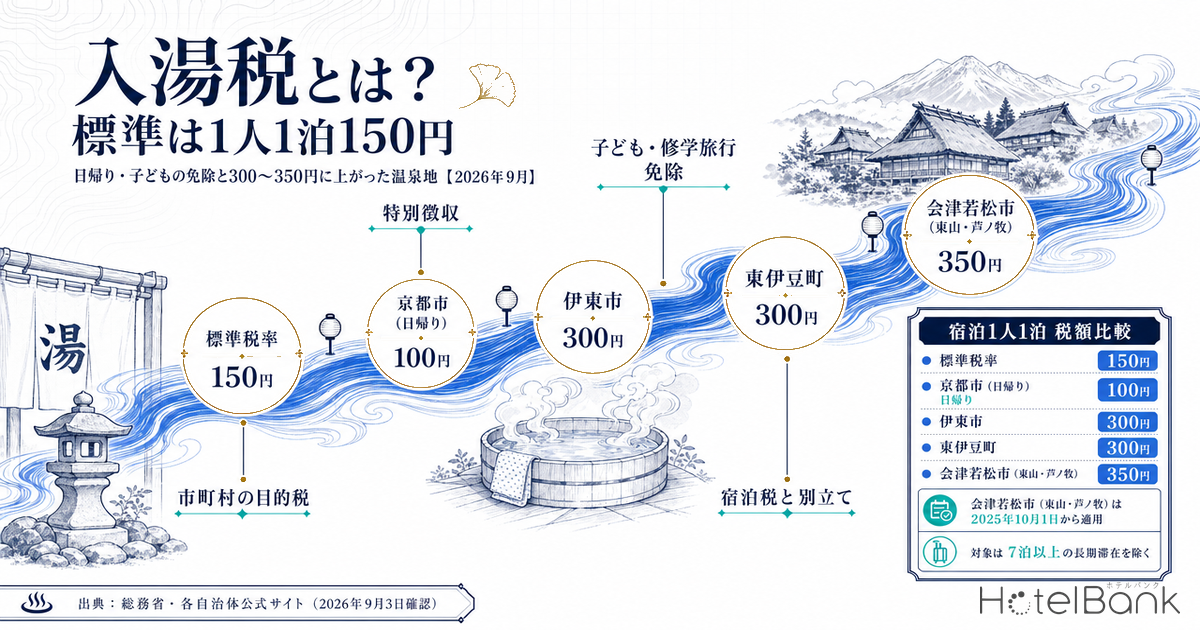
The onsen bathing tax (nyuto-zei) is a municipal earmarked tax levied on people who bathe at hot spring (mineral bath) facilities in Japan, and the standard rate is ¥150 per person per night (Local Tax Act; Ministry of Internal Affairs and Communications, “Local Tax System | Bathing Tax”). It sits outside the tax-inclusive room rate you see when booking, and most properties settle it at check-out. Because the amount is set by each municipality’s own ordinance, some hot spring towns charge ¥300 or ¥350, some cut the day-use rate to ¥100, and many exempt children and school excursions. This article sets out how much you pay, whether day-use bathing is taxed, who is exempt, and where the charge appears on your rate display and receipt — all from official municipal sources (verified 3 September 2026).
- — The standard rate is ¥150 per person per night. It is a municipal earmarked tax on hot spring bathing, and the revenue funds source protection, environmental sanitation, fire services and tourism promotion.
- — Day-use bathing is taxable too. But Kyoto City charges ¥100 per person per day and Ito City ¥150 — lower than the overnight rate — and many municipalities waive the tax when the bathing fee falls below a set threshold.
- — Elementary-school children and younger are usually exempt. Kyoto City, Aizuwakamatsu City, Izu City and Ito City all exempt them. The age cut-off differs by ordinance: “under 12”, or “until the first 31 March / 1 April after turning 12”.
- — Some hot spring towns have raised the rate to ¥300–350. Aizuwakamatsu City charges ¥350; Ito City and Higashiizu Town ¥300. Each increase carries roughly a ten-year sunset clause, with the extra revenue earmarked for purposes such as townscape improvement.
- — It is separate from the lodging tax. At a Kyoto City property with a hot spring bath you pay both the lodging tax (from ¥200 per person per night) and the ¥150 bathing tax. Neither is normally included in the listed OTA price, and both are usually settled on site.
What the bathing tax is — a municipal earmarked tax, ¥150 per person per night as standard
The bathing tax is a municipal tax charged to bathers at “mineral bath facilities” that use hot spring water as defined under the Hot Springs Act. It is an earmarked tax, meaning its use is fixed in advance: environmental sanitation facilities, fire-fighting facilities, protection and management of hot spring sources, and tourism promotion including tourism infrastructure (Ministry of Internal Affairs and Communications). In other words, the ¥150 you pay flows back into maintaining the springs and the streetscape of the town you are staying in.
The collection method is distinctive as well: properties and day-use bathing facilities collect the tax from bathers and remit it to the municipality under a “special collection” system. Guests do not need to file anything themselves — you simply pay the amount that appears on the property’s bill. Because it is a separate tax from consumption tax, a room rate advertised as “¥20,000 tax included” does not normally include the bathing tax.
Does day-use bathing count? — Yes, but many municipalities charge less or exempt it
The bathing tax is levied per person per day, so day-use bathing is taxable. Many municipalities, however, set a lower rate for day use, or exempt it when the bathing fee is below a set threshold. Here are the examples confirmed on official municipal websites.
- Kyoto City: ¥150 per person per night for overnight stays, ¥100 per person per day for day use. Day use is exempt when the fee is ¥1,500 or less, judged on the amount excluding consumption tax and local consumption tax (Kyoto City official).
- Aizuwakamatsu City: the day-use rate is the same ¥350 as the overnight rate, but the tax is waived when the total facility fee is ¥1,000 or less before tax (Aizuwakamatsu City official). That is an unusual design among municipalities, most of which discount day use.
- Ito City: from 1 October 2025 the city split the rate by stay type — ¥300 for overnight stays and ¥150 for day use (Ito City official).
- Izu City: the rate follows the facility fee rather than the stay type — ¥150 for fees of ¥5,000 or more, ¥100 for ¥1,000 or more but under ¥5,000, and exempt below ¥1,000 (Izu City official).
A day-use bathing fee may be displayed as, for example, “¥700 (bathing tax included)”, or it may fall below the exemption line and carry no tax at all. In practice the tax is usually built into the ticket-machine price, and being asked for it separately at a day-use facility is rare.
Children, school trips and long therapeutic stays are often exempt — it depends on the ordinance
The scope of exemption is set by each municipality’s ordinance, but the common patterns are consistent.
- Children under 12 (elementary school and younger): exempt in Kyoto City, Aizuwakamatsu City and Izu City, among others. Ito City’s October 2025 revision widened its exemption from “under 6” to elementary-school children. The age line — “under 12” versus “until the first 31 March after turning 12” — differs slightly between municipalities, so for a sixth-grader it is safest to confirm with the property.
- School excursions and other school events: Kyoto City, Aizuwakamatsu City and Izu City exempt participating pupils and their supervising teachers (universities are outside the scope in most municipalities). Aizuwakamatsu City requires that a teacher accompany the group and that the school principal issue a certificate.
- Therapeutic or convalescent bathing: Aizuwakamatsu City exempts bathing for therapeutic purposes supported by a doctor’s certificate. Kyoto City exempts bathing at medical care facilities such as hospitals, clinics and geriatric health services facilities. Higashiizu Town reduces the rate to ¥150 (from the usual ¥300) from the first night for bathers staying seven days (six nights) or more continuously, on application (Higashiizu Town official). It is effectively a provision for long therapeutic stays.
- Communal and public bathhouses: local communal baths and ordinary public bathhouses are exempt in most municipalities.
For a family trip, then, two adults and two elementary-school children staying one night at an onsen ryokan would in most municipalities pay bathing tax only on the adults — ¥300 (¥150 × 2).
More hot spring towns now charge above ¥150 — the ¥300 and ¥350 cases
The standard rate is ¥150, but a growing number of hot spring towns have raised it by ordinance. The additional revenue is directed to uses that return to visitors, such as townscape improvement and protection of hot spring sources. These are the cases confirmed on official municipal websites (verified 3 September 2026).
| Municipality | Overnight rate | Effective from | Notes |
|---|---|---|---|
| Aizuwakamatsu City (Higashiyama and Ashinomaki Onsen) | ¥350 per person per night | 1 October 2025 | Special measure through 30 September 2035. The ¥200 increase goes to a fund for townscape improvement in the hot spring district |
| Ito City | ¥300 per person per night | 1 October 2025 | Day use ¥150. Exemption widened to elementary-school children |
| Higashiizu Town (Atagawa, Inatori and others) | ¥300 per person per night | 1 March 2025 | Ten years, through 28 February 2035. Stays of seven days (six nights) or more are reduced to ¥150 from the first night on application |
Two nights in Aizuwakamatsu City comes to ¥700 per person, which is not trivial once you add up a family. That said, the tax is roughly 1–2% of a one-night listed rate — not enough to change which property you book. It is best understood as the reason the total you saw at booking and the amount you settle on site do not quite match. For how these increases compare with actual room rates in each town, see Onsen Bathing Tax Rises: ¥350 Aizuwakamatsu, ¥300 Izu, 1.1–1.6% of ADR.
Quick reference by municipality — rates, day use and children
Here are the five municipalities covered above, compared on four points: the overnight rate, the day-use rate, the exemption for children, and the day-use exemption threshold. All of it was confirmed on the official municipal websites on 3 September 2026, and each municipality name links to its official page. Ordinances change, so if the exact amount matters, search the municipality name of your destination together with “入湯税” on its official site.
| Municipality | Overnight (per person per night) | Day use (per person per day) | Exemption for children | Day-use / long-stay provisions |
|---|---|---|---|---|
| Aizuwakamatsu City | ¥350 | ¥350 | Under 12 | Exempt at ¥1,000 or less before tax |
| Ito City | ¥300 | ¥150 | Until the first 1 April after turning 12 (elementary school and younger) | — |
| Higashiizu Town | ¥300 | — | — | Stays of seven days (six nights) or more: ¥150 from the first night on application |
| Kyoto City | ¥150 | ¥100 | Until the first 31 March after turning 12 (elementary school and younger) | Exempt at ¥1,500 or less before tax |
| Izu City | ¥150 | ¥150 | Under 12 (including 12-year-olds in elementary school) | Exempt below ¥1,000 / ¥100 for ¥1,000 to under ¥5,000 |
“—” indicates that the official site does not state a figure for that category. Higashiizu Town publishes only the rate for overnight guests. Izu City does not distinguish between overnight and day use; its rate depends on the facility fee.
Figure 1: Bathing tax per person per night for overnight stays (same data as Table 2). The standard rate under the Local Tax Act is ¥150, the level charged by Kyoto City and Izu City.
The ¥150 standard is now close to the lowest level in the field. What the three municipalities that raised their rate have in common is that each set a time limit and restricted the additional revenue to specific uses such as townscape improvement. Aizuwakamatsu City applies the same ¥350 to day use as to overnight stays, taking a different view from Kyoto City and Ito City, which discount day use.
When both taxes apply — Kyoto City properties with hot spring baths
The tax most often confused with the bathing tax is the lodging tax. The lodging tax is a tax on staying; the bathing tax is a tax on bathing. They are entirely separate tax items, so at a property with a hot spring bath in a city that levies a lodging tax, you pay both.
Stay at a ryokan with a hot spring bath in Kyoto City, for example, and you pay the lodging tax scaled to your room rate (from ¥200 per person per night) plus ¥150 of bathing tax for each person each night. With the lodging tax spreading to Tokyo, Osaka, Kanazawa City and elsewhere, receipts showing two taxes side by side at hot spring properties will only become more common. Hot spring municipalities themselves are also moving on the lodging tax: Hakone Town submitted a draft ordinance for ¥350 per person per night in August 2026. For the amounts and the full list of municipalities that levy a lodging tax, see our separate article Japan Lodging Tax 2026: ¥100–200 per Night, Kyoto Up to ¥10,000.
How it appears on rate displays and receipts
The listed (tax-inclusive) price on booking sites does not normally include the bathing tax. Plan details typically carry a note such as “bathing tax of ¥150 payable separately on site” or “bathing tax not included”, and the standard flow is to settle it at the front desk on check-out. Even on plans paid by card in advance, it is common for the bathing tax alone to be settled on site.
On the receipt, the bathing tax is outside the scope of consumption tax, so it is itemised separately from the room charge as “bathing tax ¥X”. That separate line is what you rely on if you need to split accommodation costs from taxes for a corporate expense claim, or if you are using a travel subsidy programme that covers the room charge only. Conversely, some plans and day-use facilities state explicitly that the bathing tax is included, so when you need the exact total, the fastest route is to read the plan’s notes.
In short: the bathing tax is a levy of ¥150 per night (¥300–350 in some municipalities) paid by hot spring bathers to the town they are bathing in, collected through the property. Exemptions for children and the treatment of day use depend on the local ordinance, so if it matters, searching the municipality name of your destination together with “入湯税” on its official site will give you the exact figure.
Frequently asked questions
How much is the onsen bathing tax?
The standard rate under the Local Tax Act is ¥150 per person per day (per night). Because the amount is set by municipal ordinance, some hot spring towns charge more — ¥350 in Aizuwakamatsu City, ¥300 in Ito City and Higashiizu Town. Some municipalities set different amounts for overnight and day use, and others vary the rate according to the facility fee.
Does day-use bathing incur the bathing tax?
Yes. The tax is levied per person per day, so day use is taxable. Kyoto City sets day use at ¥100 per person per day and Ito City at ¥150, both below the overnight rate, and the tax is waived when the fee is ¥1,500 or less before tax in Kyoto City, ¥1,000 or less before tax in Aizuwakamatsu City, and below ¥1,000 in Izu City. At day-use facilities the tax is usually included in the bathing fee, so being charged separately on the spot is rare.
Are children exempt from the bathing tax?
In most municipalities, yes. Kyoto City, Aizuwakamatsu City, Izu City and Ito City all exempt elementary-school children and younger. The wording of the cut-off differs: Izu City uses “under 12 (including 12-year-olds in elementary school)”, Kyoto City “until the first 31 March after turning 12”, and Ito City “until the first 1 April after turning 12”. If the treatment of a sixth-grader matters to you, confirm with the property.
When and where do you pay it?
Properties and day-use bathing facilities collect the tax from bathers and remit it to the municipality under a “special collection” system. Guests do not file anything themselves; at most properties it is settled at the front desk on check-out. Even on plans paid by card in advance, it is common for the bathing tax alone to be settled on site.
Do the lodging tax and the bathing tax both apply?
They are separate tax items, so at a property with a hot spring bath in a city that levies a lodging tax, both apply. At a ryokan with a hot spring bath in Kyoto City, for instance, you pay the lodging tax scaled to your room rate (from ¥200 per person per night) plus ¥150 of bathing tax for each person each night.
Is the bathing tax included in the tax-inclusive room rate, and how does it appear on the receipt?
It is generally not included in the listed (tax-inclusive) price on booking sites, and plan details carry a note that the bathing tax is charged separately. Because the bathing tax is outside the scope of consumption tax, the receipt itemises it separately from the room charge as “bathing tax ¥X”. That separate line is your basis when a corporate expense claim requires accommodation costs and taxes to be split.
Does the tax apply to school excursions and therapeutic stays?
Many municipalities exempt them. Kyoto City, Aizuwakamatsu City and Izu City exempt pupils and supervising teachers on school excursions run as school events (universities excluded), and Aizuwakamatsu City requires an accompanying teacher and a certificate issued by the school principal. For therapeutic purposes, Aizuwakamatsu City exempts bathing supported by a doctor’s certificate, and Kyoto City exempts bathing at medical care facilities such as hospitals, clinics and geriatric health services facilities. Higashiizu Town reduces the rate to ¥150 from the first night for stays of seven days (six nights) or more, on application.
Related reading
References and sources
Every tax amount and exemption condition in this article was confirmed on 3 September 2026 against the primary sources below — the ministry responsible for the legislation and the official websites of each municipality. No secondary media coverage was used as a source. All linked pages are in Japanese.
- Ministry of Internal Affairs and Communications, “Local Tax System | Bathing Tax” — status as an earmarked tax, the ¥150 standard rate per person per day, and the permitted uses of revenue
- Kyoto City, “About the bathing tax” — ¥150 overnight / ¥100 day use, the day-use exemption at ¥1,500 or less (judged before tax), and exemptions for elementary-school children and younger, school excursions and medical care facilities
- Aizuwakamatsu City, “About the bathing tax” — ¥350 (1 October 2025 to 30 September 2035), the day-use exemption at ¥1,000 or less before tax, the conditions for therapeutic and school-excursion exemptions, and the hot spring district revitalisation fund
- Ito City, “Revision of the bathing tax rate” — ¥300 overnight / ¥150 day use (from 1 October 2025) and the widened exemption age
- Izu City, “Bathing tax” — the fee-linked rate (¥150 at ¥5,000 or more / ¥100 at ¥1,000 to under ¥5,000 / exempt below ¥1,000) and the scope of exemptions
- Higashiizu Town, “Notice on the bathing tax increase” — ¥300 (1 March 2025 to 28 February 2035) and the reduction for stays of seven days (six nights) or more
■ Notes
Because the bathing tax is set by municipal ordinance, amendments may leave the figures in this article out of date. Exemptions are determined by the municipality rather than the property, so treatment can differ within the same hot spring area if the properties sit in different municipalities. Statements about listed prices reflect general tendencies in publicly available OTA data (HotelBank Editorial Team research) and do not describe the billing of any individual property. Where the exact amount matters, please confirm with the official site of the municipality of your destination and with the property itself.