

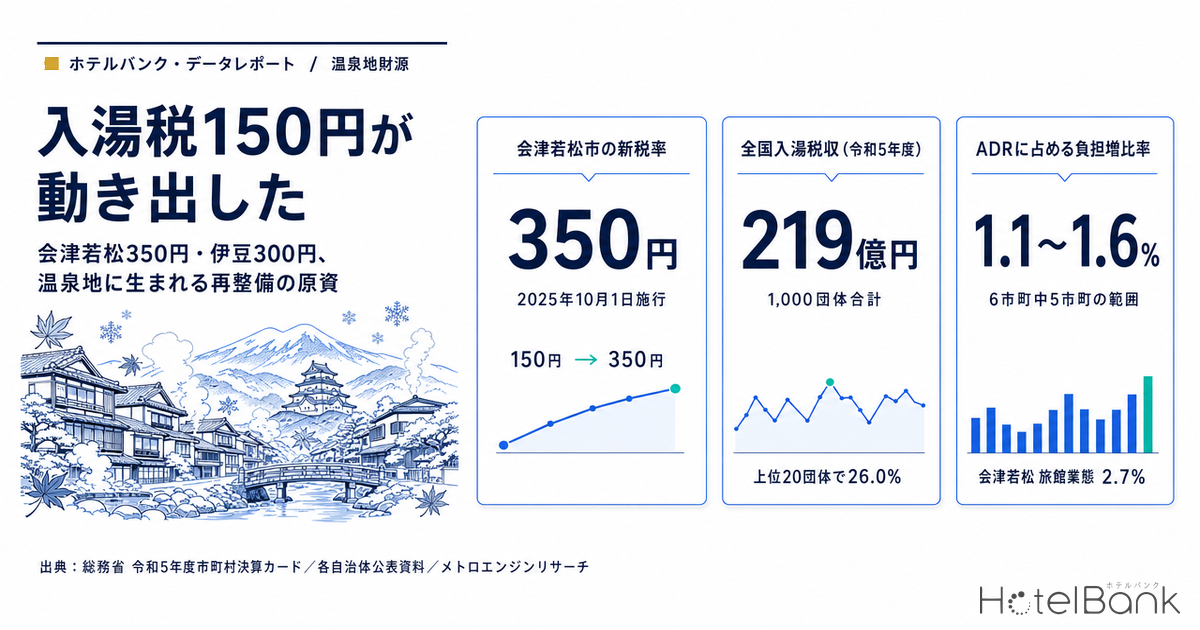
Tourism funding in Japan’s hot-spring towns is being quietly restructured. The Local Tax Act sets a standard rate of ¥150 per person per day for the bathing tax (nyuto-zei), and a growing number of municipalities are now setting rates above that standard by local ordinance. Aizuwakamatsu, Fukushima moved to ¥350 effective October 1, 2025; Higashiizu, Shizuoka moved to ¥300 effective March 1, 2025. In Hokkaido, prefectural and municipal lodging taxes started in April 2026, and one town lowered its bathing tax to coincide with them. This article verifies each rate and effective date one by one against municipal ordinances and tax-division disclosures, then works backward from settlement figures to estimate bather counts and quantify how much this added burden represents as a share of prevailing room rates.
Metric Definitions Used in This Article
- ADR (average daily rate): An estimated settled rate (tax-exclusive equivalent) calculated by applying category-specific adjustment coefficients to the lowest published plan rate each property lists on OTAs (double occupancy, per-room rate, tax-inclusive). Cross-checked against property-level results disclosed by listed hotel REITs (91 properties, most recent 3 months), the median error is approximately 7%. These are estimates and differ from each property’s actual transacted prices and accounting figures. Area-level ADR is the median across the target properties (the level of a typical property in that area).
- Bathing tax (nyuto-zei): A statutory earmarked tax under the Local Tax Act. The standard rate is ¥150 per bather per day, and no ceiling rate (restrictive rate) is prescribed. Municipalities may set a rate above the standard (an excess rate) or below it by ordinance.
- Back-calculated bather count: An estimate of total bathers derived by dividing a municipality’s bathing tax settlement amount by that fiscal year’s rate. It includes day-use bathers as well as overnight guests, and excludes exempt categories (children under 12, etc.).
- Data sources: MetroEngines Research / Ministry of Internal Affairs and Communications, “FY2023 Municipal Settlement Cards” / Japan Tourism Agency, “Overnight Travel Statistics Survey” / disclosures published by each municipality
- — No ceiling rate——The bathing tax has a ¥150 standard rate but no statutory upper limit, so the rate can be changed by ordinance alone. That is a far lighter procedure than the lodging tax, which requires the consent of the Minister for Internal Affairs and Communications.
- — Seven municipalities verified——Aizuwakamatsu ¥350; Higashiizu, Ito and Kushiro ¥300; Beppu on a ¥50–¥500 tiered scale. Toyako alone cut its rate from ¥300 to ¥100 to coincide with the new lodging tax.
- — ¥21.9 billion nationwide across 1,000 municipalities——Working backward from FY2023 bathing tax revenue gives 146.09 million total bathers. The top 20 municipalities account for 26.0% of the total.
- — 1.1–1.6% of the room rate——Dividing the added burden for two guests in one room by estimated settled ADR puts five of six municipalities in that range. Only Aizuwakamatsu is roughly double, at 2.7% for the ryokan category.
- — Scale of the funding——Aizuwakamatsu’s ¥200 increment generates roughly ¥120 million a year, or about ¥1.2 billion over ten years. Beppu set aside ¥211.42 million in its fund in FY2024.
An earmarked tax with no ceiling — why the bathing tax is easy to move
The bathing tax was established under the current Local Tax Act in 1950. It began as an ordinary tax of ¥10 per person, was reclassified as an earmarked tax in 1957, and the standard rate was raised to today’s ¥150 in the amendment that took effect in 1978. In the roughly half-century since, the standard rate itself has been left unchanged.
The key point here — as Hakone spells out in the materials for its tourism-development funding review council — is that the bathing tax has no restrictive rate (no upper limit on rates set above the standard). A municipality can set the rate through a council vote and an ordinance amendment alone, a far lighter procedure than the non-statutory local taxes that require the consent of the Minister for Internal Affairs and Communications. Whereas a lodging tax is introduced only after consultation with and consent from the ministry, a change to the bathing tax rate is settled entirely at the municipal level. That procedural lightness explains the speed of recent activity.
Its uses are also limited by law. Revenue must be allocated to four fields: environmental sanitation facilities; facilities for the protection and management of mineral springs; fire-service facilities and other facilities needed for firefighting activity; and tourism promotion (including development of tourism facilities). Because it cannot be blended into the general fund, the tax has the character of a funding source tied to the redevelopment of hot-spring districts.
It is worth separating the bathing tax from the lodging tax. The bathing tax is a statutory earmarked tax levied on the act of bathing at a mineral-spring bathhouse, and day-use bathers are also liable. The lodging tax, by contrast, is a non-statutory earmarked tax each municipality creates by ordinance; it is levied on the act of staying overnight and applies whether or not there is a hot spring. Because the two have different taxable objects, they can be levied together, and at an onsen inn both can apply. In a calculation Kushiro presented in its lodging tax study materials, a guest staying at a hot-spring property in the Lake Akan onsen district for under ¥20,000 per person per night would face ¥150 bathing tax + ¥150 excess levy + ¥100 prefectural lodging tax + ¥200 municipal lodging tax, for a total of ¥600.
The seven municipalities verified against ordinances and tax-division pages
This topic is usually discussed on the basis of news coverage, but amounts and effective dates cannot be stated precisely unless they are checked against official municipal materials. What follows covers only what could be confirmed on each municipality’s tax-division page, ordinance, or official tax guide.
| Municipality | Before | After | Effective date | Principal uses |
|---|---|---|---|---|
| Aizuwakamatsu, Fukushima | ¥150 | ¥350 | October 1, 2025 for 10 years, through September 30, 2035 |
The ¥200 increment goes into the Hot-Spring District Revitalization Fund. Landscape-restoration projects at Higashiyama and Ashinomaki onsen (subsidies for demolishing closed ryokan, etc.) |
| Higashiizu, Shizuoka | ¥150 | ¥300 | March 1, 2025 for 10 years, through February 28, 2035 |
Tourism promotion, facility development, facility maintenance. Stays of 7 days (6 nights) or more are charged ¥150 per night on application |
| Ito, Shizuoka | ¥150 flat | ¥300 overnight ¥150 day use |
October 1, 2025 | The exemption was simultaneously widened from under-6s to elementary-school age and below |
| Kushiro, Hokkaido | ¥250 since April 2015 |
¥300 | April 1, 2025 | The ¥150 excess levy goes into the Temporary Tourism Promotion Fund, allocated to tourism projects in the Lake Akan onsen district (¥150 for properties other than registered hotels and ryokan) |
| Noboribetsu, Hokkaido | ¥150 | ¥300 overnight ¥50 day use |
April 1, 2020 | Only general overnight guests saw an increase. School-trip guests (¥70) and long-stay cure guests (¥70) were left unchanged |
| Beppu, Oita | ¥150 flat | Tiered, ¥50–¥500 | April 1, 2019 through March 31, 2029 |
The excess levy goes into the Tourism Future Creation Fund. FY2024 contribution: ¥211.42 million |
| Toyako, Hokkaido | ¥300 since June 2020 |
reduced to ¥100 | April 1, 2026 | The bathing tax was cut to coincide with the new lodging tax (town ¥200–¥1,000 + prefecture ¥100–¥500) |
Source: Compiled by the HotelBank Editorial Team from municipal tax-division disclosures, ordinances and official bathing tax guides
Aizuwakamatsu’s ¥350 is the highest flat rate we were able to confirm. According to the city’s disclosures, the ¥200 increment is set aside in the “Aizuwakamatsu Hot-Spring District Revitalization Fund” and applied to support for landscape-restoration projects under the “Aizuwakamatsu Hot-Spring District Landscape Creation Vision Action Plan.” The original ¥150 continues to fund environmental sanitation facilities, fire-service facilities, tourism facility development and tourism promotion. Notably, the application period is explicitly set at ten years, through September 30, 2035 — it is designed as an earmarked funding source with a defined end date.
Beppu’s tiered scale varies the tax with the band of the accommodation or food-and-beverage charge (excluding consumption tax): ¥50 for ¥1,500–¥2,000, ¥100 for ¥2,001–¥4,500, ¥150 for ¥4,501–¥6,000, ¥250 for ¥6,001–¥50,000, and ¥500 for ¥50,001 and above. Long-stay guests of 8 days / 7 nights or more pay half of each. It is a progressive structure that falls below the standard rate at the low end and rises well above it at the high end. How the burden differs between a tiered scale and a flat rate is the same question we examined for the lodging tax in our comparison of the October 1 rollouts in Nasu and Morioka.
Source: Compiled by the HotelBank Editorial Team from municipal tax-division disclosures and ordinances (Beppu shown at the ¥6,001–¥50,000 band rate)
Toyako moved in the opposite direction. The town promulgated its lodging tax ordinance in September 2025, obtained the ministry’s consent dated February 13, 2026, and introduced the lodging tax from April 2026 (¥200 under ¥20,000 / ¥500 for ¥20,000–under ¥50,000 / ¥1,000 for ¥50,000 and above). Hokkaido launched its prefectural lodging tax (¥100 / ¥200 / ¥500) at the same time, with the town collecting the prefectural portion as well. Alongside that introduction, the town cut its bathing tax from ¥300 per night to ¥100. It is a concrete example of onsen-district tourism funding being redesigned from the bathing tax alone into a bathing-tax-plus-lodging-tax combination.
Source: Compiled by the HotelBank Editorial Team from official municipal disclosures
Backing out real onsen demand from tax revenue — 1,000 municipalities, ¥21.9 billion
Because the bathing tax is a fixed amount per person per day, dividing the settlement figure by the rate yields an estimate of total bathers. Aggregating bathing tax receipts from the FY2023 Municipal Settlement Cards published by the Ministry of Internal Affairs and Communications (all 1,741 municipalities), 1,000 municipalities reported bathing tax revenue, totaling ¥21,913.86 million. The top 20 account for 26.0% of the total and the top 100 for 55.7%. As a tourism funding source, the bathing tax is heavily concentrated in a small number of onsen districts.
Source: Aggregated by the HotelBank Editorial Team from the Ministry of Internal Affairs and Communications, “FY2023 Municipal Settlement Cards” (N=1,741 municipalities; 1,000 of which reported bathing tax revenue)
Hakone, Kanagawa leads with ¥624.94 million, followed by Beppu, Oita at ¥535.31 million and Atami, Shizuoka at ¥440.09 million. Large cities also rank high — Sapporo (4th), Kobe (8th), Osaka (9th), Kyoto (12th) and Sendai (14th) — because they contain a large number of lodging properties using hot-spring water within their city limits; that is a different phenomenon from concentration as an onsen destination.
Working backward from there: for municipalities whose rate was a flat ¥150 as of FY2023, dividing the settlement figure by ¥150 gives the following.
| Municipality | Bathing tax revenue (FY2023) | Back-calculated bathers | Ratio to prefectural guest-nights (2023) |
|---|---|---|---|
| Atami, Shizuoka | ¥440.09m | 2.93m | 13.4% |
| Ito, Shizuoka | ¥319.19m | 2.13m | 9.7% |
| Higashiizu, Shizuoka | ¥95.65m | 0.64m | 2.9% |
| Three Shizuoka municipalities | ¥854.92m | 5.70m | 26.1% |
| Aizuwakamatsu, Fukushima | ¥90.40m | 0.60m | 6.2% |
| National total | ¥21,913.86m | 146.09m | 23.7% |
Source: Compiled by the HotelBank Editorial Team from the Ministry of Internal Affairs and Communications, “FY2023 Municipal Settlement Cards,” and the Japan Tourism Agency, “Overnight Travel Statistics Survey” trend tables (calendar-year 2023)
Those three Shizuoka municipalities alone yield 5.70 million back-calculated bathers — equivalent to 26.1% of Shizuoka Prefecture’s 21.85 million total guest-nights in 2023. Nationally, 146.09 million back-calculated bathers is 23.7% of Japan’s 617.47 million total guest-nights.
Two caveats are inherent in this back-calculation. First, the bathing tax also applies to day-use bathers (except in municipalities such as Noboribetsu and Hakone that set a separate day-use rate), so the back-calculated figure includes demand with no overnight stay; compared directly with guest-nights, the bather side is inflated. Second, dividing by ¥150 in municipalities that levy an excess rate produces an overestimate.
The second point can be tested against real data. In its official bathing tax guide, Beppu discloses FY2024 taxable persons of 2.333 million and revenue of ¥553.41 million, which works out to an effective rate of ¥237 per person. Dividing that revenue by the ¥150 standard rate would give 3.69 million — 58.1% above the actual taxable count. In municipalities on a tiered scale, back-calculation at ¥150 does not work. Conversely, because municipalities like Beppu publish the taxable count itself, both the validity and the limits of the back-calculation method can be verified.
The share of the prevailing rate — 1.1–1.6% per night, with Aizuwakamatsu the exception
Next, how large is this added burden relative to actual room rates? Using MetroEngines Research data, we pulled estimated settled ADR for the six municipalities over the 12 months from August 2025 to July 2026. Area-level ADR is the median across the target properties and indicates the level of a typical property.
Source: MetroEngines Research; compiled by the HotelBank Editorial Team (Ito N=120–127 properties, Higashiizu N=46–49, Noboribetsu N=14–15, Toyako N=13–15, Aizuwakamatsu N=38–40, Kushiro N=29–31)
The two Izu municipalities show the classic twin-peak pattern, with highs in December–January and August; Higashiizu hit its annual high of ¥24,800 in January 2026. The Hokkaido side is the mirror image: Noboribetsu peaks in January at ¥23,200 while Kushiro peaks in summer at ¥12,000 in August. Aizuwakamatsu peaks in August and May and runs around ¥10,000 through the year.
Because the bathing tax is levied per person, two guests sharing one room means twice the added burden per room. ADR is a per-room rate, so the numerator has to be put on a per-room basis for the comparison to hold.
| Municipality | Change per person per night | Change per room (2 guests) | Estimated settled ADR (12-month avg, all properties) |
Share of ADR |
|---|---|---|---|---|
| Aizuwakamatsu | +¥200 | +¥400 | ¥10,100 | 4.0% |
| Noboribetsu | +¥150 | +¥300 | ¥18,900 | 1.6% |
| Ito | +¥150 | +¥300 | ¥20,700 | 1.4% |
| Higashiizu | +¥150 | +¥300 | ¥20,900 | 1.4% |
| Toyako bathing tax −¥200 + lodging tax ¥300 | +¥100 | +¥200 | ¥13,900 | 1.4% |
| Kushiro | +¥50 | +¥100 | ¥8,800 | 1.1% |
Source: MetroEngines Research; compiled by the HotelBank Editorial Team (ADR is the 12-month average for August 2025–July 2026. Toyako is calculated using the ¥300 lodging tax for the under-¥20,000 band)
Source: MetroEngines Research; compiled by the HotelBank Editorial Team
In five of the six municipalities, the added burden comes to 1.1–1.6% of ADR. A level of roughly 1–2% of the room rate is small next to seasonal swings or the spread across plan design. Ito and Higashiizu both land at 1.4%, so the move to ¥300 across the Izu area settles at almost identical relative levels. For what the same calculation looks like under an ad valorem tax, see our municipality-by-municipality estimate of Okinawa’s 2% lodging tax per guest per night.
| Added amount per person per night | ¥8,800 Kushiro |
¥10,100 Aizuwakamatsu all properties |
¥13,900 Toyako |
¥15,000 Aizuwakamatsu ryokan category |
¥18,900 Noboribetsu |
¥20,900 Higashiizu |
|---|---|---|---|---|---|---|
| +¥50 Kushiro |
1.1% | 1.0% | 0.7% | 0.7% | 0.5% | 0.5% |
| +¥100 Toyako |
2.3% | 2.0% | 1.4% | 1.3% | 1.1% | 1.0% |
| +¥150 Ito, Higashiizu, Noboribetsu |
3.4% | 3.0% | 2.2% | 2.0% | 1.6% | 1.4% |
| +¥200 Aizuwakamatsu |
4.5% | 4.0% | 2.9% | 2.7% | 2.1% | 1.9% |
| +¥350 Beppu, top band |
8.0% | 6.9% | 5.0% | 4.7% | 3.7% | 3.3% |
Source: Calculated for this article (added amounts span the +¥50 to +¥350 range of actual revisions confirmed in the text; ADR values are the estimated settled ADR of the six municipalities discussed. Cell = added amount × 2 people ÷ ADR)
This grid shows whether the ratio is driven by the tax rate or by ADR. In the high-rate band of ¥18,900–¥20,900 per night (Noboribetsu, Higashiizu), even a +¥200 increment keeps the ratio within 2.1%, whereas at Kushiro’s ¥8,800 a +¥200 increment reaches 4.5%. That Izu and Noboribetsu opted for ¥300 while Kushiro limited itself to a +¥50 step from ¥250 to ¥300 is consistent with where each sits on this grid. Aizuwakamatsu’s +¥200 works out to 2.7% against a ryokan-category ADR of ¥15,000 because it sits in the middle band of the grid.
Aizuwakamatsu’s 4.0% looks like an outlier, but there is a compositional reason. Its ADR includes not only Higashiyama and Ashinomaki onsen but also business hotels in the city center. Narrowing the aggregation to the ryokan category, which is what the bathing tax applies to, gives an estimated settled ADR of ¥15,000 (N=26–28 properties) and brings the ratio down to 2.7%. Even so, that is roughly double the other areas, and it is a fact that ¥350 is relatively heavy against the local rate band. Aizuwakamatsu’s choice to set a ten-year limit, ring-fence the increment in a fund and restrict its use to landscape restoration can be read as a design intended to make results visible in proportion to that relative size.
Demolishing derelict buildings — upside for room stock and neighboring properties
Translating these figures into the scale of available funding: Aizuwakamatsu’s FY2023 bathing tax revenue of ¥90.40 million divided by ¥150 gives 0.60 million back-calculated bathers. Multiplying that by the ¥200 increment implies roughly ¥120 million a year, or about ¥1.2 billion over ten years, in fund contributions (calculated for this article, assuming bather counts hold flat). On the same basis, Higashiizu’s 0.64 million back-calculated bathers multiplied by ¥150 implies roughly ¥96 million a year in additional revenue.
For Beppu there are actual figures. In the city’s published FY2024 breakdown of bathing tax allocations, ¥211.42 million of the ¥553.41 million total was set aside in the “Beppu Tourism Future Creation Fund” as the excess-levy portion. That is 38.2% of the total to the fund, with ¥94.37 million (17.1%) to tourism facilities, ¥105.32 million (19.0%) to hot-spring facilities and ¥65.60 million (11.9%) to fire-service facilities. Six years into the excess levy, a tourism funding stream on the order of ¥200 million a year has become institutionally established.
Where that money goes is what feeds through to the asset value of neighboring properties. Closed ryokan in onsen districts tend to sit abandoned for long periods because ownership is unclear or no one is designated to bear demolition costs, and for the operating inns next door the effects show up in both streetscape and walkability. Aizuwakamatsu’s explicit commitment to support landscape-restoration projects under its Hot-Spring District Landscape Creation Vision Action Plan, backed by a ten-year time-limited fund, means public money is now attached to block-scale redevelopment that individual properties could never finance alone. Closures have been concentrated in particular regions, with ryokan bankruptcies clustering where COVID-era zero-interest, no-collateral loans came due.
There are implications for room stock as well. Once a closed property is demolished, its site becomes available for new development or for the expansion and renovation of an existing inn. In areas like Izu and Aizu, where large Showa-era ryokan cluster and rebuilding demand has accumulated, clearing sites is itself a precondition for turnover in the room stock. Landscape work, walking-route improvements and visitor-infrastructure upgrades are direct demand-generation measures on the surface, but indirectly they create the conditions for higher average rates at surrounding properties.
Seen from the burden side, a level of 1–2% per night sits within the range that can be recouped once the funding takes visible form. Designs that pair the increase with consideration for families are spreading too — as when Ito simultaneously widened its exemption from under-6s to elementary-school age and below. Higashiizu’s reduction for stays of 7 days or more, Beppu’s half rate for long-stay guests, and Noboribetsu’s unchanged ¥70 for school-trip guests are all mechanisms that tune the burden by demand segment.
Adjustments in the other direction have also appeared, as at Toyako, where the bathing tax was cut alongside the introduction of a lodging tax. Because Hokkaido’s prefectural lodging tax applies across the whole prefecture from April 2026, onsen districts face an overlap with the bathing tax. By cutting the bathing tax from ¥300 to ¥100, the total burden on a stay under ¥20,000 becomes ¥100 bathing tax + ¥200 town lodging tax + ¥100 prefectural lodging tax, or ¥400, against the previous ¥300 of bathing tax alone. The increment is only ¥100 per person, and the composition of the funding shifts toward the town’s tourism promotion programs. It shows that layering the two systems makes it possible to restructure how revenue is used while holding down the total burden.
| Rate band | Before bathing tax only |
After bathing + town + prefecture |
Change | Share of the band’s lower bound |
|---|---|---|---|---|
| Low band under ¥20,000 | ¥300 | ¥400 100 + 200 + 100 | +¥100 | — |
| Mid band ¥20,000 to under ¥50,000 | ¥300 | ¥800 100 + 500 + 200 | +¥500 | 4.0% |
| High band ¥50,000 and above | ¥300 | ¥1,600 100 + 1,000 + 500 | +¥1,300 | 3.2% |
Source: Calculated for this article from Toyako’s “About the Bathing Tax” and “About the Lodging Tax” and Hokkaido’s “Hokkaido Lodging Tax” (the ratio is the per-person, per-night total against each band’s lower bound; the low band has no defined lower bound and is therefore not calculated)
Sliced by rate band, Toyako’s redesign adds ¥100 at the low band, ¥500 at the mid band and ¥1,300 at the high band — the burden weights toward the upper bands. Measured against each band’s lower bound, the ratio tapers as you go up, at 4.0% for the mid band and 3.2% for the high band, so the same progressive design logic Beppu adopted in 2019 is at work here too. A rate-band-specific allocation that a flat bathing tax alone could never deliver becomes possible in combination with a lodging tax.
Conclusion
The ¥150 standard bathing tax rate has been left unchanged for close to half a century since 1978, but onsen districts are now using the structural latitude of having no ceiling rate to set their own levels — a movement that began with Beppu in 2019 and has spread since. In 2025, Aizuwakamatsu went to ¥350 and Higashiizu, Ito and Kushiro to ¥300.
Backing out the numbers from the ministry’s settlement data, the 1,000 municipalities with bathing tax revenue total ¥21.9 billion, implying total bathers on the order of 146.09 million. Adding ¥150–¥200 on top of demand at that scale generates roughly ¥100 million a year even for a single onsen district. As Beppu’s record shows, there are cases where a fund on the order of ¥200 million a year has become established within six years.
And the share of that burden in the room rate stays at 1.1–1.6% per night (2.7% for Aizuwakamatsu’s ryokan category). Once the intended uses — demolishing derelict buildings, restoring the streetscape, upgrading visitor infrastructure — take visible form, the return flows back into the asset value of nearby properties and into turnover in the room stock. For onsen districts, it means block-scale redevelopment that could previously only be addressed within the general fund now has a funding source with an explicit time limit and an explicit purpose.
⚠ Note on ADR for future dates: For months from August 2026 onward, the ADR figures in this article are estimates based on the selling prices published on OTAs as of the survey date, and they will move as the check-in date approaches. The 12-month averages used in the text and tables are calculated only from settled months, August 2025 through July 2026.
Related reading
- Nasu vs Morioka Lodging Tax Oct 1: Tiered 1.0–3.0% vs Flat ¥200
- Japan’s 15 Trailhead Towns: Autumn ADR Peaks vs Winter Ski Peaks
- Gunma Settled ADR June 2026: Business +2.9%, City −9.0%
- Okinawa’s 2% Lodging Tax: ¥60–¥340 per Guest Night by Municipality
References and sources
■ Data sources
Rates, effective dates and uses were verified one by one against each municipality’s ordinance, tax-division disclosures and official bathing tax guide. Bathing tax revenue is the aggregated receipts from the Ministry of Internal Affairs and Communications’ “FY2023 Municipal Settlement Cards” (all 1,741 municipalities). Total guest-nights are the calendar-year 2023 figures from the Japan Tourism Agency’s “Overnight Travel Statistics Survey” trend tables. Room rates are MetroEngines Research municipality-level estimated settled ADR (August 2025–July 2026; Ito N=120–127 properties, Higashiizu N=46–49, Noboribetsu N=14–15, Toyako N=13–15, Aizuwakamatsu N=38–40 and ryokan category N=26–28, Kushiro N=29–31).
■ Calculation assumptions
Back-calculated bather count = bathing tax settlement amount ÷ that fiscal year’s rate (only for municipalities on a flat ¥150). Fund contributions for Aizuwakamatsu and Higashiizu = back-calculated bather count × the increment (assuming bather counts hold flat). Share of ADR = change per person per night × 2 people ÷ the 12-month average estimated settled ADR (assuming double occupancy in one room; ADR is a per-room rate). The sensitivity grid takes added amounts across the +¥50 to +¥350 range of actual revisions confirmed in the text and ADR values from the six municipalities discussed, applying the same formula; it contains no new forecasts. Toyako’s band totals are the sum of the ¥100 bathing tax plus town lodging tax of ¥200/¥500/¥1,000 and prefectural lodging tax of ¥100/¥200/¥500 as stated in the text.
■ Limitations and caveats
Back-calculated bather counts include day-use bathers, so comparing them directly with guest-nights inflates the bather side. Dividing municipalities on an excess or tiered rate by ¥150 produces an overestimate: against Beppu’s actuals (FY2024 taxable persons 2.333 million, effective rate ¥237), the ¥150 back-calculation exceeds the measured figure by 58.1%. Exempt categories (children under 12, etc.) are not included in the back-calculated figure. Estimated settled ADR is an estimate based on published selling prices and differs from actual transacted prices and accounting figures (median error approximately 7% when cross-checked against 91 REIT-disclosed properties over the most recent 3 months). Months from August 2026 onward are future dates and are excluded from the 12-month averages.
■ Municipal sources (verification of rates and effective dates)
- Aizuwakamatsu, “About the Bathing Tax”
- Higashiizu, “Notice on the Bathing Tax Increase”
- Ito, “On the Revision of the Bathing Tax Rate”
- Kushiro, “Partial Amendment of the Kushiro Municipal Tax Ordinance Accompanying the Bathing Tax Rate Revision”
- Noboribetsu, “Bathing Tax”
- Beppu City, General Affairs Department, Municipal Tax Division, “Guide to the Bathing Tax” (PDF)
- Toyako, “About the Bathing Tax”
- Toyako, “About the Lodging Tax”
- Hakone, “The State of Hakone’s Bathing Tax,” 2nd Hakone Tourism Development Funding Review Council, Document 4 (PDF)
- Kushiro, “Basic Approach to the Lodging Tax,” 1st Kushiro Lodging Tax Roundtable (PDF)
- Atami, “Overview of the Bathing Tax”
- Hokkaido, “Hokkaido Lodging Tax”
■ Government statistics
- Ministry of Internal Affairs and Communications, “FY2023 Municipal Settlement Cards” — bathing tax receipts aggregated across all 1,741 municipalities
- Japan Tourism Agency, “Overnight Travel Statistics Survey” trend tables — total guest-nights by prefecture (annual)
- Ministry of Internal Affairs and Communications, Local Tax System, “Bathing Tax”
■ Market data
- MetroEngines Research — municipality-level estimated settled ADR (August 2025–November 2026, including category-level breakdowns)