

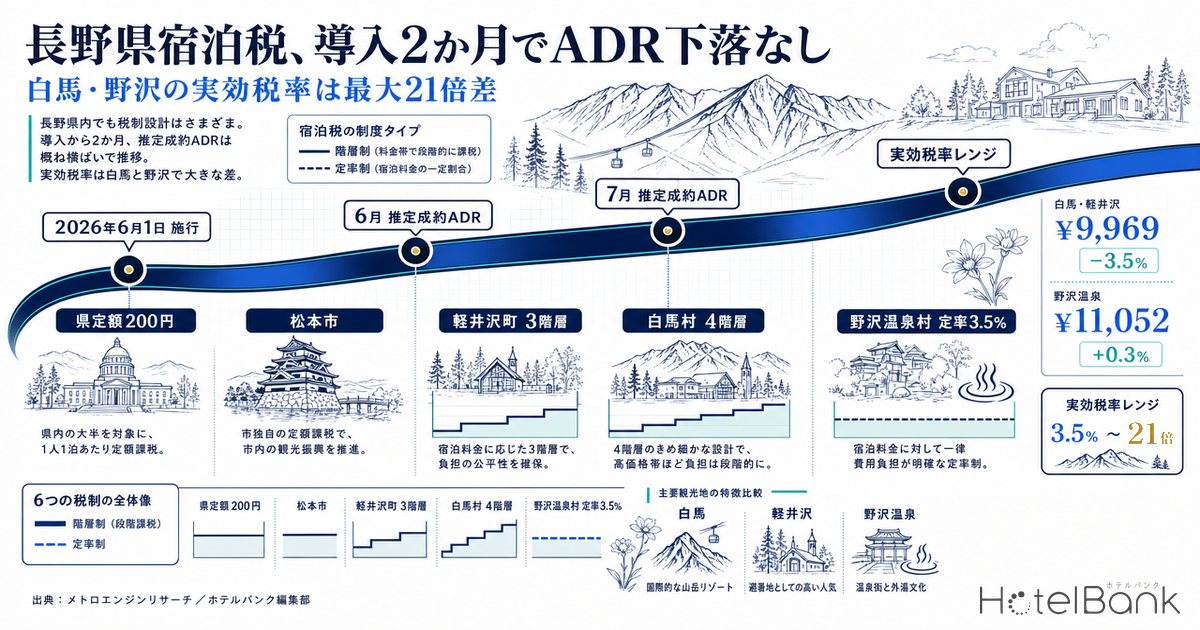
Nagano Prefecture’s lodging tax took effect for stays from Monday, June 1, 2026, and three months have now passed. Before it started, operators voiced concern that the new levy would land on top of the slow rainy-season demand period. Checking the finalised months against MetroEngines Research data, however, Nagano’s estimated settled ADR was −3.5% year on year in June and +0.3% in July — 1.9 points ahead of the average for four neighbouring prefectures with no lodging tax (Yamanashi, Gunma, Gifu and Niigata), which came in at −3.6% over the same period. No demand damage is visible in pricing, at least two months in.
The more pressing practical issue lies elsewhere. Because five municipalities — Matsumoto City, Karuizawa Town, Achi Village, Hakuba Village and Nozawaonsen Village — launched their own levies on the same day as the prefectural tax, Nagano now has a structure without precedent anywhere in Japan: six separate tax regimes coexisting inside a single prefecture. Flat-rate, tiered and percentage-based systems all sit side by side, and the tax charged on a stay priced at ¥120,000 per person per night ranges from ¥200 to ¥4,200 — a 21-fold spread. This article reads that structural asymmetry against three months of actual market data.
- — ADR ran −3.5% then +0.3% over the first two months. That is 1.9 points ahead of the four untaxed neighbouring prefectures (−3.6% over the same period); no demand damage is visible in pricing.
- — Six tax regimes in one prefecture. Alongside the prefectural tax, Matsumoto, Karuizawa, Achi, Hakuba and Nozawaonsen all began charging on the same day, mixing flat, tiered and percentage-based designs.
- — Effective rates diverge by up to 21x. On a ¥120,000 per-person night the tax is ¥200 in a standard Nagano location but ¥4,200 in Nozawaonsen. Even Hakuba and Karuizawa differ 2.7-fold at that price point.
- — No demand discontinuity at the tax boundary. Saturday check-in occupancy at 60 days out moved only 1.4 points, from 71.8% on May 30 to 70.4% on June 6; no pull-forward booking rush was detected.
- — The ¥6,000 exemption threshold cuts straight through the middle of the price distribution. In the June week, 59.5% of listings fell in the ¥6,000–20,000 band. Revenue growth depends less on guest numbers than on how thick the above-threshold price bands become.
Metric Definitions Used in This Article
- ADR (average daily rate): an estimated settled rate (tax-exclusive equivalent) derived by applying property-type correction factors to the lowest published plan level each property lists on OTAs and similar channels (double occupancy, per-room rate, tax-inclusive). Cross-checked against property-level results disclosed by listed hotel REITs (91 properties, most recent three months), the median error is approximately 7%. These are estimates and differ from each property’s actual transacted rates and accounting figures. Area-level ADR is the median across the target properties — the level of a typical property in that area.
- Published rate: the average of all plans listed on OTAs and similar channels (room-only through meal-inclusive, per-room rate at double occupancy, tax-inclusive). This uses a different basis from ADR.
- OCC (occupancy): sold rooms as a share of total rooms in the area (an estimate based on OTA sales inventory). Because it is based on how OTA-listed inventory sells down, it differs from a property’s true overall occupancy.
- LT (lead time): days remaining until check-in. LT0 = same day.
- Data source: MetroEngines Research
Six systems in one prefecture: how Nagano’s lodging tax is built
The Nagano prefectural lodging tax is a non-statutory earmarked tax that began applying to stays from June 1, 2026. The prefecture’s base design is flat-rate: ¥200 per person per night for the first three years of the system (through May 31, 2029), rising to ¥300 from June 1, 2029. The exemption threshold is a room charge below ¥6,000 per person per night (room-only, tax-exclusive); stays below that level are not taxed. School educational and research activities, and events organised by childcare facilities, are among the exempt categories.
The complexity starts here. Matsumoto City, Karuizawa Town, Achi Village, Hakuba Village and Nozawaonsen Village all launched their own lodging taxes on June 1, 2026, the same day as the prefecture. Within these five municipalities the prefectural portion is reduced from ¥200 to ¥100, and the guest pays the combined municipal-plus-prefectural amount. The municipal designs are not standardised either: Matsumoto chose a flat rate, Karuizawa and Hakuba went tiered, and Nozawaonsen adopted a percentage-based rate — a rarity nationally. The result is a single prefecture in which the shape of the tax branches six ways.
| Jurisdiction | Structure | Guest burden (June 2026 – May 2029) | From June 2029 |
|---|---|---|---|
| Standard Nagano locations (outside the five municipalities) | Flat | ¥200 | ¥300 |
| Matsumoto City (incl. Kamikochi) | Flat | ¥200 (city ¥100 + prefecture ¥100) | ¥300 |
| Achi Village | Flat | ¥300 (village ¥200 + prefecture ¥100) | — |
| Karuizawa Town | 3 tiers | ¥6,000–under ¥10,000: ¥200 / ¥10,000–under ¥100,000: ¥250 / ¥100,000 and above: ¥700 | ¥300 / ¥350 / ¥800 |
| Hakuba Village | 4 tiers | ¥6,000–under ¥20,000: ¥200 / ¥20,000–under ¥50,000: ¥400 / ¥50,000–under ¥100,000: ¥900 / ¥100,000 and above: ¥1,900 | To be adjusted alongside the increase in the prefectural portion to ¥150 |
| Nozawaonsen Village | Percentage | 3.5% of the room charge (rate published by the village) | 5.0% |
Source: compiled by the HotelBank Editorial Team from materials published by Nagano Prefecture and each municipality. All six apply the same exemption threshold of under ¥6,000 per person per night (room-only, tax-exclusive).
The one thing they share is that threshold. All six drew the same line: no tax below ¥6,000 per person per night on a room-only, tax-exclusive basis. It also matters that the tax base is the room-only equivalent. At ryokan where two meals are standard, the ¥6,000 test has to be applied after deducting the meal component, the bathing tax and consumption tax. A plan displayed above ¥20,000 can still fall outside the tax if its room-only equivalent is under ¥6,000. The administrative burden of making that separation falls hardest on smaller ryokan with lower price points and more complex plan structures.
Effective rates diverge up to 21-fold: the regressivity of flat rates versus the proportionality of a percentage
Different structures produce completely different curves for the tax as a share of the room charge — the effective tax rate. Plot the tax base (room-only equivalent per person per night, tax-exclusive) on the horizontal axis and the tax as a share of the room charge on the vertical, and the gap is immediately visible.
Source: compiled by the HotelBank Editorial Team from materials published by Nagano Prefecture and each municipality
The prefecture’s flat ¥200 works out at a steep 3.3% just above the ¥6,000 threshold, and thins out as the price rises — down to 0.17% on a ¥120,000 per-person stay. A flat rate is structurally regressive, and it bites hardest just above the exemption threshold: precisely the mid-price band occupied by regional ryokan and business hotels.
Nozawaonsen’s 3.5% rate, by contrast, holds the same ratio at any price — ¥210 on a ¥6,000 per-person night, ¥4,200 at ¥120,000. The burden rises in proportion to ability to pay, and revenue tracks any move upmarket automatically. Hakuba’s four tiers and Karuizawa’s three sit in between, tracing a staircase.
| Tax base (per person per night, room-only, tax-exclusive) | Standard Nagano | Karuizawa | Hakuba | Nozawaonsen | Max / min |
|---|---|---|---|---|---|
| ¥5,000 | Exempt | Exempt | Exempt | Exempt | — |
| ¥8,000 | ¥200 | ¥200 | ¥200 | ¥280 | 1.4x |
| ¥15,000 | ¥200 | ¥250 | ¥200 | ¥525 | 2.6x |
| ¥30,000 | ¥200 | ¥250 | ¥400 | ¥1,050 | 5.3x |
| ¥60,000 | ¥200 | ¥250 | ¥900 | ¥2,100 | 10.5x |
| ¥120,000 | ¥200 | ¥700 | ¥1,900 | ¥4,200 | 21.0x |
Source: HotelBank Editorial Team calculations based on materials published by Nagano Prefecture and each municipality. Nozawaonsen figures use the 3.5% rate published by the village.
At the luxury end the difference becomes decisive. Sell a suite at ¥120,000 per person per night (equivalent to ¥240,000 per room at double occupancy) and the guest pays ¥400 per room in a standard Nagano location, ¥3,800 in Hakuba and ¥8,400 in Nozawaonsen. Hakuba and Karuizawa are the prefecture’s two flagship mountain resorts, yet their systems differ: at the same ¥120,000 band the tax is ¥1,900 versus ¥700, a 2.7-fold gap. That two areas concentrating high-rate development carry different tax shapes is a starting condition regional investors cannot ignore when structuring room rates.
Tiered systems carry another practical implication. In Hakuba a tax base of ¥49,999 attracts ¥400 while ¥50,000 attracts ¥900 — one yen of price difference creating ¥500 of tax difference. Karuizawa has a ¥450 jump at the boundary between ¥99,999 and ¥100,000. Steps like these create an incentive to sit just below the line. Whether to cap prices immediately under a tier boundary, or to cross it with enough added value to justify the step, is one more input into revenue management decisions.
Two months in, ADR went −3.5% then +0.3% — measured against four untaxed prefectures
From system design to actual market conditions. Tracking Nagano’s estimated settled ADR monthly, June 2026 — the first taxed month — came in around ¥10,000 (¥9,969 precisely, N=796 properties), down 3.5% from ¥10,330 a year earlier. July was around ¥11,100 (¥11,052, N=820 properties), up 0.3% year on year. Both months are on a finalised basis (verified data for past months).
Source: MetroEngines Research; compiled by the HotelBank Editorial Team (Nagano Prefecture, N=585–878 properties per month)
Reading June’s −3.5% as a tax-driven decline would be premature, however. June 2026 was a soft month for rates nationwide, and neighbouring prefectures with no lodging tax fell too. So set alongside Nagano four prefectures that are geographically close and structurally similar in demand, and that levy no lodging tax: Yamanashi, Gunma, Gifu and Niigata.
Source: MetroEngines Research; compiled by the HotelBank Editorial Team (Nagano N=796–820, Yamanashi N=302–304, Gunma N=437–438, Gifu N=377–382, Niigata N=416–421 properties)
The four-prefecture control group averaged −2.7% in June, only 0.9 points away from Nagano’s −3.5%. Nagano and Gifu matched exactly at −3.5%, and Gunma fell further at −5.4%. June’s softness was not specific to Nagano but common to inland tourism prefectures — that is the fair reading.
In July the gap reverses. The control-group average sank to −4.5% while Nagano held +0.3%, a difference of +4.8 points clearly in Nagano’s favour. Averaged across June and July, Nagano is at −1.6% against the control group’s −3.6%, a +1.9-point gap. Had taxation depressed demand and fed through to price, Nagano should have trailed the control group; the actual result runs the other way.
| Prefecture | Lodging tax | June 2026 ADR | YoY | July 2026 ADR | YoY |
|---|---|---|---|---|---|
| Nagano | From June 1 | ¥9,969 | −3.5% | ¥11,052 | +0.3% |
| Yamanashi | None | ¥10,058 | −1.0% | ¥10,720 | −6.4% |
| Gunma | None | ¥10,560 | −5.4% | ¥10,860 | −3.5% |
| Gifu | None | ¥9,623 | −3.5% | ¥10,186 | −4.7% |
| Niigata | None | ¥8,368 | −0.7% | ¥8,974 | −3.4% |
| Control group average (4 prefectures) | — | — | −2.7% | — | −4.5% |
Source: MetroEngines Research; compiled by the HotelBank Editorial Team
As a natural experiment this comparison is admittedly crude. The control group was selected on qualitative grounds — geographic proximity and similar demand structure — and does not control for differences in inbound share, ski dependence or new-supply pace. Two months is also a short observation window. Even so, the negative conclusion can be stated with reasonable confidence: current data does not support the concern that rates would visibly break down the moment taxation began.
No demand discontinuity on June 1 — booking curves either side of the tax boundary
Beyond rates, it is also possible to test whether the pattern of bookings itself changed at the tax date. If guests were conscious of “stay by May 31 and pay no tax”, inventory should have sold down faster for late-May check-ins and stalled in early June — a visible step in the curve. Using OTA-listed inventory across Nagano (roughly 1,200 properties, about 35,000–36,000 rooms), Friday and Saturday check-in dates across the four weeks straddling the tax boundary are plotted by lead time.
Source: MetroEngines Research; compiled by the HotelBank Editorial Team (all Nagano properties, 35,247–36,592 rooms covered)
The result is unambiguous: there is no step. Saturday check-in occupancy at 60 days out ran 71.7% on May 23, 71.8% on May 30, 70.4% on June 6 and 66.0% on June 13, so the drop across the tax boundary (May 30 to June 6) is just 1.4 points. The larger fall comes on June 13, where the seasonal factor — a weekend after the rainy season set in — is doing far more of the work. Friday check-ins behave the same way, at 67.6% on May 29 versus 66.0% on June 5, a 1.6-point gap.
The levels reached close in (LT1) tell the same story: 94.2% on May 30 against 91.8% on June 6, and 89.4% on May 29 against 88.6% on June 5. The plain reading is that ¥200 a night is not enough of a motive to move a trip forward by a day. No pull-forward booking rush was detectable, at least at the area-aggregate level.
For reference, Nagano’s estimated occupancy rose in line with the season — 85.5% in June 2026, 89.4% in July and 93.6% in August. By property type, ryokan were lowest in June at 82.2%, business hotels reached 88.6%, and the luxury band with published rates above ¥100,000 was highest at 92.0%. The segment left holding the most inventory in the rainy season is not the mid-price band where the tax bites relatively hardest, but the strongly seasonal ryokan segment.
Where the ¥6,000 threshold sits in Nagano’s price distribution
The decisive fact for understanding Nagano’s price structure is that the ¥6,000 exemption threshold runs almost exactly through the middle of the prefecture’s distribution. Converting observed listed plan prices in Nagano to a tax-exclusive amount per person per night (apportioned on a double-occupancy basis) gives the following distribution.
Source: MetroEngines Research; compiled by the HotelBank Editorial Team (June week N=597,989 listings / 1,874 properties; July week N=747,366 / 1,989; August week N=543,981 / 2,026)
In the second week of June (check-ins June 5–11, N=597,989), 6.6% fell below ¥6,000, 59.5% in the ¥6,000–20,000 band, 29.9% in ¥20,000–50,000, 3.5% in ¥50,000–100,000 and 0.5% at ¥100,000 and above. Listings above ¥100,000 — where Hakuba’s top tier of ¥1,900 applies — accounted for just 0.5% in the June week.
The picture changes in the second week of August (August 7–13, N=543,981), which includes the Obon holiday. Sub-¥6,000 shrinks to 1.2% while ¥50,000 and above swells to a combined 16.2% (13.8% in ¥50,000–100,000 and 2.4% at ¥100,000 and above). In other words, the upper tiers Hakuba and Karuizawa created only really engage on a handful of peak-season dates. Across the full year the revenue workhorse remains the thick ¥6,000–20,000 band.
An important caveat applies here. The above is a published-rate distribution, whereas the actual tax base is the room-only equivalent (after deducting meals, bathing tax and consumption tax). At ryokan, where two-meal plans dominate, a listing in an upper band can drop one or two tiers once converted to a tax base. The true exempt share is therefore higher than 6.6%, and the share hitting the top tiers lower than 0.5%. Published-rate figures should be read as an upper bound on the taxable range.
Property types diverged — business hotels +2.9%, resort hotels −7.3%
The prefecture-wide average is the net of property types moving in opposite directions. Breaking it down sharpens the outline.
| Property type | June 2026 ADR | June YoY | July YoY | Indicative per-person figure | N |
|---|---|---|---|---|---|
| Business hotels | ¥7,240 | +2.9% | +5.6% | approx. ¥3,600 (below threshold) | 166 |
| City hotels | ¥8,988 | −9.2% | −2.1% | approx. ¥4,500 (below threshold) | 16 |
| Ryokan | ¥11,556 | −0.1% | −2.8% | approx. ¥5,800 (near threshold) | 501 |
| Resort hotels | ¥13,558 | −7.3% | −2.5% | approx. ¥6,800 (above threshold) | 112 |
Source: MetroEngines Research; compiled by the HotelBank Editorial Team. The “indicative per-person figure” apportions the lowest published plan level across two guests in one room and is a reference value only; it differs from the actual tax base (the room-only equivalent).
Business hotels ran +2.9% in June and +5.6% in July — accelerating, if anything, after taxation began. Splitting their lowest published level across two guests gives roughly ¥3,600 per person, well under the ¥6,000 threshold. The core of Nagano’s business hotel demand sits outside the taxable range to begin with. That this segment holds strong demand at all speaks to the depth of real domestic need — intra-prefecture business travel, construction work, school club trips — and it can equally be read as the exemption threshold having been set to spare that layer.
Resort hotels, by contrast, softened at −7.3% in June and −2.5% in July. At roughly ¥6,800 per person they sit just above the threshold, inside the taxable range but at an effective rate around 2.9% — comparatively heavy. That said, June is a structural shoulder month for resorts, and similar softness appears in the untaxed control prefectures. Separating tax effects from seasonal ones will require a full-year view. Ryokan were essentially flat in June at −0.1%, the most stable of the property types.
Destinations ran hot and cold — Karuizawa +21.4%, Hakuba +8.3%, Nozawaonsen −5.1%
Drop down to the prefecture’s main destinations and the spread is wider still than across property types.
| Area | Tax structure | June ADR | June YoY | July ADR | July YoY | N (July) |
|---|---|---|---|---|---|---|
| Karuizawa Town | 3 tiers | ¥20,568 | +21.4% | ¥24,726 | +3.4% | 50 |
| Achi Village | Flat ¥300 | ¥20,204 | +9.5% | ¥21,737 | +6.4% | 19 |
| Hakuba Village | 4 tiers | ¥11,176 | +8.3% | ¥11,685 | +7.3% | 44 |
| Yamanouchi Town (Yudanaka, Shibu, Jigokudani) | Prefectural flat ¥200 | ¥10,434 | −6.9% | ¥10,983 | +1.3% | 97 |
| Matsumoto City (incl. Kamikochi) | Flat ¥200 | ¥11,787 | −6.9% | ¥13,141 | −5.2% | 107 |
| Nozawaonsen Village | 3.5% rate | ¥10,512 | −5.1% | ¥10,394 | −10.5% | 23 |
| Nagano City | Prefectural flat ¥200 | ¥9,207 | +2.9% | ¥10,050 | −1.2% | 78 |
Source: MetroEngines Research; compiled by the HotelBank Editorial Team. N is the number of properties used to calculate estimated settled ADR.
The two areas that adopted tiered systems — Karuizawa (June +21.4%) and Hakuba (June +8.3%, July +7.3%) — both ran well ahead of the prefectural average. The places that levy the heaviest tax at the top tier are also the ones growing rates fastest. Karuizawa is especially telling: its published rate (the all-plan average) rose only 4.4%, from ¥42,800 to ¥44,700, while estimated settled ADR on a lowest-published-level basis gained 21.4%. The floor under discounting lifted rather than the ceiling on price — that is closer to what happened. Summer demand was thick enough that there was little need to release cheap inventory.
Nozawaonsen, meanwhile, was the softest in the prefecture at −5.1% in June and −10.5% in July. But the sample is small at N=23 properties, and green-season Nozawaonsen is a strongly seasonal market with a wide gap to winter (around ¥16,600 in January 2026). The effect of the 3.5% rate itself cannot be isolated from two months of data; that question needs re-testing across a full year including the high-rate winter period. Several high-end development projects are under way in Nozawaonsen and Hakuba, at scales and under operating structures that this data set does not attempt to cover.
Matsumoto’s −6.9% and −5.2% also deserve attention, but Matsumoto is a wide municipality that includes Kamikochi and Utsukushigahara, so urban business demand and mountain resort demand sit in the same aggregate. By August 2026 its estimated occupancy reached 97.5% (N=139 properties, 5,417 rooms), the highest of any major area in the prefecture, so demand itself is firm. How price tiers break down across Matsumoto and its surrounding municipalities is set out property-by-municipality in Matsumoto ADR ¥13,400 vs ¥18,300 Ceiling: Absorbing 222 New Rooms.
Compared with Kyoto and Hokkaido — aligned by months since introduction
2026 was a banner year for lodging taxes. Kyoto City redesigned its tier structure on March 1, adding a new top band of ¥10,000 for stays of ¥100,000 and above; Hokkaido and Sapporo City introduced theirs on April 1 (¥100 under ¥20,000, ¥200 for ¥20,000–under ¥50,000, ¥500 for ¥50,000 and above); and Nagano followed on June 1. Three consecutive months of taxation events with different designs make it possible to line up post-introduction rate trends by elapsed month.
Source: MetroEngines Research; compiled by the HotelBank Editorial Team (Kyoto N=580–607, Hokkaido N=879–952, Nagano N=771–820 properties)
Hokkaido held positive or flat for four consecutive months — +2.8% in month one, +3.5% in month two, +0.1% in month three and +1.4% in month four. Its design is tiered with a ¥500 maximum, yet no negative spillover into rates is visible. Nagano started at −3.5% in month one, moved to +0.3% in month two and a provisional +3.9% in month three, improving as the months pass.
Kyoto alone looks different. Months one to three after the revision (March to May) held positive at +7.2%, +0.6% and +3.5%, but month four (June) fell 8.6% and month five (July) 12.8%. Reading that as a delayed effect of the rate increase would be risky, however. April–October 2025 covered the Osaka-Kansai Expo, giving Kyoto an extremely high comparison base in the prior year. Kyoto’s decline is better explained by that base effect than by taxation, and it illustrates how precarious it is to interpret a single series with no control group when arguing causation between tax and demand.
What the three regions share is that no collapse in rates was observed immediately after introduction. As a share of room rates, a lodging tax at these levels is small: Nagano’s flat ¥200 is 1.3% on a ¥15,000 per-person night, and Hokkaido’s ¥100 band works out at roughly 0.5–1%. An addition of that size is easily buried by other drivers of price — seasonality, day of week, currency moves. The reasonable conclusion is that lodging taxes at current levels are simply not large enough to push rates down through demand elasticity.
Operations: bundle the tax into the rate, or collect it on site
While the price impact is limited, the operational burden on properties grows in proportion to the complexity of the system. Accommodation providers act as special collection agents, filing and remitting to the municipality the tax they take from guests. In accounting terms it is handled as a deposit received, not as revenue. Filing deadlines, payment deadlines and record-keeping requirements are set by each municipality, so an operator with properties in both Matsumoto and Hakuba will be running two filing regimes in parallel.
The distribution decision is whether to build the tax into the selling price as an all-inclusive rate, or to collect it on site. Bundling avoids missed collections and front-desk disputes, and gives guests a clear total. On the other hand, because the exemption test is applied to the room-only equivalent, bundling a meal-inclusive plan requires managing the tax base separately behind the scenes, which adds work in keeping plan design and display consistent. Collecting on site keeps displayed prices simple but loads cash and cashless handling, plus explanation, onto the front desk at check-in.
Either way, the prerequisite is a single set of display rules across the official website, the direct booking engine, OTAs and the accommodation terms and conditions. Working through how consecutive nights are counted, how children are treated and how exemption is determined is worth doing once per property to keep operations stable. In Hakuba and Karuizawa in particular, where tiers apply, the amount collected changes when a plan price crosses a tier boundary, so collection settings need reviewing at every price revision. Differences in tax amount, exemption conditions and payment method by municipality are collected in Japan Lodging Tax 2026: ¥100–200 per Night, Kyoto Up to ¥10,000, which is a useful base when drafting guest-facing wording.
How to read the ¥2.2 billion-a-year tourism revenue stream
Nagano projects lodging tax revenue of roughly ¥2.2 billion a year over the system’s first three years, rising to about ¥3.3 billion a year from June 2029. The proceeds are earmarked for priority measures toward building a world-class mountain and highland tourism destination, grants to municipalities, and collection and publicity costs — specifically, richer tourism content, improved visitor infrastructure and a stronger tourism promotion framework. The plan period runs from fiscal 2026 through fiscal 2030.
Converting ¥2.2 billion a year into taxable person-nights, a simple division by ¥200 implies roughly 11 million taxable person-nights annually (the actual figure will be higher, since the prefectural portion is reduced to ¥100 inside the five municipalities). Given that the ¥6,000 threshold removes a substantial share of the low-rate layer from the taxable range, only part of the prefecture’s total lodging demand is taxed. Put the other way round, future revenue growth depends far more on how much thickness the above-threshold price bands gain than on guest numbers.
Decomposing the prefecture’s two projections, ¥2.2 billion (June 2026 – May 2029) and ¥3.3 billion (from June 2029) stand in an exact 1.5:1 ratio, matching the increase from ¥200 to ¥300. The projection is therefore a linear extension that assumes taxable person-nights stay flat, with no movement in the tax base itself built in.
Because the prefectural portion drops to ¥100 inside the five municipalities, however, the average prefectural tax per person-night corresponding to prefectural revenue falls somewhere between ¥100 and ¥200. Recasting revenue along the two axes of taxable person-nights and average prefectural tax per person-night shows that the same ¥2.2 billion is consistent with a fairly wide set of combinations.
| Taxable person-nights (annual) | Average ¥150 | Average ¥170 | Average ¥185 | Average ¥200 |
|---|---|---|---|---|
| 10 million | 150 | 170 | 185 | 200 |
| 11 million | 165 | 187 | 204 | 220 |
| 12 million | 180 | 204 | 222 | 240 |
| 13 million | 195 | 221 | 241 | 260 |
| 15 million | 225 | 255 | 278 | 300 |
Shaded cells mark the combinations consistent with the prefecture’s published ¥2.2 billion projection. Because the prefectural tax is ¥200 in standard locations and ¥100 in the five municipalities, the average prefectural tax falls between the two. Municipal tax portions accrue to each municipality and are excluded from this estimate. Source: HotelBank Editorial Team calculations based on materials published by Nagano Prefecture.
Combinations consistent with ¥2.2 billion in prefectural revenue are widely distributed: 11 million person-nights at an average of ¥200, about 12 million at ¥185, about 13 million at ¥170, about 15 million at ¥150. Given that the five municipalities (Matsumoto, Karuizawa, Achi, Hakuba and Nozawaonsen) are among the prefecture’s deeper lodging demand areas, and that the prefectural tax halves there, actual taxable person-nights are likely to run appreciably above 11 million. Where the capture rate sits relative to total person-nights in the prefecture will not be settled until first-year accounts are published.
Bracketing the range: 10 million person-nights at an average ¥150 gives ¥1.5 billion at the low end, and 15 million at ¥200 gives ¥3.0 billion at the high end, placing the prefecture’s ¥2.2 billion projection close to the middle. The variable that decides where within that range the outcome lands is not guest numbers as such, but the share of stays that clear the ¥6,000 threshold. On a published-rate basis only 6.6% fell below ¥6,000 in the June week, but because a two-meal ryokan’s tax base drops one or two tiers below its published rate, the true exempt share is higher. Which way the price bands nearest the threshold move will determine how much of the projected revenue materialises.
On this point, Nozawaonsen’s percentage-based design carries a structurally different meaning. In flat-rate municipalities, revenue per person-night does not change when rates rise (absent a tier crossing). In percentage-based Nozawaonsen, a rate increase translates directly into more revenue. The more an area moves upmarket, the better a percentage system secures growth in the tourism promotion funding stream. Hakuba’s four-tier design sits as a compromise: keeping much of the simplicity of a flat rate while capturing the high-rate band. For municipal tourism departments, the view they take of an area’s future price structure becomes, directly, the axis on which the system choice turns.
Conclusion — three practical implications
First, in two months of actual market data, no downward pressure on rates from the lodging tax was detected. Nagano’s estimated settled ADR ran −3.5% in June and +0.3% in July, running 1.9 points ahead of the four untaxed neighbouring prefectures (−2.7% / −4.5%) on a two-month average. Booking curves show no step at the tax boundary either: occupancy at 60 days out differed by just 1.4 points between Saturday May 30 and Saturday June 6. A ¥200 nightly charge is not functioning as a motive to shift travel dates.
Second, what deserves attention is not the rate impact but the asymmetry of the system. Six tax regimes exist inside one prefecture, and the tax on a ¥120,000 per-person night ranges from ¥200 to ¥4,200 — a 21-fold spread. Hakuba and Karuizawa, the prefecture’s two signature mountain resorts, differ 2.7-fold in tax burden at the same price band. For operators and investors weighing high-rate development, that is one more variable in site selection.
Third, the fact that the ¥6,000 threshold runs through the middle of the price distribution needs building into business planning. Nagano’s business hotels sit outside the taxable range at roughly ¥3,600 per person when the lowest level is split between two guests, while resort hotels fall just inside at about ¥6,800. The regressivity of a flat rate — heaviest in effective terms just above the threshold — bites hardest on regional mid-price properties. When considering a price revision, checking where a rate sits relative to the exemption threshold and the tier boundaries will support a sharper decision.
⚠ A note on ADR for future dates: estimated settled ADR and published rates for August 2026 onwards in this article are estimates based on selling prices published on OTAs and similar channels at the time of research, and will move as check-in dates approach. Data on a finalised basis extends through July 2026. Prices currently set high may be adjusted downward close in. Tax amounts and taxation requirements may also change through future ordinance revisions, so always check the latest materials published by Nagano Prefecture and the relevant municipality before acting operationally.
Related reading
- Nagano Accommodation Tax June 1: 2nd Prefecture, ADR Impact & Pass-Through Scenarios
- Japan Lodging Tax 2026: All 62 Municipalities, Rates and ADR Burden
- Nasu vs Morioka Lodging Tax Oct 1: Tiered 1.0-3.0% vs Flat ¥200
- Nagano Late-Summer Booking Curve 2026: Ryokan -11.8pt at 45 Days Out
- Japan Lodging Tax 2026: ¥100–200 per Night, Kyoto Up to ¥10,000
- Matsumoto ADR ¥13,400 vs ¥18,300 Ceiling: Absorbing 222 New Rooms
- Onsen Bathing Tax Rises: ¥350 Aizuwakamatsu, ¥300 Izu, 1.1–1.6% of ADR
References and Sources
■ Data sources
System details, tax amounts, exemption thresholds and use of proceeds come from materials published by Nagano Prefecture and by Matsumoto City, Karuizawa Town, Achi Village, Hakuba Village, Nozawaonsen Village and Komagane City. Pricing and demand figures use aggregated MetroEngines Research data: estimated settled ADR covers N=771–878 properties per month for Nagano; the control group covers Yamanashi N=302–304, Gunma N=437–438, Gifu N=377–382 and Niigata N=416–421; the comparison regions cover Kyoto N=580–607 and Hokkaido N=879–952. The published-rate distribution covers N=543,981–747,366 plans per week across June–August 2026. Estimated occupancy and booking curves cover 35,247–36,592 listed rooms in Nagano.
■ Calculation assumptions
Effective tax rates are the simple ratio of each municipality’s published tax amount to the tax base (per person per night, room-only, tax-exclusive). Per-person amounts are reference values apportioned on a double-occupancy basis and do not match the actual tax base. The four control prefectures were selected qualitatively, on geographic proximity to Nagano and a similar demand structure as inland tourism prefectures, and the tax effect is approximated by the difference in year-on-year change. The post-introduction comparison aligns each jurisdiction’s first month of taxation as month one. The sensitivity estimate for prefectural revenue is a simple multiplication of taxable person-nights by average prefectural tax per person-night and excludes municipal tax portions.
■ Limitations and caveats
The observation window is two months from introduction (finalised through July 2026; August onwards is provisional) and does not span a full seasonal cycle. Because the control group is not adjusted for inbound share, ski dependence or new-supply pace, the difference cannot be read as a causal tax effect. Nozawaonsen’s sample is small at N=23 properties and its seasonal gap to winter is wide, so isolating the system’s contribution is not possible. Matsumoto mixes urban and mountain-resort demand in a single aggregate. The price distribution is on a published-rate basis and therefore sits above the actual tax base after deducting meals, bathing tax and consumption tax, so the true exempt share is higher than the figures shown. Tax amounts and taxation requirements may change through ordinance revision.
■ Official materials on the tax systems
- Nagano Prefecture, “Nagano Prefectural Lodging Tax” (system overview, rates, exemption threshold, use of proceeds)
- Nagano Prefecture Tax Division, “About the Lodging Tax”
- Nagano Prefecture Tourism & Sports Department and General Affairs Department, “The Nagano Prefectural Lodging Tax System” (PDF)
- Karuizawa Town, “About the Karuizawa Town Lodging Tax” (tier table)
- Hakuba Village, “Guide to the Lodging Tax” (four-tier rates)
- Nozawaonsen Village, “About the Lodging Tax” (3.5% rate)
- Matsumoto City, “Matsumoto City Lodging Tax”
- Achi Village, “About the Lodging Tax”
- Komagane City, “Nagano Prefectural Lodging Tax”
- Ministry of Internal Affairs and Communications, “On the Establishment of Nagano Prefecture’s Lodging Tax” (consultation document extract, PDF)
■ Systems in other jurisdictions (for comparison)
- Hokkaido lodging tax (introduced April 1, 2026): rate bands
- Kyoto City lodging tax, March 2026 revision (tier redesign, ¥10,000 top band)
- Lodging tax nationwide list 2026 (amounts, tiers, effective dates)
■ Press coverage and practitioner commentary
- Nikkei, “Nagano’s lodging tax set to start June 1, 2026; five municipalities to begin the same day”
- Nikkei, “Nagano lodging tax proposal: ¥200 per person for the first three years, from June 2026”
- Shinano Mainichi Shimbun, “Nozawaonsen Village to introduce its own lodging tax; ordinance passed by village assembly”
- NBS Nagano Broadcasting Systems, “Matsumoto City to introduce its own lodging tax; revenue projected at ¥200–300 million a year”
- Suwa Tourism Association, “Notice of the introduction of Nagano’s lodging tax, for stays from June 1, 2026”
- “What is the lodging tax? A 2026-revision guide to on-site operations and accounting for accommodation providers”
- “The lodging tax is a local tax handled as a deposit received: account treatment and invoicing”
■ Pricing and demand data
- MetroEngines Research — estimated settled ADR (Nagano, Yamanashi, Gunma, Gifu, Niigata, Kyoto and Hokkaido, June 2024 – October 2026), published-rate distribution (Nagano, June–August 2026), estimated occupancy and booking curves (Nagano, May–August 2026)