

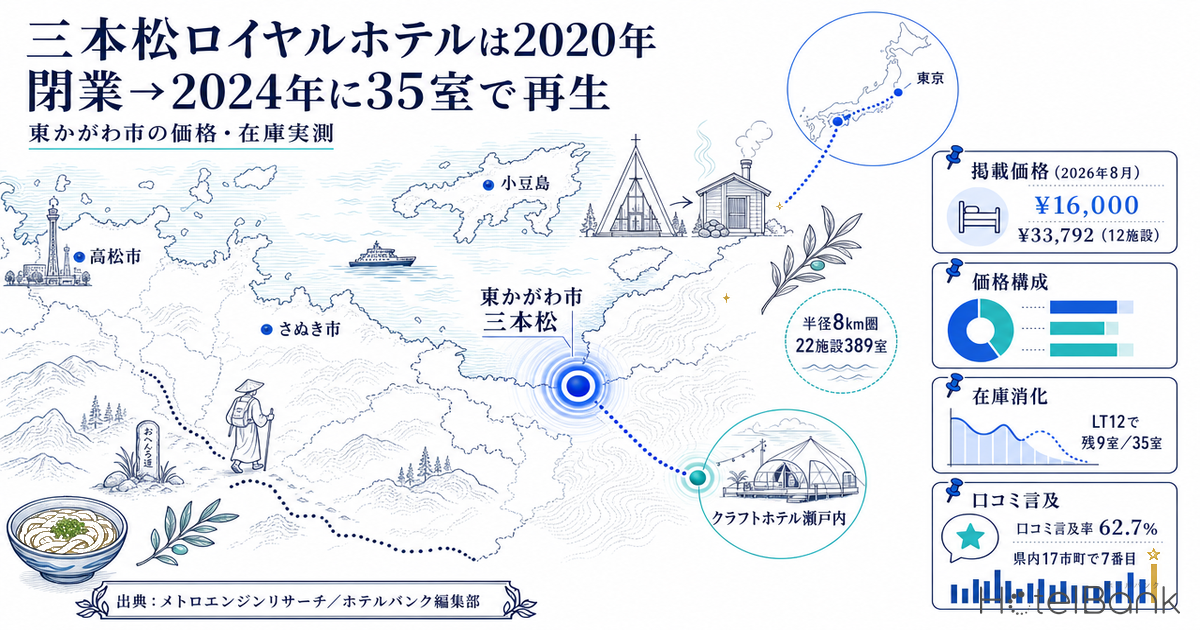
Sanbonmatsu Royal Hotel (三本松ロイヤルホテル), in the Sanbonmatsu district of Higashikagawa City, Kagawa, closed at the end of June 2020. Tokyo-based Dive Inc. (株式会社ダイブ) fully refurbished the building and reopened it on 1 March 2024 as Craft Hotel Setouchi (クラフトホテル瀬戸内), with all 35 rooms. The room count was left unchanged at 35, and the chapel that stood in the courtyard was converted into a Finnish sauna. It is a case in which the use of a building was rearranged — from a community hotel built around banquet halls into a stay-oriented hotel centred on sauna and the outdoors.
This article first traces the path from closure to revival through news coverage and the operator’s own announcements, then uses measured data from MetroEngines Research to set out where the reopened property now stands on price structure, pace of inventory sell-down, and the axes on which guests rate it. The intended readers are investors considering the revival of mid-sized regional room stock, and operators who want to assess this kind of conversion from an operational standpoint.
Metric Definitions Used in This Article
- ADR (average daily rate): an estimated settled rate (tax-exclusive equivalent) calculated by applying a category-specific adjustment coefficient to the cheapest plan each property publishes on OTAs and other booking sites (two guests per room, per-room price, tax-included). Cross-checked against property-level results disclosed by listed hotel REITs (91 properties, most recent three months), the median error is approximately 7%. These are estimates and differ from each property’s actual transacted prices and accounting figures. Area-level ADR is the median of the properties covered (the level of a typical property in that area).
- Listed price: the average price of all plans published on booking sites (two guests per room, per-room price, tax-included, from room-only through to meal-inclusive plans). Every figure described as a “listed price” in this article uses this basis.
- Occupancy (OTA-listed-inventory basis, estimated): the share of sold rooms against total rooms in the area (an estimate based on OTA sales inventory). It is derived from how inventory offered on booking sites sells down and differs from each property’s actual overall occupancy.
- LT (lead time): days remaining until the check-in date. LT0 = same day.
- Data source: MetroEngines Research
- — 35 rooms stayed 35 rooms. Sanbonmatsu Royal Hotel, which closed at the end of June 2020, reopened on 1 March 2024 as Craft Hotel Setouchi. No rooms were added; the banquet halls and chapel were rebuilt into a roughly 40 m² sauna, cold plunge and pool.
- — 62.7% of guest reviews mention the sauna (94 reviews, all positive / most recent 24 months, N=150). Chapel floor space that was hard to monetise as lodging has become a reason to book.
- — But the guest-room score is 3.89 (151 reviews), below the 4.32 overall score. Shared-space experience lifts the rating while the rooms themselves stay as they were — the outline of a revival carried out without adding rooms.
- — The cheapest plan held at ¥16,000 for nine months while higher-tier plans lifted the average. August listed prices ran ¥42,528 in 2024 and ¥41,518 in 2026 — essentially level for three straight years — while the cheapest plan itself was raised to ¥22,800–23,900 for October to December.
- — Properties observed in Higashikagawa City went from 5 to 12 in two years. The ¥33,792 listed price ranks 7th among the prefecture’s 17 municipalities, but the sample has turned over: the figure should be read as “the mix of listed lodging changed,” not “rates went up.”
Closed at the end of June 2020 — opened 1989, a community hotel with 35 rooms and banquet halls
Sanbonmatsu Royal Hotel opened in November 1989. Our own property master carries an opening record with that same date, listing 35 rooms and several banquet halls. Sanbonmatsu is the central district of Higashikagawa City and also sits along the pilgrimage route linking Shikoku’s 88 temples. Beyond lodging, the location served as a venue for banquets, memorial services and community events.
According to reporting by KSB Setouchi Broadcasting, the hotel entered a temporary closure from 1 May 2020 because of COVID-19, and closure at the end of June that year was decided on the grounds that “no recovery in demand can be expected.” The operator was Souyu (創裕) of Takamatsu City, which stated that its 30 employees would continue to be employed at other facilities. The hotel closed in its 31st year.
Even after the closure, our property master retained the old facility’s record and a history of 239 guest reviews. The building had not been demolished; a stock of 35 rooms had simply exited the market intact. Most closures in regional cities take this form. The land and building remain as assets, and only operations stop. That is where the scope for revival arises. Which properties closed during 2026 and how their successors moved is tracked property by property in Japan Hotel Closures 2026.
Reopened 1 March 2024 as Craft Hotel Setouchi — 35 rooms unchanged, the non-guest-room space rebuilt
The building was acquired and refurbished by Dive Inc. (株式会社ダイブ; founded March 2002, Shinjuku, Tokyo; representative director Kiyoshi Shoji). The company has run glamping facilities under the Lantern brand nationwide, and Craft Hotel Setouchi is its first hotel-format property. Refurbishment work advanced from autumn 2023; an opening in January 2024 was originally planned, but the actual opening date became 1 March 2024.
What stands out in the post-revival configuration is that the room count was left at 35, the same as the old hotel. According to the press release, the mix is 8 single, 9 twin, 9 double, 5 queen, 2 maisonette and 2 Japanese-style rooms. Weighting the 31 rooms whose floor area is known in our property master gives 16.5 m², made up of 8 rooms at 12 m², 14 rooms at 15 m² and 9 rooms at 18–28 m². Compact rooms dominate — standard for a mid-sized regional hotel.
What was rearranged was not the guest rooms but everything around them. The gable-roofed chapel that stood in the courtyard was converted into a Finnish sauna of roughly 40 m². It is used communally in swimwear and supports self-löyly, with a cold plunge and pool, terrace seating and a café & bar placed alongside. Floor space tied to banquet demand was replaced with floor space for bathing and outdoor experience — a conversion that swapped the product without adding rooms. The rate level required when turning an existing building over to lodging use is examined from the required-ADR side in Department Store Sites: 6 of 14 Go Hotel.
| Item | Sanbonmatsu Royal Hotel | Craft Hotel Setouchi |
|---|---|---|
| Opened | November 1989 | 1 March 2024 |
| Rooms | 35 | 35 (unchanged) |
| Main non-guest-room functions | Banquet halls, chapel | Sauna converted from the chapel (approx. 40 m²), cold plunge, pool, terrace, café & bar |
| Operator | Souyu (Takamatsu City) | Dive Inc. (Shinjuku, Tokyo) |
| Closed | End of June 2020 (31st year after opening) | — |
| Room area (our aggregation) | — | 16.5 m² weighted average across the 31 rooms with known area (12–28 m²) |
Source: KSB Setouchi Broadcasting reporting, Dive Inc. announcements, MetroEngines Research; compiled by the HotelBank Editorial Team
Four months later, in July 2024, the same company also opened The Lantern Higashikagawa (ザランタン東かがわ), a glamping property of about 17 pitches, within the same city. Placing the revival of an existing building alongside a new outdoor-format property in the same catchment suggests a design aimed at capturing stay demand across an area rather than at a single property.
Higashikagawa City’s listed price was ¥33,800 in August 2026 — but the observed properties turned over from 5 to 12 in two years
Now to the market level after the revival. According to MetroEngines Research, Higashikagawa City’s listed price (all-plan average, two guests per room, tax-included) was ¥33,800 in August 2026 across 12 properties, against ¥35,400 across 7 properties in the same month a year earlier. The difference is −4.6%, but that figure cannot be read as a price decline. The number of observed properties rose 1.7x from 7 to 12, so the sample itself has turned over.
Going further back, the city’s listed price in August 2024 was ¥16,900 across 5 properties. Over two years the observed properties went from 5 to 12 and the listed-price level moved by roughly a factor of two. During that period the hotel’s reopening, a glamping opening, and listings for whole-house rentals and guesthouses all landed together. Rather than saying the city’s room rates rose, it is closer to reality to say the mix of lodging listed in the city changed.
An estimated settled ADR also exists for the city — ¥10,600 in August 2026 — but it covers only 2 properties. Because the sample is small it is treated as a reference value, and this article uses listed price as the main axis when discussing levels in Higashikagawa City.
Source: MetroEngines Research; compiled by the HotelBank Editorial Team (Higashikagawa City; listed price = all-plan average, two guests per room, tax-included. September–December 2026 are estimates based on listed levels at the time of the survey)
7th among the prefecture’s 17 municipalities — high rates in small cities reflect facility mix, not demand strength
The table below ranks Kagawa’s municipalities by listed price for the same month, August 2026. At the top is Manno Town at ¥52,000, though only 3 properties are observed, followed by Sanuki City at ¥46,600 (29 properties) and Shodoshima Town at ¥43,000 (23 properties). Higashikagawa City’s ¥33,800 places it 7th of the 17 municipalities.
Takamatsu City, the prefecture’s largest lodging market, sits at ¥22,300 (169 properties), only 12th by rank. Average listed prices fall as market size grows because business hotels account for a larger share of rooms. On estimated settled ADR, Takamatsu comes in at ¥10,000 (71 properties), where the sample is ample. The high listed prices of small municipalities reflect a narrow facility mix — a high proportion of whole-house rentals, glamping and resort formats — and do not directly indicate strong demand. How rate levels within the prefecture split by tier is set out in Kagawa’s 16 Municipalities: 9.4x ADR Gap and Four Autumn Price Tiers.
Source: MetroEngines Research; compiled by the HotelBank Editorial Team (August 2026; listed price = all-plan average, two guests per room, tax-included)
| Municipality | Listed price | Properties observed | Estimated settled ADR | Properties covered |
|---|---|---|---|---|
| Manno Town | ¥51,971 | 3 | ¥33,273 | 1 |
| Sanuki City | ¥46,573 | 29 | ¥10,056 | 3 |
| Shodoshima Town | ¥42,970 | 23 | ¥23,980 | 8 |
| Mitoyo City | ¥39,793 | 43 | ¥10,111 | 4 |
| Tonosho Town | ¥36,675 | 40 | ¥15,385 | 9 |
| Kotohira Town | ¥35,165 | 27 | ¥13,287 | 15 |
| Higashikagawa City | ¥33,792 | 12 | ¥10,606 | 2 |
| Miki Town | ¥29,924 | 3 | ¥9,162 | 2 |
| Ayagawa Town | ¥29,096 | 4 | — | — |
| Tadotsu Town | ¥25,939 | 6 | ¥18,193 | 1 |
| Naoshima Town | ¥25,003 | 36 | ¥31,476 | 2 |
| Takamatsu City | ¥22,287 | 169 | ¥9,990 | 71 |
| Kanonji City | ¥19,305 | 22 | ¥9,493 | 12 |
| Marugame City | ¥18,595 | 23 | ¥8,156 | 11 |
Source: MetroEngines Research; compiled by the HotelBank Editorial Team (as of August 2026. The prefecture’s 17 municipalities ranked by listed price, showing the top 14. Zentsuji City, Sakaide City and Utazu Town fall outside the table)
Pricing in year three — the cheapest plan held at ¥16,000 while higher tiers were thickened
Next, the price trajectory of Craft Hotel Setouchi on its own. Its August listed price (all-plan average) was ¥42,500 in its opening year of 2024, ¥42,100 in 2025 and ¥41,500 in 2026 — essentially the same level for three years. That points to a stable product design for the summer peak.
The change shows up outside peak months. Listed prices from February to July 2025 ranged from ¥24,700 to ¥34,500, whereas the same months in 2026 ran ¥34,300 to ¥35,900. Meanwhile the cheapest plan stayed around ¥16,000 from January through September 2026, and was raised to ¥22,800–23,900 from October to December.
In other words, the entry price point was maintained while a thicker set of higher-tier plans lifted the average. Building a price range from room-only through to experience-inclusive around in-house features such as the sauna, pool and terrace is a reasonable approach to raising revenue per guest at a scale of 35 rooms. Raising the floor itself from autumn onward also suggests a sharper read on which periods carry demand.
Source: MetroEngines Research; compiled by the HotelBank Editorial Team (Craft Hotel Setouchi; listed price = all-plan average, two guests per room, tax-included. September–December 2026 are estimates based on listed levels at the time of the survey)
Autumn inventory sells down from 33 rooms left at LT90 to 9 rooms left at LT12
The pace of inventory sell-down is worth checking too. For check-in on Saturday 12 September, rooms remaining on booking sites moved from 33 of 35 at LT90 (90 days before check-in) to 27 at LT60, 22 at LT30 and 10 at LT14, with 9 left as of 31 August (LT12). For this date, up to 94.3% of total rooms appeared on booking sites during the observation period, so the sell-down occurred with an ample public allocation.
For Saturday 19 September the path was 26 rooms at LT90, 19 at LT60 and 10 at LT19 — a somewhat faster sell-down over the most recent three weeks. Saturday 10 October stood at 31 rooms at LT90 and 25 at LT60, still mid-course with 40 days to check-in. In each case most of the movement came in the final one to two weeks, indicating that demand concentrates in a relatively short lead time for a regional resort-style property.
On the macro side, occupancy for Kagawa as a whole in July 2026 (OTA-listed-inventory basis, estimated) was 84.6% across 274 properties and 11,834 rooms, with resort-format properties at 79.5%. Across the prefecture, summer inventory sold down at a high level.
Source: MetroEngines Research; compiled by the HotelBank Editorial Team (35 rooms in total; observed as of 31 August 2026)
62.7% of guest reviews mention the sauna — the chapel conversion became the draw
In gauging whether a revival has worked, where guests concentrate their evaluation is an important indicator. Analysing 150 guest reviews from the most recent 24 months compiled by the HotelBank Editorial Team, mentions of the sauna were the most frequent at 94 (a 62.7% mention rate), and every one appeared in a positive context. Next came the pool at 55 (36.7%), food overall at 46 (30.7%, of which 38 positive) and room cleanliness at 23 (15.3%).
Guest comments include phrases such as “I booked room-only because the sauna drew me in” and “it felt like an extraordinary space, as if I were overseas.” The old hotel’s chapel — floor space that was hard to monetise as a lodging business — is now the very reason people book. The overall score is 4.32; by category, service is 4.20 (140 reviews), facilities and amenities 4.21 (19 reviews) and location 4.17 (118 reviews), so in-house experience and hospitality both rate highly. On the other hand, guest rooms, the most-rated category, come in at 3.89 (151 reviews) and bathrooms at 3.68 (37 reviews), both below the overall score. In a conversion that reuses a structure more than 35 years old as it stands, shared-space experience tends to lift the rating while the rooms themselves stay where they were. The limit of a revival without added rooms shows up in that gap.
| Element mentioned | Mentions | Mention rate | Of which positive |
|---|---|---|---|
| Sauna and cold plunge | 94 | 62.7% | 94 |
| Pool | 55 | 36.7% | 46 |
| Food overall | 46 | 30.7% | 38 |
| Room cleanliness | 23 | 15.3% | 23 |
| Bathing and spa | 21 | 14.0% | 21 |
| Staff service | 17 | 11.3% | 17 |
| Value for money | 14 | 9.3% | 14 |
Source: HotelBank Editorial Team research (analysis of 150 guest reviews from the most recent 24 months. Mention rate = share of reviews touching on that element)
New supply in Kagawa is fragmenting — where 35 rooms sit within 22 properties and 389 rooms inside 8 km
Placing this revival on the supply side makes its meaning clearer. Within the scope MetroEngines Research tracks, new openings in Kagawa (on a booking-site listing-confirmed basis) numbered 43 in 2023, 46 with 399 rooms in 2024 and 45 with 710 rooms in 2025. The count holds steady in the low 40s each year, but the scale per opening is small. In 2023, 43 openings came to 136 rooms — just 3.2 rooms each — and only one had 20 or more rooms. Of the 46 openings in 2024, only 5 had 20 rooms or more, and Craft Hotel Setouchi’s 35 rooms is counted among them.
For 2026, 19 openings and 734 rooms have been confirmed so far, but this is a figure still being observed. Because listings appear on booking sites several months before opening, recent and later months may rise with future listings. Projects of 20 rooms or more include business-hotel openings in Takamatsu City and Kanonji City.
| Year | Openings | Total rooms | Of which 20+ rooms | Notes |
|---|---|---|---|---|
| 2023 | 43 | 136 | 1 | Mostly whole-house rentals and guesthouses |
| 2024 | 46 | 399 | 5 | Includes Craft Hotel Setouchi (35 rooms) |
| 2025 | 45 | 710 | 6 | Led by lodging-focused hotels in Takamatsu City and Kanonji City |
| 2026 | 19 | 734 | 6 | Still being observed; expected to rise with future listings |
Source: MetroEngines Research & Consulting (booking-site listing-confirmed basis); compiled by the HotelBank Editorial Team
Narrowing the catchment further sharpens the picture. Within an 8 km radius of the hotel, 22 lodging properties with 389 rooms can be confirmed as operating. One 133-room business hotel plus the hotel’s own 35 rooms account for 43% of that total, with the remainder made up of small properties of 1 to 17 rooms. For the nearly four years in which a consolidated block of 35 rooms in central Sanbonmatsu sat idle, this catchment had effectively only one property able to take groups.
Source: MetroEngines Research; compiled by the HotelBank Editorial Team (circle size indicates room count)
Conclusion — 35 rooms whose product was swapped without adding a single room
What the Sanbonmatsu Royal Hotel case shows is that reviving mid-sized regional stock does not necessarily start from moving the room count. The 35 rooms stayed 35 rooms, and rebuilding the non-guest-room floor space — the banquet halls and the chapel — into bathing and outdoor experience swapped out the very reason for staying. That 62.7% of guest reviews mention the sauna shows the rebuild is working as the draw.
On price, the structure holds the cheapest plan at around ¥16,000 while thickening higher tiers, and peak-season listed prices have stayed at nearly the same level for three consecutive years. Inventory sell-down concentrates around LT14, so room remains to capture last-minute demand. From autumn the floor itself is being raised as well — a sign that, entering year three, the resolution of the pricing design is improving.
That Higashikagawa City’s listed price now spans 12 observed properties instead of 5 within two years is itself a sign that new lodging product is accumulating in this catchment. In small markets, a single revival moves the municipal statistics themselves. When weighing the revival of regional stock, the view required covers not only the economics of the single property but how that one property changes the product mix of the whole catchment.
⚠ Note on prices for future dates: Prices in this article for September 2026 onward are estimates based on rates published on booking sites at the time of the survey, and will move as the check-in date approaches. Please note that the current level will not necessarily become the transacted price. Inventory observations are as of 31 August 2026, and each property’s sales status is updated daily.
Related reading
- Kagawa’s 16 Municipalities: 9.4x ADR Gap and Four Autumn Price Tiers
- Japan Hotel Closures 2026: 3 Hotels, 316 Rooms Closed, 1,149 Delayed
- Department Store Sites: 6 of 14 Go Hotel, ADR Needs 1.4-3.1x Market
- Hotels at Year 10: The Renovation Gap Is +13.6% Below 100 Rooms
- 98,338 Lodging Facilities: 30 of 47 Prefectures Lost Rooms in FY2024
References and Sources
■ News coverage and official announcements
- [COVID-19] Sanbonmatsu Royal Hotel to close: “no recovery in demand can be expected” — Higashikagawa City, Kagawa (KSB Setouchi Broadcasting, 2020)
- Former Sanbonmatsu Royal Hotel refurbished: a “stay-and-outdoor” hotel to open — Higashikagawa City, Kagawa (KSB Setouchi Broadcasting, 2023)
- [Higashikagawa City, Kagawa] Concept hotel Craft Hotel Setouchi, with a chapel sauna, opens 1 March 2024 (Dive Inc. press release)
- [Higashikagawa City, Kagawa] Concept hotel CRAFT HOTEL Setouchi to open (Dive Inc. press release)
- Craft Hotel Setouchi (Higashikagawa City tourism information site)
■ Data sources
Facility specifications (room count, room area, opening date) and guest reviews come from our property master and review analysis (most recent 24 months, N=150). Listed prices and estimated settled ADR were aggregated monthly from August 2024 to December 2026 for Kagawa’s 17 municipalities and for the subject property. Remaining-room trajectories are observations of inventory published on booking sites against 35 total rooms (as of 31 August 2026). Kagawa occupancy is an aggregation of 274 properties and 11,834 rooms for July 2026. New openings are counted for 2023–2026 on a booking-site listing-confirmed basis.
■ Calculation assumptions
Listed price is the all-plan average (two guests per room, per-room price, tax-included); estimated settled ADR is an estimated settled rate (tax-exclusive equivalent) derived by applying a category-specific adjustment coefficient to the cheapest plan level, with the median of covered properties used at area level. Occupancy estimates the share of sold rooms against total rooms in the area from OTA-listed inventory. The municipal ranking sorts listed prices for a single month (August 2026) in descending order and shows the top 14. Review mention rates divide the number of reviews touching on an element by N=150.
■ Limitations and caveats
Estimated settled ADR for Higashikagawa City covers 2 properties, and Manno Town and Miki Town are observed at 3 properties each — samples too small to be more than reference values. The main reason the city’s listed price roughly doubled in two years is that observed properties turned over from 5 to 12; it does not indicate the size of price increases at existing properties. Prices from September 2026 onward are estimates based on listed levels at the time of the survey and will move as the arrival date approaches. The 19 openings and 734 rooms for 2026 are still being observed and will rise with future listings. Occupancy is an OTA-listed-inventory-based estimate and differs from each property’s actual occupancy and accounting results.
■ Market data
- MetroEngines Research — listed price and estimated settled ADR (Kagawa’s 17 municipalities, August 2024–December 2026), remaining-room trajectories (35 total rooms), new openings (listing-confirmed basis)
- HotelBank Editorial Team research — guest review analysis (most recent 24 months, N=150)
■ Official statistics