

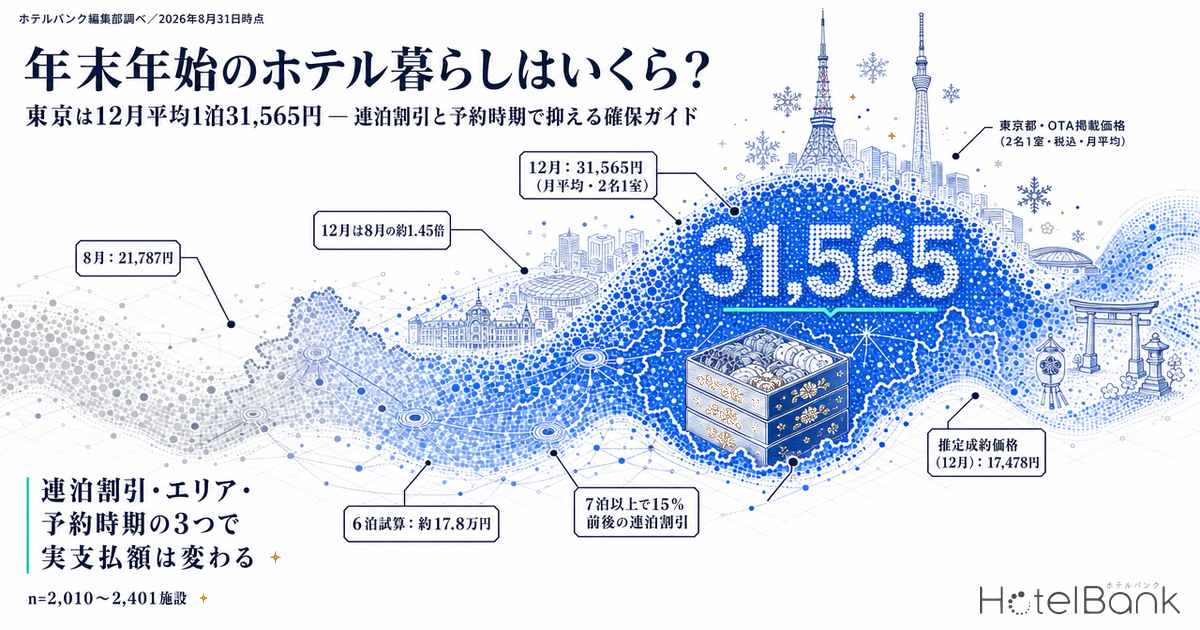
What does it cost to spend the New Year holidays in a hotel instead of going back to your family home? Based on OTA listed prices in Tokyo (two guests per room, tax included, monthly average), December 2026 runs ¥31,565 a night — about 1.45 times the August level of ¥21,787 (HotelBank Editorial Team research, as of 31 August 2026, n=2,010–2,401 properties). Six nights from 29 December to 3 January works out to roughly ¥178,000 on a straight calculation at the average listed price. But that is a monthly average across every price band, and what you actually pay shifts substantially with three things: long-stay discounts, which area you choose, and when you book. This article lays out — from measured data — how much it costs and how to secure a room, for anyone whose company dormitory or corporate housing closes over the New Year, or who is spending the holidays in a hotel rather than travelling home.
• Listed price = the monthly average of the selling prices each property publishes on OTAs (two guests per room, per room, tax included). Because higher-priced rooms on sale are included, it runs above the level at which bookings actually close.
• Estimated transaction price = an estimated per-room transaction rate (tax-excluded equivalent) derived by applying category-specific adjustment factors to the listed price. It is an estimate and differs from each property’s actual transaction prices and accounting figures.
• Area (prefecture) figures are aggregates across the covered properties and do not represent the price of any specific date or specific property.
• Source: HotelBank Editorial Team research (ongoing aggregation of OTA public prices, as of 31 August 2026)
- — Tokyo’s listed price reaches ¥31,565 a night in December (two guests per room, tax included, monthly average, n=2,010 properties). That is about 1.45 times the August figure of ¥21,787, while January 2027 — just across the year boundary — falls about 12% to ¥27,767.
- — Six nights from 29 December to 3 January come to roughly ¥178,000 on the listed-price average, or about ¥94,000 on the estimated transaction price. What you actually pay is likely to land inside that range, so “¥32,000 a night on average” is best read as an upper-end benchmark.
- — Reshape the stay into seven nights and apply a 15% long-stay discount and you get an extra night for almost exactly what six nights cost at rack rate (about ¥178,000). Over the New Year, moving onto a long-stay plan is more efficient than cutting nights.
- — Choosing the area is worth roughly ¥10,000 a night in the measured data. December listed prices by ward run ¥45,304 in Shibuya against ¥24,431 in Ota and ¥25,943 in Toshima — step away from the central terminals and options sit more than 40% lower.
- — Only 2,010 properties had December on sale, fewer than the 2,401 selling August. With properties still to open year-end inventory, the earlier you look, the more room you have to pick your price band.
Tokyo’s listed price hits ¥31,565 a night in December — about 1.45× August
Start with the going rate. Aggregate OTA listed prices for hotels across Tokyo (all categories) by month, and they climb in stages from autumn into year-end.
| Month | Listed price (monthly average, two guests per room, tax incl.) | Properties in sample |
|---|---|---|
| August 2026 | ¥21,787 | 2,401 |
| September 2026 | ¥25,154 | 2,361 |
| October 2026 | ¥30,516 | 2,270 |
| November 2026 | ¥31,243 | 2,126 |
| December 2026 | ¥31,565 | 2,010 |
| January 2027 | ¥27,767 | 1,875 |
Source: HotelBank Editorial Team research (aggregation of OTA public data, as of 31 August 2026). Average selling price per room.
Source: HotelBank Editorial Team research (OTA public data, aggregated as of 31 August 2026, Tokyo, all categories)
December’s ¥31,565 is about 1.45 times the August level. January 2027, across the year boundary, comes in at ¥27,767 — roughly 12% below December on a monthly average. The point to watch is that these are averages across the whole month. December’s early-month weekdays and its year-end days have quite different pricing characteristics, and the price on a specific date will not necessarily match the monthly average. For when and how far day-by-day New Year pricing takes shape, Year-End 2026-27 Room Rates Are Already Visible tests December forward prices against prior-year actuals.
One more distinction to keep in mind: listed prices and the level at which bookings actually close are not the same thing. The listed price is an average that includes higher-priced rooms on sale, and by our estimate the level at which reservations are actually being made (estimated transaction price, a tax-excluded-equivalent estimate) is running at ¥17,478 in December (n=1,004 properties) — below the listed average. In other words, “¥32,000 a night on average” is close to a ceiling, and if you book with the price band in mind there is ample room to pay less.
Costing six New Year nights — about ¥178,000 straight, or seven nights for the same on a long-stay plan
■ Assumptions
- Period: check in 29 December 2026, check out 3 January 2027 (six nights)
- Rate: Tokyo monthly average OTA listed price (two guests per room, tax included, aggregated as of 31 August 2026). ¥31,565 applied to the three December nights, ¥27,767 to the three January nights
- A mechanical calculation using monthly averages; actual conditions on specific year-end dates may differ. Meals and transport are not included
On these assumptions, six nights of accommodation come to ¥31,565 × 3 nights + ¥27,767 × 3 nights = about ¥178,000 (per room).
That is an upper-end figure on a listed-price basis, though. Replace the same six nights with the estimated transaction price (a tax-excluded-equivalent estimate) and you get ¥17,478 × 3 nights + ¥13,991 × 3 nights = about ¥94,000. Realistically, what you pay will land in a range of roughly ¥94,000 to just under ¥178,000 depending on the price band you choose — there is no need to brace for “¥178,000 for six nights in Tokyo over the New Year.”
| Stay pattern | Listed-price basis | Estimated transaction price basis | Discount applied |
|---|---|---|---|
| 6 nights (29 Dec–3 Jan) | approx. ¥178,000 | approx. ¥94,000 | None |
| 7 nights (28 Dec–4 Jan), rack rate | approx. ¥210,000 | approx. ¥112,000 | None |
| 7 nights (28 Dec–4 Jan), long-stay plan | approx. ¥178,000 | approx. ¥95,000 | 15% |
| 30 nights (mid-December to mid-January) | approx. ¥710,000 | approx. ¥380,000 | 20% |
Source: HotelBank Editorial Team research (aggregation of OTA public data, as of 31 August 2026). Listed prices are for two guests per room, tax included; estimated transaction prices are tax-excluded-equivalent estimates. A mechanical calculation using monthly average rates, which differs from actual conditions on specific dates.
Source: HotelBank Editorial Team research (OTA public data, aggregated as of 31 August 2026, per room)
This is where long-stay discounts start to matter. In our measured survey of long-stay plans, discounts of around 15% at seven nights or more and around 20% at 30 nights or more are confirmed at market level (details in “Japan Hotel Long-Stay Discounts: 15% at 7 Nights, 20% at 30 Nights“). Reshape the stay into the seven nights from 28 December to 4 January and apply a 15% discount, and the seven-night rack rate of about ¥210,000 falls to about ¥178,000. That means six nights become seven for the same outlay — over the New Year, moving onto a long-stay plan tends to make more sense than trimming nights. For what a week itself costs as a unit, One Week of Hotel Living in Tokyo: ¥88,200 for 7 Nights, Any Start Day measures it, including what happens when you shift the starting day of the week.
For a monthly-style 30-night stay covering mid-December through mid-January, applying the 20% discount to the monthly average rates above gives about ¥710,000 — but that is an upper-end benchmark based on an all-category average that includes high-priced rooms. Narrow the search to limited-service or apartment-style properties and there are genuinely selectable properties whose monthly cost sits well below that level.
Three ways to keep the cost down — long-stay plans, area, and booking timing
1. Move onto a long-stay or monthly plan. As noted above, measured OTA data shows discounts of around 15% at seven nights or more and around 20% at 30 nights or more. A stay straddling the New Year can often be shifted by a day or two to land inside the seven-night bracket and qualify for the discount.
2. Step away from the city centre. The table above is an average for Tokyo as a whole, and listed price levels differ clearly between the areas around central terminal stations and areas 15 to 30 minutes away by train. Aggregate December 2026 by ward and the gap comes to roughly ¥10,000 a night.
| Ward | Listed price | Estimated transaction price | Properties in sample |
|---|---|---|---|
| Shibuya | ¥45,304 | — | 88 |
| Chuo | ¥38,934 | ¥21,020 | 192 |
| Minato | ¥36,704 | ¥20,976 | 189 |
| Shinjuku | ¥35,323 | ¥20,460 | 177 |
| Sumida | ¥34,389 | — | 111 |
| Chiyoda | ¥32,672 | ¥19,383 | 107 |
| Taito | ¥32,048 | ¥17,462 | 339 |
| Toshima | ¥25,943 | ¥15,704 | 112 |
| Ota | ¥24,431 | ¥14,794 | 78 |
Source: HotelBank Editorial Team research (aggregation of OTA public data, as of 31 August 2026). Wards with fewer than 75 properties in the sample are omitted, since a small number of properties would skew the average. Estimated transaction prices are shown as “—” for wards with fewer than 30 properties in the sample.
Source: HotelBank Editorial Team research (OTA public data, December 2026 stays, two guests per room, tax included)
Against Shibuya’s ¥45,304, Ota runs ¥24,431 and Toshima ¥25,943. Step away from the central terminals and the options available sit more than 40% lower. Taito offers the widest choice at 339 properties, at ¥32,048 — in line with the Tokyo-wide average of ¥31,565 — and Ueno and Asakusa make it easy to move into the centre. Most people are not commuting over the New Year, and that is the season’s advantage: you can drop the everyday constraint of “close to the office.” Simply avoiding the entertainment districts and major terminals where countdown crowds and first-shrine-visit traffic concentrate, and staying by a station one transfer out, makes it easier to compress the bill at the same standard of facilities.
3. Lock it in early, once selling starts. At the time of this aggregation (31 August 2026), 2,010 properties had December prices on sale — fewer than the 2,401 selling the current month of August. Properties have yet to open year-end inventory, which means the basic approach is to secure a room when the property you want releases its New Year long-stay plan. The earlier you lock it in, while choice is wide, the more room you keep to pick your price band.
Facilities to check when securing a room — two conditions specific to the New Year
For anyone whose dormitory or corporate housing closes, or who is spending a week or so in a hotel instead of going home, choosing a hotel over the New Year involves two conditions that do not apply the rest of the year.
First, securing meals. Over the New Year there are days when nearby restaurants and supermarkets close or cut their hours, and “I’ll just eat out” does not hold up. A property where you can have both breakfast and dinner on site, or one with a kitchen and microwave in the room so you can cook, means you will not struggle for meals during the first three days of January. How to combine eating out, takeaway and in-room cooking — and how that compares against the price gap for a breakfast-included plan — is set out in Hotel Long-Stay Meals in Japan: 3 Patterns & ¥565–2,174 Breakfast Gap. Apartment-style hotels with a kitchen and a washer-dryer in the room suit this kind of “living there” stay particularly well (for specific properties, “Top 5 apartment-style hotels with kitchens and washer-dryers for living-style stays” goes into detail, in Japanese).
Second, the laundry routine. On stays beyond six nights, whether the building has laundry facilities directly determines how much you have to pack and how comfortable the stay is. With an in-room washer-dryer, you also skip the queue for shared machines when they are busy.
The things to watch when living in a hotel for more than a week in general — residence registration, post, how costs accumulate — are set out in “6 Downsides of Hotel Living in Japan: ¥502,000 per 30 Nights & Fixes.” If a New Year stay is prompting you to consider longer-term hotel living, that is worth reading first.
Looking further
For side-by-side comparisons of specific properties, these articles go into detail (in Japanese).
Five properties with in-room kitchens and washer-dryers — including Tokyu Stay Shinjuku Eastside (東急ステイ新宿イーストサイド) and MIMARU Tokyo Ueno East (MIMARU東京 上野EAST) — selected across Tokyo, Osaka, Fukuoka and Sapporo and compared on long-stay rates and the quality of everyday infrastructure. Directly usable for finding a room to “live in” over the New Year.
Five properties where both breakfast and dinner can be handled in-house — including Hotel MyStays Premier Narita (ホテルマイステイズプレミア成田, three restaurants on site) and the hot-spring-equipped Hotel MyStays Premier Sapporo Park (ホテルマイステイズプレミア札幌パーク) — compared right down to dinner service hours. A particularly useful angle for New Year long stays, when restaurants tend to be closed.
Frequently asked questions
How much does it cost to stay at a Tokyo hotel over the New Year?
OTA listed prices in Tokyo (two guests per room, tax included, all-category monthly average) are ¥31,565 a night for December 2026 and ¥27,767 for January 2027. Six nights from 29 December to 3 January come to about ¥178,000 on the listed-price average, or about ¥94,000 on the estimated transaction price (a tax-excluded-equivalent estimate), and what you actually pay will generally land within that range. Both figures are per room and exclude meals and transport (HotelBank Editorial Team research, as of 31 August 2026, n=1,875–2,010 properties).
Which is cheaper, December or January?
On a monthly average, January 2027 at ¥27,767 is about 12% below December 2026 at ¥31,565. That said, these are averages across the whole month, and December’s early-month weekdays and its year-end days have different pricing characteristics. The price on a specific date will not necessarily match the monthly average, so if your dates are already fixed, check day-by-day prices.
Do long-stay discounts apply over the New Year too?
In our measured survey of long-stay plans, discounts of around 15% at seven nights or more and around 20% at 30 nights or more are confirmed at market level. A stay straddling the New Year can often be moved by a day or two to fall inside the seven-night bracket; reshape it into the seven nights from 28 December to 4 January and apply a 15% discount, and the rack rate of about ¥210,000 becomes about ¥178,000. That is an extra night for almost exactly what six nights cost at rack rate.
Which areas work out cheaper?
Looking at December 2026 by ward across Tokyo’s 23 wards, Shibuya is the most expensive at ¥45,304 (88 properties), while Ota at ¥24,431 (78 properties) and Toshima at ¥25,943 (112 properties) sit more than 40% lower. Taito is ¥32,048 but has the largest sample at 339 properties, making it the easiest area for balancing breadth of choice against access to the centre. Because the commuting constraint lifts over the New Year, an approach that does not insist on the central terminals pays off.
When should I book?
As of 31 August 2026, 2,010 properties had December prices on sale, fewer than the 2,401 selling the current month of August. With properties still to open year-end inventory, the basic approach is to secure a room when the property you want releases its New Year long-stay plan. The earlier you lock it in, while choice is wide, the more room you keep to pick your price band.
How should I handle meals during a New Year hotel stay?
Over the New Year there are days when nearby restaurants and supermarkets close or cut their hours, so choosing a property where you can have both breakfast and dinner on site, or one with an in-room kitchen and microwave for cooking, means you will not struggle for meals during the first three days of January. Apartment-style hotels with a kitchen and a washer-dryer in the room are a particularly good fit for “living there” stays beyond six nights.
References and sources
■ Data sources
Prices are drawn from ongoing aggregation of the listed prices of accommodation plans published on OTAs (HotelBank Editorial Team research, as of 31 August 2026). Tokyo-wide monthly levels cover stays from August 2026 to January 2027, with 1,875 to 2,401 properties in the sample each month. Estimated transaction prices cover 955 to 1,101 properties over the same period. Ward-level figures are for December 2026 stays, with the nine wards holding 75 or more properties in the sample shown (from Taito at 339 to Ota at 78). The long-stay discount levels (around 15% at seven nights, around 20% at 30 nights) come from our measured survey of long-stay plans.
■ Calculation assumptions
Listed prices are per-room rates for two guests per room (tax included, averaged across all plans) and include higher-priced rooms on sale. Estimated transaction prices are estimated rates (tax-excluded equivalent) derived by applying category-specific adjustment factors to listed prices, and differ from actual transaction prices and each property’s accounting figures. Stay totals are simple products of monthly average rates: six nights as three December nights plus three January nights, seven nights as four December nights plus three January nights, and 30 nights as the average of the December and January rates multiplied by 30. Long-stay discounts are applied uniformly at 15% for seven nights and 20% for 30 nights. Meals, transport and optional charges are excluded.
■ Limitations and caveats
Every figure in this article is a mechanical calculation based on monthly averages and may differ from actual conditions on specific dates over the New Year. Because December’s first half and its year-end days have different pricing characteristics, the monthly average is not necessarily a guide to any specific date. Ward-level figures are area aggregates and do not represent the price of a specific property or a specific date. At the time of aggregation (31 August 2026), properties had yet to open year-end inventory, and levels may move once the full set of selling properties is in place. Whether long-stay discounts apply, and at what rate, varies by property and plan; the same discount is not available everywhere. On New Year demand patterns (crowds for first shrine visits, countdown events and the like), no estimates have been made beyond what can be confirmed in primary published materials.
Related reading
- Year-End 2026-27 Room Rates Are Already Visible: December Forward ADR vs Prior-Year Actuals
- One Week of Hotel Living in Tokyo: ¥88,200 for 7 Nights, Any Start Day
- Japan Hotel Long-Stay Discounts: 15% at 7 Nights, 20% at 30 Nights
- Hotel Long-Stay Meals in Japan: 3 Patterns & ¥565–2,174 Breakfast Gap
- Business Hotels for Long Stays: 6 Checks and ¥16,722 a Night in Tokyo
- Monthly Hotels in Japan: No Lease, 20% Off at 30 Nights (Aug 2026)
- 6 Downsides of Hotel Living in Japan: ¥502,000 per 30 Nights & Fixes