

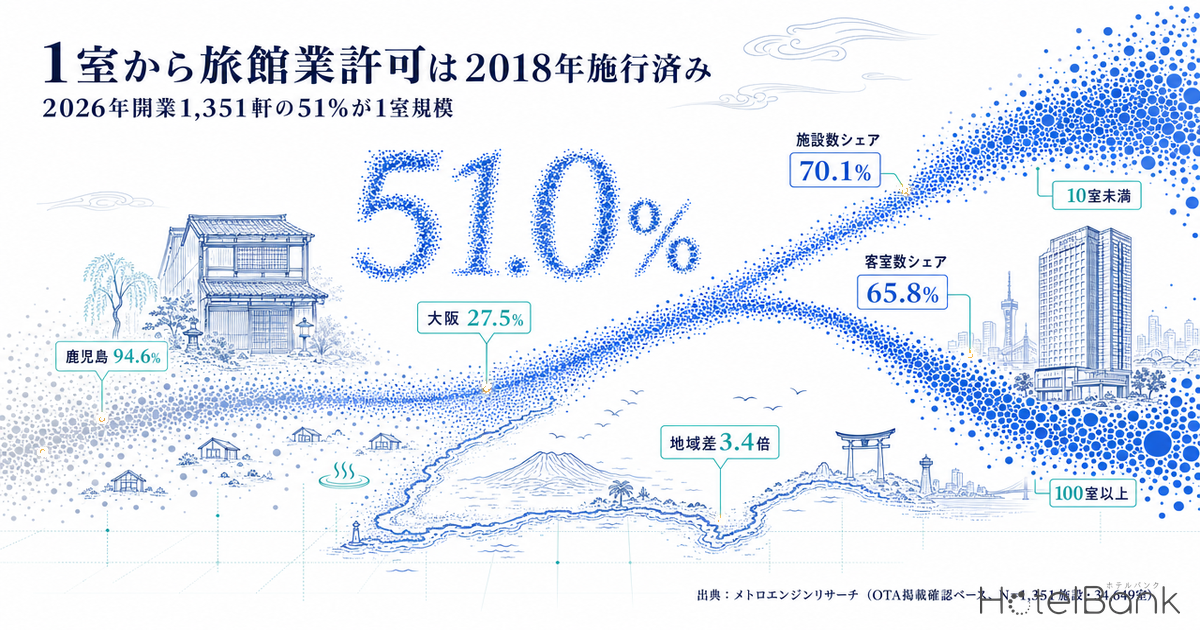
Being able to obtain a ryokan/hotel business licence for a property with a single guest room is not something that began in 2026. The minimum room-count requirement — 10 rooms for hotel business, 5 rooms for ryokan business — was abolished by the amended Hotel Business Act that took effect on June 15, 2018 (Act No. 84 of 2017). Eight years have already passed since then. So how has the shape of lodging supply changed over those eight years? Across the 1,351 facilities that opened in Japan in 2026 and are tracked by MetroEngines Research, 51.0% have a single room and 70.1% have fewer than 10. Size brackets that would not have met the licensing requirements under the old rules now account for seven out of every ten new openings.
Metric Definitions Used in This Article
- ADR (Average Daily Rate): An estimated settled rate (tax-excluded equivalent) calculated by applying a property-type correction factor to the lowest publicly listed plan rate each facility shows on OTAs (double occupancy, per-room rate, tax included). Cross-checked against property-level results disclosed by listed hotel REITs (91 facilities, most recent three months), the median error is approximately 7%. These are estimates and differ from each facility’s actual transacted rates and accounting figures. Area-level ADR is the median across the facilities covered (the level of a typical facility in that area).
- Number of new openings: Of the roughly 168,000 domestic facilities tracked by MetroEngines Research, the approximately 27,000 with confirmed activity on OTAs form the population; facilities whose opening date falls within the year in question are counted (OTA-listing-confirmed basis). Ryokan, minshuku and simple lodgings not listed on OTAs are excluded.
- Data sources: MetroEngines Research; published materials from the Ministry of Land, Infrastructure, Transport and Tourism and the Ministry of Health, Labour and Welfare
- — Licensing a ryokan/hotel business with a single room took effect on June 15, 2018. Descriptions that place it in 2026 have the year wrong, and the December 2023 amendment did not touch the room-count standard either.
- — Of the 1,351 facilities that opened in 2026, 51.0% have one room and 70.1% have fewer than 10. Size brackets that would not have qualified under the old rules (10 rooms for hotels, 5 for ryokan) make up seven-tenths of new openings.
- — Measured in rooms, however, single-room properties are just 2.0% of the total. The 116 facilities with 100 or more rooms hold 65.8% of the 34,649 rooms. Counted by facility or by room, the market stands on its head — a classic barbell structure.
- — The regional spread in the sub-10-room share is 3.4x (Kagoshima 94.6% vs Osaka 27.5%). What drives it is not regulation but the convertible building stock and the unit size in which land is acquired.
- — Rate gaps come from what is offered, not from the licence category. In Shizuoka, ryokan run at ¥16,100 against ¥7,000 for business hotels — yet in Hokkaido, ryokan at ¥9,400 sit below business hotels at ¥10,400.
First, a fact check: single-room operation was deregulated in 2018, and the most recent amendment came in 2023
Before turning to the substance, it is worth pinning down the regulatory timeline precisely. Several accounts circulating online state that “the amended Hotel Business Act took effect on June 15, 2026, making it possible to operate with a single room,” but the year is wrong. The date “June 15” is correct; the year is 2018 (Heisei 30).
There is more than one source for this. Kanko Keizai Shimbun, reporting the confirmed enforcement date, described the consolidation of business categories into “ryokan/hotel business,” the abolition of the minimum room count, and the conditional waiver of the front-desk requirement, all as taking effect on June 15. Materials published by the Tokyo Metropolitan Government’s Bureau of Social Welfare and Public Health (as it was then named) on March 28, 2018 for an advisory council set out the same content as an overview of the amended Act. The amending law passed on December 8, 2017 and took effect on June 15 of the following year.
The amendment that followed took effect on December 13, 2023 (Reiwa 5), and it centred on clarifying the grounds on which accommodation may be refused and on infectious-disease provisions; it did not move the standards for room counts or structural facilities. In other words, as of the end of August 2026, the rules governing single-room operation have not changed since 2018. The Act sets out three licence categories — ryokan/hotel business, simple lodging business and boarding-house business — each with its own requirements, and neither the 2018 nor the 2023 amendment redrew the boundaries between them.
| Date | Event | Impact on lodging supply |
|---|---|---|
| July 1948 | Hotel Business Act enacted | Four categories: hotel business, ryokan business, simple lodging business, boarding-house business |
| December 8, 2017 | Amending law passed (Act No. 84 of 2017) | — |
| June 15, 2018 | Amended Act takes effect | Business categories consolidated into “ryokan/hotel business” / minimum room counts (10 and 5 rooms) abolished, making licensing possible from a single room / guest-room floor area set at 7 m² or more per room, 9 m² or more where beds are installed / dimensional rules for the front desk removed and conditional waiver permitted / ICT-based identity verification treated as equivalent to in-person checks / guest register retention period set at three years |
| June 15, 2018 | Private Lodging Business Act takes effect | A notification-based minpaku regime (capped at 180 nights offered per year) runs in parallel |
| December 13, 2023 | Amended Act takes effect (Reiwa 5) | Clarified grounds for refusing accommodation, among other changes. No change to room-count or structural-facility standards |
Source: Compiled by the HotelBank Editorial Team from published materials of the Ministry of Health, Labour and Welfare and the Tokyo Metropolitan Government, and reporting by Kanko Keizai Shimbun
Operating without a front desk has been subject to three conditions since the day the amendment took effect: a system allowing staff to reach the property within roughly 10 minutes in an emergency, continuous monitoring by video camera or equivalent, and appropriate handover of keys. ICT-based identity verification likewise presumes that the guest’s face and passport can be clearly confirmed from the image and that the image is transmitted from the immediate vicinity of the facility. Unattended operation was never approved unconditionally — and that has not changed eight years on.
51% of the 1,351 facilities opened in 2026 have one room — a supply structure that inverts between facilities and rooms
Enough on the regulation; the question is what supply actually looks like. Splitting the 2026 openings tracked by MetroEngines Research (1,351 facilities for which room counts are known) into size brackets, the structure is clearly polarised.
By facility count, single-room properties account for 689 facilities, or 51.0%; by room count, they represent a mere 2.0% of the 34,649 rooms. Conversely, properties with 100 or more rooms number just 116 facilities, or 8.6%, yet hold 22,799 rooms — 65.8% of the total. Whether you count doors or rooms, the market looks the opposite way round: a textbook barbell structure.
Source: MetroEngines Research (OTA-listing-confirmed basis, N=1,351 facilities / 34,649 rooms), compiled by the HotelBank Editorial Team
This is not unique to 2026. Running the same tally back to 2023, the single-room share comes to 47.6% in 2023, 49.2% in 2024, 46.8% in 2025 and 51.0% in 2026 — broadly stable around half over four years. The sub-10-room share has likewise held in the 70s: 75.0% → 76.4% → 70.0% → 70.1%. Rather than a surge triggered by the deregulation of single-room operation, it reads closer to reality to say that, several years on from that change, “a majority of openings are single-room” has settled into a steady state.
Source: MetroEngines Research (OTA-listing-confirmed basis; 2023 N=2,012 / 2024 N=1,975 / 2025 N=1,741 / 2026 N=1,351), compiled by the HotelBank Editorial Team
One caveat concerns the facility counts for the most recent year. Because our opening data captures a property at the point its OTA listing is confirmed, and listings typically appear only a few months before opening, the latest year is always undercounted. The total of 1,351 facilities for 2026 will grow as further listings are added, and it should not be compared directly with the 1,700–2,000 facilities recorded for 2023–2025 to conclude that openings have declined. The shares by size bracket, on the other hand, move little as the denominator grows, so comparisons on a percentage basis do hold. That is why this article is built around shares rather than totals. The gap between the number of licensed premises the authorities count and the number visible on OTAs is itself substantial — roughly 98,000 licensed facilities against some 27,000 with confirmed OTA listings.
Breakdown by property type — 655 rental villas, 38 machiya, both with a median of one room
Breaking the 689 single-room facilities down by property type, rental villas account for 575 facilities, or 83.5%. They are followed by machiya townhouses (32), cottages (26) and guesthouses (20). The structure by which whole-property rentals are registered as having “one room” shows up directly in the numbers.
| Property type | Facilities | Median rooms | Share under 10 rooms | Total rooms |
|---|---|---|---|---|
| Rental villa | 655 | 1 room | 99% | 1,042 |
| Business hotel | 146 | 67 rooms | 8% | 14,687 |
| Hostel | 80 | 11 rooms | 45% | 1,349 |
| Guesthouse | 70 | 3 rooms | 91% | 292 |
| Resort hotel | 61 | 45 rooms | 13% | 5,578 |
| Cottage | 50 | 1 room | 70% | 505 |
| Ryokan | 44 | 9 rooms | 52% | 667 |
| City hotel | 39 | 112 rooms | 3% | 4,526 |
| Machiya townhouse | 38 | 1 room | 97% | 68 |
| Minshuku | 23 | 4 rooms | 91% | 116 |
| Pension | 13 | 5 rooms | 85% | 70 |
| Glamping | 12 | 5 rooms | 67% | 93 |
Source: MetroEngines Research (OTA-listing-confirmed basis; 2026 openings with known room counts, N=1,351 facilities), compiled by the HotelBank Editorial Team
What stands out is that the nine small-format property types — rental villas, machiya, cottages, guesthouses, minshuku, pensions, glamping, lodges and hostels — total 949 facilities, yet between them hold only 3,605 rooms. That is an average of 3.8 rooms per facility. More than six times as many properties are sharing out less than a quarter of the rooms held by business hotels alone (146 facilities, 14,687 rooms).
A 3.4x regional gap — Kagoshima at 94.6% against Osaka at 27.5%
The share of small openings splits sharply by region. Looking at 2026 openings by prefecture, the sub-10-room share is led by Kagoshima at 94.6% (35 of 37 facilities), followed by Gunma at 85.3%, Shizuoka at 83.8% and Hyogo at 80.4%. At the other end, Osaka comes in at 27.5% (11 of 40 facilities), and Tokyo, at 51.9%, also sits below the national picture. The spread between top and bottom is 3.4x.
Source: MetroEngines Research (OTA-listing-confirmed basis; 2026 openings with known room counts, tallied as of August 31, 2026), compiled by the HotelBank Editorial Team
This distribution is explained by land prices and the unit size in which land is acquired. In city centres, making the economics work requires stacking floors, and the result is that 100-room-class business hotels and city hotels dominate supply. In hot-spring resorts, second-home areas, remote islands and rural districts, by contrast, converting an existing detached house or old folk house into a single whole-property inn is the realistic route. The figures for single-room openings — 83 facilities in Hokkaido, 54 in Shizuoka, 46 in Kyoto and 41 in Okinawa — track the depth of that convertible stock almost exactly.
In Kyoto, a particular kind of building stock is doing the work: the machiya townhouse. A separate MetroEngines Research tally places 88% of Japan’s 1,537 machiya lodgings in Kyoto, and among 2026 openings the prefecture’s sub-10-room share reaches 78.9% (56 of 71 facilities). More than the fact that opening small became legally possible, what appears to determine the supply structure is how much building stock a region has that can be opened small in the first place.
Rates are set by the experience on offer, not by the licence category
It is worth checking rate levels in the regions where small openings cluster. A recurring theme is the idea that “taking a ryokan/hotel business licence might lift your rates,” but what our data can test is the rate gap between property types, not a gap created by licence category. The figures below do not demonstrate that carrying a particular licence pushes rates up, and that caveat should be stated up front.
Looking at estimated settled ADR for June–July 2026 (finalised months) by property type across the seven prefectures with many small openings, the pattern is clear. Ryokan in Shizuoka run at ¥16,100 (N=457 facilities) against ¥7,000 for business hotels (N=221 facilities); in Kyoto, ryokan are at ¥17,600 (N=203 facilities) versus ¥9,900 for business hotels (N=325 facilities). Hyogo shows a 2.2x spread as well, with ryokan at ¥16,700 (N=279 facilities) and business hotels at ¥7,500 (N=166 facilities).
Source: MetroEngines Research (median estimated settled ADR for June–July 2026, finalised months), compiled by the HotelBank Editorial Team
The natural reading, though, is that the gap comes from what is actually provided rather than the type of licence. Ryokan and resort hotel rates include dinner, breakfast and bathing facilities, while business hotels are largely room-only. There are regions such as Hokkaido where ryokan at ¥9,400 sit below business hotels at ¥10,400, so the relationship between property type and rate is not uniform. For anyone opening a single-room property, what sets the rate is not the business category on the sign but the design of the experience — meals, bathing, length of stay, exclusive use of the whole property.
Note that property types such as rental villas, machiya and guesthouses fall outside the categories against which our estimated settled ADR has been validated (business, city, resort, ryokan and capsule), so they are excluded from the rate comparison in this article. Whole-property rentals price on the basis of several guests staying in what is registered as “one room,” which rests on different assumptions from a metric based on double occupancy; placing them side by side would invite misreading.
An operator’s view: what opening with one room makes possible, and what remains to be settled
It is worth setting out the options that single-room licensing has opened up for operators. As background: a Hotel Business Act licence (ryokan/hotel business or simple lodging business) and a notification-based minpaku under the Private Lodging Business Act are separate regimes, and the latter carries a ceiling of 180 nights offered per year. If the economics are built on year-round operation, taking a Hotel Business Act licence is now a viable route even at very small scale — that is the practical significance of the 2018 amendment.
| Consideration | What single-room operation makes possible | Points to confirm |
|---|---|---|
| Operating days | A Hotel Business Act licence carries no cap on nights, so the economics can assume year-round operation | Some zoning districts restrict hotel-business operation. This must be confirmed with the local authority at the planning stage |
| Staffing model | The conditional waiver of the front desk and ICT identity verification make a design without on-site staff possible under the rules | The three conditions — response within roughly 10 minutes, continuous monitoring, key handover — are prerequisites. The more widely multiple properties are dispersed, the harder that system is to build |
| Building and fire codes | Converting existing detached houses and old folk houses becomes a realistic option | Easing the Hotel Business Act does not ease the Building Standards Act or the Fire Service Act. Whether a change of use is required, and fire equipment such as automatic fire alarms and emergency lighting, are judged separately |
| Guest-room specification | Floor area of 7 m² or more per room (9 m² or more where beds are installed) means rooms in existing homes often meet the requirement as they stand | Structural and facility standards for ventilation, natural light, lighting, bathing facilities and toilets continue to apply |
| Administration | The guest register retention period has been set at three years, clarifying operational rules | Practical requirements for register entries, such as passport checks for foreign guests, are unchanged |
| Additional local rules | — | Detailed structural standards are largely delegated to ordinances of prefectures and public-health-centre cities, so regional variation persists |
Source: Compiled by the HotelBank Editorial Team from published materials of the Ministry of Health, Labour and Welfare and local authorities. Actual licensing requirements are determined by the public health centre with jurisdiction
In short, the scale barrier came down eight years ago, but two barriers remain in place: the Building Standards Act and the Fire Service Act. Being able to open with one room and being able to open cheaply with one room are different propositions. The distribution noted earlier — small openings clustering in regions where converting existing housing is easiest — is a mirror of exactly that cost structure.
The economics of a single-room property also have their own character. With only one guest room, a night lost cannot be made up by another room on the same date. Swings in occupancy translate directly into swings in revenue, which suits a design that lifts the rate per group and the length of stay — exclusive whole-property use, multi-night stays, pet-friendly policies, extended stays. This is fundamentally different from the way a 100-room hotel absorbs volatility by smoothing inventory.
Conclusion
To restate what this article has established. First, licensing a ryokan/hotel business from a single room took effect on June 15, 2018, not in 2026, and the most recent amendment (effective December 13, 2023) did not move the room-count standard. Accounts online citing “effective June 15, 2026” have the year wrong.
Second, what supply has done under those rules. Of the 1,351 facilities that opened in 2026, 51.0% have one room and 70.1% have fewer than 10 — yet by room count, single-room properties are only 2.0% of the total, while the 116 facilities with 100 or more rooms hold 65.8%. A barbell structure, in which the market looks inverted depending on whether you count facilities or rooms, has become entrenched.
Third, the regional differences. Kagoshima at 94.6%, Gunma at 85.3% and Shizuoka at 83.8% against Osaka at 27.5% and Tokyo at 51.9%. What determines how many small openings a region sees is not regulation but the convertible building stock and the unit size in which land is acquired.
And on rates: while ryokan-type properties are observed at roughly double the level of business hotels in the same area, that reflects differences in what is provided — meals, bathing, exclusive use — rather than licence category. Now that opening with a single room has become far more feasible, the question for operators has shifted from “which licence to take” to how much stay value can be designed into that one room.
Related Reading
- Japan 2026: 1,242 Openings, 33,749 Rooms — 47% Villas, 42% Business
- 98,338 Lodging Facilities: 30 of 47 Prefectures Lost Rooms in FY2024
- Lodging Supply Denominator: 44,901 Simple Lodgings Move Kyoto 21st→5th
References and Sources
■ Regulation and legislation
- “Amended Hotel Business Act to take effect on June 15” (Kanko Keizai Shimbun) — effective date, consolidation of business categories, abolition of the minimum room count, conditional waiver of the front desk
- Tokyo Metropolitan Government, “Overview of the Amended Hotel Business Act” (March 28, 2018) — consolidation into “ryokan/hotel business” and structural facility requirements
- Ministry of Health, Labour and Welfare, “Overview of the Hotel Business Act” — business categories, licensing requirements, guest registers
- Ministry of Health, Labour and Welfare, “Overview of the Cabinet Order on the Development of Related Orders Accompanying Enforcement of the Act Partially Amending the Hotel Business Act”
■ Data sources
New-opening counts are drawn from the roughly 168,000 domestic facilities tracked by MetroEngines Research, of which the approximately 27,000 with confirmed activity on OTAs form the population; facilities whose opening date falls within the year in question are counted (OTA-listing-confirmed basis, as of August 31, 2026). Property-type classification and room counts are based on each facility’s OTA listing information. Estimated settled ADR is the median by prefecture and property type for June–July 2026 (finalised months), limited to validated categories (business, city, resort, ryokan and capsule). The regulatory and legislative sections draw on published materials from the Ministry of Health, Labour and Welfare and the Tokyo Metropolitan Government, together with press reporting, as primary sources.
■ Calculation assumptions
Size brackets use three thresholds — one room, fewer than 10 rooms, and 100 rooms or more — and in every case only facilities with known room counts form the denominator (2026: N=1,351 facilities / 34,649 rooms). All shares are stated separately on a facility basis and a room basis, and the two are never mixed. Estimated settled ADR applies a property-type correction factor to each facility’s lowest listed plan rate; cross-checked against property-level results disclosed by listed hotel REITs (91 facilities, most recent three months), the median error is approximately 7%. Area-level ADR is the median across the facilities covered.
■ Limitations and caveats
(1) Because our opening data captures a property at the point its OTA listing is confirmed, the most recent year is structurally undercounted. The 1,351 facilities recorded for 2026 cannot be compared directly with the 1,700–2,000 recorded for 2023–2025, which is why this article is built around shares rather than totals. (2) Ryokan, minshuku and simple lodgings not listed on OTAs are outside the population, so the figures do not match the licensed-facility counts held by the authorities. (3) Rental villas, machiya, guesthouses and similar types are not among the validated categories for estimated settled ADR and are excluded from the rate comparison. Whole-property rentals price on the basis of several guests in what is registered as one room, which rests on different assumptions from a double-occupancy metric. (4) This article addresses the structure of supply; demand-side analysis (guest nights, occupancy) is out of scope. (5) Rate differences by property type reflect differences in what is provided and do not demonstrate that licence category determines rates. (6) Prefecture-level tallies shift daily as listings are added. The figures here are as of August 31, 2026.
■ Market data
- MetroEngines Research — new-opening facility data (OTA-listing-confirmed basis; 2023 N=2,012 / 2024 N=1,975 / 2025 N=1,741 / 2026 N=1,351)
- MetroEngines Research — estimated settled ADR (June–July 2026, finalised months; median by prefecture and property type)