

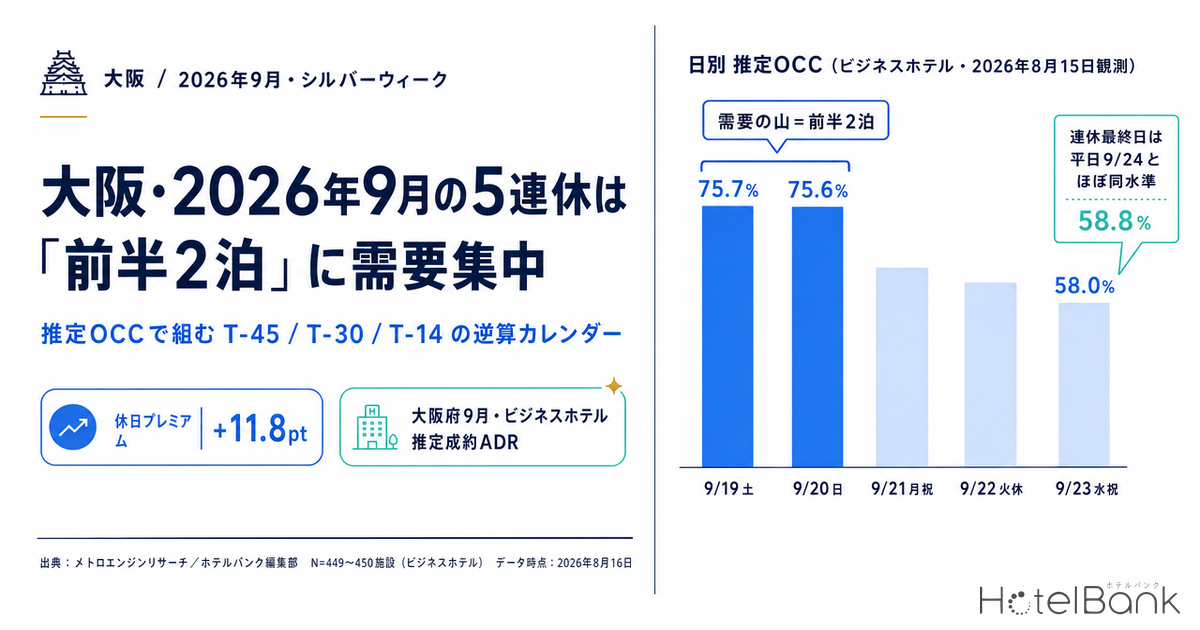
In calendar terms, September 2026 gives Osaka a five-day run of days off, from Saturday, September 19 through Wednesday, September 23. Lodging demand, however, is not spread evenly across those five days. As observed on August 15, 2026, estimated OCC for business hotels in Osaka (N=449 properties) peaks at 75.7% on Saturday, September 19, with Sunday, September 20 nearly level at 75.6%, while the final day of the run — Wednesday, September 23 (Autumnal Equinox Day) — falls to 58.0%. That is essentially the same level as Thursday, September 24, an ordinary weekday right after the holiday. The same shape appears in the other segments: city hotels (N=91 properties) go from 89.5% on September 20 to 79.0% on September 23, and ryokan (N=30 properties) from 80.4% to 52.3%. An approach that says “it’s a five-day holiday, so raise rates for all five nights” risks leaving the back three nights unsold. This article breaks down the demand shape of this holiday run using estimated OCC, then translates it into a T-45 / T-30 / T-14 countdown calendar.
Scope: Osaka Prefecture — city hotels N=91 properties / business hotels N=449–450 properties / ryokan N=30 properties (estimated OCC); settled ADR estimates cover city N=97 properties and business N=487 properties. The price metric in this article is the settled ADR estimate (a transaction-price level estimated from OTA and other sales data, roughly tax-exclusive); occupancy is an estimate based on OTA-listed inventory. Full definitions appear at the end of the article. Data as of August 16, 2026.
- — Of the five holiday days, only the first two nights carry the demand. As observed on August 15, 2026, business-hotel estimated OCC was 75.7% on Sep 19 and 75.6% on Sep 20, while the final day, Sep 23, sat at 58.0% — the same level as Sep 24 (58.8%), an ordinary weekday after the holiday.
- — The holiday premium is already locked in 45 days out. The gap between Sep 19 and an ordinary Saturday, Sep 12, was 11.3 points at 45 days out and 11.8 points at 35 days out for business hotels — essentially flat. The assumption that the premium “builds up later” does not hold.
- — The window inside 30 days out is still live. The ordinary Saturday of Sep 12 gained +2.8 points over the seven days from 35 to 28 days out — a faster pace than the +2.1 points it added over the preceding ten days.
- — Anchor your pricing to the monthly level. The settled ADR estimate for Osaka in September 2026 is roughly ¥13,000 for city hotels (N=97 properties) and roughly ¥9,700 for business hotels (N=487 properties). Because April–October 2025 fell within the Expo period, year-on-year comparisons for those months should be read with a discount.
Five days on the calendar, but demand rides on only the first two nights
First, the make-up of the September 2026 holiday run. According to the Cabinet Office list of national holidays, September 21, 2026 is Respect for the Aged Day and September 23 is Autumnal Equinox Day, with September 22 — sandwiched between them — designated a holiday under the Holiday Act. Combined with Saturday, September 19 and Sunday, September 20, that produces an unbroken five-day run from September 19 to 23. It has been a long time since this provision last applied in September, and the calendar quirk itself has drawn coverage.
For a look at the back half of this same holiday run on a nationwide scale, Silver Week 2026 Back Half at T-47: Sep 23 Matches a Normal Wednesday shows the same shape as the Osaka observations here.
The question is whether demand across those five days is uniform. Laying out the observations from August 15, 2026 (33 to 41 days ahead of each stay date) day by day makes it clear that the peak sits firmly in the first half.
Source: MetroEngines Research; compiled by the HotelBank Editorial Team
All three segments form a peak on Saturday, September 19 and Sunday, September 20, step down on Respect for the Aged Day (Monday, September 21), and return to weekday levels on September 22 (Tuesday) and 23 (Wednesday). Business hotels are the clearest case: the 58.0% recorded for September 23 is below the 58.8% of Thursday, September 24, an ordinary post-holiday weekday — meaning the calendar label “final day of the holiday” and the actual state of sales do not line up. The gap is even wider at ryokan, falling 28.1 points from 80.4% on September 20 to 52.3% on September 23 (note that N=30 properties is a small sample).
The share of properties for which no listed inventory can be confirmed (estimated) shows the same shape. For business hotels the figure is 22.6% on September 20 and 21.5% on September 19, versus just 9.7% on September 21, 3.8% on September 22 and 1.1% on September 23. For city hotels it was 14.3% on September 19 and 11.0% on September 20, against 0.0% on both September 22 and 23. The back three days of the run are less a case of demand failing to materialise than of the market still being wide open.
| Stay date | Days out | City est. OCC (N=91) |
Business est. OCC (N=449–450) |
Ryokan est. OCC (N=30) |
Business no listed inventory share of properties (est.) |
|---|---|---|---|---|---|
| Sep 17 (Thu) | 33 days | 80.0% | 59.5% | 59.3% | 1.3% |
| Sep 18 (Fri) | 34 days | 80.7% | 60.9% | 53.9% | 1.3% |
| Sep 19 (Sat) — first day of the run | 35 days | 87.8% | 75.7% | 74.7% | 21.5% |
| Sep 20 (Sun) | 36 days | 89.5% | 75.6% | 80.4% | 22.6% |
| Sep 21 (Mon) Respect for the Aged Day | 37 days | 84.9% | 68.1% | 71.6% | 9.7% |
| Sep 22 (Tue) statutory holiday | 38 days | 82.2% | 65.8% | 56.4% | 3.8% |
| Sep 23 (Wed) Autumnal Equinox Day | 39 days | 79.0% | 58.0% | 52.3% | 1.1% |
| Sep 24 (Thu) | 40 days | 80.0% | 58.8% | 62.4% | 1.8% |
| Sep 25 (Fri) | 41 days | 82.7% | 63.8% | 55.1% | 2.9% |
Osaka Prefecture — estimated OCC (OTA-listed-inventory basis) as observed on August 15, 2026. Source: MetroEngines Research; compiled by the HotelBank Editorial Team
Where the gap opens against an ordinary weekend — lining up equal days out
A single day-by-day snapshot cannot separate “high because it is a holiday” from “high because the observation window has advanced.” Estimated OCC accumulates as the stay date approaches, so simply lining up different stay dates mixes in differences in days out. To avoid that, we compare Saturday, September 19 — the first day of the run — with Saturday, September 12, an ordinary September Saturday, at matching points in days out.
For seasonal context, Osaka Obon 2026 Booking Curve: Aug 14 at 74.9%, Aug 16 Stuck at 64.1% tracks inventory progress by days out for the same Osaka business-hotel segment.
Source: MetroEngines Research; compiled by the HotelBank Editorial Team
The result is unambiguous. At 45 days out, business-hotel estimated OCC was 73.1% for September 19 and 61.8% for September 12 — a gap of 11.3 points. At 35 days out it was 75.7% versus 63.9%, a gap of 11.8 points: essentially unchanged. In other words, the holiday premium was already priced in at 45 days out, and the gap did not widen over the following ten days. City hotels behave the same way: a 5.5-point gap at 45 days out (86.5% vs 81.0%) was still 5.6 points at 35 days out (87.8% vs 82.2%).
| Segment | 45 days out Sep 19 (Sat) |
45 days out Sep 12 (Sat) |
35 days out Sep 19 (Sat) |
35 days out Sep 12 (Sat) |
Change in gap |
|---|---|---|---|---|---|
| City (N=91) | 86.5% | 81.0% | 87.8% | 82.2% | +5.5pt→+5.6pt |
| Business (N=449–450) | 73.1% | 61.8% | 75.7% | 63.9% | +11.3pt→+11.8pt |
| Ryokan (N=30) | 70.6% | 58.2% | 74.7% | 60.1% | +12.4pt→+14.6pt |
Osaka Prefecture — estimated OCC compared at matching days out (the window used in this article runs from 45 days before the stay date to the most recent observation). Source: MetroEngines Research; compiled by the HotelBank Editorial Team
There is a second point, about the pace of accumulation. For business hotels, Saturday, September 12 added +2.1 points over the ten days from 45 to 35 days out (61.8% → 63.9%), then added +2.8 points over the following seven days from 35 to 28 days out (63.9% → 66.7%) — more pick-up in a shorter span. In other words, for Osaka business hotels, the window inside 30 days out is still very much a window in which to earn. The 75.7% figure for September 19 may look high, but with 17,782 rooms still available across the observed properties, the outcome is not settled.
The price yardstick — where Osaka’s September settled ADR estimate sits
Daily pricing is out of scope here, because the settled ADR estimate is canonical at a monthly granularity. Instead, we fix the monthly level as the coordinate against which to position your own property’s rates.
For how the post-Expo pullback deepened month by month, see Osaka Settled ADR June 2026: City -26.3%, Business -32.8% Post-Expo.
Source: MetroEngines Research; compiled by the HotelBank Editorial Team
Osaka Prefecture’s settled ADR estimate for September 2026 is roughly ¥13,000 for city hotels (N=97 properties) and roughly ¥9,700 for business hotels (N=487 properties). Both are estimates based on the current state of sales and will move as sales progress. For reference, the finalised figures for September 2025 were roughly ¥16,700 for city hotels (N=91 properties) and roughly ¥13,500 for business hotels (N=498 properties) — but a finalised figure and a current-point estimate cannot be compared directly, so any year-on-year read has to wait for the month to close.
The most recent month where finalised figures can be compared with finalised figures is July 2026. City hotels fell 25.1%, from roughly ¥16,800 in July 2025 (N=90 properties) to roughly ¥12,600 in July 2026 (N=97 properties); business hotels fell 31.9%, from roughly ¥12,400 (N=502 properties) to roughly ¥8,400 (N=497 properties). The key context behind those declines is Expo 2025 Osaka, Kansai, held at Yumeshima in Osaka from April 13 to October 13, 2025. April–October 2025 in Osaka therefore represents an unusual comparison base, lifted by that event. It follows that year-on-year declines in Osaka in 2026 should be treated as expected, and it is more practical to focus on the within-year seasonal shape and on your own property’s position than on the absolute size of the year-on-year change.
Viewed through that seasonal shape, Osaka’s settled ADR estimate places September in the lower band of the year, with the level shifting into a higher band from autumn onwards. The five-day holiday run in September is best understood as one of the few high-demand dates standing inside that lower band. Setting rates for the holiday nights by the feel of the monthly average makes it easy to leave money on the table on September 19 and 20, where the demand actually sits.
For revenue managers running city and business hotels in Osaka — implications and an action plan
Operator-level insights
1. Do not treat the “five-day holiday” as a single block. Market estimated OCC peaks on September 19 and 20, and by September 23 business hotels are down to 58.0% — the same level as Thursday, September 24 (58.8%), an ordinary post-holiday weekday. If your calendar applies a flat rate multiplier across all five days, there is room to redesign the first two nights and the back three nights as different days. Building the back half around a weekday demand shape, rather than a holiday one, is closer to the actual state of sales.
2. The holiday premium is already in the market price. The gap between September 19 and the ordinary Saturday of September 12 was 11.3 points at 45 days out and 11.8 points at 35 days out — essentially unchanged. The gap did not widen later; it was open from the start. That means the current data offers no grounds for sitting on inventory in the expectation that it “should pick up from here.” If your property’s figures for these dates are clearly below the market level (city 87.8% / business 75.7% / ryokan 74.7%), that is a moment to suspect property-side factors rather than a lag in holiday demand.
3. The window inside 30 days out is still live. The ordinary Saturday of September 12 added +2.8 points over the seven days from 35 to 28 days out, faster than the +2.1 points added over the preceding ten days. For Osaka business hotels, the accumulation after passing the 30-day mark is not small. For the holiday dates too, the share of business-hotel properties with no confirmable listed inventory as of August 15 was 21.5% for September 19 and 22.6% for September 20 — meaning the market as a whole still has room open.
4. Anchor your pricing to the monthly level. Osaka’s September settled ADR estimate is roughly ¥13,000 for city hotels and roughly ¥9,700 for business hotels (both current-point estimates). Use that band as the baseline for deciding how far above it to place the first two holiday nights, and how far back toward weekday levels to pull the back three. Handle year-on-year comparisons with the caveat that April–October 2025 was an Expo-period comparison base.
Putting all of that into a countdown calendar gives the following. Today (August 16, 2026) is 34 days out from September 19: T-45 has already passed, and T-30 is just ahead.
| Timing | Action | Decision trigger (figures from this article) | Objective |
|---|---|---|---|
| T-45 (already passed — review) |
Look back at your settings and check whether the five holiday days are priced as two blocks — the first two nights and the back three | Business-hotel estimated OCC for Sep 23 is 58.0%, the same level as the weekday of Sep 24 (58.8%). If you are applying holiday rates to the back half, revisit them | Clear, early on, any state in which the back three nights are stalled by price |
| T-45 (already passed — review) |
Confirm that the scope of your minimum length of stay (LOS) restriction was limited to the two nights of Sep 19 and Sep 20 | In all three segments the peak is the two days of Sep 19 and Sep 20. Applying a three-night-plus LOS restriction across all five days casts too wide a net | Avoid blocking your own inflow of bookings on the thinner back-half dates |
| T-30 (this week to next) |
Compare your own booking pace for Sep 19 and Sep 20 against market estimated OCC levels | At 35 days out the market stands at city 87.8% / business 75.7% / ryokan 74.7%. If your property is well below that, re-examine pricing and inventory allocation | Detect early that the “it’s a holiday, it will fill later” assumption is wrong |
| T-30 (this week to next) |
Re-cut the rate structure for the back three nights (Sep 21–23) around a weekday demand shape, and restore weekday-oriented allocations | For Sep 22 and Sep 23, the share of business-hotel properties with no confirmable listed inventory is low at 3.8% and 1.1%, so the market as a whole is still wide open | Rather than leaving the back three nights alone, secure a route to capture weekday demand |
| T-14 (early September) |
For the first two nights, move inventory by adding stay value (consecutive-night perks, in-house facility use, flexible check-in/check-out times) rather than cutting price | The ordinary Saturday of Sep 12 added +2.8 points over the seven days from 35 to 28 days out — the near-in window accumulates fast. There is still time before discounting | Sell through remaining inventory without breaking the holiday price level |
| T-14 (early September) |
Prepare multi-night products that include a back-half date (two front nights plus one back night, for example) so front-half demand pulls the back half along | The estimated OCC gap between Sep 20 and Sep 23 is 17.6 points for business hotels and 28.1 points for ryokan. The larger the front-to-back gap, the more sense bundling makes | Secure room-nights on the back-half dates without dropping rate |
Source: MetroEngines Research; compiled by the HotelBank Editorial Team
Note that all of the target dates are still more than 30 days from the stay date, so this article makes no definitive forecast as to whether any given date will sell out. The decision triggers above are simply a reading of current conditions based on the state of sales as of August 15, 2026.
Conclusion — read the holiday by its shape, not its length
There are three yardsticks to take away from Osaka’s September 2026 holiday run.
First, the number of days on the calendar does not match the number of days of demand. Of the five days from September 19 to 23, only the first two nights clearly carry demand in Osaka. City hotels go from 89.5% (Sep 20) to 79.0% on Sep 23; business hotels from 75.6% to 58.0%; ryokan from 80.4% to 52.3%. Treating the back half of the run as a weekday demand shape is closer to reality.
Second, the size of the holiday premium is determined early. The gap against an ordinary Saturday held roughly constant for business hotels at 11.3 points at 45 days out and 11.8 points at 35 days out. A plan built on waiting for the premium to “accumulate later” does not fit this market.
Third, the window inside 30 days out is still live. The ordinary Saturday of September 12 added +2.8 points over the seven days from 35 to 28 days out, a faster pace than the preceding ten days. Even for the first two nights, 17,782 rooms remained available across the observed properties as of August 15 (business hotels, Sep 19), leaving time to try levers other than price cuts up to T-14.
React to the daily shape, not to the number of holiday days. That is the design principle for Osaka’s September that this data points to.
About the Data
Definition of estimated OCC: occupancy on an OTA-listed-inventory basis = 100 − 100 × rooms remaining on OTA listings ÷ total rooms. It is an estimate based on how listed inventory is being sold down on OTAs, and its definition differs from actual room occupancy (it reads higher). This article labels it “estimated OCC (OTA-listed-inventory basis).” The target month is September 2026 and the target area is Osaka Prefecture.
Booking curve: observations are captured from 90 days before the stay date up to the most recent point, and this article uses the window from 45 days out onward. The most recent observation date in this article is August 15, 2026, and each stay date is 33 to 41 days out.
Definition of the settled ADR estimate: a transaction-price level (roughly tax-exclusive) estimated from OTA and other sales data (lowest-plan level × segment coefficient, ensembled across multiple channels). Past months are finalised figures; current and future months are estimates based on the current state of sales. Median error against published operating results is 6.6%.
Breakdown of N: for estimated OCC, Osaka Prefecture city hotels N=91 properties, business hotels N=449–450 properties (varying by observation date), ryokan N=30 properties. For the settled ADR estimate, Osaka Prefecture city hotels N=97 properties (September 2026) and N=91 properties (September 2025), business hotels N=487 properties (September 2026) and N=498 properties (September 2025). Ryokan are treated as a reference figure because the number of observed properties is small.
Share of properties with no confirmable listed inventory: the share (estimated) of observed properties for which no listed inventory can be confirmed on OTAs or similar channels. Because all target dates are more than 30 days from the stay date, this does not indicate whether they will sell out.
Data as of: August 16, 2026. Sales conditions and inventory move daily, so the figures in this article are a snapshot at the time of retrieval.
References and Sources
■ Data sources
The estimated OCC, share of properties with no confirmable listed inventory, and remaining-room counts in this article were compiled by MetroEngines from time-series data on publicly listed inventory on OTAs and similar channels, covering Osaka Prefecture (city hotels N=91 properties / business hotels N=449–450 properties / ryokan N=30 properties). The settled ADR estimate is a monthly aggregation covering city N=97 properties and business N=487 properties (September 2026). The calendar was confirmed using the Cabinet Office’s “National Holidays” and the National Astronomical Observatory of Japan’s “Calendar and Ephemeris for 2026 (Reiwa 8).” Source: MetroEngines Research; compiled by the HotelBank Editorial Team.
■ Estimation assumptions
Observations are captured from 90 days before the stay date, and this article uses only the window from 45 days out onward. Because different stay dates mix in different degrees of observation progress, holiday dates and ordinary dates are compared at matching days out (45 days, 35 days and 28 days). Pricing is handled only as a monthly settled ADR estimate; daily pricing is not addressed. The most recent observation date is August 15, 2026, and the data is as of August 16, 2026.
■ Limitations and caveats
Estimated OCC is an estimate on an OTA-listed-inventory basis, and its definition differs from actual room occupancy (it reads higher). Ryokan are treated as a reference figure because the observed base of N=30 properties is small and day-to-day swings are large. All target dates are more than 30 days from the stay date, so nothing here indicates whether a given date will sell out. Because April–October 2025 in Osaka was an unusual comparison base lifted by the Expo period, the absolute values of year-on-year changes need to be read with a discount. For detailed metric definitions, see the “About the Data” section.
• Cabinet Office, “National Holidays” / national holiday list data: https://www8.cao.go.jp/chosei/shukujitsu/gaiyou.html (confirming September 21, 2026 as Respect for the Aged Day, September 22 as a statutory holiday, and September 23 as Autumnal Equinox Day)
• National Astronomical Observatory of Japan, “Calendar and Ephemeris for 2026 (Reiwa 8)”: https://eco.mtk.nao.ac.jp/koyomi/yoko/2026/rekiyou262.html
• Nikkei, “A four-day holiday run in September 2026 — first in 11 years under the Holiday Act, says the National Astronomical Observatory”: https://www.nikkei.com/article/DGXZQOUE030MI0T00C25A2000000/
• EXPO 2025 Osaka, Kansai, Japan official site, “Overview” (period: April 13 to October 13, 2025): https://www.expo2025.or.jp/overview/