

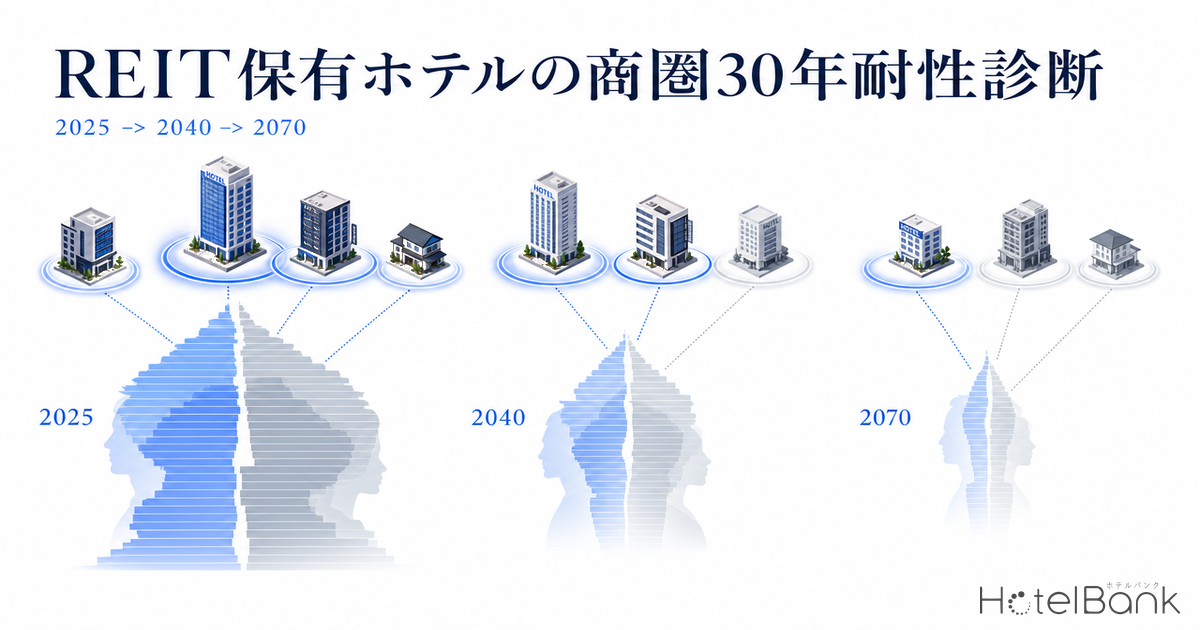
When discussing the exit strategy for a hotel investment, the conventional centerpiece has been the “rate of future population decline.” But the decline rate only indicates how fast demand is shrinking; it tells us nothing about whether that location can be regenerated for uses other than lodging. In this article, rather than the decline rate, we quantify the age composition of the trade area (the aging rate) using the 250m mesh of the National Land Numerical Information, and we work backward from Atami and Takayama to assess how the aging of the resident population affects guest-room demand (i.e., external demand) and the conditions under which a holding exit (nursing care, serviced housing for the elderly, or residential conversion) can succeed.
Metric Definitions Used in This Article
- Trade-area aging rate: The share of the population aged 65 and over within the total population, measured within the 250m meshes inside a 1.5km radius centered on the hotel location (2025 estimate). It is based on the resident population from the Ministry of Land, Infrastructure, Transport and Tourism’s National Land Numerical Information “Future Population Estimates by 250m Mesh (R6 National Land Policy Bureau estimate)” and does not include staying or transient populations.
- ADR (Average Daily Rate): The average of the selling prices published on OTAs. It differs from actual transacted prices (it tends to run +25-30% higher than the transacted ADR). It is the per-room rate (tax included) for double occupancy (two people per room), averaged across all plans (from room-only to meal-inclusive).
- OCC (Occupancy Rate): The share of sold rooms relative to the total room inventory in the area (an estimate based on OTA sales inventory).
- Employment ratio: The share of office-type occupations among workers within the trade area. A proxy indicator showing the depth of business demand.
- Data sources: MetroEngines Research & Consulting / Ministry of Land, Infrastructure, Transport and Tourism, National Land Numerical Information / Ministry of Internal Affairs and Communications and Ministry of Economy, Trade and Industry, Economic Census
- — Atami, with a trade-area aging rate of 49.1%, sees land prices rising (published land price +11.1%) even as the aging of its resident population advances the furthest. Its exit splits into two: continued lodging supported by the “depth of external demand,” or conversion to nursing care / residential use.
- — Takayama has a mid-level aging rate of 38.8% combined with inbound growth. Its external dependence is replaced by depth of external demand, and real demand backed by occupancy (occupancy-rate confirmation) raises the exit value of the lodging use.
- — The exit is determined at the intersection of “age composition × external demand.” A high ADR (Atami ¥61,700, Hakone ¥82,900) does not guarantee a secure exit; the trade area’s age composition governs the room for conversion.
- — The conditions for nursing care / serviced elderly housing / residential conversion to succeed are reverse-engineered from three angles: demand, regulation, and physical conditions. The more extreme the aging and the thinner the external demand, the more conversion comes to the fore.
- — For reference: Hoshino Resorts REIT (3287) had a portfolio occupancy rate of 79.3% (as of April 2026). The high occupancy of listed resort REITs is consistent with this article’s thesis that “resorts with deep external demand have a high exit value in the lodging use.”
Executive Summary — Even for the Same Hot-Spring Resort, the “Exit” Differs Entirely
Let us state the conclusion first. Atami and Takayama share the trait of being “external-demand-dependent hot-spring resorts whose trade areas are aging and whose employment ratio is low at about 11%.” Yet their exit-strategy premises are almost opposite. In Atami, the aging rate within a 1.5km radius is extremely high at 49.1% (roughly half of residents are 65 or older), so the source of demand is entirely skewed toward external (tourist) demand—and yet land prices continue to rise, with commercial land up +11.14% year over year (2025 published price). Takayama, by contrast, has a more moderate aging rate of 38.8%, and inbound tourism—4.42 million visitors annually and 770,000 foreign overnight stays (2024, an all-time high)—provides a thick underpinning for external demand.
In other words, reading along the two axes of “trade-area aging rate × external dependence,” Atami can be characterized as an area where external dependence is extreme and the exit options polarize between lodging and elderly-care facilities, while Takayama is an area where external demand (especially inbound) is thick and continued holding for lodging use remains rational. In this article, we line up the trade-area age compositions of 10 areas side by side and reverse-engineer the conditions under which a holding exit (nursing care, serviced elderly housing, residential conversion) can succeed.
10-Area Comparison — The Trade-Area Aging Rate, “Another Map”
First, for the 1.5km-radius trade areas of 10 areas centered on hot-spring and tourist resorts, we aggregated the share of those 65 and over (the aging rate) and the working-age share (15-64) from the National Land Numerical Information 250m mesh. Even among “tourist destinations,” the age composition diverges sharply.
Atami’s aging rate of 49.1% stands out. This is a level at which nearly one in two residents is 65 or older, exceeding even other leisure-specialized areas such as Karuizawa (42.3%), Kusatsu Onsen (41.5%), and Shirahama (41.2%). Conversely, Kanazawa (29.8%), Naha (29.2%), and the area around Kyoto Station (27.4%) have the depth of urban functions and resident population, so their trade-area age compositions are close to the national average (29.4%). Takayama (38.8%) sits in the middle.
What matters here is that the higher the aging rate, the more structurally the resident-originated lodging demand thins out (accompanying returning relatives, local dining and banquets, business trips, and so on). Both areas have a low employment ratio of about 11% and lack the depth of business demand. Consequently, room occupancy depends almost entirely on “external = tourists.” The trade-area aging rate functions as a proxy indicator measuring the degree to which the demand structure “loses domestic demand and stands on the single leg of external demand.”
Looking at the scatter plot of aging rate against ADR, there is no clear correlation. Atami (aging 49.1%, ADR ¥61,700) and Hakone Town (aging 38.6%, ADR ¥82,900) both sit in the high-price band, yet their trade-area age compositions are entirely different. This shows that even for a high-priced resort, exit risk cannot be measured by land prices or occupancy alone, and it must be evaluated on the independent axis of the trade area’s age composition. A high ADR does not mean a secure exit.
Area Analysis — Atami: Land Prices Rise, but the Trade Area Is the Most Aged
| Trade-area population (2025) | 11,718 |
| Aging rate (65 and over) | 49.1% |
| Working-age share | 46.2% |
| Employment ratio (office) | 11.1% |
| 2040 population change | -25.6% |
| Area ADR | ¥61,700 |
| 2025 average | approx. ¥203,000/㎡ (+11.1%) |
| 2026 average | approx. ¥193,000/㎡ (+8.7%) |
Source: Ministry of Land, Infrastructure, Transport and Tourism, Published Land Prices / Prefectural Land Price Surveys (compiled by tochidai.info)
Atami’s distinctiveness lies in the fact that its trade area is among the most aged in the country (49.1%), yet land prices continue to rise by double digits. This is because lodging and condominium demand flows in strongly from external sources, sparking competition over redevelopment sites. In fact, redevelopment of former defunct-ryokan sites is dominated by lodging and condominium uses—examples include La Vista Atami (239 rooms) on the former Atami Grand Hotel site, a hotel plan on the former Tamanoi Honkan site (a Sumitomo Realty affiliate), and a long-stay condominium plan in Higashikaiganchō (Nihon Escon, scheduled for completion in 2029). The redevelopment is mainly lodging and condominium use.
Here lies an important implication for exit strategy. In Atami, the logic that “since the trade area is aging, convert to a nursing-care facility” is not necessarily the optimal solution. Because external demand is pushing up land prices, the continued value (and sale value) as lodging or a condominium is being kept high. The trade-area aging rate shows that “domestic demand has disappeared,” but in Atami external demand fully compensates for it. The exit centers on “continued lodging or high-priced housing (condominium),” and conversion to nursing care / serviced elderly housing is limited to a subset of properties that satisfy the locational conditions (near the station, flat land, shuttle access). We dig into the structure of Atami’s lodging market itself (the ADR trend across 76 establishments and 2,508 rooms) in A Thorough Analysis of Atami City’s Ryokan.
Area Analysis — Takayama: Inbound Turns External Dependence into “Healthy Depth”
Takayama’s trade-area aging rate is 38.8%. That is more than 10 points lower than Atami, and its working-age share of 51.0% keeps a majority. And the decisive difference is the nature of external demand. The total number of tourists in 2024 was 4.422 million (+8.6% year over year), of which foreign overnight visitors reached a record high of about 770,000. This is a recovery far exceeding the pre-pandemic peak (about 610,000 in 2019), and the external dependence has qualitatively shifted from “the flip side of vanished domestic demand” to “depth supported by inbound—a growth demand.”
This difference splits the exit strategy. In Takayama, room demand is in an expansion phase centered on foreign visitors, and so continued holding and value-up for lodging use (renovating guest rooms for inbound, upgrading to higher grades) remains the primary exit. Although the ADR of ¥47,400 is lower than Atami’s, the quality of demand is, if anything, sturdier in that it is backed by real demand accompanied by occupancy. The fact that the trade-area aging rate is mid-level (38.8%) also lowers the hurdle to continued operation, in terms of room to secure local employees and to maintain surrounding living functions. The Hida-Takayama region also forms a touring circuit extending to Gero and Shirakawa-gō, where the economics of room-reduction rebranding warrant a separate, detailed assessment.
Reverse-Engineering the Holding Exit — Conditions for Nursing Care / Serviced Elderly Housing / Residential Conversion to Succeed
So, when continued lodging use becomes difficult in an aged trade area, how can the holding exit succeed? For conversion to nursing-care facilities, serviced housing for the elderly (serviced elderly housing), and residential (condominium) use, we reverse-engineer the success conditions from three angles: demand, regulation, and physical conditions.
| Conversion target | Basis of demand | Location / physical conditions | Atami | Takayama |
|---|---|---|---|---|
| Continued lodging / renovation | External demand (tourism, inbound) | Room scale, views, hot spring | Conditional ○ | ◎ |
| Condominium / residential | Relocation, dual-residence, second home | Suitability for sectional ownership, views, distance to station | ◎ | ○ |
| Fee-based nursing home with care | Trade-area elderly + residents from a wider area | Flat land, shuttle access, proximity to medical care | Conditional ○ | Conditional ○ |
| Serviced elderly housing | Independent to support-needing tier, subsidies | Barrier-free conversion cost, floor area | △ | Conditional ○ |
Let us organize the points into three. First, demand for nursing care / serviced elderly housing cannot succeed on the “number of trade-area elderly” alone. The rate of certified need for long-term care rises from age 80 onward (26.2% for ages 80-84, 60.1% for 85 and over), so even if the trade-area aging rate is high, occupancy will not fill up without a location, medical-care linkage, and shuttle access that can attract residents from a wider area. Serviced elderly housing nationwide had accumulated to about 291,000 units (8,327 buildings) as of the end of September 2025, and oversupply is causing closures and withdrawals. A high aging rate shows “the existence of demand” but does not guarantee “the viability of the business.”
Second, physical conversion costs constrain profitability. Hot-spring ryokan and resort hotels have guest rooms designed on the premise of banquets and views, and their corridor widths, level differences, and bathroom specifications often do not align with nursing-care use. Introducing barrier-free renovation, sprinklers, and mechanical baths requires commensurate investment, and once the renovation cost per tsubo approaches the construction cost of a newly built serviced elderly housing, the economic advantage of conversion disappears. Atami and Takayama, being mountainous with limited flat land, also face severe conditions in securing shuttle and emergency-access routes. This is the inverse of converting to a hotel, but the way of thinking about construction costs and use boundaries when converting an aged non-residential asset into guest rooms is also organized in The Investment Boundary for Converting Commercial and Logistics Facilities into Hotels, which offers a useful sense of conversion economics.
Third, in Atami, “as long as external demand supports land prices, the exit value of lodging / residential conversion exceeds that of nursing-care conversion.” In a phase where land prices rise by double digits, sale or continuation as a condominium or lodging tends to be the most rational exit. Conversion to nursing care / serviced elderly housing comes to the fore when external demand thins out and land prices turn to decline—that is, when the dual condition of “high trade-area aging rate × declining external dependence” is met. Atami and Takayama still have thick external demand and have not reached that stage.
Investment-Decision Summary — The Exit Is Determined at the Intersection of “Age Composition × External Demand”
Atami: Extreme Aging × Thick External Demand
Trade-area aging is 49.1%, yet land prices are +11%. The exit centers on continued lodging and condominium conversion. Nursing-care conversion is limited to a subset of properties near the station and on flat land.
Takayama: Mid-Level Aging × Inbound Growth
Aging is 38.8%, with foreign overnight stays at a record 770,000. Continuation and value-up of the lodging use is the primary exit. The quality of demand is sturdy.
Conditions Where Conversion Comes to the Fore
An area where the dual condition of “high aging rate × declining external dependence” is met and where land prices have turned to decline. The current Atami and Takayama do not qualify.
This article’s argument is simple. Evaluating a hotel investment’s exit by the future population decline rate alone is crude. For the same decline rate, which of continued lodging, residential conversion, or nursing-care conversion can succeed varies greatly depending on the trade area’s age composition and the quality of external demand. By reading areas along the two axes of trade-area aging rate multiplied by external dependence, we can distinguish the “Atami type, where external demand supports it even after domestic demand disappears,” the “Takayama type, where growing inbound creates depth,” and the “future type, where external demand also thins and conversion becomes the realistic answer.” As an axis that raises the resolution of exit strategy by one step, quantifying age composition is effective.
For reference, Hoshino Resorts REIT (星野リゾート・リート) Investment Corporation (3287), which has a high resort ratio, had an overall portfolio occupancy rate of 79.3% as of April 2026, with an ADR of ¥21,600 and a RevPAR of ¥17,100 (occupancy rate -2.0pt year over year). The operating performance of the listed resort REIT continues to maintain high occupancy, consistent with this article’s framework that “resorts with deep external demand have a high exit value in the lodging use.”
⚠ Note on estimated data: The trade-area population and aging rates in this article are from the National Land Numerical Information’s future population estimates (resident-population basis) and do not include staying or transient populations such as tourists or commuters. Land prices and tourism statistics are published values as of the time of the survey. The evaluation of conversion scenarios is an organization of general success conditions; an individual property’s investment decision requires a detailed feasibility study.
Related Reading
- Reverse-Engineering the Maximum Acquisition Price for Onsen Ryokan — Yugawara, Izu-Nagaoka, Minakami, Kusatsu at ADR × OCC × 12% Yield
- A Thorough Analysis of Atami City’s Ryokan | Market Structure and ADR Trend of 76 Establishments and 2,508 Rooms
- A Sustainable Supply Structure Led by Mid-Scale Facilities: New Openings in Atami City
- Aged Malls and Warehouses Become the Next Guest Rooms: The Investment Boundary for Converting Commercial and Logistics Facilities into Hotels
- Getting Ahead of the Competitive Sets of 3 Hotels Opening in 2026 | Imperial Hotel Kyoto (帝国ホテル京都), Hamamatsu Marriott, Hilton Takayama Resort
References and Sources
■ Data sources
The trade-area aging rate is the resident population (2025 estimate) from the Ministry of Land, Infrastructure, Transport and Tourism’s National Land Numerical Information “Future Population Estimates by 250m Mesh (R6 National Land Policy Bureau estimate).” ADR and property counts are from MetroEngines Research & Consulting’s OTA published-price data (by area, N=220-297 properties). Land prices are a compilation of Published Land Prices and Prefectural Land Price Surveys. The resort REIT performance is from Hoshino Resorts REIT (星野リゾート・リート) Investment Corporation (3287)’s disclosure as of April 2026.
■ Estimation premises
The trade area is the 250m-mesh aggregation within a 1.5km radius centered on the hotel location. ADR is the all-plan average (tax included) for two people per room and is an OTA-listed value rather than a transacted value (tending to run +25-30% higher than transacted). Conversion success conditions are evaluated on three angles: demand (depth of external demand), regulation (use zones and various standards), and physical conditions (room scale, views, hot spring).
■ Limitations and caveats
The aging rate is on a resident-population basis and does not include staying or transient populations. ADR is an estimate of listed values and does not guarantee an individual property’s transactions or earnings. Future population estimates are estimated values and may diverge from actuals. Whether conversion is possible requires a final judgment based on individual use zones, building standards, and licensing. This article is not a solicitation to invest but aims to present an analytical framework for exit strategy.
■ Market data
- MetroEngines Research & Consulting — OTA published-price data (ADR by area, N=220-297 properties/area)
■ Government statistics and public data
- Ministry of Land, Infrastructure, Transport and Tourism, National Land Numerical Information “Future Population Estimates by 250m Mesh (R6 National Land Policy Bureau estimate)”
- Ministry of Internal Affairs and Communications / Ministry of Economy, Trade and Industry “Economic Census – Activity Survey” (boundaries = 2020 Population Census small areas)
- Atami City official website “Changes in Atami City’s Population Structure”
- Takayama City “Foreign Tourist Lodging Statistics”
- Atami City Published Land Prices and Reference Land Prices (compilation of Published Land Prices and Prefectural Land Price Surveys)
- Senior Residential Association “Latest Trends in Serviced Housing for the Elderly”
■ REIT and industry reports
■ News and reference articles
- Hotel Plan on the Former Tamanoi Honkan Site in Atami, a Sumitomo Realty Affiliate (Atami Keizai Shimbun)
- Foreign overnight visitors reached a record high of about 770,000 last year, Takayama City, Gifu Prefecture (Gifu Broadcasting)