

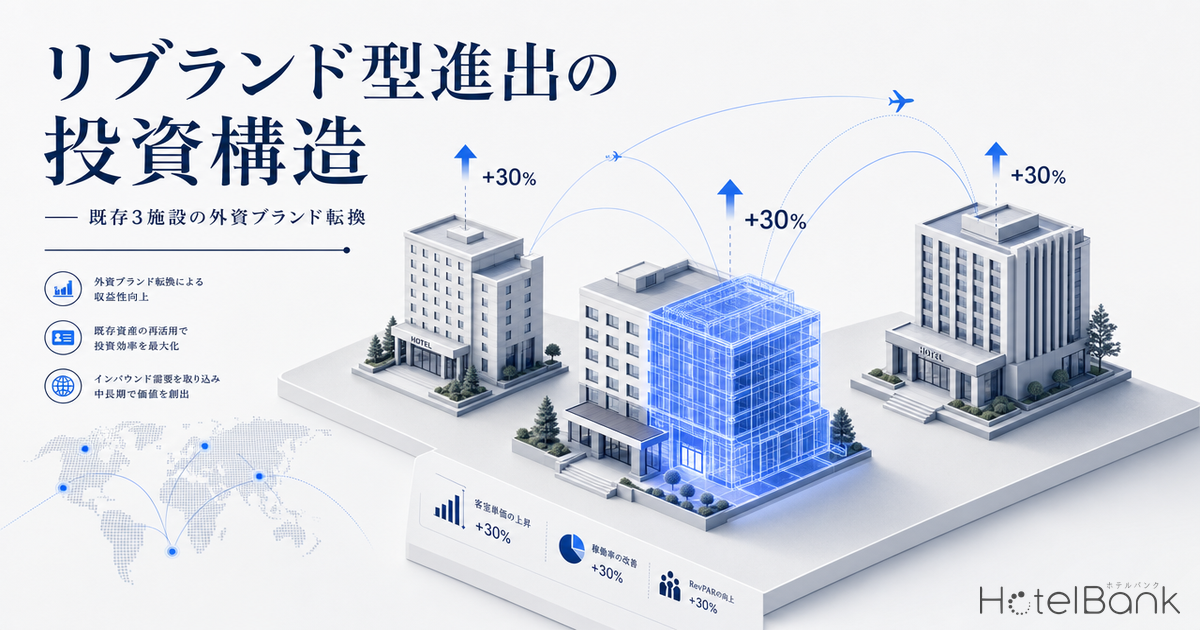
“Rebrand-type entry,” where ownership stays unchanged while only the brand is swapped to a foreign chain, is gaining ground as an option for hotel operations in regional cities. This article uses the case of IHG Hotels & Resorts and Hotel Management International (HMI) converting three existing properties (539 rooms total) to “ANA Crowne Plaza” in the first half of 2026 to quantitatively analyze how Capex compression, reservation channel expansion, and Hotel Management Agreement (HMA) fees affect owner NOI. We also aggregate the actual ADR tiers in Kochi City, Chiryu (Kariya area), and Hamamatsu, and estimate the room-rate uplift potential from the foreign brand crown by price band.
Metric Definitions Used in This Article
- ADR (Average Daily Rate): Average of selling prices published on OTAs and similar platforms. This differs from actual transaction prices (cross-checks with REIT disclosure data show OTA averages tend to be +25-30% higher than transaction ADRs. This is because unsold high-price-band plans remain on OTAs, structurally biasing public price averages upward). Per-room rate for double occupancy (tax-included), averaged across all plan types (room-only through meal-inclusive plans).
- OCC (Occupancy Rate): Ratio of sold rooms to total rooms in the area (estimated from OTA sales inventory). This article uses OCC only at the municipality-level macro aggregation; we do not address individual hotel OCC.
- RevPAR: ADR x OCC. Revenue per available room.
- HMA (Hotel Management Agreement): A contract structure that separates ownership from operations, entrusting operations to an operator with brand and operational know-how.
- Data Source: MetroEngines Research & Consulting
- – The “rebrand-type entry” that converts three properties totaling 539 rooms to ANA Crowne Plaza with ownership unchanged is a design that compresses Capex and timelines vs. new-build while incorporating reservation channels and a fee structure.
- – Under the inbound +30% assumption, the foreign brand crown’s rate uplift and occupancy lift work multiplicatively, with RevPAR potentially +20-34% vs. current (optimistic, neutral, conservative three-scenario simulation).
- – The starting point for rate uplift differs by city: decomposing the actual ADR tiers of Kochi, Chiryu, and Hamamatsu by price band reveals the structure of the growth runway.
- – HMA (operations entrustment) fee structure: the basic fee acts as a fixed cost regardless of occupancy, while the incentive fee is linked to GOP. The presence or absence of ramp-up provisions determines the boundary for owner NOI.
- – On the three axes of location, price band, and contract terms, the three cities’ positioning diverges, enabling prioritization of investment opportunities.
Deal Outline: Ownership Unchanged, Only the Brand Goes Foreign
This deal is based on the strategic partnership announced by IHG Hotels & Resorts and HMI on August 28, 2024. The targets are “The Crown Palais New Hankyu Kochi” (Kochi City, Kochi Prefecture; 242 rooms), “Hotel Crown Palais Chiryu” (Chiryu City, Aichi Prefecture; 105 rooms), and “Hotel Crown Palais Hamamatsu” (Hamamatsu City, Shizuoka Prefecture; 192 rooms), totaling 539 rooms. All will undergo renovation and approximately two years of IHG staff training, then rebrand-open as “ANA Crowne Plaza Hotels” by the first half of 2026. The Chiryu opening on June 1, 2026 has already been announced. HMI President Tatsutora Hira has stated that joining the Crowne Plaza network of over 400 properties worldwide (20 in Japan) is expected to lift new inbound foreign guest counts at each property by approximately 30% versus current levels (Sources: Monthly Hoteres / Travel Voice 2024-08-29 / Nikkei). The economic impact of these three properties’ rebranding as a “domestic mid-tier to global brand promotion” is examined more thoroughly in our analysis of the IHG x ANA Crowne Plaza rebrand of three properties (Kochi/Hamamatsu/Chiryu) as a domestic mid-tier to global promotion model.
What stands out is that this deal is not a property sale-and-purchase transaction; ownership remains with HMI and only the operating brand is swapped to a foreign chain – a “rebrand-type” structure. Compared with new development, Capex (capital expenditure) is limited to renovation costs, and the development period is significantly shortened. In exchange, the deal brings in reservations from IHG’s loyalty program “IHG One Rewards” and the price premium of the joint ANA-IHG brand. In other words, this structure overlays high demand-generating intangible assets (brand, channel) onto the heaviest assets – land and building – without moving them.
Investment Structure of Rebrand-Type Entry: Compressing Capex and Timeline While Layering Channels and Fees
New development and rebranding have entirely different investment centers of gravity. New-build requires 2-4 years from land acquisition through construction, with construction costs exceeding 2 million yen per tsubo, whereas rebranding leverages existing structures and concentrates investment in interior renovation, signage updates, system integration, and staff training. Per MLIT Building Start Statistics, 2025 hotel construction costs averaged 1.952 million yen per tsubo across all structures (S-construction 2.405 million, RC-construction 2.026 million yen per tsubo) – sustained record-high levels, raising the bar for new-build further. In this environment, the relative appeal of converting existing stock to foreign brands increases.
The chart below is a conceptual comparison of initial investment and ramp-up time for a city hotel of equivalent scale (150 rooms hypothetically) under “new-build” versus “rebrand” scenarios. Rebranding compresses initial investment significantly, but the ongoing cost of operations entrustment fees layers onto NOI – differing from self-operation under new-build. The investment decision boils down to whether the revenue increase brought by the brand (RevPAR lift + inbound channel) exceeds the “compressed Capex” plus the “additional fees.”
Source: MetroEngines Research & Consulting based on MLIT “Building Start Statistics” (construction costs). Figures are conceptual values reflecting typical levels for 150-room scale, not actuals for this deal.
HMA compensation typically comprises two tiers: a base fee linked to revenue and an incentive fee linked to GOP (gross operating profit) achievement. Per JLL’s framework, the base fee is generally 1.5-5% of revenue (recent average roughly 1.6-1.7%), and the incentive fee is around 5% of GOP as a benchmark. Japan’s hotel management contract period averages approximately 23 years – longer than the Asia-Pacific average (about 17 years) – reflecting a tendency toward long-term brand commitment (Sources: JLL / Travel Voice 2024-09-26). From the owner’s perspective, the fee is “compensation for the brand and operational know-how,” and its appropriateness is ultimately evaluated against the revenue uplift effect.
Actual ADR Tiers in the Three Cities: A Different “Starting Point for Rate Uplift” in Each
Looking at municipality-level ADR (double-occupancy, tax-included, all-plan average) as of May 2026 compiled by MetroEngines Research & Consulting, there is a clear hierarchy in price levels across the three cities. Kochi City sits at ¥32,200 (N=45 properties) – relatively high for a regional prefectural capital – while Chiryu City is ¥13,600 (N=2 properties) and central Hamamatsu (Naka Ward) is ¥20,300 (N=28 properties), both below the national average in business-demand-driven markets. Note that Chiryu has a small sample size, so it should be interpreted in the context of the West Mikawa area including neighboring Kariya City (¥11,200 / N=7), Anjo City (¥14,400 / N=11), and Toyota City (¥23,300 / N=19).
Source: MetroEngines Research & Consulting (Kochi N=45 / Chiryu N=2 / Hamamatsu Naka Ward N=28, May 2026)
Tracking each city’s ADR over time, the character differences become even clearer. Kochi City has a tourism-business hybrid profile that swings between ¥27,000-¥38,000 monthly on seasonal factors, with YoY essentially flat (+0.6%). Hamamatsu Naka Ward has stepped up from late 2025 into the ¥18,000-¥20,000+ band, with YoY +18.1% showing a clear recovery trajectory. West Mikawa (Chiryu, Kariya) is a stable market underpinned by manufacturing-related business travel demand, with small price swings. All three cities – unlike the major metro areas crowded with foreign luxury chains – carry a “price-band gap” with thin supply at upper price tiers. A horizontal comparison of ADR, supply, and yield structure across regional designated cities including Hamamatsu is covered in our analysis of regional designated city second-tier 5-city hotel investment potential covering Saitama, Chiba, Hamamatsu, Niigata, and Kitakyushu.
Source: MetroEngines Research & Consulting (municipality-level monthly ADR)
Rate Uplift Potential from a Foreign Brand Crown: Estimating Growth Headroom by Price Band
The rate impact of attaching a foreign brand differs by the market’s existing price band. In major metros where upper price tiers are already thick, the runway is limited; conversely, in regional cities with thin upper tiers, the “ceiling-raising” effect bites more readily. The table below presents, anchored to each city’s current ADR, the price bands potentially reachable after brand conversion across three scenarios (conservative / neutral / optimistic) as ranges. These are not point estimates but inferred ranges derived from current market price bands and inbound channel assumptions.
| City (Target Property Rooms) | Current ADR (Market) | Conservative (+5%) | Neutral (+12%) | Optimistic (+20%) |
|---|---|---|---|---|
| Kochi City (242 rooms) | ¥32,200 | ¥33,800 | ¥36,100 | ¥38,600 |
| Chiryu City / West Mikawa (105 rooms) | ¥13,600 | ¥14,300 | ¥15,200 | ¥16,300 |
| Hamamatsu Naka Ward (192 rooms) | ¥20,300 | ¥21,300 | ¥22,700 | ¥24,400 |
*Current ADR is each city’s market average (May 2026). Uplift rates are inferred ranges derived from foreign-brand-crown upper-tier shift and inbound channel assumptions; they do not guarantee transaction prices for individual properties.
Rate uplift is most effective in cities with a “stepping stone” between current market ADR and the area’s top-tier property ADR. In Kochi City, there is about ¥13,000 of headroom to the local top tier (e.g., Tosa City at ¥45,000), giving substantial room to penetrate mid-to-upper tiers with brand attachment. In Chiryu / West Mikawa, while manufacturing-related business travel provides solid baseline demand, the price ceiling is low, so a realistic growth scenario is “stable mid-tier rate + occupancy uplift” rather than a leap into the luxury tier. Hamamatsu, with Shinkansen station access plus deal-meeting demand from the musical instruments industry, is positioned to amplify the recovery momentum as the foreign brand overlays on the rate step-up phase from late 2025.
RevPAR Sensitivity Under Inbound +30%: Optimistic, Neutral, and Conservative Scenarios
Translating the “inbound +30%” outlook HMI envisions into RevPAR, the effect propagates to both rate (ADR lift) and occupancy (OCC lift). Here we run a three-scenario sensitivity simulation for Hamamatsu Naka Ward, anchored to current market RevPAR. We use municipality-level macro-estimated OCC and do not address individual property values. RevPAR is defined as ADR x OCC.
Source: MetroEngines Research & Consulting (simulation based on Hamamatsu Naka Ward ADR and area-estimated OCC). Inbound ratio uplift is allocated as an addition of new demand to both occupancy and rate in this conceptual simulation.
| Scenario | ADR Lift | OCC Assumption | RevPAR | vs. Current |
|---|---|---|---|---|
| Current (Base) | +/-0% | 72% | ¥14,600 | – |
| Conservative | +5% | 74% | ¥15,800 | +8% |
| Neutral | +12% | 77% | ¥17,500 | +20% |
| Optimistic | +20% | 80% | ¥19,500 | +34% |
*OCC is the ratio of sold rooms to total rooms in the area (estimated from OTA sales inventory). This simulation is a market-based conceptual model and does not represent individual property results.
What this sensitivity shows is that if the inbound +30% assumption holds, the rate lift and occupancy lift work multiplicatively, potentially reaching RevPAR +20-34% versus current. Even in the neutral scenario, +20% RevPAR improvement is expected, and the heart of the investment decision is whether this can absorb HMA fees (1.6-1.7% of revenue + ~5% of GOP) and still leave a positive owner NOI. Conversely, if it remains in the conservative scenario (+8%), the post-fee NOI improvement narrows, extending the payback period on the renovation Capex. How effectively inbound channel performance can be secured at the contract negotiation stage holds the key to the scenario fork.
HMA Fee Structure and the Boundary of NOI Distribution
The owner’s take-home (NOI) is determined by a structure where fees act in two stages around the GOP calculation. The chart below conceptualizes the waterfall – starting from revenue, deducting base fee, operating costs, and incentive fee sequentially to arrive at owner NOI. The base fee accrues at a fixed rate against revenue regardless of occupancy performance, while the incentive fee is performance-linked and accrues only on the portion of GOP that exceeds a certain threshold (hurdle) – that’s the character difference between the two.
Source: MetroEngines Research & Consulting based on JLL “Cautionary Points in Hotel Management Contracts Preferred by Foreign Hotels” etc. (conceptual diagram)
There are three main boundaries owners should watch in negotiations. First, whether the incentive fee’s calculation basis is “GOP-based” or “which profit stage pre/post fee deduction” changes the owner’s share. Second, since the base fee rate acts as a fixed cost even during poor occupancy periods, the presence or absence of a startup fee reduction (ramp-up provision) affects initial NOI. Third, the balance between the average ~23-year long contract period and mid-term cancellation clauses. These are exercises in drawing the distribution line between “revenue increase brought by the brand” and “the ongoing cost of fees,” and the larger the upside potential in inbound channel – as in this deal in regional cities – the more incentive design skill determines the owner NOI runway.
Positioning of the Three Cities and Organizing Investment Opportunities
Kochi (242 rooms)
Market ADR ¥32,200 / N=45
Stepping stone to prefecture top tier (~¥45,000). Crowning a foreign brand on tourism-business hybrid demand provides the largest room for rate uplift into mid-to-upper tiers.
Chiryu / West Mikawa (105 rooms)
Market ADR ¥13,600 / N=2
Solid baseline demand supported by manufacturing business travel. The price ceiling is low, but stable mid-tier rate + occupancy lift is a realistic growth scenario. The scarcity value of IHG’s first entry serves as a selling point.
Hamamatsu (192 rooms)
Market ADR ¥20,300 / N=28 (Naka Ward)
Shinkansen station + deal-meeting demand overlaying with the rate step-up phase from late 2025. Positioned to amplify recovery momentum with a foreign brand. In RevPAR sensitivity simulation, the most multiplicative effect is expected.
Investment Decision Summary
Rebrand-type entry is a design that overlays high demand-generating intangible assets (brand, reservation channel) onto the heaviest assets (land, building) without moving them, and its relative appeal is increasing in the current environment where construction costs trend at record highs. The core of the investment in this deal is whether the reservation channel obtained (IHG One Rewards) and inbound channel (+~30% outlook) can absorb the additional HMA fees (1.6-1.7% of revenue + ~5% of GOP) and still leave a positive owner NOI.
The sensitivity simulation shows that even in the neutral scenario, RevPAR +20% is expected and upside remains after fee deduction. All three cities carry “price-band gaps” with thin upper-tier supply, giving them market characteristics where the foreign brand rate uplift bites readily. For regional hotel owners and operators considering entrustment, identifying the conditions under which brand conversion functions as “Capex-compression growth investment” – namely, how far the effectiveness of inbound channel and favorable incentive fee design can be embedded in the contract – is the starting point for applying this deal-type scheme to their own portfolios.
*The simulations in this article are market-based conceptual models; actual investment decisions require detailed feasibility studies for individual properties.
Notes on ADR and Future Outlook: The ADR in this article is the average of selling prices published on OTAs at the time of research and differs from actual transaction prices. The inbound +30% and RevPAR uplift figures are simulations / estimates based on HMI statements and market assumptions, and do not guarantee future actuals.
Related Reading
- Regional Designated Cities Second-Tier 5-City Hotel Investment Potential: Comparing Saitama, Chiba, Hamamatsu, Niigata, Kitakyushu ADR, Supply, and Yield
- Marriott vs. Hyatt Japan Expansion Strategy in Data: 122 Properties 15 Brands vs. 22 Properties 7 Brands, Next Foreign Brand Entry Candidates in the Regions
- Foreign Brand Rebrand Strategy: The Structure of Faster, Cheaper Branding Than New-Build Openings
References and Source List
– Data Sources
Municipality-level ADR and estimated occupancy rates from MetroEngines Research & Consulting’s OTA public-price aggregation (Kochi N=45 / Chiryu N=2 / Hamamatsu Naka Ward N=28, May 2026). Inbound visitor counts from JNTO inbound visitor statistics; land prices from tochidai.info published / standard prices; construction costs from MLIT Building Start Statistics; operations contract benchmarks from public reports such as JLL and travelvoice.
– Simulation Assumptions
RevPAR sensitivity uses inbound demand +30% as the neutral-case anchor, and conceptually simulates rate uplift and occupancy lift from the foreign brand crown across three scenarios – optimistic, neutral, conservative. NOI distribution assumes standard HMA base fee (revenue-linked, fixed) and incentive fee (GOP-linked) levels.
– Limitations and Notes
ADR is the average of OTA public prices, differing from transaction prices (with a tendency to skew +25-30% higher). Occupancy is a municipality-level macro estimate, not individual hotel actuals. Chiryu City has small N=2 and serves as reference. The simulations are conceptual models; actual investment decisions require property-level due diligence.
– Market Data
- MetroEngines Research & Consulting – OTA public price data (municipality-level ADR: Kochi N=45 / Chiryu N=2 / Hamamatsu Naka Ward N=28, May 2026), estimated occupancy (OCC)
– Government Statistics / Public Data
- MLIT “Building Start Statistics” (construction cost per tsubo)
- JNTO “Inbound Visitor Statistics” (2025 inbound 42.68 million, YoY +15.8%)
- Kochi City Published / Standard Land Prices (commercial land, 2025)
– Industry Reports / Operations Contracts
- JLL “Cautionary Points in Hotel Management Contracts Preferred by Foreign Hotels”
- Travel Voice “Japan’s Hotel Management Contract Period Averages 23 Years” (2024-09-26)
– News / Press Releases
- Travel Voice “Three Domestic Hotels to Become ANA Crowne Plaza, HMI Strategic Partnership with IHG Hotels” (2024-08-29)
- Monthly Hoteres “IHG and HMI Conclude Business Agreement, Rebranding in Kochi, Chiryu, Hamamatsu”
- HMI Press Release “ANA Crowne Plaza Hotel Chiryu Opens June 1, 2026”
- Nikkei “IHG and HMI Rebrand Three Hotels to ANA Crowne Plaza”