

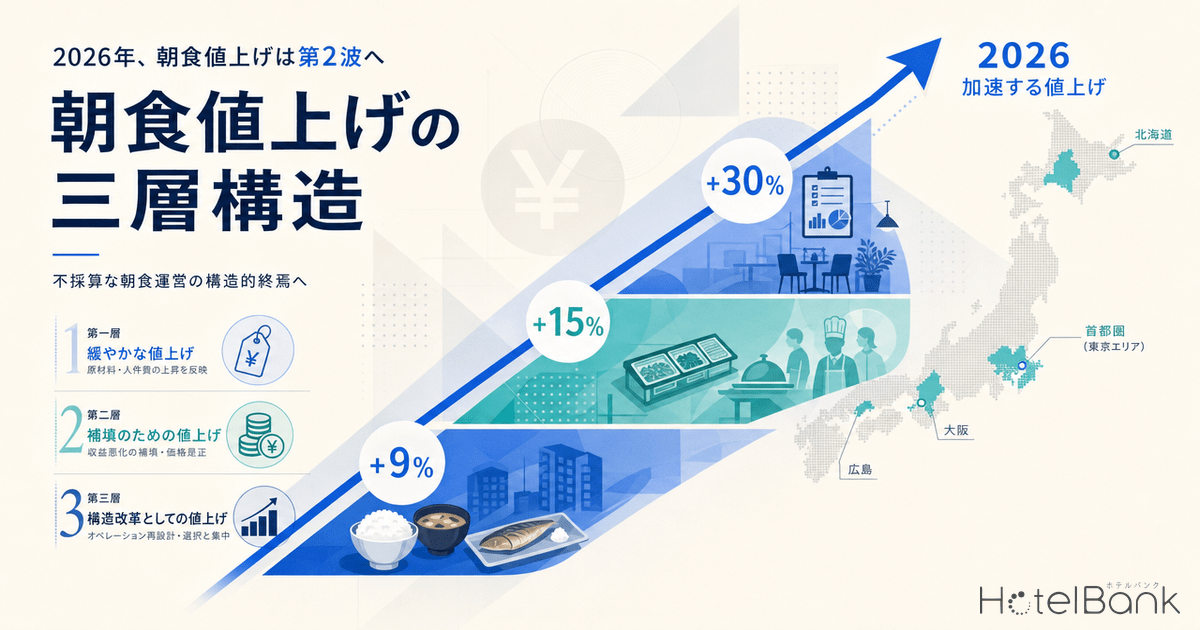
Since the start of 2026, Japanese hotels have been announcing breakfast price revisions one after another. Beginning with ANA Crowne Plaza Hotel Kushiro raising its adult breakfast price from ¥2,200 to ¥3,300 — a 50% jump in one move — Hiroshima Washington Hotel, Hotel Gracery Sapporo, Oiso Prince Hotel, Meitetsu Komaki Hotel, and Hiroshima Intelligent Hotel Annex have followed suit, with revision announcements concentrated in January through April 2026 across all grades and regions. This is a “second wave” following the first round of price hikes that ran its course in 2023–2024, and what makes it distinctive is that the revision magnitudes are a step larger. Why is the wave of price increases sweeping in again now? In this article, we organize over ten publicly announced revision cases and decode 2026 hotel breakfast strategy through three lenses: ratio analysis against room rates, the structural deficit in breakfast operations, and the binary opposition with the “room-only” model.
Metric Definitions Used in This Article
- ADR (Average Daily Rate): Average of public selling prices on OTAs and other channels. Differs from actual transacted prices. Per-room rate (tax-included) for double occupancy, averaged across all plan types (room-only through breakfast/dinner inclusive plans).
- Data Source: MetroEngines Research
The Second Wave Defined: Breakfast Price Hikes Concentrated in Jan–Apr 2026
First, we review the breakfast price revisions officially announced from January to April 2026. The table below extracts and organizes information from notices posted on each hotel’s official website. Hike percentages are calculated from pre- and post-revision adult prices.
| Hotel Name | Revision Date | Before | After | Hike % | Grade Tier |
|---|---|---|---|---|---|
| ANA Crowne Plaza Hotel Kushiro | 2026/1/1 | ¥2,200 | ¥3,300 | +50.0% | Upper Midscale |
| Hiroshima Washington Hotel | 2026/1/1 | ¥1,980 | ¥2,200 | +11.1% | Business |
| Hotel Urban Grace Utsunomiya | 2026/1/6 | − | +¥50–400 | +5–20% | Business |
| Hotel MyStays Hiroshima Peace Park | 2026/1/2 | − | Revised | − | Business |
| Hotel Gracery Sapporo | 2026/2/1 | ¥2,800 | ¥3,000 | +7.1% | Midscale |
| Osaka View Hotel Honmachi | 2026/3/1 | ~¥2,000 | ¥2,310 | +15.5% | Midscale |
| Oiso Prince Hotel | 2026/4/1 | ¥3,600 | ¥3,800 | +5.6% | Upper Midscale |
| Hiroshima Intelligent Hotel Annex | 2026/4/1 | ~¥1,300 | ¥1,600 | +23.1% | Business |
| Hiroshima Grand Intelligent Hotel | 2026/4/1 | ~¥2,200 | ¥2,500 | +13.6% | Midscale |
| Meitetsu Komaki Hotel | 2026/4/1 | ~¥2,200 | ¥2,500 | +13.6% | Midscale |
Source: Compiled by HotelBank Editorial Team from official hotel website notices (announcements made Jan–Apr 2026, N=10)
What stands out from this list is, first, that the revisions are “not biased toward any specific grade or region.” They span widely from business hotels at around ¥10,000 room-only to upper midscale properties exceeding ¥30,000, and geographically from Hokkaido through Hiroshima, Osaka, and the metropolitan area. While the first wave (2023–2024) of price hikes was led mainly by luxury hotels and famous city hotels, the second wave is decisively different in that it has spread to business hotels and regional properties as well. Notably, alongside reasons such as “rising food and other costs” and “soaring prices, fuel, and delivery costs,” many hotels also cite “maintaining and improving service quality.” The former is a passive price hike, while the latter signals a shift toward an active stance: “raising prices to preserve quality.”
The Three-Layer Structure of Hike Magnitudes: Moderate, Substantive Catch-up, and Structural Redesign
Looking more closely at the distribution of hike percentages, a clear three-layer structure emerges: the “moderate layer” at 9–15%, the “substantive catch-up layer” at 15–30%, and the “structural redesign layer” exceeding 30%. We organize the meaning of each layer along with representative examples.
Source: Compiled by HotelBank Editorial Team from official hotel website notices
The moderate layer (9–15%) — including Hiroshima Washington Hotel (+11.1%), Hotel Gracery Sapporo (+7.1%, just below the lower bound), and Oiso Prince Hotel (+5.6%) — represents a restrained pass-through of food cost increases accumulated over the past two to three years. Absolute price differences are around ¥200–¥220, kept within a range that does not strongly trigger guest price perception. The substantive catch-up layer (15–30%), on the other hand, is exemplified by Hiroshima Intelligent Hotel Annex (+23.1%) and Osaka View Hotel Honmachi (+15.5%). Here, multiple years of accumulated cost increases are reflected at once, representing what can be called a “settling of held-back hikes.”
What deserves particular attention is the structural redesign layer (over 30%), where ANA Crowne Plaza Hotel Kushiro’s +50.0% stands out as an exceptional case. The ¥1,100 hike magnitude is no longer simply about cost compensation; it can be interpreted as a figure that redesigns the very premise of breakfast service. The phrase “to provide a higher-quality breakfast” cited in the hotel’s announcement suggests a fundamental review encompassing menu composition, procurement policies, and operational staffing. This pattern can be seen as symbolizing the endpoint of the second wave of price hikes.
Why Now: The Lens of Room Rate Increases and Breakfast-to-ADR Ratio
To properly evaluate breakfast price hikes, it is effective to view them in ratio against room rates. Aligning the ADR for major prefectures (selling-price basis, double occupancy, tax-included) and ADR by business hotel category as compiled by MetroEngines Research as of April 2026 yields the following.
Source: Compiled by HotelBank Editorial Team from MetroEngines Research (April 2026, N=Tokyo 1,634 / Kyoto 1,479 / Osaka 855 / Hokkaido 1,456 / Okinawa 1,715 / Fukuoka 723 properties)
ADRs in the major six prefectures all posted year-on-year gains: Kyoto +18.6%, Tokyo +17.4%, Hokkaido +11.2%, Osaka +8.4%, Okinawa +7.0%, and Fukuoka +5.2%. In other words, room prices themselves are rising substantially, and breakfast prices are being revised in step with this trend. For example, the average ADR of business hotels in Hokkaido is estimated at around ¥15,000, so ANA Crowne Plaza Kushiro’s post-revision breakfast price of ¥3,300 corresponds to roughly 20–25% of the room rate. This is the level where “breakfast cost accounts for 20% of the room price” — a threshold that directly stimulates consumer price sensitivity. The structural decomposition behind this room rate surge is laid out in detail in National Average ADR Hits Record ¥32,340 (May 2026): A Three-Year +19% Decoded, examined as a three-year cumulative effect of inflation and labor cost pass-through.
Source: Compiled by HotelBank Editorial Team from official hotel breakfast prices and ADR by grade tier from MetroEngines Research
The ADR for the business hotel category as of April 2026 was ¥15,037 (N=7,123 properties), while midscale to upper midscale city hotels averaged ¥24,666 (N=1,093) and resort hotels reached ¥42,946 (N=1,512), forming a step-like ascent. Breakfast prices roughly mirror this ADR ladder, with ranges forming at ¥1,500–¥2,500 for business hotels, ¥2,500–¥3,000 for midscale, and ¥3,500–¥4,000 for upper midscale. The second wave of hikes is pushing the business tier through the threshold from “the low ¥2,000s” to “above ¥2,500” within this ladder — a shift that can be read as a change in market structure.
Structural Deficit: The Reality of “120% Cost Ratio on a ¥2,200 Plan”
Behind these breakfast price hikes lies a structural deficit problem unique to the business hotel industry. In a 2024 article titled “Cost Ratios Even at 120%!? [The Business Hotel Breakfast Battle],” journalist Nobuaki Takizawa described cases where some hotels offering popular Japanese-Western buffet styles in the ¥2,200 range have fallen into a “deficit breakfast” state where food cost ratios exceed the selling price. This is the structural result of running breakfast as a marketing tool for so long that quality competition ran past the cost line.
Organizing the typical P&L of a hotel breakfast buffet, food cost (ingredients) accounts for 40–60% of selling price, labor costs (chefs, service, dishwashing) for 15–25%, energy costs (kitchen gas and electricity) and consumables for 5–10%, and overhead allocation (space costs, depreciation) for around 10–15%. To secure operating profit, the cost ratio must be held in the 40% range, but several years of food cost surges have pushed business hotel cost ratios up to 60–80%, with extreme cases overshooting 100%. On top of this, service charge increases and labor cost inflation from rising hourly wages have further distorted the structure. How this labor cost inflation is being passed through into room rates is explored in The Real Story Behind Labor-Cost-Driven ADR Rises, which examines the divergence between OCC and ADR.
Source: Estimates by HotelBank Editorial Team based on industry standard cost models (referencing Nobuaki Takizawa’s article “Cost Ratios Even at 120%!?” and Pasco’s “Hotel Buffet Cost Ratios”)
In short, the second wave of price hikes in 2026 is not a simple cost pass-through but carries a strong “structural adjustment” character aimed at restoring the breakeven point of breakfast operations. Hiroshima Washington Hotel candidly cited “rising food and miscellaneous costs” in its announcement, and ANA Crowne Plaza Kushiro paired its major hike with a menu enhancement preview — both are explanatory strategies designed to win consumer understanding for this structural adjustment. To return breakfast to a profitable business, there are only two options: raise prices, or lower the breakfast-attached ratio (i.e., move toward room-only).
The Fork: Breakfast-as-Value-Add vs. Room-Only — A Binary Strategic Choice
Hotel operators face a strategic choice: refine breakfast as a “revenue source” or treat it as a “cost center” and shift to a room-only-centric model. The two place breakfast in opposite positions and demand entirely different operational capabilities. We organize the merits and challenges of each below.
| Strategic Axis | Breakfast Value-Add Strategy (Plan A) | Room-Only Strategy (Plan B) |
|---|---|---|
| Pricing | Breakfast ¥2,500–¥4,000, premium menu front-and-center | Breakfast as option, external partnerships considered |
| Required Capabilities | Culinary staff, menu development, local-ingredient sourcing | Room turnover efficiency, cleaning automation, IT infrastructure |
| Effect on Per-Guest Spend | +15–25% (depends on breakfast attach rate) | Compete on room rate alone, limited upside |
| Impact on Reviews | Breakfast is a key satisfaction driver, room for upside | No breakfast risks downside ratings from “budget guest” segment |
| Best-Fit Grade | Upper midscale and above, tourist locations | Business segment, station-front locations |
| Representative Examples | ANA Crowne Plaza Kushiro, Oiso Prince | Urban business hotels moving to optional breakfast |
Source: Industry trend overview by HotelBank Editorial Team
Hotels adopting Plan A position breakfast as the “core content of the stay experience,” incorporating value-driven elements such as locally sourced ingredients, made-to-order dishes, and live cooking, while crossing into the over-¥3,000 range. This fits upper midscale and above, particularly in tourist and onsen locations. Hotels adopting Plan B, by contrast, scale down, eliminate, or outsource breakfast service and concentrate management resources on room turnover efficiency and pricing management. This suits station-front business hotels driven by corporate travel and short-stay city hotel concepts.
What deserves attention is that both Plans A and B are economically more rational than continuing to operate “half-baked ¥2,000 buffets.” The strategy most to be avoided is leaving prices in the “breakfast-included ¥2,000” range while cost ratios deteriorate — this preserves losses while also degrading customer satisfaction, creating a vicious cycle. The wave of second-wave revisions can be read as evidence that hotels are making strategic decisions to escape this “in-between zone.”
For Consumers: How to Choose Breakfast-Inclusive Plans Wisely
Amid these price hikes, how should guests respond? We organize key checkpoints when choosing breakfast-inclusive plans. First, check the difference between walk-in and in-house breakfast prices. At Hiroshima Washington Hotel, the in-house guest price is ¥2,200 versus ¥2,420 for walk-ins — a ¥220 gap, and there are cases where this gap widened after revision. Second, compare the price differential of adding breakfast on the day versus booking a breakfast-inclusive plan. Booking room-only and adding breakfast on arrival often costs ¥1,000–¥1,500 more, so reserving with breakfast included up front is frequently cheaper.
Third, it is important to at least check the review scores of breakfast offerings. Breakfasts with review scores of 4.4 and above tend to be perceived as “worth the price” even at ¥3,000+, but ordering a ¥3,000 breakfast at a property scoring under 3.8 is questionable from a satisfaction standpoint. A method for assessing hotel meal experience value through review scores is laid out in Hotel Dining Chosen for Special Occasions: Tokyo, Osaka, Nagoya Luxury Review Rankings, which analyzes guest reviews in the luxury segment. Fourth, business travelers seeking budget-friendly breakfasts should keep options outside the hotel (station-front cafes, convenience stores, local breakfast spots) in view. The combination of room-only plus an external breakfast often comes in ¥1,000–¥2,000 cheaper than a hotel breakfast-inclusive plan.
For the Industry: Signs of a Third Wave and Strategic Implications
From the second-wave dynamics observable as of April 2026, three points warrant attention by industry stakeholders going forward. First is the existence of a third wave. From the second half of 2026 into 2027, hotels that held off on revisions in the second wave are likely to follow suit. In Japan’s hotel industry where peer pressure is strong, the situation of “competitors raising prices while we hold steady” is hard to sustain, and the imperative of securing funds for quality maintenance further amplifies catch-up pressure.
Second is the trajectory of regional hotels. The second wave of hikes has spread to regional cities such as Hiroshima, Sapporo, Kushiro, and Utsunomiya — a movement that can be interpreted as responding to the regional dispersion of inbound demand seen up through 2024. Regional hotels crossing into the ¥2,500 range for breakfast signals the collapse of the long-standing “regional pricing” benchmark. Third is the expansion of breakfast-less business models. The market share of room-only-focused budget formats (capsule hotels and apartment-style accommodations) may further expand on the back of breakfast price hikes. For incumbent business hotels this represents a demand-loss risk, becoming a factor that forces strategic format choices.
Summary: The Break from “Breakfast Deficit” Has Begun
Analyzing the 10+ breakfast revisions announced from January to April 2026 surfaces three findings. First, hikes are not limited to specific grades or regions; they have spread broadly from business hotels to upper-tier properties. Second, the magnitudes form a three-layer structure — moderate (9–15%), substantive catch-up (15–30%), and structural redesign (over 30%) — with ANA Crowne Plaza Kushiro’s +50% standing as a symbol of structural redesign. Third, these movements are not simple responses to food cost surges but strategic choices to restore breakfast operations to profitability, with each hotel clarifying its direction toward either a “breakfast value-add strategy” or a “room-only strategy.”
The hotel breakfast battle through 2024 had spawned a deformed competition of “ignoring costs to attract guests.” The second wave of 2026 price revisions can be positioned as a movement declaring an end to this deficit breakfast era. Going forward, in parallel with further room rate increases, breakfast prices in the ¥3,000s are likely to become “standard,” with the ¥4,000s shifting to indicate “premium.” For consumers, the decision between “choosing breakfast-inclusive or room-only” will become more important; for the industry, this signals the dawn of an era that no longer permits half-measures. Whether the price hikes will translate into a virtuous cycle of revenue improvement and service quality enhancement depends on each hotel’s next move.
Note on Future-Date ADR: The ADRs in this article are averages of selling prices publicly available on OTAs at the time of survey, and they fluctuate as check-in dates approach. Prices currently set at high levels may decline through last-minute markdowns.
Related Reading
- Business Hotel Price Surge: National ADR Analysis and Top 10 Cost-Performance Prefectures for Business Travel
- In-Room and On-Site Sauna Hotels: Premium Verification — Reading 1,500 Properties’ ADRs in 2026 “Year of the Bath”
- Hyatt Centric Sapporo Opens — Reading the Spread of Foreign Brands in Hokkaido and ADR Trends
- National Average ADR Hits Record ¥32,340 (May 2026): A Three-Year +19% Decoded by Inflation × Labor Cost Pass-Through
- Government Travel Allowance vs. Actual ADR — Visualizing the 47-Prefecture Gap (2026 Latest)
- Summer 2026: Okinawa, Hokkaido, Kyoto Hotel Price Comparison — When Is the Best Time to Book?
- Rainy-Season-Free Hokkaido in June: How Do Hotel Prices Move? 6-City ADR Comparison 2026
- May–June 2026 Hotel Opening Cluster: Geography and Structure of 13 Properties / 1,149 Rooms, Decoding the Regional-Hub Shift
References
- ANA Crowne Plaza Hotel Kushiro: Breakfast Price Revision Notice
- Oiso Prince Hotel: Breakfast Price Revision Notice
- Hotel Gracery Sapporo: Breakfast Price Revision Notice
- Hiroshima Washington Hotel: Breakfast Price Change Notice
- Hiroshima Intelligent Hotel Annex: Breakfast Price Revision Notice
- Nobuaki Takizawa, “Cost Ratios Even at 120%!? [The Business Hotel Breakfast Battle]”
- Kanko Keizai Shimbun (Tourism Economic News)