

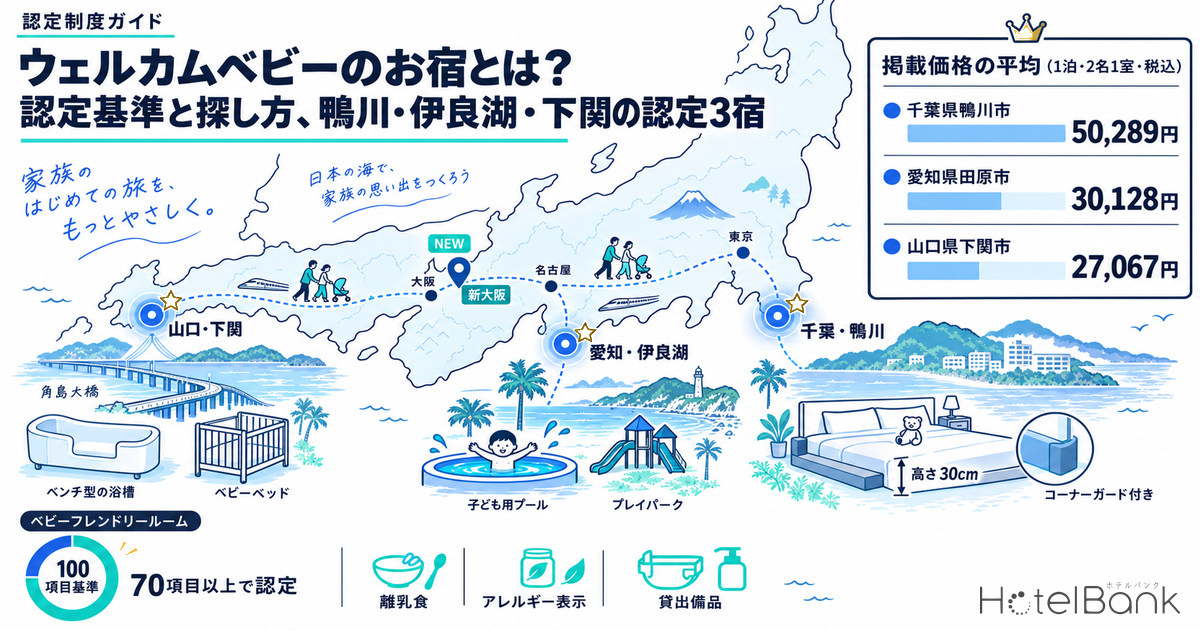
“Welcome Baby Inn” (ウェルカムベビーのお宿) is a certification program run by Miki House Child & Family Research Institute (ミキハウス子育て総研株式会社) for accommodations where families with babies and small children can stay with peace of mind. Using its own 100-item checklist, the program evaluates both hardware (guest rooms and facilities) and software (hospitality and services), and certifies properties that meet 70 or more of the items. This article explains how the program works, how to search the official list, three certified inns that HotelBank has previously covered or interviewed (Kamogawa in Chiba, Irago in Aichi, and Shimonoseki in Yamaguchi), and what a stay costs based on listed prices for two guests sharing one room.
- — Certification is granted to properties that meet 70 or more of 100 items, after a dedicated certified inspector stays in each room under review (program launched March 2008).
- — Certification generally applies to specific certified rooms, not the whole property. When booking, you need to choose a plan for a certified room such as a “Baby Friendly Room.”
- — To search, use the official “Welcome Baby Inn” website’s region, category, and popular keyword filters. The latest announced addition is Hotel Green Core Main Building (ホテルグリーンコア本館), certified July 22, 2026 (checked September 2026).
- — Median listed prices across the three cities (September 2026, 2 guests per room, tax included): Kamogawa ¥50,289 (N=72 properties), Tahara ¥30,128 (N=23), and Shimonoseki ¥27,067 (N=66).
What Is a Welcome Baby Inn? — Certified at 70+ of 100 Criteria
The certification program began on March 1, 2008. Miki House Child & Family Research Institute runs it to promote facilities that families raising young children can use with confidence, certifying both accommodations (“Welcome Baby Inn”) and day-use facilities (“Welcome Baby Facility”).
The evaluation has two main pillars:
- Hardware: bed height, rounded or padded furniture corners, flooring, bathroom design, and amenities such as baby cots and formula-ready hot water dispensers
- Software: baby food and allergy accommodations, staff hospitality, and guidance systems for guests traveling with babies
Properties are assessed against a proprietary list of 100 items, and those meeting 70 or more are certified. The review is conducted by the institute’s own certified inspectors over a one-night, two-day itinerary, actually staying in each room for which certification is sought. As a result, many properties apply certification to specific room types, such as a “Baby Friendly Room.” Because certified rooms and standard rooms at the same property differ in amenities and design, it is important to specify a certified room or plan when you book.
The number of certified properties continues to grow. Notices on the official website announced new certifications for Shin-Osaka Station Hotel (新大阪ステーションホテル) on June 22, 2026, and Hotel Green Core Main Building on July 22, 2026 (per the official website as of September 2026). Certification is renewed in three-year terms, and a July 1, 2026 notice stated that four properties, including Irago Ocean Resort, had entered their next certification term. For what baby-ready rooms mean for hotels themselves, our analysis Baby-Friendly Hotels in Japan 2026: Latest Trends and Revenue Structure takes a deep dive from the operator’s perspective.
How to Find Certified Inns: Using the Official List and Pre-Booking Checks
Searching is simple: Miki House Child & Family Research Institute’s official “Welcome Baby Inn” website (in Japanese) lists certified facilities along with announcements. There are three ways to search: “Search by Region” (by prefecture), “Search by Category” (seaside and waterfront resort hotels, onsen hotels, Japanese-style ryokan, and more), and “Search by Popular Keyword” (inns that host okuizome, the traditional first-meal ceremony for babies; inns with kids’ spaces; inns where you can use a private bath with your baby; and more). If you already have candidate destinations, the most reliable approach is to narrow down by region first, then confirm the details of certified rooms on each property’s official website. It also helps to cross-reference certification with the review factors that make a hotel kid-friendly to shortlist candidates.
Three things worth checking before you book:
- Is it a certified room? Many properties have only a limited number of certified rooms, and they tend to fill up early on weekends and holidays. Check the room or plan name, such as “Baby Friendly Room,” on the booking screen.
- Meal accommodations: which baby food stages are offered (early through late weaning), allergen labeling, and whether allergen-free meals can be arranged
- Loaner items: whether baby cots, baby bathtubs, toilet training seats, diaper bins, and other items are available so you can pack less
Note that even without certification, many inns across Japan offer features that make a real difference for families with babies, such as private baths and in-room dining. For a real-world example of searching by those conditions, see Top 5 inns for a first onsen overnight with a 0–2-year-old, securing “it’s okay if they cry” through private baths and in-room dining — weekday stays in Kawaji and Shiobara, Tochigi (HotelPicks, in Japanese).
Three Certified Inns We Have Covered — Kamogawa, Irago, and Shimonoseki
From the certified inns HotelBank has covered in news reports and interviews, here are three seaside resort properties. All three were listed on the official website’s list of certified facilities as of September 2026, and each offers a kids’ space along with meal options for children (facility details reflect the time each original article was published).
Kamogawa Grand Hotel (鴨川グランドホテル) — Kamogawa, Chiba
A long-established resort where every room faces the Pacific Ocean, the hotel was certified on July 24, 2025. Its certified rooms come in two types of “Baby Friendly Room.” King-size beds for co-sleeping are kept low at about 30cm, and the rooms feature allergy-friendly tatami and cushioned flooring, corner guards on furniture, bench-style bathtubs that make it easier to bathe while holding a child, and even a microwave for warming milk. The hotel also opened a new play area, “Waku Waku Hiroba,” for children aged roughly 18 months to 4 years, and its buffet offers baby food from early to late weaning stages plus allergen labeling for eight major allergens in Japanese and English. Details were covered in HotelBank’s news report at the time of certification (in Japanese).
Irago Ocean Resort (伊良湖オーシャンリゾート) — Tahara, Aichi (Cape Irago)
Located at Cape Irago on the tip of the Atsumi Peninsula, this resort hotel was certified in June 2023. The following July it opened “Kids Park,” a playroom created by renovating part of the building, and its grill buffet restaurant, which opened that June, set up a children’s corner with cotton candy and a chocolate fountain. The renovated outdoor pool also includes a dedicated children’s pool (all as of the article published in August 2023). On July 1, 2026, the hotel completed its first three-year certification term and entered its second. The background was covered in HotelBank’s article at the time of certification (in Japanese).
Hotel Nishinagato Resort (ホテル西長門リゾート) — Shimonoseki, Yamaguchi
This oceanfront resort in Hohoku-cho, Shimonoseki, overlooks the Tsunoshima Ohashi Bridge (77 guest rooms in total). Its certified “Baby Friendly Room” reflects feedback from families with babies: low 30cm beds designed with falls in mind, allergy-friendly tatami, a baby cot as standard, a microwave and formula-ready hot water dispenser, and a two-tier washbasin with separate heights for adults and children. There is also a “Waku Waku Hiroba” play area with educational toys and a jungle gym, and the hotel accommodates baby food requests and provides allergen labeling. In an interview with the hotel (in Japanese), HotelBank asked staff what they prioritized in pursuing certification. For its position within the prefecture and nearby listed price levels, see our analysis of Yamaguchi Prefecture’s four-tier hotel market.
Cost Guide — Listed Prices in the Three Areas (September 2026, 2 Guests per Room, Tax Included)
To give a sense of budget, we compiled OTA listed prices (per room for two guests, tax included) in the cities where the three inns are located. The figures are medians across listed properties in each city, compiled by the HotelBank Editorial Team for September 2026 stays as of September 6, 2026.
| Area | Median listed price (per night, 2 guests per room, tax included) | Sample |
|---|---|---|
| Kamogawa, Chiba (Kamogawa Grand Hotel) | ¥50,289 | N=72 properties |
| Tahara, Aichi (Irago Ocean Resort) | ¥30,128 | N=23 properties |
| Shimonoseki, Yamaguchi (Hotel Nishinagato Resort) | ¥27,067 | N=66 properties |
* Listed prices (all plans) for September 2026 stays, compiled by the HotelBank Editorial Team from publicly available OTA data. Values are the city-level median of each property’s daily average, averaged over the month. They are a guide for all listed properties in each city, not the rates of the certified inns or certified rooms themselves. Actual payment varies by plan, meal conditions, and dates.
Kamogawa is the most expensive of the three cities, at 1.7–1.9 times the level of Tahara and Shimonoseki. One likely factor is the large number of seaside onsen resorts there, but the mix of properties differs by city, so please use these figures only as a budget guide. In every area, certified rooms are limited in number, so the basic approach to booking a trip with a baby is to secure a certified room as soon as your destination and dates are set, and to arrange meal accommodations at the same time.
Explore Further
For detailed comparisons of specific inns, these articles (in Japanese) go deeper.
Compares five inns, including Motoyu Jinya (元湯陣屋, Tsurumaki Onsen, Kanagawa), Motoyu Ryusenkaku (元湯龍泉閣, Arima Onsen), and Aoyama Yamato (青山やまと, Ito Onsen), by their official information on celebration meals, teething stones, and baby cots, along with approximate prices for two guests per room. It also explains how to plan backward from the celebration meal booking deadline.
Introduces five inns selected for private baths, in-room dining, and Japanese-style rooms, including Iwaiyado Juan (祝い宿 寿庵, Kawaji Onsen), which has a baby cot in the changing area, and Keiunkaku (渓雲閣, Oku-Shiobara Shinyu), which serves breakfast and dinner in-room and offers two private open-air baths free of charge 24 hours a day.
Frequently Asked Questions
Q. What are the certification criteria for a Welcome Baby Inn?
A property must meet at least 70 of the 100 items defined by Miki House Child & Family Research Institute. A dedicated certified inspector reviews each room for which certification is sought by staying there over a one-night, two-day itinerary. The items cover both hardware, such as facilities, and software, such as hospitality and service offerings.
Q. When did the certification program start?
It began on March 1, 2008. There are two categories: “Welcome Baby Inn” for accommodations and “Welcome Baby Facility” for day-use facilities.
Q. At a certified inn, is every room certified?
No. Because reviews are conducted room by room, many properties limit certification to specific rooms such as a “Baby Friendly Room.” Please confirm that you are booking a plan for a certified room.
Q. Where can I find certified inns?
On Miki House Child & Family Research Institute’s official “Welcome Baby Inn” website, you can search by region, category, or popular keyword (such as inns that host okuizome or inns with kids’ spaces). New certifications and term renewals are announced in the news section.
Q. Does certification expire?
Certification is renewed in three-year terms. For example, Irago Ocean Resort was certified in June 2023, completed its first term on July 1, 2026, and entered its second certification term.
Q. How much does it cost to stay in Kamogawa, Irago, and Shimonoseki?
Median listed prices for September 2026 stays (2 guests per room, tax included) are ¥50,289 in Kamogawa, ¥30,128 in Tahara, and ¥27,067 in Shimonoseki. These are guides for all listed properties in each city, not the rates for certified rooms.
Methodology and Sources
■ Data Sources
Certification criteria, program start date, certification terms, and announcement dates of new certifications are based on pages of Miki House Child & Family Research Institute’s official “Welcome Baby Inn” website (checked by the HotelBank Editorial Team on September 11, 2026). Facility details for the three inns are based on HotelBank’s news reports and interviews (for Hotel Nishinagato Resort, the certified room plan listing on its official website was also confirmed). Listed prices are city-level values compiled by the HotelBank Editorial Team from publicly available OTA data (Kamogawa N=72 properties, Tahara N=23, Shimonoseki N=66).
■ Calculation Assumptions
Listed prices are for September 2026 stays, per room for two adults, tax included, across all plans. We took the city-level median of each property’s daily average and averaged it over the month. As of the compilation date (September 6, 2026), September data mixes past dates and future dates; future-date values are listed prices currently on sale.
■ Limitations and Notes
Listed prices are not actual transaction prices, nor do they represent the rates of certified inns or certified rooms. Actual payment varies significantly by meal conditions, plan, day of week, and season. Facilities and services at the three inns reflect the time each article was published and may change. The total number of certified facilities is not stated on the official website and is therefore not covered in this article.
■ References
- Miki House Child & Family Research Institute, “Welcome Baby Inn” official website (list of certified facilities)
- Miki House Child & Family Research Institute, “What Is the Welcome Baby Inn Certification Project?”
- Miki House Child & Family Research Institute, “Evaluation Items and Criteria”
- Miki House Child & Family Research Institute, “Announcements and Media Coverage”
- Hotel Nishinagato Resort official website
- HotelBank, “Kamogawa Grand Hotel Certified as a ‘Welcome Baby Inn'” (August 28, 2025, in Japanese)
- HotelBank, “Irago Ocean Resort Certified as a ‘Welcome Baby Inn'” (August 23, 2023, in Japanese)
- HotelBank, “[Interview] Hotel Nishinagato Resort Earns Welcome Baby Certification” (September 4, 2025, in Japanese)
Related Articles
- Baby-Friendly Hotels in Japan 2026: Latest Trends and Revenue Structure Analysis
- What Makes a Hotel Kid-Friendly: Japan’s Top Family-Stay Rankings and Geographic Growth Potential
- Hotels with In-Room Slides: Market Analysis of Family-Differentiated Rooms and Revenue Contribution
- Reading Yamaguchi’s Hotel Market in Four Tiers: Prices and White Space in Shimonoseki, Yuda Onsen, Iwakuni, and Akiyoshidai/Nagato Yumoto