

Silver Week 2026 runs Saturday, September 19 through Wednesday, September 23 — five consecutive days off. A line-up in which Respect for the Aged Day, a Citizens’ Holiday and the Autumnal Equinox Day fall right after a weekend has not happened since 2015, eleven years ago, and hotel listed prices have already risen sharply for those dates alone. This article sets out why the calendar produces a five-day break, how many years it has been and when the next one comes, and shows with measured data exactly how much hotels in Tokyo, Osaka and Kyoto have raised prices on each night — so you can see, by date, which nights inside the same holiday are still cheap.
• Average listed price = the listed price of accommodation plans each property publishes on OTAs (average across all plans). It is an estimate and differs from actual transaction prices.
• Prices are per room for two adults sharing one room (tax included). Amounts in the body text are rounded to the nearest ¥100; tables and charts use measured values.
• Occupancy (OCC) = sold rooms as a share of total rooms in the area (an estimate based on OTA-listed inventory).
• Data as of August 31, 2026. Listed prices change daily, so they may differ from the price you see when booking.
• Source: MetroEngines Research; compiled by the HotelBank Editorial Team
- — Five days off, Saturday September 19 to Wednesday September 23. Respect for the Aged Day, a Citizens’ Holiday and the Autumnal Equinox Day line up straight after a weekend — the first such run since 2015, eleven years ago.
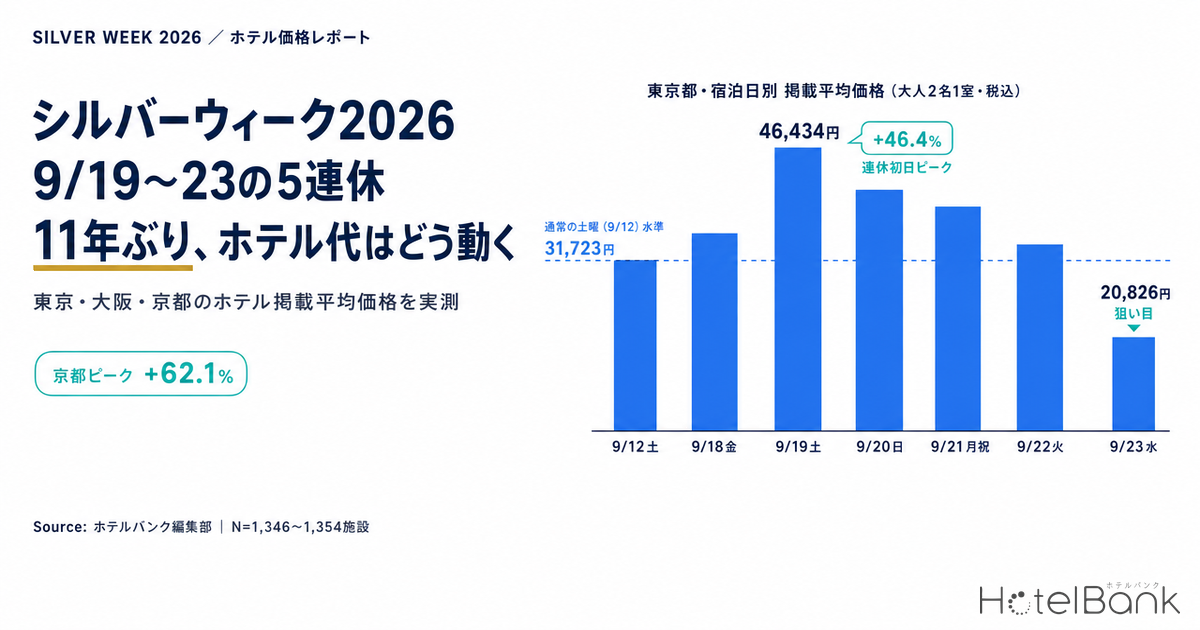
- — Tokyo opens the holiday at +46.4%. Against ¥31,700 on an ordinary Saturday, the night of September 19 lists at ¥46,400 (as of August 31, 2026; N=1,346–1,354 properties).
- — Kyoto shows the steepest rise at +62.1%, with Osaka at +56.3%. Kyoto also holds high prices on the night of September 21, so demand there runs later into the break than in Tokyo or Osaka.
- — The final night, September 23, lists at ¥20,800 — less than half the opening night. September 21 and 22 also fall back to ordinary-Saturday levels, so shifting your stay by one day moves the bill by ¥13,000–¥18,000 per night.
- — Occupancy is already 80–90% a month out. Locking in early to keep your choice of rooms tends to beat waiting for a price drop.
When is Silver Week 2026? — Saturday September 19 to Wednesday September 23
In the public holiday data published by the Cabinet Office (syukujitsu.csv), September 2026 carries three holidays: Monday, September 21 (Respect for the Aged Day), Tuesday, September 22 (a holiday) and Wednesday, September 23 (Autumnal Equinox Day). Under Japan’s Public Holiday Act a weekday sandwiched between two holidays becomes a “Citizens’ Holiday,” which is what September 22 is — and that joins up with the preceding weekend to create five consecutive days off from Saturday, September 19 to Wednesday, September 23.
Add two days of leave on Thursday, September 24 and Friday, September 25 and the break stretches to nine days, through Sunday, September 27. For anyone able to take the time off, that puts a long trip on the table on a scale usually reserved for New Year or Obon.
How many years since the last five-day break, and when is the next one?
The previous five-day run was September 19–23, 2015. The same Cabinet Office data confirms that 2015 had the identical line-up: Respect for the Aged Day on September 21, a holiday on September 22 and Autumnal Equinox Day on September 23. That makes the 2026 break the first in eleven years.
When does the next one come? Respect for the Aged Day is fixed as the third Monday of September, while the Autumnal Equinox Day is set each year by astronomical observation. A five-day break therefore needs the equinox to fall on a Wednesday with Respect for the Aged Day on the Monday two days earlier. Applying that test to the years ahead, 2027 does not qualify: Respect for the Aged Day falls on Monday, September 20 and the equinox on Thursday, September 23, leaving a gap (2027 is already fixed in the Cabinet Office data). By astronomical calculation, the next year that could line up is September 2032 — if the equinox falls on Wednesday, September 22, the break would run Saturday, September 18 to Wednesday, September 22. But the equinox date is only formally set in the official calendar notice published in the government gazette the previous February, so it is not confirmed yet. It is worth planning on the basis that 2026 is the last confirmed five-day break for the foreseeable future.
How much do hotel rates rise? — Tokyo is +46% against an ordinary Saturday
The HotelBank Editorial Team compiled publicly listed OTA data as of August 31, 2026. Across all property types in Tokyo, for two adults in one room, the average listed price for the night of Saturday, September 19 — the first night of the holiday — is ¥46,400, or +46.4% against ¥31,700 on an ordinary Saturday (the night of September 12). The night of Sunday, September 20 stays high as well at ¥43,800 (+38.0%). Occupancy based on OTA-listed inventory was already close to 90% almost a month ahead: 89.7% on September 19 and 89.2% on September 20 (Tokyo, N=1,346–1,354 properties).
| Stay date (September 2026) | Day | Average listed price (Tokyo) | Inventory-based occupancy |
|---|---|---|---|
| September 12 | Sat (ordinary weekend) | ¥31,723 | 84.4% |
| September 18 | Fri (day before the break) | ¥25,634 | 80.3% |
| September 19 | Sat (first night) | ¥46,434 | 89.7% |
| September 20 | Sun | ¥43,781 | 89.2% |
| September 21 | Mon · Respect for the Aged Day | ¥33,476 | 84.3% |
| September 22 | Tue · Citizens’ Holiday | ¥28,585 | 81.9% |
| September 23 | Wed · Autumnal Equinox Day (final night) | ¥20,826 | 74.0% |
| September 26 | Sat (weekend after the break) | ¥34,775 | 80.5% |
Average listed price (all property types, two adults per room, tax included, as of August 31, 2026). Source: MetroEngines Research; compiled by the HotelBank Editorial Team (Tokyo N=1,346–1,354 properties. The observed property count varies by date because plans withdrawn from sale by the time of compilation are mixed in.)
Tokyo — average listed price across all property types (two adults per room, tax included, as of August 31, 2026). Source: MetroEngines Research; compiled by the HotelBank Editorial Team
Osaka and Kyoto climb even harder. Osaka goes from ¥19,700 on the night of Saturday, September 12 to ¥30,700 on the night of Saturday, September 19, or +56.3% (N=708–710 properties). Kyoto goes from ¥33,100 on the night of September 12 to a peak of ¥53,600 on the night of Sunday, September 20, or +62.1%, with inventory-based occupancy reaching 93.6% (as of August 31, 2026; N=1,094–1,100 properties). Kyoto also stays expensive on the night of Monday, September 21 at ¥45,300 with occupancy at 91.0% (same basis) — demand there runs into the back half of the break in a way it does not in Tokyo or Osaka. Narrowing to the business-hotel segment shows the same pattern: in Tokyo, ¥27,000 on the night of September 12 against ¥38,200 on the night of September 19 (+41.3%, N=850–859 properties). Why Osaka’s demand concentrates in the front half is tracked through inventory progress by lead time in Osaka Sep 2026 Holiday: Demand Peaks First 2 Nights, Sep 23 at 58.0%.
Average listed price on an ordinary Saturday (the night of September 12) compared with the holiday peak night (September 19 for Tokyo and Osaka, September 20 for Kyoto) — all property types, two adults per room, tax included, as of August 31, 2026. Tokyo N=1,346–1,354 properties, Osaka N=708–710 properties, Kyoto N=1,094–1,100 properties. Source: MetroEngines Research; compiled by the HotelBank Editorial Team
Tokyo — inventory-based occupancy by stay date (an estimate based on OTA-listed inventory, as of August 31, 2026, N=1,346–1,354 properties). Source: MetroEngines Research; compiled by the HotelBank Editorial Team
Which nights are cheap — September 21 and 22, plus the eve and the final night
Within the same five-day break, moving your stay by a single day changes the bill substantially. Three openings stand out in the table above.
1. The back half — nights of Monday, September 21 and Tuesday, September 22
In Tokyo the night of September 21 lists at ¥33,500 and September 22 at ¥28,600. Against ¥46,400 on the opening night that is ¥13,000–¥18,000 less per night, and September 21 comes back down to roughly the level of an ordinary Saturday (¥31,700 on September 12, ¥34,800 on September 26). A back-loaded itinerary — stay home over the weekend, then take two nights from Monday — cuts the bill considerably for a trip inside the same holiday. Kyoto is the exception: at ¥45,300 the night of September 21 is still expensive there, so this tactic works best in Tokyo and Osaka.
2. The eve of the break — the night of Friday, September 18
Tokyo lists at ¥25,600, more than ¥20,000 below the opening night. Travel out on Friday evening and start moving on Saturday morning and you avoid one night at the peak.
3. The final night — Wednesday, September 23
At ¥20,800, Tokyo is the lowest of the eight dates compared. With weekdays resuming the next morning there are few overnight guests, so extending the end of your break by one night works out at less than half the opening-night rate. For anyone able to add leave from September 24 onward, it is the best value date in the set. The way September 23 falls back to the level of an ordinary Wednesday is also visible as a fixed-point observation 47 days out in Silver Week 2026 Back Half at T-47: Sep 23 Matches a Normal Wednesday.
How to book — early reservations, splitting properties, and cancellation terms
Use early-booking and prepaid plans for what each is good at
With inventory-based occupancy in the major cities already at 80–90% at the end of August, waiting for a price drop is less rational than locking in early to keep your choice of rooms. Early-booking and prepaid plans often carry a lower total for the same room. If your dates are firm, take the prepaid type; if they are still fluid, take a standard plan with a long free-cancellation window. Local government lodging subsidies, where they are running, can change what you actually pay by a wide margin, so check each destination’s discount conditions alongside the price.
Split the front and back halves across two properties
Running all five nights at a single property tends to drag the opening night’s peak rate across the whole stay. Split it in two — a property in a sightseeing area for the front half, a city property where prices settle for the back half (from September 21) — and you capture the day-by-day gaps shown above directly. If you would rather cut the travel, as on a family trip, the opposite approach works too: settle into one stay-put property for the whole break.
Check the cancellation terms when you book
Under the standard form of Japanese accommodation terms, cancellation fees start a few days before the stay date and rise in steps (for example a set percentage the day before and a higher one on the day; both the rate and the day it starts differ by property and by plan). Holiday periods sometimes carry different terms from ordinary dates, so confirm the exact deadlines and rates on each property’s official site or in the plan terms before you book. With the season overlapping typhoon season, how long free cancellation lasts is as important a comparison point as the price.
Looking for specific properties
For side-by-side comparisons of individual properties, these articles go deeper.
Compares five properties two to three hours from the Tokyo area that suit consecutive nights with children aged 4–10 — including Fujisan Onsen Hotel Kanezanen (Yamanashi), Minakami Hotel Juraku (Gunma) and Ikaho Onsen Hotel Kogure — on room size, indicative price and how easy the property is to spend a day inside. For families who want to spend the break in a single property.
Selects five Nasu Highlands properties — including Hotel Harvest Nasu and TOWA Pure Cottage (the official hotel of Rindoh Lake Family Farm, with free park entry during the stay) — for how easily grandparents and grandchildren can move around together and for the harvest season. Useful when choosing a destination for a three-generation trip over Respect for the Aged Day.
Frequently asked questions
Q. What are the exact dates of Silver Week 2026?
Five consecutive days from Saturday, September 19 to Wednesday, September 23, 2026. September 21 is Respect for the Aged Day, September 22 is a Citizens’ Holiday and September 23 is Autumnal Equinox Day (already fixed in the Cabinet Office holiday data).
Q. How many years since the last five-day break?
Eleven years — the last was September 19–23, 2015. That break had the same line-up, with a Citizens’ Holiday falling between Respect for the Aged Day and Autumnal Equinox Day.
Q. When is the next five-day break?
2027 does not qualify: Respect for the Aged Day (September 20) and Autumnal Equinox Day (September 23) sit too far apart. By astronomical calculation, the next year that could line up is September 2032 — if the equinox falls on Wednesday, September 22, the break would run September 18–22. The equinox date is only formally set in the official calendar notice published the previous February, so it is not confirmed yet.
Q. When do hotel rates start to rise?
Listed prices for holiday dates are set high from an early stage. As of August 31, 2026, the night of September 19 in Tokyo was 46% above an ordinary Saturday and inventory-based occupancy had reached about 90%. Booking early to keep your choice of rooms tends to work out better than waiting for a last-minute drop.
Q. What is the weather like at that time of year?
On Japan Meteorological Agency climatological normals, the mean September temperature in Tokyo is 23.3°C (daily high 27.5°C, daily low 20.3°C). Late-summer heat lingers during the day while mornings and evenings turn comfortable; in the highlands and the Tohoku region you will want a light jacket.
Method and sources
Holiday dates follow the Cabinet Office’s published data, “About Japan’s National Holidays” (syukujitsu.csv, retrieved September 1, 2026). Hotel prices and occupancy are the average listed price (two adults per room, tax included, averaged across all plans) compiled by the HotelBank Editorial Team from publicly listed OTA data as of August 31, 2026, together with occupancy estimated from OTA-listed inventory. Coverage is Tokyo N=1,346–1,354 properties, Osaka N=708–710 properties and Kyoto N=1,094–1,100 properties (the Tokyo business-hotel segment is N=850–859 properties). Listed prices change daily and may differ from the price you see when booking. Temperatures are Japan Meteorological Agency climatological normals (1991–2020, Tokyo). For a deeper read of market-wide booking behaviour, see also Silver Week 2026: First in 11 Years — ADR & Booking Curve Analysis.
■ Data sources
Holiday dates come from the Cabinet Office’s published data, “About Japan’s National Holidays” (syukujitsu.csv, retrieved September 1, 2026). Hotel prices and occupancy were compiled by the HotelBank Editorial Team from publicly listed OTA data as of August 31, 2026. Temperatures come from the Japan Meteorological Agency’s “Past Weather Data” climatological normals (1991–2020, Tokyo).
■ Calculation assumptions
The average listed price is the per-room rate for two adults sharing one room (tax included, averaged across all plans). Rates of increase are calculated against each prefecture’s “ordinary Saturday” — the night of September 12, 2026. Inventory-based occupancy is estimated as sold rooms as a share of total rooms listed on OTAs. Amounts in the body text are rounded to the nearest ¥100; tables and charts use measured values.
■ Limitations and caveats
Listed prices are not transaction prices and differ from the amount charged at the time of booking. Listed prices and inventory move daily, so there is no guarantee that the relative order seen on August 31 holds through to the stay date. The observed property count varies by date because plans withdrawn from sale by the time of compilation are mixed in. A night-by-night breakdown is given for Tokyo only; Osaka and Kyoto are limited to a two-point comparison between the baseline date and the peak date. Five-day breaks from 2032 onward precede formal confirmation in the official calendar notice and are not settled dates.
Related reading
- Osaka Sep 2026 Holiday: Demand Peaks First 2 Nights, Sep 23 at 58.0%
- Silver Week 2026 Back Half at T-47: Sep 23 Matches a Normal Wednesday
- Ibaraki Silver Week: Ryokan-Business Gap Hits 21.9pt, Back Half Flat
- Hokkaido Silver Week: Sep 20 Peaks, Ryokan 96.4%, Only Business Dips
- Silver Week 2026: First in 11 Years — ADR & Booking Curve Analysis