

If you want to stay at a ryokan (Japanese inn) for an extended period, there are three main routes: choose a ryokan that offers multi-night (renpaku) plans, choose an onsen inn with toji (therapeutic bathing) plans, or switch to room-only and source your meals outside. Unlike hotels, ryokan rarely sell packaged products such as “monthly plans,” but ryokan have a long-standing culture of extended stays in the form of toji — and once you know how to search, a one-week or one-month stay is entirely doable.
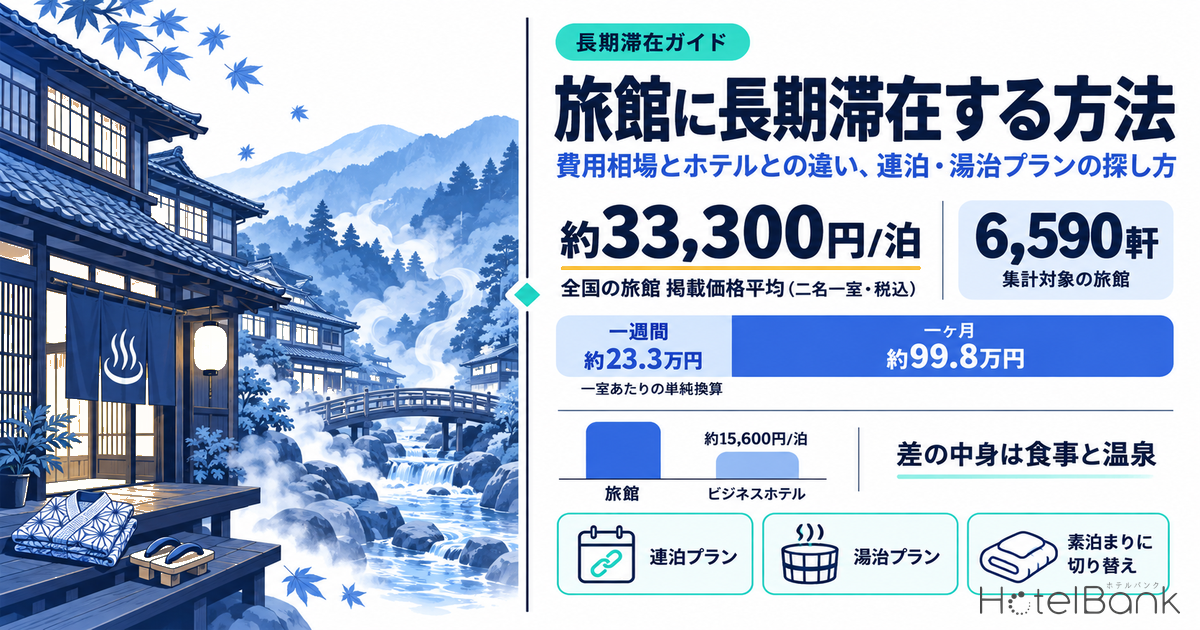
As a cost benchmark, OTA public data compiled by the HotelBank Editorial Team shows that the 6,590 properties in the ryokan category nationwide have an average listed price of about ¥33,300 per night (per room, 2 guests per room, tax included, as of September 2026). For two guests that works out to about ¥16,600 per person per night — and since many plans include dinner and breakfast, the figure is less expensive than it looks. This article sets out concrete ways to stay long-term at a ryokan, current listed prices, and whether a ryokan or a hotel suits you better.
- — A long ryokan stay can be built from three entry points: ryokan with multi-night plans, onsen inns with toji plans, and switching to room-only.
- — The average listed price is ¥33,281 per night (6,590 ryokan nationwide, per room with 2 guests, tax included, as of September 2026). Note that this price includes dinner, breakfast and hot-spring bathing.
- — About ¥233,000 for 7 nights and about ¥998,000 for 30 nights (total per room for 2 guests). Per person that is about ¥116,000 and about ¥499,000 — an upper-end guide based on simply multiplying the average.
- — Changing prefecture moves a 30-night bill by about ¥590,000. At the Tochigi level (¥29,626) it is about ¥889,000; at the Kyoto level (¥49,233) about ¥1,477,000. Where you stay has the biggest effect on cost.
- — Choose between ryokan and hotel by purpose. A ryokan suits you if you want meals and bathing taken care of for recuperation or rest; a hotel suits you if self-catering and a base for work come first.
Three Ways to Stay Long-Term at a Ryokan
1. Look for ryokan with multi-night plans
The quickest route is to filter OTA searches by keywords or plan names such as “連泊” (consecutive nights) or “○連泊限定” (limited to stays of X nights or more). Ryokan that offer multi-night plans not only lower the rate from the second night onward — some also officially state that they change the dinner menu on the second night. Kaiseki meals are designed to be complete within a single night, so an inn that can rotate its menu day by day is one that is set up to host long stays. For how meals change on consecutive nights, an article examining ryokan that officially publish their multi-night menus (in Japanese) goes into detail.
2. Choose an onsen inn with toji plans
Toji is the original form of the long stay at a ryokan: traditionally one week counted as one “round” (hitomawari), and stays were built up to two or three weeks. Today’s toji inns accept guests from two or three nights under names such as “petit toji” or “modern toji,” and even with two meals included, their rates are generally set lower than standard kaiseki plans. At inns that still keep a self-catering wing (jisuibu), you can bring your own ingredients and cut costs further. You will find the most options in hot-spring towns where the toji culture is still alive, such as the Tohoku onsen areas (Naruko, Hijiori and others) and Shima Onsen in Gunma. If you want to narrow down inns by how they use their source water, a ranking of free-flowing (kakenagashi) hot springs is also a useful reference.
3. Switch to room-only / no meals
Seven nights with two meals a day adds up to a considerable sum for food alone. For long stays, a realistic structure is “two meals included for the first two or three nights, then room-only or breakfast-only after that.” Whether you can change meal conditions night by night when booking varies from inn to inn, so for stays of a week or longer, consulting the inn directly often gives you more flexibility than booking through a reservation site. Even inns that do not show toji plans or long-stay discounts in search results sometimes quote a long-stay rate when you call them. For how to organize meals after switching to room-only, our article sorting hotel long-stay meals into three patterns — eating out, take-out, and in-room is a helpful reference.
How Much Does a Long Ryokan Stay Cost? — Current Listed Prices
According to OTA public data compiled by the HotelBank Editorial Team (as of September 2026), the 6,590 properties in the ryokan category nationwide have an average listed price of about ¥33,300 per night (per room, 2 guests per room, tax included). A simple conversion gives the following guide for multi-night stays.
| Length of stay | Per room (2 guests) | Per person |
|---|---|---|
| 1 night | ¥33,281 | approx. ¥16,600 |
| 7 nights (1 week) | approx. ¥233,000 | approx. ¥116,000 |
| 30 nights (1 month) | approx. ¥998,000 | approx. ¥499,000 |
*A guide obtained by simply multiplying the average listed price of 6,590 ryokan nationwide (2 guests per room, tax included, as of September 2026; HotelBank Editorial Team research) by the number of nights. Multi-night plans, toji plans and switching to room-only can bring the actual amount paid below these figures.
Going one step further, the factor that moves cost the most is the prefecture you stay in. Using prefecture-level averages from the same dataset and stacking up three levels — a low-cost prefecture, the national average and a high-cost prefecture — the 30-night total varies across a range of about ¥590,000.
| Level | 1 night | 7 nights (1 week) | 30 nights (1 month) |
|---|---|---|---|
| Lower (Tochigi level) | ¥29,626 | approx. ¥207,000 | approx. ¥889,000 |
| National average | ¥33,281 | approx. ¥233,000 | approx. ¥998,000 |
| Higher (Kyoto level) | ¥49,233 | approx. ¥345,000 | approx. ¥1,477,000 |
*Each figure is a guide obtained by stacking the average listed price for that level (2 guests per room, tax included, as of September 2026; HotelBank Editorial Team research) directly by the number of nights. Tochigi is the lowest and Kyoto the highest of the 13 prefectures excerpted here. At every level, multi-night plans, toji plans and switching to room-only bring the actual amount paid down from these figures.
Bear in mind, however, that this is an average centered on standard plans, and it should be treated as a starting point rather than a ceiling. Combining toji plans or room-only stays changes the per-night amount considerably, and staying mainly on weekdays lets you avoid weekend rates. Conversely, choosing a room with a private open-air bath or a luxury ryokan puts you above ¥50,000 per night. To see how much length-of-stay discounts actually help, you can check measured hotel-side rates in Japan Hotel Long-Stay Discounts: 15% at 7 Nights, 20% at 30 Nights.
How Much Do Prices Differ by Prefecture?
Ryokan listed prices vary widely by region. The average listed prices (2 guests per room, tax included, as of September 2026) for major onsen and tourism prefectures are excerpted below.
| Prefecture | Average listed price (per room, 2 guests, tax incl.) | Sample |
|---|---|---|
| Kyoto | ¥49,233 | N=186 properties |
| Hyogo | ¥37,495 | N=264 properties |
| Shizuoka | ¥37,116 | N=453 properties |
| Gunma | ¥36,955 | N=255 properties |
| Ishikawa | ¥36,198 | N=116 properties |
| Gifu | ¥34,552 | N=219 properties |
| Niigata | ¥34,482 | N=223 properties |
| Yamagata | ¥33,572 | N=185 properties |
| Miyagi | ¥33,105 | N=113 properties |
| Nagano | ¥31,716 | N=483 properties |
| Oita | ¥31,575 | N=302 properties |
| Kanagawa | ¥29,841 | N=270 properties |
| Tochigi | ¥29,626 | N=198 properties |
*Average OTA listed prices (as of September 2026; HotelBank Editorial Team research). Excerpt of major onsen and tourism prefectures.
Kyoto sits at a high level nationally, in the ¥49,000 range, while Nagano, Oita, Tochigi and Kanagawa fall within ¥29,000–¥31,000. Nagano (483 properties) and Oita (302 properties) also have large pools to choose from, so if you want to keep long-stay costs down, the standard approach is to search in “prefectures with many inns and listed prices below the national average.” Even within the same prefecture, small hot-spring villages where the toji culture survives make it easier to find inns with long-stay pricing than large entertainment-style onsen resorts.
Ryokan or Hotel: Which Suits a Long Stay?
In the same dataset, the 7,900 properties in the business hotel category nationwide have an average listed price of about ¥15,600 per night (2 guests per room, tax included, as of September 2026). That is less than half the ryokan figure, but the gap consists mainly of meals and bathing. Ryokan rates often include dinner and breakfast, and bathing in the large hot-spring baths is part of the stay experience. Once you add the cost of eating out every day and visiting day-use bathhouses while staying room-only at a hotel, the real difference is smaller than the listed prices suggest.
To sum up, a long ryokan stay suits: (1) people who do not want to think about arranging meals (two meals included covers it), (2) people whose goal is recuperation or refreshment in the hot springs (the toji tradition), and (3) people who want to enjoy the stay itself (the room, garden and meals are at the center of the experience). A hotel-style stay suits: (1) people who want to organize daily life around self-catering with a kitchen and washing machine, (2) people who prioritize location and connectivity as a work base, and (3) people for whom the per-night amount comes first. For long hotel stays, see Monthly Hotels in Japan: No Lease, 20% Off at 30 Nights and our other long-stay coverage, where this is discussed in detail.
Where to Look Further
For comparisons of specific inns, these articles (in Japanese) go into detail.
Examines three inns that publish menu changes for consecutive stays on their official websites. It compares the approach of Sekizenkan Honkan (積善館 本館) at Shima Onsen, a toji wing that prepares a daily-changing menu for multi-night guests, with that of Meigetsuso (名月荘) at Kaminoyama Onsen, a detached-villa-style inn that serves a different menu on the second night.
From Naruko Onsenkyo, renowned as a destination for multi-night toji stays, it traces on a map five inns with different spring types — including Ryokan Onuma (旅館大沼), with its own source and eight baths, and Yusaya Ryokan (ゆさや旅館), a wooden inn registered as a Tangible Cultural Property — along with their price ranges.
Frequently Asked Questions
Can I stay at a ryokan for a week or more?
Yes. Ryokan with multi-night plans and toji inns accept stays of one week to one month. Even inns that do not show long-stay plans in search results may quote a long-stay rate if you ask them directly, so for seven nights or more, contacting the inn directly is the shortcut.
How much does a one-month ryokan stay cost?
A simple conversion of the average listed price of about ¥33,300 per night across 6,590 ryokan nationwide (2 guests per room, tax included, as of September 2026; HotelBank Editorial Team research) gives a guide of about ¥998,000 per room for 30 nights (about ¥499,000 per person). Toji plans, switching to room-only and staying mainly on weekdays can bring the amount paid down from there.
What is a toji plan?
It is a plan for long stays aimed at hot-spring therapy. Rates are kept lower than standard kaiseki plans, and the plans typically offer daily-changing meals you won’t tire of or self-catering facilities. Traditionally, guests counted one week as one “round” (hitomawari) and stayed two to three weeks, but more inns now accept “petit toji” stays from two or three nights.
Which prefectures are cheapest for a long ryokan stay?
Among the major onsen and tourism prefectures excerpted here, Tochigi (¥29,626), Kanagawa (¥29,841), Oita (¥31,575) and Nagano (¥31,716) are at the lower end (all average listed prices, 2 guests per room, tax included, as of September 2026; HotelBank Editorial Team research). The highest, Kyoto, is ¥49,233; stacked over 30 nights, the Kyoto level comes to about ¥1,477,000 versus about ¥889,000 at the Tochigi level — a difference of about ¥590,000. Prefectures with large sample pools, such as Nagano (483 properties) and Oita (302 properties), also offer more choice, making it easier to find inns suited to long stays.
For a long stay, which is cheaper: a ryokan or a business hotel?
Comparing listed prices alone, business hotels average ¥15,625 per night (7,900 properties nationwide) and ryokan ¥33,281 per night (6,590 properties nationwide), making ryokan roughly 2.1 times as expensive (both per room with 2 guests, tax included, as of September 2026; HotelBank Editorial Team research). However, ryokan rates often include dinner, breakfast and use of the large hot-spring baths, so once you add the cost of arranging daily meals and bathing separately at a room-only hotel, the real difference is smaller than it appears. A hotel suits people who want to organize their own meals; a ryokan suits people who want all of that taken care of.
Methodology and Sources
Listed prices are compiled by the HotelBank Editorial Team from OTA public data (as of September 2026). They are per-room rates for 2 guests per room (tax included), covering 6,590 properties in the ryokan category and 7,900 properties in the business hotel category nationwide. Listed prices vary with booking timing, plan and room type, so they may differ from the actual amount paid. Prefecture-level figures are aggregated at the same point in time on the same basis. Source: HotelBank Editorial Team research.
■ Data Source
OTA public data compiled by the HotelBank Editorial Team (as of September 2026). The population is 6,590 properties nationwide in the “ryokan” accommodation category and 7,900 in the “business hotel” category, using the average per-room listed price (tax included) for 2 guests per room. Prefecture-level figures were aggregated by prefecture at the same point in time on the same basis; the article excerpts 13 major onsen and tourism prefectures.
■ Calculation Assumptions
Costs by number of nights are a simple conversion that stacks the average listed price directly by the number of nights. Multi-night discounts, toji plans, switching to room-only, and day-of-week or seasonal variation are not factored in. Per-person amounts assume 2 guests per room and are the per-room amount divided by 2. The cost range is shown with the levels of Tochigi (lowest) and Kyoto (highest) among the 13 excerpted prefectures at either end.
■ Limitations and Notes
Listed prices are not prices at which bookings were completed; the actual amount paid varies with booking timing, plan, room type and number of guests. Because the data include many plans with two meals, the figures are best read as an upper-end guide for the room-only-centered structure typical of long stays. Bathing tax (nyuto-zei) and municipal accommodation taxes are not included. This article aims to organize how to search and what to expect on cost; for availability and rates at individual inns, please check each inn’s latest information.
Related Articles