

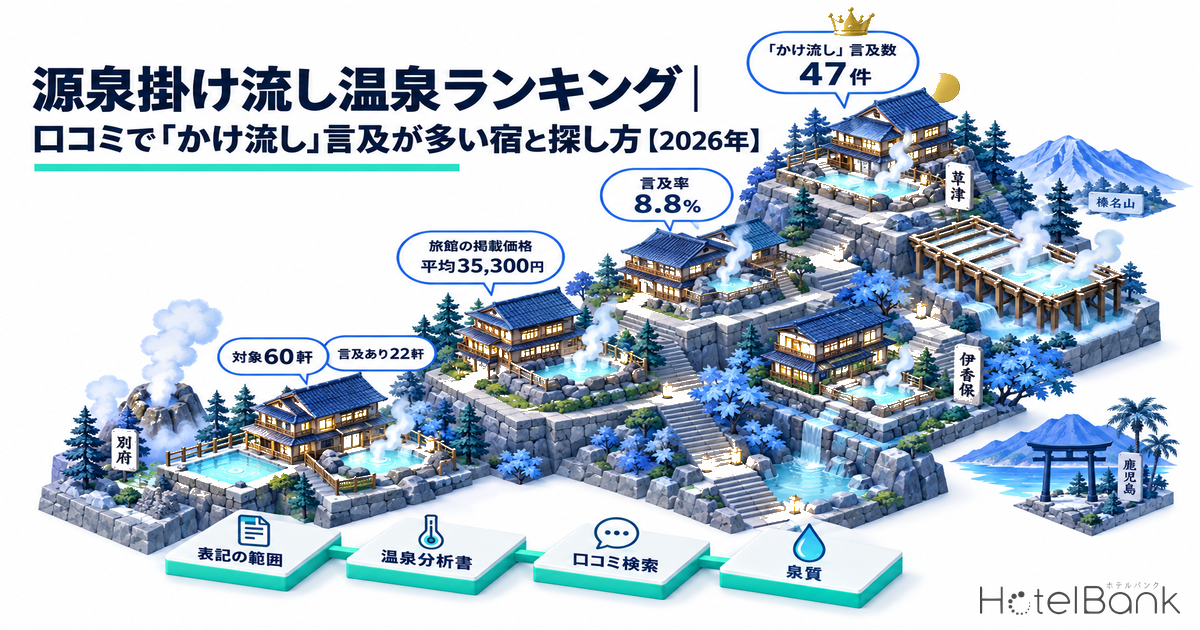
If you are looking for a ranking of onsen inns with free-flowing hot spring water (gensen kakenagashi, 源泉掛け流し), the fastest route is to start with the inns whose guests actually talk about “kakenagashi” in their reviews. The HotelBank Editorial Team analyzed the last 24 months of guest reviews (as of September 2026) for 60 highly rated ryokan across six onsen-rich prefectures (Gunma, Tochigi, Akita, Aomori, Oita and Kagoshima). The inn with the most “kakenagashi” mentions was Chigira Jinsentei (千明仁泉亭) at Ikaho Onsen, Gunma, with 47 mentions. This article presents the mention ranking, the typical listed price of ryokan, and a checklist for identifying genuinely free-flowing onsen inns yourself.
- — The most-mentioned inn is Chigira Jinsentei (千明仁泉亭) in Ikaho, Gunma (47 mentions, 8.8% mention rate). Of the 60 highly rated ryokan across six prefectures, 24 had at least one “kakenagashi” mention (last 24 months as of September 2026).
- — 335 of the 349 mentions (96%) were positive. The numbers show the water itself is a reason guests choose these inns.
- — Ranking by count alone favors inns with many reviews. Adding the mention rate reshuffles the order: Shiosai no Yado Harumi, 3rd by count, has a 2.5% rate, while Hatagoya Maruichi, 10th by count, has 8.0%.
- — Budget guide: the average for all ryokan is ¥35,252 (per room, 2 guests, tax included; N=6,559 properties; as of August 2026). Combining weekday stays and room-only plans lets you enjoy top-ranked water for less than the average.
- — There is no unified definition of “gensen kakenagashi”. The most reliable approach is to check, inn by inn, whether water is diluted, heated, recirculated/filtered or disinfected.
Onsen Inns Ranked by “Kakenagashi” Mentions in Guest Reviews (2026)
Because the “gensen kakenagashi” label on official websites covers different things at different inns, the editorial team built this ranking around the number of times guests actually mentioned “kakenagashi” in their reviews. The sample consists of highly rated ryokan in the six prefectures above (overall score of 4.3 or higher, at least 150 reviews), taking the 10 with the most reviews in each prefecture for a total of 60. “Kakenagashi” mentions were found at 24 of them, and 335 of the 349 mentions were positive (HotelBank Editorial Team research; last 24 months as of September 2026).
| Rank | Inn | Prefecture | “Kakenagashi” mentions | Reviews analyzed | Mention rate |
|---|---|---|---|---|---|
| 1 | Chigira Jinsentei (千明仁泉亭) | Gunma | 47 | 537 | 8.8% |
| 2 | Tsukakoshiya Shichibei (塚越屋七兵衛) | Gunma | 23 | 232 | 9.9% |
| 3 | Oyado Yukizumi (お宿 ゆきずみ) | Gunma | 19 | 414 | 4.6% |
| 3 | Shiosai no Yado Harumi (潮騒の宿 晴海) | Oita | 19 | 770 | 2.5% |
| 5 | Kusatsu Onsen Bouun (草津温泉 望雲) | Gunma | 18 | 746 | 2.4% |
| 6 | Iyashi no Yado Iroha (癒しの宿 彩葉) | Oita | 17 | 250 | 6.8% |
| 7 | Sekizenkan Main Building (積善館 本館) | Gunma | 16 | 656 | 2.4% |
| 7 | Nikko Astraea Hotel (日光アストリアホテル) | Tochigi | 16 | 213 | 7.5% |
| 9 | Myoken Ishiharaso (妙見石原荘) | Kagoshima | 15 | 230 | 6.5% |
| 10 | Hatagoya Maruichi (旅籠屋丸一) | Gunma | 14 | 176 | 8.0% |
| 11 | Kusatsu Onsen Yado Nagataya (草津温泉宿 永田屋) | Gunma | 13 | 499 | 2.6% |
| 11 | Kappo Ryokan Yunohanaso (割烹旅館湯の花荘) | Tochigi | 13 | 169 | 7.7% |
| 11 | Keiunkaku (渓雲閣) | Tochigi | 13 | 182 | 7.1% |
| 11 | Komagatake Onsen (駒ヶ岳温泉) | Akita | 13 | 241 | 5.4% |
| 11 | Yutoan (優湯庵) | Kagoshima | 13 | 258 | 5.0% |
Source: HotelBank Editorial Team research. “Kakenagashi”-related mentions in guest reviews of 60 highly rated ryokan in six prefectures (last 24 months as of September 2026; N = figures in the “Reviews analyzed” column), aggregated per property. Mention counts reflect how often guests referred to free-flowing water in reviews; this is not a comprehensive list of inns advertising gensen kakenagashi.
Inns in Gunma, home to Ikaho and Kusatsu, account for nearly half of the top positions. At No. 1, Chigira Jinsentei, 47 of 537 reviews analyzed (8.8%) mentioned “kakenagashi”, and all 47 were positive. No. 2, Tsukakoshiya Shichibei, also posts a high 9.9% mention rate, showing that the water itself is a reason guests choose these inns. Myoken Ishiharaso (Kagoshima) and Kappo Ryokan Yunohanaso (Tochigi) reach mention rates of 6–8%, suggesting many guests stay there specifically for the baths.
Because mention counts rise with the total number of reviews, ranking by count alone tends to push inns with many reviews to the top. The mention rate changes the picture: Shiosai no Yado Harumi, 3rd by count, has 19 mentions in 770 reviews (2.5%), while Hatagoya Maruichi, 10th by count, has 14 in 176 (8.0%), so the order flips on a rate basis. If the water is your main criterion, check the count to confirm the sample is large enough, then focus on inns with high mention rates.
How Much Does a Free-Flowing Onsen Inn Cost? Typical Listed Ryokan Prices
Listed OTA prices for the ryokan category as a whole make a useful budget benchmark. As of August 2026, the average listed price for ryokan nationwide was ¥35,252 (per room, 2 guests, tax included; N=6,559 properties; HotelBank Editorial Team research). Free-flowing onsen inns are broadly centered on this range, spanning everything from room-only toji (therapeutic bathing) inns to high-end ryokan known for their cuisine.
Even at the same inn, what you pay varies greatly with the date and meal plan. Weekday and Sunday-night stays tend to be cheaper than Saturday nights, and at ryokan the gap between half-board and room-only plans is large. If the free-flowing water is all you are after, combining a no-meal plan with a weekday stay lets you experience top-tier baths for less than the average. Note also that some onsen towns charge a bathing tax (nyuto-zei) on top of the room rate, so it is worth checking the local rules before you go.
Four Checkpoints for Identifying Free-Flowing Onsen Inns
1. Check what the “kakenagashi” label actually covers
The word “kakenagashi” itself is not defined in any national law. However, disclosure of dilution, heating, recirculation (filtration), added bath agents and disinfection is mandatory. Facilities offering hot spring water for public bathing must post information “in a clearly visible place within the facility” (Hot Springs Act, Article 18(1)), and the specific items required are “the fact and the reason” if water is added, if it is heated, if it is recirculated (including whether it is filtered), and if bath agents are added or it is disinfected (Ordinance for Enforcement of the Hot Springs Act, Article 10(2)). Failing to post this information, or posting false information, is punishable by a fine of up to ¥300,000 (Hot Springs Act, Article 41, item 2).
In other words, how an inn uses its water is not voluntary disclosure — you can always confirm it on the notices posted in the changing room or at the front desk. The bath pages of official websites often reproduce these notices, so you can use them to check before booking. Some inns run free-flowing water in every bath, while others do so only in the outdoor bath or private baths, so it is worth checking exactly which baths are free-flowing. An inn that discloses water usage bath by bath is signaling confidence in its water.
2. Read the hot spring analysis report and flow rate
The posted notice includes the source name, spring type, temperature, components, date of analysis, the name and registration number of the registered analysis institution, contraindications and bathing precautions (Ordinance for Enforcement of the Hot Springs Act, Article 10(1)). It is natural for water to be diluted if the source is too hot, or heated if it is too cool, so check whether the reason is also posted. Under the Hot Springs Act, “hot spring” water must meet either of two conditions: a temperature of at least 25°C at the source, or more than the prescribed amount of certain components (Ministry of the Environment, “Definition of Hot Springs”); water below 25°C still qualifies if it meets the component criteria. By contrast, flow rate (liters per minute) and how water is delivered from the source to the bath are not subject to mandatory disclosure and are provided voluntarily, so inns that publish them can be read as confident in the volume of their water.
3. Search reviews for “kakenagashi”
As the ranking in this article shows, guests at inns with truly good water mention “kakenagashi” of their own accord. Before booking, search reviews for the inn’s name together with “kakenagashi” (かけ流し) and see whether recent posts describe the condition of the water.
4. Work backward from spring type
If you want to choose by spring type, such as sulfur springs or bicarbonate springs, our analysis of the top 30 onsen inns by spring-type review mentions is a useful reference. And if you plan to explore villages with naturally gushing springs, such as Sujiyu and Kabeyu in Oita’s Kuju mountains, narrowing your search by onsen area — as in this comparison of five small highland inns in Kokonoe, Oita (Japanese) — is the quickest route.
There is no simple verdict on whether recirculating/filtered systems or free-flowing systems are better. The Hot Springs Subcommittee of the Central Environment Council concluded that bathing conditions depend on factors such as the volume of water supplied, the number of bathers and the hygiene management of the bath, so neither method is uniformly superior to the other (Ministry of the Environment, “On Labeling by Hot Spring Operators,” February 2005). The ranking in this article likewise shows not the quality of the water but “how much guests talked about the water.”
Explore Further
For detailed comparisons of specific inns, see these articles (in Japanese).
Oita’s Kuju Mountains — Sujiyu, Hosenji and Kabeyu: 5 Small Inns Hidden in the Yamanami Highlands (wabistay)
Compares five small inns of around 10 rooms each, with price guides — including Kabeyu Onsen Fukumotoya, with a cave-like bath that has gushed naturally for over 300 years, and the detached-villa inn 旅籠 彩くら (Hatago Irodori Sakura), whose detached villas each have an outdoor bath with free-flowing source water.
Proposes a three-day, two-night itinerary built around water quality and altitude, with four inns ranging from Okunikko Yumoto Onsen Katsurasou, which runs 70°C sulfur source water free-flowing, to Kinugawa Kanaya Hotel, where all 41 rooms face the gorge.
Frequently Asked Questions
Q. What is this ranking based on?
A. The number of “kakenagashi” mentions that actually appeared in guest reviews. We analyzed the last 24 months of reviews (as of September 2026) for 60 highly rated ryokan (overall score of 4.3 or higher, at least 150 reviews) — 10 in each of six onsen-rich prefectures: Gunma, Tochigi, Akita, Aomori, Oita and Kagoshima. Because the “gensen kakenagashi” label on official websites covers different things at different inns, the ranking is based on how often guests actually talked about it (HotelBank Editorial Team research).
Q. Which inn has the most “kakenagashi” mentions in reviews?
A. Chigira Jinsentei at Ikaho Onsen, Gunma. Of 537 reviews analyzed, 47 (an 8.8% mention rate) mentioned “kakenagashi”, and all 47 were positive. No. 2 is Tsukakoshiya Shichibei, also in Gunma, with 23 mentions (9.9% mention rate). Mentions were found at 24 of the 60 inns in the sample.
Q. Does a higher mention count mean better water?
A. Not necessarily. Mention counts rise with total review volume, so inns with more reviews tend to rank higher. Shiosai no Yado Harumi, 3rd by count, has 19 mentions in 770 reviews (2.5%), while Hatagoya Maruichi, 10th by count, has 14 in 176 (8.0%) — on a rate basis the order flips. Looking at both count and mention rate gives a more realistic reading.
Q. How much does it cost to stay at a free-flowing onsen inn?
A. The average listed OTA price for the ryokan category as a whole was ¥35,252 as of August 2026 (per room, 2 guests, tax included; N=6,559 properties; HotelBank Editorial Team research). Free-flowing onsen inns are broadly centered on this range, spanning room-only therapeutic bathing inns to high-end ryokan known for their cuisine. Choosing a weekday stay or a room-only plan lets you enjoy top-tier baths for less than the average.
Q. Is there a legal definition of “gensen kakenagashi”?
A. No national law defines “kakenagashi” or “gensen kakenagashi”. However, facilities offering hot spring water for public bathing must post whether water is diluted, heated, recirculated (filtered), has bath agents added or is disinfected (Hot Springs Act, Article 18(1); Ordinance for Enforcement, Article 10(2)). Failing to post this, or posting false information, is punishable by a fine of up to ¥300,000 (Article 41, item 2 of the Act). Rather than asking “is it kakenagashi?”, the reliable approach is to check “is the water diluted, heated, recirculated or disinfected?”
Q. How can I check whether an inn’s water is free-flowing before booking?
A. The posted notice at the facility is the primary source. It must be displayed “in a clearly visible place within the facility,” so you can find it in the changing room or at the front desk. Official websites often reproduce it on their bath pages, so check there before booking. Also confirm which baths are free-flowing, since some inns run it in every bath and others only in the outdoor or private baths — and search reviews for the inn’s name with “kakenagashi” to see whether recent posts describe the condition of the water.
Methodology and Sources
■ Data sources
The ranking was compiled by the HotelBank Editorial Team by aggregating, per property, “kakenagashi”-related mentions in the last 24 months of guest reviews (as of September 2026) for 60 highly rated ryokan (overall score of 4.3 or higher, at least 150 reviews) — the 10 with the most reviews in each of six onsen-rich prefectures (Gunma, Tochigi, Akita, Aomori, Oita and Kagoshima). The listed price is the August 2026 average of publicly listed OTA prices for the ryokan category nationwide (per room, 2 guests, tax included; N=6,559 properties). Regulatory information draws on the Hot Springs Act, its Enforcement Ordinance, and Ministry of the Environment publications.
■ Assumptions
Mention counts are the number of times guests referred to “kakenagashi” in reviews; they are not a determination of how an inn uses its water. The mention rate is the number of “kakenagashi” mentions divided by the number of reviews analyzed. Listed prices are the prices shown on booking screens, not actual transaction prices. They are total prices per room for 2 guests, so the amount paid will vary for single occupancy or different meal plans.
■ Limitations
The sample is limited to 60 highly rated ryokan in six prefectures and is not a comprehensive list of inns advertising gensen kakenagashi. Inns with free-flowing water do not appear in the results unless guests mention it in reviews. Because mention counts rise with total reviews, a count-only ranking favors inns with many reviews (which is why this article also shows the mention rate). Small or new inns that do not meet the criteria (overall score of 4.3 or higher, at least 150 reviews) were excluded from the sample from the start. The average listed price covers the ryokan category as a whole, not free-flowing onsen inns specifically.
■ References
- Hot Springs Act (Act No. 125 of 1948), Articles 18 and 41 and Appended Table (e-Gov Law Search, Japanese)
- Ordinance for Enforcement of the Hot Springs Act (Ministry of Health and Welfare Ordinance No. 35 of 1948), Article 10 (e-Gov Law Search, Japanese)
- Ministry of the Environment, “Overview of the Hot Springs Act” (Japanese)
- Ministry of the Environment, “Definition of Hot Springs” (Japanese)
- Hot Springs Subcommittee, Nature Conservation Committee, Central Environment Council, “On Labeling by Hot Spring Operators” (February 2005, Japanese)
Related Articles