

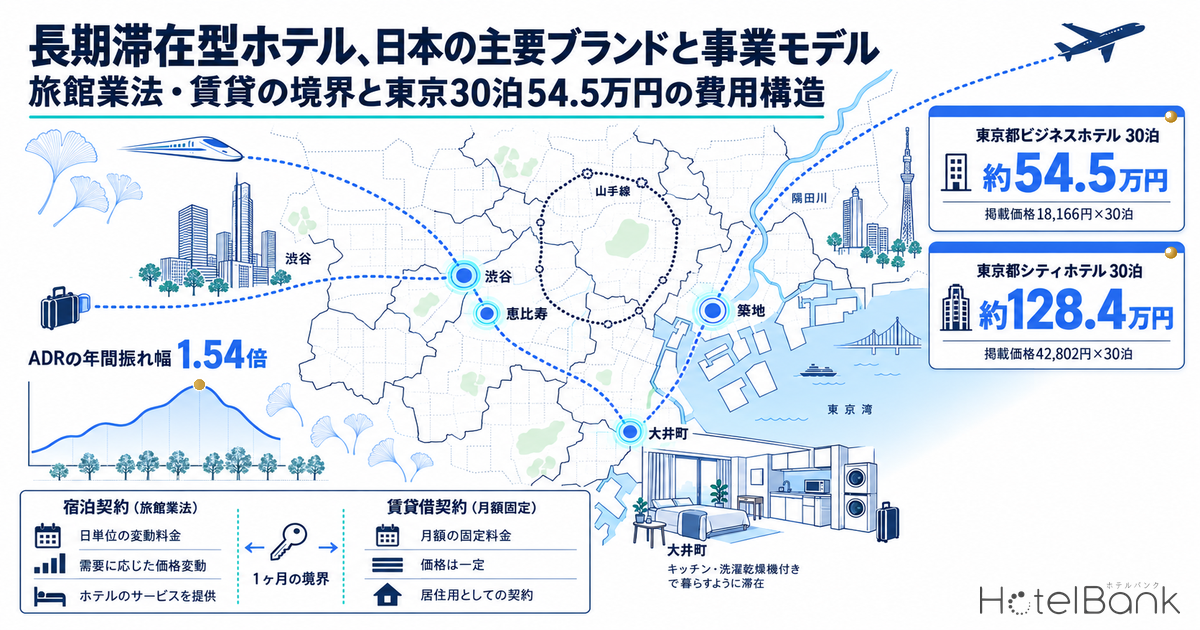
“Extended-stay hotel” is an umbrella term covering extended-stay hotels, serviced apartments, apartment hotels and limited-service hotels that accept monthly stays. Viewed as businesses, however, they split into a model that sells lodging contracts under the Hotel Business Act (Ryokan Gyoho) and moves prices day by day and a model that fixes a monthly rent under a lease – and licensing, consumption tax, accommodation tax and revenue volatility all differ between the two. For investors, operators and market researchers, this article works through (1) how the segment is defined and where it sits in the regulatory framework, (2) the main brands operating in Japan (quoting each company’s published figures), (3) what a 30-night stay costs based on listed prices in Tokyo, and (4) the revenue structure of the ADR x occupancy lodging model versus the fixed-monthly residence model.
Metric Definitions Used in This Article
- Listed price (all-plan average): the average of the rate plans each property publishes on OTAs and other channels (from room-only to plans with meals), per room for two guests, tax included. The “30-night cost” in this article is an estimate that multiplies this level by 30 and differs from actual consecutive-stay or corporate contract rates.
- ADR (Average Daily Rate): an estimated settled rate (tax-exclusive equivalent) derived by applying a segment-specific adjustment factor to the lowest plan each property publishes on OTAs (per room for two guests, tax included). Checked against property-level results disclosed by listed hotel REITs (91 properties, most recent 3 months), the median error is about 7%. It is an estimate and differs from each property’s actual settled rates and accounting figures. Area-level ADR is the median of the covered properties (the level of a typical property in the area).
- OCC (Occupancy): the share of rooms sold out of total rooms in the area (an estimate based on OTA sales inventory). It reflects how OTA-listed inventory is absorbed and differs from a property’s actual overall occupancy.
- Data sources: MetroEngines Research (prices and occupancy), company publications (brand information), Ministry of Health, Labour and Welfare, National Tax Agency and Tokyo Metropolitan Bureau of Taxation (regulation)
- — What defines the business is not the fit-out but the contract type. A lodging contract (Hotel Business Act) is subject to consumption tax and accommodation tax even at 30+ nights, while a residential lease of one month or longer is exempt from consumption tax and outside the accommodation tax.
- — At Tokyo listed prices (Sep 2026, one room for two, tax included), 30 nights costs about ¥545k at a business hotel (968 hotels) and about ¥1.284M at a city hotel (121 hotels). Even assuming a 20% long-stay discount, that is about ¥436k and ¥1.027M.
- — Over the last 12 months (Sep 2025 – Aug 2026), Tokyo’s estimated settled ADR in its peak month was 1.54x the trough month. Monthly and multi-night products work as a smoothing tool that props up revenue in slow months.
Defining the Extended-Stay Segment — Four Types Split by Contract Type
Judged by room equipment alone (kitchen, washer-dryer, living space), long-stay accommodation products look much alike. But what defines the business is not the equipment – it is the contract type. As long as a stay is sold as a lodging contract, the property remains a facility licensed under the Hotel Business Act even if the stay exceeds 30 nights, and prices can change day by day. When rooms are let for a month or longer under a lease, by contrast, there is room for the business to be treated as real estate leasing, and the tax treatment changes too.
In practice, the segment can be broadly sorted into the following four types. Note that many brands sell both “lodging products bookable from one night” and “long-stay products of 30 nights or more” side by side, and it is not unusual for a single property to span more than one type.
| Type | Main contract type | Typical length of stay | Rooms and services |
|---|---|---|---|
| Extended-stay hotel | Lodging contract (Hotel Business Act) | 1 night to several weeks | Limited-service hotel rooms equipped with a mini kitchen, washer-dryer, microwave, etc. |
| Apartment hotel | Lodging contract (Hotel Business Act) | Group stays of a few nights to about 2 weeks | Large rooms of around 40 sq m, kitchen and dining area, capacity of 4-6 guests |
| Serviced apartment | Lodging contract or lease (varies by property and product) | 1 month to years (some accept stays from 1 night) | Residential-grade units with a staffed front desk, housekeeping and lounge |
| Monthly rentals (furnished leases) | Lease (1 month or longer) | 1 month or longer | Units with furniture and appliances. Cleaning and bedding are in principle the tenant’s responsibility |
Source: Compiled by HotelBank Editorial Team from company publications, Ministry of Health, Labour and Welfare notices, etc.
The Regulatory Position — The Line Between the Hotel Business Act and Leasing, and How “30 Days or More” Is Treated
The test for whether a business counts as a hotel business is set out in a notice from the then Ministry of Health and Welfare, “Questions on the Operation of the Hotel Business Act” (Eishi No. 23, January 29, 1988). It turns on two points: whether the operator bears responsibility for maintaining the facility’s hygiene, and whether the business is operated on the principle that guests do not make the room their base of living.
The “one month” threshold appears in the criteria local governments use to apply this test. For example, Tokyo’s Chuo City, in its “Criteria for Distinguishing Hotel Business from Room Rental Business“, treats all stays of less than one month as, in principle, subject to the Hotel Business Act. It also states, however, that even stays of one month or longer fall under the Act if the operator has not publicly declared its intention to run a room rental business of one month or longer, or if it repeatedly ends the service before a month has elapsed. In other words, “30 nights or more” does not automatically make it a lease. The contract type, the way tenants are recruited and the allocation of hygiene responsibilities are judged together.
This distinction feeds directly into taxation. As the National Tax Agency’s Tax Answer No. 6226 “Leasing of Housing” explains, leasing of housing is exempt from consumption tax except where the lease period is less than one month, among other cases. Meanwhile, the Basic Circular on the Consumption Tax Act (Section 13, Leasing of Housing) states that letting facilities such as hotels and ryokan covered by the Hotel Business Act is not exempt even when the period of use is one month or longer. A hotel’s long-stay plan generates taxable sales even at 30 nights, whereas a residence operated under leases generates exempt sales – and that difference affects not only price display but also the operator’s cost structure, because consumption tax on purchases attributable to exempt sales is in principle not deductible.
The accommodation tax splits along the same line. According to the Tokyo Metropolitan Bureau of Taxation, the current Tokyo accommodation tax applies to guests of hotels and ryokan in Tokyo on a flat-rate basis: exempt for a room charge (per person per night) below ¥10,000, ¥100 for ¥10,000 to under ¥15,000, and ¥200 for ¥15,000 or more. From stays on or after April 1, 2027, it will switch to a flat 3% of the room charge, the exemption threshold will rise to below ¥13,000 per person per night, and the scope will widen to include simple lodging facilities (kan-i shukusho) and others. For a room charge of ¥20,000 per person per night, for example, the tax rises from ¥200 today to ¥600 after the change – and on a long stay it accumulates night by night. Units provided under a lease are outside this accommodation tax.
| Item | Lodging contract (hotels, apartment hotels, etc.) | Lease (housing let for 1 month or longer) |
|---|---|---|
| Legal basis / licensing | Hotel Business Act license | Act on Land and Building Leases, etc. (no hotel business license required, but judged on actual operation) |
| What “one month” means | Still a lodging contract even at 30+ nights | Presupposes the business is declared and marketed as room rental of 1 month or longer (Chuo City criteria as an example) |
| Consumption tax | Taxable (not exempt even for use of 1 month or longer) | Leasing of housing is in principle exempt |
| Tokyo accommodation tax | Applies (now: flat ¥100 / ¥200; from Apr 2027: 3%) | Does not apply |
| Responsibility for hygiene | Operator (room cleaning, bedding) | In principle the tenant (inside the unit) |
Source: Compiled by HotelBank Editorial Team from the Ministry of Health, Labour and Welfare notice (Eishi No. 23 of 1988), Chuo City “Criteria for Distinguishing Hotel Business from Room Rental Business”, the National Tax Agency and the Tokyo Metropolitan Bureau of Taxation. Whether a specific case qualifies is determined by the competent public health center and tax office
Main Brands Operating in Japan — Company-Published Figures Quoted As-Is
Japan’s extended-stay brands fall into three camps: foreign serviced-apartment operators, apartment hotels backed by domestic developers, and limited-service hotels adapted for medium- and long-term stays. The table below lists the figures each company has published on its own website or in press releases, as-is and together with their reference dates. Brands are listed in Japanese syllabary (gojuon) order, as in the original edition. Because each company counts properties differently (combining several brands or not, including planned openings or not, etc.), this article does not compare or rank brands by property or room count.
| Brand (operator) | Published scale / plans | Long-stay features | Source |
|---|---|---|---|
| Ascott (Ascott, Somerset, Citadines, Oakwood, lyf) | Operates 22 properties under 5 brands in Japan (as of the June 25, 2026 announcement) | Oakwood Oimachi Tracks Tokyo, opened June 25, 2026, is dedicated to stays of 30 nights or more: 78 units of about 27-107 sq m, all with a full kitchen and washer-dryer | The Ascott Japan announcement (June 25, 2026) |
| WAYPOINT (Mitsubishi Estate / Mitsubishi Estate Hotels & Resorts) | First property, WAYPOINT TSUKIJI TOKYO, opened April 1, 2026 with 52 rooms. Targets 10 openings by 2030 | Up to 6 guests. Some rooms have a mini kitchen and washer-dryer for long stays | Mitsubishi Estate news release (February 2, 2026) |
| Tokyu Stay (Tokyu Resorts & Stay) | Tokyu Stay Shibuya Ebisu (77 rooms), opened March 17, 2026, is the brand’s 33rd property nationwide | Serves short to medium/long stays, from business trips and sightseeing to temporary housing during job relocations. Rooms have a washer-dryer, microwave and mini kitchen (some room types) | Tokyu Land news release (March 13, 2026), Tokyu Land business overview |
| Hyatt House (Hyatt) | Two hotels in Japan: Hyatt House Tokyo Shibuya (126 rooms, opened February 26, 2024) and Hyatt House Kanazawa (92 rooms, opened August 2020) | A brand built around “staying like you live there”. Tokyo Shibuya offers 32-96 sq m apartment-type rooms designed for medium and long stays, all with a kitchen and washer-dryer | Hyatt Hotels of Japan press materials (April 2026), Tokyu Land news release (2024) |
| Fraser (Frasers Hospitality) | Fraser Residence Nankai Osaka: 114 units, 28-77 sq m, opened October 5, 2010 | Serviced apartments for medium and long stays. All units have a kitchen and washer-dryer. Also bookable from one night | Nankai Toshi Sozo / Frasers Hospitality announcement (July 15, 2010) |
| MIMARU (Cosmos Initia / Cosmos Hotel Management) | MIMARU Osaka Shinsaibashi CENTRAL, opened September 1, 2026, is the 28th property, for 1,500 rooms in total. Aims for 3,000 rooms by 2030 | Rooms of over 40 sq m with kitchen, dining area and washer-dryer. Designed for long stays and family trips with children | Cosmos Initia announcement (August 26, 2026) |
Source: Compiled by HotelBank Editorial Team from company publications. Figures are as of each company’s publication date; counting methods differ by company
Two currents stand out in this line-up. One is that apartment hotels for groups with kitchens are expanding under developer leadership: MIMARU’s 3,000-room target for 2030 and WAYPOINT’s goal of 10 properties by 2030 are both supply plans aimed at capturing medium-length stays by inbound group travelers. The other is that foreign serviced-apartment operators are moving into products designed exclusively for 30+ night stays, with Oakwood Oimachi Tracks Tokyo as the leading example. The strength of limited-service brands adapted for medium- and long-term stays lies in the flexibility to take corporate demand – business trips, training and relocations – on both a nightly and a monthly basis.
Brand-level going rates and location distribution are covered in HotelBank’s separate brand-map and 30-night price analyses. This article focuses on the regulation and revenue structure that underlie them.
Actual Rates — 30 Nights in Tokyo Cost About ¥545k to ¥1.284M at Listed Prices
First, as a benchmark for long-stay costs, consider what 30 nights at a regular hotel would cost. According to MetroEngines Research, Tokyo’s listed prices in September 2026 (all-plan average, per room for two guests, tax included) were about ¥18,200 per night at business hotels (968 hotels) and about ¥42,800 per night at city hotels (121 hotels). Simply multiplying by 30 gives about ¥545k for a business hotel and about ¥1.284M for a city hotel (calculated with unrounded nightly rates; see the table below for the yen-level assumptions). Per person, even a business hotel comes to about ¥272k for 30 nights.
This estimate, however, is an upper-bound guide that excludes long-stay discounts. Tokyo’s published plans include many multi-night plans discounted by length of stay, such as “5-10% off for 2+ nights” or “15% off for 7+ nights”. The chart below shows the 30-night cost if long-stay discounts of 5%, 10% or 20% applied: even at 20% off, it is about ¥436k at a business hotel and about ¥1.027M at a city hotel. The discount rates are assumptions to test sensitivity; actual discount levels vary by property and season.
Source: Compiled by HotelBank Editorial Team from MetroEngines Research (Tokyo, Sep 2026, listed-price basis, tax included, one room for two. Discount rates are assumptions)
| ■ Assumptions (Tokyo, Sep 2026) | Business hotels | City hotels |
|---|---|---|
| Listed price (all-plan average, 1 night, 1 room for 2, tax incl.) | ¥18,166 | ¥42,802 |
| Hotels covered | 968 | 121 |
| 30 nights (no discount) | ¥544,980 | ¥1,284,060 |
| 30 nights (assuming 10% long-stay discount) | ¥490,482 | ¥1,155,654 |
| 30 nights (assuming 20% long-stay discount) | ¥435,984 | ¥1,027,248 |
Source: Compiled by HotelBank Editorial Team from MetroEngines Research. Listed prices are all-plan averages including plans with meals and exclude accommodation tax
Long-stay pricing is designed on a different logic from “one night x number of nights”. As a representative example, the rate card Fraser Residence Nankai Osaka published at its 2010 opening (per-person rates including utilities, housekeeping, breakfast, service charge and consumption tax) set the monthly rate at the equivalent of about 8.2-10.8 nightly rates. A Studio Deluxe was ¥28,600 per night versus ¥290,000 per month (about 10.1 nights’ worth), and a 2-Bedroom Executive was ¥95,000 per night versus ¥870,000 per month (about 9.2 nights’ worth). The published nightly rate is in effect a rack rate, and the monthly rate was built as a separate price schedule.
Source: Compiled by HotelBank Editorial Team from the standard rates in the Nankai Toshi Sozo / Frasers Hospitality opening announcement for Fraser Residence Nankai Osaka (July 15, 2010). Not current rates
A rate structure combining weekly, monthly and multi-night plans lowers the per-night price for guests, and for operators it is also a way to price in the fact that cleaning frequency, check-in count and distribution commissions do not rise in proportion to nights stayed. When evaluating the cost structure of long stays, it is not enough to compare nightly rates; you need to separate the costs that scale with nights from those that are fixed per stay. HotelBank has also quantified the relationship between average length of stay and housekeeping cost separately, finding that it moves the annual housekeeping cost by about ¥187k per room.
Comparing Business Models — The ADR x Occupancy Lodging Model vs the Fixed-Monthly Residence Model
In the lodging model, room revenue is determined by “ADR x OCC x days”. Because prices can move day by day, rates can be raised on high-demand dates. The flip side is that revenue is directly exposed to seasonality and day of week. Overlaying the estimated settled ADR of Tokyo business hotels (N=894-924 properties) for 2025 and 2026 clearly shows the annual peaks and troughs. Over the last 12 months (Sep 2025 – Aug 2026), the peak month was April 2026 at about ¥17,800 and the trough was August 2026 at about ¥11,600, so the peak month was 1.54x the trough month. August 2026 was down 8.9% YoY. City hotels (N=104-109 properties) showed almost the same swing: their peak month in the last 12 months (November 2025, about ¥32,800) was also 1.54x the trough (August 2026, about ¥21,300).
Source: Compiled by HotelBank Editorial Team from MetroEngines Research (Tokyo business hotels, estimated settled ADR, tax-exclusive equivalent. 2026 shown through August, the last month with finalized results)
Occupancy also moves sharply from day to day. Tokyo’s estimated OCC (529-535 business hotels, about 78,000 rooms, based on major booking-site listings) averaged 93.5% in May 2026, but ranged daily from 73.3% on May 6 to 99.9% on May 21. In August the monthly average was 88.8%, with a daily range of 80.3%-93.5%. Multiplying estimated settled ADR by estimated OCC to estimate monthly room revenue per room gives about ¥432k in May versus about ¥318k in August for business hotels, and about ¥751k in May versus about ¥575k in August for city hotels (52-54 properties, about 17,000 rooms). Even for the same room, revenue swings by roughly 30% from month to month.
Source: Compiled by HotelBank Editorial Team from MetroEngines Research (Tokyo, May-Aug 2026. Estimated as estimated settled ADR x estimated OCC x calendar days. Coverage: business hotels 529-535 properties / about 78,000 rooms for estimated OCC; city hotels 52-54 properties / about 17,000 rooms; based on major booking-site listings)
The residence model (fixed monthly leases), by contrast, keeps the monthly rent unchanged throughout the contract while a unit is occupied. There is no room to raise prices on high-demand dates, but the same amount comes in during slow months. The driver of revenue volatility shifts from daily price and occupancy to vacancy periods created by tenant turnover. Operationally, room cleaning, linen changes and front-desk contact become less frequent, and sales channels center on corporate contracts and brokers, so variable costs that scale with nights shrink. On the other hand, as seen in the previous section, the revenue becomes exempt from consumption tax, and the different treatment of consumption tax on purchases compared with the lodging model needs to be built into the business plan as a premise.
| Dimension | Lodging model (ADR x occupancy) | Residence model (fixed monthly) |
|---|---|---|
| Revenue formula | ADR x OCC x days | Monthly rent x occupied units |
| Price changes | Daily (demand-based dynamic pricing) | At contract renewal or new leasing |
| Revenue volatility | Varies by season and day of week (in Tokyo, peak-month ADR / trough-month ADR = 1.54x) | Stable while occupied. Vacancy during turnover is the main source of variation |
| Costs linked to nights stayed | Cleaning, linen, amenities, per-booking distribution commissions | Small (mainly periodic cleaning and restoration at move-in/move-out) |
| Main sales channels | OTAs, own website, corporate contracts | Corporate contracts, brokers, own website |
| Consumption tax / accommodation tax | Subject to consumption tax and accommodation tax | Leasing of housing is exempt from consumption tax and outside the accommodation tax |
Source: Compiled by HotelBank Editorial Team from MetroEngines Research, the National Tax Agency and the Tokyo Metropolitan Bureau of Taxation
As a guide to profitability, GOP margins in hotel operations differ widely by segment. According to Relo Hotel Solutions, business hotels centered on room revenue tend to have relatively high GOP margins, while city hotels with a large share of food, beverage and banquets tend to carry higher cost-of-sales and labor ratios. In listed REIT disclosures, hotels operated by MyStays Hotel Management for Invincible Investment Corporation (8963) posted a GOP margin of 38.9% (fiscal period ended December 2024, 91 properties) (Invincible Investment Corporation, “Financial Results Presentation for the Fiscal Period Ended December 2024”). Raising the share of long stays pushes down cleaning and distribution costs that scale with nights, so there is scope to lift the already high GOP margins of limited-service hotels further.
From a practical standpoint, the model worth watching is hybrid operation that combines both approaches in a single property. Formats like Tokyu Stay and Fraser, which take both one-night stays and medium/long stays in the same building, allow operators to sell at daily prices in strong periods and build an occupancy base with multi-night and monthly products when demand softens. In the Tokyo business hotel estimate, monthly room revenue per room in August (estimated, tax-exclusive equivalent) was about ¥318k. If operators can design monthly and multi-night products that reliably secure this level in slow months, they can smooth annual revenue volatility while keeping the upside of daily sales in peak months. The rational way to decide what share of rooms to allocate to long stays in which month is to work backward from booking curves and monthly ADR and occupancy results.
Summary — Choose Extended-Stay Formats by “Contract and Revenue Design”, Not by “Equipment”
Extended-stay hotels tend to be discussed in terms of equipment such as kitchens and washer-dryers, but their character as a business is determined by contract type. The model that sells 30 nights under a lodging contract keeps pricing flexibility but is subject to consumption tax and accommodation tax. The model operated as leases of one month or longer delivers stable revenue but must satisfy the boundary with the hotel business in its actual operation. The shift of Tokyo’s accommodation tax to a percentage rate in April 2027 will add to the total cost of long-stay lodging products night by night, making it a reason to revisit rate design.
On the supply side, expansion plans for apartment hotels and the opening of serviced apartments dedicated to 30+ night stays are progressing at the same time. Thirty nights at a Tokyo hotel costs about ¥545k to ¥1.284M at listed prices, and long-stay monthly and multi-night products are positioned as an alternative to that level. For operators, the starting point for building long stays into their revenue base is deciding how far monthly products can smooth the 1.54x annual swing in ADR.
For hotels: plan-naming tips for this theme
The selling points that appear most often in the names of published multi-night plans in Tokyo —
Multi-night discountRoom onlyBreakfast includedDiscountLong stay / live like a local
Examples of actual plan names (anonymized, translated from Japanese):
- Web / prepaid only [non-refundable from 21 days before] – discounted monthly plan for 30+ nights
- [Multi-night plan] 5% OFF for bookings of 2+ nights – your base for business and sightseeing in Tokyo – with breakfast buffet
- [5% OFF] 2+ nights – eco plan with no daily cleaning (room only) – about 5 min walk to Senso-ji
* These are tendencies based on an aggregation of published plan names and do not show that naming causes sales. For deeper analysis of markets and naming, see HotelBank’s naming benchmark and event articles.
⚠ Note on prices for future dates: The September 2026 listed prices include stay dates that had not yet arrived at the time of the survey and reflect listing levels at that time. They will change as check-in dates approach, through new plans and price adjustments. The 30-night costs and monthly room revenue figures in this article are all estimates and differ from the actual rates and revenue of individual properties. Because the application of regulations depends on the specific contract terms and actual operation, please consult the competent public health center, tax office and other authorities before launching a business.
Related Articles
References and Sources
■ Market data
- MetroEngines Research — Tokyo listed prices by category (Sep 2026, 968 business hotels and 121 city hotels), estimated settled ADR (Jan 2025 – Aug 2026), estimated OCC (May-Aug 2026), aggregation of published plan names
■ Laws and public documents
- Ministry of Health, Labour and Welfare, “Questions on the Operation of the Hotel Business Act” (Eishi No. 23, January 29, 1988) (Japanese)
- Chuo City, Tokyo, “Criteria for Distinguishing Hotel Business from Room Rental Business” (Japanese)
- National Tax Agency, Tax Answer No. 6226 “Leasing of Housing” (Japanese)
- National Tax Agency, Basic Circular on the Consumption Tax Act, Section 13 “Leasing of Housing” (Japanese)
- Tokyo Metropolitan Bureau of Taxation, “Revision of the Accommodation Tax” (Japanese)
■ Company publications
- The Ascott Japan, Oakwood Oimachi Tracks Tokyo opens June 25, 2026 (June 25, 2026)
- Mitsubishi Estate, “Full-Scale Entry into the Apartment Hotel Business” (February 2, 2026)
- Tokyu Land, Tokyu Stay Shibuya Ebisu opens March 17, 2026 (March 13, 2026)
- Tokyu Land, Tokyu Stay business overview
- Hyatt Hotels of Japan, press materials (April 2026)
- Tokyu Land, Hyatt House Tokyo Shibuya opens February 26, 2024
- Nankai Toshi Sozo / Frasers Hospitality, Fraser Residence Nankai Osaka opening announcement (July 15, 2010)
- Cosmos Initia, MIMARU Osaka Shinsaibashi CENTRAL opening announcement (August 26, 2026)
■ Industry materials