

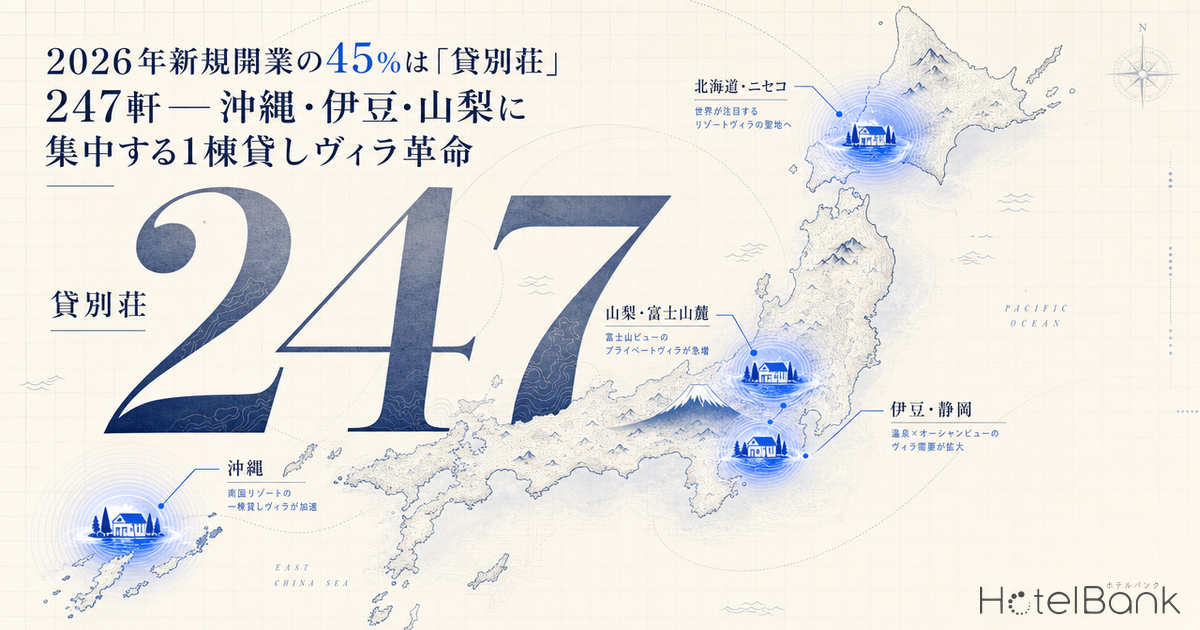
Of the 556 new lodging facilities opened in Japan in 2026, an astounding 247 (44.4%) fell into the “vacation rental” (kashibesso) category. While this represents a decline from the previous year (661 in 2025), it marks the fifth consecutive year that vacation rentals have topped the category rankings, far outpacing traditional business hotels (87 facilities, 15.6%) and resort hotels (28 facilities, 5.0%). This article combines 2026 new-opening data tracked by MetroEngines Research with OTA published rate data from four major regions (Okinawa, Shizuoka, Yamanashi, and Hokkaido) to visualize the geographic concentration of the single-building villa segment and its price-band competition with existing resorts.
Metric Definitions Used in This Article
- ADR (Average Daily Rate): Average of published sales prices on OTAs. Differs from actual booked rates. Per-room rate (tax inclusive) for double occupancy, averaged across all plans (including room-only and meal-inclusive plans).
- OCC (Occupancy, estimated): Ratio of sold rooms to total rooms in the area (estimated based on OTA sales inventory).
- “Vacation Rental” (kashibesso): In this article, refers to single-building villa-style lodging rented as a whole house. “Room counts” indicate “building counts.” With an average of 1.9 buildings per facility (min 1, max 54), this represents a micro-supply format where roughly “one building = one operating unit.”
- Data Source: MetroEngines Research (based on confirmed OTA listings)
Category Breakdown of 556 New 2026 Openings: Vacation Rentals Dominate at 44.4%
Looking at the breakdown of 556 facilities confirmed as new openings in 2026 (including those scheduled to open January through December, as of the survey date): 247 vacation rentals (44.4%), 87 business hotels (15.6%), 28 resort hotels (5.0%), 27 guesthouses (4.9%), 25 hostels (4.5%), 24 city hotels (4.3%), 21 ryokan (3.8%), 21 machiya (traditional townhouses, 3.8%), 18 cottages (3.2%), and so on. When combining “vacation rental-like categories” such as glamping, pensions, cottages, and machiya, the total reaches 293 facilities (52.7%), making traditional aggregated hotel formats clearly the minority.
Source: MetroEngines Research & Consulting (based on confirmed OTA listings, N=556 facilities)
What stands out is that vacation rentals average just 1.9 buildings per facility (min 1, max 54), representing a micro-supply format where roughly “one building = one operating unit.” In contrast, business hotels average 118.6 rooms and resort hotels 115.8 rooms — an order of magnitude different in scale from these traditional aggregated formats. Recalculated on a room-count basis, 247 vacation rentals × 1.9 buildings average = approximately 470 building-equivalents of supply, far below the 87 business hotels × 118.6 rooms = approximately 10,300 rooms. The gap between impact measured by facility count versus by bed count is substantial.
5-Year Trend: Vacation Rental Boom Peaked in 2024, 2026 Marks Adjustment Phase
Looking at year-over-year trends by category, vacation rentals surged from 543 facilities in 2022 to 728 in 2023 to 829 in 2024 (the 5-year peak), then began contracting to 661 in 2025 and 247 in 2026 (as of survey date). The 2026 figure is based on listings confirmed as of the survey, and while OTA listings will likely be added and the final count increase, signs are clear that the post-pandemic vacation rental boom is reaching a plateau.
Source: MetroEngines Research & Consulting (based on confirmed OTA listings)
*2026 figures reflect listings confirmed as of the survey date. Because OTA listings typically appear several months before opening, the count is expected to grow with additional listings.
The 2024-2025 vacation rental rush began with pandemic-era “social distancing” demand and expanded with the loosened operation of the Private Lodging Business Act and the tailwind from the revised Hotel Business Act (effective December 2023, strengthening customer harassment response and infection control measures). Meanwhile, business hotels have contracted from 266 in 2025 to 87 in 2026 (as of survey date), indicating a parallel plateau in central-city business hotel supply. Resort hotels show an even sharper deceleration from 99 in 2025 to 28 in 2026 (same basis).
Monthly Opening Pace: 150 Rush Openings in January, Structurally Under-Reported from May Onward
Looking at monthly vacation rental openings for 2026: 150 in January, 44 in February, 36 in March, 9 in April — concentrated rush openings in January. From May onward the count drops to single digits or low teens monthly. This is not because “supply has dried up” but rather an observation lead-time issue: OTA listings appear only a few months before opening, so 2026 second-half openings have yet to be captured. In fact, 2024-2025 monthly opening data shows steady year-round averages of 40 to 100 facilities, with observation timing — not seasonality — being the dominant factor.
Source: MetroEngines Research & Consulting (based on confirmed OTA listings)
Geographic Concentration Map: A 4-Pole Structure of Okinawa 22, Yamanashi 21, Shizuoka 21, Hokkaido 20
Breaking down the 247 new vacation rental openings in 2026 by prefecture reveals a concentration structure with the top four prefectures accounting for 74 facilities (30%). Okinawa 22, Yamanashi 21, Shizuoka 21, and Hokkaido 20 — all share the common trait of being “vacation home and resort areas with good access from major cities.” This is followed by Hyogo 13 (centered on Awaji Island), Fukuoka 13, Chiba 12 (Boso Peninsula), Kagoshima 12 (remote islands), Nagano 11, and Kanagawa 10 (centered on Hakone), showing a clear concentration trend toward specific resort areas.
Source: MetroEngines Research & Consulting (N=124 facilities, vacation rentals with latitude/longitude data only)
Map tiles: CartoDB Positron
The concentration is even sharper at the municipal level: Awaji City 9, Hakone Town 9, Fujikawaguchiko Town 9, Ito City 8, Atami City 6, Miyakojima City 4, Motobu Town (Okinawa) 3, Yamanakako Village 3, and Kutchan Town (near Otaru) 3 — clustered in some of Japan’s most prominent vacation home, hot spring, and resort areas. The themes raised in the analysis — “Junglia Okinawa surrounding area (Motobu, Nago, Nakijin),” “Lake Yamanaka,” “Izu/Atami,” and “Niseko (Kutchan)” — all align with the major clusters on this 2026 new-opening map. The single-building villa “Bise Enpu,” which had its grand opening in March 2026 in Bise, Motobu Town, exemplifies this northern-resort concentration.
ADR Comparison Across the 4 Major Prefectures: Vacation Rentals Surprisingly Command Higher Rates Than Resort Hotels
Aggregating OTA published rates for the 2026 Golden Week period (May 1-7), the four prefectures show vacation rental average ADRs of ¥70,800 in Okinawa, ¥82,800 in Hokkaido, ¥86,900 in Yamanashi, and ¥93,600 in Shizuoka. Meanwhile, resort hotel ADRs for the same period were ¥75,200 in Okinawa, ¥59,400 in Hokkaido, ¥76,800 in Yamanashi, and ¥75,600 in Shizuoka. In the three prefectures excluding Okinawa, vacation rental ADR exceeds resort hotel ADR — a structure that seems counterintuitive at first glance.
Source: MetroEngines Research & Consulting (May 1-7, 2026, N=vacation rentals 1,384 facilities × 7 days / resort hotels 623 facilities × 7 days)
This is a critical shift that overturns the old image of “vacation rental = minpaku = cheap lodging.” The reason is simple: vacation rental ADR represents a “whole-building rate,” and when split among 4 to 8 guests, the per-person cost falls to ¥10,000-¥20,000, on par with or below a resort hotel shared room. Conversely, when used by just two people, it competes in the high-rate band with resort suite-class rooms. Single-building villas target family/group demand by “positioning at high price points while lowering per-person rates through group use,” clearly differentiating from resort hotels’ “couple/small-party” demand.
Okinawa Case Study: ADR and Sellout Rates at Existing Resorts Rose Even as Vacation Rentals Increased
We tested the analytical axis of “ADR and sellout-rate changes at existing hotels in vacation-rental-growth regions” against Okinawa Prefecture, which has the highest vacation-rental concentration. Aggregating monthly ADR and sellout rate (percentage of OTA inventory reaching zero) over the past six months (December 2025 to May 2026) for all Okinawa resort hotels (approximately 270 properties), ADR rose 17.6% from ¥47,400 (Dec 2025) to ¥55,800 (May 2026), while the sellout rate surged from 0% to 38.0%.
Source: MetroEngines Research & Consulting (approximately 270 resort hotel facilities in Okinawa)
This is not a simple substitution where “new vacation rental supply pressures existing resorts,” but rather shows a structure where both coexist while the overall market expands. The July 2025 opening of Junglia Okinawa appears to have served as a catalyst, lifting overall lodging demand in the Motobu, Nago, and Nakijin area and benefiting both resorts and vacation rentals. As Nikkei reported on “Junglia effect drives hotel investment fever in Okinawa, boosting tourism in the northern main island,” area-wide demand creation underlies the vacation rental rush.
The same structure can be confirmed in year-over-year Golden Week performance. Comparing resort hotel ADRs for 2025 Golden Week (May 3-4) and the same period in 2026 across four prefectures: Okinawa ¥85,400 → ¥91,800 (+7.5%), Shizuoka ¥91,000 → ¥101,100 (+11.0%), Hokkaido ¥64,800 → ¥62,000 (-4.4%), and Hyogo ¥91,200 → ¥102,100 (+11.9%) — with sellout rates rising sharply from 0% in the prior year across the board. The slight ADR decline in Hokkaido is attributable to structural changes in major resorts (such as new supply in central Sapporo) and is a separate context from price competition with vacation rentals.
Boundaries with Glamping and Cottages: The Diversity Encompassed by the “Vacation Rental” Category
The boundaries between business categories are also becoming blurred. Among 2026 new openings, glamping at 4, cottages at 18, pensions at 6, and machiya at 21 are all “single-building rental / small-scale distributed” formats similar to vacation rentals. In fact, looking at overlaps across the four prefectures, Nagano has 11 vacation rentals, 3 pensions, 2 cottages, and 1 glamping, while Yamanashi has 21 vacation rentals, 1 cottage, and 1 glamping — with the vacation rental category expanding in a way that encompasses other formats.
| Prefecture | Vacation Rental | Cottage | Pension | Glamping | Machiya | Total |
|---|---|---|---|---|---|---|
| Okinawa | 22 | 0 | 0 | 1 | 0 | 23 |
| Yamanashi | 21 | 1 | 0 | 1 | 0 | 23 |
| Shizuoka | 21 | 1 | 1 | 0 | 0 | 23 |
| Hokkaido | 20 | 1 | 0 | 0 | 0 | 21 |
| Nagano | 11 | 2 | 3 | 1 | 0 | 17 |
| Kyoto | 7 | 0 | 0 | 0 | 20 | 27 |
Source: MetroEngines Research & Consulting
Kyoto’s case is particularly symbolic. Of Kyoto’s 27 new openings in 2026, 20 are machiya and 7 are vacation rentals — all in single-building rental format. Centered on the Kamogawa-west area and Minami Ward, machiya renovation properties continue to open as a steady stream, and while categorized separately from “vacation rentals,” they are essentially a derivative of the single-building villa format. The “villas” of resort-oriented prefectures like Okinawa, Izu, Yamanashi, and Hokkaido, and Kyoto’s “machiya,” have together become the leading actors of 2026 new supply.
Connection with the Revised Hotel Business Act and Format Transitions
Regarding the theme of “single-room operation lifted after the revised Hotel Business Act effective June 15,” official enforcement-date announcements have not yet been confirmed as of May 2026. However, it is a fact that easing of minimum-room-count regulations under the Hotel Business Act and reviews of the operational boundary between Private Lodging Business and simplified accommodation business permits are proceeding in stages. Notably, since the revised Hotel Business Act (effective December 2023), in exchange for strengthened infection control and customer harassment response, facility operation has been granted some additional flexibility.
Among the 247 new vacation rentals opened in 2026, the distribution showing 1.9 buildings on average and a minimum of 1 building indicates that entry “at one building = one operating unit” has become commonplace. Many cases are operated as full-fledged lodging businesses with simplified accommodation business permits (no annual operating-day limit), rather than under simplified operations under the Private Lodging Business Act (capped at 180 days annually). Going forward, geographic disparities in vacation rental supply will widen further between areas with overlay regulations under municipal ordinances (such as Sumida Ward, Tokyo, effective April 2026, and Toshima Ward, scheduled for December 2026) and areas where loosened operations advance in resort regions.
Summary: The “Parallel-Growth Model” of Single-Building Villas and Existing Resorts
The analysis of 556 new openings in 2026 reveals that the vacation rental / single-building villa segment is functioning not as “a substitute for the urban hotel opening rush” but as “a complement to resort demand growth.” In the Okinawa case, amid northern tourism revitalization triggered by Junglia Okinawa, resort hotels (ADR +17.6%, sellout 0% → 38%) and vacation rentals (stable around ¥70,800 ADR) are growing in parallel. In Yamanashi, Shizuoka, and Hokkaido as well, Golden Week sellout rates at existing resorts have risen sharply year-over-year, and the structure points more toward demand-segment differentiation (couples/small parties vs. families/groups) than to price-band competition with vacation rentals.
The boundaries between formats are also blurring: Kyoto’s machiya, Nagano’s pensions, Izu’s vacation rentals, and Niseko’s cottages all converge on the common “single-building rental / small-party operation” format. Although 2026 has entered an adjustment phase from the 2024 vacation rental peak, geographic concentration centered on vacation-home areas, hot springs, and remote-island resorts has, if anything, intensified — making region-level supply-demand balance analysis ever more important. For existing resort hotels, the opportunity to leverage area-wide demand creation to redesign guest segments and selling rates is expanding, more so than the risk of being drawn into price competition with vacation rentals.
⚠ Note on Future-Date ADRs: The ADRs in this article are averages of sales prices published on OTAs as of the survey date and will fluctuate as check-in dates approach. Please note that prices currently set high may drop due to last-minute discounting. Additionally, the count of 2026 new openings is based on facilities whose OTA listings could be confirmed as of the survey, and the figure is expected to grow with additional listings.
References and Sources
- MetroEngines Research & Consulting — OTA published rate data and new opening data (based on confirmed OTA listings, N=556 facilities)
- Ministry of Health, Labour and Welfare: “On the History of Hotel Business Act Revisions”
- All Nippon Hotel Association: “Regarding Partial Revisions to the Hotel Business Act Enforcement Order”
- Nikkei: “Junglia Effect Drives Hotel Investment Fever in Okinawa, Boosting Northern Main Island Tourism”
- JUNGLIA OKINAWA Official Site (opened July 25, 2025)
- Sumida Ward Hotel Business and Private Lodging Business Ordinance Revision (effective April 2026)