

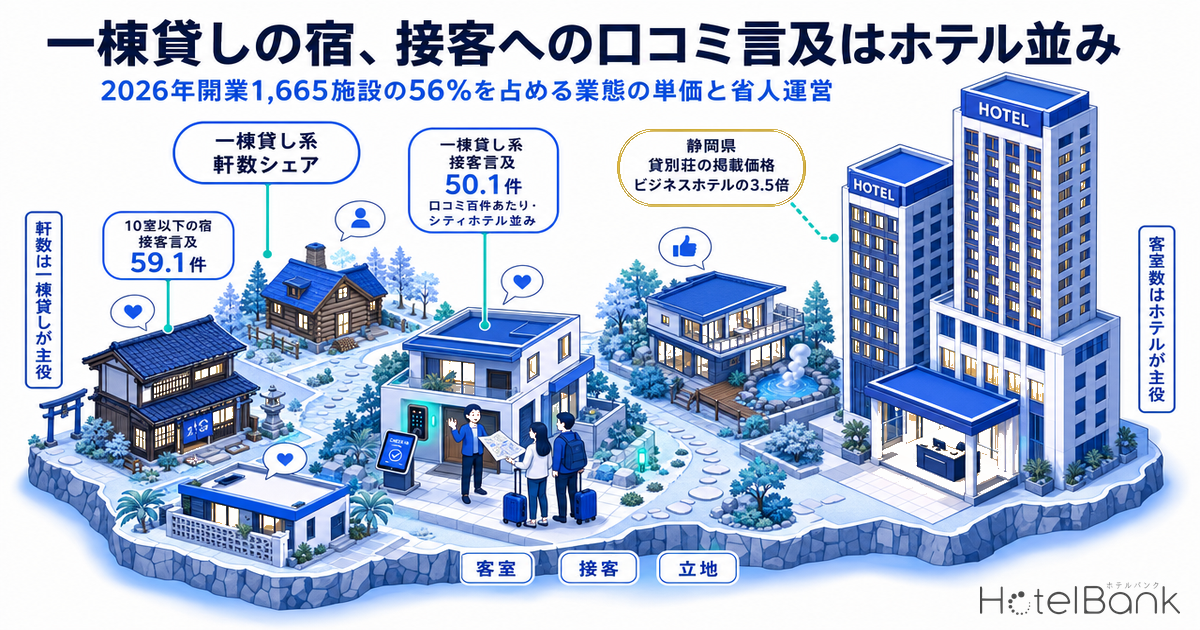
MetroEngines Research had identified 1,665 lodging properties with 41,273 rooms opening in Japan in 2026 as of its October 5 survey. By property count, whole-house rentals — villas, cottages and machiya townhouses — make up 55.9%, while by room count the three hotel types (business, city and resort) make up 82.6%: which segment leads new supply depends on how you count. This article looks at how guests are receiving this smaller-scale supply, using the structure of service-related review mentions and the price tiers of five prefectures, and draws out what it means for designing lodging that works with a small staff.
Metric Definitions Used in This Article
| New openings | Properties tracked by MetroEngines Research with an opening date between January and December 2026 and a registered room count: 1,665 properties as of October 5, 2026. Coverage is limited to properties confirmed as listed on OTAs and similar channels and is not a complete census. Because the count is based on opening date, it includes some reopenings of existing buildings under a new operator. |
| Whole-house rentals | Three property types: villas (貸別荘), cottages and machiya townhouses. We treat them as types where operation without a staffed front desk is commonly chosen, but staffing at individual properties has not been verified. |
| Review mentions | Guest reviews are analyzed by topic, and we count how many out of every 100 reviews touch on a given topic (NLP analysis by the HotelBank Editorial Team, most recent 24 months). This measures how often a topic comes up, not a rating score. Up to the top 50 topics per property are counted. |
| ADR (average daily rate) | An estimated settled rate (tax-exclusive equivalent) calculated by applying segment-specific adjustment factors to the lowest plan rate each property publishes on OTAs (two guests per room, per-room rate, tax included). Checked against property-level actuals disclosed by listed hotel REITs (91 properties, most recent 3 months), the median error is about 7%. These are estimates and differ from each property’s actual settled rates and accounting figures. Area-level ADR is the median of the properties covered (the level of a typical property in the area). Calculated for business hotels, city hotels, resort hotels, ryokan and capsule hotels. |
| Listed price | The average across all plans of the rate per room (per house for whole-house rentals) for two guests, tax included. Because its level differs from ADR, the two are not compared directly. |
| Data sources | MetroEngines Research (covering about 27,000 properties in Japan confirmed to be operating) / HotelBank Editorial Team research |
- — 55.9% and 82.6% Of the 1,665 properties opening in 2026 (as of October 5), whole-house rentals account for 55.9% of properties, while the three hotel types account for 82.6% of rooms. The leader in new supply changes with how you count.
- — June 2018 Replacing the front desk with ICT equipment was permitted by the 2018 amendment. The December 2023 amendment centered on the grounds for refusing accommodation, and the final standards are set by municipal ordinance.
- — 59.1 per 100 reviews At properties with 10 rooms or fewer, 59.1 of every 100 reviews mention service, above the 47.6 at properties with 200 rooms or more. The content shifts from front-desk service to the host’s attentiveness (N=599 properties).
- — Overall rating of 4.57 Even whole-house rentals where service is hardly mentioned have a median overall rating of 4.57. Room size and the stay environment are the reasons they are chosen (N=265 properties).
- — 1.8x to 3.5x Listed prices for villas are 1.8 to 3.5 times those of business hotels in the five prefectures (per house, tax included, 12-month average) — a price band that can readily absorb fixed tasks such as on-site response and cleaning.
1,665 Openings in 2026 — Villas Lead by Property Count, Business Hotels by Rooms
We start with the measured supply. The 1,665 properties opening in 2026 total 41,273 rooms, an average of 24.8 rooms per property. The median, however, is just 2 rooms, and the distribution has a long tail: the largest is a 750-room resort hotel that opened in Chiba. Looking at the average alone suggests that “properties of around 25 rooms are increasing,” but in reality two peaks overlap — properties with one or two rooms, and hotels in the 100-room class.
Breaking the data down by property type makes this two-tier structure clear. Villas number 797 properties, or 47.9% of the property count, yet only 1,337 rooms, or 3.2% of rooms, with an average of 1.7 rooms. Business hotels, by contrast, number just 208 properties, or 12.5% of the count, but supply 20,759 rooms — 50.3% of the total — with an average of 99.8 rooms.
Source: MetroEngines Research & Consulting (based on confirmed OTA listings, N=1,665 properties, as of October 5, 2026)
| Property type | Properties | Share of properties | Rooms | Share of rooms | Avg. rooms | Median |
|---|---|---|---|---|---|---|
| Villa | 797 | 47.9% | 1,337 | 3.2% | 1.7 | 1 |
| Business hotel | 208 | 12.5% | 20,759 | 50.3% | 99.8 | 65 |
| Hostel | 123 | 7.4% | 2,313 | 5.6% | 18.8 | 11 |
| Resort hotel | 98 | 5.9% | 7,587 | 18.4% | 77.4 | 38.5 |
| Guesthouse | 91 | 5.5% | 395 | 1.0% | 4.3 | 3 |
| Cottage | 76 | 4.6% | 683 | 1.7% | 9.0 | 4.5 |
| Ryokan | 59 | 3.5% | 854 | 2.1% | 14.5 | 8 |
| Machiya | 58 | 3.5% | 103 | 0.2% | 1.8 | 1 |
| City hotel | 51 | 3.1% | 5,725 | 13.9% | 112.3 | 88 |
| All types | 1,665 | 100.0% | 41,273 | 100.0% | 24.8 | 2 |
Source: MetroEngines Research & Consulting (based on confirmed OTA listings, N=1,665 properties, as of October 5, 2026). The top nine property types are shown; the all-types total includes other types
Whole-house rentals — villas, cottages and machiya combined — come to 931 properties, 55.9% of the property count but only 2,123 rooms, or 5.1% of rooms. The three hotel types (business, city and resort), meanwhile, number 357 properties, or 21.4%, and supply 34,071 rooms, or 82.6%. In other words, the question “which property type is growing?” yields opposite conclusions depending on whether you answer by property count or by room count.
The same picture emerges when properties are grouped by size. Single-room properties number 829, or 49.8% of the property count, and widening the band to 10 rooms or fewer brings it to 1,200 properties, or 72.1% — yet their rooms total 2,738, just 6.6% of the whole. The 218 properties with 50 rooms or more (13.1%) account for 78.6% of rooms.
| Property size | Properties | Share of properties | Rooms | Share of rooms |
|---|---|---|---|---|
| 1 room | 829 | 49.8% | 829 | 2.0% |
| 2–10 rooms | 371 | 22.3% | 1,909 | 4.6% |
| 11–49 rooms | 247 | 14.8% | 6,101 | 14.8% |
| 50–199 rooms | 155 | 9.3% | 16,211 | 39.3% |
| 200+ rooms | 63 | 3.8% | 16,223 | 39.3% |
Source: MetroEngines Research & Consulting (based on confirmed OTA listings, N=1,665 properties, as of October 5, 2026)
Note that the largest properties by room count include at least one reopening of an existing building under a new brand, with 333 rooms. Even excluding it, the three hotel types’ share of rooms remains above 80%, so the two-tier reading holds. In addition, only 67 properties have opening dates in October–December, but listings on OTAs and similar channels typically begin to appear several months before opening, so the count for this period is likely to rise as more listings are added.
By prefecture, Hokkaido has the most with 164 properties, followed by Tokyo with 100, Okinawa with 93, and Kyoto and Shizuoka with 91 each. In Hokkaido, Kyoto and Shizuoka, whole-house rentals exceed 70% of the property count and the median room count is 1. Tokyo alone has a different mix, with whole-house rentals at just 31.0% and a median of 9 rooms.
| Prefecture | Openings | Rooms | Median rooms | Whole-house share of properties |
|---|---|---|---|---|
| Hokkaido | 164 | 3,019 | 1 | 72.0% |
| Tokyo | 100 | 2,885 | 9 | 31.0% |
| Okinawa | 93 | 2,926 | 2 | 60.2% |
| Kyoto | 91 | 1,109 | 1 | 71.4% |
| Shizuoka | 91 | 1,139 | 1 | 70.3% |
Source: MetroEngines Research & Consulting (based on confirmed OTA listings, N=1,665 properties, as of October 5, 2026)
A Timeline of Front-Desk Rules — ICT Substitution Dates to 2018; the 2023 Amendment Addressed Other Issues
The rules permitting operation without staff stationed at a front desk (玄関帳場, genkan-choba) are often cited as a backdrop to the growth of small lodgings. The basis is sometimes described as “the amended Inns and Hotels Act (旅館業法) that took effect in December 2023,” but the primary documents of the Ministry of Health, Labour and Welfare show a different chronology. Replacing the front desk with ICT equipment was permitted by the June 2018 amendment; the December 2023 amendment centered on other issues, such as revising the grounds for refusing accommodation.
| Date | Basis | Front-desk provisions | Status |
|---|---|---|---|
| Effective June 15, 2018 | Amended Inns and Hotels Act and its Enforcement Order | Merged the hotel and ryokan business categories into a single “ryokan/hotel business” and abolished the minimum room count. The Enforcement Order requires “a front desk or other facility for properly verifying such persons that conforms to the standards set by Ministry of Health, Labour and Welfare ordinance,” allowing ICT equipment as a substitute | Final (in force) |
| Effective December 13, 2023 | Amended Inns and Hotels Act (Act No. 52 of 2023) | Centered on revised grounds for refusing accommodation, requests for cooperation with infection-control measures, and succession procedures on business transfers. The requirements for substituting the front desk were not changed | Final (in force) |
| Applied from April 1, 2025 | Partial revision of the Hygiene Management Guidelines (Notice Kensei-hatsu 0311 No. 1) | Spelled out ICT-based methods for identity verification and related checks. Added “when someone enters the guest-only area without permission” to the examples of emergencies. An FAQ dated March 11, 2025 clarified how the “roughly 10 minutes” standard is applied | Final (technical advice) |
| Revised June 12, 2026 | FAQ on the Inns and Hotels Act (administrative notice) | Added a section on “preventing adverse effects on the living environment of surrounding areas.” Confirmed that, depending on local conditions, an on-site front desk or resident staff may be required by ordinance | Final (confirms municipal discretion) |
Source: Compiled by the HotelBank Editorial Team from the Enforcement Order of the Inns and Hotels Act (e-Gov Laws and Regulations Search), the Ministry of Health, Labour and Welfare’s “FAQ on the Inns and Hotels Act” (revised June 12, 2026) and its “FAQ on the Revision of the Hygiene Management Guidelines for Lodging Businesses (dated March 11, 2025)”
The ministry’s FAQ organizes the substance of the requirements into three points. The table below summarizes the key points of the provisions and notices.
| Requirement | Content | Operational guidance (March 2025 FAQ) |
|---|---|---|
| Emergency response | A system under which staff can reach the property, on request, normally within roughly 10 minutes when a guest faces an urgent situation | This is not meant to uniformly require an office within 10 minutes from which staff can respond at all times; municipalities may set the required time flexibly. The means of travel is not limited to walking |
| Identity verification and monitoring of entry and exit | Install video cameras or similar equipment at each property and verify guests’ identity and their comings and goings with clear images at all times | Images clear enough for recordings to be properly checked are sufficient, and existing security cameras may be used |
| Key handover | Provide equipment that allows keys to be handed over properly | Depending on the nature and urgency of the case, remote handling using ICT is also acceptable |
| Outsourcing of operations | Parts of identity verification, entry/exit monitoring, answering guest contacts and on-site response may be outsourced | Three preconditions: a communication system between the operator and the contractor, the contractor’s emergency-response system, and informing guests of the contact point |
Source: Compiled by the HotelBank Editorial Team from the Ministry of Health, Labour and Welfare’s “FAQ on the Inns and Hotels Act” and its “FAQ on the Revision of the Hygiene Management Guidelines for Lodging Businesses”
The point to keep in mind is that the guidelines and FAQs are technical advice to municipalities, and the final standards are set by each municipality’s ordinance. Simple lodging businesses (簡易宿所営業) have no statutory obligation to install a front desk; installing one or providing ICT equipment is merely described as “desirable.” At the same time, the FAQ revised in June 2026 states explicitly that an on-site front desk or resident staff may be required by ordinance. Kyoto City, for example, requires small lodging properties with an off-site front desk to station staff within roughly 800 m by road.
To separate settled facts from expectations: every item in the timeline above is already in force or applied. Within the published Ministry of Health, Labour and Welfare materials reviewed for this article, we found no pending legislative amendment that would change the front-desk requirements. Future changes are more likely to appear as revisions to municipal ordinances than as national legislation, which makes advance consultation with the public health center at the development site the starting point for design.
Service in Reviews — The Smaller the Property, the More Mentions, Shifting From “the Counter” to “the Person”
How, then, do guests receive small lodgings? The HotelBank Editorial Team randomly sampled operating properties in five prefectures — Hokkaido, Okinawa, Tokyo, Shizuoka and Kyoto — by size band, and tallied topic mentions for the 599 properties with 20 or more reviews in the most recent 24 months (October 2024 to September 2026), covering 426,574 reviews.
| Property size | Properties | Reviews | Service (all) | Front-desk service | Check-in process | Owner/host | Location (all) | Rooms (all) |
|---|---|---|---|---|---|---|---|---|
| 10 rooms or fewer | 88 | 6,775 | 59.1 | 1.1 | 1.5 | 8.6 | 48.9 | 78.8 |
| 11–49 rooms | 130 | 26,057 | 56.5 | 4.8 | 2.2 | 1.2 | 46.8 | 80.0 |
| 50–199 rooms | 180 | 107,619 | 48.7 | 7.1 | 3.8 | 0.0 | 69.1 | 86.0 |
| 200+ rooms | 201 | 286,123 | 47.6 | 6.1 | 5.8 | 0.0 | 68.4 | 80.7 |
Source: HotelBank Editorial Team research (NLP analysis of guest reviews posted October 2024 to September 2026). N=599 properties, 426,574 reviews; figures are mentions per 100 reviews
The result: the smaller the property, the more service is mentioned. At properties with 10 rooms or fewer, 59.1 of every 100 reviews touch on service, above the 47.6 at properties with 200 rooms or more. The breakdown differs sharply, however. Mentions of front-desk service are 1.1 at properties with 10 rooms or fewer versus 6.1 at those with 200 or more, and mentions of the check-in process are 1.5 versus 5.8. What rises instead is mentions of the owner or host as an individual, which reach 8.6 at properties with 10 rooms or fewer.
The difference becomes clearer still by property type. Splitting 2,136 properties and 959,373 reviews in the five prefectures by type, service mentions at whole-house rentals came to 50.1 per 100 reviews — nearly level with city hotels at 51.0 and above business hotels at 45.6. Even in types where operation without a staffed front desk is common, service remains a major topic in reviews.
| Property type | Properties | Reviews | Median rooms | Service (all) | Front-desk service | Check-in process | Attentiveness | Owner/host |
|---|---|---|---|---|---|---|---|---|
| Whole-house rentals | 265 | 19,727 | 2 | 50.1 | 1.5 | 2.2 | 8.4 | 3.6 |
| Guesthouse | 152 | 17,602 | 6 | 61.2 | 1.4 | 2.8 | 8.3 | 6.3 |
| Hostel | 157 | 36,456 | 19 | 54.3 | 4.0 | 3.9 | 3.5 | 0.5 |
| Pension/minshuku | 165 | 10,967 | 7 | 60.7 | 0.5 | 0.1 | 8.5 | 14.2 |
| Ryokan | 325 | 97,115 | 20 | 55.4 | 4.7 | 3.3 | 6.2 | 1.3 |
| Business hotel | 542 | 356,956 | 109.5 | 45.6 | 7.5 | 5.0 | 2.5 | 0.0 |
| Resort hotel | 301 | 160,537 | 60 | 48.6 | 5.8 | 3.7 | 4.3 | 0.1 |
| City hotel | 229 | 260,013 | 163 | 51.0 | 6.3 | 5.1 | 3.5 | 0.0 |
Source: HotelBank Editorial Team research (NLP analysis of guest reviews posted October 2024 to September 2026). N=2,136 properties, 959,373 reviews; figures are mentions per 100 reviews. The 265 whole-house rentals are located in Kyoto (142), Okinawa (71), Shizuoka (26), Hokkaido (23) and Tokyo (3)
Source: HotelBank Editorial Team research (NLP analysis of guest reviews posted October 2024 to September 2026). Mentions per 100 reviews
At whole-house rentals, the most-mentioned items are kindness and personality (11.0) and attentiveness (8.4). Mentions of attentiveness are more than three times the 2.5 at business hotels, and mentions of local sightseeing information and recommendations, at 2.2, far exceed the 0.2 at business hotels. Even with less face-to-face counter work, touchpoints such as post-booking messages, pre-arrival guidance and responses to inquiries during the stay appear to be remembered as “service.”
In addition, among reviews that mention the check-in process, the share of favorable comments is almost the same: 66.1% at whole-house rentals and 67.1% at business hotels. The difference in format — self check-in or face-to-face — does not show up as a difference in how guests receive it, at least in this tally.
Chosen for Rooms and Location — Whole-House Rentals With No Service Mentions Still Rate 4.57
On the other hand, some properties are rated highly even though service is hardly mentioned. We divided the 265 whole-house rentals into three tiers by how often service is mentioned and compared their overall ratings (out of 5).
| Tercile by frequency of service mentions | Properties | Service mentions (per 100 reviews, median) | Room + location mentions (same basis) | Median overall rating | Share of properties rated 4.5+ |
|---|---|---|---|---|---|
| Low-mention tier | 88 | 0.0 | 59.3 | 4.57 | 55.7% |
| Middle tier | 88 | 18.4 | 118.4 | 4.56 | 58.0% |
| High-mention tier | 89 | 69.6 | 121.0 | 4.76 | 71.9% |
Source: HotelBank Editorial Team research (N=265 properties, 19,727 reviews, posted October 2024 to September 2026)
In the tier with the fewest service mentions, the median is zero — that is, at more than half of these properties service does not come up in reviews at all. Even so, the median overall rating is 4.57, and 55.7% of the properties are rated 4.5 or higher. That falls short of the 4.76 and 71.9% of the high-mention tier, but properties where human contact is not a topic are not being rated poorly. It is probably closer to the reality to say that properties that add a design in which service leaves an impression gain something on top.
What, then, are these properties chosen for? Comparing the topic mix across property types, whole-house rentals show rooms at 29.6%, service at 19.4% and location at 19.0%; these three account for nearly 70% of mentions. The axes of evaluation are simply different from those of ryokan, where meals and baths together make up nearly 40%.
Source: HotelBank Editorial Team research (NLP analysis of guest reviews posted October 2024 to September 2026). N=2,136 properties, 959,373 reviews; share of mentions by topic
Within rooms, 90.8% of the reviews mentioning spaciousness at whole-house rentals are favorable. Business hotels stand out for mentions of proximity to a station, at 28.1 per 100 reviews, showing that they are a type chosen for locational convenience. At whole-house rentals, station proximity is mentioned only 7.3 times; instead, proximity to sightseeing spots (7.1) and quiet surroundings come up. The “value of space” — spaciousness and the stay environment — can be said to have become the reason for choosing them in place of resident staff.
Price Tiers in Five Prefectures — Villa Listed Prices Are 1.8x to 3.5x Business Hotels
On price, whole-house rentals sit in a high band. Comparing listed prices on a 12-month average for October 2025 to September 2026, villas come to about ¥49,900 in Hokkaido, about ¥48,700 in Tokyo and about ¥48,300 in Shizuoka — in each case above resort hotels and city hotels in the same prefecture. In Okinawa, too, villas at about ¥39,200 are on a par with resort hotels (about ¥39,400).
Source: Compiled by MetroEngines Research and the HotelBank Editorial Team (listed price, all-plan average, tax included; 12-month average for October 2025 to September 2026)
| Prefecture | Villa | Resort hotel | City hotel | Business hotel | Guesthouse | Villa ÷ business hotel |
|---|---|---|---|---|---|---|
| Hokkaido | ¥49,865 N=492 | ¥43,995 N=154 | ¥27,450 N=76 | ¥16,843 N=419 | ¥15,200 N=162 | 3.0x |
| Okinawa | ¥39,195 N=797 | ¥39,364 N=304 | ¥28,942 N=16 | ¥15,600 N=210 | ¥12,867 N=162 | 2.5x |
| Tokyo | ¥48,669 N=260 | ¥33,476 N=22 | ¥44,590 N=121 | ¥22,790 N=991 | ¥20,073 N=160 | 2.1x |
| Shizuoka | ¥48,278 N=380 | ¥43,922 N=153 | ¥28,142 N=31 | ¥13,604 N=227 | ¥21,460 N=73 | 3.5x |
| Kyoto | ¥39,730 N=257 | ¥44,826 N=16 | ¥39,538 N=67 | ¥21,813 N=367 | ¥19,492 N=194 | 1.8x |
Source: Compiled by MetroEngines Research and the HotelBank Editorial Team. 12-month average of listed prices (two guests, per room or per house, tax included, all-plan average); N is the number of properties covered in September 2026
The ratio to business hotels ranges from 1.8x in Kyoto to 3.5x in Shizuoka. Villa prices, however, are per house, and many properties sleep four or more. Higher revenue per unit means the fixed tasks per stay, such as cleaning and on-site response, are easier to absorb, which suits small-staff operation. Guesthouses, by contrast, range from about ¥12,900 to ¥21,500 across the five prefectures and can be positioned as a type that works through lean operation rather than rate.
Kyoto shows a somewhat different picture. While villas are about ¥39,700, machiya are a step higher at about ¥46,600 (N=623 as of September 2026), second only to ryokan at about ¥53,200. Even among whole-house rentals, machiya — where the building itself is the purpose of the stay — form a separate price band.
For the four property types where estimated settled ADR — which is closer to actual settled levels — can be calculated, we also show the same 12-month average. For anyone considering a small-scale development, it serves as a baseline for the rate band at which existing hotels in the same prefecture operate.
| Prefecture | Business hotel | City hotel | Resort hotel | Ryokan |
|---|---|---|---|---|
| Hokkaido | ¥8,954 N=437 | ¥14,624 N=75 | ¥16,687 N=147 | ¥9,670 N=294 |
| Okinawa | ¥8,928 N=197 | ¥19,115 N=16 | ¥16,730 N=282 | ¥8,354 N=17 |
| Tokyo | ¥14,203 N=914 | ¥27,211 N=110 | ¥14,614 N=21 | ¥11,174 N=55 |
| Shizuoka | ¥7,092 N=221 | ¥13,379 N=31 | ¥18,344 N=148 | ¥18,860 N=460 |
| Kyoto | ¥13,868 N=327 | ¥23,435 N=61 | ¥19,312 N=14 | ¥24,472 N=197 |
Source: Compiled by MetroEngines Research and the HotelBank Editorial Team. Estimated settled ADR (tax-exclusive equivalent), average for October 2025 to September 2026; N is the number of properties covered in September 2026. Categories with N below 30 are for reference
Business hotel ADR is about ¥14,200 in Tokyo and about ¥13,900 in Kyoto, around ¥9,000 in Hokkaido and Okinawa, and about ¥7,100 in Shizuoka. In Shizuoka, ryokan at about ¥18,900 and resort hotels at about ¥18,300 are more than 2.5 times business hotels: in hot-spring and resort locations, guests are paying for the stay itself. The concentration of new villa openings in Shizuoka can be read as reflecting demand at the upper end of this price ladder. Note that listed prices and ADR are on different bases, so the two tables above should not be placed side by side to calculate ratios.
Designing for a Small Staff — Three Implications
To sum up so far, the shift to smaller-scale supply is not a simple story of “more unstaffed lodgings.” The smaller the property, the more service becomes a topic in reviews, and its content shifts from procedures at the counter to the attentiveness of an individual host. With that in mind, we offer three points for operators considering small-scale development and for existing operators looking to review their staffing.
First, treat “resident staffing,” not “touchpoints,” as the target of labor saving. What was mentioned most at whole-house rentals was attentiveness and local guidance, both of which can be designed through pre-arrival messages and in-house guidance materials. With no one stationed at a front desk, redirecting that time to the quality of advance guidance and the speed of responses to inquiries can be effective.
Second, room size and the stay environment are reasons to be chosen in their own right. Even whole-house rentals where service is hardly mentioned have a median overall rating of 4.57, leaving ample room to invest in the design of the space. For existing hotels, too, room types that can lead with spaciousness and quiet offer upside in an appeal that does not depend on face-to-face service.
Third, plan on operating at the upper end of the price ladder. On-site response and cleaning are fixed tasks per stay, and a listed price band of ¥40,000–50,000 per house can readily absorb them. On the regulatory side, municipal ordinances set the final standards, so the starting point will be to confirm both the requirements and the rate level for each development site.
Summary
The 1,665 properties opening in 2026 form a two-tier structure: whole-house rentals account for 55.9% of properties, and the three hotel types for 82.6% of rooms. ICT substitution for the front desk began with the June 2018 amendment, and the April 2025 revision of the guidelines clarified the methods of identity verification and how the 10-minute response standard is applied. In reviews, service mentions at properties with 10 rooms or fewer, at 59.1 per 100 reviews, exceed those at large properties, and whole-house rentals, at 50.1, are on a par with city hotels. On price, villas sit in a listed price band 1.8 to 3.5 times that of business hotels, and the conditions for operating with a small staff are falling into place. The upside of labor saving lies not in cutting staff as such, but in a design that reallocates the time once spent on resident staffing to advance guidance and the value of the space.
Frequently Asked Questions
Q. Since when have lodgings without front-desk staff been permitted?
A. For ryokan/hotel businesses, ICT equipment in place of a front desk was permitted by the amended Inns and Hotels Act and Enforcement Order that took effect on June 15, 2018. The amendment that took effect in December 2023 centered on revising the grounds for refusing accommodation and did not change the front-desk requirements. The actual standards are set by municipal ordinance, so confirmation with the public health center at the development site is necessary.
Q. Do small lodgings receive lower marks for service?
A. In this article’s tally, 59.1 of every 100 reviews at properties with 10 rooms or fewer mention service, more than the 47.6 at properties with 200 rooms or more. Mentions of front-desk service decrease, but mentions of the owner’s or host’s attentiveness increase (N=599 properties, 426,574 reviews, October 2024 to September 2026).
Q. How do villa prices compare with hotels?
A. Listed prices in the five prefectures (two guests, per house, tax included, 12-month average) were about ¥39,200 to ¥49,900, or 1.8 to 3.5 times those of business hotels in the same prefecture. Keep in mind that these are per-house prices and that many properties sleep larger groups.
Q. Why does the leader in new openings differ between “property count” and “room count”?
A. Because the scale per property differs greatly. Villas opening in 2026 number 797 properties, or 47.9% of the property count, but with an average of 1.7 rooms they account for only 3.2% of rooms. Business hotels number 208 properties, or 12.5%, but with an average of 99.8 rooms they account for 50.3% of rooms (N=1,665 properties, as of October 5, 2026).
Q. How should listed price and estimated settled ADR be used?
A. Listed price is the all-plan average per room (per house for whole-house rentals) for two guests, tax included, and can be used to compare property types including villas and guesthouses. Estimated settled ADR is a tax-exclusive-equivalent estimate closer to settled levels, shown in this article only for four types: business hotels, city hotels, resort hotels and ryokan. Because the bases differ, do not place the two side by side to calculate ratios.
References and Sources
■ Data sources
MetroEngines Research’s tally of new openings (opening dates January–December 2026 with a registered room count; N=1,665 properties, as of October 5, 2026); listed prices and estimated settled ADR by property type in five prefectures (October 2025 to September 2026); the HotelBank Editorial Team’s topic analysis of guest reviews (posted October 2024 to September 2026; N=2,136 properties, 959,373 reviews); and primary documents from the Ministry of Health, Labour and Welfare, e-Gov Laws and Regulations Search and Kyoto City.
■ Assumptions
Whole-house rentals are the three types of villa, cottage and machiya; the three hotel types are business, city and resort. Review mentions are counts per 100 reviews, covering properties with 20 or more reviews in the most recent 24 months. The comparison by property size uses 599 properties randomly sampled by size band from the five prefectures. Listed price is the all-plan average per room (per house for whole-house rentals) for two guests, tax included; estimated settled ADR is a tax-exclusive equivalent; both are 12-month averages, and N is the number of properties covered in September 2026.
■ Limitations and caveats
New openings are limited to properties confirmed as listed on OTAs and similar channels and are not a complete census; the count for October–December openings is likely to rise as more listings are added. Mention counts indicate how often a topic comes up, not a rating score. Of the 265 whole-house rentals covered in the review analysis, 142 are concentrated in Kyoto. Staffing at individual properties has not been verified. Listed price and estimated settled ADR are on different bases and are not compared directly. Regulatory information is based on materials published as of October 2026, and the final standards are set by municipal ordinance.