

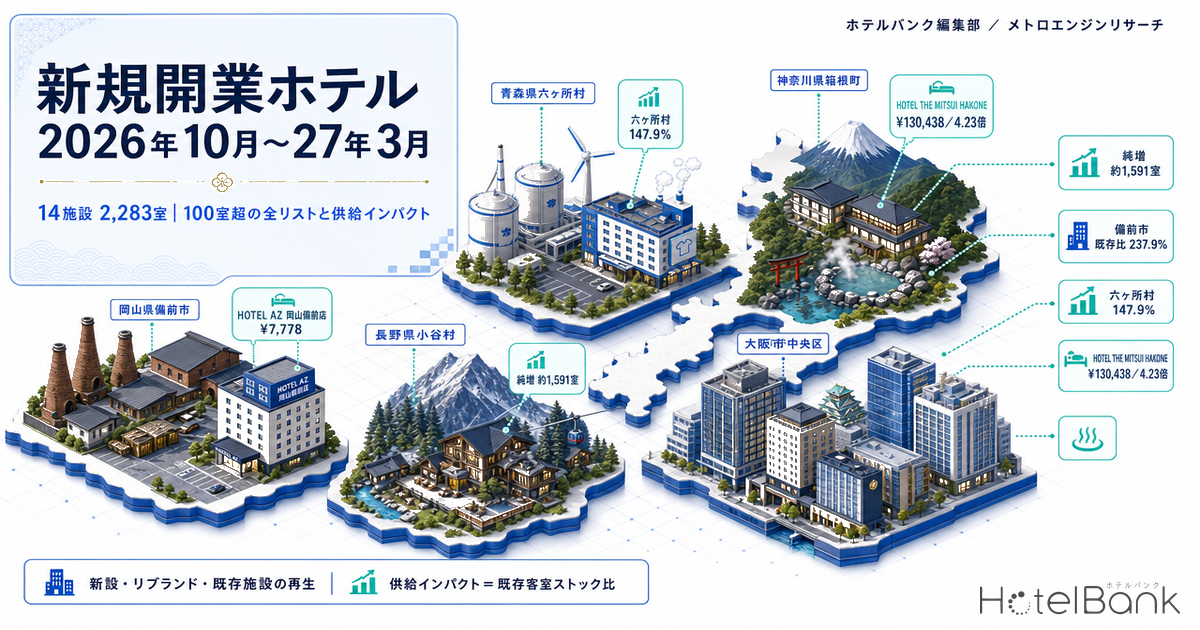
Between October 2026 and March 2027, 14 hotels with more than 100 rooms — 2,283 rooms in total — are scheduled to open in Japan, based on what MetroEngines Research is able to track. Eleven of them (1,580 rooms) are new builds; the remaining three (703 rooms) are renewals, renovations or rebrands of existing properties. After deducting the existing rooms lost to reconstruction and conversion, the effective net addition comes to roughly 1,591 rooms.
What stands out is where this supply lands. By room count alone, Naha’s 333 rooms and Tachikawa’s 211 rooms are the largest, but measured against the local existing room stock, the biggest impact falls on Bizen in Okayama (237.9% of existing stock), Yasugi in Shimane (149.1%) and Rokkasho in Aomori (147.9%) — all industrial towns with populations of a few tens of thousands or fewer. This article organises three things in numbers — the opening list, the supply impact, and launch pricing — and considers which price bands and guest segments existing hotels can realistically go after in the towns where this supply arrives.
Metric Definitions Used in This Article
- ADR (average daily rate) = an estimated settled rate (tax-excluded equivalent), calculated by applying a property-type correction factor to the lowest published plan rate each property lists on OTAs and similar channels (double occupancy, per-room rate, tax included). Cross-checked against property-level results disclosed by listed hotel REITs (91 properties, most recent three months), the median error is approximately 7%. These are estimates and differ from each property’s actual transacted rates and accounting figures. Area-level ADR is the median of the properties covered (the level of a typical property in that area).
- Listed price = the average of all plans published on OTAs and similar channels (double occupancy, per-room rate, tax included). Because the basis differs from estimated settled ADR, the two are labelled separately throughout this article.
- Existing room stock = the total number of rooms at accommodation facilities confirmed to be operating in the municipality concerned, to the extent MetroEngines Research is able to track them (excluding newly opening properties). Ryokan, minshuku and simple lodging houses not listed on OTAs or similar channels are not included.
- Data sources: MetroEngines Research (based on confirmed OTA listings) / company disclosures
- — 14 hotels, 2,283 rooms open between October 2026 and March 2027. Eleven properties (1,580 rooms) are new builds; after deducting reconstruction and conversion, the effective net addition is about 1,591 rooms.
- — The largest supply impact is not in the major cities but in industrial towns: Bizen, Okayama (237.9% of existing stock), Yasugi, Shimane (149.1%) and Rokkasho, Aomori (147.9%).
- — Launch pricing ranges from 0.38x to 4.23x the estimated settled ADR median of the same municipality — a spread of more than tenfold. Even among “new openings above 100 rooms,” the guest segments being targeted differ sharply.
- — The 210 rooms going into Rokkasho, population 9,740, are justified not by resident population but by working population. Within a 3km radius there are 8,708 workers against a resident population of 3,692 — a ratio of 2.36.
14 Hotels, 2,283 Rooms — but the Net Addition Is About 1,591
Start with the overall picture. Fourteen properties above 100 rooms open during the period covered (October 2026 to March 2027). These were extracted from the roughly 168,000 domestic properties MetroEngines Research tracks, limited to opening hotels listed on major OTAs and similar channels; this is not a complete census. Because OTA listings typically begin a few months before opening, the count for the later part of the period (particularly from February 2027 onward) may rise as further listings appear.
Stacked by month, openings peak in October 2026 with five properties and 729 rooms. From there the pace runs at one to three properties a month. November and December are dominated by regional cities away from the Tokyo–Nagoya–Osaka corridor and by mountain resorts, while from the new year onward rebrands and post-renovation reopenings of existing properties account for most of the volume.
Source: MetroEngines Research & Consulting (based on confirmed OTA listings, N=14 properties) / company disclosures, compiled by the HotelBank Editorial Team
The key point here is to count “new builds” and “renewals of existing properties” separately. THE ALPS HOTEL HAKUBA (Otari, Nagano; 159 rooms) is a full renewal of an existing hotel directly connected to the Hakuba Norikura Onsen ski area; its predecessor had 121 rooms. The Grand Castle Naha Shurijo by Hewitt Resort (Naha, Okinawa; 333 rooms) is an operator and brand change at an existing 333-room hotel. THE NEXTT HOTEL (Tachikawa, Tokyo; 211 rooms) reopens after renovating the former Palace Hotel Tachikawa (238 rooms). Deducting these three, the rooms genuinely added to the market work out to roughly 1,591.
| Opening | Property | Location | Rooms | Category |
|---|---|---|---|---|
| 2026/10/02 | Tabino Hotel Aomori Rokkasho (たびのホテル青森六ヶ所村) | Rokkasho, Aomori | 210 | New build |
| 2026/10/15 | HOTEL AZ Okayama Bizen (HOTEL AZ 岡山備前店) | Bizen, Okayama | 157 | New build |
| 2026/10/16 | Smile Hotel Hachioji Minamiguchi Ekimae (スマイルホテル八王子南口駅前) | Hachioji, Tokyo | 114 | New build |
| 2026/10 | Richmond Hotel Hachinohe Square (リッチモンドホテル八戸スクエア) | Hachinohe, Aomori | 126 | New build |
| 2026/10/31 | Toyoko Inn Ofuna Station West Exit (東横INN大船駅西口) | Kamakura, Kanagawa | 122 | New build |
| 2026/11/01 | Kamenoyu by HATAGO INN (亀の湯 by HATAGO INN) | Higashi-ku, Kumamoto City, Kumamoto | 134 | Rebrand opening |
| 2026/11/01 | Smile Hotel Premium Tottori (スマイルホテルプレミアム鳥取) | Tottori City, Tottori | 119 | New build |
| 2026/11/15 | Tabino Hotel lit Toyokawa (たびのホテルlit豊川) | Toyokawa, Aichi | 112 | New build |
| 2026/12/01 | THE ALPS HOTEL HAKUBA | Otari, Nagano | 159 | Renewal of existing property |
| 2026/12/15 | HOTEL THE MITSUI HAKONE | Hakone, Kanagawa | 126 | New build |
| 2026/12/18 | Solaria Nishitetsu Hotel Osaka Honmachi (ソラリア西鉄ホテル大阪本町) | Chuo-ku, Osaka City, Osaka | 202 | New build |
| 2027/01/01 | The Grand Castle Naha Shurijo by Hewitt Resort (ザ グランドキャッスル 那覇 首里城 by ヒューイットリゾート) | Naha, Okinawa | 333 | Rebrand |
| 2027/01/15 | HOTEL AZ Shimane Yasugi (HOTEL AZ 島根安来店) | Yasugi, Shimane | 158 | New build |
| 2027/03/01 | THE NEXTT HOTEL | Tachikawa, Tokyo | 211 | Renovation of existing property |
Source: MetroEngines Research & Consulting (based on confirmed OTA listings, N=14 properties) / company disclosures, compiled by the HotelBank Editorial Team. Opening dates follow company-announced figures where available. Kamenoyu by HATAGO INN is a rebrand opening that takes over the existing property “Tsurunoyu,” but its guest rooms are counted as new inventory.
Opening Locations — Three in the Tokyo–Nagoya–Osaka Corridor, Eleven in Regional Cities and Resorts
Plotting the 14 properties on a map makes it immediately clear that this is not a metro-concentrated cycle. Only three sit in the three major metropolitan areas — Chuo-ku in Osaka City, Hachioji and Tachikawa — while the remaining eleven are spread across regional hub cities, industrial clusters, and mountain and onsen resorts. Circle size indicates room count.
Source: MetroEngines Research & Consulting
The Supply Impact Lands in Small Towns — Bizen Gets 2.4x Its Existing Stock
Judging a new opening by absolute room count alone leads to the wrong conclusion. The 202-room Solaria Nishitetsu Hotel Osaka Honmachi adds just 0.8% on top of Chuo-ku’s existing 26,506 rooms (233 properties). The 157-room HOTEL AZ Okayama Bizen, by contrast, equals 237.9% of Bizen’s existing 66 rooms (7 properties) — meaning the town’s room inventory more than triples at a stroke.
The same pattern holds in Yasugi, Shimane (HOTEL AZ Shimane Yasugi, 158 rooms / existing 106 rooms across 10 properties = 149.1%) and Rokkasho, Aomori (Tabino Hotel Aomori Rokkasho, 210 rooms / existing 142 rooms across 2 properties = 147.9%). In each case the existing stock is dominated by ryokan, minshuku and small business hotels, and the market simply had no 100-room-class limited-service hotel to begin with.
Source: MetroEngines Research & Consulting (based on confirmed OTA listings, N=14 municipalities), compiled by the HotelBank Editorial Team
| Municipality | Opening property | New rooms | Existing room stock | Ratio to existing |
|---|---|---|---|---|
| Bizen, Okayama | HOTEL AZ Okayama Bizen | 157 | 66 (7 properties) | 237.9% |
| Yasugi, Shimane | HOTEL AZ Shimane Yasugi | 158 | 106 (10 properties) | 149.1% |
| Rokkasho, Aomori | Tabino Hotel Aomori Rokkasho | 210 | 142 (2 properties) | 147.9% |
| Higashi-ku, Kumamoto City, Kumamoto | Kamenoyu by HATAGO INN | 134 | 394 (4 properties) | 34.0% |
| Kamakura, Kanagawa | Toyoko Inn Ofuna Station West Exit | 122 | 834 (46 properties) | 14.6% |
| Toyokawa, Aichi | Tabino Hotel lit Toyokawa | 112 | 789 (10 properties) | 14.2% |
| Otari, Nagano | THE ALPS HOTEL HAKUBA | 159 | 1,183 (58 properties) | 13.4% |
| Tachikawa, Tokyo | THE NEXTT HOTEL | 211 | 1,637 (18 properties) | 12.9% |
| Hachioji, Tokyo | Smile Hotel Hachioji Minamiguchi Ekimae | 114 | 1,616 (14 properties) | 7.1% |
| Tottori City, Tottori | Smile Hotel Premium Tottori | 119 | 2,124 (42 properties) | 5.6% |
| Hachinohe, Aomori | Richmond Hotel Hachinohe Square | 126 | 3,107 (42 properties) | 4.1% |
| Naha, Okinawa | The Grand Castle Naha Shurijo by Hewitt Resort | 333 | 16,614 (227 properties) | 2.0% |
| Hakone, Kanagawa | HOTEL THE MITSUI HAKONE | 126 | 6,296 (235 properties) | 2.0% |
| Chuo-ku, Osaka City, Osaka | Solaria Nishitetsu Hotel Osaka Honmachi | 202 | 26,506 (233 properties) | 0.8% |
Source: MetroEngines Research & Consulting (based on confirmed OTA listings), compiled by the HotelBank Editorial Team. Existing room stock is the total rooms at properties confirmed to be operating in the municipality concerned (excluding newly opening properties).
How these figures should be read requires care, however. The 2.0% for The Grand Castle Naha Shurijo by Hewitt Resort and the 12.9% for THE NEXTT HOTEL are both operator and brand changes at existing properties, so neither is a net addition to market inventory. THE ALPS HOTEL HAKUBA is likewise a renewal of a 121-room predecessor, making the effective addition to Otari the equivalent of 38 rooms.
Conversely, all three of Bizen, Yasugi and Rokkasho are new builds, and each town’s lodging capacity genuinely doubles. For incumbent operators, two things start at once: demand that previously ended as a day trip because lodging options were limited may convert into overnight stays, and the price bands within the area may be reorganised. Our national ranking of supply pressure measured against existing stock, Hotel Supply Pressure Ranking 2026-2027, likewise found the top places taken not by large cities but by municipalities with small populations.
Launch Pricing Runs 0.38x to 4.23x the Market Median — Same “New Opening,” Different Target Guests
Next, we compared the estimated settled ADR calculated from advance listings for each opening month against the estimated settled ADR median of the same municipality. As of the survey date (September 2026), pricing could be confirmed for 6 of the 14 properties; for the remaining 8, either the opening date is still far off or sales have not yet begun, so no price is listed. Because check-in dates from February 2027 onward have not yet started appearing at all, THE NEXTT HOTEL (opening March 2027) was excluded from this tabulation.
Source: MetroEngines Research & Consulting (N=6 properties; the number of properties behind each municipal median is shown in the table), compiled by the HotelBank Editorial Team. The vertical axis uses a logarithmic scale.
| Property | Month | Launch estimated settled ADR | Municipal median | Ratio |
|---|---|---|---|---|
| HOTEL AZ Okayama Bizen | October 2026 | ¥7,778 | ¥20,327 (N=3) | 0.38x |
| Toyoko Inn Ofuna Station West Exit | November 2026 | ¥10,247 | ¥19,936 (N=18) | 0.51x |
| Tabino Hotel lit Toyokawa | November 2026 | ¥10,755 | ¥10,778 (N=9) | 1.00x |
| THE ALPS HOTEL HAKUBA | December 2026 | ¥47,502 | ¥13,324 (N=6) | 3.57x |
| HOTEL THE MITSUI HAKONE | December 2026 | ¥130,438 | ¥30,844 (N=149) | 4.23x |
| HOTEL AZ Shimane Yasugi | January 2027 | ¥7,778 | ¥12,946 (N=7) | 0.60x |
| Tabino Hotel Aomori Rokkasho | October 2026 | No price listed as of the survey date | ||
| Smile Hotel Hachioji Minamiguchi Ekimae | October 2026 | No price listed as of the survey date | ||
| Richmond Hotel Hachinohe Square | October 2026 | No price listed as of the survey date | ||
| Kamenoyu by HATAGO INN | November 2026 | No price listed as of the survey date | ||
| Smile Hotel Premium Tottori | November 2026 | No price listed as of the survey date | ||
| Solaria Nishitetsu Hotel Osaka Honmachi | December 2026 | No price listed as of the survey date | ||
| The Grand Castle Naha Shurijo by Hewitt Resort | January 2027 | No price listed as of the survey date | ||
| THE NEXTT HOTEL | March 2027 | No price listed as of the survey date | ||
Source: MetroEngines Research & Consulting (estimates based on advance listings as of August 30, 2026), compiled by the HotelBank Editorial Team
The ratios span 0.38x to 4.23x — a spread of more than tenfold. Even among “new openings above 100 rooms,” the stance taken toward the market differs completely.
Pulling the market up from the high end. HOTEL THE MITSUI HAKONE (126 rooms) shows an estimated settled ADR of about ¥130,400 for December 2026, or 4.23x the Hakone-wide median of about ¥30,800 (N=149 properties). As Mitsui Fudosan Group’s top-tier brand, with natural hot-spring baths in every room, it sets a range that does not overlap with Hakone’s existing price bands. THE ALPS HOTEL HAKUBA (159 rooms) is similar: its estimated settled ADR of about ¥47,500 for December 2026 is 3.57x the Otari median of about ¥13,300 (N=6 properties). The design sells a ski-in location asset at mountain-resort pricing rather than at the minshuku and lodge rates that came before.
Matching the market median. Tabino Hotel lit Toyokawa (112 rooms) shows an estimated settled ADR of about ¥10,800 for November 2026, essentially level with the Toyokawa median of about ¥10,800 (N=9 properties) at 1.00x. It is built for medium-to-long stays, with a microwave and two-door refrigerator in every room and some rooms with a kitchenette, but the initial pricing enters in line with the market — a launch pattern that builds occupancy first and goes after rate later. Our own measurement of 182 newly opened hotels likewise found that pricing immediately after opening converges to area levels in a median of two months.
Taking a different segment with clear flat pricing. Toyoko Inn Ofuna Station West Exit (122 rooms) sits a one-minute walk from the west exit of JR Ofuna Station and presents straightforward pricing from about ¥9,400 for a single. Its listed price holds at roughly ¥12,000 throughout November 2026 to January 2027, with little variation by calendar date. Kamakura’s median (about ¥19,900, N=18 properties) is pushed up by tourist ryokan and resort properties, so rather than competing on the same ground as leisure lodging, this property is going after the segment where its own strengths work — predictable pricing, a station-front business location and short stays. For business travellers who want a fixed budget, and for pre- and post-night demand around Kamakura sightseeing, the choice set gets easier.
Entering regional markets on chain-wide flat pricing. HOTEL AZ Okayama Bizen and HOTEL AZ Shimane Yasugi both sit at a lowest published plan rate of about ¥8,900, and their estimated settled ADRs match at about ¥7,800. This is a national chain’s uniform pricing design carried straight into regional markets. Bizen’s median of about ¥20,300 rests on only three properties and is dominated by ryokan and minshuku where one night with two meals is standard, so the product differs from a room-only business hotel and the comparison should be discounted accordingly. For reference, the estimated settled ADR median for Okayama Prefecture as a whole is about ¥11,600 for October 2026 (N=180 properties), and about ¥12,200 for Shimane Prefecture in January 2027 (N=135 properties).
210 Rooms in Rokkasho, Population 9,740 — How to Read Industrial-Site Lodging Demand
The entry on this list that most needs explaining is the 210 rooms in Rokkasho, Aomori. Rokkasho’s population is 9,740 (as of August 1, 2026). A municipality of fewer than 10,000 people is receiving a hotel larger than its entire existing lodging inventory of 142 rooms across 2 properties. It is neither a tourist destination nor a prefectural capital.
The answer lies in working population, not resident population. Based on the Economic Census for Business Activity (2021) by the Ministry of Internal Affairs and Communications and the Ministry of Economy, Trade and Industry, the 3km radius around the hotel site counts 275 establishments and 8,708 workers. By contrast, MLIT’s National Land Numerical Information 250m-mesh estimates put the resident population within that same 3km radius at 3,692 (2025 estimate). Dividing workers by residents gives 2.36 — more than twice as many people come to work as live there.
The age profile is distinctive too. The working-age share within that radius is 77.6%, far above the four comparison areas (54.2% to 61.1%). The ageing rate, at 11.8%, is well below the national average. This is a textbook industrial-site population profile, showing that it is work rather than residential life that draws people to the area.
Source: Ministry of Internal Affairs and Communications / Ministry of Economy, Trade and Industry, “Economic Census for Business Activity” (2021), and MLIT National Land Numerical Information (250m-mesh future population estimates), compiled by the HotelBank Editorial Team. Note that Rokkasho has only one applicable Economic Census small-area block, and that blocks become coarse in rural and coastal areas.
Rokkasho hosts a cluster of facilities: Japan Nuclear Fuel Limited’s reprocessing plant, uranium enrichment plant and MOX fuel fabrication plant, a national petroleum stockpiling base, and the Rokkasho Fusion Energy Institute (International Fusion Energy Research Centre) of the National Institutes for Quantum Science and Technology. In its public materials, operator Sun Frontier Hotel Management explains the opening by noting that researchers, engineers and construction personnel visit from Japan and abroad while lodging capacity to receive them has been limited. Every room has a washing machine, microwave and two-door refrigerator, and some rooms include a kitchenette — a specification built for residencies of weeks to months rather than trips of a few days.
Mapping the resident population at 250m mesh makes the character of the site clearer still. Only 45 cells within the 3km radius record any resident population at all; most of the area is unpopulated industrial land, protection forest and coastline. People do not live there, but they come there to work. Lodging demand is generated by that movement.
Source: MLIT National Land Numerical Information (250m-mesh future population estimates, FY2024 National Institute estimates). These are resident population figures (census basis), not daytime or transient population.
The same reading applies to the other two cities. Yasugi in Shimane is a specialty-steel town home to the Proterial Yasugi Works, formerly Hitachi Metals; against 716 establishments and 9,378 workers within a 3km radius, office-type workers account for just 5.4%. The employment structure is led by manufacturing and construction. According to Nikkei, HOTEL AZ Shimane Yasugi is the chain’s first property in the San’in region and is targeting business and construction-related lodging demand tied to the surrounding factory base. Bizen in Okayama is similar: office-type workers make up only 1.7% of the 7,552 workers within a 3km radius, in an industrial cluster built on refractory brick and ceramics.
Industrial-site lodging demand has three properties that set it apart from leisure demand. First, it concentrates on weekdays and is weak at weekends. Second, because it tracks project timelines, the peaks and troughs are readable from construction and periodic-inspection schedules. Third, stays tend to run long, so the selection criteria become the monthly total rather than the nightly rate, plus the in-room living functions — laundry, cooking and storage. That all three of these properties are equipped for medium-to-long stays is an answer to that demand structure. For a sense of scale, see also our estimate of construction-phase lodging demand counted from the project side, Data Center Construction Needs 364-725 Hotel Rooms per 50MW.
In Towns Where Supply Arrives: the Price Bands and Guest Segments Incumbents Can Go After
The final step is to translate these figures into moves incumbent operators can make.
1. In markets where “the town’s inventory doubles,” the room to differentiate widens on use case rather than price. In markets like Bizen, Yasugi and Rokkasho, where existing stock was only around 100 rooms, some lodging demand was most likely leaking to neighbouring cities (Okayama City, Yonago, Misawa, Hachinohe and others). A new opening is a competitor, but it is also a device that establishes “staying overnight here” as an option in the market’s mind. For existing ryokan and minshuku, there is a shelf to hold that differs in product terms from a 100-room limited-service hotel — one night with two meals, whole-property use by families and groups, dinners built on local ingredients. In fact, the estimated settled ADR median of Bizen’s existing properties (about ¥20,300) is 2.6x the new opening’s launch level (about ¥7,800); the two are not in head-on competition within the same price band.
2. In industrial-site markets, the contest is decided on the monthly equivalent for long stays. Demand from construction, periodic inspections and research residencies is compared on the 30-night total rather than the nightly rate. The moves available to existing properties against a new opening are operational: designing consecutive-night discounts, offering plans with selectable cleaning frequency, retrofitting laundry and cooking facilities, and securing parking. This raises stay value without cutting rate — a direction with meaningful revenue upside.
3. A high-end new opening can be a tailwind for the mid-priced properties around it. In Hakone, HOTEL THE MITSUI HAKONE enters at 4.23x the town median; in Otari, THE ALPS HOTEL HAKUBA at 3.57x. Properties like these lift the ceiling of an area’s price range and shift the reference point for comparison. As the overall product grade of the area rises, existing mid-priced properties gain the relative appeal of “this price, in this area, is good value.” A lodging tax ordinance proposal of ¥350 is also in motion in Hakone, a point worth keeping in view when designing the timing of a rate revision.
4. In urban areas, a new opening affects guest mix more than occupancy. The 202 rooms in Chuo-ku, Osaka City amount to just 0.8% of existing stock, so the effect on the supply-demand balance is limited. Rather, given a location directly connected to Honmachi Station inside a mixed-use complex, and a product design of consecutive-stay rooms with kitchenettes and washing machines, this reads as a property digging into the relatively new shelf of central-city medium-to-long-stay demand. For incumbent city-centre hotels, the competitive axis shifts up a level — less about occupancy worries, more about how to lock in consecutive-night and corporate monthly demand. A similar structure is visible in the price bands of the Nishi-Mikawa area of Aichi Prefecture.
5. Read rebrand deals as “product replacement,” not “supply growth.” The three cases in Naha, Tachikawa and Otari are operator changes or brand changes at existing properties. Room counts are not added to the market, but price band, guest segment and distribution channels all change. For existing properties in the same area, this moves where the competition sits and creates an opportunity to reposition. Kumamoto City is also in a continuing supply-growth phase, where the relationship between supply and estimated settled ADR is worth monitoring on an ongoing basis.
⚠ A note on ADR for future dates: ADR figures for October 2026 onward in this article are estimates based on selling prices published on OTAs and similar channels as of the survey date (data compiled August 30, 2026), and they move as the check-in date approaches. Newly opening properties frequently list only a subset of plans before opening, so levels may shift as plan counts increase after opening. Opening months, room counts and property names are all as announced by the companies concerned at the time of writing and may change.
Methodology and Sources
■ Data sources
Opening properties were extracted from the roughly 168,000 domestic properties MetroEngines Research tracks, limited to properties listed on major OTAs and similar channels with an opening date between October 1, 2026 and March 31, 2027 and a room count of 100 or more. After extraction, property names, room counts, opening dates and locations were cross-checked against company disclosures (press releases, official websites, news reports), and where they differed, the company-announced figure was adopted. Surrounding employment and residential data come from public statistics (the Economic Census and National Land Numerical Information).
■ Calculation assumptions
Existing room stock is the total number of rooms at accommodation facilities confirmed to be operating in the municipality concerned (excluding newly opening properties). Estimated settled ADR is an estimate calculated by applying a property-type correction factor to the lowest published plan rate each property lists on OTAs and similar channels, based on advance listings as of August 30, 2026. The number of properties (N) behind each municipal median is shown alongside it in the tables.
■ Limitations and caveats
This is not a complete census; properties not listed on OTAs or similar channels, and properties whose listings had not started as of the survey date, are not included. Properties with no registered room count are treated as zero rooms, so existing room stock may come out slightly smaller than actual inventory. ADR for October 2026 onward is an estimate based on selling prices for future dates published as of the survey date, and moves as the check-in date approaches. Opening months, room counts and property names are all as announced by the companies concerned at the time of writing.
Related reading
- Hotel Supply Pressure Ranking 2026-2027: Ozu Kumamoto Tops at 30.8%
- Japan 2026: 1,242 Openings, 33,749 Rooms — 47% Villas, 42% Business
- Data Center Construction Needs 364-725 Hotel Rooms per 50MW in Japan
References and Sources
■ Market data
- MetroEngines Research & Consulting — new opening data (based on confirmed OTA listings), estimated settled ADR, room stock by municipality
■ Government statistics and public data
- Ministry of Internal Affairs and Communications / Ministry of Economy, Trade and Industry, “Economic Census for Business Activity” (2021)
- MLIT National Land Numerical Information, “250m-mesh Future Population Estimates (FY2024 estimates)”
- Japan Tourism Agency, “Overnight Travel Statistics Survey”
- Rokkasho Village official website (Basic Resident Register population)
■ Company disclosures and press releases
- Sun Frontier Fudousan, “Tabino Hotel Aomori Rokkasho begins accepting reservations” (June 2026)
- Sun Frontier Fudousan, “Tabino Hotel lit Toyokawa opens November 15” (May 2026)
- AMAZE, “HOTEL AZ Okayama Bizen opens October 15, 2026”
- AMAZE, “HOTEL AZ Shimane Yasugi opens January 2027”
- Nikkei, “Hotel AZ to open in Yasugi, Shimane in 2027, targeting business demand”
- Mitsui Fudosan, “HOTEL THE MITSUI HAKONE opens December 15, 2026”
- Nishi-Nippon Railroad, “Solaria Nishitetsu Hotel Osaka Honmachi opens December 18, 2026” (April 17, 2026)
- THE ALPS HOTEL HAKUBA, “Opening December 2026; reservations now open”
- Hospitality Operations, “Smile Hotel Hachioji Minamiguchi Ekimae grand opening October 16, 2026”
- Ryoko Shimbun, “Tottori Prefecture’s first Smile Hotel Premium — 119 new-build rooms, opening November 1”
- Royal Holdings, “Richmond Hotel Hachinohe Square opening autumn 2026”
- Solare Hotels & Resorts, “Kamenoyu by HATAGO INN opens November 1, 2026”
- Toyoko Inn, “New property: Toyoko Inn Ofuna Station West Exit — reservations open August 26”
- Core Global Management, “The Grand Castle Naha Shurijo by Hewitt Resort rebrand opening January 1, 2027”
- Tachihi Holdings, “THE NEXTT HOTEL confirmed to open March 1, 2027”