


Mitsui Fudosan announced on July 13, 2026 that HOTEL THE MITSUI HAKONE will open on Tuesday, December 15, 2026 in Kowakidani, Hakone, Kanagawa Prefecture, as a 126-room luxury hotel in which every room has natural hot-spring water drawn on site and a balcony or terrace. It is the brand’s second property after HOTEL THE MITSUI KYOTO (opened November 2020); it will be operated by Mitsui Fudosan Resort Management and affiliated with Marriott International’s The Luxury Collection. This article first lays out the published facts as they stand, then uses MetroEngines Research data to examine the 10-year trend in room stock within 2 km of Kowakidani Station, Hakone’s monthly settled ADR estimate, the price-tier distribution inside the 2 km radius, and how stay dates in the upper tier fill up.
• ADR (average daily rate) = an estimated settled rate (tax-excluded equivalent), calculated by applying a property-type correction factor to each property’s lowest published plan on OTAs (per room, 2 guests, tax included). Benchmarked against property-level results disclosed by listed hotel REITs (91 properties, latest 3 months), the median error is about 7%. These are estimates and differ from each property’s actual achieved rates and accounting figures.
• ADR at the area level (prefecture / municipality) is the median of the estimated settled rates of the properties covered (the level of a typical property in the area).
• Where listed prices are cited, they are per-room rates for 2 guests sharing one room (tax included).
• OCC (occupancy) = rooms sold as a share of total rooms in the area (an estimate based on OTA sales inventory).
• Source: MetroEngines Research (continuous tracking of published OTA prices for about 168,000 properties, of which about 27,000 are confirmed as operating)
Room stock in this article covers lodging properties with 10 or more rooms within a 2,000 m radius of Kowakidani Station (excluding leisure/love hotels); “operating” means a selling price was observed on major booking sites in the latest three months (September–November 2026) (as of November 10, 2026, compiled by MetroEngines Research). The annual trend for the 2 km radius counts properties that had opened and not yet closed at each year-end (regardless of room count), so the scope differs. Booking curve = the change in OTA remaining inventory toward the check-in date. LT (lead time) = days before check-in. The curves and estimated OCC in this article use only observations from LT45 to LT1. MetroEngines Research tracks about 168,000 properties, of which about 27,000 properties / about 1.26 million rooms confirmed as operating on OTAs form the analysis universe.
- — Opening Tuesday, December 15, 2026 with 126 rooms: every room has natural hot-spring water and a balcony or terrace. It is the brand’s second hotel after HOTEL THE MITSUI KYOTO and is affiliated with Marriott’s The Luxury Collection (Mitsui Fudosan, announced July 13, 2026).
- — +2.9% on 4,354 rooms within 2 km of Kowakidani Station: the radius went from 147 properties / 4,526 rooms in 2017 to 185 properties / 4,354 rooms in 2026. This single hotel accounts for more than half of the 227-room net increase from 2025 to 2026.
- — Hakone’s settled ADR estimate was ¥28,500 in December 2025 (N=172 properties): the three-month winter average rose 4.0% year on year, less than the six nearby hot-spring towns (+7.3% to +23.9%), while the level is second only to Atami.
- — The upper tier above ¥50,000 settled ADR is 14 properties / 472 rooms: apart from Ten-yu, all 13 have 70 rooms or fewer. Adding 126 rooms takes the upper tier to 598 rooms on a simple sum, +27%.
- — Upper-tier estimated occupancy averaged 94.9% in October 2026 (listed price ¥100,000+, 25 properties / 554 rooms, LT45–LT1), above 95% on 16 of 31 days. Filling the 126 rooms to 60% while keeping existing occupancy intact would require upper-tier demand to grow by about 17–20%.
Opening Overview — Hot-Spring Water in All 126 Rooms, from 48 m² Deluxe Rooms to a 217 m² Villa
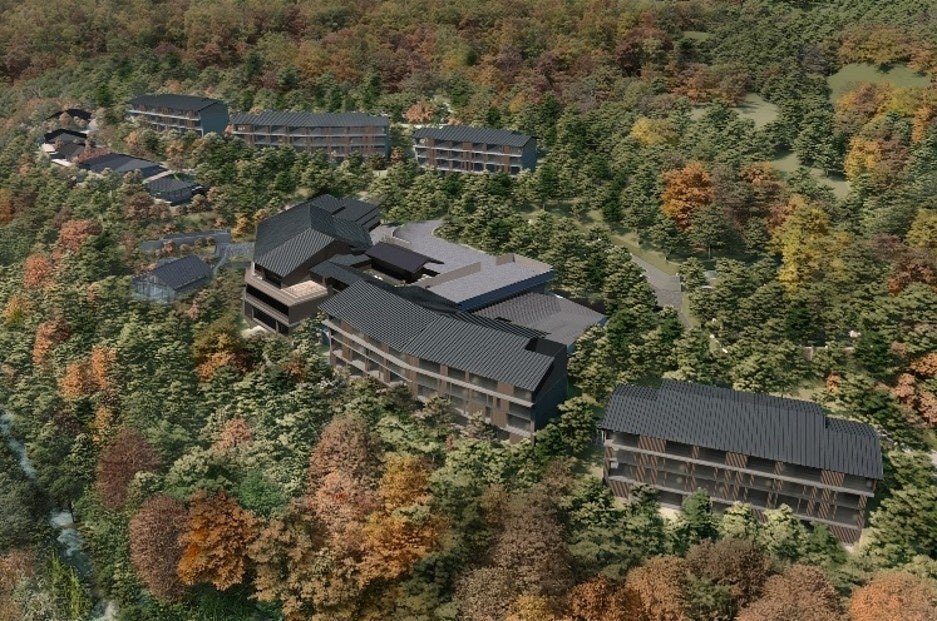
Let us start with the published facts. According to Mitsui Fudosan’s press release (July 13, 2026), the site is in Kowakidani, Hakone-machi, Ashigarashimo-gun, Kanagawa Prefecture, within Fuji-Hakone-Izu National Park. The site covers about 135,500 m² (about 40,980 tsubo), on a slope with about 45 m of elevation difference, and the company says it minimized grading by placing buildings along the terrain. There are 126 rooms in 10 types; even the smallest, the Deluxe Room, is 48 m² with a 10 m² balcony. Reservations opened on Wednesday, July 15, 2026, and the December 15 opening day falls on a Tuesday.
| Room type | Rooms | Room size | Balcony / terrace |
|---|---|---|---|
| Deluxe Room | 43 | 48㎡ | 10㎡ |
| Premier Room | 30 | 48–57 m² | 10–11 m² |
| Grand Room | 14 | 51㎡ | 12㎡ |
| Onsen Garden Room | 22 | 45–50 m² | 13–14 m² |
| Deluxe Suite | 7 | 105㎡ | 32㎡ |
| Onsen Garden Suite | 4 | 100㎡ | 34㎡ |
| Presidential Suite | 1 | 240㎡ | 81㎡ |
| Villa | 3 | 101–112 m² | 55–60 m² |
| Terrace Villa | 1 | 101 m² (private garden 52 m²) | 75㎡ |
| Signature Villa | 1 | 217㎡ | 120㎡ |
| Total | 126 |
Source: Compiled by the HotelBank Editorial Team from Mitsui Fudosan’s press release “HOTEL THE MITSUI HAKONE opens December 15, 2026” (July 13, 2026). Room counts and sizes are published figures.
Published facilities include the Thermal Springs (indoor and open-air baths entered in swimwear), a spa with five treatment rooms, the Japanese restaurant “Sankei” (64 seats; kaiseki, sushi and teppanyaki), the all-day dining “RIVERINE” (96 seats), “The Bar LAMBENT” (34 seats), a detached pavilion “Shikian” built by Kyoto sukiya carpenters, and a function room of about 73 m². Design and construction are by Takenaka Corporation, with interior design by Yabu Pushelberg. The plan also specifies a heat-exchange system using hot-spring heat and the reuse of existing trees, reflecting its national-park setting.
That the earlier HOTEL THE MITSUI KYOTO has earned a Forbes Travel Guide Five-Star rating for five consecutive years since 2022 and holds three MICHELIN Keys is a premise for reading the price range of the second property. Because room rates have not been announced, however, this article does not assert the hotel’s rates or required ADR. Instead, it shows, as far as can be observed, how many rooms already exist in the same market and how full each price tier is.
Room Stock Within 2 km of Kowakidani — +38 Properties in 10 Years, Rooms Down from 4,526 to 4,354
Extending the radius to 2 km from Kowakidani Station, the planned site, takes in nearly all the main hot-spring inns of Gora, Miyanoshita, Ninotaira and Kowakidani. Counting properties within this radius that had opened and not yet closed at each year-end, there were 147 properties / 4,526 rooms in 2017 versus 185 properties / 4,354 rooms in 2026. The number of properties grew by 38 (+26%) over the decade, while rooms fell by 172 (−3.8%), shrinking the average size from 30.8 to 23.5 rooms per property. The crossing of these two lines reflects how Hakone’s structure has changed: large corporate retreats and group-oriented facilities have disappeared while small, high-priced inns have multiplied.
Source: MetroEngines Research & Consulting (based on confirmed OTA listings; properties opened and not yet closed at each year-end; N=185 properties for 2026)
From 2025 to 2026 the radius added 10 properties and 227 rooms, the largest net room increase in the decade. HOTEL THE MITSUI HAKONE’s 126 rooms equal 2.9% of the 4,354 rooms projected for end-2026, meaning one hotel accounts for more than half of that year’s 227-room net increase. Given that supply in the 2 km radius has moved within a band of roughly 4,000–4,600 rooms, it is more realistic to see 126 rooms not as a volume that “pushes up supply in the radius” but as one that “changes the composition of the upper tier.”
On the current listing basis limited to properties with 10 or more rooms, the 2 km radius has 104 properties / 3,821 rooms (including the 126 rooms of the not-yet-open HOTEL THE MITSUI HAKONE), of which 67 properties / 2,354 rooms are operating, with selling prices observed in the latest three months. By type, ryokan account for more than half of both properties and rooms at 67 properties / 2,074 rooms, while resort hotels number only 16 properties / 897 rooms. By size band, properties with 50 rooms or fewer make up 84 properties / 1,648 rooms, or 81% of the count, while 101–200 rooms is just 7 properties / 1,062 rooms and 201+ rooms only 1 property / 224 rooms. At 126 rooms, the new hotel ranks among the eight largest in the radius.
| Size band | Listed properties | Listed rooms | Operating properties | Operating rooms |
|---|---|---|---|---|
| 50 rooms or fewer | 84 | 1,648 | 53 | 1,019 |
| 51–100 rooms | 12 | 887 | 10 | 757 |
| 101–200 rooms | 7 | 1,062 | 4 | 578 |
| 201+ rooms | 1 | 224 | 0 | 0 |
| Total | 104 | 3,821 | 67 | 2,354 |
Source: MetroEngines Research; compiled by the HotelBank Editorial Team (November 2026; within 2,000 m of Kowakidani Station; 10+ rooms)
Hakone’s Monthly Settled ADR Estimate — ¥28,500 in December 2025, and How to Read the Gap with ¥50,000-Range Listed Prices
So where do rates stand for Hakone as a whole? Hakone’s settled ADR estimate (median of covered properties) was ¥28,500 in December 2025 (N=172 properties), ¥26,600 in January 2026 (N=173) and ¥24,900 in February (N=178). Year on year these were +5.4%, +1.2% and +5.4%, so every winter month landed above the prior year. October 2026, the latest finalized month, came in at ¥27,700, a wider +8.5% YoY gain, though August, at ¥28,200 (−3.4% YoY), was below the prior year. November is the peak of the autumn-foliage season, and the estimate based on listed levels at the time of the survey is ¥30,100, the highest in the series. However, values from November 2026 onward are estimates based on current listing snapshots and are calculated on a different basis from finalized past months, so the difference from the prior-year month (finalized November 2025: ¥28,900) cannot be read directly as a growth rate.
Source: MetroEngines Research; compiled by the HotelBank Editorial Team (Hakone, all property types; settled ADR estimate = median of covered properties; N=143–193 properties per month. November 2026 onward are estimates based on listed levels at the time of the survey)
One point needs care here: the gap with listed prices. Hakone’s listed price (average of all plans, 2 guests per room, tax included) was ¥53,400 in December 2025 and ¥54,400 in October 2026, moving broadly between the high ¥40,000s and the ¥50,000s. The settled ADR estimate sits at just over half that level, but the two measure different things. The listed price is the average of all plans from room-only to two meals included, and in Hakone, where ryokan make up more than half of properties, high-priced plans including dinner pull the average up. The settled ADR estimate, by contrast, is an estimate of the achieved room rate on a tax-excluded basis, calculated by applying a property-type correction factor to each property’s lowest plan level, and is designed to be comparable with the achieved ADR disclosed by listed REITs. “Hakone’s going rate is ¥50,000” and “Hakone’s ADR is ¥28,000” are not contradictory: the former is the price tag in the shop window, the latter an estimate of the rate at which rooms actually sell.
This gap also matters for positioning a new hotel. A property like HOTEL THE MITSUI HAKONE, made up entirely of rooms of 48 m² or more with private hot-spring water, will be competing not at Hakone’s median but for the same demand as the upper-tier group examined in the next section. The median’s trend is best read as a thermometer of the resilience of demand across Hakone as a whole.
Hakone’s level and movement come into sharper focus when set beside nearby hot-spring destinations. Table 3 lines up six towns and cities—hot-spring towns and highland resorts that people from the Tokyo area visit on weekends—on the same settled ADR estimate. On the three-month winter average for December 2025–February 2026, Hakone (¥26,700) ranks second after Atami (¥27,800), and in October 2026, a finalized month, it is the highest of the seven at ¥27,700. On the other hand, its winter YoY gain of +4.0% is the smallest of the seven; unlike Atami (+23.9%) or Yugawara (+22.4%), it did not step up from the prior year’s level. Hakone is best read as “a market already holding steady at a high level,” and the 126 rooms opening in winter will join the upper tier of a high-priced market rather than enter one with large headroom. The ratio of listed price to settled ADR estimate falls within 1.66–2.17x in all seven, so the listed-versus-settled gap discussed above is not unique to Hakone.
| Municipality | Winter average (Dec 2025–Feb 2026) | YoY (same period) | Oct 2026 | YoY | Listed price ÷ settled ADR (winter) | Properties covered (N, properties/month) |
|---|---|---|---|---|---|---|
| Hakone (Kanagawa) | ¥26,700 | +4.0% | ¥27,700 | +8.5% | 1.92x | 172–187 |
| Atami (Shizuoka) | ¥27,800 | +23.9% | ¥23,400 | +4.7% | 1.81x | 100–106 |
| Izu (Shizuoka) | ¥24,300 | +7.8% | ¥18,400 | −9.4% | 1.66x | 58–65 |
| Yugawara (Kanagawa) | ¥24,000 | +22.4% | ¥19,200 | −2.5% | 1.92x | 50–59 |
| Ito (Shizuoka) | ¥23,200 | +7.3% | ¥18,400 | −4.7% | 1.66x | 121–126 |
| Karuizawa (Nagano) | ¥22,400 | +10.8% | ¥25,800 | +24.5% | 2.17x | 49–53 |
| Nikko (Tochigi) | ¥18,800 | +15.1% | ¥19,600 | −8.0% | 1.79x | 112–120 |
Source: MetroEngines Research; compiled by the HotelBank Editorial Team (monthly settled ADR estimate for each municipality, all property types = median of covered properties. Winter average is the simple average of three months; YoY compares with the simple average for December 2024–February 2025. All values are for finalized months)
Price-Tier Distribution in the 2 km Radius — 14 Properties / 472 Rooms Above ¥50,000 Settled ADR
How, then, are individual properties in the 2 km radius distributed across price tiers? Of the properties with 10 or more rooms within 2 km of Kowakidani Station, we took the 55 properties / 2,049 rooms that fall into the property types covered by the settled ADR estimate (ryokan, resort hotels, business hotels) and had prices observed over the 12 months from November 2025 to October 2026, and assigned tiers by each property’s median monthly settled ADR estimate. The result: ¥50,000–100,000 had 14 properties / 472 rooms, ¥30,000–50,000 had 15 / 741, ¥20,000–30,000 had 10 / 387, and under ¥20,000 had 16 / 449; no property was at ¥100,000 or above. By rooms, the upper tier above ¥50,000 accounts for 23% of the 2,049 rooms.
Source: MetroEngines Research; compiled by the HotelBank Editorial Team (within 2 km of Kowakidani Station; each property’s median monthly settled ADR estimate, November 2025–October 2026; N=55 properties / 2,049 rooms)
Splitting the 67 properties whose listed prices (average of all plans, tax included) could be observed, 16 properties / 618 rooms are at ¥100,000 or more and 21 properties / 989 rooms at ¥50,000–100,000; the 14 properties above ¥50,000 on settled ADR largely overlap with the group listed at ¥100,000 or more. Among deluxe hotels and other types not covered by the settled ADR estimate, Hyatt Regency Hakone Resort and Spa (opened December 2006, 80 rooms; Hyatt Hotels Japan press materials, April 2026) and bar hotel Hakone Kayama (21 rooms) sell at listed prices in the ¥80,000–100,000+ range, and including these would widen the lower edge of the upper tier further. For an analysis of high-priced supply arriving in Hakone this autumn and winter from the perspective of price tiers, see also Hakone’s High-Priced Supply Building Up This Autumn and Winter.
The table below lists the 14 properties above ¥50,000 on settled ADR in order of room count. Apart from the 150-room Hakone Kowakien Ten-yu, all 13 have 70 rooms or fewer, and eight—more than half—are small inns with 20 rooms or fewer. When a single property with 126 rooms joins the upper tier’s 472 rooms, upper-tier room count rises to 598 on a simple sum, +27%. Luxury demand in the Kowakidani and Gora area has so far been shared among ryokan of around 20 rooms, and entering it with a 100-plus-room hotel format is what sets HOTEL THE MITSUI HAKONE apart.
| Property | Rooms | Type | Opened / founded | Distance from Kowakidani Sta. |
|---|---|---|---|---|
| Hakone Kowakien Ten-yu | 150 | Ryokan | 2017 | approx. 270 m |
| Hakone Gora Karaku | 70 | Ryokan | 2020 | approx. 1,290 m |
| Gora Kadan | 41 | Ryokan | 1952 | approx. 1,010 m |
| Fufu Hakone | 39 | Resort hotel | 2022 | approx. 1,770 m |
| Hakone Suishoen | 23 | Ryokan | 2007 | approx. 160 m |
| Matsuzakaya Honten | 21 | Ryokan | 1662 | approx. 1,970 m |
| Gora Hanaougi Madoka no Mori | 20 | Ryokan | 2014 | approx. 1,660 m |
| Hakone Ginyu | 20 | Ryokan | 2002 | approx. 1,450 m |
| Gora Hanaougi | 20 | Ryokan | 2009 | approx. 1,290 m |
| Hakone Honbako | 18 | Ryokan | 2018 | approx. 1,560 m |
| Hakone Gora Byakudan | 16 | Ryokan | 2016 | approx. 680 m |
| Gora Kansuiro | 14 | Ryokan | 1949 | approx. 1,010 m |
| Regina Resort Hakone Ungaiso | 10 | Resort hotel | 2014 | approx. 1,240 m |
| Hakone Ryoriyado Kyuan | 10 | Ryokan | 2008 | approx. 530 m |
| Total, 14 properties | 472 |
Source: MetroEngines Research; compiled by the HotelBank Editorial Team (properties with a 12-month median settled ADR estimate above ¥50,000, by room count. Opening/founding year and distance are our own compilation)
More upper-tier supply is planned for Hakone. Hyatt Hotels Japan’s press materials (April 2026) list a new-brand property, “Atona Hakone (tentative name),” as scheduled to open in 2028 or later, with room count undecided (for rate levels at each of the new brand’s sites, see Hyatt Atona’s 5 Sites by ADR). The opening of HOTEL THE MITSUI HAKONE can be positioned as the first large project in a shift in which Hakone’s upper tier broadens from a ryokan-led mix to one that includes hotel formats.
Which Dates Does the Upper Tier Fill? — In October, 25 Properties Listed at ¥100,000+ Topped 95% on 16 of 31 Days
Finally, we check how upper-tier stay dates fill, using estimated occupancy based on OTA listed inventory. Here we compare the group of properties in Hakone with listed prices of ¥100,000 or more (the “upper tier” below) with Hakone as a whole. In October 2026 the upper tier covered 25 properties / 554 rooms (based on listings on major booking sites), with a monthly average estimated occupancy of 94.9% and 16 of 31 days above 95%. Hakone as a whole (160 properties / 4,445 rooms) averaged 92.5%, with only 7 days above 95%. With 96.0% on weekends and 94.5% on weekdays, the upper tier shows little day-of-week gap and does not dip sharply on weekdays as the overall market does (95.6% weekends, 91.3% weekdays).
Source: MetroEngines Research; compiled by the HotelBank Editorial Team (Hakone, October 2026; estimates based on observations from LT45 to LT1 for each stay date. Upper tier = listed price ¥100,000+, 25 properties / 554 rooms; overall = 160 properties / 4,445 rooms. These are estimates based on the sell-through of inventory sold on OTAs and differ from each property’s actual occupancy)
Going back month by month reveals the upper tier’s seasonality. In August, the upper tier (30 properties / 675 rooms) averaged 83.9%, and only one day—Monday, August 10, the eve of Mountain Day—exceeded 95%. September (11 properties / 166 rooms) averaged 87.9%, but the autumn holiday from Saturday, September 19 to Tuesday, September 22 ran at 95.5–99.7%, and weekends alone averaged 92.2%, above weekdays at 86.3%. In October, even weekdays filled to around 95%, and November 1–9 (29 properties / 621 rooms) climbed further to an average of 96.4%. The outline is that the upper tier fills even on weekdays during the autumn holidays and foliage season, while in summer demand concentrates on weekends and public holidays. Note that because the upper tier is defined by listed price, the number of properties covered changes from month to month.
What about December, the opening month? The table below shows booking progress for stay dates observable as of November 8, 2026, comparing the LT45 value with the latest value. For the opening day, Tuesday, December 15, the upper tier (15 properties / 310 rooms) moved from 62.6% at LT45 to 67.1% at LT37, and Hakone overall (155 properties / 4,374 rooms) from 57.3% to 60.7%—gains of 4.5 points and 3.4 points respectively over eight days, with bookings still building. For Saturday, December 19, the upper tier (28 properties / 645 rooms) started at 87.1% at LT45, well above the Tuesday and Sunday of the same week, and was nearly flat at 87.3% at LT41. The upper tier stood at 72.1% (LT45) for Sunday, December 20 and 76.4% (LT45) for Wednesday, December 23.
| Stay date | Segment | Properties / rooms | At LT45 | Latest observation |
|---|---|---|---|---|
| Tue, Dec 15 (opening day) | Upper tier | 15 properties / 310 rooms | 62.6% | 67.1% (LT37) |
| Hakone overall | 155 properties / 4,374 rooms | 57.3% | 60.7% (LT37) | |
| Sat, Dec 19 | Upper tier | 28 properties / 645 rooms | 87.1% | 87.3% (LT41) |
| Hakone overall | 170 properties / 4,541 rooms | 76.2% | 77.9% (LT41) | |
| Sun, Dec 20 | Upper tier | 20 properties / 494 rooms | 72.1% | 71.7% (LT42) |
| Hakone overall | 171 properties / 4,554 rooms | 59.5% | 61.2% (LT42) | |
| Wed, Dec 23 | Upper tier | 19 properties / 496 rooms | 76.4% | — |
| Hakone overall | 161 properties / 4,451 rooms | 59.9% | — |
Source: MetroEngines Research; compiled by the HotelBank Editorial Team (observed as of November 8, 2026; estimated occupancy based on OTA listed inventory. Upper tier = listed price ¥100,000+. Only the LT45 observation is available for December 23)
Source: MetroEngines Research; compiled by the HotelBank Editorial Team (Hakone, stay date Tuesday, December 15, 2026; observations from LT45 to LT37. Upper tier = 15 properties / 310 rooms; resort hotels = 20 properties / 926 rooms; ryokan = 100 properties / 2,818 rooms; overall = 155 properties / 4,374 rooms)
These figures are interim readings taken with more than a month to go before opening day, and how far bookings build over the remaining period is yet to be determined. Even so, the fact that two-thirds of the upper tier was already booked for the Tuesday opening day, and that the following Saturday was close to 90% at 45 days out, shows that Hakone’s upper tier is a market that sells winter weekends early. Taken together with October results, when the upper tier filled to around 95% even on weekdays, the question for Kowakidani this winter, as 126 rooms are added, is likely to be less about sharing weekend demand than about how much the upper tier can deepen its weekday base.
Tourism Demand in Hakone — 21.12 Million Visitors and 4.148 Million Overnight Guests in 2025
The demand-side backdrop is also worth noting. Hakone’s tourist arrivals for 2025, announced by the town in June 2026, rose 4.0% year on year to 21.12 million, recovering to 99.4% of pre-COVID 2018. Of these, overnight visitors numbered 4.148 million (+4.1%) and day-trippers 16.974 million (+4.0%); foreign overnight guests grew sharply, up 27.6%, while domestic visitors were reported as flat. By month, November had the most arrivals, consistent with the settled ADR estimate also reaching one of its highest levels of the year in November, on par with August. A likely factor behind upper-tier properties filling even on weekdays is inbound demand, which has a high weekday share, and this is in line with Mitsui Fudosan’s explanation that it aims to draw guests from overseas membership bases through its affiliation with Marriott’s The Luxury Collection.
In addition, Hakone has passed an accommodation tax ordinance of ¥350 per person per night, with the effective date yet to be set. The tax mechanism and its current status are covered in Hakone Accommodation Tax: ¥350 Passed, Not Yet Charged (Nov 2026). For upper-tier properties, a flat ¥350 levy is small relative to selling prices and is unlikely to shift the price-tier distribution, but it will need to be built into billing and price-display practice once the hotel is operating.
Sensitivity — How Much Must Upper-Tier Demand Grow to Fill 126 Rooms?
When 126 rooms join the upper tier, how much must total upper-tier demand (room nights sold) grow for the new rooms to fill while existing upper-tier properties keep their occupancy? Table 6 is a mechanical calculation under assumed occupancy for HOTEL THE MITSUI HAKONE and for the existing upper tier. The formula is “required demand growth = 126 rooms × new hotel occupancy ÷ (472 existing upper-tier rooms × existing occupancy),” and no room rate or ADR is assumed.
| New hotel (126 rooms) occupancy | Existing upper tier 80% | Existing upper tier 85% | Existing upper tier 90% | Existing upper tier 95% |
|---|---|---|---|---|
| 50% | +16.7% | +15.7% | +14.8% | +14.0% |
| 60% | +20.0% | +18.8% | +17.8% | +16.9% |
| 70% | +23.4% | +22.0% | +20.8% | +19.7% |
| 80% | +26.7% | +25.1% | +23.7% | +22.5% |
| 90% | +30.0% | +28.3% | +26.7% | +25.3% |
Source: HotelBank Editorial Team estimates (the 472 upper-tier rooms are the 14 properties within 2 km of Kowakidani Station with a 12-month median settled ADR estimate above ¥50,000, Table 4. All occupancy rates are assumptions; a simple calculation holding existing properties’ room counts and occupancy constant)
The existing upper-tier occupancy columns are set in an 80–95% range, using as a guide the monthly averages of 83.9–96.4% observed for the upper tier (listed price ¥100,000+) from August to early November 2026. For example, if the existing upper tier stays around 95%, as in October 2026, and the new hotel fills 60% in its first year, upper-tier demand would need to grow by about 17%. If the new hotel reaches 80%, the required increase widens to 22–27%. Hakone’s overnight guests grew 4.1% year on year in 2025 (announced by the town), so absorbing the upper-tier room addition through town-wide growth in overnight demand alone would, on paper, take several years of accumulation. The rest would have to come from new demand, such as guests sent from overseas via The Luxury Collection or customer segments that have so far sat outside the upper tier. The table is not a forecast of future occupancy but a scale for translating the 126 rooms into upper-tier demand.
Summary — 126 Rooms Is +2.9% of Supply, Enough to Change the Upper Tier’s Composition
To sum up, HOTEL THE MITSUI HAKONE’s 126 rooms equal 2.9% of the 4,354 rooms projected within 2 km of Kowakidani Station at end-2026, not a volume that pushes up total supply in the radius. Yet the upper tier above ¥50,000 settled ADR comprises only 14 properties / 472 rooms, most of them ryokan of around 20 rooms. The arrival of a 100-plus-room hotel format lifts upper-tier room count by +27% on a simple sum, broadening Hakone’s high-priced market from a ryokan-centered mix to one that includes hotels.
On the demand side, the upper tier’s estimated occupancy exceeded 95% on 16 of 31 days in October 2026 and held at 94.5% on weekdays, and Saturday, December 19 had reached 87.1% at 45 days out—both signs of a resilient winter upper tier. In August, on the other hand, the upper tier averaged only 83.9%, leaving headroom on summer weekdays. How the hotel converts its 126 rooms with private hot-spring water, its Thermal Springs and spa on a site of about 14 hectares, and the brand reputation built by its Kyoto predecessor into weekday demand will be the thing to watch after opening. Hakone’s settled ADR estimate landed +1.2% to +5.4% YoY for December 2025–February 2026, and we will revisit this series to track the winter of 2026, when the hotel opens.
⚠ Note on ADR and booking progress for future dates: Of the ADR figures in this article, those for November 2026 onward, as well as booking progress for December stay dates, are estimates based on selling prices and inventory published on OTAs at the time of the survey, and will change as check-in dates approach. Please note that prices currently set high may be revised close to the date, and that progress rates may shift as inventory is added or withdrawn.
Frequently Asked Questions
Q. When does HOTEL THE MITSUI HAKONE open, and how many rooms does it have?
It opens on Tuesday, December 15, 2026 in Kowakidani, Hakone, Kanagawa Prefecture, with 126 rooms in 10 types. The smallest, the Deluxe Room, is 48 m² and the largest, the Signature Villa, is 217 m²; every room has natural hot-spring water and a balcony or terrace. Reservations opened on July 15, 2026 (Mitsui Fudosan, announced July 13, 2026).
Q. How large are 126 rooms relative to room supply around Kowakidani?
Rooms within 2 km of Kowakidani Station are projected at 185 properties / 4,354 rooms at end-2026, and 126 rooms equal 2.9% of that. By contrast, the upper tier with a 12-month median settled ADR estimate above ¥50,000 is only 14 properties / 472 rooms, against which the new hotel is a +27% increase on a simple sum.
Q. Why do Hakone’s settled ADR estimate and listed price differ by nearly 2x?
Because they measure different things. The listed price is the average of all plans from room-only to two meals included (2 guests per room, tax included), ¥53,400 in December 2025. The settled ADR estimate applies a property-type correction factor to each property’s lowest plan level to give a tax-excluded-equivalent estimate, ¥28,500 for the same month. In six nearby hot-spring destinations as well, winter listed prices are 1.66–2.17x the settled ADR estimate.
Q. How full are Hakone’s upper-tier properties?
In October 2026, the 25 properties / 554 rooms in Hakone listed at ¥100,000 or more had a monthly average estimated occupancy of 94.9%, exceeding 95% on 16 of 31 days. In August 2026, 30 properties / 675 rooms averaged 83.9%. Both are estimates based on the sell-through of OTA listed inventory (observations from LT45 to LT1) and differ from each property’s actual occupancy.
Q. Have HOTEL THE MITSUI HAKONE’s room rates been announced?
As of this survey (November 2026), room rates had not been announced, so this article does not estimate or assert rates or a required ADR. As a guide to the price range, it shows the makeup of the 14-property / 472-room upper tier above ¥50,000 settled ADR within 2 km of Kowakidani Station and the pattern of dates on which the upper tier fills.
Related Articles
- Hakone Gora Same-Day Openings: 34 Ryokan Rooms and 18 Kitchen Rooms
- Citizens’ Day Fridays: Nov 13 OCC Hits 86.8% in Hakone, 72.5% in Atami
- Hakone Accommodation Tax: ¥350 Passed, Not Yet Charged (Nov 2026)
- Anniversary Stays Cluster in Izu & Hakone: Shizuoka 8.3% of Reviews
- Yokohama Royal Park Reopens 2028 as Luxury Collection: 603-Room Math
- Hakone’s 126-Room Luxury Supply: Listed +30.9%, Settled ADR +5.7%
- Palace Hotel Hakone 2029: 69 Rooms, 186 m² per Key, +5.0% Supply
- Hyatt Atona’s 5 Sites by ADR: Hakone ¥26k to Yakushima ¥12k, 2028+
- Hakone Gora Ryokan Appraised at ¥390mn a Room: REIT Equity, 184 Keys
- Kanagawa Hotel Market 2026: Four Tiers and a ¥15,400 Autumn ADR Gap
References and Sources
■ Data sources
MetroEngines Research (continuous tracking of published OTA prices and sales inventory for lodging properties in Japan): annual room stock within 2 km of Kowakidani Station (properties opened and not yet closed at each year-end, 2017–2026); listed / operating properties with 10+ rooms within a 2,000 m radius (as of November 10, 2026); monthly settled ADR estimates and listed prices for Hakone and six comparison municipalities (July 2024–February 2027; November 2026 onward are estimates based on listing snapshots); property-level settled ADR estimates (November 2025–October 2026, 55 properties); and estimated occupancy and booking curves for Hakone (stay dates August–December 2026, LT45–LT1). Published facility figures are from Mitsui Fudosan’s press release (July 13, 2026), and tourism demand is from a Honichi Lab article reporting the town of Hakone’s announcement.
■ Calculation assumptions
The upper-tier room comparison (472 + 126 = 598 rooms) is a simple sum. Required demand growth in Table 6 is “126 rooms × new hotel occupancy ÷ (472 rooms × existing upper-tier occupancy),” a mechanical calculation holding existing room counts and occupancy constant, with no room rate or ADR assumed. The winter average in Table 3 is the simple average of monthly settled ADR estimates for December 2025–February 2026, and YoY compares with the simple average for December 2024–February 2025.
■ Limitations
The settled ADR estimate applies a property-type factor to the lowest plan level (median error of about 7% against results disclosed by listed REITs) and does not cover deluxe hotels and certain other types. Estimated occupancy is based on the sell-through of OTA listed inventory, and stop-sells and withdrawn inventory are also counted as sell-through. The definition of the upper tier differs by section (price-tier distribution and Tables 4 and 6 = settled ADR above ¥50,000 within 2 km of Kowakidani Station; occupancy = listed price ¥100,000+ in Hakone), so property and room counts do not match. ADR from November 2026 onward and booking progress for December stay dates are estimates as of the survey and are on a different basis from finalized months.
- Mitsui Fudosan, “Mitsui Fudosan Group’s finest luxury hotel HOTEL THE MITSUI HAKONE to open December 15, 2026” (PR TIMES, July 13, 2026; in Japanese)
- Travel Voice, “Mitsui Fudosan to open hotel under top-tier HOTEL THE MITSUI brand in Kowakidani, Hakone with 126 rooms in December 2026” (July 13, 2026; in Japanese)
- Honichi Lab, “Hakone inbound overnight stays up 27.6% in 2025; foreign visitors drive total as domestic flat” (June 10, 2026, reporting the town of Hakone’s 2025 tourist arrivals; in Japanese)
- Japan Tourism Agency, “Overnight Travel Statistics Survey”
- Japan National Tourism Organization (JNTO), “Visitor Arrivals Statistics”
- Hyatt Hotels Japan, press materials, April 2026 (list of hotels operated in Japan and upcoming openings)
- MetroEngines Research & Consulting — room stock within 2 km of Kowakidani Station (based on confirmed OTA listings), Hakone settled ADR estimate (N=143–193 properties per month), property-level settled ADR estimates (N=55 properties), and estimated occupancy and booking curves based on OTA listed inventory (LT45–LT1)