

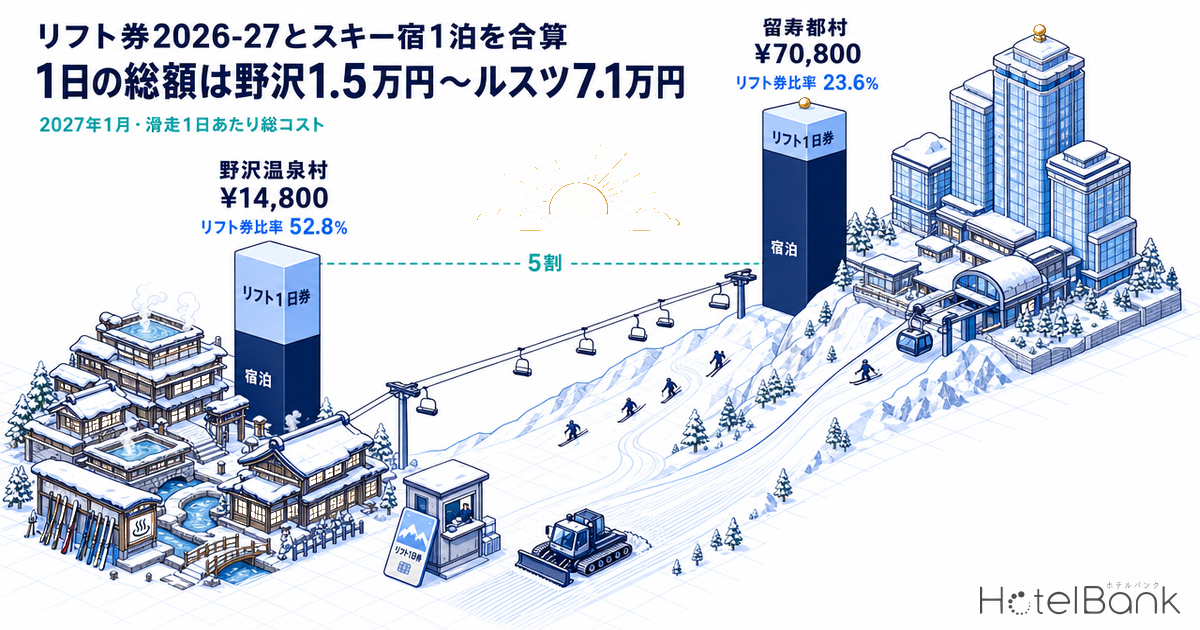
Adult one-day lift tickets for the 2026-27 season have gone up at most major ski resorts, by anywhere from a few hundred yen to ¥1,600 over last season. For lodging operators, though, the size of the increase matters less than the share of a guest’s “ski day” spend that the lift ticket takes up. This article combines adult one-day lift ticket prices confirmed on each resort’s official website with the estimated transacted ADR for January 2027 (two guests per room) in 10 ski-area municipalities, converted to a per-person figure, and ranks the resulting “total cost per ski day” and its breakdown by area. Combined, the January total ranges from about ¥15,000 in Nozawa Onsen Village to about ¥71,000 in Rusutsu Village. The lift ticket accounts for more than half of the total in three areas of northern Nagano, but only around a fifth in Rusutsu.
Metric Definitions Used in This Article
- ADR (Average Daily Rate): An estimated transacted rate (tax-excluded equivalent), calculated by applying property-type correction factors to the lowest plan price each property publishes on OTAs (two guests per room, per-room rate, tax included). Checked against property-level results disclosed by listed hotel REITs (91 properties, most recent three months), the median error is about 7%. These are estimates and differ from each property’s actual transacted prices and accounting figures. Area-level ADR is the median of the covered properties (the level of a typical property in the area).
- Listed price (all-plan average): The average of all plans published on OTAs (from room-only to meal-inclusive). Per-room rate for two guests per room (tax included).
- Per-person lodging rate: Estimated transacted ADR (two guests per room) ÷ 2.
- Total cost per ski day: Adult one-day lift ticket (list price) + per-person lodging rate. A rough estimate assuming one day of skiing per night stayed; transport, rentals, and food and drink are not included. Lift tickets are tax-inclusive while the lodging rate is a tax-excluded equivalent, so on an actual-payment basis the lodging share would be slightly higher.
- Data sources: MetroEngines Research (lodging rates); official ski resort websites (lift tickets)
- — One-day lift tickets keep rising year on year. For 2026-27, Rusutsu is ¥16,700, the Niseko United all-mountain pass ¥13,500 (peak), and the Hakuba Valley all-area pass ¥11,100 (official resort websites).
- — Total cost per ski day runs from about ¥14,800 to ¥70,800. A rough estimate of January 2027 estimated transacted ADR ÷ 2 plus a one-day lift ticket: lowest in Nozawa Onsen Village, highest in Rusutsu Village (N=2 properties; indicative only).
- — Lodging drives the gap in the total. Lift tickets differ by about 2.4x across areas, but the per-person lodging rate spans about ¥7,000 to ¥54,100, a gap of about 7.8x.
- — Two tiers by lift ticket share. Otari Village 54.1%, Nozawa Onsen Village 52.8% and Yamanouchi Town 52.5% are above half; Kutchan Town 31.4% and Rusutsu Village 23.6% are around 30% or below.
- — 23–79% of properties have listed January (relative to properties listing September; surveyed September 26, 2026). Yamanouchi Town is at 79% versus Kutchan Town at 23%, showing that winter sales ramp up at different speeds by area.
2026-27 One-Day Lift Tickets — Levels Confirmed on Official Price Lists
We first checked lift ticket levels against the 2026-27 price lists published on each ski resort’s official website. The most expensive is the adult one-day ticket at Rusutsu Resort (ticket window, December 19 to March 14) at ¥16,700, with an online price of ¥13,200. The Niseko United all-mountain one-day pass is priced by period: ¥13,500 at peak (December 24 to February 28) and ¥12,600 in the regular period (December 12–23 and March 1–22). According to figures compiled by the travel research firm Tabiris, last season’s all-mountain pass was ¥12,000, so this is a revision of +12.5% for the peak period and +5% for the regular period.
In Nagano Prefecture, the Hakuba Valley all-area one-day pass is ¥11,100 (¥10,400 last season, per Tabiris), Tsugaike Mountain Resort is ¥9,800 (¥8,200), the Shiga Kogen common one-day pass (ticket window) is ¥9,500 (¥9,000), and Nozawa Onsen Snow Resort is ¥7,800 (December 19 to March 28). In Niigata Prefecture, Akakura Kanko Resort Ski Area charges ¥7,000 for a one-day ticket (opening day to March 22) and also sells a super-early-bird one-day ticket available only in September and October. Note that Furano Ski Area and Naeba Ski Resort had not posted 2026-27 day-ticket prices on their official websites at the time of the survey, so this article provisionally uses their official 2025-26 prices (Furano ¥8,000, Naeba ¥9,800).
| Area (municipality) | Ski resort / ticket type | 2026-27 adult 1-day | Last season (ref.) |
|---|---|---|---|
| Rusutsu Village (留寿都村) | Rusutsu Resort 1-day (window, 12/19–3/14) | ¥16,700 | ¥16,200 |
| Niseko Town / Kutchan Town (ニセコ町・倶知安町) | Niseko United all-mountain 1-day (peak, 12/24–2/28) | ¥13,500 | ¥12,000 |
| Hakuba Village (白馬村) | Hakuba Valley all-area 1-day | ¥11,100 | ¥10,400 |
| Otari Village (小谷村) | Tsugaike Mountain Resort 1-day (standard) | ¥9,800 | ¥8,200 |
| Yuzawa Town (湯沢町) | Naeba Ski Resort (Mt. Naeba) 1-day (regular price) | ¥9,800 * | — |
| Yamanouchi Town (山ノ内町) | Shiga Kogen common 1-day (window) | ¥9,500 | ¥9,000 |
| Furano City (富良野市) | Furano Ski Area 1-day (regular period) | ¥8,000 * | — |
| Nozawa Onsen Village (野沢温泉村) | Nozawa Onsen Snow Resort 1-day (12/19–3/28) | ¥7,800 | — |
| Myoko City (妙高市) | Akakura Kanko Resort Ski Area resort 1-day (to 3/22) | ¥7,000 | — |
Source: Official ski resort websites (checked September 26, 2026). Last-season prices compiled by Tabiris (Rusutsu, Niseko, Hakuba Valley, Tsugaike, Shiga Kogen). * Official 2025-26 price, as the 2026-27 day-ticket price had not been posted at the time of the survey.
Where a municipality has more than one ski resort, we chose the single representative ticket most closely tied to lodging demand. For example, Otari Village is also covered by the Hakuba Valley all-area pass, but we used the day ticket for Tsugaike Mountain Resort, which is within the village. Likewise for Yuzawa Town and Myoko City, note that day tickets at other ski resorts in the same town or city sit at different levels from the figures used here.
January 2027 Estimated Transacted ADR — ¥14,000 to ¥108,000 Across 10 Municipalities
Next, the lodging side. According to municipality-level data from MetroEngines Research, the January 2027 estimated transacted ADR (two guests per room) stands out in Rusutsu Village at ¥108,300, followed by Kutchan Town at ¥59,000, Niseko Town at ¥36,000, Hakuba Village at ¥36,000 and Yuzawa Town at ¥31,500. Northern Nagano and Myoko fall within a ¥14,000–¥18,800 range, and Furano City is at ¥22,400. However, the estimate covers only N=2 properties in Rusutsu Village and N=4 in Nozawa Onsen Village, too few to state firmly as the level for the area. In Hakuba Village (N=21) and Myoko City (N=21), too, January coverage is still only about half of the number of properties covered over a full year in the same area, so the levels may shift as more listings are added.
| Municipality | Est. transacted ADR Jan 2027 | Properties covered | Listed price (all-plan average) | Listed ÷ est. transacted | Ref.: Jan 2026 est. transacted ADR (final) |
|---|---|---|---|---|---|
| Rusutsu Village * | ¥108,254 | N=2 | ¥246,170 | 2.27x | ¥67,974 (N=2) |
| Kutchan Town | ¥59,010 | N=16 | ¥98,061 | 1.66x | ¥61,574 (N=20) |
| Niseko Town * | ¥35,971 | N=7 | ¥130,019 | 3.61x | ¥42,306 (N=10) |
| Hakuba Village * | ¥35,985 | N=21 | ¥80,473 | 2.24x | ¥21,490 (N=44) |
| Yuzawa Town | ¥31,458 | N=30 | ¥58,808 | 1.87x | ¥23,164 (N=47) |
| Furano City | ¥22,423 | N=11 | ¥72,147 | 3.22x | ¥16,025 (N=11) |
| Myoko City * | ¥18,786 | N=21 | ¥35,728 | 1.90x | ¥13,162 (N=36) |
| Yamanouchi Town | ¥17,182 | N=75 | ¥37,202 | 2.17x | ¥15,048 (N=113) |
| Otari Village | ¥16,600 | N=11 | ¥33,233 | 2.00x | ¥13,744 (N=16) |
| Nozawa Onsen Village * | ¥13,957 | N=4 | ¥26,237 | 1.88x | ¥16,582 (N=15) |
Source: Compiled by HotelBank Editorial Team from MetroEngines Research (surveyed September 26, 2026). January 2027 figures are estimates based on listing levels at the time of the survey. * Indicative only: few properties covered, or fewer than 60% of the number of properties covered over a full year in the same area.
The right-hand column of the table shows last season’s final figures (January 2026) for reference. This season’s January figures are estimated from listings about three months before the stay date, whereas last season’s are final values taken after the stay month had ended. Because the two are observed at different points in time, the difference should not be read as a year-on-year change but only as a rough guide to level. With that caveat, in areas with enough properties covered, such as Kutchan Town (¥59,000 vs. last season’s final ¥61,600) and Yamanouchi Town (¥17,200 vs. ¥15,000), this season’s estimate sits close to last season’s final value.
The Gap Between Listed Price and Estimated Transacted ADR — How Much “Room to Move” Remains
Comparing the all-plan average listed price on OTAs with the estimated transacted ADR for the same January, the ratio ranges from 1.66x to 3.61x depending on the area. Listed prices include high-priced plans such as upper-grade rooms, meal-inclusive plans and plans for larger groups, so it is structural that they come out above the estimated transacted level. The size of the ratio, however, shows how thick a layer of high-priced options sits above the price band where most bookings close. In Niseko Town (3.61x) and Furano City (3.22x), the options above the core transacted band are especially thick.
With more than three months to go before the stay dates, the practical reading of this gap is as “room for transacted prices to move either up or down.” If high-priced plans sell through, the estimated transacted level will shift upward; if more properties adjust prices close to the date, it will shift downward. In areas where the ratio is below 2x, such as Kutchan Town, Yuzawa Town, Myoko City and Nozawa Onsen Village, the core transacted band and the full set of listed options are relatively close together.
Source: Compiled by HotelBank Editorial Team from MetroEngines Research (January 2027; two guests per room; estimates based on listing levels at the time of the survey)
Total Cost per Ski Day — From ¥14,800 in Nozawa Onsen Village to ¥70,800 in Rusutsu Village
Now to the core metric. We added the adult one-day lift ticket to the per-person lodging rate (January 2027 estimated transacted ADR divided by two) to get a “total cost per ski day” for each municipality. Rusutsu Village is the highest at ¥70,800 (lodging ¥54,100 + lift ¥16,700), followed by Kutchan Town at ¥43,000, Niseko Town at ¥31,500, Hakuba Village at ¥29,100 and Yuzawa Town at ¥25,500. Northern Nagano and Myoko range from ¥14,800 to ¥18,100, and Furano City is at ¥19,200.
Source: Compiled by HotelBank Editorial Team from MetroEngines Research and official ski resort websites. Lodging is January 2027 estimated transacted ADR ÷ 2 (tax-excluded equivalent); lift is the adult one-day list price (tax included). * Indicative only for areas with few properties covered.
The gap in the total comes mainly from the lodging side. The most expensive lift ticket (Rusutsu, ¥16,700) is about 2.4x the cheapest (Akakura Kanko, ¥7,000), but the per-person lodging rate spans about 7.8x, from about ¥7,000 in Nozawa Onsen Village to about ¥54,100 in Rusutsu Village. Lift tickets are relatively fixed prices that each resort sets season by season, whereas lodging rates swing widely to reflect each area’s guest mix and room composition, and that difference in nature shows up directly in the numbers.
Two Tiers by Lift Ticket Share — Over Half in Northern Nagano, 20–30% in Hokkaido’s High-Rate Areas
Re-ranking by the lift ticket’s share of total cost brings the character of each area into sharper focus. In three areas, Otari Village (54.1%), Nozawa Onsen Village (52.8%) and Yamanouchi Town (52.5%), the lift ticket accounts for more than half of a ski day’s spend. All three sit in a price band where the per-person lodging rate is below ¥10,000, and all are known as areas popular with domestic skiers and families.
By contrast, in Rusutsu Village (23.6%) and Kutchan Town (31.4%), the lift ticket’s share stays around 30% or below. Both have high per-person lodging rates of roughly ¥30,000 to ¥54,000 and are known as areas where overseas long-stay guests have a strong presence. Even when lift tickets rise, the impact on guests’ total spend is relatively small. Hakuba Village (38.2%) and Yuzawa Town (38.4%) sit in between, while Niseko Town, Furano City and Myoko City line up just above 40%.
Source: Compiled by HotelBank Editorial Team from MetroEngines Research and official ski resort websites (January 2027)
This two-tier structure means the same “lift ticket price increase” lands differently on lodging operators. For example, a ¥1,000 rise in the lift ticket would push the total cost up by about 6.8% in Nozawa Onsen Village but only about 1.4% in Rusutsu Village. The higher an area’s lift ticket share, the more readily guests experience a lift ticket revision as a price rise for the whole trip. That makes it all the more worthwhile for properties there to carefully design ways of adding value to the “ski day” experience on the lodging side.
How Far Have Winter Sales Moved? — Share of Properties Listing January
September and October are when early-bird season passes and early lodging bookings start to move. However, stay dates in late December and January have not yet entered the window in which booking progress can be compared using remaining-inventory data (roughly 45 days or less before the stay date). Remaining inventory more than 45 days out largely reflects the state before properties have built up their allocations on OTAs, so we do not use it to compare booking progress. Instead, this article uses the share of properties listing September prices that have already listed January 2027 prices as a guide to how far winter sales have ramped up.
Source: Compiled by HotelBank Editorial Team from MetroEngines Research (surveyed September 26, 2026; properties listing January 2027 ÷ properties listing September 2026)
The share is highest in Yamanouchi Town (79%, 99/125 properties), Yuzawa Town (76%, 64/84), Furano City (69%, 76/110) and Myoko City (64%, 63/98), areas where the same properties keep selling on OTAs year-round from summer through winter. By contrast, in Kutchan Town (23%, 37/160), Nozawa Onsen Village (31%, 23/75), Hakuba Village (39%, 141/357) and Niseko Town (42%, 27/65), many properties have not yet put January on OTAs.
There is no single reason for a low share. The mix likely includes properties that have yet to open winter sales, properties selling winter mainly through their own websites, travel agencies or overseas booking channels, and properties that operate only in summer. Booking progress based on remaining inventory can be re-examined for the same areas from mid-November onward, once stay dates are within 45 days. The timing of winter listing launches at the prefecture level is analyzed in detail in our article December Listings 56–83% of August: Japan’s Winter Inventory Timing.
What Properties Can Do — Building Lift-Inclusive Plans and the Elements They Can Stack On
Lift tickets are a fixed cost that properties cannot control, and they keep rising every season. Within that constraint, a property’s options fall broadly into two kinds: “presentation” and “stacking.” Behind those prices sit the resorts’ ongoing capital investment in lifts and ropeways.
First, how lift-inclusive plan prices are presented. In areas where the lift ticket is more than half of the total, guests tend to be sensitive to the overall amount. Showing the resort’s list price explicitly in the plan’s price breakdown, for example “equivalent to one-day lift ticket (1 adult, ¥9,800),” prevents a lift ticket revision from looking like a price rise by the property itself. Where a property can use the gap between the resort’s online or early-bird prices and the window price (at Rusutsu, ¥16,700 at the window versus ¥13,200 online) as its own purchasing terms, the difference from the displayed list price becomes an easy-to-understand perk for guests. In areas where the ticket price changes between peak and regular periods (Niseko: ¥13,500 and ¥12,600), switching plan prices on the same period boundaries keeps things consistent.
Second, the elements a property can stack on itself. Shuttles (to the ski area, station or airport), rental discounts or in-house pickup of rental gear, drying rooms and ski lockers, and hot springs or dinner after skiing are among the many elements a property can price itself. On meals, a same-hotel comparison in Hakuba Village (properties selling both room-only and breakfast-included plans) shows breakfast-included rates in September 2026 at +¥3,600 (+10.2%, N=10 properties) over room-only. That is a green-season figure, but plans that include breakfast and dinner on ski days are an area that is even easier to promote in winter.
Third, in high-rate areas with a low lift ticket share, plans built around the value of the room and the stay experience fit the price band better than showing a lift-inclusive total. In areas where, as noted above, the gap between listed price and estimated transacted ADR is large, the thick layer of high-priced options leaves headroom to lift the transacted level by steering guests toward multi-night stays and upper-grade rooms.
| Area type | Areas (Jan 2027, lift ticket share) | Plan design direction |
|---|---|---|
| Lift ticket share above 50% | Otari Village 54.1%, Nozawa Onsen Village 52.8%, Yamanouchi Town 52.5% | Show the lift-ticket-equivalent amount in the breakdown and make the total clear. Add experience value by stacking shuttles, rentals and meals |
| Around 40% | Niseko Town 42.9%, Myoko City 42.7%, Furano City 41.6%, Yuzawa Town 38.4%, Hakuba Village 38.2% | Sell lift-inclusive plans matched to the ticket periods alongside room-only. Move plan prices in step with ticket price revisions |
| Around 30% or below | Kutchan Town 31.4%, Rusutsu Village 23.6% | Lead with the room and stay experience. Use multi-night stays and upper-grade rooms to capture headroom in the transacted level |
Source: Compiled by HotelBank Editorial Team from MetroEngines Research
Frequently Asked Questions
Q. How much is the Niseko United all-mountain one-day pass for the 2026-27 season?
A. According to the official Niseko United website, the adult one-day pass is ¥13,500 at peak (December 24, 2026 to February 28, 2027) and ¥12,600 in the regular period (December 12–23, 2026 and March 1–22, 2027). The early and spring periods are set at ¥8,800, and the final period at ¥6,300.
Q. What share of the daily cost of a ski trip does the lift ticket account for?
A. In this article’s estimate (January 2027; one-day lift ticket + estimated per-person lodging rate), it was more than half in Otari Village, Nozawa Onsen Village and Yamanouchi Town; just over 40% in Niseko Town, Myoko City and Furano City; just under 40% in Hakuba Village and Yuzawa Town; about 30% in Kutchan Town; and about 20% in Rusutsu Village. This is a rough estimate that excludes transport, rentals, and food and drink.
Q. Will January lodging rates change from here?
A. The January 2027 figures in this article are estimates based on prices listed on OTAs as of late September 2026. They will change as stay dates approach, with plans being added and prices adjusted. Treat the figures for areas with few properties covered (Rusutsu Village N=2, Nozawa Onsen Village N=4, Niseko Town N=7) as indicative only.
Summary
One-day lift tickets for the 2026-27 season have been raised from last season at many ski resorts, including Rusutsu at ¥16,700, the Niseko United all-mountain pass at ¥13,500 (peak) and the Hakuba Valley all-area pass at ¥11,100. Adding the estimated per-person lodging rate for January 2027, the total per ski day ranges from about ¥14,800 in Nozawa Onsen Village to about ¥70,800 in Rusutsu Village. The gap comes mainly from the lodging side, and the lift ticket share reveals a two-tier structure: above 50% in three domestically oriented areas of northern Nagano, and 20–30% in Hokkaido’s high-rate areas.
In short, the higher an area’s lift ticket share, the more readily guests feel lift ticket price increases in their total trip cost. For lodging operators, the practical starting point for winter pricing is to show the lift-ticket-equivalent amount in the breakdown so the total is easy to understand, and to build up experience value with elements they can price themselves, such as shuttles, rentals and meals. We plan to re-examine booking progress based on remaining inventory from mid-November onward, once stay dates are within 45 days.
⚠ Note on ADR for future dates:The December 2026 and January 2027 ADR figures in this article are estimates based on selling prices listed on OTAs at the time of the survey (September 26, 2026) and will change as check-in dates approach. Figures for areas with few properties covered (Rusutsu Village N=2, Nozawa Onsen Village N=4, Niseko Town N=7) can move especially widely. Lift ticket prices are based on each resort’s official announcements and may differ with future revisions and by purchase channel (ticket window, online, early bird).
Related Articles
References and Sources
■ Data sources
Lodging rates are from MetroEngines Research’s municipality-level aggregates (estimated transacted ADR, listed price and properties covered; surveyed September 26, 2026). Lift tickets are from each ski resort’s official 2026-27 price list (adult one-day, list price); last-season prices were compiled by Tabiris. For Furano and Naeba, official 2025-26 prices are used because 2026-27 prices had not been posted.
■ Calculation assumptions
Total cost per ski day = one-day lift ticket (adult, list price, tax included) + per-person lodging rate (January 2027 estimated transacted ADR [two guests per room, tax-excluded equivalent] ÷ 2). Assumes one day of skiing per night stayed; transport, rentals, and food and drink are excluded. For each municipality, the single representative ticket most closely tied to lodging demand was used.
■ Limitations
The January 2027 estimated transacted ADR is based on listing levels about three months before the stay date and will change before then. Rusutsu Village (N=2), Nozawa Onsen Village (N=4) and Niseko Town (N=7) have few properties covered and are indicative only. Lift tickets (tax included) and lodging rates (tax-excluded equivalent) use different tax bases, so on an actual-payment basis the lodging share would be slightly higher. The actual lift ticket price varies by purchase channel (ticket window, online, early bird).
- Niseko United, “Niseko All-Mountain Lift Pass” (official website, in Japanese)
- Rusutsu Resort, “Gondola & Lift Tickets” (official website)
- Hakuba Valley, “All-Area Lift Pass” (official website)
- Hakuba Tsugaike Mountain Resort, “Lift Prices” (official website)
- Shiga Kogen, “2026-2027 Lift Ticket Window Prices” (official website)
- Nozawa Onsen Snow Resort, “Lift & Gondola Prices” (official website)
- Akakura Kanko Resort Ski Area, “Slopes & Prices” (official website)
- Furano Ski Area, “Lift Prices & Purchase” (official website)
- Naeba Ski Resort, “Lift Prices & Advance Purchase” (official website)
- Tabiris, “Ski Lift Ticket Prices Keep Rising: Niseko ¥13,500 for 2027” (September 1, 2026, in Japanese)
- Tabiris, “Rusutsu Sets Japan’s Highest One-Day Lift Ticket at ¥16,700” (in Japanese)
- Japan Tourism Agency, “Overnight Travel Statistics Survey”
- JNTO, “Visitor Arrivals Statistics”
- MetroEngines Research — municipality-level estimated transacted ADR, listed prices and number of listing properties (surveyed September 26, 2026); same-hotel price comparison by meal type