

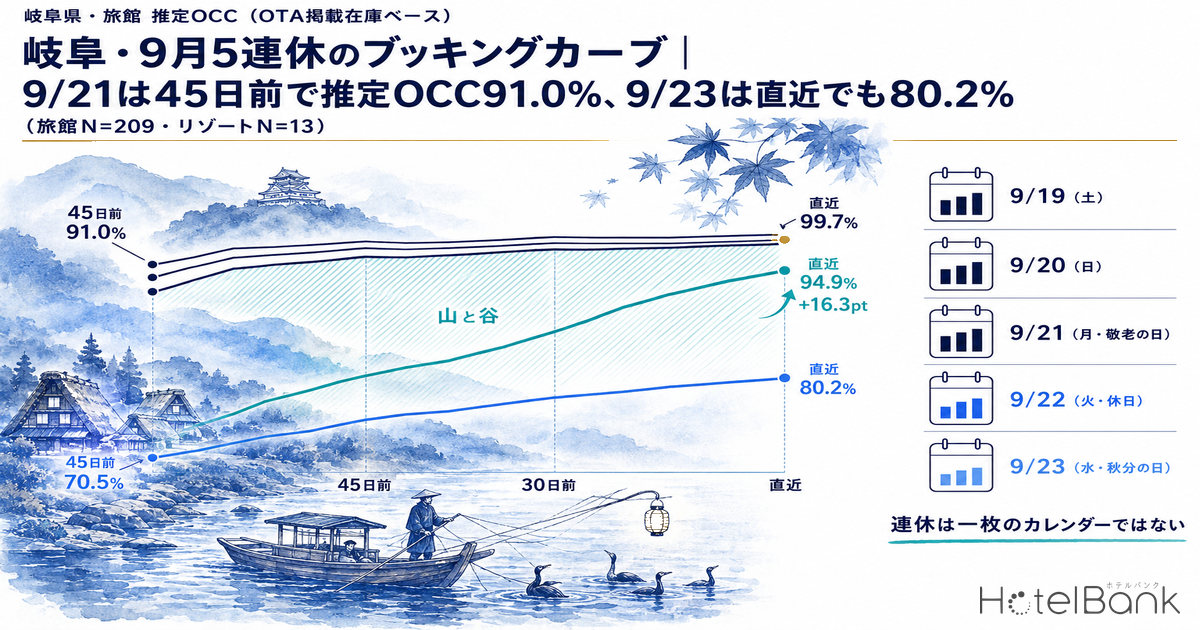
Tracking the booking curves of 209 ryokan (4,386 rooms) in Gifu Prefecture from 45 days before arrival through the most recent observation, across the five-day holiday running Saturday, September 19 to Wednesday, September 23, 2026, reveals a clear split between a “peak” and a “trough” nearly 20 points apart in estimated OCC (based on OTA-listed inventory) within the very same holiday block. Monday, September 21 (Respect for the Aged Day) was already at 91.0% at 45 days out and reached 99.7% at the latest observation, while the estimated sold-out property rate climbed 36.4 points from 61.2% to 97.6%. The final day, Wednesday, September 23, by contrast, moved only from 70.5% at 45 days out to 80.2% at the latest reading, with the estimated sold-out property rate advancing just 8.2 points from 34.6% to 42.8%. This is a situation that calls for branching tactics day by day, rather than treating the holiday block as a single page on the calendar.
About the data in this article — Scope: Gifu Prefecture ryokan N=209 properties (4,386 rooms) and resort hotels N=13 properties (1,153 rooms). Price figures in this article are estimated settled ADR (the transaction price level estimated from OTA and other sales data, tax-excluded equivalent); occupancy is an estimate based on OTA-listed inventory. Definitions for both are given at the end of the article. Data as of September 7, 2026.
- — Estimated OCC split by 20 points inside the same five-day holiday. For ryokan, Sep 21 moved from 91.0% at 45 days out to 99.7% at the latest reading, while the closing day Sep 23 went only from 70.5% to 80.2%. The holiday cannot be treated as a single calendar page.
- — Sep 22 is not a “weak day” but a “late-moving day.” It starts low at 78.6% at 45 days out, yet climbs to 94.9% at the latest reading — a gain of +16.3 points (+20.0 points for resorts), the largest build of the five days. Cutting price on the 45-day snapshot alone means misreading it.
- — Sep 23 behaves less like a holiday than like a slightly soft weekday. Its latest reading of 80.2% sits below ordinary weekends — Sep 26 (86.2%) and Oct 3 (86.4%). The estimated sold-out property rate is also 42.8%, meaning more than half of properties still have inventory open.
- — The main battleground for rate is October–November. Ryokan estimated settled ADR is ¥15,438 for September 2026 against ¥17,897 in October and ¥17,268 in November. The high occupancy of the September holiday is leading information for autumn-foliage pricing.
A five-day holiday is not uniform — daily booking curves for Gifu ryokan
First, the premise. The list of national holidays published by the Cabinet Office (syukujitsu.csv) records September 21, 2026 as Respect for the Aged Day, September 22 as a citizens’ holiday (a day sandwiched between two public holidays), and September 23 as the Autumnal Equinox. September 19 is a Saturday and September 20 a Sunday, so September 2026 forms five consecutive days from Saturday the 19th through Wednesday the 23rd. It is a long block by Japanese standards, but the last two days fall on a Tuesday and a Wednesday on the working calendar, so the character of demand may differ from the first half. What follows tests that hypothesis against the booking curves.
Source: MetroEngines Research; compiled by the HotelBank Editorial Team
All five lines share one property: they rise as they move right, toward the stay date. The differences lie in the height they started from and how much they were able to add. Sunday, September 20 was already effectively in sold-out territory at 93.7% at 45 days out. Monday, September 21 (Respect for the Aged Day) started at 91.0%, reached 97.0% at 30 days out, and 99.7% at the latest reading. Saturday, September 19 moved 87.1% → 93.0% → 98.3%, adding 11.2 points between 45 days out and the latest observation.
The back half of the holiday traces a distinctly different curve. Tuesday, September 22 started more than ten points lower at 78.6% at 45 days out and was still at 85.4% at 30 days out. Yet it has since reached 94.9%, making its gain from 45 days out +16.3 points, the largest of the five days. In other words, September 22 is a day that fills late, and writing it off as weak on the 45-day snapshot alone is a misread. The closing day, Wednesday, September 23 (Autumnal Equinox), ran 70.5% at 45 days out, 74.5% at 30 days out, and 80.2% at the latest reading. The build is +9.7 points, but in level terms it is the only day of the holiday still in the low 80s. An earlier back-calculation of this same holiday from the 45-day and 30-day snapshots is covered in our analysis of Gifu’s autumn five-day holiday, which found ryokan at 93.7% for Sep 20 at 45 days out and the closing Sep 23 alone at 76.3%.
| Stay date | Est. OCC T-45 | Est. OCC T-30 | Est. OCC latest | Gain T-45 → latest | Est. sold-out property rate T-45 → latest |
|---|---|---|---|---|---|
| Sep 19 (Sat) | 87.1% | 93.0% | 98.3% | +11.2pt | 54.5% → 87.6% |
| Sep 20 (Sun) | 93.7% | 98.0% | 99.8% | +6.1pt | 70.0% → 97.6% |
| Sep 21 (Mon, Respect for the Aged Day) | 91.0% | 97.0% | 99.7% | +8.7pt | 61.2% → 97.6% |
| Sep 22 (Tue, citizens’ holiday) | 78.6% | 85.4% | 94.9% | +16.3pt | 36.5% → 69.2% |
| Sep 23 (Wed, Autumnal Equinox) | 70.5% | 74.5% | 80.2% | +9.7pt | 34.6% → 42.8% |
Gifu Prefecture ryokan N=209 properties (4,386 rooms). The latest observation date is September 6, 2026 in every case (13–17 days remaining depending on the stay date). Source: MetroEngines Research; compiled by the HotelBank Editorial Team
Measured by sold-out property rate, the gap between peak and trough widens further
Estimated OCC is an average that takes prefecture-wide inventory as its denominator, so it is pulled by the inventory position of large properties. Lining up the share of properties whose listed inventory can no longer be found — the estimated sold-out property rate — makes the day-by-day divergence sharper still.
Source: MetroEngines Research; compiled by the HotelBank Editorial Team
September 20 and 21 both stand at 97.6% at the latest reading — effectively every observable property has exhausted its general-sale allocation on OTAs and similar channels. September 19 is at 87.6%. For these three days, the market as a whole is no longer in a “selling” phase; the only remaining question is at what price and on what terms to release the rooms that are left.
September 23, by contrast, sits at 42.8%. More than half of properties still had inventory open even at the latest reading. September 22, at 69.2%, falls between the two. What matters here is that September 23’s latest estimated OCC of 80.2% (observed September 6, 2026, with 17 days remaining) is merely on par with an ordinary weekend outside any holiday block. Among the same Gifu ryokan, Saturday, September 26 stood at 86.2% with 20 days remaining, and Saturday, October 3 at 86.4% with 27 days remaining. The curve indicates that September 23 is better priced and promoted as “a slightly soft weekday” than as “part of the holiday”.
Resort hotels (N=13) — a similar shape, with a deeper trough
Resort hotels in the same prefecture are a small set at N=13 properties (1,153 rooms), where a single property moves the sold-out rate by roughly 7.7 points. The following should therefore be read as directional reference values, not as definitive figures.
| Stay date | T-45 | T-30 | Latest | Gain | Gap vs. ryokan latest |
|---|---|---|---|---|---|
| Sep 19 (Sat) | 81.4% | 83.3% | 96.7% | +15.3pt | −1.6pt |
| Sep 20 (Sun) | 85.3% | 93.0% | 98.9% | +13.6pt | −0.9pt |
| Sep 21 (Mon, Respect for the Aged Day) | 81.2% | 89.6% | 99.0% | +17.8pt | −0.7pt |
| Sep 22 (Tue, citizens’ holiday) | 72.3% | 82.7% | 92.3% | +20.0pt | −2.6pt |
| Sep 23 (Wed, Autumnal Equinox) | 66.3% | 71.5% | 75.1% | +8.8pt | −5.1pt |
Gifu Prefecture resort hotels N=13 properties (1,153 rooms). Estimated OCC (based on OTA-listed inventory). Source: MetroEngines Research; compiled by the HotelBank Editorial Team
The shape closely resembles that of ryokan. September 19–21 climb from the low 80s at 45 days out to 96–99% at the latest reading, and September 22 shows the largest build of the five days at +20.0 points. September 23, meanwhile, runs 66.3% at 45 days out to 75.1% at the latest reading — a further 5.1 points below ryokan on the same day (80.2%). Even allowing for the small base of N=13, the direction is readable: the drop-off on the final day of a holiday block tends to show up more sharply at resort hotels. That is consistent with the interpretation that the more a category fills on multi-night demand (checking in on the 19th or 20th for two or three nights), the thinner standalone demand for the closing day becomes. The same concentration of demand in the first half of the holiday has been observed in a neighbouring prefecture; Mie’s ryokan and resorts, facing their first five-day holiday in 11 years, saw demand concentrate in the first three days, which covers the same structure.
One note on the supply side. In the Hida area, the existing Hotel Associa Takayama Resort (ホテルアソシア高山リゾート) reopened on Monday, September 14, 2026 as a rebrand, Hilton Takayama Resort (ヒルトン高山リゾート) — the first Hilton in Gifu Prefecture. This is a rebrand rather than new-build net additional supply: of its 283 rooms, roughly 90 are in operation at opening, with the full inventory scheduled for spring 2027. The resort-hotel base tracked here was constant at 13 properties and 1,153 rooms across all five days, so the curves for this holiday are unaffected by any change in the observation base. Any impact would appear from the autumn-foliage season of October–November onward, as rooms come online in stages. When supply is accumulating in the high-rate band, it is worth watching not only occupancy but how the price tiers within the category move. The details are set out in Hilton Takayama Resort opens September 14 — 283 rooms entering Hida’s high-rate band, against an existing 21 properties and 562 rooms.
The yardstick for price — estimated settled ADR for Gifu Prefecture (monthly)
Against the daily curves, price levels are checked using monthly estimated settled ADR. Daily and day-of-week price cuts are not covered in this article, because the canonical granularity for estimated settled ADR is monthly.
Gifu Prefecture ryokan. Figures from September 2026 onward are estimates based on current sales conditions (subject to change). Source: MetroEngines Research; compiled by the HotelBank Editorial Team
On a finalised basis, Gifu ryokan recorded ¥16,491 in August 2026 (N=234 properties) against ¥16,368 in August 2025 (N=230 properties), +0.8% year on year. The month before, July, came in at ¥13,782 (N=237) against ¥14,574 (N=236) a year earlier, −5.4%; June was ¥12,803 (N=235) against ¥13,441 (N=246), −4.7%. After a run of months in the first half of 2026 that sat modestly below the prior year, August returned to roughly flat.
On that basis, September 2026 — the month in question — is estimated at ¥15,438 (N=228 properties) from current sales conditions, with October at ¥17,897 (N=219 properties) and November at ¥17,268 (N=205 properties). Simple comparison against the prior-year finalised figures (September 2025 ¥13,672, October ¥15,056, November ¥16,432) should be avoided; assessment of September needs to wait for the month-end finalisation. Resort hotels are currently estimated at ¥14,274 for September 2026 (N=13 properties) and ¥16,964 for October (N=13 properties). Both rest on a small base and should be treated as reference levels.
The point to hold onto here is the seasonal shape: September’s estimated level (around ¥15,400 for ryokan) sits ¥1,800–2,500 below the estimated levels for October and November (¥17,000–17,900). For ryokan and resorts in Gifu Prefecture, the main battleground on the revenue calendar is the October–November foliage season, and the five-day holiday in September sits just ahead of it as a phase of high occupancy where rate has yet to reach its peak. The fact that three days of the holiday are effectively sold out is also important leading information for pricing in the months that follow. Gifu is a market where rate levels diverge widely within the prefecture, a structure examined in detail in Gifu’s hotel market in 2026 — Shirakawa-go, Takayama and Gero against Gifu City’s business band.
For revenue managers running ryokan and resort hotels in Gifu — implications and an action plan
(1) Check your own curve against the market’s “starting height.” The market began from a high position — 93.7% for Sep 20 and 91.0% for Sep 21, both at 45 days out. If your property was clearly below the market on the same day at that point, it does not mean demand was absent; it suggests the allocation, terms and price you had in the market at that moment were not reaching the entry point. It is worth recording your position at the 45-day snapshot for the same holiday in future years.
(2) Sep 22 is not a “weak day” but a “late-moving day.” It started low at 78.6% at 45 days out, yet added +16.3 points by the latest reading (+20.0 points for resorts). Cutting price early on the 45-day snapshot alone means taking the back half of demand at a discount. On days with a large expected build, there is room to push the timing of any discount later.
(3) The trough is concentrated on Sep 23. The estimated sold-out property rate is 42.8% for ryokan, and estimated OCC is 80.2% for ryokan and 75.1% for resorts (N=13) — all observed September 6, 2026, with 17 days remaining. That is below ordinary weekends (86.2% on Sep 26, 86.4% on Oct 3), making it a day prone to going unsold if holiday rates are simply left in place. A day-by-day decision is needed on how far into the block the holiday premium should apply.
(4) The main battleground for rate is October–November. Against September’s current estimate of ¥15,438, October stands at ¥17,897 and November at ¥17,268 (all ryokan, N=205–228). Using the high occupancy of the September holiday as evidence, it is worth checking now whether October–November settings sit below the estimated market level.
| Time horizon | Action | Decision trigger (figures from this article) | Objective |
|---|---|---|---|
| Today to this week (peak days: Sep 19–21) | Adjust how remaining allocation is released through terms rather than price. Consider partially opening higher room types and group allocation, or releasing last-minute inventory in small batches | The market’s estimated sold-out property rate is 97.6% on Sep 20 and Sep 21, and 87.6% on Sep 19. If you still have allocation open, there is almost no competing capacity on the market side | Clear the last few rooms without discounting |
| Today to this week (peak days) | Review the timing of lifting minimum-length-of-stay restrictions on a day-by-day basis | Latest estimated OCC of 98.3% on Sep 19 and 99.7% on Sep 21 (both observed September 6, 2026). If restrictions remain after the market has entered sold-out territory, single-night demand may be left on the table | Avoid missed pickup in sold-out territory |
| Today to this week (trough days: Sep 22–23) | Switch the selling terms for Sep 23 alone from holiday pricing to an ordinary-day design. Prioritise incentives that steer guests into multi-night stays (Sep 22–23, Sep 21–23) | Latest estimated OCC for Sep 23 of 80.2% (ryokan) and 75.1% (resorts, N=13), as observed September 6, 2026, sits below the 86.2% of the ordinary weekend date Sep 26 | Absorb closing-day vacancy through multi-night stays from the previous day |
| Within two weeks | Record which distribution channels and incentives worked on the trough days and organise them into a form that can be reused for weekday troughs from October onward | Sep 22 moved from 78.6% at 45 days out to 94.9% at the latest reading, a build of +16.3pt. Knowing where the demand for a late-moving day came from has high replication value | Build a repeatable playbook for trough days |
| Looking to next month | Review October–November (foliage season) rate settings against the estimated settled ADR level in the market | Current ryokan estimates are ¥17,897 for October (N=219) and ¥17,268 for November (N=205), more than ¥1,800 above the September estimate of ¥15,438 | Confirm headroom to lift rate in line with the seasonal shape |
| Looking to next month | Fix the three points of “45 days out, 30 days out, latest” as standing items in your regular review, and place them alongside the market curve day by day | Even within the same holiday block, the 45-day level ranged from 70.5% to 93.7%, a spread of 23.2pt. There is no way to judge without looking day by day | Shift to running a holiday block as a set of individual days |
Note: the above is an organisation of opportunities readable from market data and does not guarantee results. Whether to act on them should be judged according to each property’s inventory and channel mix.
In summary — break a holiday block down with three yardsticks
There are three yardsticks to take away from Gifu Prefecture’s five-day holiday in September 2026.
First, the starting height (estimated OCC at 45 days out). The same selling strategy cannot hold for both Sep 20 at 93.7% and Sep 23 at 70.5%. The 45-day snapshot can serve as a first-pass judgment on whether a given day will fill on its own.
Second, the size of the build (45 days out → latest). As with Sep 22’s +16.3 points (+20.0 points for resorts), some days start low and still climb in the back half. Discounting too early on a day where a build can be expected cuts into your own revenue.
Third, cross-checking the estimated sold-out property rate against an ordinary-day benchmark. Sep 23 came in at a 42.8% sold-out rate and 80.2% estimated OCC (observed September 6, 2026, with 17 days remaining), below ordinary weekends (86.2% on Sep 26, 86.4% on Oct 3). The judgment is not “it’s a public holiday, so it’s strong,” but whether the numbers actually exceed an ordinary day.
The conclusion is that tactics for this holiday branch by day. On the peak days (Sep 19–21), the work is managing how remaining rooms are released and how minimum-stay rules are applied; on the trough days (Sep 22–23, and Sep 23 in particular), it is channel selection and steering guests into multi-night stays — and whether you can switch between the two inside a single holiday block carries straight through to rate strategy for the coming foliage season.
About the data
- Definition of estimated OCC: occupancy based on OTA-listed inventory = 100 − 100 × rooms still listed on OTAs ÷ total rooms. It is an estimate based on how far inventory offered on OTAs has been sold down, and is defined differently from actual room occupancy (it reads higher). The scope of this article is stay dates of September 19–23, 2026 (plus September 26 and 27 and October 3 for comparison).
- Booking curves: based on observations from 45 days before the stay date through the latest reading. The fixed points are 45 days out, 30 days out and latest (the latest observation date is September 6, 2026, with 13–17 days remaining depending on the stay date).
- Estimated sold-out property rate: the estimated share of observed properties whose listed inventory can no longer be found on OTAs or similar channels.
- Definition of estimated settled ADR: the transaction price level (tax-excluded equivalent) estimated from OTA and other sales data (lowest-plan level × category-specific coefficient, as an ensemble across multiple channels). Past months are finalised values; the current and future months are estimates based on current sales conditions. Cross-checking against published operating results (property-level monthly results disclosed by listed REITs and others) gives a median error of 6.6%. The cross-check is based on periodic verification by MetroEngines Research.
- Breakdown of N: for booking curves, Gifu Prefecture ryokan N=209 properties (4,386 rooms; 208–210 properties depending on the stay date) and resort hotels N=13 properties (1,153 rooms). For estimated settled ADR, ryokan N=228 properties for September 2026, N=219 for October, N=205 for November, N=234 for August 2026 and N=230 for August 2025; resort hotels N=13 properties for both September and October 2026.
- Individual property names and results are not handled; everything is presented as anonymised aggregates at the prefecture and category level.
- Data as of September 7, 2026. Sales conditions and inventory change daily, so the figures in this article are a snapshot at the time of retrieval.
References and sources
- Cabinet Office, “National Holidays” — list of national holidays and citizens’ holidays by date (syukujitsu.csv) — confirms September 21, 2026 as Respect for the Aged Day, September 22 as a citizens’ holiday, and September 23 as the Autumnal Equinox
- Cabinet Office, “About National Holidays”
■ Data sources
Accommodation inventory and pricing are observation data for properties in Gifu Prefecture collected daily by MetroEngines Research from publicly available OTA information (ryokan N=209 properties, 4,386 rooms; resort hotels N=13 properties, 1,153 rooms; 208–210 properties depending on the stay date). Estimated settled ADR is the same firm’s monthly aggregation (ryokan N=205–234 properties, resort hotels N=13 properties). Holiday dates are confirmed against the Cabinet Office’s published list in “About National Holidays.” Data was retrieved as of September 7, 2026, and the latest booking-curve observation date is September 6, 2026.
■ Assumptions
Estimated OCC is based on OTA-listed inventory (100 − 100 × rooms still listed on OTAs ÷ total rooms); it is defined differently from actual room occupancy and reads higher. Booking curves are compared at three fixed points — 45 days out, 30 days out and latest — where “latest” spans 13–17 days remaining depending on the stay date. Estimated settled ADR is a tax-excluded-equivalent transaction price level estimated from the lowest-plan level × category-specific coefficient and an ensemble across multiple channels, with monthly as its canonical granularity (it is not broken down by day or day of week). Past months are finalised values; September 2026 onward are estimates based on current sales conditions.
■ Limitations and caveats
Resort hotels rest on a small base of N=13 properties, where a single property moves the sold-out rate by roughly 7.7 points, so they should be treated as a directional reference rather than a level. Estimated OCC looks only at OTA-listed inventory and does not capture allocation sold through direct websites, telephone or group channels. ADR from September 2026 onward may diverge from the month-end finalised value as sales conditions change, so simple comparison against the same month a year earlier should wait for finalisation. Individual property names and results are not handled; everything is presented as anonymised aggregates at the prefecture and category level.
Related reading
- Gifu’s Hotel Market in 4 Tiers 2026: ADR from ¥6,200 to ¥16,500
- Mie Silver Week: Sep 20 Ryokan 97.5% at T-31, Sep 23 Just 66.1%
- Wakayama Silver Week Peaks Midway: Ryokan 93.7% Sun, 82.9% Sat
- Ehime Silver Week: Sep 21 Ryokan 99.9%, Business 91.9%, Sep 23 Flat
- Nagano September: Wed 58.7% vs Holiday Sat 93.0%, 34pt Gap Holds
- Hilton Takayama Resort Opens Sept 14: 283 Rooms Into a 562-Room Tier