

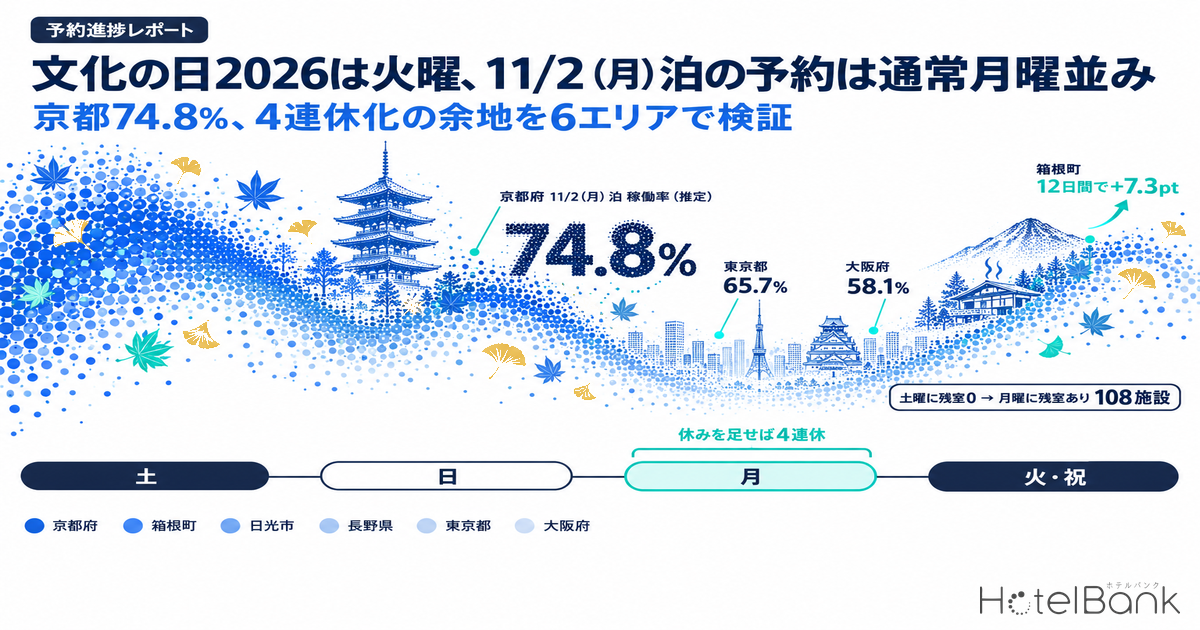
Culture Day (November 3) falls on a Tuesday in 2026, so taking one day off on Monday, November 2 creates a four-day break starting Saturday, October 31. Checking how far bookings for those four nights had progressed using inventory as of September 30 — 31 to 34 days before the stay dates — estimated OCC for the night of Monday, November 2 stood at 74.8% in Kyoto, 65.7% in Tokyo and 66.7% in Nagano, 3–5pt below a regular October Monday at the same lead time. Meanwhile, listed prices for November 2 were higher than a regular Monday in five of six areas, and in Hakone, Monday pickup advanced 7.3pt over the latest 12 days. This article lines up the four nights — Saturday, Sunday, Monday and the holiday night itself — across six areas (Kyoto Prefecture, Hakone, Nikko, Nagano Prefecture, Tokyo and Osaka Prefecture) to gauge how much room is left on “Monday night.”
Metric Definitions Used in This Article
- LT (lead time): Days until the check-in date. The snapshot in this article is as of September 30, 2026, which is 31 days before the October 31 stay, 32 days before November 1, 33 days before November 2 and 34 days before November 3. Where trends are shown, only observations from 45 days before the stay date onward are used.
- OCC (occupancy rate): Rooms sold as a share of total rooms in the area (an estimate based on OTA sales inventory). It is estimated from how inventory sold on OTAs is being consumed and differs from each property’s actual overall occupancy.
- Regular Monday (regular weeks): The average of estimated OCC and listed prices for the same weekday and same lead time across two weeks containing no public holiday: October 17–20 and October 24–27, 2026.
- Remaining-room rate (share of total rooms): Rooms still available at the time of observation as a share of a property’s total rooms. Table 4 and Figure 4 cover only properties that list at least 30% of their total rooms on OTAs.
- Listed price: The average of selling prices published at the time of the survey. Per-room rate for two guests in one room (tax included); it differs from actual transacted prices.
- Data source: MetroEngines Research
- — The night of Nov 2 (Mon) leans toward a “weekday”: As of September 30, 2026 (33 days before the stay), estimated OCC was 74.8% in Kyoto, 83.6% in Hakone, 65.7% in Tokyo and 58.1% in Osaka. The gap versus a regular Monday is only −5.1 to +1.5pt.
- — 2.7–8.4pt below a holiday-eve Sunday: The gap versus the eve of Sports Day (Oct 11, Sun) at the same 33 days out. Multiplied by the rooms covered, this equals roughly 2,400 rooms in Kyoto and roughly 8,200 rooms in Tokyo.
- — Prices have already moved to holiday-eve levels: Listed prices for the night of Nov 2 exceed a regular Monday in five of six areas (Hakone +15.8%, Nikko +11.1%). Only Tokyo is lower, at −2.6%.
- — Hakone’s Monday is catching up: From 76.3% at 45 days out to 83.6% at 33 days out, a 7.3pt gain in 12 days — roughly twice the pace of a regular Monday over the same span (+3.7pt).
- — Of 132 properties with zero rooms left on Saturday, 108 still have rooms on Monday: 2,513 rooms in total, based on a same-property comparison of 797 properties / 59,282 rooms that list at least 30% of their total rooms on OTAs.
Autumn 2026 holiday layout — two three-day weekends with one “Tuesday holiday” in between
First, the calendar. According to the national holidays published by Japan’s Cabinet Office, there are three public holidays in October–November 2026: Sports Day (Monday, October 12), Culture Day (Tuesday, November 3) and Labor Thanksgiving Day (Monday, November 23). The two Monday holidays connect to the weekend to form three-day weekends, but Culture Day, falling on a Tuesday, leaves the preceding Monday as an ordinary workday.
From a lodging operator’s perspective, the difference shows up in whether the morning after a stay is a day off. In a three-day weekend, both the Saturday and Sunday nights are followed by a day off. In the Culture Day week, by contrast, the sequence breaks at Sunday night after Saturday night, and Monday night returns as another “night followed by a day off.” In other words, the night of Monday, November 2 is a holiday eve on the calendar, while the night of Sunday, November 1 is usable only by people who take Monday off.
| Period | Sequence | Consecutive days off without taking leave | Nights followed by a day off |
|---|---|---|---|
| Oct 10–12 | Sat, Sun, Mon (Sports Day) | 3 days | 2 nights: Oct 10 (Sat) and Oct 11 (Sun) |
| Oct 31–Nov 3 | Sat, Sun, Mon (workday), Tue (Culture Day) | 2 days + 1 day (4 days if Nov 2 is taken off) | Oct 31 (Sat) and Nov 2 (Mon). Nov 1 (Sun) only for those taking Monday off |
| Nov 21–23 | Sat, Sun, Mon (Labor Thanksgiving Day) | 3 days | 2 nights: Nov 21 (Sat) and Nov 22 (Sun) |
Source: Compiled by HotelBank Editorial Team from the Cabinet Office’s “National Holidays” page
In 2025, November 3 fell on a Monday, making a three-day weekend counting from the preceding Saturday. In 2026 the same holiday has simply shifted one day later, yet the shape of the break now depends on whether people add a day off. Price movements were covered in our August day-by-day listed price analysis, so this article focuses on how inventory has progressed since then.
Snapshot of the four nights — OCC falls 5.5–30.8pt from Saturday to Monday
We start by lining up where each of the four nights stands. Figure 1 and Table 1 compare estimated OCC (based on OTA-listed inventory) as of September 30, 2026 across the six areas. Hakone and Nikko are aggregated at the municipal level; the other four areas at the prefectural level.
Source: MetroEngines Research, compiled by HotelBank Editorial Team (coverage: Kyoto 789 properties / 33,023 rooms; Hakone 162 properties / 4,487 rooms; Nikko 128 properties / 4,593 rooms; Nagano 699 properties / 22,258 rooms; Tokyo 883 properties / 106,739 rooms; Osaka 458 properties / 63,251 rooms. Based on listings on major booking sites, as of September 30, 2026, 31–34 days before the stay dates)
| Area | Coverage (listed on major booking sites) | Oct 31 (Sat) 31 days out | Nov 1 (Sun) 32 days out | Nov 2 (Mon) 33 days out | Nov 3 (Tue, holiday) 34 days out | Mon − Sat |
|---|---|---|---|---|---|---|
| Kyoto | 789 properties / 33,023 rooms | 85.1% | 76.5% | 74.8% | 71.6% | −10.3pt |
| Hakone | 162 properties / 4,487 rooms | 89.1% | 88.4% | 83.6% | 78.0% | −5.5pt |
| Nikko | 128 properties / 4,593 rooms | 84.8% | 83.2% | 73.4% | 68.0% | −11.4pt |
| Nagano | 699 properties / 22,258 rooms | 86.1% | 73.0% | 66.7% | 64.0% | −19.4pt |
| Tokyo | 883 properties / 106,739 rooms | 75.5% | 67.6% | 65.7% | 62.2% | −9.8pt |
| Osaka | 458 properties / 63,251 rooms | 88.9% | 75.6% | 58.1% | 53.7% | −30.8pt |
Source: MetroEngines Research, compiled by HotelBank Editorial Team (properties and rooms covered are the values for the night of November 2; as of September 30, 2026)
In every area, Saturday, October 31 is the highest, and OCC declines day by day from there. The size of the decline varies, however: the Saturday–Monday gap is only 5.5pt in Hakone but widens to 10.3pt in Kyoto, 19.4pt in Nagano and 30.8pt in Osaka. Osaka’s Saturday is the second highest of the six areas at 88.9%, while its Monday drops to 58.1%, a pattern in which demand is concentrated on the single Saturday night. October 31 is also the Saturday of Halloween itself, which is consistent with a one-night concentration of demand in Osaka.
Hakone and Nikko, by contrast, show only a small dip on Sunday. Hakone is at 88.4% on Sunday versus 89.1% on Saturday, and Nikko at 83.2% versus 84.8%, putting the Sunday night almost level with Saturday. Because a night that should be hard to use without taking Monday off is filling up, the first signs that the period is being used as a four-day break can be read in Sunday nights at hot-spring destinations.
Is Nov 2 (Mon) a holiday eve or a weekday? — the gap versus a regular Monday is −5.1 to +1.5pt
That said, Monday is lower than Saturday every week. To read the calendar effect, we need to compare with the same weekday in weeks without a holiday. We therefore averaged estimated OCC for the same weekday and same lead time across two holiday-free weeks, October 17–20 and October 24–27, and took the difference from the Culture Day week. We also set it alongside October 11 (Sunday, the eve of Sports Day) at 33 days out, which is likewise a “holiday-eve night.”
| Area | Saturday gap | Sunday gap | Nov 2 (Mon) gap | Nov 3 (Tue, holiday) gap | Regular Monday (33 days out) | Oct 11 (Sun), holiday eve (33 days out) | Nov 2 − Oct 11 |
|---|---|---|---|---|---|---|---|
| Kyoto | −1.7pt | −3.3pt | −3.2pt | −8.5pt | 78.0% | 82.2% | −7.4pt |
| Hakone | +0.1pt | +3.2pt | +0.2pt | −5.5pt | 83.4% | 86.3% | −2.7pt |
| Nikko | +3.0pt | +5.4pt | +1.5pt | −3.0pt | 71.9% | 77.2% | −3.8pt |
| Nagano | +0.9pt | +0.3pt | −4.1pt | −8.1pt | 70.8% | 75.1% | −8.4pt |
| Tokyo | −1.7pt | −4.9pt | −5.1pt | −10.3pt | 70.8% | 73.4% | −7.7pt |
| Osaka | +12.1pt | +10.7pt | −2.8pt | −8.2pt | 60.9% | 61.5% | −3.4pt |
Source: MetroEngines Research, compiled by HotelBank Editorial Team (same coverage as Figure 1. Regular weeks are the average of the same weekday and same lead time for October 17–20 and October 24–27. Gaps are percentage-point differences in estimated OCC)
Source: MetroEngines Research, compiled by HotelBank Editorial Team (same coverage as Figure 1. Based on listings on major booking sites; all figures are estimated OCC at 33 days before the stay date)
The results show that the night of Monday, November 2 sits closer to a “weekday” than to a “holiday eve.” The gap versus a regular Monday was actually negative in Kyoto (−3.2pt), Nagano (−4.1pt), Tokyo (−5.1pt) and Osaka (−2.8pt); only Hakone (+0.2pt) and Nikko (+1.5pt) came in above. Across the six areas the gap falls within −5.1 to +1.5pt, and the uplift expected of a night followed by a day off had not yet appeared in inventory at 33 days out.
Compared with October 11 (Sunday), also a holiday eve, the gap is even larger. At 33 days out, October 11 stood at 82.2% in Kyoto, 75.1% in Nagano and 73.4% in Tokyo, whereas November 2 is at 74.8%, 66.7% and 65.7% — lower by 7.4pt, 8.4pt and 7.7pt respectively. Simply multiplying these gaps by the rooms covered in each area gives roughly 2,400 rooms in Kyoto, 1,900 in Nagano, 8,200 in Tokyo, 2,200 in Osaka, 180 in Nikko and 120 in Hakone. This is a rough measure of the number of rooms that would move if Monday night were used as much as the middle night of a three-day weekend, and it represents the size of the room for a four-day break to take shape.
One more night worth examining is Tuesday, November 3, the holiday itself. The holiday night is below a regular Tuesday in all six areas: −10.3pt in Tokyo, −8.5pt in Kyoto and −8.2pt in Osaka. The next morning is a workday, which makes it hard for leisure guests to stay, and because it is a holiday, business-trip demand is also unlikely to come in. The last day of the four-day break tends to be a quieter night than an ordinary weekday.
Hakone’s Monday is catching up — from −3.4pt at 45 days out to +0.2pt at 33 days out
Beyond the level of the snapshot, the pace also differs. Figure 3 overlays estimated OCC for the night of Nov 2 (Mon) and a regular Monday at the same lead times, from 45 to 33 days before the stay date.
Source: MetroEngines Research, compiled by HotelBank Editorial Team (coverage: Hakone 162 properties / 4,487 rooms; Kyoto 789 properties / 33,023 rooms. Based on listings on major booking sites. Regular Monday is the average of October 19 and 26)
Hakone’s November 2 night advanced 7.3pt in 12 days, from 76.3% at 45 days out to 83.6% at 33 days out. A regular Monday moved 3.7pt over the same span, from 79.7% to 83.4%, so the November 2 night filled about twice as fast, closing the 3.4pt gap that existed at 45 days out and drawing level with a regular Monday. In Kyoto, by contrast, the November 2 night rose 3.7pt from 71.1% to 74.8% while a regular Monday rose 3.9pt from 74.1% to 78.0% — moving in parallel at nearly the same slope. The areas divide into those where the gap is narrowing and those advancing with the gap intact.
There is still room for movement from here. Kyoto’s October 11 (Sunday) night added 6.6pt over 22 days, from 82.2% at 33 days out to 88.8% at 11 days out. Given that even the middle night of a three-day weekend advances this much in the final month, the level of the November 2 night will be determined over the coming weeks.
Prices have already moved to holiday-eve levels — listed prices exceed a regular Monday in five areas
On the price side, meanwhile, things have already moved. Comparing listed prices for the night of Nov 2 (Mon) with a regular Monday at the same lead time, Hakone was about ¥65,300, +15.8% (versus about ¥56,400 for a regular Monday); Nikko about ¥41,800, +11.1%; Nagano about ¥29,300, +8.1%; Kyoto about ¥41,000, +6.0%; and Osaka about ¥17,900, +5.4%. Only Tokyo, at about ¥29,000, was slightly below a regular Monday at −2.6%. In other words, in most areas lodging operators are pricing November 2 as a holiday eve, while inventory is being consumed at the pace of a regular Monday.
This combination — “prices at holiday-eve levels, inventory at weekday pace” — comes into sharper focus by property type. Table 3 compares the night of November 2 with a regular Monday by property type at the prefectural level (resort hotels in Kyoto and city hotels in Tochigi are omitted because of the small number of properties).
| Prefecture / type | Properties / rooms | Nov 2 (Mon) | Regular Monday | Gap | Listed price Nov 2 (Mon) | vs. regular Monday |
|---|---|---|---|---|---|---|
| Kyoto – Ryokan | 125 / 2,344 | 64.5% | 67.2% | −2.7pt | ¥46,427 | +7.2% |
| Kyoto – City hotels | 37 / 5,084 | 83.6% | 84.8% | −1.2pt | ¥42,048 | −3.4% |
| Kyoto – Business hotels | 197 / 19,376 | 76.4% | 79.5% | −3.1pt | ¥29,393 | +3.4% |
| Kanagawa – Ryokan | 163 / 4,051 | 75.8% | 76.8% | −1.0pt | ¥49,718 | +11.0% |
| Kanagawa – Resort hotels | 38 / 4,633 | 53.0% | 39.1% | +13.9pt | ¥60,671 | +27.0% |
| Kanagawa – City hotels | 27 / 5,162 | 72.8% | 67.4% | +5.4pt | ¥22,282 | +0.9% |
| Kanagawa – Business hotels | 122 / 16,510 | 51.4% | 55.0% | −3.6pt | ¥13,531 | +6.1% |
| Tochigi – Ryokan | 146 / 5,829 | 69.7% | 66.5% | +3.2pt | ¥39,641 | +13.1% |
| Tochigi – Resort hotels | 27 / 1,726 | 72.1% | 62.6% | +9.5pt | ¥46,359 | +27.2% |
| Tochigi – Business hotels | 65 / 5,451 | 45.6% | 45.6% | ±0.0pt | ¥12,171 | +1.0% |
| Nagano – Ryokan | 270 / 6,462 | 59.6% | 68.4% | −8.8pt | ¥31,329 | +5.7% |
| Nagano – Resort hotels | 64 / 4,129 | 77.2% | 79.1% | −1.9pt | ¥48,257 | +22.6% |
| Nagano – City hotels | 15 / 1,446 | 70.0% | 73.8% | −3.8pt | ¥19,438 | +2.6% |
| Nagano – Business hotels | 84 / 7,577 | 70.9% | 72.8% | −1.9pt | ¥15,096 | +0.3% |
| Tokyo – Ryokan | 25 / 648 | 69.6% | 74.3% | −4.7pt | ¥28,790 | −1.7% |
| Tokyo – Resort hotels | 12 / 1,024 | 77.1% | 79.4% | −2.3pt | ¥40,111 | −5.1% |
| Tokyo – City hotels | 52 / 16,054 | 72.4% | 78.7% | −6.3pt | ¥45,401 | −8.8% |
| Tokyo – Business hotels | 562 / 80,955 | 64.3% | 69.2% | −4.9pt | ¥22,108 | −5.3% |
| Osaka – Ryokan | 24 / 662 | 56.3% | 59.6% | −3.3pt | ¥31,666 | +6.8% |
| Osaka – City hotels | 41 / 9,590 | 73.6% | 76.8% | −3.2pt | ¥22,976 | +0.3% |
| Osaka – Business hotels | 302 / 49,350 | 54.7% | 57.5% | −2.8pt | ¥13,481 | +7.7% |
Source: MetroEngines Research, compiled by HotelBank Editorial Team (based on listings on major booking sites, as of September 30, 2026. Listed price is the average per-room rate for two guests in one room, tax included)
On the inventory side, resort hotels are where Monday is running ahead. Resort hotels in Kanagawa (38 properties / 4,633 rooms) stood at 53.0% for the night of November 2, 13.9pt above the regular-Monday 39.1%, and resort hotels in Tochigi (27 properties / 1,726 rooms) were at 72.1%, +9.5pt. In both, listed prices are about 27% higher than a regular Monday, meaning inventory is advancing even after prices were raised. Travelers who add a day off to stay multiple nights appear to be moving first at stay-oriented properties.
Nagano offers a contrast. Its resort hotels (64 properties / 4,129 rooms) have raised listed prices substantially, by +22.6%, yet estimated OCC is 77.2%, 1.9pt below a regular Monday. Its ryokan (270 properties / 6,462 rooms) were at 59.6%, −8.8pt — the largest shortfall versus a regular Monday among all prefecture and property-type segments in the six prefectures. In many parts of Nagano, early November coincides with the off-peak gap between the tail end of autumn foliage and the start of the ski season, so seasonal factors may be overlapping with the Monday pattern. In Tokyo, city hotels (52 properties / 16,054 rooms) were at −6.3pt and business hotels (562 properties / 80,955 rooms) at −4.9pt, with listed prices also below a regular Monday. In urban areas where business travel is the core demand, a holiday-eve Monday tends to work in the direction of weekday demand dropping out.
Comparing Saturday and Monday at the same properties — of 132 with zero rooms left on Saturday, 108 have rooms on Monday
Area-wide estimated OCC includes rooms not offered on OTAs in its denominator. We therefore add a tabulation that directly tracks rooms remaining at each property. Here we cover only properties that list at least 30% of their total rooms on OTAs, and further limit the set to the same properties meeting that condition on all four nights. The nine segments with at least 30 properties total 797 properties and 59,282 rooms.
| Area / type | Properties / rooms | Oct 31 (Sat) | Nov 1 (Sun) | Nov 2 (Mon) | Nov 3 (Tue, holiday) | Zero rooms left on Saturday | Of which, rooms left on Nov 2 (Mon) |
|---|---|---|---|---|---|---|---|
| Kyoto – Ryokan | 76 / 1,342 | 21.9% | 34.3% | 39.3% | 41.3% | 12 properties | 11 properties / 60 rooms |
| Kyoto – Business hotels | 72 / 4,999 | 27.3% | 33.6% | 35.2% | 38.8% | 16 properties | 15 properties / 275 rooms |
| Hakone – Ryokan | 43 / 895 | 21.3% | 23.4% | 32.7% | 43.2% | 6 properties | 1 property / 3 rooms |
| Nikko – Ryokan | 31 / 1,115 | 27.8% | 22.7% | 35.8% | 44.6% | 8 properties | 7 properties / 40 rooms |
| Nagano – Ryokan | 151 / 2,732 | 28.4% | 40.5% | 49.2% | 46.9% | 34 properties | 28 properties / 269 rooms |
| Nagano – Resort hotels | 33 / 1,303 | 22.9% | 28.5% | 31.8% | 44.7% | 5 properties | 3 properties / 35 rooms |
| Nagano – Business hotels | 44 / 3,403 | 18.0% | 44.1% | 44.1% | 51.0% | 12 properties | 10 properties / 329 rooms |
| Tokyo – Business hotels | 292 / 38,244 | 30.5% | 37.3% | 39.4% | 43.6% | 28 properties | 23 properties / 1,220 rooms |
| Osaka – Business hotels | 55 / 5,249 | 14.7% | 39.2% | 54.6% | 58.4% | 11 properties | 10 properties / 282 rooms |
Source: MetroEngines Research, compiled by HotelBank Editorial Team (only properties whose OTA-listed allotment is at least 30% of total rooms. 797 properties / 59,282 rooms meeting the condition on all four nights, based on listings on major booking sites. Observed from September 30 to the early hours of October 1, 2026)
Source: MetroEngines Research, compiled by HotelBank Editorial Team (same 797 properties / 59,282 rooms as Table 4. Remaining-room rate is the share of total rooms)
Even on a same-property basis, more rooms remain on Monday than on Saturday. The remaining-room rate was 39.3% on Monday versus 21.9% on Saturday for Kyoto ryokan, 49.2% versus 28.4% for Nagano ryokan, and 54.6% versus 14.7% for Osaka business hotels. As of September 30 to the early hours of October 1, 132 properties across the nine segments had zero rooms left for the night of Saturday, October 31; 108 of them had rooms left for the night of Monday, November 2, totaling 2,513 rooms. Rooms that could absorb the demand unable to stay on Saturday are open at the same properties two days later.
Differences by segment are also visible. Nikko ryokan (31 properties / 1,115 rooms) have a Sunday remaining-room rate of 22.7%, lower than Saturday’s 27.8%, meaning Sunday nights are filling first. Among Hakone ryokan (43 properties / 895 rooms), only 1 of the 6 properties with zero rooms left on Saturday has rooms on Monday — just 3 rooms — so popular properties remain full through Monday. Conversely, Tokyo business hotels (292 properties / 38,244 rooms) and Osaka business hotels (55 properties / 5,249 rooms) have 1,220 and 282 rooms left on Monday, respectively, even where Saturday shows zero.
Note that zero rooms left here is an observation within the allotment offered on OTAs and does not mean the entire property is fully booked. Allotments may also be added after the time of observation. In addition, we exclude properties listing less than 30% of their total rooms on OTAs; several explanations are possible for such low shares — operations centered on other channels such as official websites and travel agencies, inventory control that adds allotment in stages as the stay date approaches, or contractual allocation limits — and these cannot be distinguished from public information alone.
Caveats when comparing with the previous year and other long weekends
In 2025, Culture Day fell on a Monday, creating a three-day weekend straight from Saturday, so it is not a suitable benchmark for measuring the room to “add a day off.” The inventory snapshot in this article covers 2026 stay dates, and the comparison axes are regular weeks in the same autumn of 2026 and the October 10–12 three-day weekend. The November 21–23 three-day weekend has not yet reached 45 days before the stay dates; a matching 33-days-out snapshot will become available in late October.
It should also be kept in mind that the regular weeks are in late October while the target week is in early November. The strength of the week itself varies with the progress of autumn foliage and the presence of events. That is why Table 2 also shows the Saturday gap: in Kyoto, Hakone, Nikko, Nagano and Tokyo, where Saturday is in line with regular weeks (−1.7 to +3.0pt), the Monday gap can largely be read as a calendar effect. In Osaka, where Saturday is +12.1pt and the whole weekend is strong, the Monday −2.8pt needs to be viewed separately from the strength of the week.
Implications for operators — three angles for building Monday demand
To summarize so far, the night of Nov 2 (Mon) is “a night where prices have risen as a holiday eve but inventory is advancing at the pace of a regular Monday.” The gap versus the middle night of a three-day weekend is 2.7–8.4pt, and this is where the upside lies. With about one month left until the stay date, we offer three angles operators can consider.
First, design sales around multi-night stays rather than Monday alone. In Hakone and Nikko, Sunday nights are already filling to Saturday levels, and those taking time off are moving from Sunday. Presenting two nights (Sunday and Monday) or three nights (Saturday through Tuesday morning) as a single product creates an opportunity to extend Sunday bookings through Monday. For the 108 properties with no rooms on Saturday but rooms on Monday, guiding guests who came looking for Saturday toward a stay starting Monday can also be effective.
Second, look at Monday’s price and inventory pace side by side. In segments such as resort hotels in Kanagawa and Tochigi, where inventory is above a regular Monday even after prices were raised, there is room to proceed through the remaining period while holding current levels. In segments where prices have risen and inventory is in line with a regular Monday, adding conditions that make a weekday-night stay easier — such as late check-in for arrival after work or a choice of dinner times — makes it easier to convey the value of the night as a holiday eve.
Third, how to position the night of Tuesday, November 3, the holiday. The holiday night is 3.0–10.3pt below a regular Tuesday in all six areas and has the most rooms left of the four nights. It is worth preparing appeals distinct from Monday’s, such as late check-out for guests in no hurry to leave the next morning, or stay proposals for people who can easily take weekdays off.
Summary
Culture Day falls on a Tuesday in 2026, making Monday, November 2 the day that determines whether the period becomes a four-day break. In the September 30 snapshot, estimated OCC for the night of November 2 was 74.8% in Kyoto, 83.6% in Hakone, 73.4% in Nikko, 66.7% in Nagano, 65.7% in Tokyo and 58.1% in Osaka, with the gap versus a regular Monday at −5.1 to +1.5pt — close to a weekday. Compared with October 11 (Sunday), likewise a holiday eve, at the same point in time, it is 2.7–8.4pt lower, and this gap corresponds to the room for a four-day break to take shape.
At the same time, listed prices exceed a regular Monday in five areas, and some areas have started to move, with Hakone’s Monday advancing 7.3pt in 12 days. Among resort hotels, Monday inventory is 9.5–13.9pt above a regular Monday in some prefectures, confirming that travelers who add a day off to stay do exist. With about one month until the stay date, how Monday night will be used is yet to be decided.
⚠ Note on figures for future dates: The estimated OCC, rooms remaining and listed prices in this article are interim figures based on sales information published as of September 30, 2026 (partly the early hours of October 1) and will change as the check-in date approaches. Inventory may be added or closed by properties, and zero rooms left at present will not necessarily persist. Please also note that prices may move up or down with future adjustments.
Frequently Asked Questions
Q. What day of the week is Culture Day in 2026, and what happens to the long weekend?
Culture Day (November 3) falls on a Tuesday in 2026. Because the preceding Monday, November 2, is a workday, without adding leave the days off split into the two-day weekend and the one-day holiday; taking one day off on November 2 creates a four-day break from Saturday, October 31. In 2025, November 3 was a Monday, giving a three-day weekend straight from Saturday.
Q. How far have bookings for the night of Monday, November 2 progressed?
As of September 30, 2026 (33 days before the stay), estimated OCC (based on OTA-listed inventory) was 74.8% in Kyoto, 83.6% in Hakone, 73.4% in Nikko, 66.7% in Nagano, 65.7% in Tokyo and 58.1% in Osaka. The gap versus a Monday in a week without a holiday was −5.1 to +1.5pt, a pace closer to a weekday than a holiday eve.
Q. How large is the gap compared with the holiday eve of a three-day weekend?
Compared with the night of October 11 (Sunday), the eve of Sports Day, at the same 33 days out, the night of November 2 (Monday) is 2.7–8.4pt lower across the six areas. Simply multiplying this gap by the rooms covered gives roughly 2,400 rooms in Kyoto, 1,900 in Nagano, 8,200 in Tokyo and 2,200 in Osaka.
Q. Have prices for the night of Monday, November 2 risen?
Listed prices (per room for two guests in one room, tax included) exceed a regular Monday in five of six areas: Hakone +15.8%, Nikko +11.1%, Nagano +8.1%, Kyoto +6.0% and Osaka +5.4%, with only Tokyo at −2.6%. These are listed prices as of September 30, 2026 and differ from actual transacted prices.
Q. If a property has no rooms left on Saturday, is Monday still available?
Among the 797 properties listing at least 30% of their total rooms on OTAs, 132 had zero rooms left for the night of Saturday, October 31 as of September 30 to the early hours of October 1, 2026. Of those, 108 had rooms left for the night of Monday, November 2, totaling 2,513 rooms. Zero rooms left is an observation within the allotment offered on OTAs and does not mean the whole property is fully booked; allotment may also be added after the observation.
Related Articles
| Culture Day 2026 Falls Tuesday: Demand Peaks on Holiday Eve, +9.3pt |
References and Sources
■ Data sources
We used estimated OCC (based on OTA-listed inventory), rooms remaining by property and listed prices, compiled by MetroEngines Research from publicly available sales information on major booking sites. Observations are as of September 30, 2026 (rooms remaining by property partly from the early hours of October 1). Coverage, based on the night of November 2, is Kyoto 789 properties / 33,023 rooms; Hakone 162 properties / 4,487 rooms; Nikko 128 properties / 4,593 rooms; Nagano 699 properties / 22,258 rooms; Tokyo 883 properties / 106,739 rooms; and Osaka 458 properties / 63,251 rooms. The holiday layout is based on materials published by the Cabinet Office and the National Astronomical Observatory of Japan.
■ Estimation assumptions
Regular Monday is the average of October 19 and 26, which contain no holiday, compared at matching days before the stay date. For the holiday-eve comparison we used the night of October 11 (Sunday), the eve of Sports Day, at 33 days out. Trends are limited to observations from 45 days before the stay date onward. The room counts for the “room for a four-day break” are a rough guide obtained by simply multiplying the percentage-point gap in estimated OCC by the rooms covered in each area. Table 4 and Figure 4 cover the nine segments with at least 30 properties (797 properties / 59,282 rooms) among the same properties that list at least 30% of their total rooms on OTAs and meet that condition on all four nights. Listed price is the average per-room rate for two guests in one room (tax included).
■ Limitations and caveats
OCC is an estimate based on the consumption of sales inventory on OTAs and differs from each property’s actual overall occupancy. All figures are interim readings at 31–34 days before the stay dates and will change with inventory additions or closures and price adjustments. Zero rooms left is an observation within the allotment offered on OTAs and does not mean the whole property is fully booked. Because the regular weeks are in late October and the target week in early November, the comparison includes differences in the strength of the week itself due to autumn foliage progress and events. No year-on-year comparison is made because Culture Day fell on a Monday in 2025 and the shape of the long weekend differed.
| Cabinet Office, “National Holidays” (内閣府「国民の祝日について」) (national holidays for 2026 / Reiwa 8) |
| National Astronomical Observatory of Japan, Ephemeris Computation Office, “Calendar and Ephemeris” (国立天文台 暦計算室「暦要項」) (national holidays and days off for 2026 / Reiwa 8) |
| MetroEngines Research — estimated OCC (based on OTA-listed inventory), rooms remaining by property and listed prices (as of September 30, 2026, partly the early hours of October 1; Kyoto, Hakone, Nikko, Nagano, Tokyo and Osaka, plus by-type tabulations for Kanagawa and Tochigi) |