

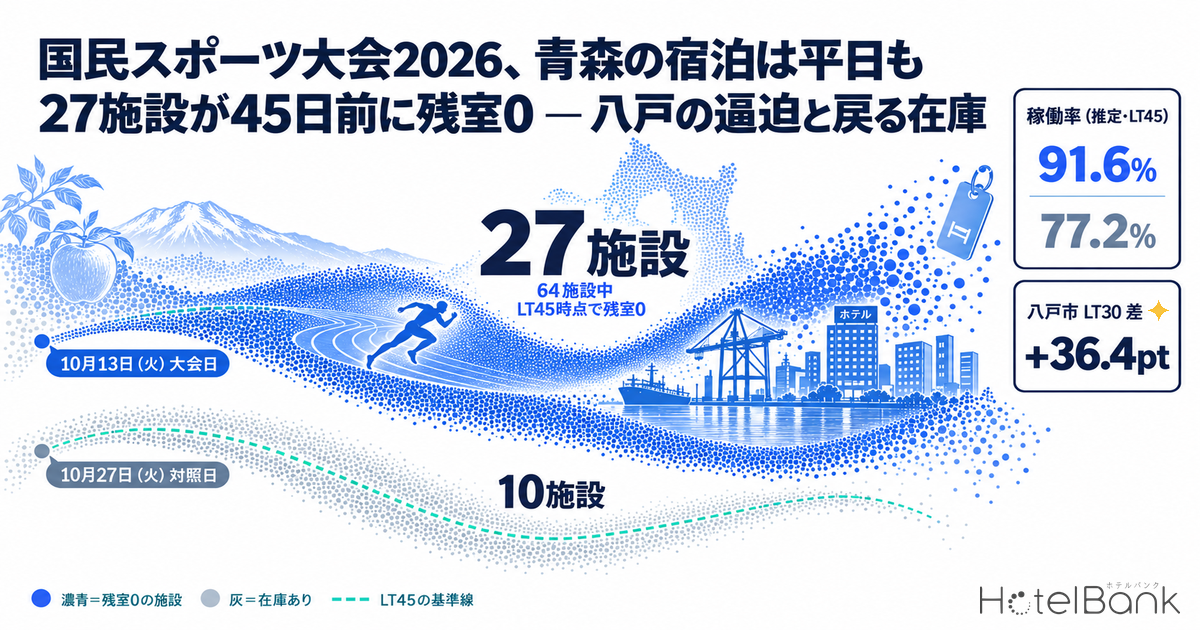
The main session of the 80th National Sports Games, branded “Ao no Kirameki Aomori Kokuspo” (青の煌めきあおもり国スポ), opens on October 10, 2026. Tracking hotel inventory in Aomori Prefecture property by property shows that even on Tuesday, October 13 — a weekday during the Games — 27 of 64 properties had zero rooms left 45 days before the stay date. For the same set of properties, Tuesday, October 27, which falls outside the Games, had only 10. Within the range of OTA-listed inventory we can observe, this article lines up Games days and non-Games days for the same properties and reads the difference as the Games’ contribution. It also looks at inventory returning to sale close to the stay date as allocated room blocks are released, and sets out three steps that hotels in prefectures hosting the Games from 2027 onward should check.
Metric Definitions Used in This Article
- LT (lead time): Days until check-in. LT0 = the stay date itself. This article uses only observations from 45 days before the stay date (LT45) onward.
- Rooms remaining: Number of rooms on sale on OTAs and similar channels on each observation date (room basis). “Zero rooms left” means no sellable inventory was observed on OTAs and similar channels; it does not necessarily mean the whole property is full.
- OCC (occupancy): Share of rooms sold relative to total rooms in the area (an estimate based on OTA inventory). It is an estimate based on how OTA-listed inventory is being absorbed and differs from a property’s actual occupancy. Used only at prefecture and city level, never for individual properties.
- Listed price: Per-room rate for two guests sharing one room (tax included). In this article it is the listed price of plans that still have inventory, not the transacted price.
- Data source: MetroEngines Research (observations through September 28, 2026)
- — 27 properties vs. 10: Among the same 64 properties, 27 had zero rooms left 45 days out for Games weekday October 13, versus 10 for non-Games October 27 (observations through September 28, 2026).
- — 91.6% estimated occupancy: Across 104 properties prefecture-wide, October 13 stood at LT45 14.4 points above the 77.2% of control date October 27.
- — Neighboring prefectures move the other way: In Iwate, Akita, Miyagi and Yamagata, estimated occupancy at LT45 for October 13 was 3.6–8.3 points below October 27. Aomori was the only prefecture where it was higher.
- — +36.4 points in Hachinohe: The weekday uplift was largest in Hachinohe, where three sports run at the same time. Aomori City came in 5.3 points below the control date.
- — Closed inventory comes back: For October 13, 170 rooms returned to sale prefecture-wide between LT25 and LT16. The free-cancellation deadline (9 days before the stay date) and teams being knocked out are the turning points for last-minute inventory.
The Games Schedule and the Four Dates Observed
The main session of the Aomori Kokuspo runs from Saturday, October 10 to Tuesday, October 20, with the opening and closing ceremonies held at Maeda Arena in Aomori City. Before the main session come pre-session I (September 3–13) and pre-session II (October 2–9), and after it closes, the National Sports Games for Persons with Disabilities follows from Friday, October 23 to Monday, October 26. Competition venues are spread across the prefecture, led by Aomori City, Hirosaki and Hachinohe.
This article compares the four dates below. October 10 and 17 are Saturdays, and October 10 is also the first day of a three-day weekend, so leisure demand overlaps. The main axis for reading the Games’ contribution is therefore a Tuesday-to-Tuesday comparison: October 13 (during the Games) versus October 27 (outside both events). Note, however, that October 27 is the day after the Games for Persons with Disabilities close, and that autumn leisure demand continues in Hirosaki at that time, so the comparison should be read with that in mind.
| Stay date | Day | Relation to the Games | Role in this article |
|---|---|---|---|
| Oct 10 | Sat | First day of main session, general opening ceremony (first day of three-day weekend) | Games day (weekend) |
| Oct 13 | Tue | During main session (soccer, wrestling and bowling in Hachinohe; tennis, table tennis and others in Aomori City) | Games day (weekday, main axis) |
| Oct 17 | Sat | During main session (team sports concentrated in the second half) | Games day (weekend) |
| Oct 27 | Tue | Outside both the Games and the Games for Persons with Disabilities | Control date (weekday) |
Source: Compiled by HotelBank Editorial Team from the Aomori Kokuspo / Para Games Executive Committee’s “Competition Schedule” and materials published by the Hachinohe and Aomori City executive committees
Prefecture-Wide, Even Weekday October 13 Was at 91.6% Occupancy 45 Days Out
We start with the prefecture-wide booking curve (observations through September 28, 2026). The scope is 104 properties / 7,451 rooms in Aomori Prefecture whose OTA-listed inventory we could observe continuously (based on listings on major booking sites; 104 properties / 7,490 rooms for October 27). At 45 days before the stay date (LT45), estimated occupancy (based on OTA-listed inventory) for October 10 was 99.7%, with only 19 rooms left across the whole prefecture. October 17 was at 98.6% (106 rooms left), so the Saturdays of the Games were almost full at the 45-day mark.
Weekday October 13 was at 91.6% (625 rooms left), 14.4 points above the 77.2% (1,708 rooms left) of control date October 27. At LT30 it was 91.7% versus 82.8%, still a gap of 8.9 points. The shape of the curves is what stands out. October 27 traces a typical weekday upward curve, adding 5.6 points between LT45 and LT30. The October 13 curve, by contrast, is nearly flat from 45 days out, with only 0.1 point between LT45 and LT30. Most of the inventory had already been secured before LT45, and little moved afterward. The same pattern — supply and demand largely settled 45 days ahead of a major event — was also observed in our booking-curve analysis of the Aomori Nebuta Festival 2026.
Source: Compiled by HotelBank Editorial Team from MetroEngines Research (Aomori Prefecture, 104 properties / 7,451 rooms, based on listings on major booking sites. LT45 onward, observations through September 28, 2026)
| Stay date | LT45 occupancy (est.) | LT45 rooms left | LT30 occupancy (est.) | LT30 listed price of remaining inventory (avg.) |
|---|---|---|---|---|
| Oct 10 (Sat) | 99.7% | 19 rooms | 99.5% | ¥69,141 |
| Oct 13 (Tue) | 91.6% | 625 rooms | 91.7% | ¥35,754 |
| Oct 17 (Sat) | 98.6% | 106 rooms | 98.9% | ¥53,308 |
| Oct 27 (Tue, control) | 77.2% | 1,708 rooms | 82.8% | ¥23,094 |
| Reference: Oct 6 (Tue, pre-session II) | 74.4% | 1,906 rooms | 80.3% | ¥22,169 |
| Reference: Oct 20 (Tue, closing ceremony) | 79.0% | 1,568 rooms | 82.0% | ¥24,771 |
Source: Compiled by HotelBank Editorial Team from MetroEngines Research (Aomori Prefecture, 104 properties / 7,451 rooms, based on listings on major booking sites. Listed prices are per room for two guests, tax included, averaged over plans with inventory remaining at the time of observation)
The listed prices of remaining inventory are also high on Games days. Comparing averages at LT30, October 13 was about ¥35,800, 1.5 times the roughly ¥23,100 for October 27. October 10 was about ¥69,100, but that average was taken when only around 40 rooms remained prefecture-wide, so a handful of high-priced plans pull it up.
Compared with Four Neighboring Prefectures — Only Aomori Beat the Control Date on October 13
One factor to net out when reading the Games’ contribution is that October 13 is the Tuesday after a three-day weekend that includes Sports Day (October 12). Demand on the weekday after a long weekend may be weak to begin with, so the gap against October 27 is not necessarily all due to the Games. We therefore lined up prefecture-wide estimated occupancy for the four neighboring Tohoku prefectures (Iwate, Akita, Miyagi and Yamagata) for the same stay dates and lead times.
| Prefecture | Scope (10/13) | 10/13 LT45 | 10/27 LT45 | Diff. | 10/13 LT30 | 10/27 LT30 | Diff. |
|---|---|---|---|---|---|---|---|
| Aomori | 104 properties / 7,451 rooms | 91.6% | 77.2% | +14.4pt | 91.7% | 82.8% | +8.9pt |
| Iwate | 184 properties / 10,222 rooms | 58.0% | 63.6% | -5.6pt | 66.8% | 67.8% | -1.0pt |
| Akita | 113 properties / 4,854 rooms | 57.5% | 64.7% | -7.2pt | 60.7% | 67.9% | -7.2pt |
| Miyagi | 210 properties / 14,363 rooms | 49.5% | 57.8% | -8.3pt | 56.9% | 62.8% | -5.9pt |
| Yamagata | 188 properties / 6,469 rooms | 53.7% | 57.3% | -3.6pt | 63.9% | 63.3% | +0.6pt |
Source: Compiled by HotelBank Editorial Team from MetroEngines Research (prefecture-wide for each prefecture, based on listings on major booking sites. Occupancy is estimated from OTA-listed inventory. Scope is the number of properties and rooms for October 13 stays; October 27 is nearly identical. Observations through September 28, 2026)
In the four neighboring prefectures, estimated occupancy at LT45 for October 13 was 3.6–8.3 points below October 27, showing that the Tuesday after the three-day weekend was, if anything, a hard day to fill. At LT30, Iwate, Akita and Miyagi were still below October 27, while Yamagata was roughly level at +0.6 points. Aomori, by contrast, was +14.4 points at LT45 and +8.9 points at LT30 — the gap runs the opposite way. Taking the neighboring prefectures’ gaps as a gauge of the day-of-week and post-holiday effect and netting them out, Aomori’s uplift on October 13 can be read as roughly 18–23 points at LT45 and 8–16 points at LT30. Because property mix and late-October leisure demand differ by prefecture, this netting is only an approximate range.
Same Properties, Side by Side — 27 Sold Out 45 Days Ahead on the Games Day vs. 10 on the Control Date
Prefecture-wide figures are affected by changes in which properties are putting inventory on sale from day to day. We therefore fixed a panel of 64 properties (4,560 rooms) — properties whose OTA allotment was at least 30% of total rooms on at least one of the four dates, and for which LT45 and LT30 observations exist for all four dates — and counted, for this same group, the number of properties with zero rooms left at LT45. Of the 800 properties we observe in the prefecture, 166–168 have inventory data for each stay date, and the panel was narrowed from these by the OTA allotment condition (35 properties met it for October 13 and 61 for October 27).
Source: Compiled by HotelBank Editorial Team from MetroEngines Research (Aomori Prefecture, fixed panel of 64 properties / 4,560 rooms. Properties with at least one date on which the OTA allotment was 30% or more of total rooms)
The result: 58 of 64 properties on October 10, 51 on October 17, 27 on October 13 and 10 on October 27. Of the 27 properties with zero rooms left on October 13, 24 (1,205 rooms) were selling inventory at the same point for October 27, so they are not properties that normally keep inventory off OTAs. Counted the same way, 49 properties (3,589 rooms) on October 10 and 42 properties (2,903 rooms) on October 17 fall into the category of “sold out 45 days ahead only on the Games day.”
Selling out this early is hard to explain by the booking behavior of ordinary individual travelers alone. According to Aomori Prefecture’s joint lodging allocation policy, the prefecture and the executive committees of the host municipalities set up a joint lodging allocation headquarters that manages accommodation centrally and allocates rooms in bulk. The commissioned work includes coordinating room procurement from fiscal 2024, and setting property-specific lodging rates and concluding agreements with properties in fiscal 2025. The athlete and coach lodging rates apply, in principle, “from 3:00 p.m. four days before the start date of the competition in which they participate until 10:00 a.m. the day after the competition ends” (for how the allocation rate cap compares with market prices, see our analysis of lodging rate rules for the Aomori 2026 Sports Games). It is possible that properties secured rooms early for Games participants and removed that portion from their OTA allotment. However, OTA inventory alone cannot tell us who the rooms were secured for. They may also have been shifted to direct booking channels or travel agency allotments, so here we only state as fact that “on OTA-listed inventory, no sellable inventory was observed from 45 or more days ahead.”
Weekday Tightness Is in Hachinohe, Not the Prefectural Capital — Venue Dispersion Shows Up Directly in Inventory
At the city level, Games demand is not uniform. On the weekend dates of October 10 and 17, Aomori City, Hirosaki, Hachinohe and Kuroishi were all at 97.9% or higher at LT30, essentially full. The difference shows up on weekday October 13. Hachinohe was at 96.8% at LT30, 36.4 points above the 60.4% on October 27. Kuroishi was also 21.9 points higher at 93.7% versus 71.8%. Aomori City, on the other hand, was at 85.9%, actually below the 91.2% on the control date, and Hirosaki was roughly level at 93.9% versus 92.0%.
Source: Compiled by HotelBank Editorial Team from MetroEngines Research (at LT30. Aomori City 24 properties / 2,677 rooms, Hirosaki 16 properties / 1,324 rooms, Hachinohe 16 properties / 1,643 rooms [17 properties / 1,697 rooms for October 27], Kuroishi 10 properties / 142 rooms. Based on listings on major booking sites)
| City | Scope | 10/10 (Sat) | 10/13 (Tue) | 10/17 (Sat) | 10/27 (Tue, control) | 10/13 vs. 10/27 |
|---|---|---|---|---|---|---|
| Aomori City | 24 properties / 2,677 rooms | 98.8% | 85.9% | 99.6% | 91.2% | -5.3pt |
| Hirosaki | 16 properties / 1,324 rooms | 100.0% | 93.9% | 99.8% | 92.0% | +1.9pt |
| Hachinohe | 16 properties / 1,643 rooms | 99.9% | 96.8% | 97.9% | 60.4% | +36.4pt |
| Kuroishi | 10 properties / 142 rooms | 99.3% | 93.7% | 97.9% | 71.8% | +21.9pt |
Source: Compiled by HotelBank Editorial Team from MetroEngines Research (occupancy estimated from OTA-listed inventory, at LT30)
This gap matches where and which competitions take place on October 13. In Hachinohe, soccer runs October 10–14, wrestling October 12–15 and bowling October 12–16, so the 13th is a day when three sports are under way simultaneously. Tennis, table tennis and other events also start in Aomori City from October 11, but the prefectural capital has thick weekday business demand to begin with, reaching 91.2% at LT30 even on control date October 27. The Games uplift is most visible in cities where baseline weekday demand is relatively thin and teams from several sports arrive at once.
The effect also spills over into areas around the venues. The 24 properties that had zero rooms left at LT45 for October 13 but had inventory for October 27 break down as 5 in Hachinohe, 4 in Hirosaki, 3 in Towada, 3 in Kuroishi, 2 in Aomori City, 2 in Misawa, 2 in Tohoku Town, and 1 each in Fukaura Town, Kazamaura Village and Gonohe Town. The joint lodging allocation policy explicitly provides for “wide-area allocation,” using properties in neighboring municipalities when host venues cannot accommodate everyone. Sell-outs appearing simultaneously not only in the prefectural capital but in towns and villages beyond the host cities are consistent with this mechanism. Towada has too few observed properties to draw a city-wide curve, so only property-level counts are shown here.
Source: Compiled by HotelBank Editorial Team from MetroEngines Research (fixed panel of 64 properties. Circle size = number of rooms. Dark blue = zero rooms left at LT45 for 10/13 but inventory for 10/27; gray = zero rooms left on both dates; light blue = inventory available for 10/13 as well)
The table below is an excerpt of properties that had zero rooms left at LT45 for October 13 but were selling inventory at the same point for October 27. All of them captured Games lodging demand early, and they range widely from rural ryokan to city hotels in urban areas.
| Property | Location | Total rooms | 10/13 LT45 rooms left | 10/13 latest observation rooms left | 10/27 LT45 rooms left |
|---|---|---|---|---|---|
| Sukayu Onsen Ryokan (酸ケ湯温泉旅館) | Aomori City | 134 | 0 | 0 (LT17) | 15 |
| Smile Hotel Towada (スマイルホテル十和田) | Towada | 126 | 0 | 3 (LT15) | 12 |
| Hachinohe Grand Hotel (八戸グランドホテル) | Hachinohe | 88 | 0 | 1 (LT15) | 69 |
| Grand Sunpia Hachinohe (グランドサンピア八戸) | Hachinohe | 84 | 0 | 0 (LT16) | 26 |
| Hirosaki Toei Hotel (弘前東栄ホテル) | Hirosaki | 75 | 0 | 0 (LT16) | 25 |
| Hotel Hyper Hills Hirosaki (ホテルハイパーヒルズ弘前) | Hirosaki | 70 | 0 | 0 (LT16) | 11 |
| Towada City Hotel (十和田シティホテル) | Towada | 70 | 0 | 0 (LT17) | 17 |
| Hotel Il Viale Hachinohe Annex (ホテルイルヴィアーレ八戸アネックス) | Hachinohe | 64 | 0 | 0 (LT17) | 9 |
| Misawa Princess Hotel (三沢プリンセスホテル) | Misawa | 55 | 0 | 0 (LT16) | 23 |
| Aone Shirakami Juniko (アオーネ白神十二湖) | Fukaura Town | 27 | 0 | 0 (LT16) | 11 |
| Iizuka Ryokan (飯塚旅舘) | Kuroishi | 15 | 0 | 0 (LT17) | 6 |
| Komise no Yado Hotel Hoshun (こみせの宿ホテル逢春) | Kuroishi | 15 | 0 | 0 (LT17) | 7 |
Source: Compiled by HotelBank Editorial Team from MetroEngines Research (excerpt from the 24 properties / 1,205 rooms in the fixed 64-property panel that had zero rooms left at LT45 for 10/13 and inventory at LT45 for 10/27. Room figures are numbers of rooms. Latest observations September 26–28, 2026. Zero rooms left means no sellable inventory was observed on OTAs and similar channels)
Closed Inventory Comes Back — When Room Blocks Are Released and Inventory Is Put Back on Sale
Inventory on Games days does not stay frozen once filled. Prefecture-wide rooms remaining for October 13 rose by 170, from 453 at LT25 to 623 at LT16. In Hirosaki, too, inventory came back from 43 rooms at LT25 to 140 at LT16. In Aomori City, the 245 rooms at LT45 grew to 384 by LT33, were absorbed down to 196 by LT19, and then returned to 268 at LT16. Rather than only ever declining, inventory is repeatedly observed being topped up along the way.
At the property level, the returns follow patterns. In this article, a return of 5 or more rooms lasting 3 or more days is treated as “inventory released by the property,” and a one-off return of 1–2 rooms as “returned through cancellation.”
Source: Compiled by HotelBank Editorial Team from MetroEngines Research (rooms remaining for October 13 stays, LT45–LT15. Observations through September 28, 2026)
- Super Hotel Aomori (スーパーホテル 青森, 89 rooms): Rooms remaining hovered around 9 from LT45 to LT37, then inventory was topped up to 47 rooms at LT36 and 94 at LT33. It has since been absorbed, with 44 rooms left as of the September 28 observation (LT15). The lowest listed price has stepped down from ¥46,900 to ¥38,900 (versus ¥16,700 at LT30 for October 27).
- Daiwa Roynet Hotel Hachinohe (ダイワロイネットホテル八戸, 227 rooms): Rooms remaining stayed at 5–10 from LT39 to LT25, then 17–48 rooms came back on sale between LT23 and LT20. These were absorbed within a few days, leaving 2 rooms at LT15.
- Annex Princess Hotel (アネックス プリンセスホテル, Misawa, 38 rooms): No sellable inventory was observed on OTAs and similar channels from LT45 through LT17, but 24 rooms went on sale at LT16 and 22 at LT15. Only two days of returns have been observed so far, so further movement needs to be watched. The listed price is ¥15,600, above the level at the same point for October 27 (about ¥8,300).
Why does inventory come back? The lodging guidelines state that, in principle, cancellations after lodging has been assigned are not accepted, but they also set caps on cancellation fees for unavoidable cases such as withdrawal from the Games or elimination from competition. No cancellation fee applies up to 9 days before the scheduled stay date; from 8 to 4 days before, the fee is 20% of the lodging rate (excluding tax); from 3 days before to the day before, 50%; and on the day itself, 100%. The outline of the commissioned joint lodging allocation work also includes an item for “measures for eliminated teams returning home,” showing that room changes caused by teams knocked out of tournament competitions heading home are anticipated in advance.
| Cancellation notice | Cancellation fee cap | Dates for an October 13 stay |
|---|---|---|
| Up to 9 days before the scheduled stay date | None | Through October 4 |
| 8 to 4 days before | 20% of the lodging rate (excl. tax) | October 5–9 |
| 3 days before to the day before | 50% of the same | October 10–12 |
| On the day | 100% of the same | October 13 |
Source: Compiled by HotelBank Editorial Team from the Aomori Kokuspo / Para Games Executive Committee’s “Aomori Kokuspo Lodging Guidelines” (adopted December 12, 2024)
Whether the observed returns of inventory are rooms released by the allocation headquarters or properties revising their allocations as headcounts are finalized cannot be determined from OTA inventory alone. Still, the system itself suggests two turning points that can generate last-minute inventory: the free-cancellation deadline (9 days before the stay date) and eliminations as the competitions progress. For hotels, this is an opportunity not to write off a closed date as “sold out,” but to get returned rooms to individual travelers and other Games-related guests.
Three Steps for Hotels in Host Prefectures from 2027 Onward
The National Sports Games move to a different host prefecture every year. The 81st Games in 2027 have been awarded to Miyazaki Prefecture (main session scheduled for September 26 – October 6), and the 83rd Games in 2029 have been provisionally awarded to Gunma Prefecture. Drawing on the inventory movements in Aomori, we set out three steps that hotels in upcoming host prefectures should check for their own properties.
| Step | What to check | Implications from the Aomori observations |
|---|---|---|
| 1. Registration with the allocation headquarters and rooms provided | Check your responses to the accommodation facility survey, and the number of rooms, dates and rates in the agreement, against your own sales plan | On Games days, many properties close OTA inventory 45 or more days ahead. Moving rooms and dates you will not provide to general sale early makes it easier to capture the remaining demand |
| 2. Block release dates | Confirm with the allocation headquarters when unused rooms will be returned and how you will be notified, and put the free-cancellation deadline (9 days before the stay date in Aomori) and the competition schedule on your own calendar | Prefecture-wide, 170 rooms of inventory came back between LT25 and LT16 on a weekday during the Games. Anticipating the return dates means you will not be late in reopening sales |
| 3. Resale pricing after rooms are returned | Decide in advance at what price and through which channels returned rooms will be sold. Check nearby remaining inventory and prices daily | Even on a weekday during the Games, the listed price of remaining inventory was about 1.5 times that of the control date. On days when nearby properties are closed, even a small amount of returned inventory can attract demand |
Source: Compiled by HotelBank Editorial Team from MetroEngines Research (institutional aspects refer to Aomori Prefecture’s joint lodging allocation policy and lodging guidelines)
For the first step, registration and rooms provided, surveys begin about two years before the Games. In the outline of Aomori’s commissioned joint lodging allocation work, the accommodation facility survey and room procurement coordination were scheduled for fiscal 2024, and property-specific rates and agreements for fiscal 2025. The flow is that by the year before the Games, how many rooms will be provided on which dates is largely fixed. For the second step, block release dates, allow for both the formal free-cancellation deadline and the swings caused by eliminations in tournament competitions. For the third step, resale pricing, set rates in light of the fact that nearby properties’ inventory is closed. All three steps are preparations for reliably accommodating Games lodging demand while also channeling returned rooms to general demand.
Summary
Within the range of OTA-listed inventory we can observe, lodging demand for the Aomori Kokuspo is showing up as inventory closing 45 or more days ahead. Prefecture-wide (104 properties / 7,451 rooms), estimated occupancy at LT45 was 91.6% for weekday October 13 during the Games, 14.4 points above the 77.2% of control date October 27. Comparing the same 64 properties, 27 had zero rooms left 45 days ahead for October 13, versus 10 for October 27.
The weekday uplift was largest in Hachinohe, 36.4 points above the control date at LT30. That date coincides with three sports running simultaneously, and sell-outs extend beyond the prefectural capital to areas around the venues such as Towada, Misawa and Kuroishi. Meanwhile, inventory is returning along the way: for October 13, 170 rooms were added back prefecture-wide between LT25 and LT16. Since the free-cancellation deadline and eliminations can be turning points for last-minute inventory, there is considerable room to go after “returning rooms” even on dates during the Games.
⚠ Note on future-date data: Rooms remaining, estimated occupancy and listed prices for the October stay dates in this article are interim figures based on sellable inventory and prices listed on OTAs and similar channels through September 28, 2026, and will change as check-in approaches. Zero rooms left means no sellable inventory was observed on OTAs and similar channels; it does not mean the whole property is full or closed, and sales may resume at any time at the property’s discretion. This article uses only observations within a 45-day lead time.
Frequently Asked Questions
Q. Is lodging for the Aomori Kokuspo full even on weekdays during the Games?
A. In the OTA-listed inventory we observe, even for weekday October 13 during the Games, 27 of the same 64 properties had zero rooms left 45 days before the stay date. For October 27, outside the Games, the figure was 10. Estimated occupancy across 104 properties prefecture-wide was 91.6% versus 77.2% at LT45 (observations through September 28, 2026).
Q. October 13 is the Tuesday after a three-day weekend — isn’t the high occupancy unrelated to the Games?
A. In neighboring Iwate, Akita, Miyagi and Yamagata, estimated occupancy at LT45 for the same October 13 was 3.6–8.3 points below October 27. Aomori was the only prefecture above its control date, a gap that is hard to explain by the post-holiday effect alone.
Q. Which city has the tightest weekday inventory?
A. Hachinohe. Estimated occupancy at LT30 was 96.8% for October 13 and 60.4% for October 27, a gap of 36.4 points. That day has three sports — soccer, wrestling and bowling — running at the same time. Aomori City has thick weekday business demand to begin with and came in 5.3 points below the control date.
Q. Does inventory on Games days come back after it has filled?
A. Yes. For October 13 stays, 170 rooms went back on sale prefecture-wide, from 453 at LT25 to 623 at LT16. Under the lodging guidelines, no cancellation fee applies up to 9 days before the scheduled stay date, and “measures for eliminated teams returning home” are built into the lodging allocation work.
Q. What should hotels in prefectures about to host the National Sports Games prepare?
A. This article sets out three steps: confirming the rooms and dates provided to the allocation headquarters, understanding block release dates and the free-cancellation deadline, and deciding resale prices and sales channels for returned rooms in advance. The 2027 Games will be held in Miyazaki Prefecture (main session scheduled for September 26 – October 6), and the 2029 Games have been provisionally awarded to Gunma Prefecture.
Related Articles
- Aomori 2026 Sports Games Lodging: ¥18,000 Cap vs ¥5,900 Break-Even
- Aomori’s First National Sports Games in 49 Years: Prices and Inventory
- Nenrinpic Saitama 2026: 12,322 Rooms, 14.6% Left vs 27.7% Normal Sat
- Aomori Nebuta 2026: 97.4% Sold 45 Days Out, Post-Festival +14pt
References and Sources
■ Data sources
OTA-listed inventory and listed prices observed daily by MetroEngines Research (Aomori Prefecture 104 properties / 7,451 rooms; fixed panel of 64 properties / 4,560 rooms; prefecture-wide data for Iwate, Akita, Miyagi and Yamagata for comparison. All observations through September 28, 2026). The Games schedule and lodging allocation system are based on materials published by Aomori Prefecture and the executive committees of the host cities.
■ Estimation assumptions
Estimated occupancy is the share of rooms sold relative to total rooms, estimated from OTA-listed inventory, using only observations within a 45-day lead time. The Games’ contribution is read as the difference between two Tuesdays, October 13 (during the Games) and October 27 (outside the Games), with the same difference in the four neighboring prefectures netted out as a gauge of day-of-week and post-holiday effects. Property-level comparisons are limited to the fixed panel of 64 properties with LT45 and LT30 observations for all four dates. Returns of inventory are classified as inventory released by the property when 5 or more rooms return for 3 or more days, and as returns through cancellation when 1–2 rooms return on a one-off basis.
■ Limitations
The October stay dates are interim and will change before check-in. Zero rooms left means no sellable inventory was observed on OTAs and similar channels and does not directly indicate a full house or rooms secured for lodging allocation. Who the rooms were secured for (allocation headquarters, travel agencies or direct channels) cannot be determined from OTA inventory. Netting against the four neighboring prefectures is an approximation that includes differences in property mix and leisure demand. Towada is not shown as a city-level curve because too few properties are observed there.
■ References
- Aomori Kokuspo / Para Games Executive Committee, “Competition Schedule” (Japanese)
- “Aomori Kokuspo Joint Lodging Allocation Policy” (adopted by the 5th Lodging Committee, November 29, 2023; Japanese PDF)
- “Aomori Kokuspo Lodging Guidelines” (adopted by the National Sports Games Committee, December 12, 2024; Japanese PDF)
- Aomori Kokuspo / Para Games, “Lodging Committee” (Japanese)
- Hachinohe Executive Committee, “Main Session” sports, schedule and venues (Japanese)
- Aomori City Executive Committee, “Aomori City Competition Schedule” (Japanese)
- Hirosaki City, “Kokuspo Sports and Schedule” (Japanese)
- Japan Sport Association, “Miyazaki Prefecture selected to host the 81st National Sports Games (2027); Gunma Prefecture provisionally selected for the 83rd (2029)” (Japanese)
- Miyazaki Prefecture, “Nihon no Hinata Miyazaki Kokuspo / Para Games” (Japanese)
- MetroEngines Research — daily observation of OTA-listed inventory and listed prices (Aomori Prefecture 104 properties / 7,451 rooms; fixed panel of 64 properties / 4,560 rooms; prefecture-wide data for Iwate, Akita, Miyagi and Yamagata for comparison; through September 28, 2026)