

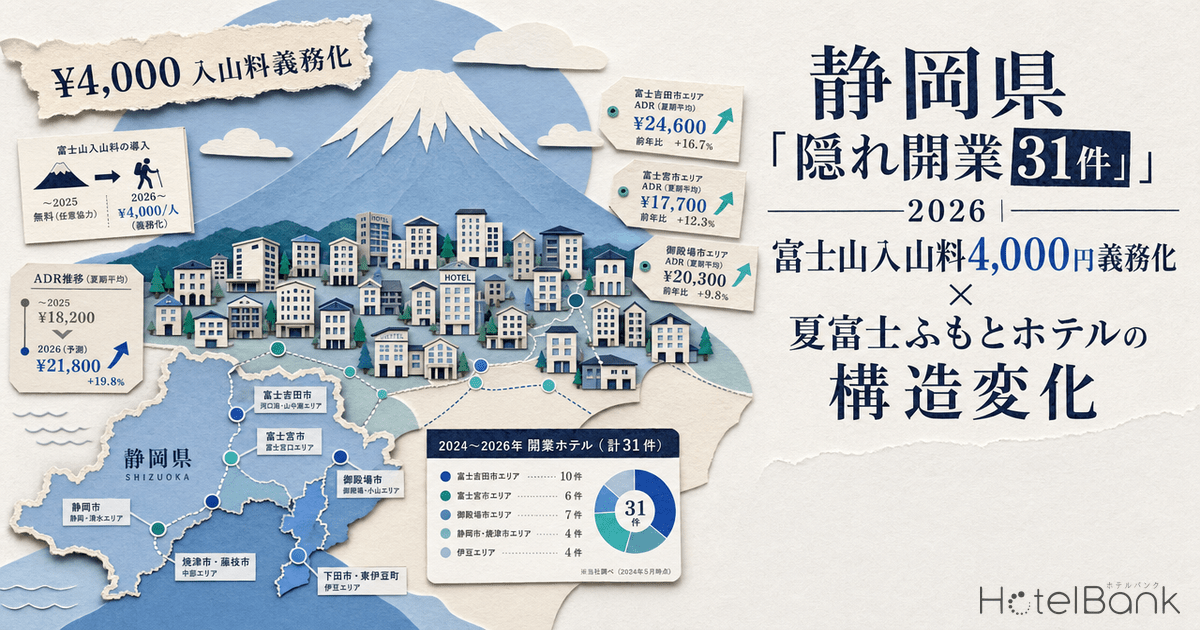

In 2026, new accommodation openings in Japan reach 475 nationwide, with Shizuoka Prefecture commanding 31 properties, ranking 4th nationally after Okinawa, Tokyo, and Kyoto. Combined with neighboring Yamanashi Prefecture (26 properties), the area surrounding Mt. Fuji near the Tokyo metropolitan region sees an unprecedented concentration of 57 new supply additions. This article uses MetroEngines Research data to examine how summer ADR has moved across Shizuoka’s three Mt. Fuji foothill municipalities (Fujinomiya City, Gotemba City, and Oyama Town) under the demand-shifting impact of the ¥4,000 Mt. Fuji entry fee, fully mandated in both prefectures from 2026 — and where the 31 new openings are geographically concentrated.
Metric Definitions Used in This Article: ADR (Average Daily Rate) = the average of publicly listed selling prices among facilities surveyed by MetroEngines Research, which differs from actual transaction prices. Sold-out rate = the percentage of sales plans that had ended reservation acceptance at the time of survey, which differs from facility-wide occupancy rates. Prices are per-room rates for double occupancy (tax included). New openings are those tracked by MetroEngines Research and do not constitute a complete census.
475 New Openings in 2026, Shizuoka Ranks 4th Nationally with 31 Properties
MetroEngines Research tracks 475 new openings nationwide in 2026, with an average of 30 rooms per property — indicating that small-scale facilities dominate. By prefecture, Okinawa leads with 35 properties, followed by Tokyo (33), Kyoto (32), Shizuoka (31), Hokkaido (27), and Yamanashi (26). With tourist destinations and major cities occupying the top spots, Shizuoka’s 31 properties significantly exceed Osaka (13) and Kanagawa (13) in scale.
What deserves attention is the combined supply concentration around Mt. Fuji: when adjacent Yamanashi is added, the area surrounding Mt. Fuji sees 57 new supply additions concentrated in one region. This concentration even surpasses Okinawa’s 35 properties, reaffirming the powerful magnetism of Mt. Fuji as a tourism asset. However, of these 57 properties, only a handful of confirmed new openings fall within the “Mt. Fuji foothills” of Shizuoka — namely Fujinomiya City, Gotemba City, and Oyama Town. The vast majority are distributed across the Atami and Izu areas. In other words, the geographic skew of new supply is the key to understanding Shizuoka’s structure.
Source: MetroEngines Research, compiled by HotelBank Editorial Team
→ Summer 2026 Five Major Resort Areas: ADR, Sold-Out Rate & YoY Comparative Analysis
Category Breakdown of “31 Hidden Openings” — 21 Vacation Rentals Reveal Where Investment Money Is Flowing
Decomposing Shizuoka’s 31 properties by category reveals that vacation rentals account for 21 properties, or 68% of the total. Following are 3 resort hotels, 2 ryokan (traditional inns), 1 business hotel, 1 cottage, 1 pension, and 1 farmhouse inn. Only two properties exceed 200 rooms: Toyoko Inn Hamamatsu Ekiminami-guchi (284 rooms) and La’gent Stay Atami Terrace (239 rooms).
This category skew clearly reveals the current state of Shizuoka’s tourism real estate market. That is, the driver of new supply is not large-scale hotel development by institutional investors, but rather investment in single-property vacation rentals and renovated lodgings by individuals and small corporations. In fact, of the 21 vacation rentals, most that could be confirmed are ultra-small facilities with 1–3 rooms, located in established resort clusters such as Izu Kogen, Atami, and West Izu. This means that the recent investment trend of “investing in high-end single-property rentals to recoup at premium rates” is strongly reflected in Shizuoka’s 31 openings.
| Category | Count | Share | Main Location |
|---|---|---|---|
| Vacation Rentals | 21 | 67.7% | Atami, Izu Kogen, West Izu |
| Resort Hotels | 3 | 9.7% | Atami, Izu Kogen, West Izu |
| Ryokan | 2 | 6.5% | Around Atami |
| Business Hotels | 1 | 3.2% | Hamamatsu Station South Exit |
| Cottages / Pensions / Inns, etc. | 4 | 12.9% | Dispersed |
Source: MetroEngines Research, compiled by HotelBank Editorial Team (N=31)
In short, the figure of “31 Shizuoka properties” should not be taken at face value as supply expansion. On a room-count basis, Toyoko Inn Hamamatsu (284 rooms) and La’gent Stay Atami Terrace (239 rooms) alone account for the majority of the supply increase, while the remaining 29 properties are mostly small facilities with 1–3 rooms. This is exactly why we call them “Hidden Openings.”
Mt. Fuji ¥4,000 Entry Fee Mandate — Full Rollout Begins in Both Prefectures from 2026
The 2026 Mt. Fuji climbing season begins under a completely different regulatory environment than ever before. In Yamanashi Prefecture, the trail reservation system and entry fee scheme introduced in 2025 will continue, while on the Shizuoka side, a ¥4,000 per-person entry fee will be mandated from 2026 across all three routes (Fujinomiya, Subashiri, and Gotemba). With both prefectures aligned, climbing Mt. Fuji has effectively become a paid World Heritage trail experience.
The Shizuoka side’s regulatory design is in some respects stricter than Yamanashi’s. Specifically, advance registration via the FUJI NAVI system and completion of e-learning on Mt. Fuji preservation and safe climbing are required, and entry between 2 PM and 3 AM requires a mountain hut reservation. Yamanashi’s Yoshida route similarly maintains a gate-closure time (2 PM) and a daily limit of 4,000 climbers. While these regulations aim to curb climber numbers and improve quality, they are expected to have complex effects on accommodation demand.
According to the Ministry of the Environment, total climbers across all routes during summer 2025 (opening day through September 10) numbered approximately 205,000 — flat year-over-year (about 204,000 in the prior year) and at 87% of pre-COVID 2019 levels (about 236,000). In other words, climber numbers have remained flat even after the entry fee system was introduced, indicating that climbing demand itself remains resilient. However, the lodging behavior of climbers must be clearly distinguished from that of “Mt. Fuji summer sightseers” who do not climb. This distinction is the key to reading the structural shifts in Shizuoka’s hotel market.
2024–2026 July–August ADR Trends Across Shizuoka’s Three Foothill Municipalities — “Fujinomiya Up, Oyama Down, Gotemba Flat”
The chart below aggregates published price data for July and August from 2024 to 2026 across the three Shizuoka foothill municipalities. The patterns differ markedly across the three.
Source: MetroEngines Research, compiled by HotelBank Editorial Team (Fujinomiya City N=20-23 facilities, Gotemba City N=25-35 facilities, Oyama Town N=5-6 facilities)
Fujinomiya City has risen steadily, from ¥17,100 in July 2024 to ¥19,100 in July 2026 (+3.5% YoY from ¥18,500 in July 2025, and +11.8% vs 2024). August likewise shows a +15.5% increase from ¥18,000 in 2024 to ¥20,800 in 2026. The combined effects of the World Heritage Center, improved access infrastructure, and the rising profile of food culture tourism such as Fujinomiya Yakisoba appear to be working in concert.
Gotemba City’s ADR for July–August stays in a stable ¥45,000–¥51,000 range, with almost no change between 2024 and 2026 (July -2.0%, August -2.2%). Gotemba has the largest existing facility count among the three foothill municipalities (27–35 facilities), and its price range is anchored by demand from Gotemba Premium Outlets and the presence of outlet-adjacent resorts including HOTEL CLAD. Furthermore, sold-out rates in 2026 reach 14.7% in July and 12.4% in August — sustained levels indicating that non-climbing tour demand is being absorbed steadily.
Meanwhile, Oyama Town, home to the Subashiri trailhead, exhibits the greatest volatility. The high levels of July 2024 ADR ¥76,100 and August ¥80,300 plunged to ¥42,600 by August 2026 (-45% YoY). However, Oyama Town has only 5–6 surveyed facilities, so it is more susceptible to changes in pricing strategy at specific properties. Notable is the 31.4% sold-out rate in July 2026 — the highest among the three municipalities — meaning that remaining inventory sold out at aggressive prices, while the average price range was revised downward: a clear signal of bifurcation.
| Municipality | July 2024 | July 2025 | July 2026 | July 2026 Sold-out | 2024→2026 Change |
|---|---|---|---|---|---|
| Fujinomiya City | ¥17,100 | ¥18,500 | ¥19,100 | 6.0% | +11.8% |
| Gotemba City | ¥47,600 | ¥44,800 | ¥46,700 | 14.7% | -2.0% |
| Oyama Town (Subashiri) | ¥76,100 | ¥67,600 | ¥70,000 | 31.4% | -8.0% |
Source: MetroEngines Research, compiled by HotelBank Editorial Team (double occupancy, tax included)
Differentiation from Yamanashi — Structural Divergence: “Shizuoka = Sightseeing, Yamanashi = Climbing”
Even within the same Mt. Fuji periphery, the Yamanashi side paints an entirely different picture. Fujiyoshida City’s August ADR jumped +25.1%, from ¥63,000 in 2024 to ¥78,900 in 2026, while Fujikawaguchiko Town climbed +17.9% from ¥52,700 to ¥62,200. Narusawa Village leaps from ¥69,600 in August 2024 to ¥117,500 in August 2026.
Source: MetroEngines Research, compiled by HotelBank Editorial Team (August 2024 and August 2026, double occupancy, tax included)
The backdrop to Yamanashi’s surge is twofold: the Yoshida route remains the dominant climbing route (around half to 60% of all climbers), and the Lake Kawaguchi and Lake Yamanaka area has become the epicenter of inbound tourism’s “Mt. Fuji photo spot tourism.” Iconic non-climbing tourism assets — the famous convenience store with a Mt. Fuji backdrop near Kawaguchiko Station, Oshino Hakkai, Arakurayama Sengen Park — wield overwhelming appeal among visitors who do not climb.
By contrast, although the Shizuoka side hosts climbing routes such as Fujinomiya and Subashiri, climber overnight stay rates are believed to be lower than on the Yamanashi side. Fujinomiya 5th Station sits at the highest elevation (2,400m), making day climbs relatively easy and foothill lodging non-essential. The Gotemba route is the longest and targets intermediate-to-advanced climbers, so climber numbers are limited. Subashiri (Oyama Town) is also intermediate-level, and day-trip climbing from the Tokyo metropolitan area tends to be preferred.
In short, Shizuoka’s hotel market is not dependent on Mt. Fuji climbers, but rather supported by non-climbing sightseers — visitors to Gotemba Premium Outlets, Fuji Safari Park, those using the area as a transit point to Izu, World Heritage Center visitors, and others. This structural difference is the backdrop for Shizuoka’s more modest ADR growth compared to Yamanashi. Conversely, this also means that Shizuoka’s hotels are less directly affected by the entry fee mandate and rest on a foundation of stable non-climbing tourism demand.
Spillover Effects from Gotemba Premium Outlets — A Year-Round Demand Anchor
To understand Gotemba City’s hotel market, the role of Gotemba Premium Outlets is decisive. Operated by Mitsubishi Estate-Simon Co., Ltd., it is one of Japan’s largest outlet malls, continuously expanding with the recent addition of the HILL SIDE area, and firmly established as a popular destination for inbound tourists. HOTEL CLAD on the outlet grounds, with views of Mt. Fuji and the adjacent day-spa “Konohana no Yu,” has become a hard-to-book popular property on weekends.
Gotemba City’s monthly ADR pattern (April 2025 through March 2026) ranges from a low of ¥40,100 in February to a high of ¥49,600 in August — moving in a relatively flat band of roughly ±10% year-round. This is markedly different from other Mt. Fuji foothill municipalities, indicating low dependence on the summer climbing season and reliance instead on outlet-driven traffic, Mt. Fuji sightseeing, and weekend demand from the Tokyo metropolitan area throughout the year.
Source: MetroEngines Research, compiled by HotelBank Editorial Team (April 2025 to March 2026, Gotemba City hotels N=32-35 facilities)
This flat demand pattern is extremely attractive from an accommodation operations perspective. Small swings between busy and slow seasons mean steady year-round occupancy is more achievable, and labor and operational cost efficiencies are easier to realize. This is precisely why Gotemba City sustains the largest existing facility count (27–35 facilities) among the three foothill municipalities. Given the geographic skew of the 31 new openings, the question of whether large hotel investment capital will flow into Gotemba — rather than Atami or Izu — remains a topic worth watching.
Reading the 2026 Structural Shift from Both Investor and Traveler Perspectives
From the investor perspective, do not be misled by the headline scale of Shizuoka’s 31 new openings. On a room-count basis, Toyoko Inn Hamamatsu (284 rooms) and La’gent Stay Atami Terrace (239 rooms) alone account for the bulk, and the remainder is small-scale single-property vacation rental supply. In other words, the main battleground for hotel investment remains major metropolitan areas and Atami, with limited new supply in the three foothill municipalities. This means the competitive environment for existing facilities is not changing significantly. Fujinomiya City’s +11.8% ADR growth (2024→2026 July) directly reflects expanding demand under low new-supply pressure — a notable revenue opportunity for existing properties.
From the traveler perspective, summer 2026 marks a structural rise in travel costs around Mt. Fuji. Lodging costs on the Yamanashi side (Yoshida route) are already at +18–25% YoY, and climbers must now budget for the ¥4,000 entry fee on top of higher accommodation. By contrast, the Shizuoka side — particularly Fujinomiya City at ¥19,100 ADR for July 2026 — offers the most price-competitive option among areas hosting climbing trailheads. Combined with the fact that the Fujinomiya route is the closest to the summit, the rationale for a Fujinomiya-base strategy strengthens for cost-conscious climbers.
For non-climbing sightseers, Gotemba City remains a stable lodging choice. With ADR settled in the ¥40,000–¥50,000 range year-round, it pairs naturally with tourism assets such as Gotemba Premium Outlets, Fuji Safari Park, and Fuji Speedway (which hosts year-round events). Assuming continued inbound demand, early reservations for summer holidays, Golden Week, and consecutive holidays are advisable.
Conclusion — “Hidden Openings” Reflect a Two-Tier Structure in Shizuoka’s Hotel Market
Shizuoka’s 31 new openings in 2026 appear at first glance to be a large number — 4th nationally — but breaking down the composition reveals a two-tier structure of 2 large hotels and 21 small vacation rentals. Geographically, supply is also skewed toward Atami and Izu, with new supply in the three Mt. Fuji foothill municipalities (Fujinomiya City, Gotemba City, Oyama Town) extremely limited within what can be confirmed.
Within this supply structure, the ¥4,000 Mt. Fuji entry fee mandate beginning in 2026 is expected to affect the surrounding hotel market in different ways. The Yamanashi side (Yoshida route) is undergoing premiumization driven by inbound Mt. Fuji photo-spot tourism, with ADR running at +18–25% YoY. By contrast, on the Shizuoka side, Fujinomiya City shows steady gains (+11.8% vs 2024), Gotemba City stays flat supported by stable non-climbing tourism demand, and Oyama Town shows accelerating bifurcation — a three-way divergence.
That is, while sharing the single tourism asset of Mt. Fuji, Shizuoka’s hotel market depends little on climbers and forms a portfolio centered on non-climbing sightseers. The full rollout of the entry fee scheme may, on the contrary, relatively elevate the value of Shizuoka’s structural strength: non-climbing tourism demand. Under low new-supply pressure, a scenario in which 2026–2027 becomes a window of supply-demand improvement for existing facilities gains realism.
What the title “31 Hidden Openings” reveals is a qualitative change in the supply structure beneath the headline figure. Investors and travelers alike must develop a perspective that combines not just superficial counts but breakdowns, geographic distribution, and the dynamic ADR trajectories of existing properties.
Related Articles
References
External References: