

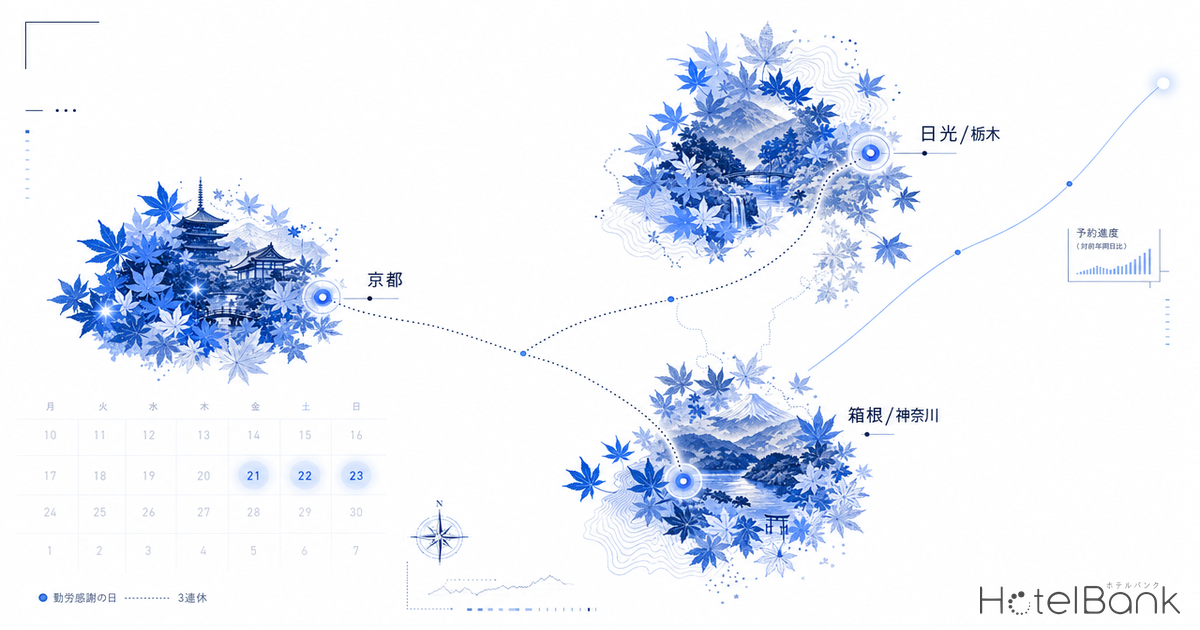
The three-day weekend from Saturday, November 21 to Monday, November 23, 2026 (Labor Thanksgiving Day) overlaps with the period when autumn foliage reaches its peak in Kyoto, Nikko (Tochigi), and Hakone (Kanagawa) — one of the peaks of autumn lodging demand. This article focuses on the check-in date of November 21, 2026, the first day of this holiday weekend, and reads how ryokan and resort bookings progress from the perspective of remaining-inventory data. At the time of writing (June 28, 2026), the weekend is still 146 days away and, as explained below, the observation window for remaining inventory has not yet opened. For that reason, rather than definitive claims such as a “fastest sell-out ranking,” we organize the structure of areas where bookings are about to start moving and the booking pace typically seen in the same lead-time band in past years to map out “area opportunities worth securing now.”
Metric Definitions Used in This Article
- ADR (Average Daily Rate): The average of publicly listed selling prices on OTAs and similar channels. This differs from actual transaction prices (because unsold higher-priced plans remain listed, the average of listed prices is structurally skewed above transaction prices). Per-room rate for double occupancy (tax included), averaged across all plans (from room-only to meals-included).
- OCC (Occupancy Rate): The share of sold rooms against the total number of rooms in the area (an estimate based on OTA sales inventory). Formula: (total rooms − remaining rooms) ÷ total rooms. This is a macro estimate at the prefecture/category level, not the occupancy of any individual property.
- LT (Lead Time): The number of days until the check-in date. LT0 = same day. The larger the value, the further from check-in.
- Remaining rooms: The number of rooms still listed on OTAs at each observation point (room basis).
- Data source: MetroEngines Research
- — Ryokan demand in Kyoto, Nikko, and Hakone overlaps on the first day of the three-day weekend, Saturday, November 21, 2026, and in comparable past Saturdays has shown a typical pattern where remaining inventory declines faster from around LT90.
- — Estimated OCC in the same lead-time band in typical years is 83% for Kyoto, 83% for Nikko, and 75% for Hakone (based on the same month of 2025, MetroEngines aggregation), confirming the boost from peak foliage x a holiday weekend.
- — The number of observed properties is 83 in Kyoto, 93 in Nikko, and 24 in Hakone; with Hakone’s thin supply, its early sell-out risk is relatively higher, and the optimal timing to book differs by lead time.
- — The overlap between the foliage calendar and the holiday weekend differs by area — Nikko (early-to-mid November → residual into late November), Hakone (mid-to-late November), Kyoto (late November to early December) — so demand ramps up at different times by area.
- — At the time of writing, the weekend is 146 days away and the remaining-inventory observation window has not yet opened, but we present the area-by-area booking-timing structure using booking-pace curves from past analog dates.
Reading the “Pre-Observation” Situation 146 Days Out Correctly
First, let us be transparent about the premise. Continuous observation of remaining inventory for the check-in date of November 21, 2026 has not yet accumulated as of the time of writing. The observation window for remaining-inventory trends is designed to use data within 90 days of lead time (LT) until check-in, and November 21 reaches LT90 around August 23, 2026. In other words, at the current point 146 days before the weekend, observation points are still near zero, and we are not yet at a stage where remaining inventory can tell us “how much has already been filled.”
Even so, there is meaningful value in writing about this now. The demand structure of an autumn three-day weekend x foliage is stable year after year, and there is a reproducible pattern in which lead-time band bookings move. We therefore use “past Saturday check-in dates with characteristics close to autumn weekends” that fall within the observable range as booking-pace analogs (reference examples), and show what curve bookings accumulate along for ryokan in Kyoto, Nikko, and Hakone respectively. This presents readers with “the outline of a market about to move” rather than definitive claims.
The population sizes of the three target areas are as follows. These are figures limited to properties where activity can be confirmed among those tracked by MetroEngines Research, and do not include small ryokan or guesthouses not listed on OTAs.
Source: Created by the HotelBank Editorial Team from MetroEngines Research (check-in 2026-11-21, ryokan + resort)
| Area | Ryokan (observed) | Resort (observed) | Tracked population |
|---|---|---|---|
| Kyoto | 83 | 10 | 498 |
| Tochigi (incl. Nikko) | 93 | 8 | 360 |
| Kanagawa (incl. Hakone) | 24 | 6 | 127 |
* “Observed properties” is the number of ryokan/resorts for which price and inventory data could be confirmed on OTAs for this check-in date. The Kanagawa figure is prefecture-level and includes areas other than Hakone (Yugawara, Yokohama, etc.).
The Typical Booking-Pace Curve — Autumn Weekends That Build Rapidly from LT90
The graph below uses, as reference examples, Saturday check-in dates with strong autumn-weekend characteristics within the observable range, and shows how estimated occupancy (OCC) for ryokan in Kyoto, Nikko, and Hakone rises along with lead time. All three areas sit in the 50–64% range at LT90 (90 days before check-in) and climb at an accelerating rate from LT60 to LT30. Nikko books earliest, reaching an estimated OCC in the 83% range at LT30 (30 days out).
Source: Created by the HotelBank Editorial Team from MetroEngines Research (estimated OCC for reference Saturday check-in dates, ryokan category, within LT90)
This shape — building at a steep angle from LT90 to LT30 — is a pattern repeatedly observed on weekends where demand concentrates, such as foliage x holidays. What matters is that November 21 reaches LT90 in late August. Working backward, bookings visibly begin to accumulate from September onward; the current point (late June) is a quiet phase before demand materializes. Conversely, moving now offers the widest range of choices.
| Lead Time | Kyoto Est. OCC | Nikko Est. OCC | Hakone (Kanagawa) Est. OCC |
|---|---|---|---|
| LT90 (~90 days out) | 59.8% | 64.1% | 52.1% |
| LT60 (~60 days out) | 66.5% | 70.4% | 56.7% |
| LT45 (~45 days out) | 69.9% | 77.3% | 64.1% |
| LT30 (~30 days out) | 76.0% | 83.2% | 75.7% |
* The table above shows estimated OCC for reference Saturday check-in dates (ryokan category), not actual measured values for November 21, 2026 itself. Please read it as a guide to booking pace, which is expected to trace a similar curve on autumn holiday weekends.
Overlap of the Foliage Calendar and the Holiday Weekend — When to Book, by Area
The foliage peaks of all three areas overlap closely with the November 21–23 holiday weekend. In typical years, the best viewing is mid-to-late November in Kyoto; early-to-mid November around Hakone’s outer caldera and Lake Ashi and mid-to-late November in lower valleys such as Kowakidani; and late October to early November at high-elevation spots such as Lake Chuzenji and the Irohazaka in Nikko, with lower-elevation areas around the city and Nikko Toshogu enjoyable until mid-November. In other words, for Kyoto and Hakone this weekend lands squarely at peak foliage, while in Nikko the higher elevations run slightly ahead and the lower elevations overlap with the weekend. That said, prolonged late-summer heat in recent years has tended to push the foliage itself later, shifting demand accordingly.
This viewing calendar directly drives the priority of area selection. Because the weekend coincides completely with peak foliage in Kyoto and Hakone, bookings tend to move from an early stage when viewed against past patterns. In Nikko, the elevation difference disperses the viewing period, so choices may remain available comparatively longer within the area — while around popular low-elevation spots, demand concentrates on the weekend. The graph below overlays the listed-price (ADR) trends of each area’s ryokan on the reference dates. It shows that Nikko tends to stay in a relatively affordable price range even during the holiday band, while Kyoto and Hakone trend at higher levels.
Source: Created by the HotelBank Editorial Team from MetroEngines Research (average listed price for reference Saturday check-in dates, ryokan category; double occupancy, tax included)
For Kyoto, the overall market ADR trend in November is also on an upward track. The average November ADR for Kyoto Prefecture as a whole (all categories) rose from about ¥40,900 in November 2023 to about ¥41,700 in November 2024 and about ¥47,400 in November 2025 — a year-on-year increase of +13.8% in 2025 (N=1,479 properties). This suggests strong foliage-season demand and pricing that reflects it. In securing a ryokan for the autumn holiday weekend, moving early and accepting the price tends to be the key to keeping options open in Kyoto.
Source: Created by the HotelBank Editorial Team from MetroEngines Research (Kyoto Prefecture, all categories, November ADR by year)
Area Opportunities Worth Securing Now
Building on the above, we summarize three opportunities in the “market about to move” anchored on November 21, 2026. None are definitive claims based on current measured remaining inventory; they are ongoing assessments derived from population size, typical booking-pace curves, and the foliage calendar.
| Area | Reading the Opportunity |
|---|---|
| Kyoto | The holiday weekend and peak foliage coincide completely. ADR is also on an upward track, and in past patterns bookings accumulate early. The earlier you move — accepting the price, without waiting for the observation window to open in late August — the wider the ryokan choices. |
| Tochigi (Nikko) | The largest ryokan population of the three areas. In the reference curve it has the fastest pace, reaching an estimated OCC in the 83% range at LT30 (same as above); but because the elevation difference disperses the viewing period, taking a wide view of the area leaves choices more likely to remain even over the weekend. The price band is relatively affordable. |
| Kanagawa (Hakone) | While peak foliage overlaps with the holiday weekend, the number of OTA-observed ryokan is the smallest of the three areas, making it highly scarce. In the reference curve it also surges to an estimated OCC in the 75% range at LT30 (based on the same month of 2025, MetroEngines aggregation). It can be called an area with relatively higher priority for early securing. |
The common implication is the timeline: November 21 reaches LT90 (= observation starts moving) in late August. Because booking pace visibly ramps up from September onward, if you want to secure a ryokan on the premise of the high-confidence demand of foliage x a holiday weekend, moving now — before observation — keeps your options widest. Going forward, once remaining-inventory data accumulates from late August, we plan to re-examine the actual booking pace of each area.
⚠ Note on future-dated data: The check-in date of this article (November 21, 2026) is 146 days ahead at the time of writing, and continuous observation of remaining inventory (within LT90) has not yet accumulated. The booking-pace curves, estimated OCC, and listed prices (ADR) in the text are values for reference check-in dates with strong autumn-weekend characteristics within the observable range — not actual measured values for November 21 itself. Actual inventory and prices will fluctuate as the check-in date approaches.
Sources & References
- MetroEngines Research — remaining-inventory trends (booking curves), estimated OCC, and listed-price (ADR) data
- Autumn Foliage Spots 2025 (Walkerplus) — typical peak-viewing information for Kyoto and Hakone
- Hakone Tourism Association: “Hakone Autumn Foliage Information”
- PublicHolidays.jp: “Labor Thanksgiving Day 2026” (November 23, 2026)
- Rurubu & more.: “2026 Public Holidays & Long-Weekend Calendar”