

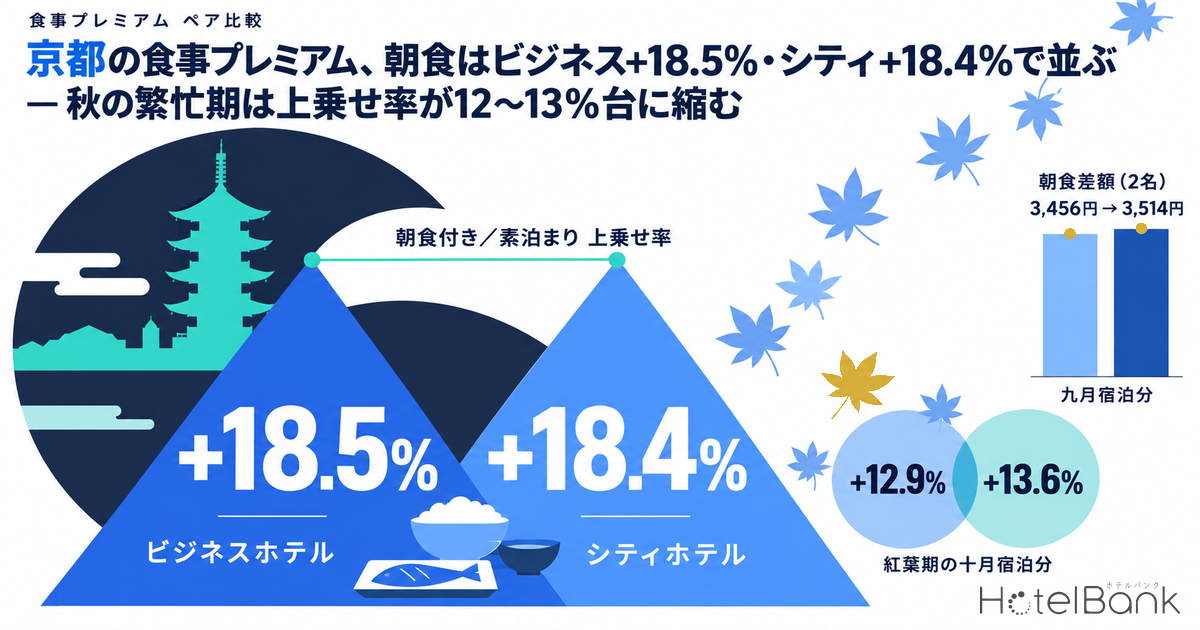
We matched the meal-inclusive plans that hotels in Kyoto Prefecture sold for September 2026 stays against the room-only plans of the same hotels. The breakfast premium came out at +18.5% for business hotels (N=71 properties) and +18.4% for city hotels (N=29 properties) — almost identical across the two segments. The step from a breakfast plan up to a half-board (two-meal) plan was +41.3% for city hotels (N=22 properties) and +46.1% for business hotels (N=17 properties), more than twice the breakfast premium. For October stays, however, as the autumn foliage season begins, the breakfast premium had narrowed to +12.9% for business hotels (N=70 properties) and +13.6% for city hotels (N=29 properties). This article unpacks that structure of Kyoto’s meal premium — the rate shrinks while the yen difference stays put — and lays out yardsticks for plan design ahead of the autumn peak.
Scope: business hotels and city hotels in Kyoto Prefecture. Meal premiums are paired comparisons limited to properties that sell both meal types within the same hotel (double occupancy; ryokan excluded; the September breakfast / room-only pair covers N=113 properties across all hotel types). The price metric in this article is estimated settled ADR (the transaction price level estimated from OTA and other sales data, tax-exclusive equivalent), and occupancy is an estimate based on OTA-listed inventory. Both are defined at the end of the article. Data as of October 5, 2026.
- — Breakfast +18.5% / +18.4%: In Kyoto Prefecture in September 2026, the breakfast / room-only premium was almost the same for business hotels (N=71 properties) and city hotels (N=29 properties).
- — Business hotels rank highest among 44 prefectures: Among prefectures with at least 20 paired properties, Kyoto comes first, ahead of Hyogo +13.8%, Tokyo and Osaka +11.3%, and Fukuoka +7.9%.
- — The half-board step exceeds 40%: Half-board / breakfast is +46.1% for business hotels (N=17 properties) and +41.3% for city hotels (N=22 properties), more than twice the breakfast premium.
- — In October the rate drops to the 12–13% range: For October stays in the foliage season, business hotels are at +12.9% and city hotels at +13.6%, well down from summer (business hotels +21.5–22.4% in June–August).
- — The yen difference barely changes: The breakfast difference (two guests) for business hotels was ¥3,456 in September and ¥3,514 in October. Only the room rate rises, which makes the percentage look thinner — leaving room to revisit seasonal bands.
September Breakfast Premiums Are Level Across the Two Segments — the Gap Opens at the Half-Board Step
First, the basis of the calculation. The meal premium here is taken only where the same hotel sells both a room-only plan and a breakfast plan for the same stay month; the price difference within that property is extracted and then averaged. Averaging properties that sell meal plans and those that do not separately, and subtracting one from the other, would mix differences in property grade into the result. The paired comparison is a way to avoid that contamination, and N= shows the number of properties that offer both plans. Ryokan are not included in the calculation.
On that basis, in Kyoto Prefecture in September 2026 the breakfast / room-only premium was +18.5% for business hotels (N=71 properties) against +18.4% for city hotels (N=29 properties), a gap of just 0.1 points. That the rates line up across two segments with very different room-rate levels suggests that breakfast pricing may have settled in the market as “a fixed share of the room rate.” Across all hotel types excluding ryokan the figure is +16.9% (N=113 properties); because this includes segments other than business and city hotels, it does not equal the sum of the two.
The step from a breakfast plan to a half-board plan, on the other hand, does differ by segment. Against +41.3% for city hotels (N=22 properties), business hotels are at +46.1% (N=17 properties), about 5 points higher. Measured as the half-board premium over room-only, the order is the same: city hotels +68.3% (N=22 properties) and business hotels +71.9% (N=16 properties). Business hotels that serve dinner are a minority, and where dinner is offered it appears to be priced as a clear added value.
Source: MetroEngines Research, compiled by HotelBank Editorial Team (Kyoto Prefecture; September 2026 stays; double occupancy; paired comparison within the same hotel)
| Comparison pair (Kyoto Prefecture, September 2026) | Business hotels | City hotels | All hotel types (excl. ryokan) |
|---|---|---|---|
| Breakfast / room-only | +18.5% (N=71) | +18.4% (N=29) | +16.9% (N=113) |
| Half-board / breakfast | +46.1% (N=17) | +41.3% (N=22) | +37.1% (N=50) |
| Half-board / room-only | +71.9% (N=16) | +68.3% (N=22) | +55.5% (N=49) |
| Dinner only / room-only | — (below reporting threshold) | +50.6% (N=7) | +53.3% (N=13) |
Source: MetroEngines Research, compiled by HotelBank Editorial Team. N= is the number of properties selling both meal types. “All hotel types” includes segments other than business and city hotels and does not equal the sum of the two.
Compared With Other Prefectures — Kyoto’s Business-Hotel Breakfast Premium Stands Out
Kyoto’s 18% level becomes clearer when set beside other major markets. For business hotels in the same month, September 2026, Hyogo was at +13.8% (N=69 properties), Tokyo and Osaka were both at +11.3% (N=361 and N=163 properties), and Fukuoka was at +7.9% (N=145 properties). Among the 44 prefectures with at least 20 paired properties, Kyoto’s +18.5% is the highest. The same picture — Kyoto’s business-hotel breakfast premium standing out among major prefectures — held for August stays as well; the line-up of 10 prefectures, including the 4.4x gap with Shizuoka, is analyzed in detail in Breakfast Premium 4.4x Gap: Kyoto 22.0% vs Shizuoka 5.0%, 10 Markets.
Turn to city hotels, though, and the view changes. Hyogo’s +20.7% (N=37 properties) exceeds Kyoto’s +18.4%, and Fukuoka +17.5% (N=30 properties), Osaka +16.9% (N=57 properties) and Tokyo +16.7% (N=65 properties) follow close behind. City-hotel breakfast premiums in the major metropolitan areas fall broadly within a 17–21% band, and Kyoto is not exceptional. In other words, what characterizes Kyoto is that business-hotel breakfast is priced at a rate on par with city hotels.
| Prefecture (September 2026; breakfast / room-only) | Business hotels | City hotels | All hotel types (excl. ryokan) |
|---|---|---|---|
| Kyoto | +18.5% (N=71) | +18.4% (N=29) | +16.9% (N=113) |
| Hyogo | +13.8% (N=69) | +20.7% (N=37) | +10.0% (N=132) |
| Osaka | +11.3% (N=163) | +16.9% (N=57) | +15.1% (N=244) |
| Tokyo | +11.3% (N=361) | +16.7% (N=65) | +13.4% (N=455) |
| Fukuoka | +7.9% (N=145) | +17.5% (N=30) | +11.1% (N=184) |
Source: MetroEngines Research, compiled by HotelBank Editorial Team (double occupancy; paired comparison within the same hotel; ryokan excluded)
Breaking the prefecture down by municipality shows the pattern concentrated in central Kyoto City. Limiting the view to areas with at least 5 paired properties, the business-hotel breakfast premium was +22.5% in Minami Ward (N=10 properties), +21.2% in Shimogyo Ward (N=27 properties) and +18.9% in Nakagyo Ward (N=12 properties) — around 20% across the belt running from Kyoto Station to Shijo-Karasuma. By contrast, Maizuru City in the north of the prefecture was at +10.6% (N=6 properties), a gap of roughly 10 points from the city center with its deep tourism demand. It is also notable that city hotels in Shimogyo Ward, at +17.1% (N=9 properties), carry a lower rate than business hotels in the same ward.
| Municipality (September 2026; breakfast / room-only) | Business hotels | City hotels | All hotel types (excl. ryokan) |
|---|---|---|---|
| Shimogyo Ward, Kyoto City | +21.2% (N=27) | +17.1% (N=9) | +19.5% (N=36) |
| Nakagyo Ward, Kyoto City | +18.9% (N=12) | — (below reporting threshold) | +20.4% (N=16) |
| Minami Ward, Kyoto City | +22.5% (N=10) | — (below reporting threshold) | +22.5% (N=10) |
| Maizuru City | +10.6% (N=6) | — (below reporting threshold) | +10.6% (N=6) |
Source: MetroEngines Research, compiled by HotelBank Editorial Team (only areas with at least 5 paired properties are shown)
Monthly Trend — the Premium Rate Is Thick in the Low Season and Thin in the Peak
This is the core of the article. The meal premium rate is not constant through the year; in Kyoto it moved in the opposite direction to the seasonal swing in room rates. Tracking the business-hotel breakfast premium from May 2026, it rose from +13.4% in May (N=65 properties) to +22.4% in June (N=68 properties), then held above 20% through the summer at +22.3% in July (N=68 properties) and +21.5% in August (N=69 properties). After +18.5% in September, it fell to +12.9% for October stays (N=70 properties).
City hotels show the same shape: +14.1% in May, +19.3% in July, +18.4% in September and +13.6% in October (N=29 properties in each case) — thick in summer, thin in spring and autumn. The half-board / breakfast step swings even more: for city hotels, +44.2% in August (N=23 properties) becomes +24.6% in October (N=22 properties), and for business hotels +47.0% in August (N=17 properties) becomes +28.6% in October (N=16 properties). The October values are based on sales status captured partway through the month and may still move, but in direction they show the same “peak-season” profile as May.
Source: MetroEngines Research, compiled by HotelBank Editorial Team (Kyoto Prefecture; breakfast / room-only premium rate; May–October 2026 stays. October is based on current sales status)
Behind this is the movement of the room-only rate, the denominator of the percentage. Looking at the yen difference itself between breakfast and room-only plans within the same hotel (two guests), business hotels were at ¥3,456 in September against ¥3,514 in October, and city hotels at ¥6,224 against ¥6,628 — barely moving. The breakfast difference is run as an almost fixed amount through the year while only the room rate moves with the season, so that, converted to a percentage, it looks thinner the busier the season. Put the other way, in autumn Kyoto the majority of properties appear not to link breakfast pricing to the rise in room rates.
The Seasonal Shape of Estimated Settled ADR — Kyoto Climbs in Steps Toward Autumn
Next, the denominator side, checked with a transaction-based price metric. Estimated settled ADR for Kyoto Prefecture business hotels was a finalized ¥11,701 in September 2026 (N=327 properties), −2.4% against ¥11,992 in the same month a year earlier (N=319 properties). City hotels were at ¥20,179 (N=61 properties), −14.6% from ¥23,624 a year earlier (N=58 properties). Estimated OCC for September (based on OTA-listed inventory) was high on a monthly average: 84.8% for business hotels (196 properties, about 19,900 rooms, listed on major booking sites) and 85.3% for city hotels (36 properties, about 5,050 rooms, same basis). It was a month in which occupancy held while rates came in below the previous year. This followed finalized June–August results in which both segments had posted double-digit year-on-year declines.
Kyoto’s rates, meanwhile, step up sharply toward autumn. In the finalized 2025 figures, business hotels climbed in steps from ¥11,992 in September to ¥18,068 in October (N=319 properties) and ¥21,610 in November (N=314 properties). For 2026, the estimate based on current sales status is ¥20,814 for October (N=322 properties) and ¥24,259 for November (N=317 properties). For city hotels, the October estimate is ¥31,306 (N=61 properties) and the November estimate ¥33,348 (N=62 properties). These are estimates that may change with future sales, and a straight comparison with last year’s finalized values should wait for month-end finalization.
Source: MetroEngines Research, compiled by HotelBank Editorial Team (estimated settled ADR of Kyoto Prefecture business hotels; tax-exclusive equivalent. Solid line = finalized; dotted line = estimate based on current sales status)
| Kyoto Prefecture: estimated settled ADR | September 2025 (finalized) | September 2026 (finalized) | YoY | October 2026 (current estimate) | November 2026 (current estimate) |
|---|---|---|---|---|---|
| Business hotels | ¥11,992 (N=319) | ¥11,701 (N=327) | −2.4% | ¥20,814 (N=322) | ¥24,259 (N=317) |
| City hotels | ¥23,624 (N=58) | ¥20,179 (N=61) | −14.6% | ¥31,306 (N=61) | ¥33,348 (N=62) |
Source: MetroEngines Research, compiled by HotelBank Editorial Team. October and November are estimates based on current sales status and may change. YoY is calculated only between finalized months.
To sum up so far: in Kyoto’s autumn, room rates step up sharply from summer while the breakfast difference is left unchanged, and as a result the premium rate thins to the 12–13% range. Since food-and-beverage costs and labor costs do not fall with the season, peak-season meal-inclusive plans are, in percentage terms, arguably the “cheapest add-on” of the year.
For Revenue Managers Running Business and City Hotels in Kyoto — Implications and Action Plan
1. Check your own breakfast premium rate against the market band, month by month. For Kyoto, the market reference points are +18.5% in September and +12.9% in October for business hotels, and +18.4% in September and +13.6% in October for city hotels. If your breakfast difference divided by your room-only rate falls well below this band in the peak season, the difference may be fixed while only the room rate has risen. Looking at both the rate and the yen difference should show which axis you are actually pricing on.
2. There is room to give the breakfast difference seasonal bands. That the difference barely moves across the market (business hotels ¥3,456 in September, ¥3,514 in October) also means that a modest upward revision in the peak season would still leave the rate thinner than in summer. Rather than keeping separate revision calendars for room rates and for meal differences, consider managing both under the same seasonal classification.
3. The half-board step is thicker in the segment where dinner supply is scarce. That half-board / breakfast for business hotels, at +46.1% (N=17 properties), exceeds the +41.3% of city hotels (N=22 properties) can be read as reflecting the limited number of properties with dinner-inclusive plans. For properties able to use an in-house restaurant or partner restaurants, a dinner-inclusive plan can be a point of differentiation.
4. Take location differences as a given. Business hotels in Shimogyo and Minami Wards are above 20% while Maizuru City is around 10% — the feel for breakfast pricing differs widely within the same prefecture. Benchmarking against the band of your own municipality, rather than the prefecture-wide average, is the more useful approach.
| Timeframe | Action | Decision trigger (figures from this article) | Aim |
|---|---|---|---|
| This week | Calculate your own breakfast premium rate for October and November stays | If your rate is below the market’s October level (business +12.9%, city +13.6%) | Understand whether breakfast is becoming relatively thin in the peak season |
| This week | Compare against the band of your own ward | If the gap from Shimogyo Ward +21.2%, Minami Ward +22.5% or Nakagyo Ward +18.9% (September, business hotels) is large | Benchmark against nearby pricing rather than the prefecture average |
| Within 2 weeks | Consider whether to set a seasonal band for the breakfast difference in the foliage peak | If the difference is still the same amount as in summer against November’s estimated settled ADR (business ¥24,259, city ¥33,348; current estimates) | Align the seasonal classification of room rates and meal differences |
| Within 2 weeks | Review the step on half-board plans | If your half-board / breakfast step is smaller than the market’s October level (city +24.6%, business +28.6%) | Confirm that the added value of dinner is reflected in the price |
| Toward next month | Rework the positioning of meal-inclusive plans for the winter low season | Given that the market’s breakfast premium exceeded 20% in June–August (business +21.5–22.4%), check your rate in months when room rates fall | Consider a design that uses meals to support spend per guest in months when room rates are hard to lift |
| Toward next month | Record three points each month: rate, yen difference and room rate | Once September’s finalized estimated settled ADR (business ¥11,701, city ¥20,179) and the finalized values for October onward are both available | Hold your own data as the basis for next year’s seasonal-band design |
Source: MetroEngines Research, compiled by HotelBank Editorial Team
Summary — Three Yardsticks for Reading the Meal Premium
Kyoto’s meal premium can be summarized in three points. First, the breakfast premium as of September is level across segments, at +18.5% for business hotels and +18.4% for city hotels, and for business hotels it is the highest among the 44 prefectures with at least 20 paired properties. Second, the step to half-board exceeds 40% and is thicker for business hotels, where dinner supply is limited. Third, the rate moves opposite to room rates, thinning from above 20% in summer to the 12–13% range in October, while the yen difference itself hardly changed.
“Rate or yen difference?” “Prefecture average or your own ward?” “Do the seasonal classifications for room rates and for meals match?” Repeating these three questions every month should be the starting point for plan design that bridges the foliage season and the low season beyond it.
Frequently Asked Questions
Q. What is the “paired comparison” used for meal premiums?
A. Where the same hotel sells two meal types (for example, room-only and with breakfast) for the same stay month, only the price difference within that property is extracted and then averaged. Because only properties selling both are covered, N= represents the number of properties where a pair exists. Ryokan are not included.
Q. Why does Kyoto’s breakfast premium rate fall in October?
A. The difference between breakfast and room-only plans is almost the same for business hotels — ¥3,456 in September and ¥3,514 in October — but room rates rise in autumn, so the difference is smaller when expressed as a percentage. It does not mean breakfast pricing has fallen.
Q. Is “all hotel types” the sum of business hotels and city hotels?
A. No. It includes every hotel type except ryokan, so it does not equal the two segments’ N added together. For the September breakfast / room-only pair, there were 71 business hotels and 29 city hotels against 113 properties across all hotel types.
About the Data
| Item | Definition / notes |
|---|---|
| Meal premium | Based on accommodation plans sold on OTAs and other channels; a paired comparison covering only properties that sell both of two meal types within the same hotel (double occupancy; by stay month). The premium rate is the within-property price difference divided by the price of the base plan. Ryokan are excluded. N= is the number of properties where a pair exists; municipality-level figures are shown only for N=5 or more. “All hotel types” covers every hotel type except ryokan and does not equal the sum of business and city hotels. |
| Estimated OCC | Occupancy based on OTA-listed inventory = 100 − 100 × rooms remaining on OTAs ÷ total rooms. Covers a fixed cohort of properties that list at least 30% of their total rooms on OTAs (the same set of properties for every stay date; N is the number of those properties). This is an estimate based on the sell-through of inventory sold on OTAs and is defined differently from actual room occupancy (it runs high because unlisted rooms are counted as sold). This article uses only the monthly average for September 2026. |
| Booking curve | Based on observations from 45 days before the stay date up to the most recent date. |
| Estimated settled ADR | The transaction price level (tax-exclusive equivalent) estimated from OTA and other sales data (lowest-plan level × segment-specific factor; multi-channel ensemble). Past months are finalized values; current and future months are estimates based on current sales status. Median error of 6.6% when checked against published operating results. |
| Sample size (N) | Meal premium (Kyoto Prefecture; September 2026; breakfast / room-only): 71 business hotels, 29 city hotels, 113 properties across all hotel types. Estimated settled ADR (September 2026): 327 business hotels, 61 city hotels. Estimated OCC (September 2026): 196 business hotels with about 19,900 rooms, 36 city hotels with about 5,050 rooms (listed on major booking sites). |
| Data as of | Data as of October 5, 2026. Sales status and inventory change daily, so the figures in this article are a snapshot at the time of retrieval. |
Source: MetroEngines Research, compiled by HotelBank Editorial Team
References and Sources
■ Data sources
MetroEngines Research accommodation-plan sales data (prices of double-occupancy plans sold on OTAs and other channels), together with the estimated settled ADR and the OTA-listed-inventory-based estimated OCC derived from the same data. Compiled by HotelBank Editorial Team as of October 5, 2026.
■ Calculation assumptions
The meal premium is a paired comparison covering only properties where the same hotel sells both of two meal types for the same stay month; it is the average of the premium rate obtained by dividing the within-property price difference by the price of the base plan. Yen differences are amounts for two guests. Estimated settled ADR is a tax-exclusive-equivalent estimate from the lowest-plan level × segment-specific factor; October and November 2026 are based on current sales status.
■ Limitations and caveats
Ryokan are excluded. Properties without a valid pair do not enter the calculation, so categories with a small N=, such as dinner-only, are swayed by the pricing of a handful of properties. Values for October onward may change with future sales. Estimated OCC runs higher than actual room occupancy because unlisted rooms are counted as sold.