

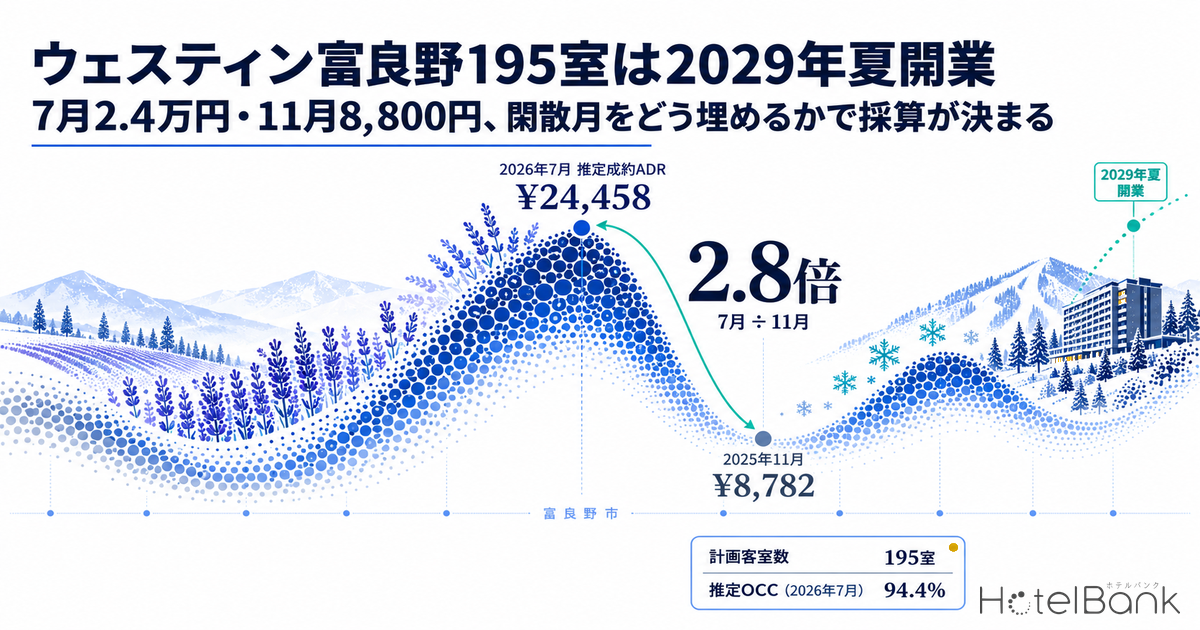
The Westin Hokkaido Furano Resort (ウェスティン北海道富良野リゾート), developed by Sekisui House (積水ハウス) under Marriott International’s Westin brand and scheduled to open in summer 2029, is a large resort with 195 rooms and roughly 17,000㎡ of gross floor area in a steel-frame building with nine floors above ground and one below. Furano’s estimated settled ADR averaged ¥14,200 over the latest 12 months; by month, July reached ¥24,500 against ¥8,800 in November — a 2.8x seasonal swing. Furano is a town with “two peaks” — lavender in summer and skiing in winter — separated by “two troughs” in spring and autumn. This article quantifies that seasonal shape and, drawing on occupancy, supply pipeline, land price and construction cost data, models the development economics of a seasonal resort and how its off-peak months can be filled.
Metric Definitions Used in This Article
- ADR (Average Daily Rate): An estimated settled rate (tax-exclusive equivalent), calculated by applying segment-specific adjustment factors to the lowest-plan price level each property publishes on OTAs (per room, two guests sharing, tax-inclusive). Checked against property-level results disclosed by listed hotel REITs, the median error is about 6.6%. These are estimates and differ from each property’s actual settled prices and accounting figures. Area-level ADR is the median of the covered properties (the level of a typical property in the area).
- OCC (Occupancy): The share of rooms sold relative to total rooms in the area (an estimate based on OTA sales inventory; consistency checks against REIT monthly disclosures confirm accuracy within roughly a few percentage points). It is based on how OTA-listed inventory is absorbed and differs from a property’s actual overall occupancy.
- Where listed prices are mentioned, they refer to the per-room rate for two guests sharing (tax-inclusive).
- Data sources: MetroEngines Research & Consulting (analysis covers about 27,000 properties in Japan with confirmed operations). Land prices and zoning are from the Ministry of Land, Infrastructure, Transport and Tourism (MLIT) Real Estate Information Library; project details are from company press releases.
- — The Westin Hokkaido Furano Resort, with 195 rooms and about 17,000㎡ of floor area (about 87㎡ per room), is scheduled to open in summer 2029. Its design allocates generous space to public areas, built to earn revenue beyond rooms
- — Furano’s estimated settled ADR shows a 2.8x seasonal gap: ¥24,458 in July 2026 vs ¥8,782 in November 2025. The 12-month average is ¥14,158 (September 2025–August 2026, N=11–13 properties)
- — Estimated OCC reached 94.4% in July 2026 (24 properties in Furano), about 10pt above the Hokkaido resort hotel average (84.6%) — summer is the true peak
- — In a simple model, lifting the four trough months by 20pt raises GOP ÷ construction cost by only +0.2pt, while a 15% rate increase in peak months adds +0.4pt. Off-peak measures are a tool for break-even and year-round employment rather than yield
- — Furano is expected to add at least about 400 hotel rooms in 2027–2029, while only 1 of the 24 Hokkaido properties held by listed REITs is a resort — exit options are limited
Summary — Building an 87㎡-per-Room Resort in a Town Where Rates Swing 2.8x
The conclusion first. Furano’s lodging market has “high summer peaks and deep spring/autumn troughs,” and between 2019 and 2026 the peaks rose further while the troughs rose only modestly. Under this shape, our model below shows that for a 195-room upper-tier brand, raising occupancy by 20pt in the four trough months lifts annual revenue by only about 4%, whereas raising peak-month rates by 15% has a larger effect. In other words, off-peak measures are best designed not as “a way to earn yield” but as “a break-even tool that supports fixed costs and year-round employment.” In addition, new supply planned in Furano for 2026–2029, including this project, will reach at least 400 rooms, so the competitive environment at opening will be thicker than today.
Project Overview — Sekisui House × Marriott × Pacifica Hotels: Breaking Down 17,000㎡
On September 2, 2026, Sekisui House, Marriott International and Pacifica Hotels G.K. (パシフィカホテルズ合同会社) announced that the Westin Hokkaido Furano Resort is scheduled to open in summer 2029. The site is at 1976-3 and five other lots in Furano City, Hokkaido. In addition to restaurants, a bar, fitness center, spa and large public bath, the plan includes an all-day dining restaurant with a semi-open kitchen, a specialty restaurant, a lobby lounge, a café, a bakery & pâtisserie, and function rooms for business and social events.
| Item | Details |
|---|---|
| Name | The Westin Hokkaido Furano Resort (ウェスティン北海道富良野リゾート) |
| Scheduled opening | Summer 2029 |
| Rooms | 195 (rooms and suites) |
| Structure / scale | Steel frame, 9 floors above ground and 1 below, gross floor area ~17,000㎡ |
| Floor area per room (our calculation) | ~87㎡ (17,000㎡ ÷ 195 rooms) |
| Main facilities | All-day dining, specialty restaurant, bar, lobby lounge, café, bakery & pâtisserie, fitness, spa, large public bath, function rooms |
| Developer / brand / operator | Sekisui House, Ltd. / Marriott International “Westin” / Pacifica Hotels G.K. |
| Concept | Well-being (Sleep Well, Move Well, Eat Well) |
Source: Prepared by MetroEngines Research & Consulting from the Sekisui House / Marriott / Pacifica Hotels press release (September 2, 2026)
Floor area of about 87㎡ per room is large not only compared with limited-service hotels (roughly 25–35㎡) but also against the level generally cited for upper-tier full-service brands (roughly 60–80㎡). Beyond generous guest rooms, the design reads as one that allocates substantial space to public areas — restaurants, spa, large bath and function rooms. This is a design that “thickens non-room revenue,” and it is closely tied to the off-peak strategy discussed below. Even in months with thin lodging demand, the property can activate revenue engines beyond rooms: corporate training and small meetings in the function rooms, wellness stays built around the spa and bath, and local use of the restaurants.
Two Peaks and Two Troughs — ¥24,500 in July vs ¥8,800 in November; Only the Peaks Rose Over Seven Years
Looking at Furano’s estimated settled ADR by month, there are two peaks. The first is July–August (lavender and farmland scenery): ¥24,500 in July 2026 and ¥18,600 in August. The second is January–February (Furano Ski Resort): ¥16,000 in January 2026 and ¥19,000 in February. There are also two troughs: spring (April–May) at ¥9,800 and ¥10,300, and autumn (October–November) at only ¥9,200 and ¥8,800.
Source: MetroEngines Research & Consulting (Furano City, N=11–13 properties; estimated settled ADR, two guests per room, tax-exclusive equivalent)
What is striking over time is how differently the peaks and troughs moved. Before COVID, July 2019 was ¥15,400 and November 2019 was ¥6,800, a peak-to-trough ratio of 2.26x. July 2026’s ¥24,500 is +59% versus 2019, while November 2025’s ¥8,800 is +29% versus November 2019, widening the ratio to 2.78x. For Hokkaido as a whole, estimated settled ADR was ¥12,200 in July and ¥9,100 in November (July 2026 / November 2025), a ratio of just 1.33x — Furano’s seasonal amplitude is more than double the Hokkaido average.
This shape also contrasts with Kutchan (倶知安町, Niseko), another Hokkaido snow resort. Kutchan is a single-peak market concentrated in winter, topping out at ¥63,500 in February 2026, with July at ¥17,500 — summer is actually a trough there. Furano is a twin-peak market with summer as the main peak and winter as the secondary one. Having two peaks helps smooth the year, but it also means the troughs come twice.
Source: MetroEngines Research & Consulting (Furano N=11–13, Kutchan N=20–24, Hokkaido resort hotels N=126–147, all Hokkaido N=865–960)
Indexed, Furano’s July stands at 173 and November at 62 relative to the annual average. For Hokkaido resort hotels overall (category median), August is 115 and November 93, so resort hotels across Hokkaido generally do not have troughs as deep as Furano’s. For an operator running an upper-tier brand in Furano, this “depth of the trough” is the starting assumption of the business plan.
Occupancy — Summer Furano Runs at 85–94% Estimated OCC, Above the Hokkaido Resort Average
MetroEngines Research’s estimated OCC (based on OTA-listed inventory) for June–September 2026 shows Furano at 89.4% in June, 94.4% in July, 85.6% in August and 84.5% in September (23–24 properties, about 581–618 rooms, based on major booking-site listings). Hokkaido’s resort hotel category recorded 78.9%, 84.6%, 86.6% and 85.7% over the same period (84–86 properties, about 9,000 rooms). Furano ran about 10pt above the Hokkaido resort average in June–July and roughly in line in August–September. July’s 94.4% means listed inventory was almost fully absorbed, confirming that summer is Furano’s “true peak,” when rate and occupancy rise together.
Source: MetroEngines Research & Consulting (Furano: 23–24 properties, ~617 rooms / Hokkaido resorts: 84–86 properties, ~9,000 rooms; based on major booking-site listings)
Occupancy in the trough months falls outside the estimated-OCC coverage window (check-in dates from May 2026 onward), so it is not shown here. Trough depth can only be read from the rate side, but in a market where rates fall 64% from July to November, it is hard to imagine occupancy alone holding up; it is reasonable to assume both rate and occupancy decline in trough months. Hoshino Resorts REIT (星野リゾート・リート投資法人, 3287) reported portfolio-wide results for July 2026 of 78.8% occupancy and ADR of ¥21,214 (year on year: occupancy +0.8pt, ADR −1.2%). Considering that even a resort-focused listed REIT runs around 80% in a summer peak month, Furano’s summer occupancy is exceptionally high.
Supply and Competition — 13 Key Properties Within 12km; 400+ Rooms to Be Added in 2026–2029
Within the scope tracked by MetroEngines Research, 259 lodging properties with about 2,760 rooms are registered within a 12km radius of Furano Station (51 properties with 10+ rooms account for about 2,170 rooms; most of the rest are small properties with one to a few rooms). The table below shows the 13 key properties whose prices can be observed continuously on OTAs.
Source: MetroEngines Research & Consulting
Area Overview
Main New Supply, 2026–2029
| Property | Rooms | Opened | Jul 2026 est. settled ADR | 12-month avg. est. settled ADR |
|---|---|---|---|---|
| Shin Furano Prince Hotel (新富良野プリンスホテル) | 407 | 1988 | — | — |
| La Vista Furano Hills (ラビスタ富良野ヒルズ) | 180 | 2019 | ¥44,068 | ¥22,555 |
| Hotel Naturwald Furano (ホテル ナトゥールヴァルト富良野) | 81 | 1992 | ¥25,917 | ¥16,878 |
| NOZO Hotel (ノゾ ホテル) | 78 | 2023 | ¥26,339 | ¥20,087 |
| Hotel Edelwarme (ホテル エーデルヴェルメ) | 74 | 1988 | ¥24,024 | ¥13,671 |
| FURANO NATULUX HOTEL | 72 | 2007 | — | — |
| Phoenix Furano (フェニックス富良野) | 62 | 2020 | ¥32,852 | — |
| Bell Hills (ベルヒルズ) | 96 | 1993 | ¥17,307 | ¥10,641 |
| HOSTEL TOMAR | 85 | 2018 | — | — |
| Hotel & Condominium Ichika (ホテル&コンドミニアム 一花) | 33 | 2018 | — | — |
| Hotel Munin Furano (ホテルムニン富良野) | 29 | 2018 | ¥24,458 | ¥12,698 |
| Highland Furano (ハイランドふらの) | 26 | 1986 | ¥23,966 | ¥9,095 |
| Furano Hoteiru (フラノ寶亭留) | 25 | 2006 | — | — |
Source: MetroEngines Research & Consulting (estimated settled ADR is calculated only for properties in validated categories; “—” indicates an unvalidated category or insufficient observations. The 12-month average covers September 2025–August 2026. Room counts are from the MetroEngines Research property master)
The highest summer-peak rate belongs to La Vista Furano Hills (180 rooms, opened 2019) at ¥44,100. With its location in front of Furano Station and a hot-spring public bath, it achieves both the largest scale and the highest rate among station-front properties. On the ski resort side, recently opened properties rank near the top: Phoenix Furano (62 rooms, opened 2020) at ¥32,900 and NOZO Hotel (78 rooms, opened 2023) at ¥26,300. Taking the median of the eight properties for which estimated settled ADR can be calculated, the November rate is 37% of July’s — individual properties move with the same trough depth as the city overall (36%).
Source: MetroEngines Research & Consulting (N=8 properties) ■ Blue box = white space of 100+ rooms × summer ADR above ¥30,000
Crowded 26–96 rooms × summer ADR ¥17k–26k
Existing hotels near the station and on the ski resort side. Summer rates cluster around the city median (¥24,500).
White space 100+ rooms × summer ADR above ¥30k
Currently occupied only by the 180-room La Vista Furano Hills. The 195-room Westin enters this space.
Separate axis Condominiums & villas
For-sale types such as Ichika (33 rooms) and LYRA by NOZO (20 units), with listed prices from tens of thousands to over ¥100,000. Small in room count, but at the very top of the rate range.
The supply pipeline also deserves a look. MLIT’s Building Construction Dynamics Survey (建築物動態統計調査), on a building confirmation application basis, lists a new hotel plan in Shimogoryo, Furano with 200 rooms, 10 floors and about 13,000㎡ of floor area (completion planned December 2027) (*based on confirmation applications as of the time of research; the count is expected to grow as further applications are filed). In the Kitanomine area, Malaysian-backed Parkwood Hotels Furano plans to open “LYRA by NOZO,” a 20-unit condominium (units of 46–248㎡, priced from ¥92.59 million to ¥577 million), in December 2026, and ES-CON Japan (エスコン) was reported to be planning a hotel, staff dormitory and residential lots on about 5ha in the same area, with construction starting in April 2026. Adding the Westin’s 195 rooms, at least about 400 hotel rooms — plus a separate cluster of condominiums — will be added in 2027–2029. That is an increase of over 30% on the roughly 1,250 hotel-type rooms of the current 13 key properties, so the economics should be built on the assumption that competition at opening will be thicker than observed today.
Location and Land Prices — Kitanomine Residential Land Up 2.2x in Three Years; Station-Front Commercial +2.5%
MLIT’s official land price publication (as of January 1, 2026) shows a polarized picture across Furano’s standard sites. On the ski resort side, Kitanomine-cho 4777-33 (Category II Residential zone, a residential area of detached houses and holiday homes) stands at ¥84,500/㎡, up 30.0% year on year. It rose from ¥38,700 in 2023 to ¥49,500 in 2024 (+27.9%) and ¥65,000 in 2025 (+31.3%) — three straight years of gains above 20%, for a 2.2x increase over three years. According to the Hokkaido Shimbun, this site ranked first nationwide in residential land price growth as of January 2025. By contrast, station-front commercial land (Hinode-machi, Commercial zone, FAR 400%) is ¥33,300/㎡ (+2.5%), residential land 950m from the station (Suehiro-cho) is ¥25,000/㎡ (+1.2%), and low-rise exclusive residential zones behind the station are flat at ¥17,000–19,000/㎡.
| Standard site | Zoning | 2026 official land price | YoY | Surroundings |
|---|---|---|---|---|
| Kitanomine-cho 4777-33 | Category II Residential (FAR 200%) | ¥84,500/㎡ | +30.0% | Residential area of detached houses and holiday homes (ski resort side) |
| Hinode-machi 1440-1 | Commercial (FAR 400%) | ¥33,300/㎡ | +2.5% | Central commercial area in front of the station, lined with retail shops |
| Suehiro-cho 4535-20 | Category I Residential (FAR 200%) | ¥25,000/㎡ | +1.2% | Established residential area mixing houses and apartments |
| Mizuho-cho 1157-863 | Category I Low-Rise Exclusive Residential (FAR 60%) | ¥19,000/㎡ | 0.0% | Quiet residential area behind the station |
| Minamiasa-machi 1154-45 | Category I Low-Rise Exclusive Residential (FAR 60%) | ¥17,000/㎡ | 0.0% | Quiet suburban residential area |
Source: Prepared by MetroEngines Research & Consulting from the MLIT Real Estate Information Library (Official Land Prices 2026)
The zoning of the Westin site (1976-3 and five other lots, Furano City) is not stated in public materials and is not addressed here. Furano’s zoning designates Neighborhood Commercial (FAR 300%, building coverage 80%), Commercial (400%, 80%) and Category I Residential (200%, 60%) zones, among others, in the urban area, while Kitanomine on the ski resort side is Category II Residential (200%, 60%). A building of 17,000㎡ on nine floors would require a site of at least about 8,500㎡ under a 200% FAR, or about 5,700㎡ under 300%, which suggests the project secured a sizable consolidated site on the ski resort side rather than in the town center. Rising land prices push up acquisition costs but also underpin asset value, making this a point on which developers and lenders may assess differently.
Development Economics — Filling the Troughs Adds +0.2pt; Lifting the Peaks Adds +0.4pt
Using the published 195 rooms and 17,000㎡ of floor area, together with Furano’s seasonal index, we built a simple financial model with the following assumptions. Annual base estimated settled ADR is ¥36,000 (tax-exclusive, nominal as of 2029), multiplied by Furano’s monthly index (July 173, November 62, etc.) to produce monthly rates. Occupancy is 85% in the four peak months (January, February, July, August), 65% in the four shoulder months (March, June, September, December), and varies by scenario in the four trough months (April, May, October, November). Non-room revenue (F&B, spa, banquets, etc.) is set at 60% of room revenue (room revenue share of 62.5%), and the GOP margin is 28% (the upper end of the 20–30% industry benchmark for resort hotels). Construction cost is based on about ¥15.4 billion (about ¥79 million per room), calculated as 5,142 tsubo of floor area multiplied by ¥3.0 million per tsubo — a benchmark for upper-tier brands. Land cost is excluded because the site area has not been disclosed.
| Item | A. Leave troughs as-is (trough OCC 35%) | B. Fill the troughsRecommended (trough OCC 55%, trough ADR −15%) | C. Deepen the peaks (peak ADR +15%) |
|---|---|---|---|
| Annual occupancy | 61.6% | 68.3% | 61.6% |
| Annual ADR (tax-exclusive) | ¥39,400 | ¥36,900 | ¥42,800 |
| RevPAR | ¥24,200 | ¥25,200 | ¥26,300 |
| Room revenue | ¥1.73B | ¥1.79B | ¥1.88B |
| Total revenue (rooms + F&B etc.) | ¥2.76B | ¥2.87B | ¥3.00B |
| GOP (28%) | ¥0.77B | ¥0.80B | ¥0.84B |
| Construction cost (¥3.0M/tsubo, 2025 level) | ¥15.4B | ¥15.4B | ¥15.4B |
| GOP ÷ construction cost | 5.0% | 5.2% | 5.4% |
| Construction cost (inflation-adjusted, 2028 construction midpoint) | ¥17.8B | ¥17.8B | ¥17.8B |
| GOP ÷ construction cost (after inflation) | 4.3% | 4.5% | 4.7% |
Source: MetroEngines Research & Consulting estimates. The ¥3.0M/tsubo construction cost references MLIT Building Construction Starts Statistics (2025 steel-frame average ¥2.405M/tsubo) and the general benchmark for luxury hotels (¥2.5M–3.5M/tsubo). Inflation applies Turner & Townsend forecasts (2026 +5.3%, 2027 +5.0%) compounded, with +4.5% assumed for 2028 onward
Source: MetroEngines Research & Consulting estimates (Furano monthly index × annual ADR of ¥36,000)
What the numbers show is where off-peak measures fit. Raising trough-month occupancy from 35% to 55% — a 20pt gain — while cutting rates 15% to attract guests lifts annual total revenue only from ¥2.76 billion to ¥2.87 billion (+4%), improving GOP ÷ construction cost by just +0.2pt. July’s room revenue alone (about ¥320 million) is seven times November’s (about ¥46 million), so even filling the troughs completely does not match a single peak month. Scenario C, raising peak-month rates by 15%, improves the ratio by +0.4pt. The main battleground for yield is therefore peak-month pricing, and off-peak measures are best designed not to “earn yield” but to “cover fixed costs and year-round employment and lower the break-even point.”
Even so, filling the troughs matters a great deal. Staffing, a chronic issue at Hokkaido resorts, favors year-round over seasonal employment for both recruitment and retention, and trough-month revenue becomes the source of funds for labor costs (staff housing can also account for roughly 10% of resort development costs). With its function rooms, this project has from the outset the means to fill the troughs with non-lodging engines: weekday corporate training, small meetings and incentive trips; wellness stays built around the spa and large bath; and workation demand through long-stay discounts. In addition, foreign guest nights reached 313,211 in FY2024 (the highest since 1999) and 103,736 in just the first half of FY2025 (April–September, +21.2% year on year), suggesting room to fill the spring trough of April–May with overseas holidays (spring breaks and Easter in Taiwan, Hong Kong, Singapore, Thailand and elsewhere).
| Sensitivity (Scenario B base) | Base | ADR −10% | OCC −5pt | Both |
|---|---|---|---|---|
| Total revenue | ¥2.87B | ¥2.58B | ¥2.67B | ¥2.40B |
| GOP | ¥0.80B | ¥0.72B | ¥0.75B | ¥0.67B |
| GOP ÷ construction cost (2025 level) | 5.2% | 4.7% | 4.9% | 4.4% |
| GOP ÷ construction cost (after inflation) | 4.5% | 4.1% | 4.2% | 3.8% |
Source: MetroEngines Research & Consulting estimates
Note that this is a simple estimate based on public information and market data and excludes land, FF&E, pre-opening costs, brand fees and management fees. Actual investment decisions require a detailed feasibility study. Rising construction costs squeeze this project’s economics, but for the same reason they restrain subsequent new supply, which works as an upside factor for the post-opening competitive environment.
The REIT and Fund Perspective — Only 1 of 24 Hokkaido Properties Held by Listed REITs Is a Resort
From an exit-strategy perspective, we checked listed hotel REITs’ holdings in Hokkaido against our ownership master. The seven domestic REITs own 24 properties in Hokkaido: Sapporo accounts for 11, a majority, followed by Hakodate with 4, Otaru and Asahikawa with 2 each, and Kushiro, Kitami, Nayoro, Tomakomai and Shiraoi with 1 each. The only resort among them is KAI Poroto (界 ポロト; Shiraoi, 42 rooms, acquisition price ¥3,060 million), acquired by Hoshino Resorts REIT in January 2025; the remaining 23 are business or city hotels.
| REIT | Hokkaido holdings | Main properties (rooms, year acquired) |
|---|---|---|
| Invincible Investment Corporation (インヴィンシブル投資法人, 8963) | 13 | Hotel MyStays Premier Sapporo Park (419 rooms, 2018), Hakodate Kokusai Hotel (435 rooms, 2024), Art Hotel Asahikawa (265 rooms, 2019), and others |
| Hoshino Resorts REIT (星野リゾート・リート投資法人, 3287) | 4 | KAI Poroto (42 rooms, 2025), Hotel WBF Grande Asahikawa (120 rooms, 2025), Comfort Hotel Hakodate (139 rooms, 2015), Comfort Hotel Tomakomai (123 rooms, 2015) |
| Ichigo Hotel REIT (いちごホテルリート投資法人, 3463) | 3 | THE KNOT SAPPORO (140 rooms, 2023), Nest Hotel Sapporo Odori (121 rooms, 2015), Comfort Hotel Kushiro (126 rooms, 2016) |
| Japan Hotel REIT (ジャパン・ホテル・リート投資法人, 8985) | 3 | Mercure Sapporo (285 rooms, 2009), ibis Styles Sapporo (278 rooms, 2010), La’gent Stay Sapporo Odori (219 rooms, 2016) |
| Kasumigaseki Hotel REIT (霞ヶ関ホテルリート投資法人, 401A) | 1 | fav Hakodate (30 rooms, 2025) |
| MORI TRUST REIT (森トラストリート投資法人, 8961) / Nippon Hotel & Residential Investment Corporation (日本ホテル&レジデンシャル投資法人, 3472) | 0 | — |
Source: Prepared by MetroEngines Research & Consulting from each REIT’s IR materials (ownership master as of September 30, 2026; domestic properties only)
Across all seven — Ichigo Hotel REIT (3463), Invincible Investment Corporation (8963), Nippon Hotel & Residential Investment Corporation (3472), Japan Hotel REIT (8985), Hoshino Resorts REIT (3287), MORI TRUST REIT (8961) and Kasumigaseki Hotel REIT (401A) — examples of listed REITs owning Hokkaido resorts with large seasonal swings are extremely limited at present. This is likely because, for listed REITs that disclose occupancy and ADR monthly, an asset whose monthly revenue moves sevenfold makes distribution stability hard to explain. Put the other way, the likely exits for a large resort like this one are long-term ownership by an operating company, private funds, or vehicles that bundle multiple resorts to offset seasonality; a standalone sale to a listed REIT is unlikely to be a main option for the time being. For regional banks and private funds, given limited exit liquidity, it is important to design from the start a capital structure that can withstand seasonal cash flow swings — assessing DSCR on an annual rather than monthly basis and providing working-capital facilities — because off-peak-month DSCR can fall well below the annual average.
Risks and Opportunities — Supply Growth, Staffing, Visitor Numbers, Land Prices and Construction Costs
| Factor | Direction | Supporting data |
|---|---|---|
| Concentrated new supply | Risk | In 2027–2029, this project’s 195 rooms plus 200 rooms in Shimogoryo, alongside condominium and ES-CON projects. An increase of over 30% on the ~1,250 existing hotel-type rooms |
| Widening seasonal amplitude | Risk | The July ÷ November rate ratio rose from 2.26x in 2019 to 2.78x in 2026; troughs have become relatively deeper |
| Staffing | Risk / Opportunity | A 195-room full-service hotel presupposes year-round employment. The structure must be designed so trough-month revenue funds labor costs |
| Fluctuating visitor numbers | Risk | Furano visitors totaled 1,853,839 in FY2024 (−1.9% year on year) and 1,087,699 in the first half of FY2025 (−3.0%, about 80% of the same period in FY2019) |
| Inbound growth | Opportunity | Foreign guest nights reached 313,211 in FY2024 (3.5x in ten years) and 103,736 in the first half of FY2025 (+21.2%) |
| Strong summer demand | Opportunity | Estimated OCC of 94.4% and estimated settled ADR of ¥24,500 in July 2026, above the Hokkaido resort average on both occupancy and rate |
| Rising land prices | Both | Kitanomine’s official land price rose 2.2x in three years (¥84,500/㎡) — both higher acquisition costs and support for asset value |
| Rising construction costs | Both | Steel-frame ¥2.405M/tsubo (2025). Squeezes economics, but restrains subsequent supply |
Source: MetroEngines Research & Consulting; Furano City tourism statistics (as reported by the Hokkaido Shimbun); MLIT Real Estate Information Library and Building Construction Starts Statistics
Methodology and Sources
Estimated settled ADR is an estimate calculated by applying segment-specific adjustment factors to the lowest-plan price level of each property observed by MetroEngines Research on major booking sites; city-level figures are the median of covered properties. Coverage is 11–13 properties for Furano, 20–24 for Kutchan, 865–960 for all of Hokkaido and 126–147 for Hokkaido resort hotels (varying by month). Values from September 2026 onward are estimates based on listed rates at the time of research (September 30, 2026) and are not final. Estimated OCC is calculated from the absorption of inventory listed on major booking sites, covering 23–24 properties and about 617 rooms in Furano and 84–86 properties and about 9,000 rooms for Hokkaido resort hotels. Property lists and room counts are based on the MetroEngines Research property master and may differ from officially announced room counts. Land prices and zoning are from the MLIT Real Estate Information Library; supply plans from MLIT’s Building Construction Dynamics Survey and company press releases and news reports; and REIT holdings from each REIT’s IR materials (ownership master as of September 30, 2026). Assumptions for the financial model are stated in the text.
Frequently Asked Questions
Q. When will the Westin Hokkaido Furano Resort open?
A. According to the September 2, 2026 announcement by Sekisui House, Marriott and Pacifica Hotels, it is scheduled to open in summer 2029. The plan calls for 195 rooms in a steel-frame building with 9 floors above ground and 1 below, about 17,000㎡ of gross floor area, with restaurants, a bar, spa, large public bath, fitness center and function rooms.
Q. How much do Furano hotel rates move with the seasons?
A. Furano’s estimated settled ADR (two guests per room, tax-exclusive equivalent) was ¥24,500 in July 2026 and ¥8,800 in November 2025, making July about 2.8 times November. Ski demand creates a second peak in January–February, while April–May and October–November are the troughs.
Q. How much does filling the off-peak months improve yield?
A. In this article’s simple model, raising occupancy by 20pt in the four trough months increases annual total revenue by only about 4% and GOP ÷ construction cost by just +0.2pt. Raising peak-month rates by 15% has a larger effect, so off-peak measures are best positioned as a break-even tool that supports fixed costs and year-round employment.
Q. What new lodging supply is coming to Furano?
A. Besides this project’s 195 rooms, building start filings show a 200-room new hotel plan in Shimogoryo, Furano (completion planned December 2027), the 20-unit LYRA by NOZO condominium in the Kitanomine area (opening planned December 2026), and an approximately 5ha hotel, dormitory and residential development by ES-CON Japan (construction start planned April 2026).
Conclusion
The Westin Hokkaido Furano Resort, with a public-area-heavy design of 87㎡ of floor area per room, will open in summer 2029 in a town that records 94% occupancy and ¥24,000+ rates in summer but sees rates fall to ¥8,800 in autumn. The main battleground for the economics is peak-month pricing, and off-peak measures are best designed as devices that protect break-even and employment rather than yield. In that sense, the project’s mix of function rooms, spa, large bath and multiple restaurants embodies a design philosophy of filling a seasonal resort’s troughs with something other than rooms. Given the new supply concentrated in 2027–2029 and the currently limited listed-REIT exit, developers, funds and lenders will likely evaluate this project on the premise of a capital structure that can withstand cash flows that swing sevenfold from month to month.
⚠ Note on future-date ADR: ADR figures in this article for September 2026 onward are estimates based on selling prices published on OTAs at the time of research (September 30, 2026) and will change as check-in dates approach. The development model provisionally sets the market at the 2029 opening from public information and current market data; actual investment decisions require a detailed feasibility study.
Related Reading
References and Sources
■ Data sources
Estimated settled ADR, estimated OCC and property lists are compiled by MetroEngines Research & Consulting (Furano estimated settled ADR covers 11–13 properties and estimated OCC 23–24 properties / about 617 rooms; comparisons cover Kutchan 20–24 properties, Hokkaido 865–960 properties and Hokkaido resort hotels 126–147 properties). Land prices and zoning are from the MLIT Real Estate Information Library (Official Land Prices 2023–2026); project details from the September 2, 2026 announcement by Sekisui House, Marriott and Pacifica Hotels; REIT holdings from each REIT’s IR materials (as of September 30, 2026); and tourism statistics from figures published by Furano City (as reported by the Hokkaido Shimbun).
■ Model assumptions
The development model assumes 195 rooms and 17,000㎡ of floor area (5,142 tsubo). Monthly rates are produced by multiplying an annual base estimated settled ADR of ¥36,000 (tax-exclusive, 2029 nominal) by Furano’s monthly index (September 2025–August 2026, 12-month average = 100). Occupancy is 85% in the four peak months, 65% in the four shoulder months, and 35% (A) / 55% (B) in the four trough months. Non-room revenue is 60% of room revenue, the GOP margin 28%, and construction cost ¥3.0M per tsubo (¥15.4 billion at 2025 levels, ¥17.8 billion inflation-adjusted). Land, FF&E, pre-opening costs, brand fees and management fees are excluded.
■ Limitations
Estimated settled ADR is an estimate derived by applying segment-specific adjustment factors to the lowest-plan price levels published on OTAs; against listed REIT disclosures, the median error is about 6.6%. Estimated OCC is based on the absorption of OTA-listed inventory and differs from a property’s actual overall occupancy. Values from September 2026 onward are estimates based on listed rates at the time of research (September 30, 2026) and are not final. Furano’s coverage is small at 11–13 properties, so price changes at individual properties have a large effect on the median. The financial model is a simple model that provisionally sets the market at the 2029 opening; investment decisions require a detailed feasibility study.
■ Market data
- MetroEngines Research & Consulting — Estimated settled ADR (Furano N=11–13, Kutchan N=20–24, Hokkaido N=865–960, Hokkaido resorts N=126–147), estimated OCC (Furano 23–24 properties, ~617 rooms), property master (259 properties within 12km of Furano Station)
■ Government statistics and public data
- MLIT Real Estate Information Library — Official Land Prices (2023–2026), zoning
- MLIT Building Construction Dynamics Survey (建築物動態統計調査) — New hotel plan in Shimogoryo, Furano (confirmation application basis)
- MLIT Building Construction Starts Statistics — 2025 cost per tsubo by structure (steel frame ¥2.405M/tsubo)
■ REIT and industry reports
- Hoshino Resorts REIT, “Monthly Operating Results, July 2026”
- Invincible Investment Corporation portfolio and other REITs’ IR materials (holdings, acquisition prices)
- Relo Hotel Solutions, “GOP margin benchmarks by hotel type”
- Turner & Townsend construction cost forecasts
■ News and press releases
- Sekisui House, Marriott and Pacifica Hotels, “Westin Hokkaido Furano Resort scheduled to open in summer 2029” (PR TIMES, September 2, 2026)
- Travel Watch, “Westin Hokkaido Furano Resort to open in summer 2029”
- Hokkaido Shimbun, “Furano foreign overnight stays hit record 140,000 in FY2024; visitors down 1.9% to 1.85 million” (May 23, 2025)
- Hokkaido Shimbun, “Furano visitors down 3% to 1.08 million in first half; inbound stays highest since 2001” (December 16, 2025)
- Hokkaido Shimbun, “The changing face of Furano: will a second or third Niseko emerge? (Part 1)” (January 6, 2026)
- Hokkaido Shimbun, “Condominiums up to ¥570 million: Malaysian-backed company to open in Kitanomine, Furano in December 2026”
- Hokkaido Shimbun, “ES-CON to develop hotel in Furano, construction from April 2026, with dormitory and residential lots” (December 26, 2025)